
Memory and Thought Memory The storage and retrieval



- Slides: 33
Memory and Thought
Memory: The storage and retrieval of something that has been learned or experienced.
To recall information, you use one memory process that relies on two other processes to occur. Encoding – transfer of information to process Storage – information is maintained Retrieval – obtaining stored information
Three stages of memory ¨ Sensory – brief memories are stored following stimulation of a sensory receptor. Last a fraction of a second, includes all senses at once. – Visual sensory memory is called iconic memory • Info is held for up to a second – Auditory (hearing) sensory memory is called echoic memory • Info is held for 1 -2 seconds
Three stages of memory ¨ Sensory – Serves three functions: • Prevents you from being overwhelmed • Gives you decision time • Allows for continuity and stability of environment
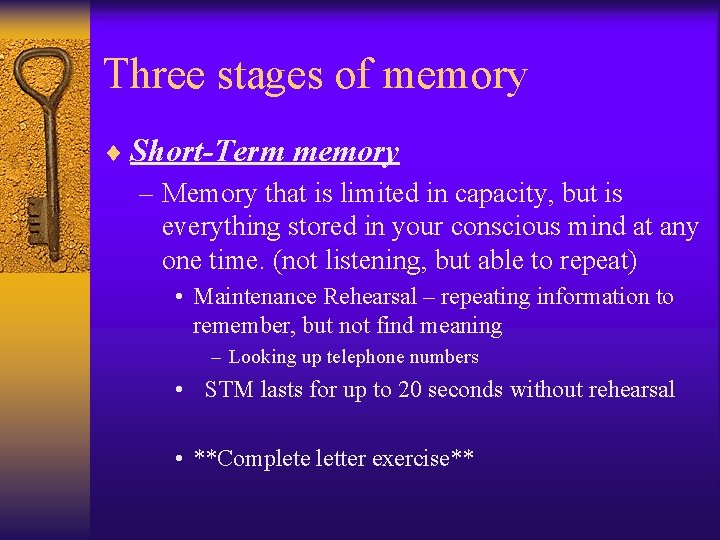
Three stages of memory ¨ Short-Term memory – Memory that is limited in capacity, but is everything stored in your conscious mind at any one time. (not listening, but able to repeat) • Maintenance Rehearsal – repeating information to remember, but not find meaning – Looking up telephone numbers • STM lasts for up to 20 seconds without rehearsal • **Complete letter exercise**
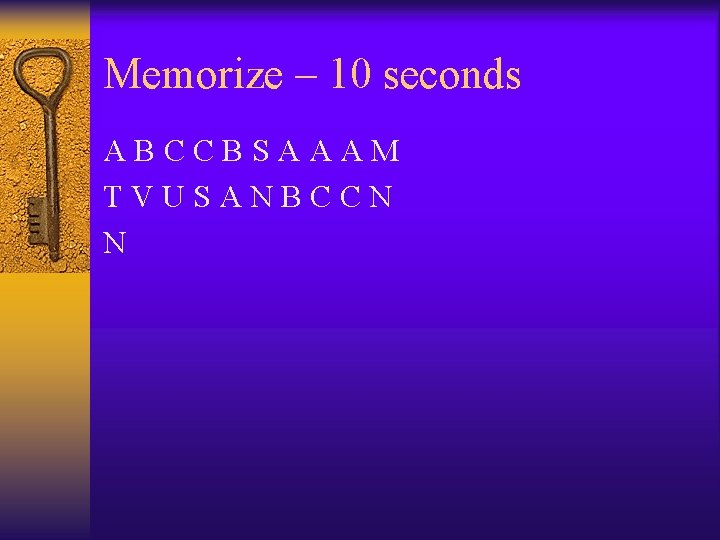
Memorize – 10 seconds ABCCBSAAAM TVUSANBCCN N
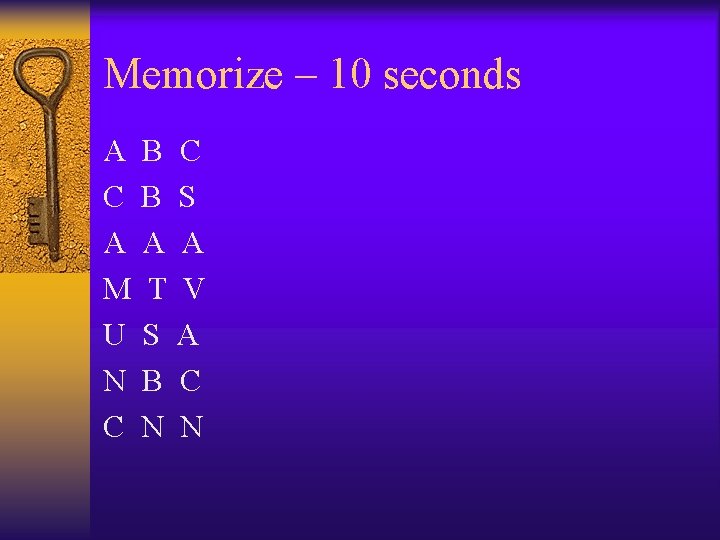
Memorize – 10 seconds A B C C B S A A A M T V U S A N B C C N N
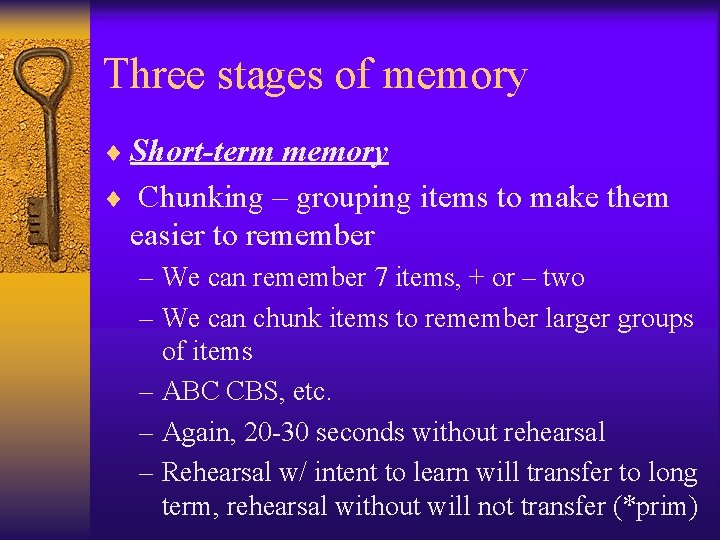
Three stages of memory ¨ Short-term memory ¨ Chunking – grouping items to make them easier to remember – We can remember 7 items, + or – two – We can chunk items to remember larger groups of items – ABC CBS, etc. – Again, 20 -30 seconds without rehearsal – Rehearsal w/ intent to learn will transfer to long term, rehearsal without will not transfer (*prim)
Three Stages of memory ¨ Short-term memory – Primacy-Recency Effect • The effect that we are better able to remember things at the beginning or end of a list • Primacy effect occurs when you remember the first part of a list because of time to rehearse • Recency occurs because the most recent items are still present in short-term memory • Working memory – short-term memory and information that is currently recalled from long term memory in order to process events
Three stages of Memory ¨ Long-term memory – Stored over an extended period of time – Categories and features – Capacity appears to be limitless • Short term memory forms chunks, those are stored, but only the striking facts remain, after years, only some details
Three Stages of memory ¨ Types of Long-term memory – Semantic • Memory of language, including rules, words, meaning – Episodic • Memory of your life, including time of occurrence – Declarative • Memory that is called forth consciously – Procedural • Memory of learned skills that does not require consciousness
Memory and the Brain ¨ How are memories stored in the brain? ¨ Some physiological changes occur – Neuronal structure change – Molecular or chemical changes – Changes depend on the level at which learning is occuring
Memory and the Brain ¨ Where does learning/memory occur? – Striatum (cortex) – front of the brain – procedural memories – Hippocampus – declarative memories – Amygdala – associate memories with emotions – Thalamus – processes sensory info. for memories
Memory and the Brain ¨ Not clear how individual nerve cells establish connections for learning – Complex chemical processes • • Increases in calcium Decreased potassium Increased protein synthesis Heightened glucose levels • Unsure of how this all fits together
Retrieving Information ¨ The key to retrieval is organization! ¨ Studying retrieval helps us learn about how memory is organized
Recognition ¨ Identifying whether or not a person has experienced a object, idea or situation with accuracy ¨ Helpful with multiple choice tests ¨ Shows memories may be stored in more than one way ¨ The more categories it is saved in, the easier it is to recognize
Recall ¨ Reconstructing information that had been learned ¨ Involves knowledge, attitudes and expectations ¨ Influenced by: – Reconstructive processes – Confabulation – Schemas – Eidetic memory
Recall ¨ Reconstructive processes – Alteration of a memory to be simplified, enriched, or distorted, depending on the individual – Confabulation is when a person fills in the gaps of memory that may or may not be true – Schemas are used to help reconstruct memories • Cars and contacted, hit, bumped, smashed speeds
Recall ¨ Eidetic memory – 5% of all children; less adults – Photographic memory – Very specific details – Very rare in adults – Short observation time, with vivid details in entirety later remembered
State-dependent learning ¨ Recalling information easily when in the same physiological or emotional state as when information was originally encoded – Study for a test in the location – Listen to the same music – Conditions are made to be similar to when memory was formed
Relearning ¨ Measure of both declarative and procedural memory – Learning a poem as a child, makes it easier to relearn later
Forgetting ¨ When information can not be retrieved from long term memory – Decay – Interference – Repression
Forgetting ¨ Decay – Fading away of memories over time – Items quickly decay in short-term memory – This may not function in long-term memory – Even a bump on the head, or brain trauma can cause forgetting, but it is always more recent memories
Forgetting ¨ Interference – A memory being blocked or erased by previous or subsequent memories – Two kinds • Proactive interference – earlier memories prevent you from remembering new information • Retroactive interference – later information prevents you from remembering old memories • Example: moving…. new numbers vs. old numbers
Amnesia ¨ Loss of memory due to brain damage, injury, drug use, or severe stress ¨ Infant amnesia – lack of early declarative memories – Emotional trauma – Lack of language – Hippocampus not mature enough – Sense of self not developed enough
Flashbulb memories ¨ Vivid recollection based on events that are shocking, emotional, or have serious consequences ¨ Involves special encoding – JFK assassination – 911 – Death of a close relative – You can describe in detail where, when, what, who, etc.
Improving memory ¨ Based on efficient organization ¨ chunking
Meaningfulness and Association ¨ Elaborative rehearsal – linking new material to information that is already known – Make a connection!! ¨ Connect to senses ¨ Avoid learning similar material together – History, biology, then government ¨ Distributed practice - study a little at a time; cramming doesn’t work!
Mnemonic Devices ¨ Using associations to memorize information ¨ Method of Loci – Greeks used this to memorize speeches – Walked around houses, etc. Each spot represented part of the speech ¨ Every good boy does fine ¨ Form a mental picture – John Updike wrote Rabbit, Run visual
Tip of Your Tongue ¨ Phenomena when you cannot remember the information you currently need ¨ Because of insufficient retrieval cues or due to interference