
Memory and Cognition General Psychology 1020 Spring 2020


- Slides: 35
Memory and Cognition General Psychology 1020 Spring 2020
Online Lecture Format/Directions • Read over the slides • Watch all video clips • Items highlighted in yellow indicate activities you should write about in this Chapter’s Discussion Post/Attendance Activity • You don’t have to comment on any of the posts…. but read them over…this is the only social interaction we are getting here, let’s embrace it! It’s really kinda fun to see how these activities went for other people.
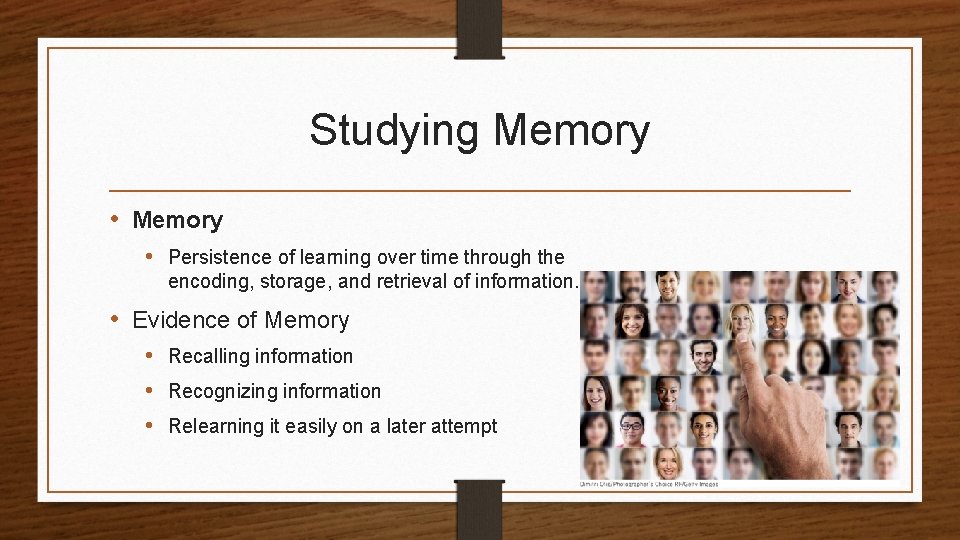
Studying Memory • Persistence of learning over time through the encoding, storage, and retrieval of information. • Evidence of Memory • Recalling information • Recognizing information • Relearning it easily on a later attempt
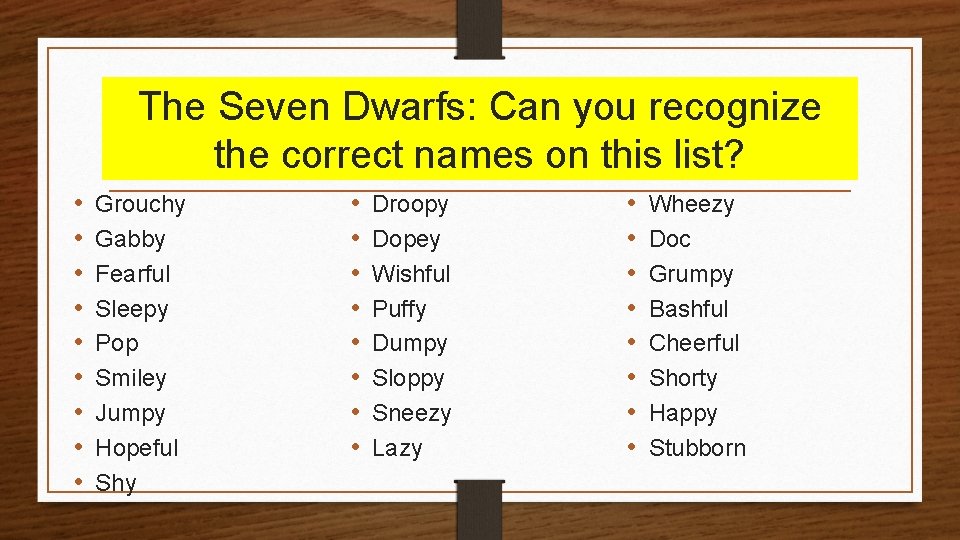
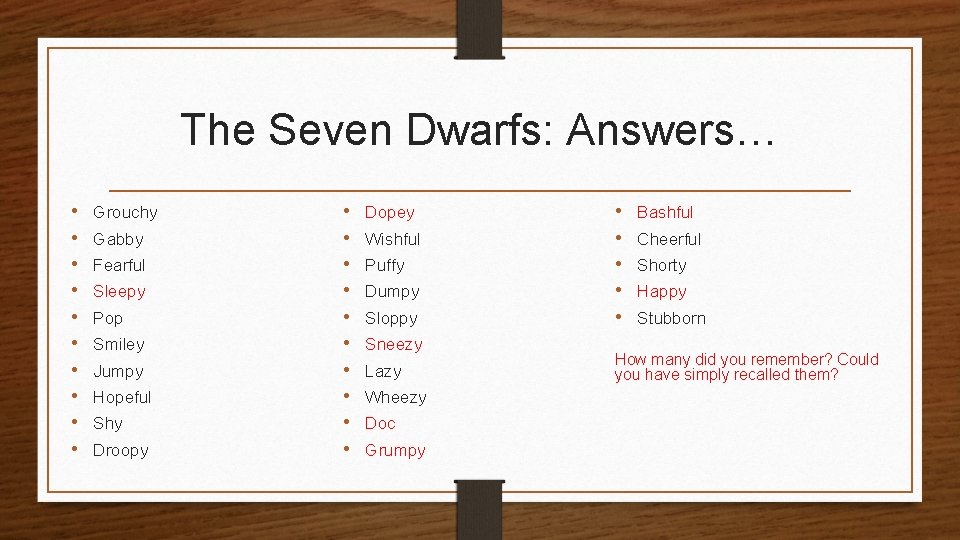
The Seven Dwarfs: Can you recognize the correct names on this list? • • • Grouchy Gabby Fearful Sleepy Pop Smiley Jumpy Hopeful Shy • • Droopy Dopey Wishful Puffy Dumpy Sloppy Sneezy Lazy • • Wheezy Doc Grumpy Bashful Cheerful Shorty Happy Stubborn
The Seven Dwarfs: Answers… • • • Grouchy Gabby Fearful Sleepy Pop Smiley Jumpy Hopeful Shy Droopy • • • Dopey Wishful Puffy Dumpy Sloppy Sneezy Lazy Wheezy Doc Grumpy • • • Bashful Cheerful Shorty Happy Stubborn How many did you remember? Could you have simply recalled them?
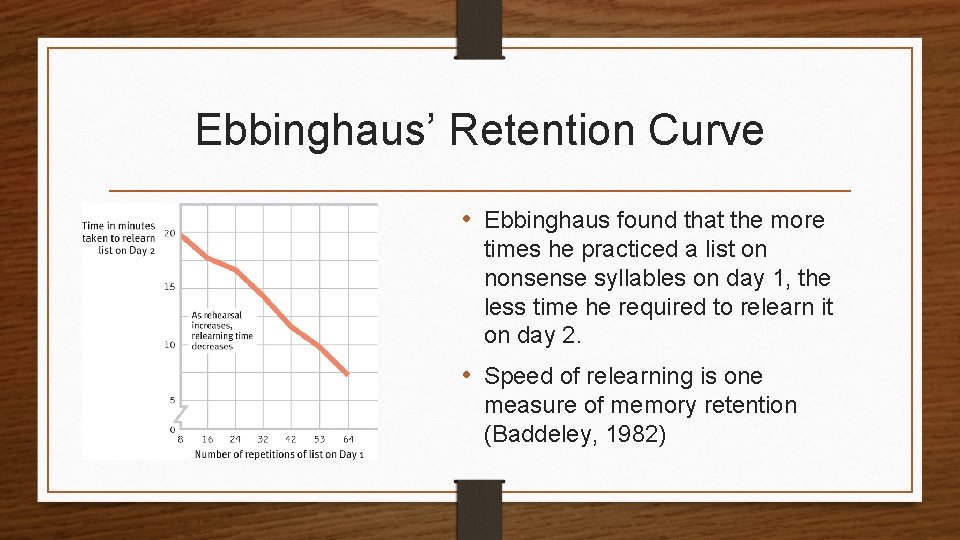
Ebbinghaus’ Retention Curve • Ebbinghaus found that the more times he practiced a list on nonsense syllables on day 1, the less time he required to relearn it on day 2. • Speed of relearning is one measure of memory retention (Baddeley, 1982)
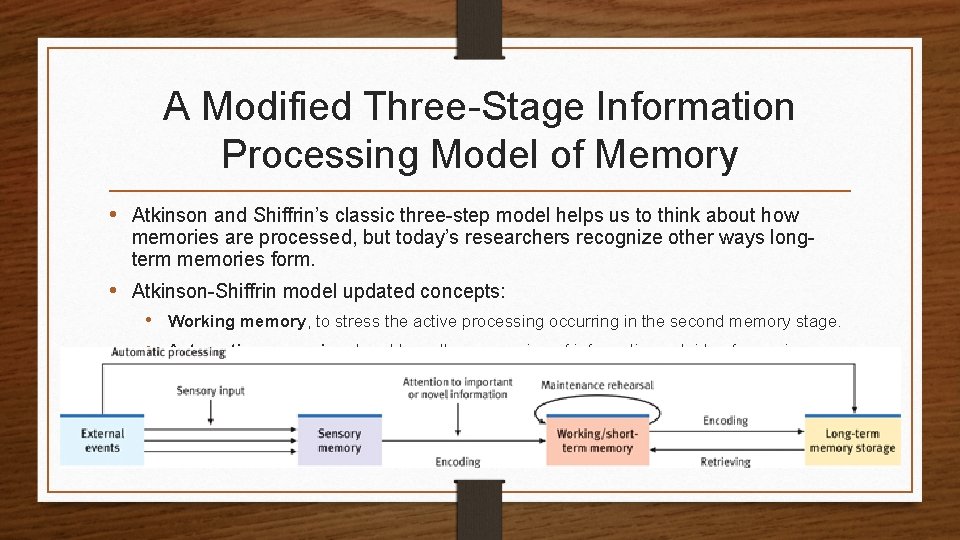
A Modified Three-Stage Information Processing Model of Memory • Atkinson and Shiffrin’s classic three-step model helps us to think about how memories are processed, but today’s researchers recognize other ways longterm memories form. • Atkinson-Shiffrin model updated concepts: • Working memory, to stress the active processing occurring in the second memory stage. • Automatic processing, to address the processing of information outside of conscious awareness.
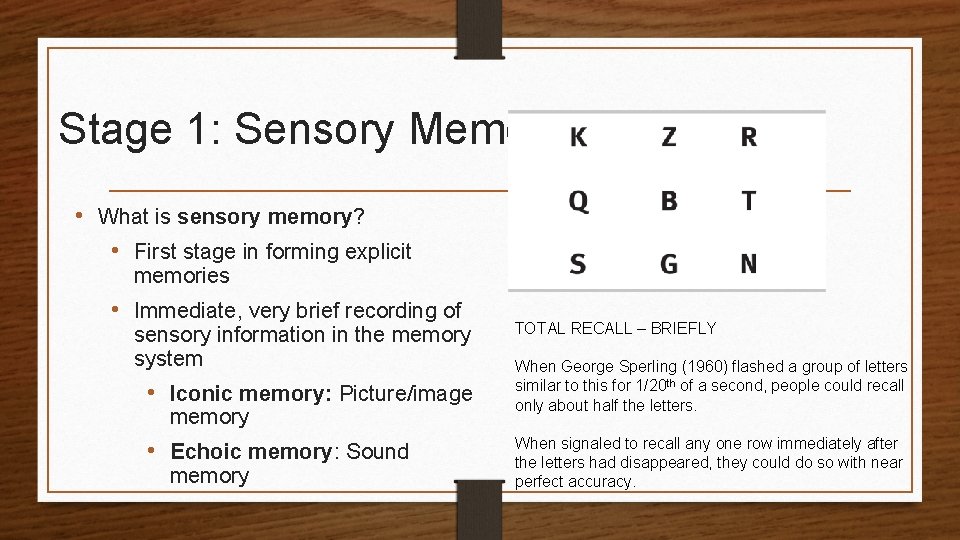
Stage 1: Sensory Memory • What is sensory memory? • First stage in forming explicit memories • Immediate, very brief recording of sensory information in the memory system • Iconic memory: Picture/image memory • Echoic memory: Sound memory TOTAL RECALL – BRIEFLY When George Sperling (1960) flashed a group of letters similar to this for 1/20 th of a second, people could recall only about half the letters. When signaled to recall any one row immediately after the letters had disappeared, they could do so with near perfect accuracy.
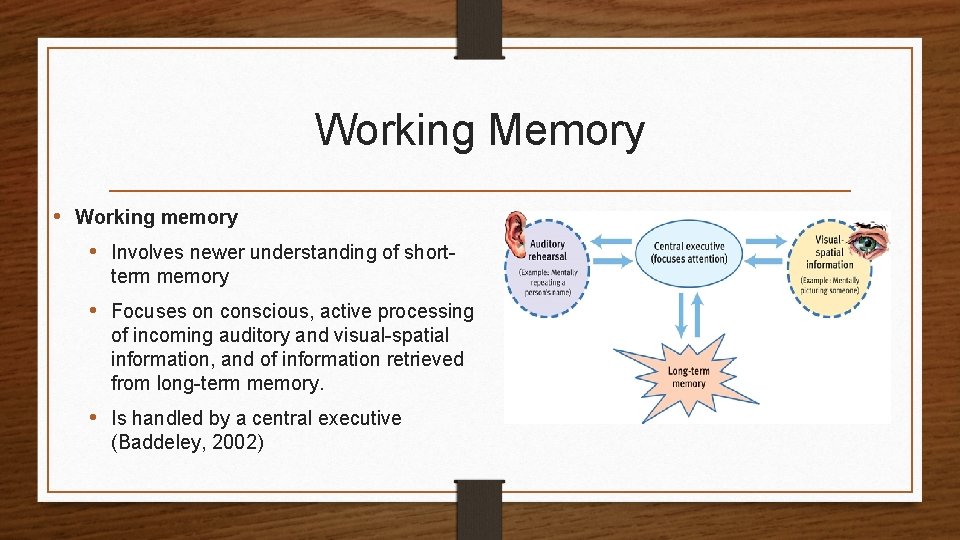
Working Memory • Working memory • Involves newer understanding of shortterm memory • Focuses on conscious, active processing of incoming auditory and visual-spatial information, and of information retrieved from long-term memory. • Is handled by a central executive (Baddeley, 2002)
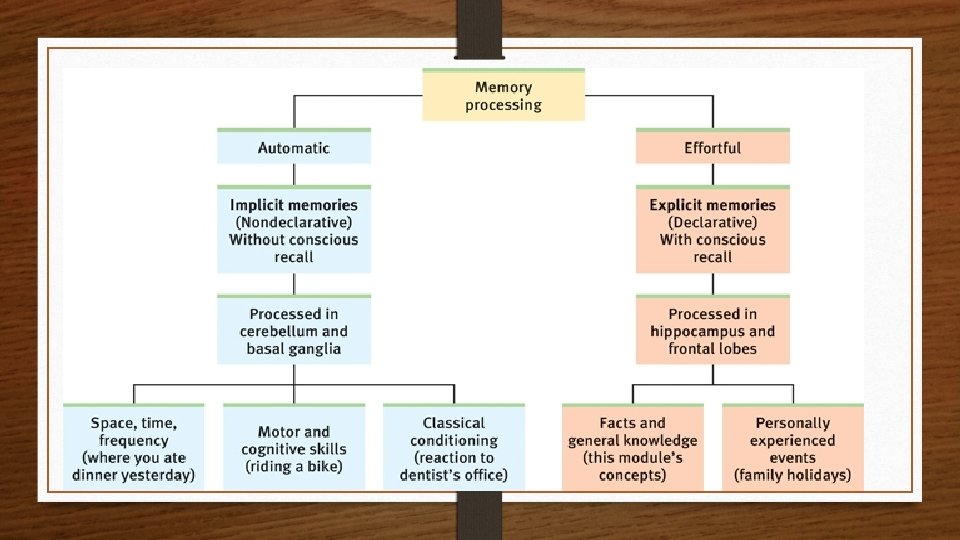
Encoding Memory • Automatic processing and implicit memories (nondeclarative memory) • Implicit memories include automatic skills and classically conditioned associations • Information is automatically processed about • Space • Time • Frequency • Effortful processing and explicit memories (declarative memory) • With experience and practice, explicit memories can become automatic
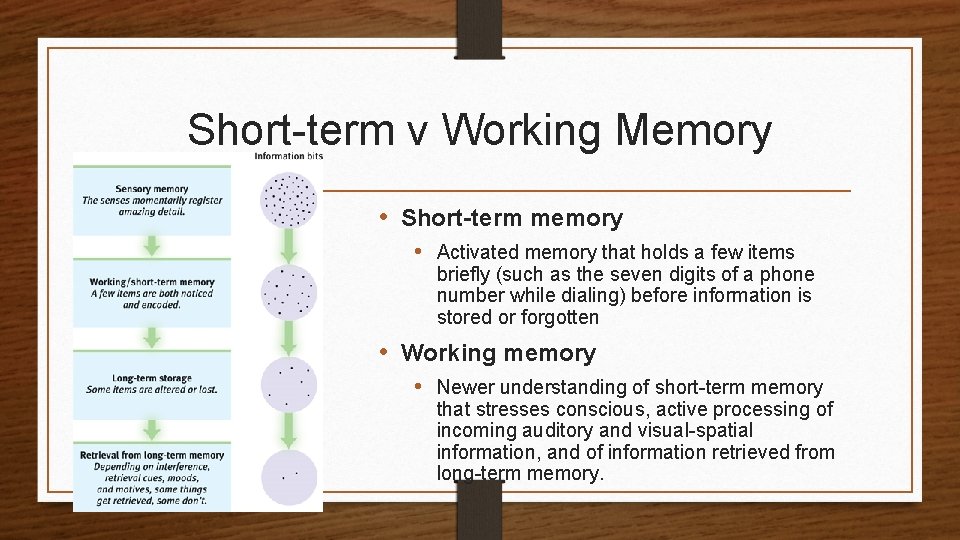
Short-term v Working Memory • Short-term memory • Activated memory that holds a few items briefly (such as the seven digits of a phone number while dialing) before information is stored or forgotten • Working memory • Newer understanding of short-term memory that stresses conscious, active processing of incoming auditory and visual-spatial information, and of information retrieved from long-term memory.
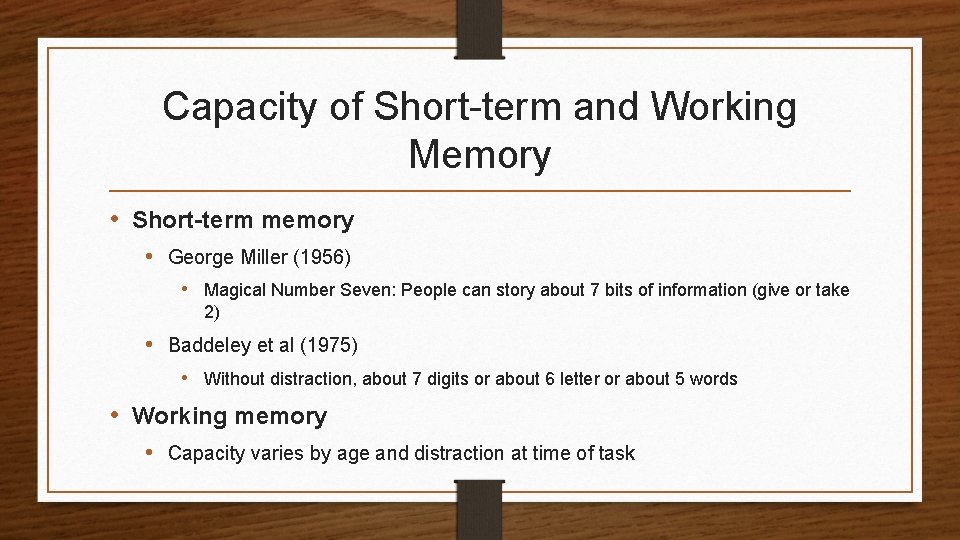
Capacity of Short-term and Working Memory • Short-term memory • George Miller (1956) • Magical Number Seven: People can story about 7 bits of information (give or take 2) • Baddeley et al (1975) • Without distraction, about 7 digits or about 6 letter or about 5 words • Working memory • Capacity varies by age and distraction at time of task
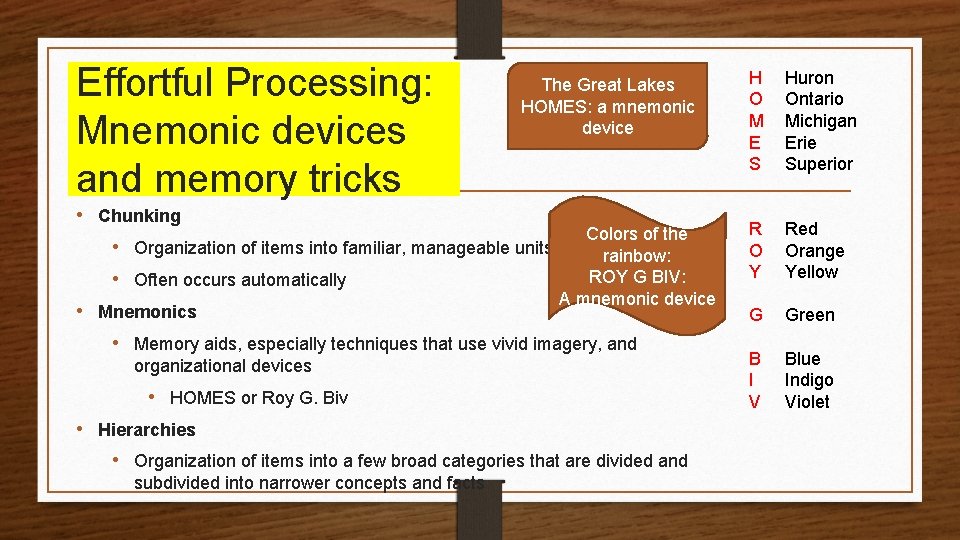
Effortful Processing: Mnemonic devices and memory tricks The Great Lakes HOMES: a mnemonic device • Chunking Colors of the • Organization of items into familiar, manageable units rainbow: ROY G BIV: • Often occurs automatically A mnemonic device • Mnemonics • Memory aids, especially techniques that use vivid imagery, and organizational devices • HOMES or Roy G. Biv • Hierarchies • Organization of items into a few broad categories that are divided and subdivided into narrower concepts and facts H O M E S Huron Ontario Michigan Erie Superior R O Y Red Orange Yellow G Green B I V Blue Indigo Violet
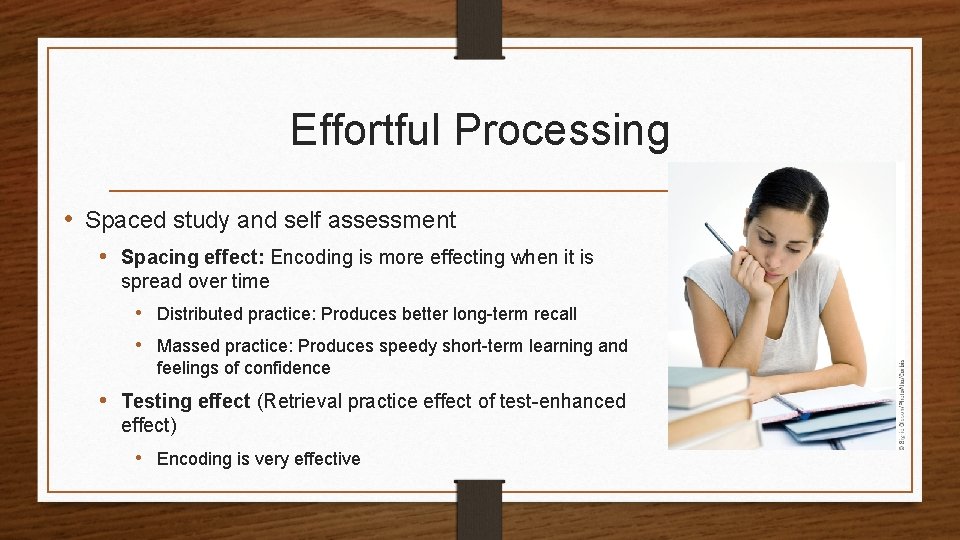
Effortful Processing • Spaced study and self assessment • Spacing effect: Encoding is more effecting when it is spread over time • Distributed practice: Produces better long-term recall • Massed practice: Produces speedy short-term learning and feelings of confidence • Testing effect (Retrieval practice effect of test-enhanced effect) • Encoding is very effective
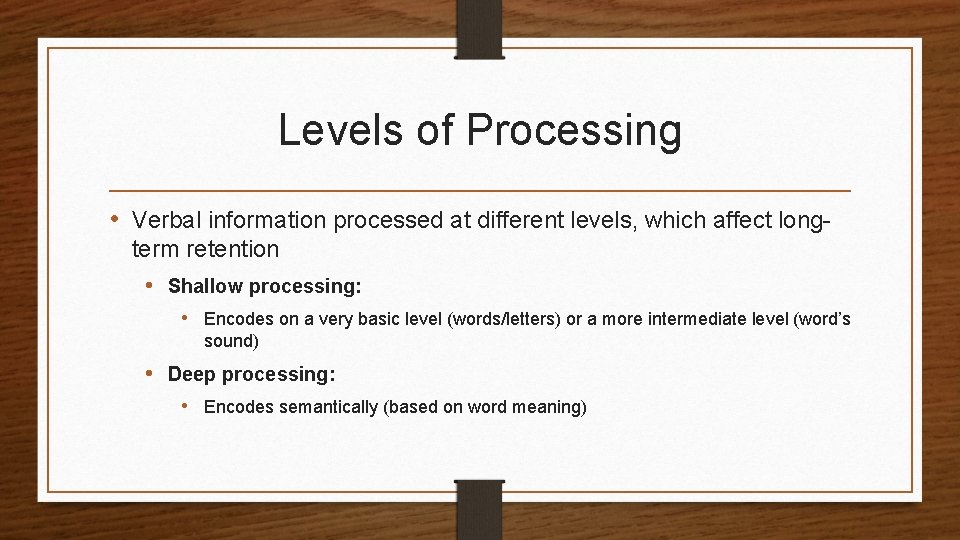
Levels of Processing • Verbal information processed at different levels, which affect longterm retention • Shallow processing: • Encodes on a very basic level (words/letters) or a more intermediate level (word’s sound) • Deep processing: • Encodes semantically (based on word meaning)
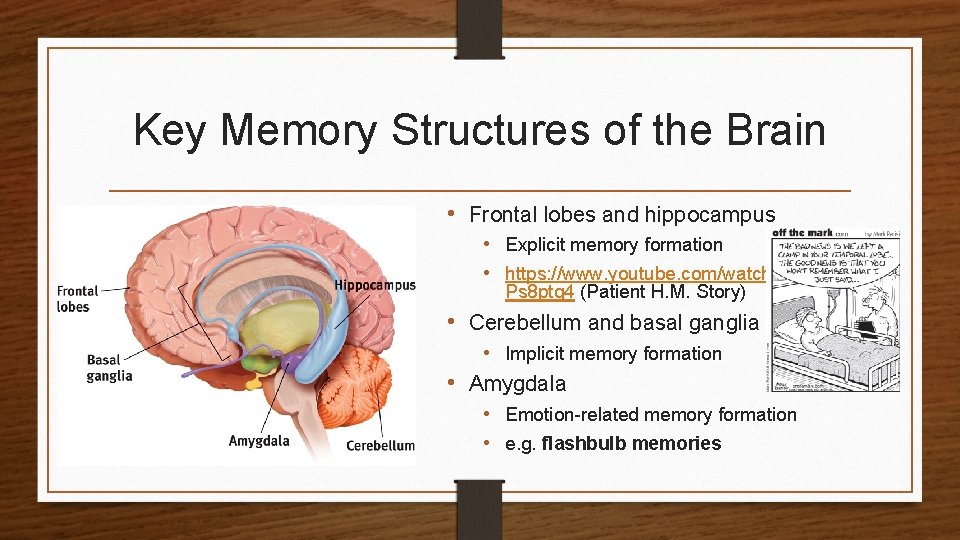
Key Memory Structures of the Brain • Frontal lobes and hippocampus • Explicit memory formation • https: //www. youtube. com/watch? v=_7 ak Ps 8 ptg 4 (Patient H. M. Story) • Cerebellum and basal ganglia • Implicit memory formation • Amygdala • Emotion-related memory formation • e. g. flashbulb memories
Memory Retrieval • Memory retrieval • Memories held in storage by web of associations • Retrieval cues serve as anchor points for pathways to memory suspended in this web • Best retrieval cues come from associations formed at the time a memory is encoded • e. g. self-reference effect • Priming • Activation (often unconsciously) of particular associations in memory
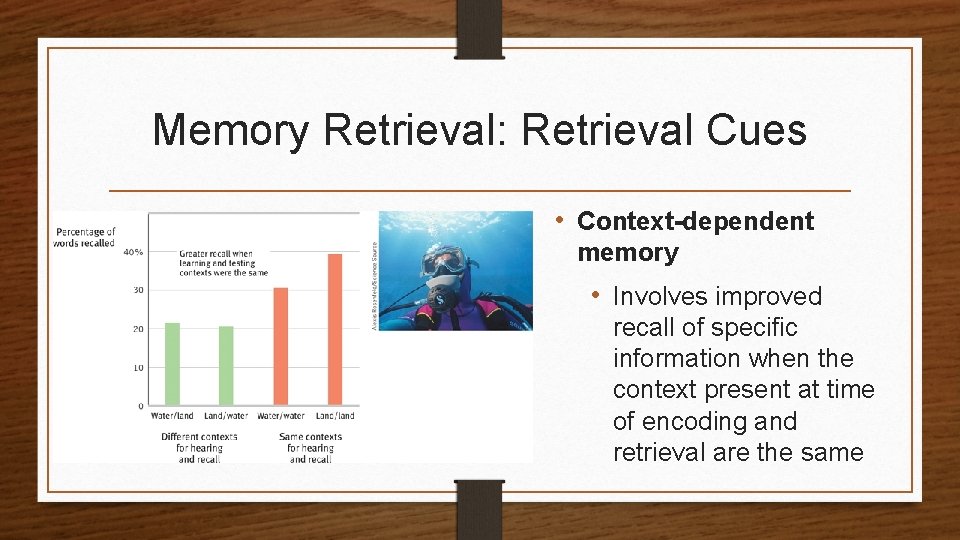
Memory Retrieval: Retrieval Cues • Context-dependent memory • Involves improved recall of specific information when the context present at time of encoding and retrieval are the same
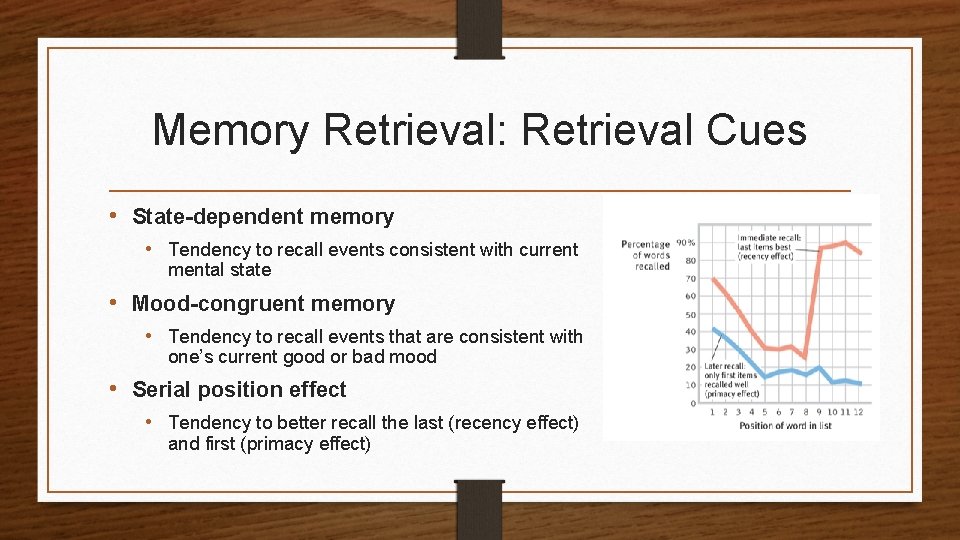
Memory Retrieval: Retrieval Cues • State-dependent memory • Tendency to recall events consistent with current mental state • Mood-congruent memory • Tendency to recall events that are consistent with one’s current good or bad mood • Serial position effect • Tendency to better recall the last (recency effect) and first (primacy effect)
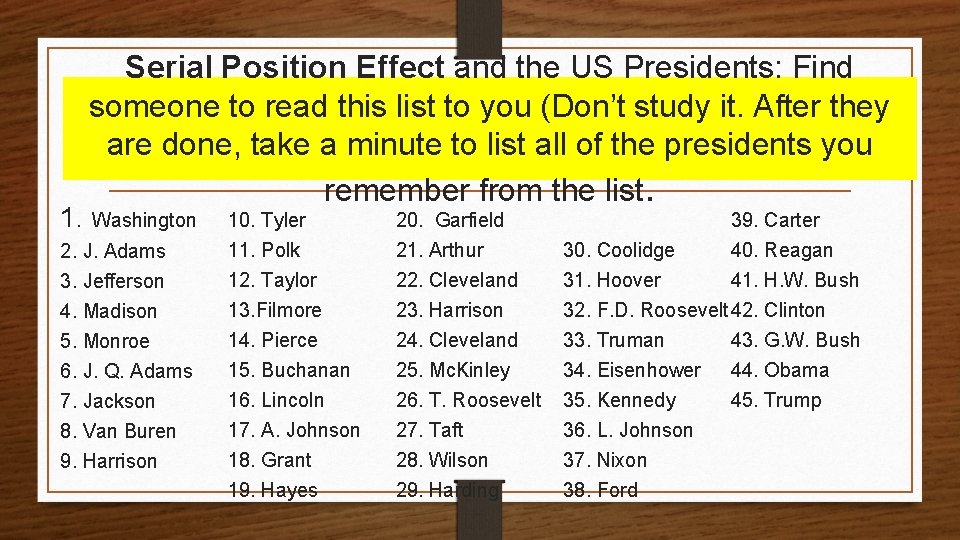
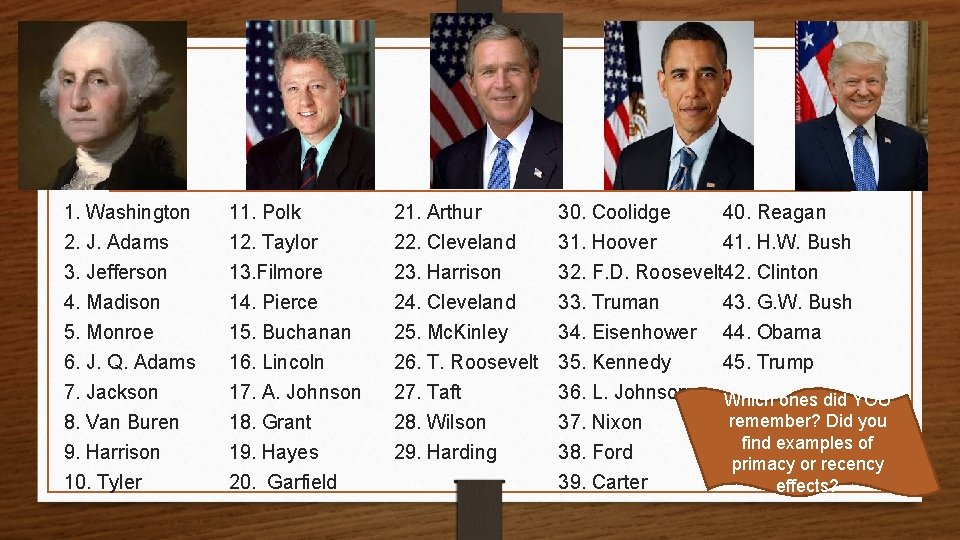
Serial Position Effect and the US Presidents: Find someone to read this list to you (Don’t study it. After they are done, take a minute to list all of the presidents you remember from the list. 1. Washington 2. J. Adams 3. Jefferson 4. Madison 5. Monroe 6. J. Q. Adams 7. Jackson 8. Van Buren 9. Harrison 10. Tyler 11. Polk 12. Taylor 13. Filmore 14. Pierce 15. Buchanan 16. Lincoln 17. A. Johnson 18. Grant 19. Hayes 20. Garfield 21. Arthur 22. Cleveland 23. Harrison 24. Cleveland 25. Mc. Kinley 26. T. Roosevelt 27. Taft 39. Carter 30. Coolidge 40. Reagan 31. Hoover 41. H. W. Bush 32. F. D. Roosevelt 42. Clinton 33. Truman 43. G. W. Bush 34. Eisenhower 44. Obama 35. Kennedy 45. Trump 36. L. Johnson 28. Wilson 29. Harding 37. Nixon 38. Ford
1. Washington 2. J. Adams 4. Madison 11. Polk 12. Taylor 13. Filmore 14. Pierce 5. Monroe 6. J. Q. Adams 7. Jackson 8. Van Buren 9. Harrison 10. Tyler 15. Buchanan 16. Lincoln 17. A. Johnson 18. Grant 19. Hayes 20. Garfield 3. Jefferson 40. Reagan 30. Coolidge 41. H. W. Bush 31. Hoover 32. F. D. Roosevelt 42. Clinton 43. G. W. Bush 33. Truman 25. Mc. Kinley 34. Eisenhower 44. Obama 45. Trump 26. T. Roosevelt 35. Kennedy 27. Taft 36. L. Johnson Which ones did YOU remember? Did you 28. Wilson 37. Nixon find examples of 29. Harding 38. Ford 21. Arthur 22. Cleveland 23. Harrison 24. Cleveland 39. Carter primacy or recency effects?
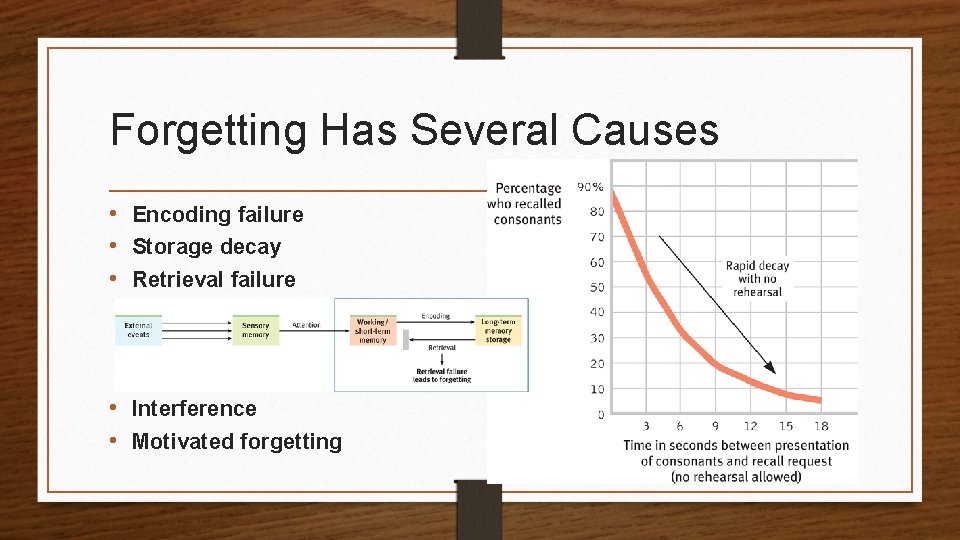
Forgetting Has Several Causes • Encoding failure • Storage decay • Retrieval failure • Interference • Motivated forgetting
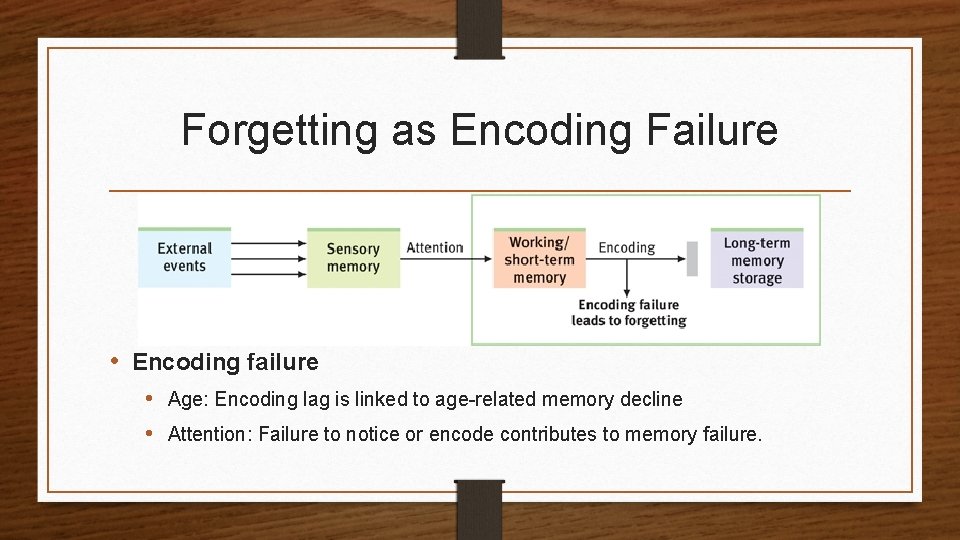
Forgetting as Encoding Failure • Encoding failure • Age: Encoding lag is linked to age-related memory decline • Attention: Failure to notice or encode contributes to memory failure.
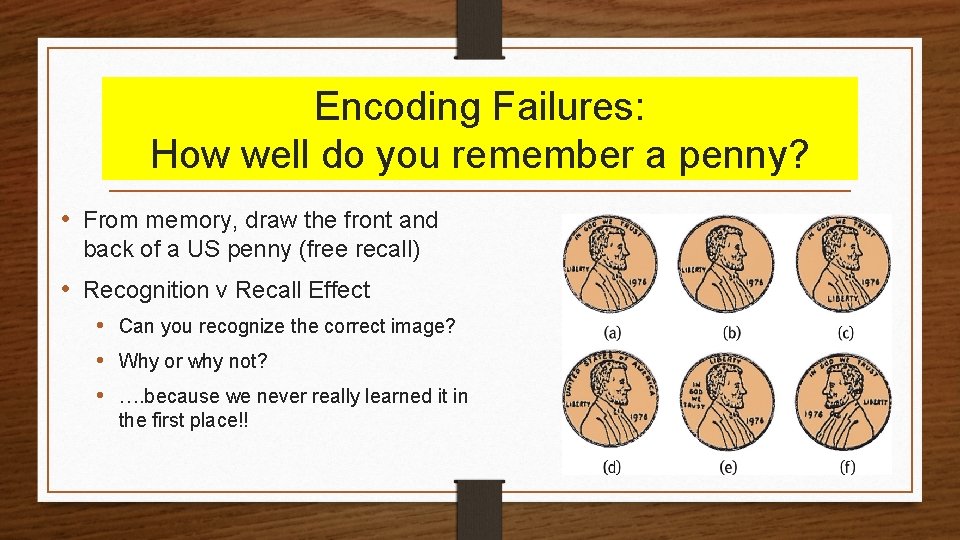
Encoding Failures: How well do you remember a penny? • From memory, draw the front and back of a US penny (free recall) • Recognition v Recall Effect • Can you recognize the correct image? • Why or why not? • …. because we never really learned it in the first place!!
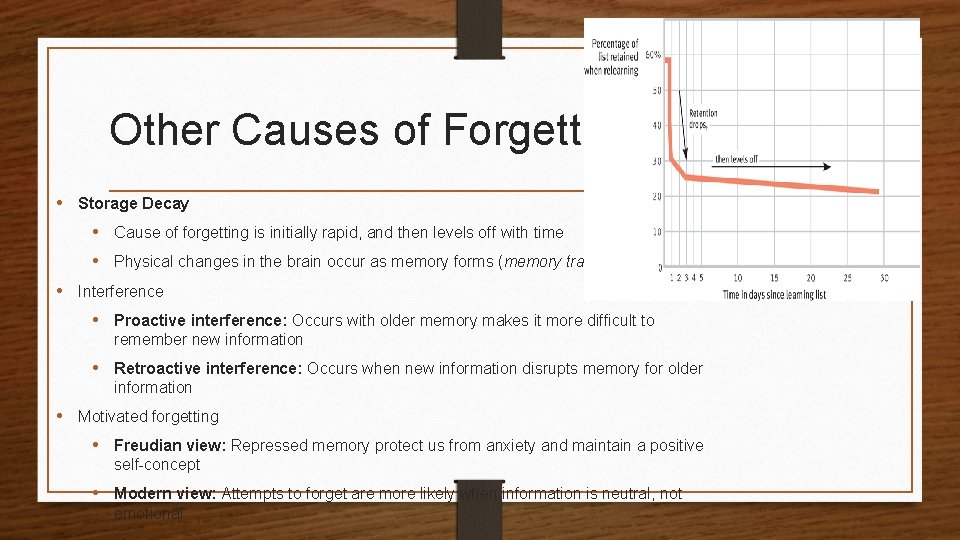
Other Causes of Forgetting • Storage Decay • Cause of forgetting is initially rapid, and then levels off with time • Physical changes in the brain occur as memory forms (memory trace) • Interference • Proactive interference: Occurs with older memory makes it more difficult to remember new information • Retroactive interference: Occurs when new information disrupts memory for older information • Motivated forgetting • Freudian view: Repressed memory protect us from anxiety and maintain a positive self-concept • Modern view: Attempts to forget are more likely when information is neutral, not emotional
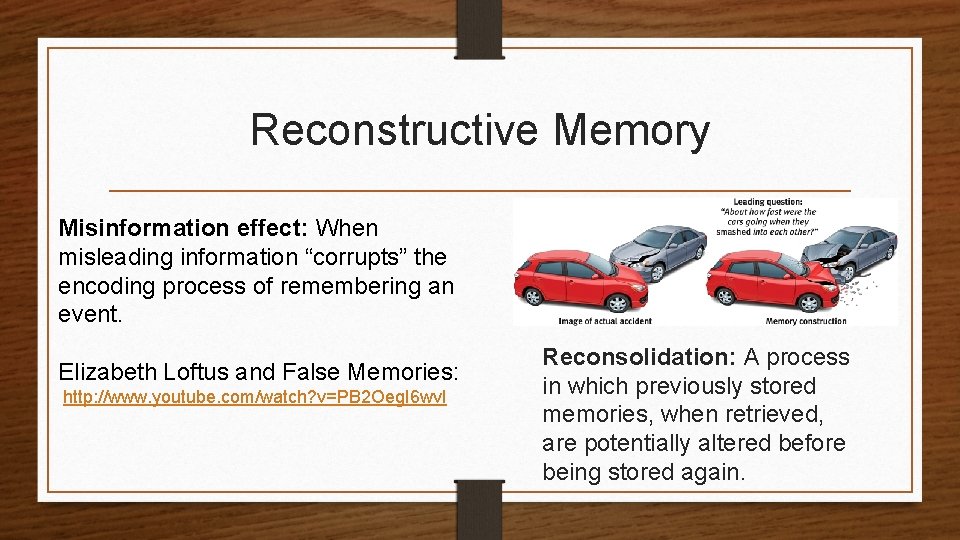
Reconstructive Memory Misinformation effect: When misleading information “corrupts” the encoding process of remembering an event. Elizabeth Loftus and False Memories: http: //www. youtube. com/watch? v=PB 2 Oeg. I 6 wv. I Reconsolidation: A process in which previously stored memories, when retrieved, are potentially altered before being stored again.
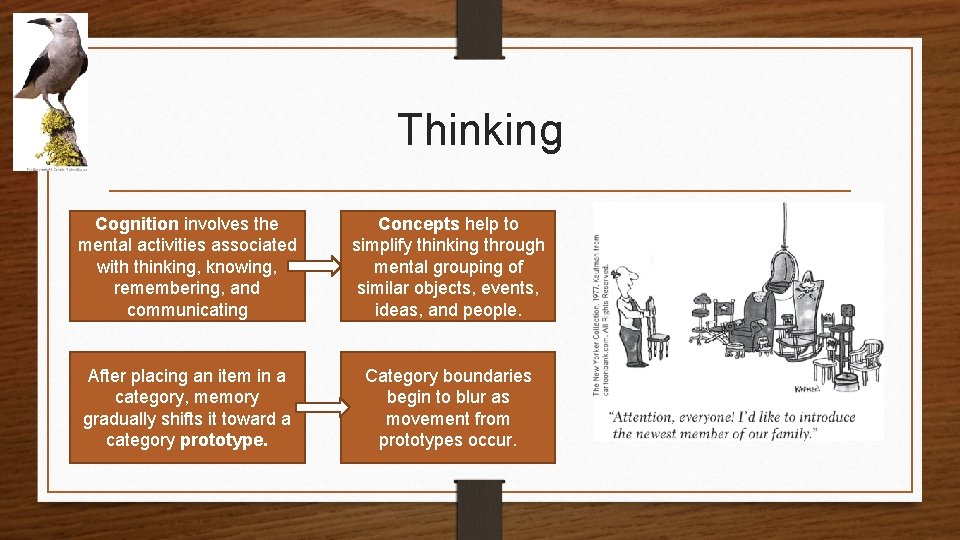
Thinking Cognition involves the mental activities associated with thinking, knowing, remembering, and communicating Concepts help to simplify thinking through mental grouping of similar objects, events, ideas, and people. After placing an item in a category, memory gradually shifts it toward a category prototype. Category boundaries begin to blur as movement from prototypes occur.
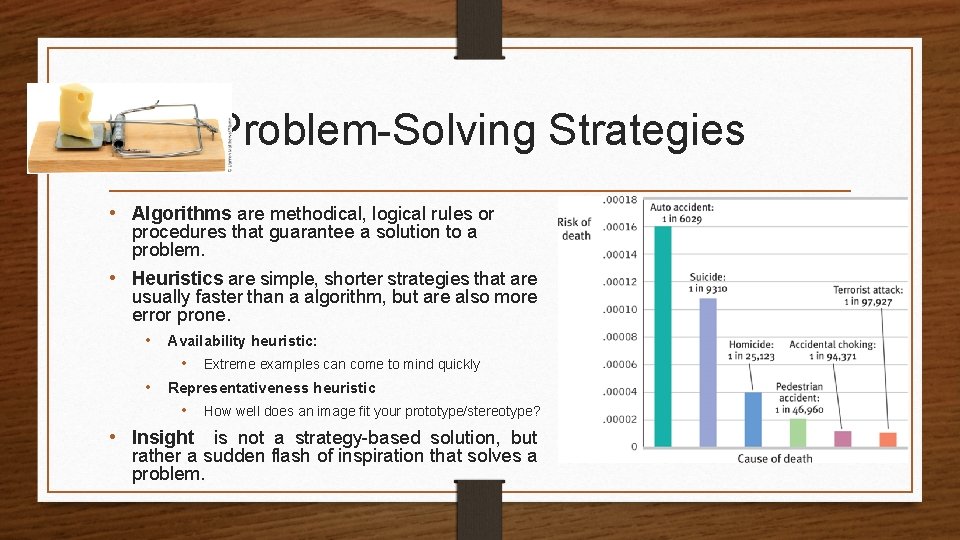
Problem-Solving Strategies • Algorithms are methodical, logical rules or procedures that guarantee a solution to a problem. • Heuristics are simple, shorter strategies that are usually faster than a algorithm, but are also more error prone. • Availability heuristic: • Extreme examples can come to mind quickly • Representativeness heuristic • How well does an image fit your prototype/stereotype? • Insight is not a strategy-based solution, but rather a sudden flash of inspiration that solves a problem.
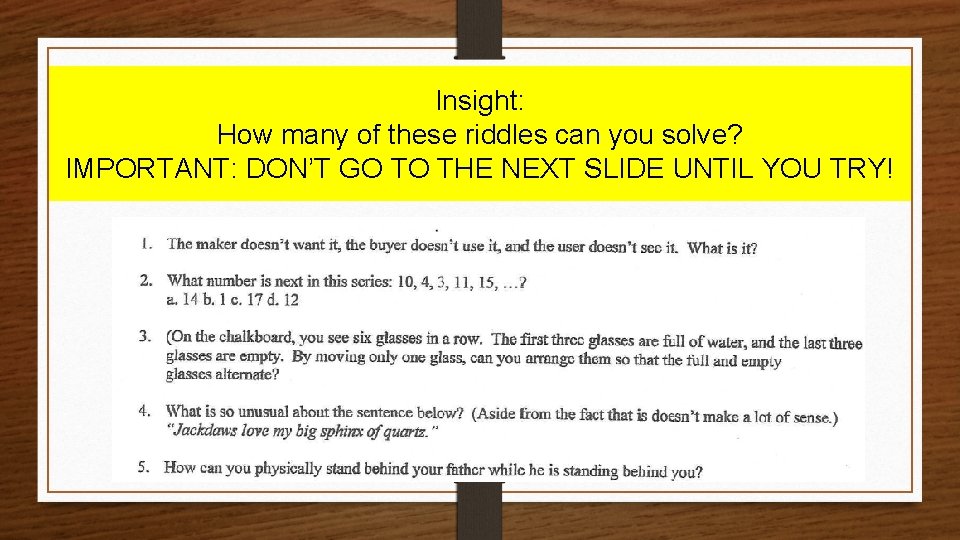
Insight: How many of these riddles can you solve? IMPORTANT: DON’T GO TO THE NEXT SLIDE UNTIL YOU TRY!
Insight: Answers to Riddles 1. A coffin 2. 14…when spelled out, each number in the series is longer than the previous number by one letter 3. Pour the water from the second glass into the fifth glass. 4. It’s the shortest sentence in the English language that includes every letter of the alphabet. 5. Stand back to back.
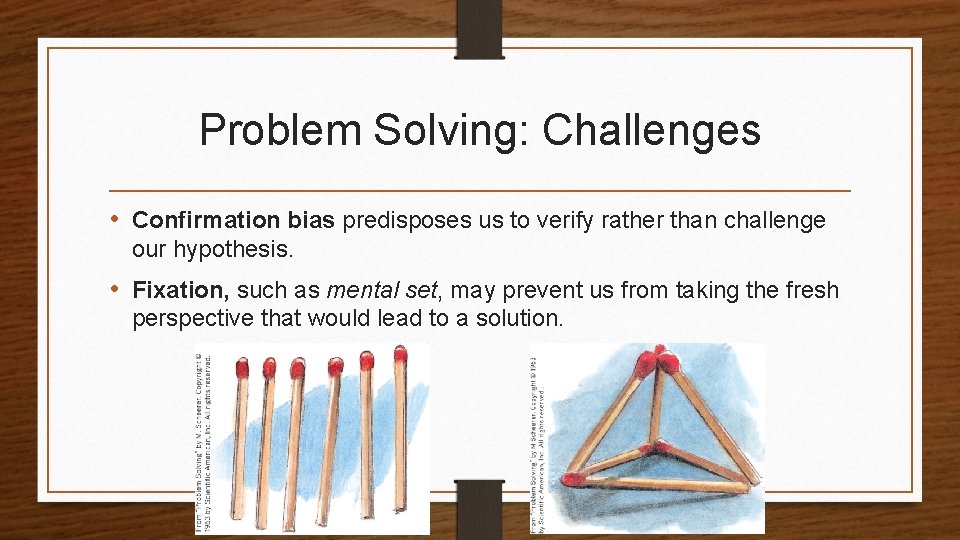
Problem Solving: Challenges • Confirmation bias predisposes us to verify rather than challenge our hypothesis. • Fixation, such as mental set, may prevent us from taking the fresh perspective that would lead to a solution.
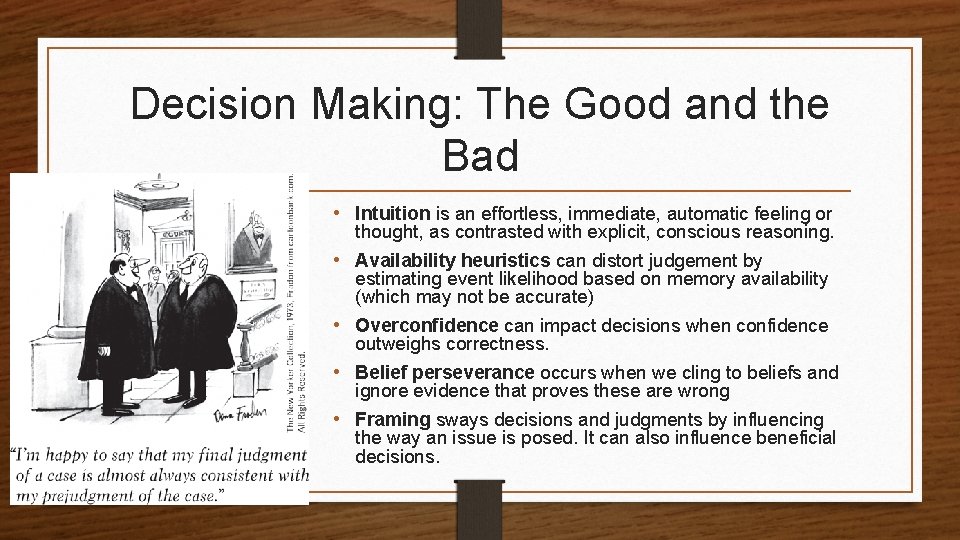
Decision Making: The Good and the Bad • Intuition is an effortless, immediate, automatic feeling or thought, as contrasted with explicit, conscious reasoning. • Availability heuristics can distort judgement by estimating event likelihood based on memory availability (which may not be accurate) • Overconfidence can impact decisions when confidence outweighs correctness. • Belief perseverance occurs when we cling to beliefs and ignore evidence that proves these are wrong • Framing sways decisions and judgments by influencing the way an issue is posed. It can also influence beneficial decisions.
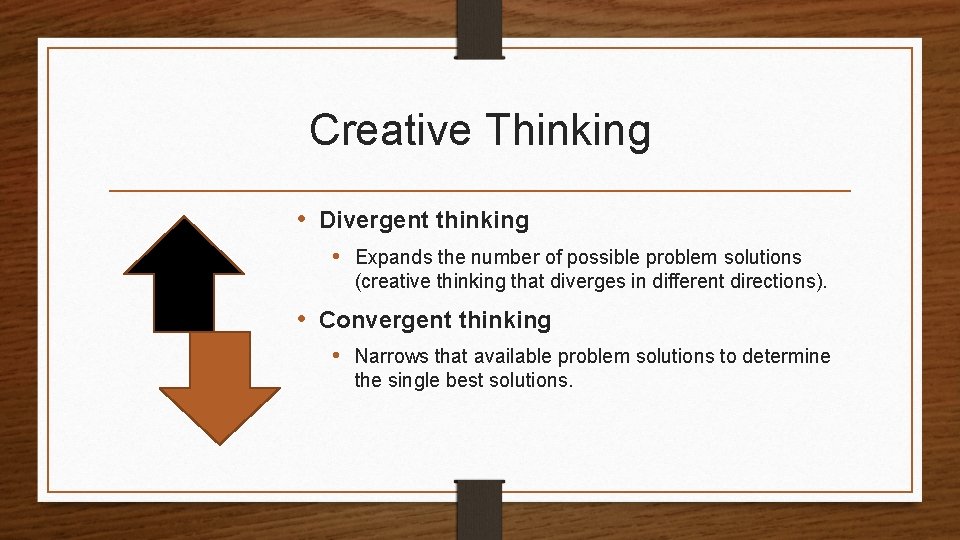
Creative Thinking • Divergent thinking • Expands the number of possible problem solutions (creative thinking that diverges in different directions). • Convergent thinking • Narrows that available problem solutions to determine the single best solutions.
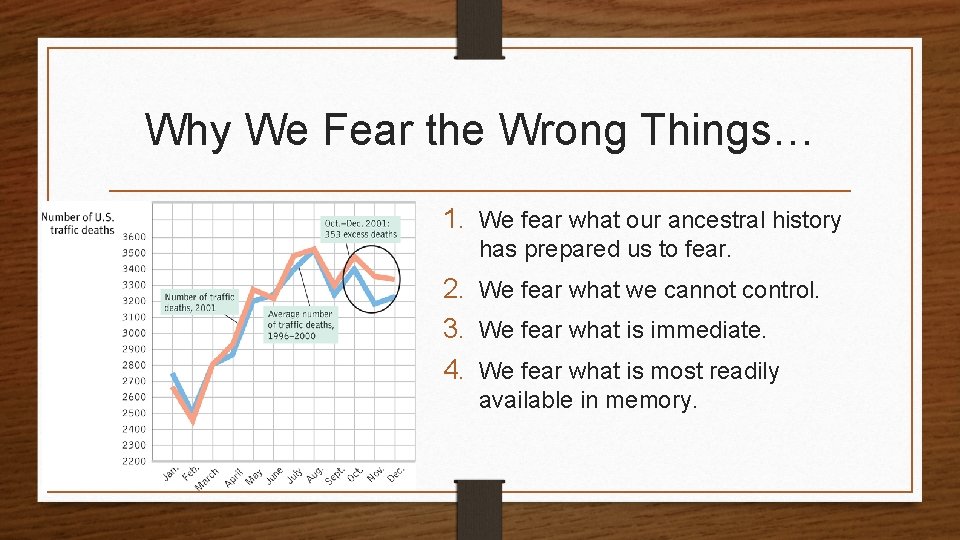
Why We Fear the Wrong Things… 1. We fear what our ancestral history has prepared us to fear. 2. We fear what we cannot control. 3. We fear what is immediate. 4. We fear what is most readily available in memory.