
Memory and Addresses Pointers 1 Memory is just

![Example: Array Resizing int *p 1 = new int[100]; Pointers 17 // create array](https://slidetodoc.com/presentation_image_h2/0ac9b40c0843c26c7dc420b40e26c206/image-17.jpg "Example: Array Resizing int *p 1 = new int[100]; Pointers 17 // create array")
- Slides: 26
Memory and Addresses Pointers 1 Memory is just a sequence of byte-sized storage devices. The bytes are assigned numeric addresses, starting with zero, just like the indexing of the cells of an array. It is the job of the operating system (OS) to: - manage the allocation of memory to processes - keep track of what particular addresses each process is allowed to access, and how - reserve portions of memory exclusively for use by the OS - enforce protection of the memory space of each process, and of the OS itself - do all this as efficiently as possible Computer Science Dept Va Tech January 2008 Data Structures & OO Development I © 2008 Mc. Quain
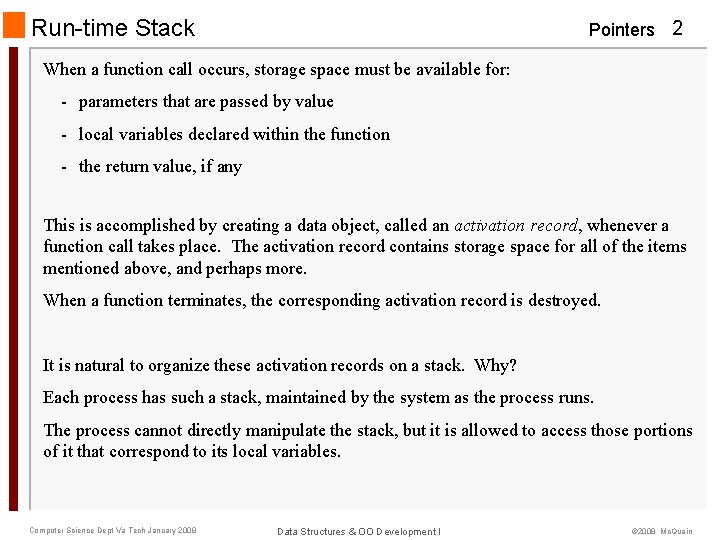
Run-time Stack Pointers 2 When a function call occurs, storage space must be available for: - parameters that are passed by value - local variables declared within the function - the return value, if any This is accomplished by creating a data object, called an activation record, whenever a function call takes place. The activation record contains storage space for all of the items mentioned above, and perhaps more. When a function terminates, the corresponding activation record is destroyed. It is natural to organize these activation records on a stack. Why? Each process has such a stack, maintained by the system as the process runs. The process cannot directly manipulate the stack, but it is allowed to access those portions of it that correspond to its local variables. Computer Science Dept Va Tech January 2008 Data Structures & OO Development I © 2008 Mc. Quain
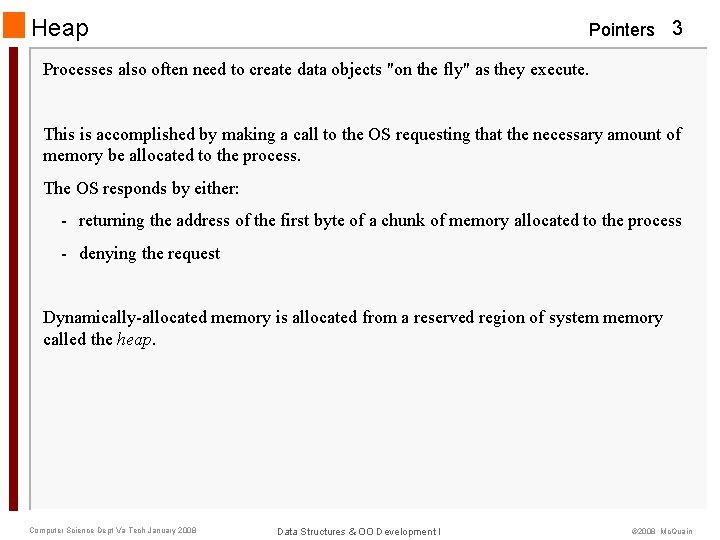
Heap Pointers 3 Processes also often need to create data objects "on the fly" as they execute. This is accomplished by making a call to the OS requesting that the necessary amount of memory be allocated to the process. The OS responds by either: - returning the address of the first byte of a chunk of memory allocated to the process - denying the request Dynamically-allocated memory is allocated from a reserved region of system memory called the heap. Computer Science Dept Va Tech January 2008 Data Structures & OO Development I © 2008 Mc. Quain
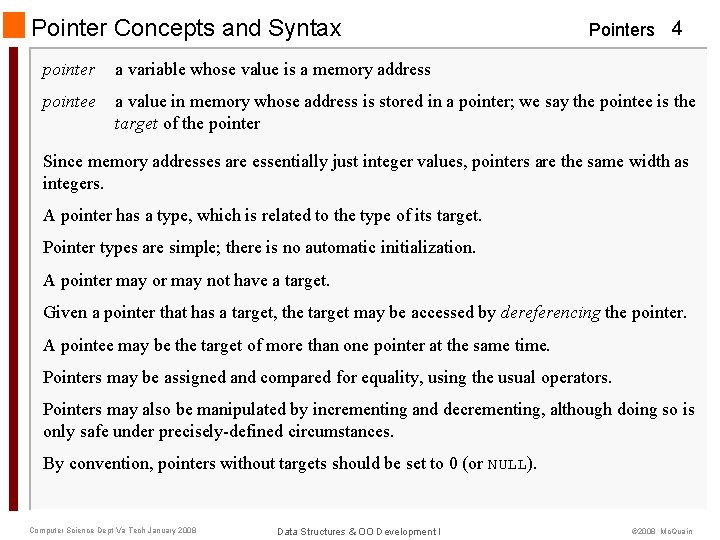
Pointer Concepts and Syntax Pointers 4 pointer a variable whose value is a memory address pointee a value in memory whose address is stored in a pointer; we say the pointee is the target of the pointer Since memory addresses are essentially just integer values, pointers are the same width as integers. A pointer has a type, which is related to the type of its target. Pointer types are simple; there is no automatic initialization. A pointer may or may not have a target. Given a pointer that has a target, the target may be accessed by dereferencing the pointer. A pointee may be the target of more than one pointer at the same time. Pointers may be assigned and compared for equality, using the usual operators. Pointers may also be manipulated by incrementing and decrementing, although doing so is only safe under precisely-defined circumstances. By convention, pointers without targets should be set to 0 (or NULL). Computer Science Dept Va Tech January 2008 Data Structures & OO Development I © 2008 Mc. Quain
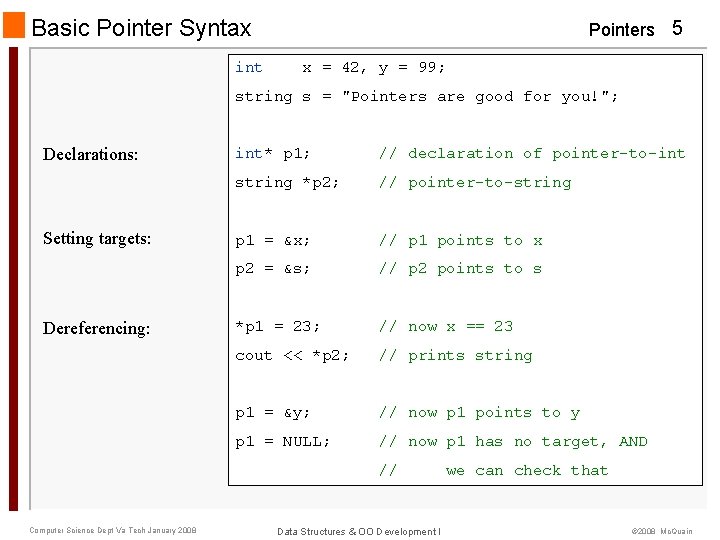
Basic Pointer Syntax int Pointers 5 x = 42, y = 99; string s = "Pointers are good for you!"; Declarations: Setting targets: Dereferencing: int* p 1; // declaration of pointer-to-int string *p 2; // pointer-to-string p 1 = &x; // p 1 points to x p 2 = &s; // p 2 points to s *p 1 = 23; // now x == 23 cout << *p 2; // prints string p 1 = &y; // now p 1 points to y p 1 = NULL; // now p 1 has no target, AND // Computer Science Dept Va Tech January 2008 Data Structures & OO Development I we can check that © 2008 Mc. Quain
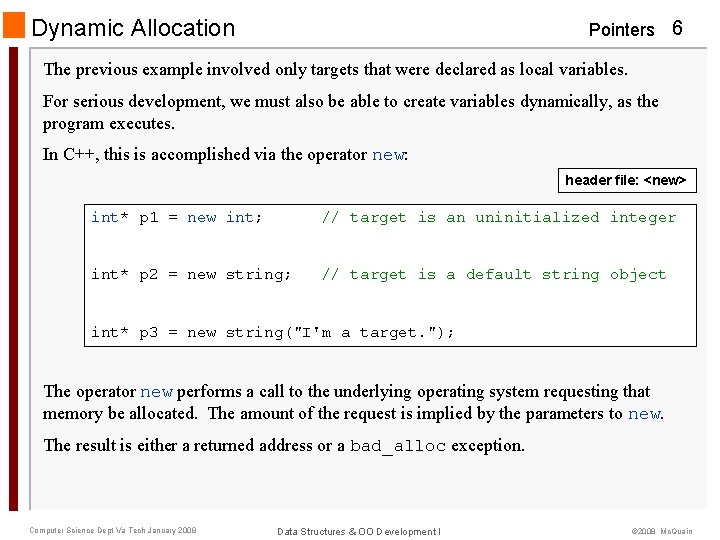
Dynamic Allocation Pointers 6 The previous example involved only targets that were declared as local variables. For serious development, we must also be able to create variables dynamically, as the program executes. In C++, this is accomplished via the operator new: header file: <new> int* p 1 = new int; // target is an uninitialized integer int* p 2 = new string; // target is a default string object int* p 3 = new string("I'm a target. "); The operator new performs a call to the underlying operating system requesting that memory be allocated. The amount of the request is implied by the parameters to new. The result is either a returned address or a bad_alloc exception. Computer Science Dept Va Tech January 2008 Data Structures & OO Development I © 2008 Mc. Quain
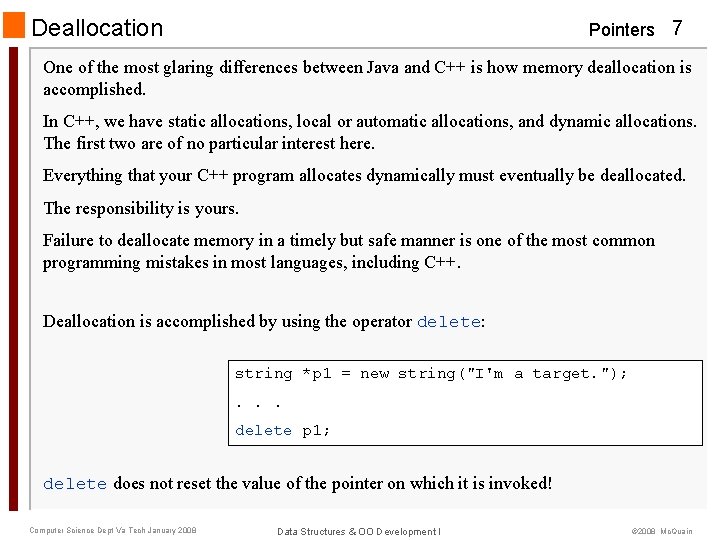
Deallocation Pointers 7 One of the most glaring differences between Java and C++ is how memory deallocation is accomplished. In C++, we have static allocations, local or automatic allocations, and dynamic allocations. The first two are of no particular interest here. Everything that your C++ program allocates dynamically must eventually be deallocated. The responsibility is yours. Failure to deallocate memory in a timely but safe manner is one of the most common programming mistakes in most languages, including C++. Deallocation is accomplished by using the operator delete: string *p 1 = new string("I'm a target. "); . . . delete p 1; delete does not reset the value of the pointer on which it is invoked! Computer Science Dept Va Tech January 2008 Data Structures & OO Development I © 2008 Mc. Quain
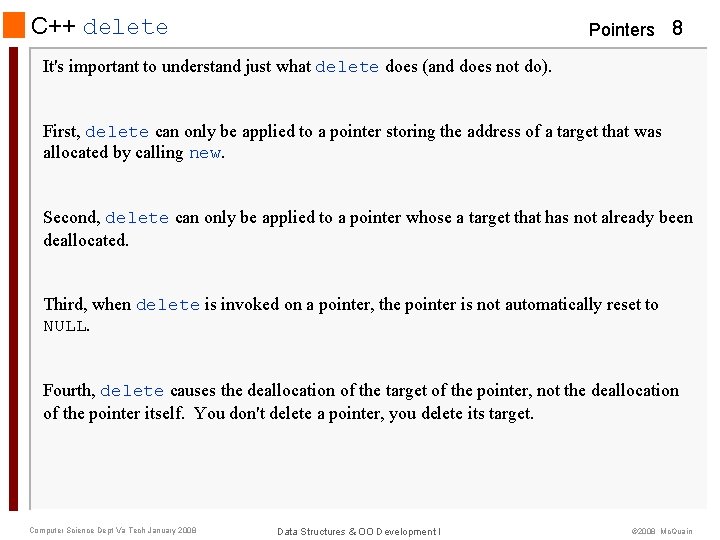
C++ delete Pointers 8 It's important to understand just what delete does (and does not do). First, delete can only be applied to a pointer storing the address of a target that was allocated by calling new. Second, delete can only be applied to a pointer whose a target that has not already been deallocated. Third, when delete is invoked on a pointer, the pointer is not automatically reset to NULL. Fourth, delete causes the deallocation of the target of the pointer, not the deallocation of the pointer itself. You don't delete a pointer, you delete its target. Computer Science Dept Va Tech January 2008 Data Structures & OO Development I © 2008 Mc. Quain
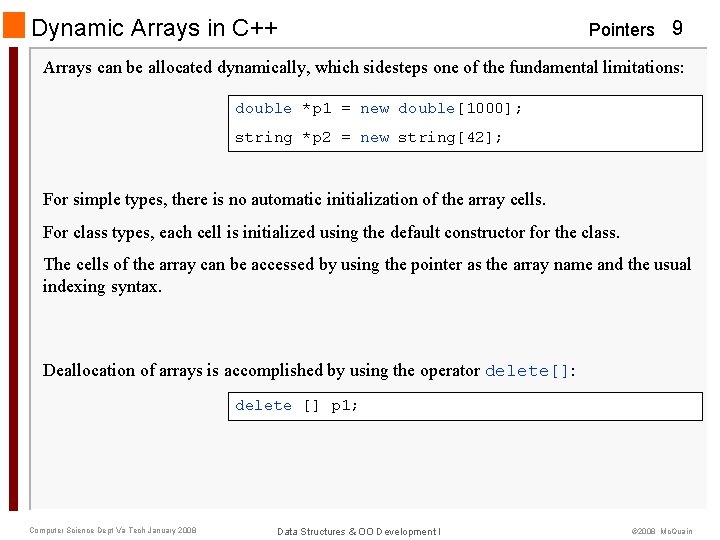
Dynamic Arrays in C++ Pointers 9 Arrays can be allocated dynamically, which sidesteps one of the fundamental limitations: double *p 1 = new double[1000]; string *p 2 = new string[42]; For simple types, there is no automatic initialization of the array cells. For class types, each cell is initialized using the default constructor for the class. The cells of the array can be accessed by using the pointer as the array name and the usual indexing syntax. Deallocation of arrays is accomplished by using the operator delete[]: delete [] p 1; Computer Science Dept Va Tech January 2008 Data Structures & OO Development I © 2008 Mc. Quain
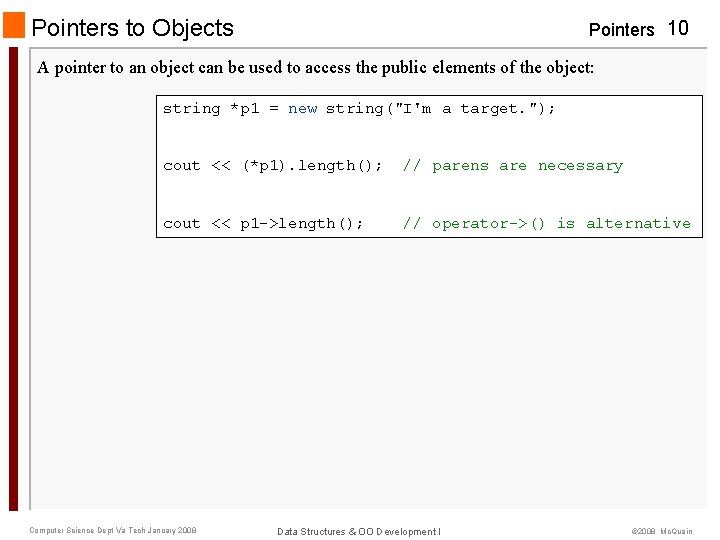
Pointers to Objects Pointers 10 A pointer to an object can be used to access the public elements of the object: string *p 1 = new string("I'm a target. "); cout << (*p 1). length(); // parens are necessary cout << p 1 ->length(); // operator->() is alternative Computer Science Dept Va Tech January 2008 Data Structures & OO Development I © 2008 Mc. Quain
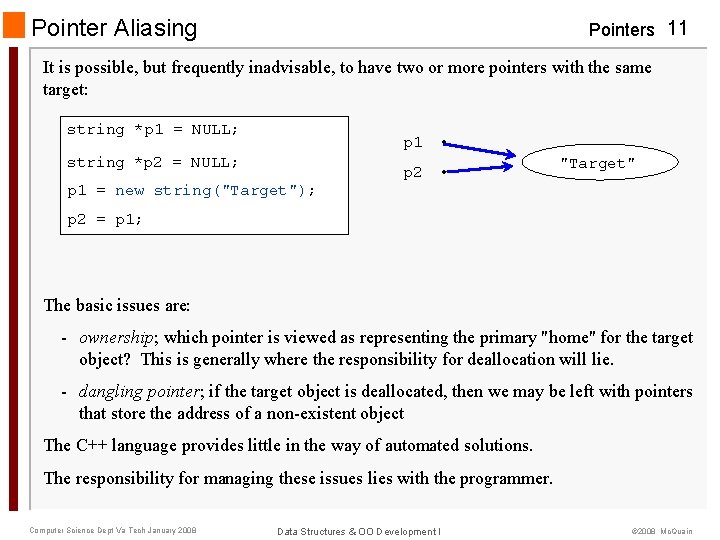
Pointer Aliasing Pointers 11 It is possible, but frequently inadvisable, to have two or more pointers with the same target: string *p 1 = NULL; string *p 2 = NULL; p 1 • p 2 • "Target" p 1 = new string("Target"); p 2 = p 1; The basic issues are: - ownership; which pointer is viewed as representing the primary "home" for the target object? This is generally where the responsibility for deallocation will lie. - dangling pointer; if the target object is deallocated, then we may be left with pointers that store the address of a non-existent object The C++ language provides little in the way of automated solutions. The responsibility for managing these issues lies with the programmer. Computer Science Dept Va Tech January 2008 Data Structures & OO Development I © 2008 Mc. Quain
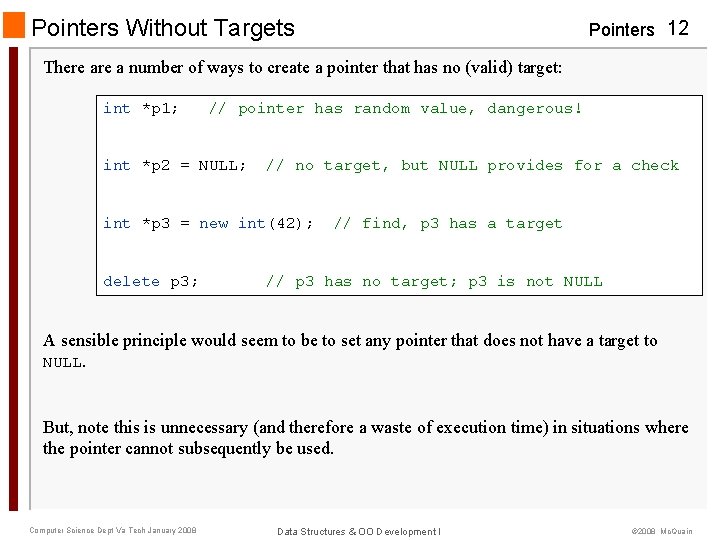
Pointers Without Targets Pointers 12 There a number of ways to create a pointer that has no (valid) target: int *p 1; // pointer has random value, dangerous! int *p 2 = NULL; // no target, but NULL provides for a check int *p 3 = new int(42); delete p 3; // find, p 3 has a target // p 3 has no target; p 3 is not NULL A sensible principle would seem to be to set any pointer that does not have a target to NULL. But, note this is unnecessary (and therefore a waste of execution time) in situations where the pointer cannot subsequently be used. Computer Science Dept Va Tech January 2008 Data Structures & OO Development I © 2008 Mc. Quain
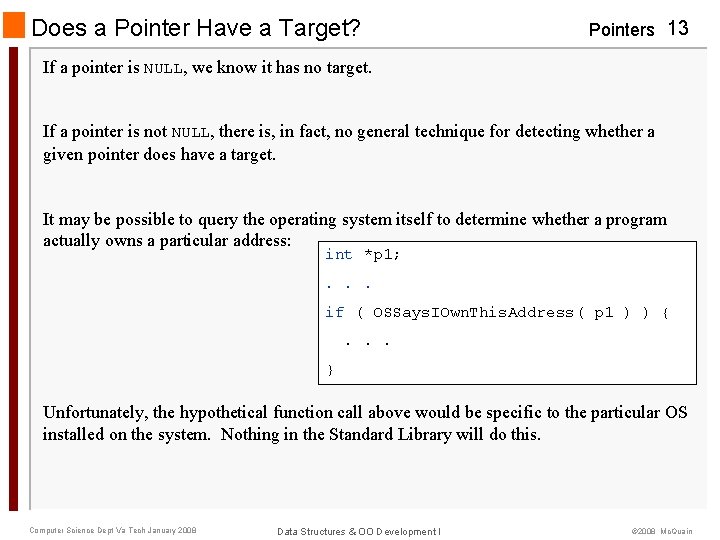
Does a Pointer Have a Target? Pointers 13 If a pointer is NULL, we know it has no target. If a pointer is not NULL, there is, in fact, no general technique for detecting whether a given pointer does have a target. It may be possible to query the operating system itself to determine whether a program actually owns a particular address: int *p 1; . . . if ( OSSays. IOwn. This. Address( p 1 ) ) {. . . } Unfortunately, the hypothetical function call above would be specific to the particular OS installed on the system. Nothing in the Standard Library will do this. Computer Science Dept Va Tech January 2008 Data Structures & OO Development I © 2008 Mc. Quain
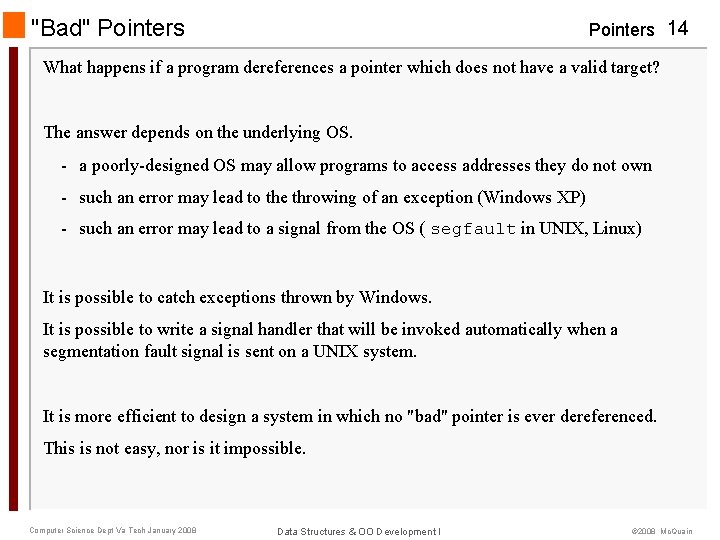
"Bad" Pointers 14 What happens if a program dereferences a pointer which does not have a valid target? The answer depends on the underlying OS. - a poorly-designed OS may allow programs to access addresses they do not own - such an error may lead to the throwing of an exception (Windows XP) - such an error may lead to a signal from the OS ( segfault in UNIX, Linux) It is possible to catch exceptions thrown by Windows. It is possible to write a signal handler that will be invoked automatically when a segmentation fault signal is sent on a UNIX system. It is more efficient to design a system in which no "bad" pointer is ever dereferenced. This is not easy, nor is it impossible. Computer Science Dept Va Tech January 2008 Data Structures & OO Development I © 2008 Mc. Quain
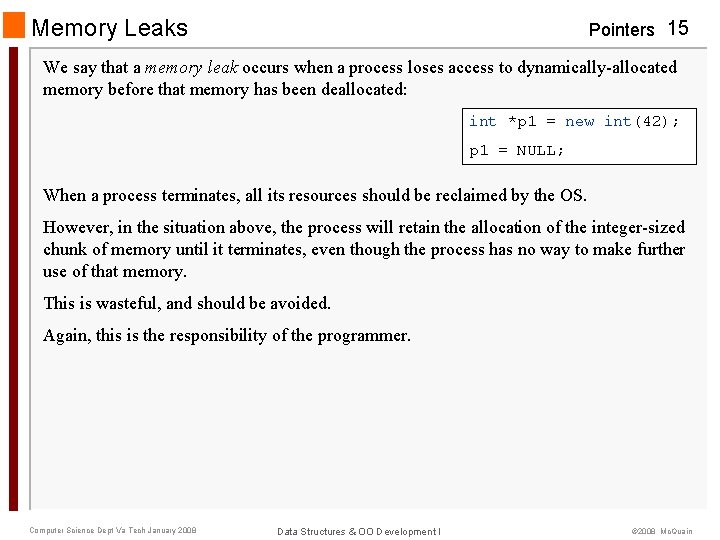
Memory Leaks Pointers 15 We say that a memory leak occurs when a process loses access to dynamically-allocated memory before that memory has been deallocated: int *p 1 = new int(42); p 1 = NULL; When a process terminates, all its resources should be reclaimed by the OS. However, in the situation above, the process will retain the allocation of the integer-sized chunk of memory until it terminates, even though the process has no way to make further use of that memory. This is wasteful, and should be avoided. Again, this is the responsibility of the programmer. Computer Science Dept Va Tech January 2008 Data Structures & OO Development I © 2008 Mc. Quain
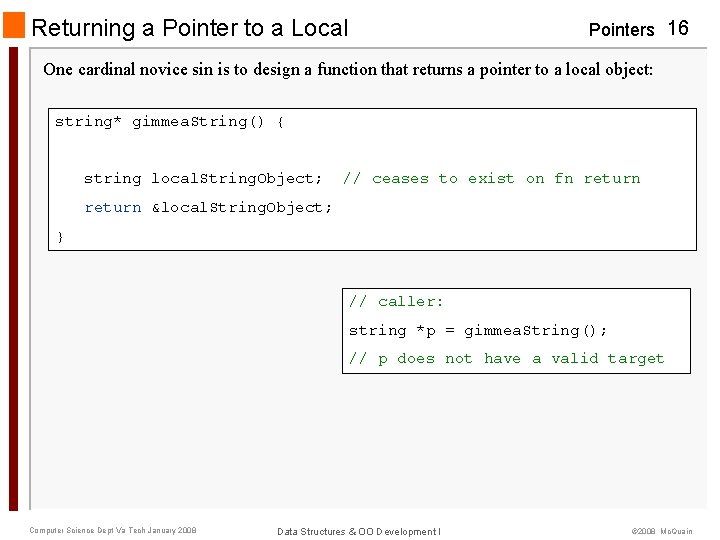
Returning a Pointer to a Local Pointers 16 One cardinal novice sin is to design a function that returns a pointer to a local object: string* gimmea. String() { string local. String. Object; // ceases to exist on fn return &local. String. Object; } // caller: string *p = gimmea. String(); // p does not have a valid target Computer Science Dept Va Tech January 2008 Data Structures & OO Development I © 2008 Mc. Quain
Example: Array Resizing int *p 1 = new int[100]; Pointers 17 // create array and use it awhile . . . int *p 2 = new int[200]; // create larger array to replace it for (unsigned int pos = 0; pos < 100; pos++) // copy values p 2[pos] = p 1[pos]; delete [] p 1; // deallocate original array p 1 = p 2; // reset original array pointer to new array p 2 = NULL; // eliminate alias Computer Science Dept Va Tech January 2008 Data Structures & OO Development I © 2008 Mc. Quain
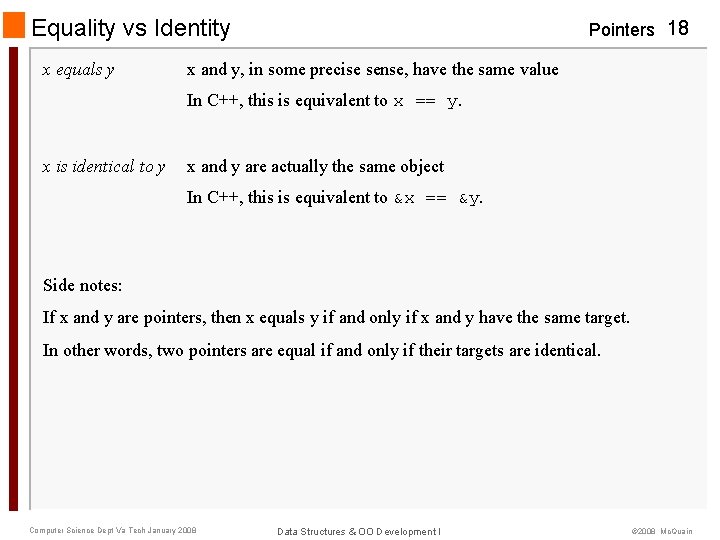
Equality vs Identity x equals y Pointers 18 x and y, in some precise sense, have the same value In C++, this is equivalent to x == y. x is identical to y x and y are actually the same object In C++, this is equivalent to &x == &y. Side notes: If x and y are pointers, then x equals y if and only if x and y have the same target. In other words, two pointers are equal if and only if their targets are identical. Computer Science Dept Va Tech January 2008 Data Structures & OO Development I © 2008 Mc. Quain
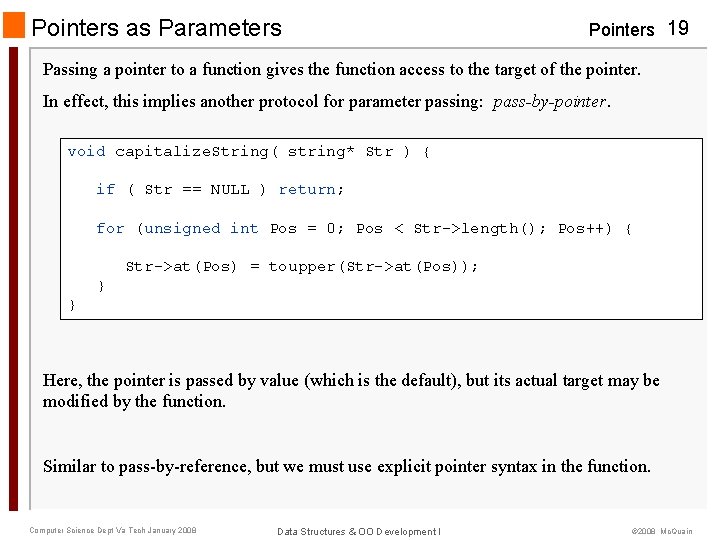
Pointers as Parameters Pointers 19 Passing a pointer to a function gives the function access to the target of the pointer. In effect, this implies another protocol for parameter passing: pass-by-pointer. void capitalize. String( string* Str ) { if ( Str == NULL ) return; for (unsigned int Pos = 0; Pos < Str->length(); Pos++) { Str->at(Pos) = toupper(Str->at(Pos)); } } Here, the pointer is passed by value (which is the default), but its actual target may be modified by the function. Similar to pass-by-reference, but we must use explicit pointer syntax in the function. Computer Science Dept Va Tech January 2008 Data Structures & OO Development I © 2008 Mc. Quain
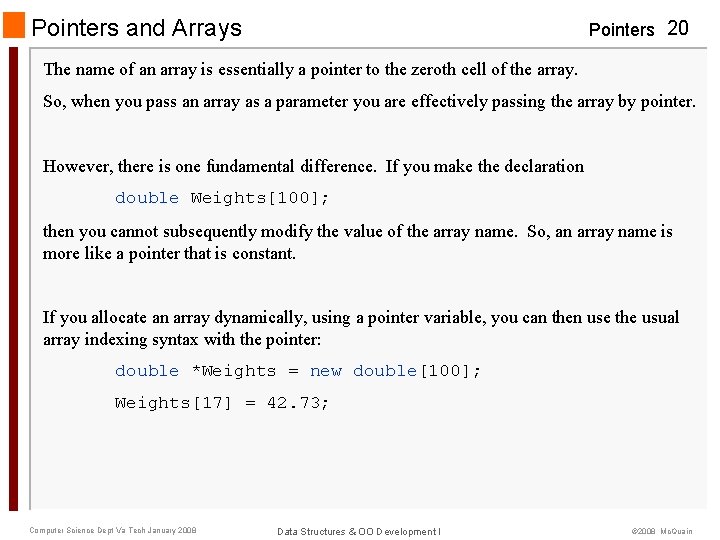
Pointers and Arrays Pointers 20 The name of an array is essentially a pointer to the zeroth cell of the array. So, when you pass an array as a parameter you are effectively passing the array by pointer. However, there is one fundamental difference. If you make the declaration double Weights[100]; then you cannot subsequently modify the value of the array name. So, an array name is more like a pointer that is constant. If you allocate an array dynamically, using a pointer variable, you can then use the usual array indexing syntax with the pointer: double *Weights = new double[100]; Weights[17] = 42. 73; Computer Science Dept Va Tech January 2008 Data Structures & OO Development I © 2008 Mc. Quain
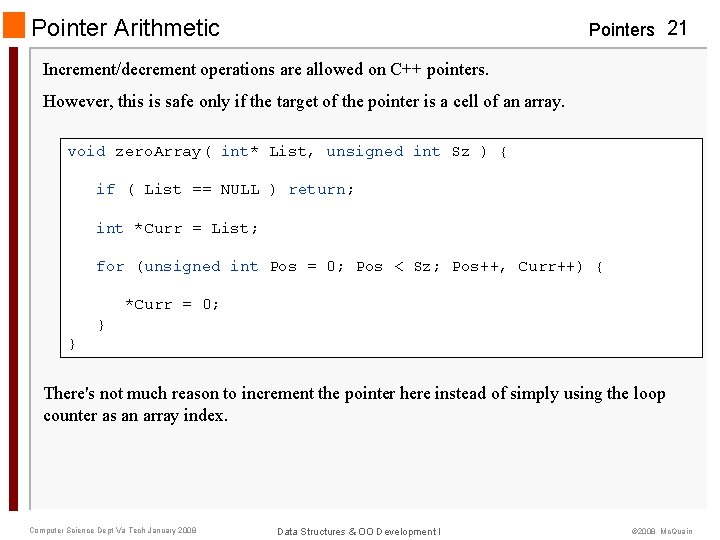
Pointer Arithmetic Pointers 21 Increment/decrement operations are allowed on C++ pointers. However, this is safe only if the target of the pointer is a cell of an array. void zero. Array( int* List, unsigned int Sz ) { if ( List == NULL ) return; int *Curr = List; for (unsigned int Pos = 0; Pos < Sz; Pos++, Curr++) { *Curr = 0; } } There's not much reason to increment the pointer here instead of simply using the loop counter as an array index. Computer Science Dept Va Tech January 2008 Data Structures & OO Development I © 2008 Mc. Quain
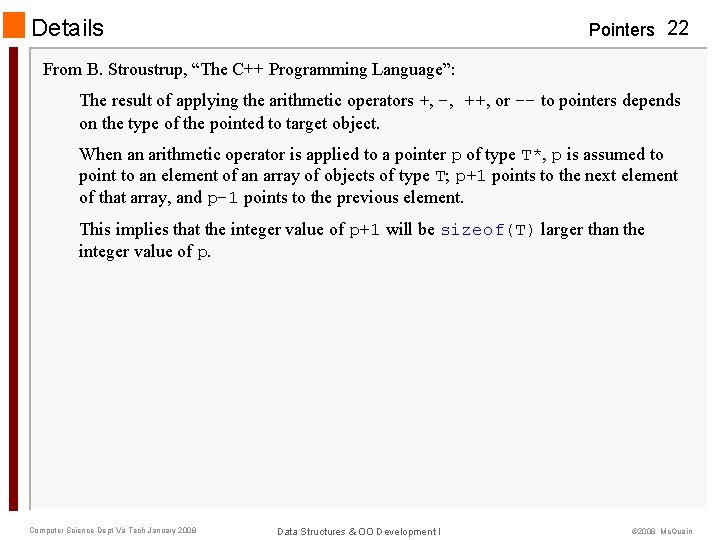
Details Pointers 22 From B. Stroustrup, “The C++ Programming Language”: The result of applying the arithmetic operators +, -, ++, or -- to pointers depends on the type of the pointed to target object. When an arithmetic operator is applied to a pointer p of type T*, p is assumed to point to an element of an array of objects of type T; p+1 points to the next element of that array, and p-1 points to the previous element. This implies that the integer value of p+1 will be sizeof(T) larger than the integer value of p. Computer Science Dept Va Tech January 2008 Data Structures & OO Development I © 2008 Mc. Quain
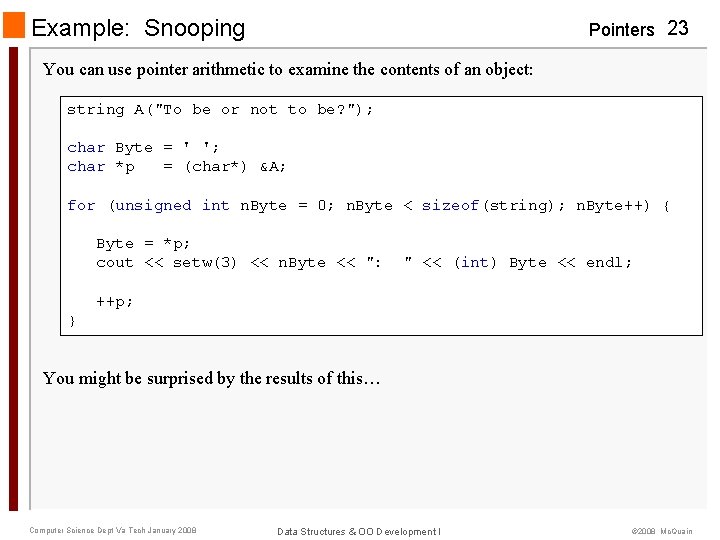
Example: Snooping Pointers 23 You can use pointer arithmetic to examine the contents of an object: string A("To be or not to be? "); char Byte = ' '; char *p = (char*) &A; for (unsigned int n. Byte = 0; n. Byte < sizeof(string); n. Byte++) { Byte = *p; cout << setw(3) << n. Byte << ": " << (int) Byte << endl; ++p; } You might be surprised by the results of this… Computer Science Dept Va Tech January 2008 Data Structures & OO Development I © 2008 Mc. Quain
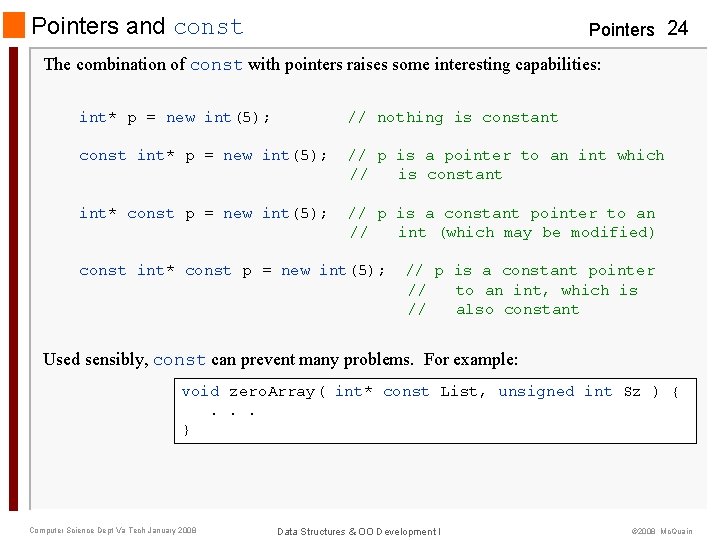
Pointers and const Pointers 24 The combination of const with pointers raises some interesting capabilities: int* p = new int(5); // nothing is constant const int* p = new int(5); // p is a pointer to an int which // is constant int* const p = new int(5); // p is a constant pointer to an // int (which may be modified) const int* const p = new int(5); // p is a constant pointer // to an int, which is // also constant Used sensibly, const can prevent many problems. For example: void zero. Array( int* const List, unsigned int Sz ) {. . . } Computer Science Dept Va Tech January 2008 Data Structures & OO Development I © 2008 Mc. Quain
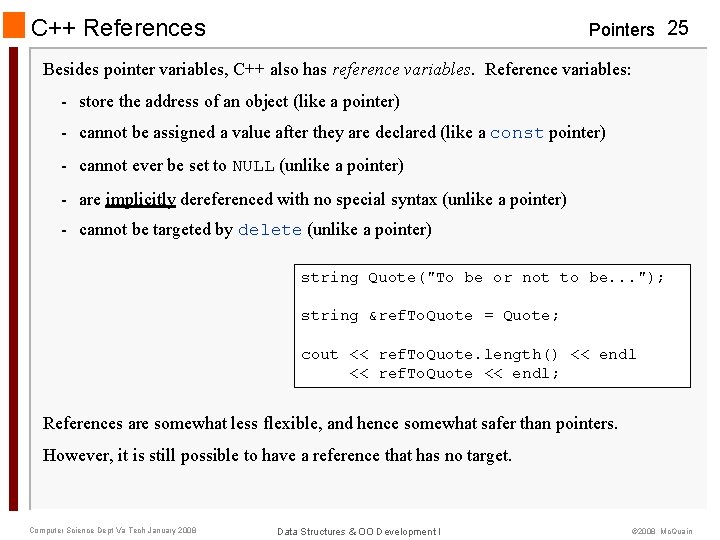
C++ References Pointers 25 Besides pointer variables, C++ also has reference variables. Reference variables: - store the address of an object (like a pointer) - cannot be assigned a value after they are declared (like a const pointer) - cannot ever be set to NULL (unlike a pointer) - are implicitly dereferenced with no special syntax (unlike a pointer) - cannot be targeted by delete (unlike a pointer) string Quote("To be or not to be. . . "); string &ref. To. Quote = Quote; cout << ref. To. Quote. length() << endl << ref. To. Quote << endl; References are somewhat less flexible, and hence somewhat safer than pointers. However, it is still possible to have a reference that has no target. Computer Science Dept Va Tech January 2008 Data Structures & OO Development I © 2008 Mc. Quain
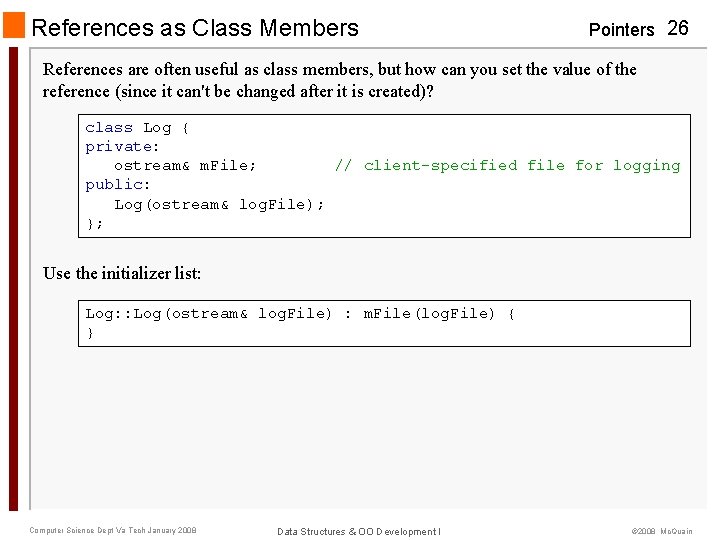
References as Class Members Pointers 26 References are often useful as class members, but how can you set the value of the reference (since it can't be changed after it is created)? class Log { private: ostream& m. File; // client-specified file for logging public: Log(ostream& log. File); }; Use the initializer list: Log: : Log(ostream& log. File) : m. File(log. File) { } Computer Science Dept Va Tech January 2008 Data Structures & OO Development I © 2008 Mc. Quain