
Memory Allocations for Tiled Uniform Dependence Programs Tomofumi
![Parametric Tiling n Series of advances n Perfect loop nests [Renganarayanan 2007] n Imperfectly](https://slidetodoc.com/presentation_image_h2/a23b7f7548200c34d367a1d1eda46d2b/image-2.jpg "Parametric Tiling n Series of advances n Perfect loop nests [Renganarayanan 2007] n Imperfectly")
![Memory Allocations n Series of polyhedral approaches n Affine Projections [Wilde & Rajopadhye 1996]](https://slidetodoc.com/presentation_image_h2/a23b7f7548200c34d367a1d1eda46d2b/image-3.jpg "Memory Allocations n Series of polyhedral approaches n Affine Projections [Wilde & Rajopadhye 1996]")
![Related Work n Affine Occupancy Vectors [Thies et al. 2001] n Restrict the universe](https://slidetodoc.com/presentation_image_h2/a23b7f7548200c34d367a1d1eda46d2b/image-14.jpg "Related Work n Affine Occupancy Vectors [Thies et al. 2001] n Restrict the universe")

- Slides: 19
Memory Allocations for Tiled Uniform Dependence Programs Tomofumi Yuki and Sanjay Rajopadhye
Parametric Tiling n Series of advances n Perfect loop nests [Renganarayanan 2007] n Imperfectly nested loops [Hartono 2009, Kim 2009] n Parallelization [Hartono 2010, Kim 2010] n Key idea: n Step out of the polyhedral model n n 1/21/13 Parametric tiling is not affine Use syntactic manipulations IMPACT 2013 2
Memory Allocations n Series of polyhedral approaches n Affine Projections [Wilde & Rajopadhye 1996] n Pseudo-Projections [Lefebvre & Feautrier 1998] n Dimension-wise “optimal” [Quilleré & Rajopadhye 2000] n Lattice-based [Darte et al. 2005] n Cannot be used for parametric tiles n Can be used to allocate per tile [Guelton et al. 2011] n Difficult to combine parametric tiling with memory-reallocation 1/21/13 IMPACT 2013 3
This paper n Find allocations valid for a set of schedules n Tiled execution by any tile size n Based on Occupancy Vectors [Strout et al. 1998] n n n Restrict the universe to tiled execution Quasi-Universal Occupancy Vectors More compact allocations than UOV n Analytically find the shortest Quasi-UOV n UOV-guided index-set splitting n Separate boundaries to reduce memory usage 1/21/13 IMPACT 2013 4
Outline n Introduction n Universal Occupancy Vectors (review) n Lengths of UOVs n Overview of the proposed flow n Finding the shortest QUOV n UOV-guided Index-set Splitting n Related Work n Conclusions 1/21/13 IMPACT 2013 5
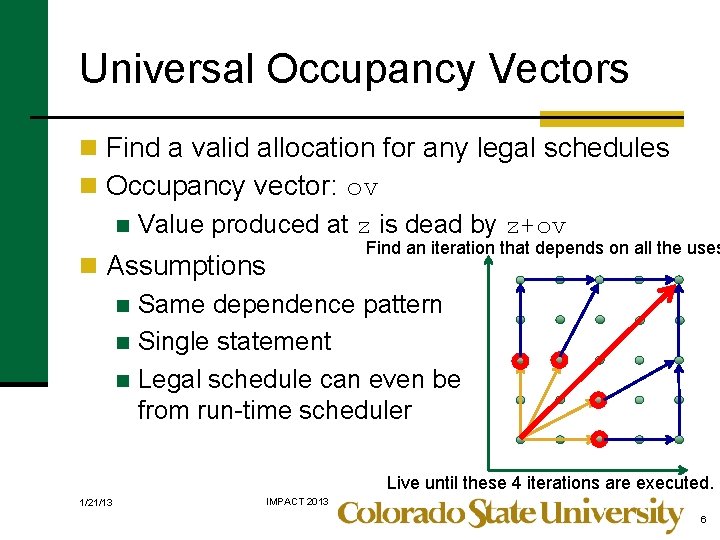
Universal Occupancy Vectors n Find a valid allocation for any legal schedules n Occupancy vector: ov n Value produced at z is dead by z+ov Find an iteration that depends on all the uses n Assumptions n Same dependence pattern n Single statement n Legal schedule can even be from run-time scheduler Live until these 4 iterations are executed. 1/21/13 IMPACT 2013 6
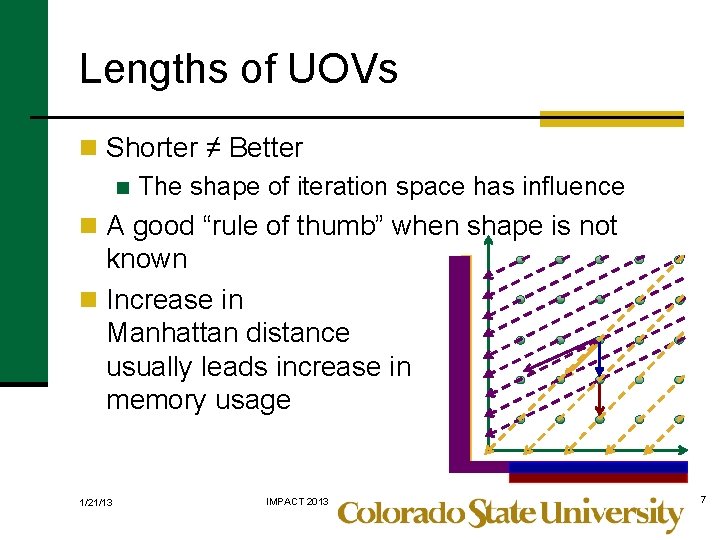
Lengths of UOVs n Shorter ≠ Better n The shape of iteration space has influence n A good “rule of thumb” when shape is not known n Increase in Manhattan distance usually leads increase in memory usage 1/21/13 IMPACT 2013 7
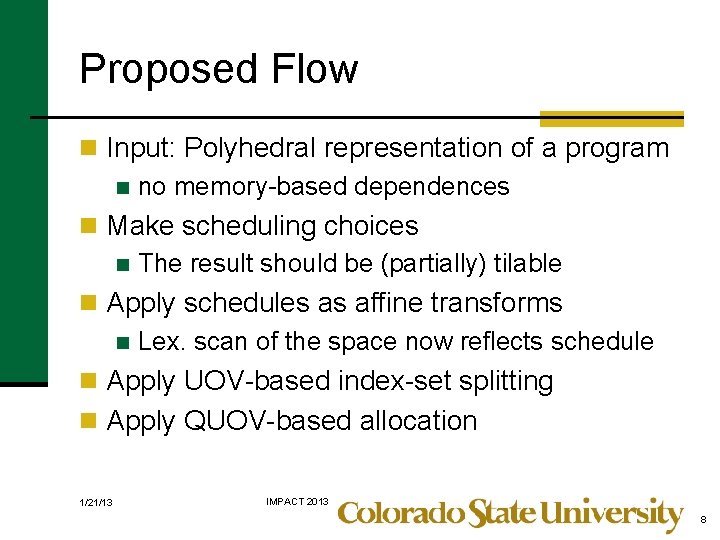
Proposed Flow n Input: Polyhedral representation of a program n no memory-based dependences n Make scheduling choices n The result should be (partially) tilable n Apply schedules as affine transforms n Lex. scan of the space now reflects schedule n Apply UOV-based index-set splitting n Apply QUOV-based allocation 1/21/13 IMPACT 2013 8
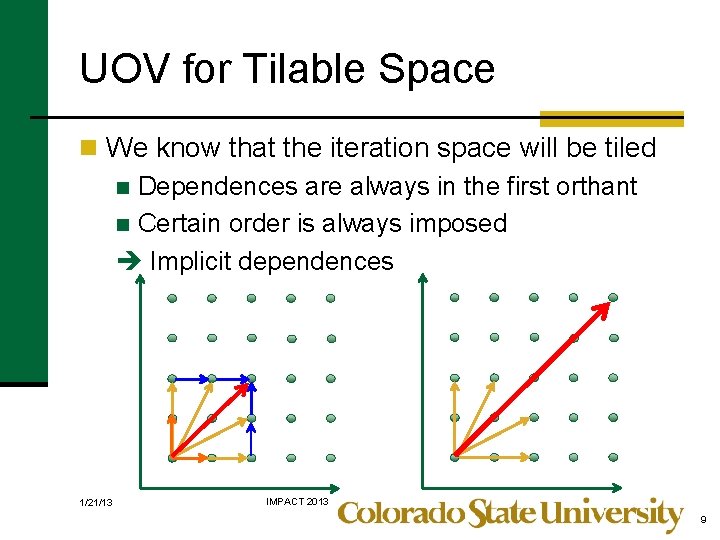
UOV for Tilable Space n We know that the iteration space will be tiled n Dependences are always in the first orthant n Certain order is always imposed Implicit dependences 1/21/13 IMPACT 2013 9
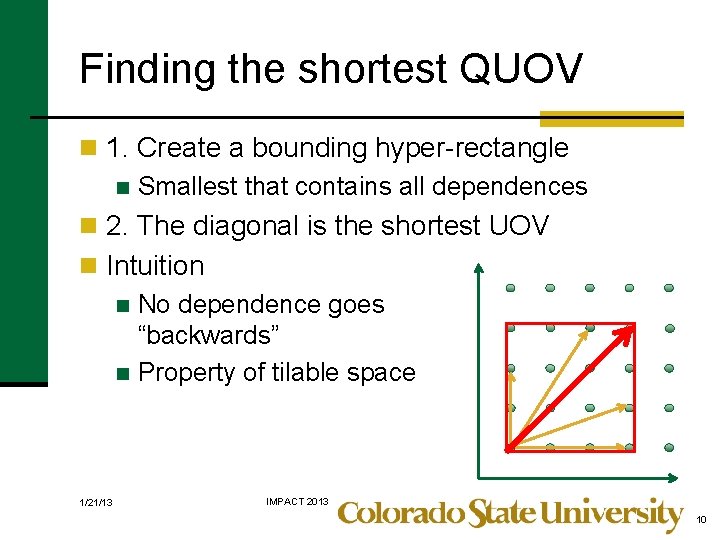
Finding the shortest QUOV n 1. Create a bounding hyper-rectangle n Smallest that contains all dependences n 2. The diagonal is the shortest UOV n Intuition n No dependence goes “backwards” n Property of tilable space 1/21/13 IMPACT 2013 10
Outline n Introduction n Universal Occupancy Vectors (review) n Lengths of UOVs n Overview of the proposed flow n Finding the shortest QUOV n UOV-guided Index-set Splitting n Related Work n Conclusions 1/21/13 IMPACT 2013 11
Dependences at Boundaries n Many boundary conditions in polyhedral representation of programs n e. g. , Gauss Seidel 2 D (from polybench) n n May negatively influence storage mapping n n Single C statement, 10+ boundary cases With per-statement projective allocations Different life-times at boundaries n May be longer than the main body n Allocating separately may also be inefficient 1/21/13 IMPACT 2013 12
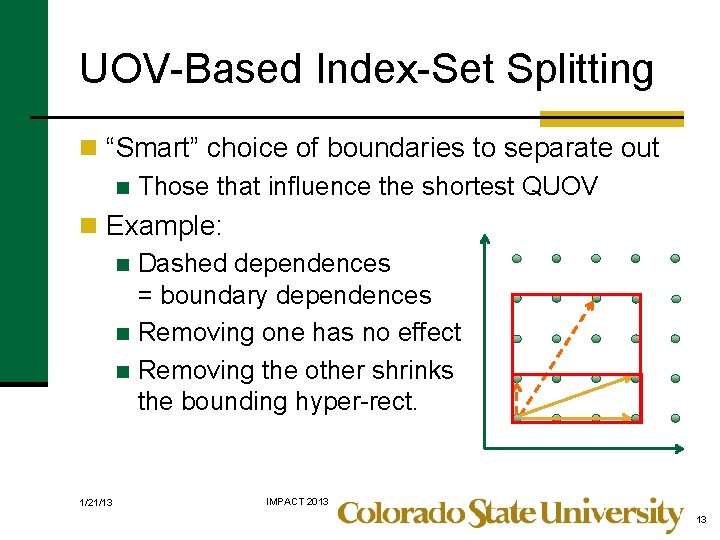
UOV-Based Index-Set Splitting n “Smart” choice of boundaries to separate out n Those that influence the shortest QUOV n Example: n Dashed dependences = boundary dependences n Removing one has no effect n Removing the other shrinks the bounding hyper-rect. 1/21/13 IMPACT 2013 13
Related Work n Affine Occupancy Vectors [Thies et al. 2001] n Restrict the universe to affine schedules n Comparison with schedule-dependent methods Schedule-dependent methods are at least as good as UOV or QUOV based approaches n UOV based methods may not be as inefficient as one might think n n 1/21/13 n Provided O(d-1) data is required for d dimensional space UOV-based methods are single projection IMPACT 2013 14
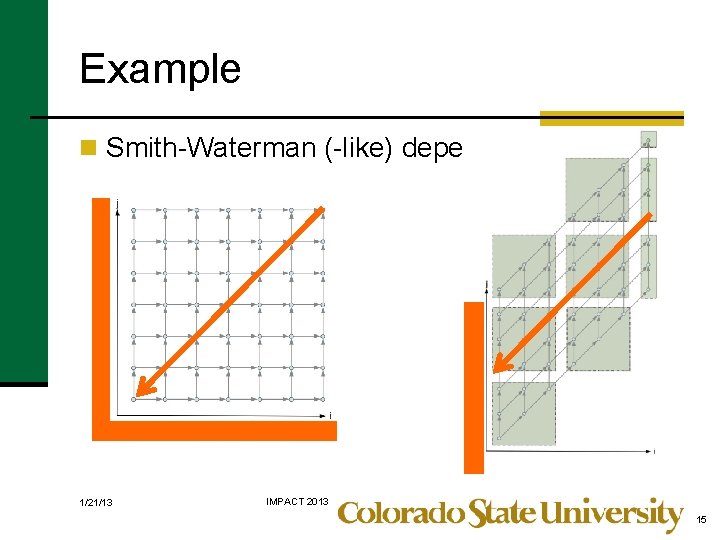
Example n Smith-Waterman (-like) dependences 1/21/13 IMPACT 2013 15
Summary and Conclusion n We “expand” the concept of UOV to a smaller universe: tiled execution n We use properties in such universe to find: More compact allocations n Shortest QUOVs n Profitable index-set splitting n n Possible approach for parametrically tiled programs 1/21/13 IMPACT 2013 16
Acknowledgements n Michelle Strout n For discussion and feedback n IMPACT PC and Chairs n Our paper is in a much better shape after revisions 1/21/13 IMPACT 2013 17
Extensions to Multi-Statement n Schedule-Independent mapping is for programs with single statement We reduce the universality to tiled execution n Multi-statement programs can be handled n n Intuition: n When tiling a loop nest, the same affine transform (schedule) is applied to all statements n Dependences remain the same 1/21/13 IMPACT 2013 18
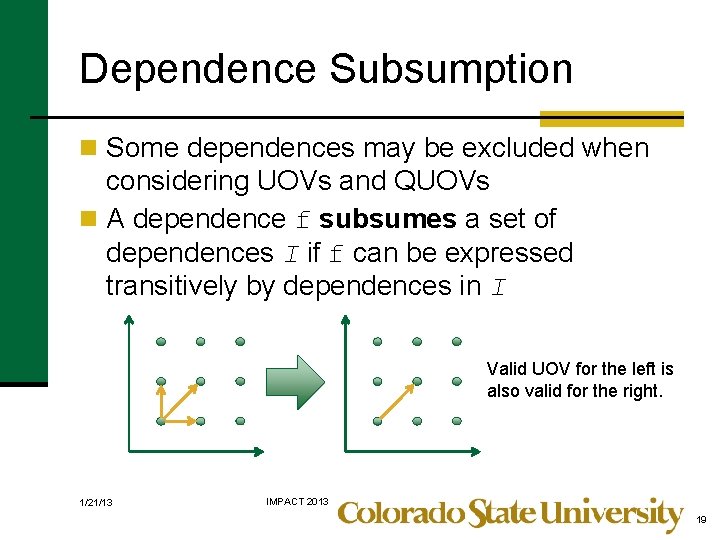
Dependence Subsumption n Some dependences may be excluded when considering UOVs and QUOVs n A dependence f subsumes a set of dependences I if f can be expressed transitively by dependences in I Valid UOV for the left is also valid for the right. 1/21/13 IMPACT 2013 19