
Memory Allocation via Graph Coloring using Scratchpad Memory

![6 Why Scratchpad Memory? Banakar [1] conducted a study comparing scratchpad and cache.](https://slidetodoc.com/presentation_image_h/f4ccad2f98469cfcc6cff1301a0853d9/image-6.jpg "6 Why Scratchpad Memory? Banakar [1] conducted a study comparing scratchpad and cache.")

![15 My approach Create a dynamic approach combining Memory Coloring [6] and Heap Allocation](https://slidetodoc.com/presentation_image_h/f4ccad2f98469cfcc6cff1301a0853d9/image-15.jpg "15 My approach Create a dynamic approach combining Memory Coloring [6] and Heap Allocation")
- Slides: 24
Memory Allocation via Graph Coloring using Scratchpad Memory Tomyo Maeshiro Tomyo. Maeshiro@my. unt. edu Software Engineering Language Lab UNT April 29, 2014 1
2 OUTLINE Motivation Problem Statement Research Question Research Plan Tools
3 MOTIVATION
4 Scratchpad Memory What is Scratchpad Memory? “Small” fast memory SRAM technology Software controlled.
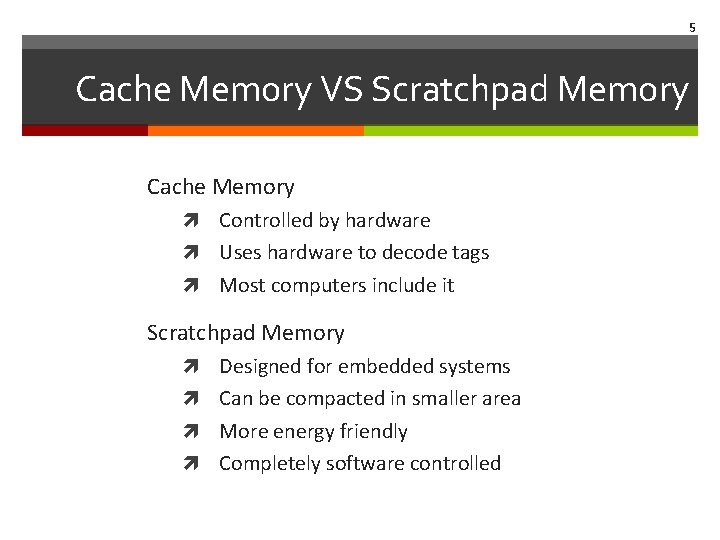
5 Cache Memory VS Scratchpad Memory Cache Memory Controlled by hardware Uses hardware to decode tags Most computers include it Scratchpad Memory Designed for embedded systems Can be compacted in smaller area More energy friendly Completely software controlled
6 Why Scratchpad Memory? Banakar [1] conducted a study comparing scratchpad and cache.
7 PROBLEM DEFINITION
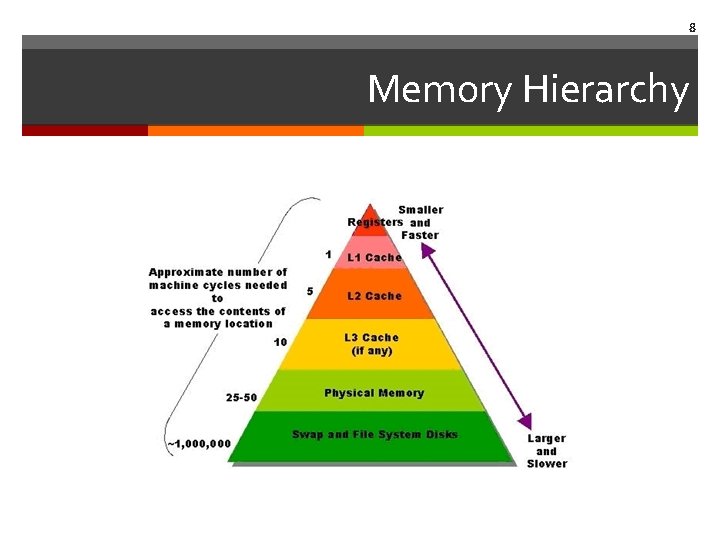
8 Memory Hierarchy
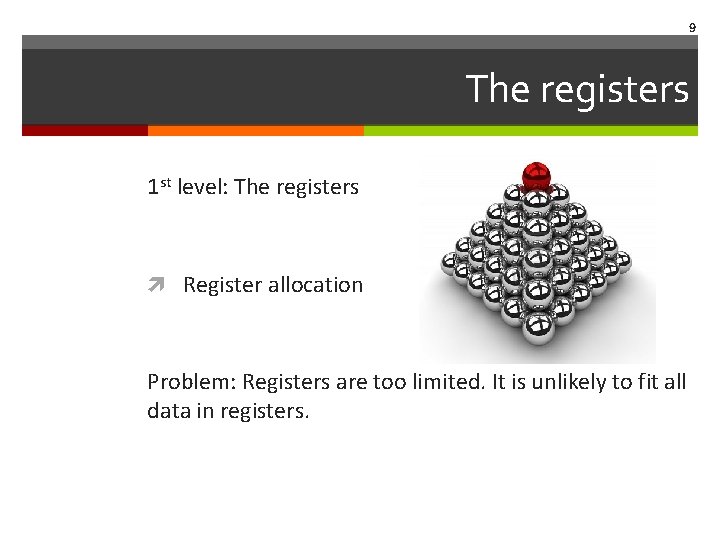
9 The registers 1 st level: The registers Register allocation Problem: Registers are too limited. It is unlikely to fit all data in registers.
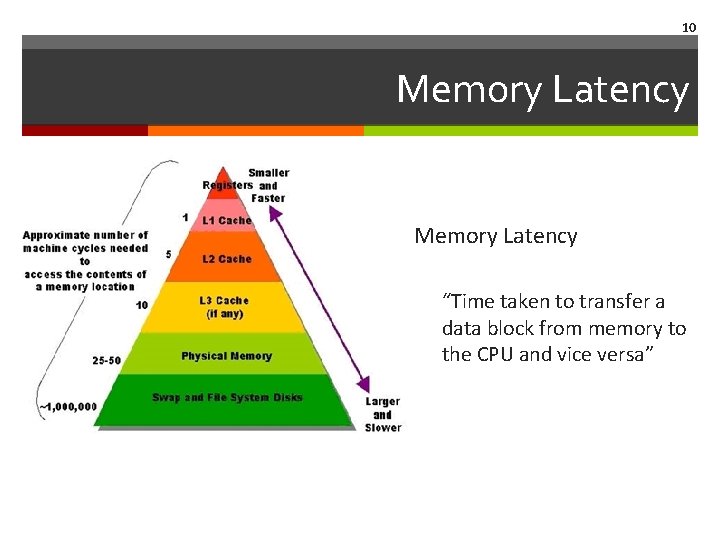
10 Memory Latency “Time taken to transfer a data block from memory to the CPU and vice versa”
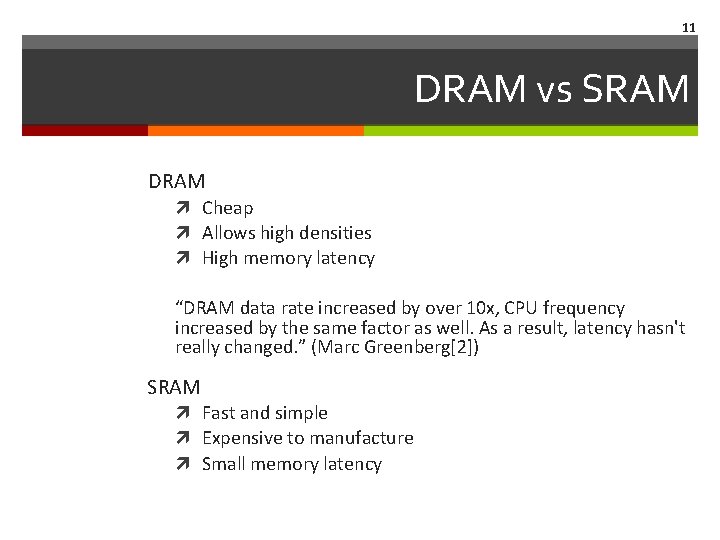
11 DRAM vs SRAM DRAM Cheap Allows high densities High memory latency “DRAM data rate increased by over 10 x, CPU frequency increased by the same factor as well. As a result, latency hasn't really changed. ” (Marc Greenberg[2]) SRAM Fast and simple Expensive to manufacture Small memory latency
12 Scratchpad Memory Scratchpad benefits of the advantages of SRAM technology. The lack of generalized compiler support for memory allocation is the reason scratchpad has not yet achieved its full potential. The challenge is to create a robust, flexible compiler technique to exploit scratchpad’s true potential
13 RESEARCH QUESTION Given sophisticated memory allocation support, how much improvement can scratchpad provide in terms of energy efficiency and overall program time execution compared to that of cache memory?
14 RESEARCH PLAN
15 My approach Create a dynamic approach combining Memory Coloring [6] and Heap Allocation [8]. Heap, stack and global area allocated via graph coloring. Not rely on profiled data.
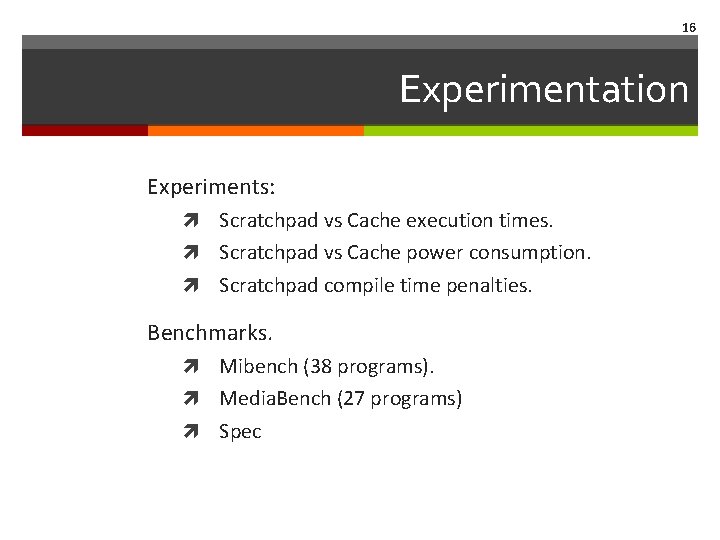
16 Experimentation Experiments: Scratchpad vs Cache execution times. Scratchpad vs Cache power consumption. Scratchpad compile time penalties. Benchmarks. Mibench (38 programs). Media. Bench (27 programs) Spec
17 TOOLS
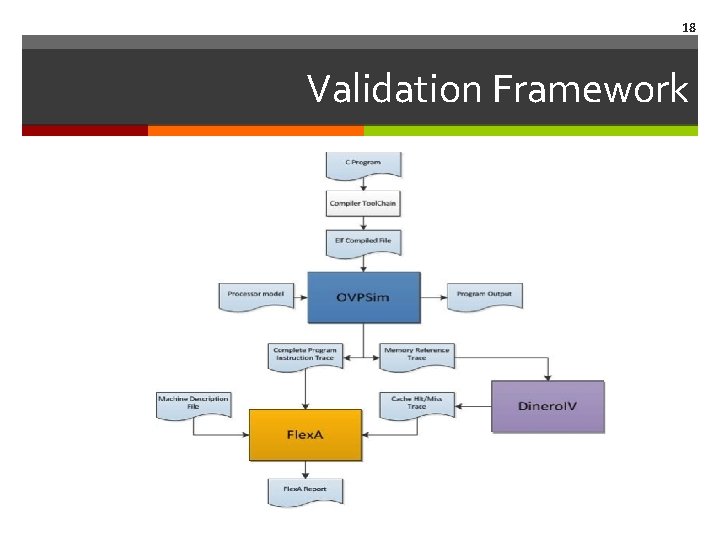
18 Validation Framework
19 OVPSim Open Virtual Platform (OVP) is an open source initiative lead by Imperas. Targeted to models of embedded components to enable embedded software development. Three Components: Platform models. Processor models. Peripheral models.
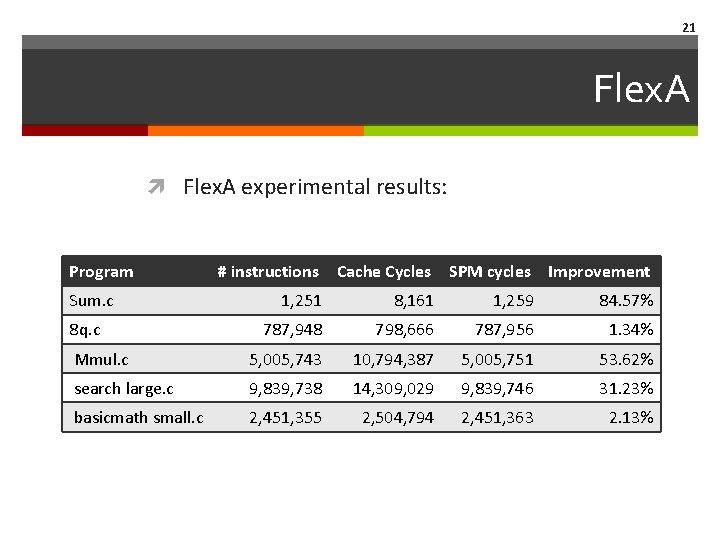
20 Flex. A analyzes a program's performance obtaining an approximate estimation of the program’s behavior in terms of cycle count and power consumption. The program is analyzed based upon: Execution time of each instruction. Cache or scratchpad overhead.
21 Flex. A experimental results: Program Sum. c # instructions Cache Cycles SPM cycles Improvement 1, 251 8, 161 1, 259 84. 57% 787, 948 798, 666 787, 956 1. 34% Mmul. c 5, 005, 743 10, 794, 387 5, 005, 751 53. 62% search large. c 9, 839, 738 14, 309, 029 9, 839, 746 31. 23% basicmath small. c 2, 451, 355 2, 504, 794 2, 451, 363 2. 13% 8 q. c
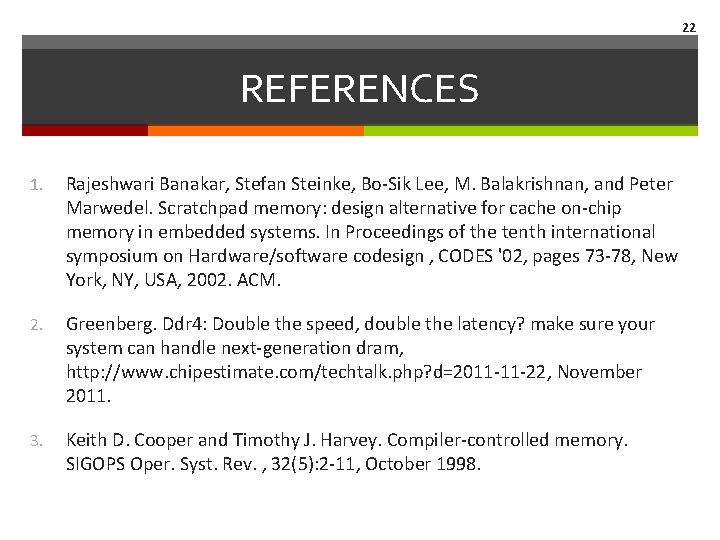
22 REFERENCES 1. Rajeshwari Banakar, Stefan Steinke, Bo-Sik Lee, M. Balakrishnan, and Peter Marwedel. Scratchpad memory: design alternative for cache on-chip memory in embedded systems. In Proceedings of the tenth international symposium on Hardware/software codesign , CODES '02, pages 73 -78, New York, NY, USA, 2002. ACM. 2. Greenberg. Ddr 4: Double the speed, double the latency? make sure your system can handle next-generation dram, http: //www. chipestimate. com/techtalk. php? d=2011 -11 -22, November 2011. 3. Keith D. Cooper and Timothy J. Harvey. Compiler-controlled memory. SIGOPS Oper. Syst. Rev. , 32(5): 2 -11, October 1998.
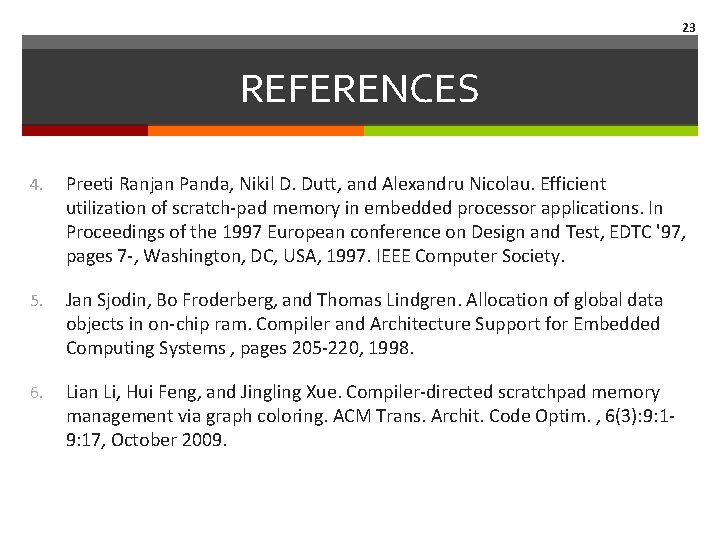
23 REFERENCES 4. Preeti Ranjan Panda, Nikil D. Dutt, and Alexandru Nicolau. Efficient utilization of scratch-pad memory in embedded processor applications. In Proceedings of the 1997 European conference on Design and Test, EDTC '97, pages 7 -, Washington, DC, USA, 1997. IEEE Computer Society. 5. Jan Sjodin, Bo Froderberg, and Thomas Lindgren. Allocation of global data objects in on-chip ram. Compiler and Architecture Support for Embedded Computing Systems , pages 205 -220, 1998. 6. Lian Li, Hui Feng, and Jingling Xue. Compiler-directed scratchpad memory management via graph coloring. ACM Trans. Archit. Code Optim. , 6(3): 9: 17, October 2009.
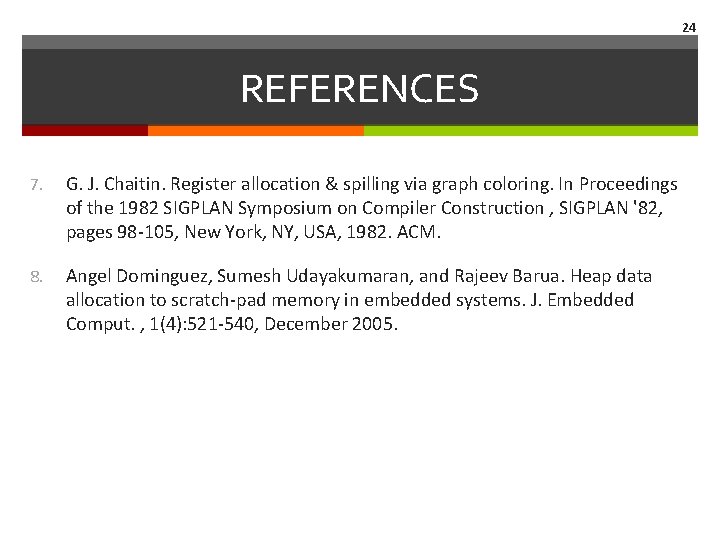
24 REFERENCES 7. G. J. Chaitin. Register allocation & spilling via graph coloring. In Proceedings of the 1982 SIGPLAN Symposium on Compiler Construction , SIGPLAN '82, pages 98 -105, New York, NY, USA, 1982. ACM. 8. Angel Dominguez, Sumesh Udayakumaran, and Rajeev Barua. Heap data allocation to scratch-pad memory in embedded systems. J. Embedded Comput. , 1(4): 521 -540, December 2005.