
MEMORIZING INFORMATION TIPS AND STRATEGIES TO HELP YOU

- Slides: 12
MEMORIZING INFORMATION TIPS AND STRATEGIES TO HELP YOU RETAIN AND REMEMBER INFORMATION
MEMORIZING INFORMATION § Do you have a hard time memorizing and remembering information for tests? § Do the things you’ve memorized seem to get mixed up in your head? § When you are taking a test, do you sometimes feel sure that you know the answer, but you just can’t remember it? § Do you wish you had better strategies to help you memorize and remember information? If you answered “Yes” to any of the above, the memorization strategies presented here are sure to help you. Give these strategies a try whenever you have information you need to
Strategies that Work USE ALL OF YOUR SENSES The more senses you involve in the learning process, the more likely you are to remember information. For example, to memorize a vocabulary word, formula, or equation, look at it, close your eyes, and try to see it in your mind. Then say it out loud and write it down. By looking at it, saying it, and writing it down, you are using your
Strategies that Work LOOK FOR LOGICAL CONNECTIONS Here a couple of examples: • To remember that Homer wrote The Odyssey, just think, “Homer is an odd name. ” • To remember that all three angles of an acute triangle must be less than 90 degrees, think “When you’re over 90, you’re not cute anymore. ”
Strategies that Work CREATE UNFORGETTABLE IMAGES Take the information you’re trying to remember and create a crazy, memorable image in your mind. • To remember that Pizarro conquered the Inca empire, imagine a pizza covering an ink spot.
Strategies that Work CREATE SILLY SENTENCES Use the first letter of the words you want to remember to make up a silly, ridiculous sentence. For example, to remember the names of the eight planets in order (Mercury, Venus, Earth, Mars, Jupiter, Saturn, Uranus, and Neptune), make up a silly sentence like this one: “My very elegant mother juggled seven ugly neckties. ”
Strategies that Work REVIEW OFTEN When you have something to memorize, concentrate on learning it, take a break, and then go back and review it. Keep reviewing until you know it. Review is the key to remembering anything. When you review, you move information from your shortterm memory into your long-term memory.
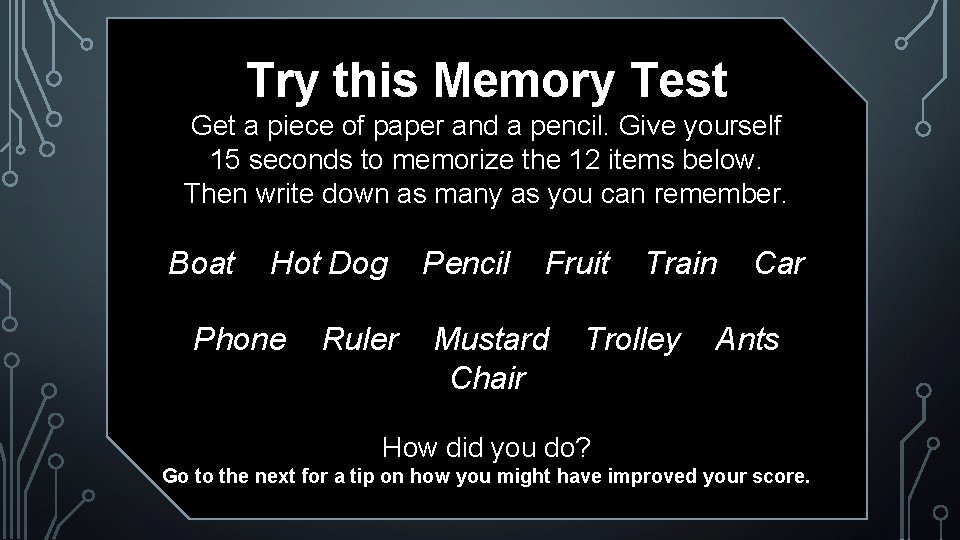
Try this Memory Test Get a piece of paper and a pencil. Give yourself 15 seconds to memorize the 12 items below. Then write down as many as you can remember. Boat Hot Dog Phone Ruler Pencil Fruit Mustard Chair Train Trolley Car Ants How did you do? Go to the next for a tip on how you might have improved your score.
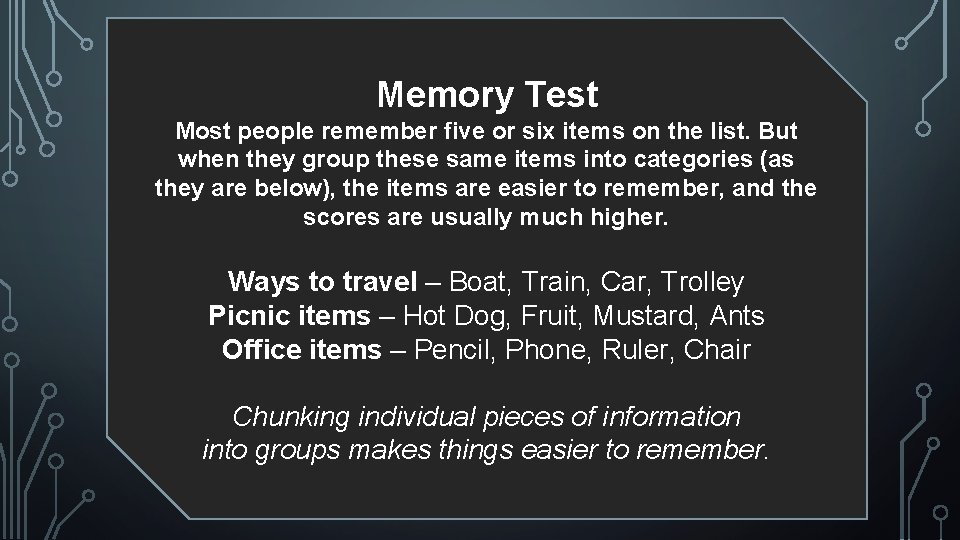
Memory Test Most people remember five or six items on the list. But when they group these same items into categories (as they are below), the items are easier to remember, and the scores are usually much higher. Ways to travel – Boat, Train, Car, Trolley Picnic items – Hot Dog, Fruit, Mustard, Ants Office items – Pencil, Phone, Ruler, Chair Chunking individual pieces of information into groups makes things easier to remember.
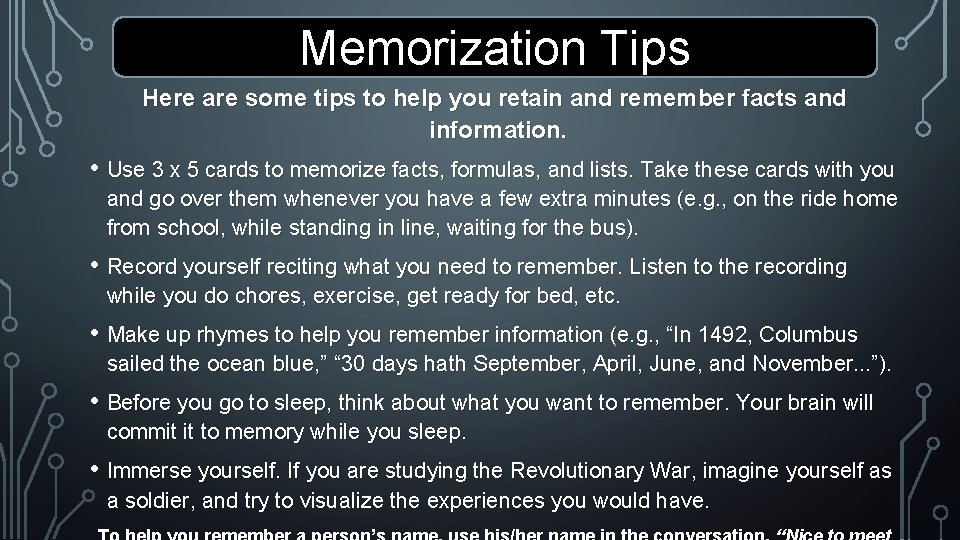
Memorization Tips Here are some tips to help you retain and remember facts and information. • Use 3 x 5 cards to memorize facts, formulas, and lists. Take these cards with you and go over them whenever you have a few extra minutes (e. g. , on the ride home from school, while standing in line, waiting for the bus). • Record yourself reciting what you need to remember. Listen to the recording while you do chores, exercise, get ready for bed, etc. • Make up rhymes to help you remember information (e. g. , “In 1492, Columbus sailed the ocean blue, ” “ 30 days hath September, April, June, and November. . . ”). • Before you go to sleep, think about what you want to remember. Your brain will commit it to memory while you sleep. • Immerse yourself. If you are studying the Revolutionary War, imagine yourself as a soldier, and try to visualize the experiences you would have.
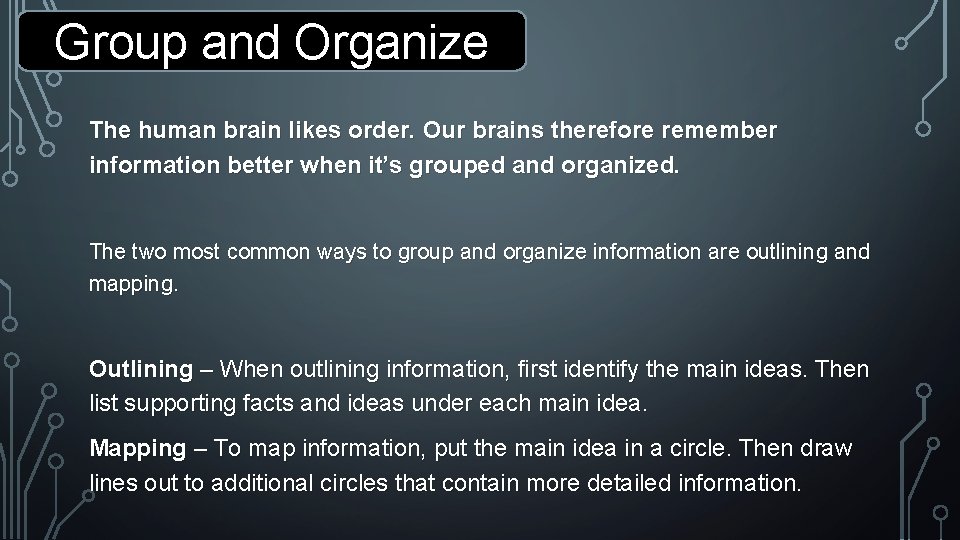
Group and Organize The human brain likes order. Our brains therefore remember information better when it’s grouped and organized. The two most common ways to group and organize information are outlining and mapping. Outlining – When outlining information, first identify the main ideas. Then list supporting facts and ideas under each main idea. Mapping – To map information, put the main idea in a circle. Then draw lines out to additional circles that contain more detailed information.
Memorizing Information WOODBURN PRESS Academic Skills Info. Guide Series www. woodburnpress. com Copyrighted Material