
Memorization Strategies Remembering Requires Understanding and Planning Understand
Memorization Strategies
Remembering Requires Understanding and Planning Understand, then memorize! Which is easier to memorize? a. XKY, TWI, PLX, ZYX, JYL b. Six, can , are, jog, who c. Ten, kids, buy, ice, cream **If you answered c, it is because this information has meaning, it makes sense.
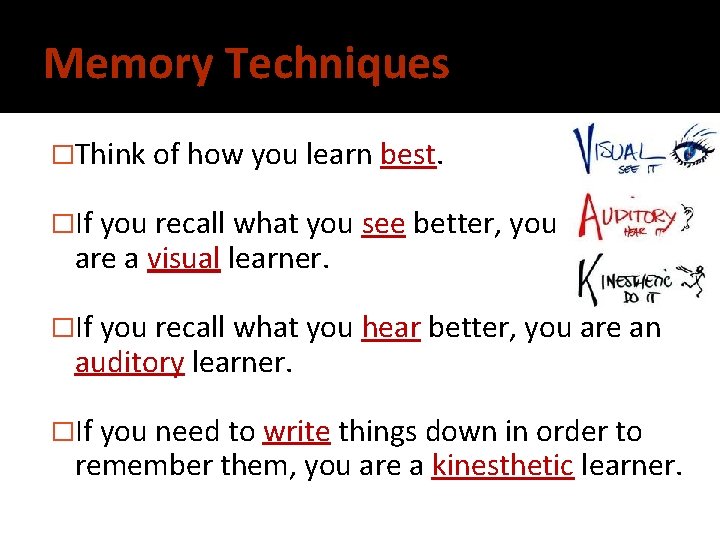
Memory Techniques �Think of how you learn best. �If you recall what you see better, you are a visual learner. �If you recall what you hear better, you are an auditory learner. �If you need to write things down in order to remember them, you are a kinesthetic learner.
Memory Techniques Continued �Regardless of your learning style, there are memory techniques that will make learning easier for you. �However, REPETITION is necessary regardless of the memory technique used.
1. Acrostics �Acrostics are silly sentences. �It is easier to memorize a long list if it makes sense the way a sentence does. �Try using the first letter of each word to be memorized to make a sentence.
Acrostics Continued �Example: To memorize the planets in their order from the sun: Mercury – Venus – Earth – Mars – Jupiter – Saturn – Uranus – Neptune – Pluto �Use: My Very Educated Mother Just Served Us Nine Pizzas
2. Acronyms �Acronyms are wacky words. �Use the first letter of each concept to be learned to form one word. �The words or words do not have to be real words as long as they are easy for you to remember.
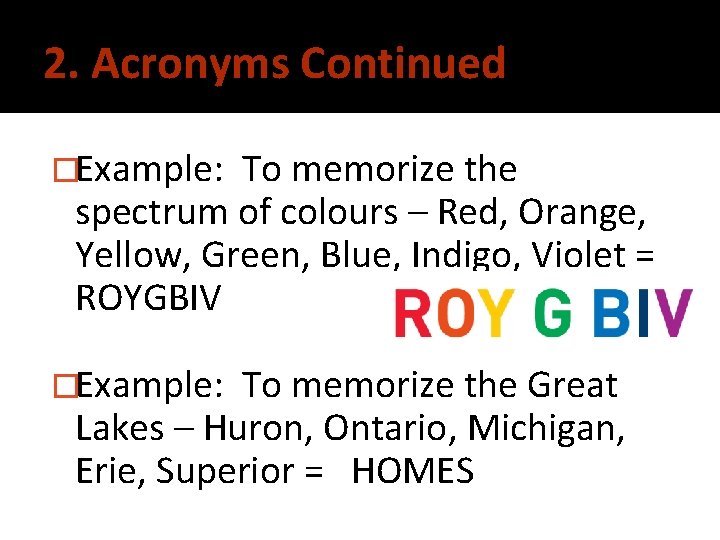
2. Acronyms Continued �Example: To memorize the spectrum of colours – Red, Orange, Yellow, Green, Blue, Indigo, Violet = ROYGBIV �Example: To memorize the Great Lakes – Huron, Ontario, Michigan, Erie, Superior = HOMES
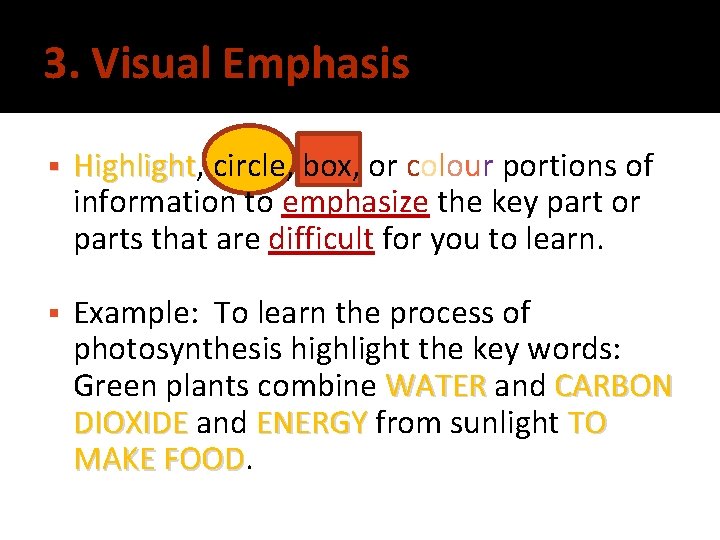
3. Visual Emphasis Highlight, Highlight circle, box, or colour portions of information to emphasize the key part or parts that are difficult for you to learn. Example: To learn the process of photosynthesis highlight the key words: Green plants combine WATER and CARBON DIOXIDE and ENERGY from sunlight TO MAKE FOOD
4. Visualization �We can enhance our memory by drawing or visualizing something that we want to recall at a later time. �To visualize information in your notes, close your eyes and form a picture of the page. Visualize the heading, boldface print, italics, and general format of information to remind you of the sequence of ideas.
4. Visualization Continued �To visualize vocabulary words and their definitions, look at the word you are to memorize. �Is there a part of this word that looks or sounds familiar that you can “see”? �You may want to draw a silly picture and then make your picture do something that directly relates to the meaning of the word.
5. Association �When you need to memorize separate facts, find a way to associate (connect) them and use that association in a phrase, a sentence, a rhyme, or a story. �For example, to remember the capital city of Manitoba. . . “Use a peg to find the winner on the map”…Winnipeg!
6. Rehearsal �Just as an actor rehearses his lines for a play until he knows it well enough to perform, a student rehearses (practices) information for a test until he knows it well enough to perform. �Rehearse information to be remembered using your strongest learning style.
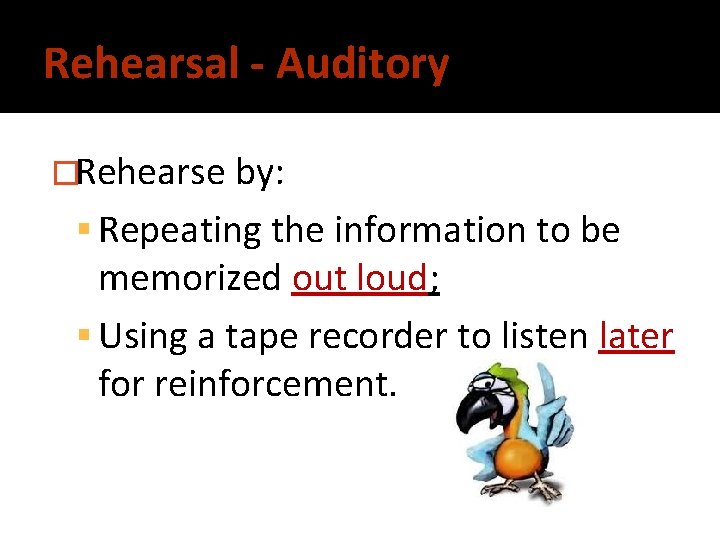
Rehearsal - Auditory �Rehearse by: Repeating the information to be memorized out loud; Using a tape recorder to listen later for reinforcement.
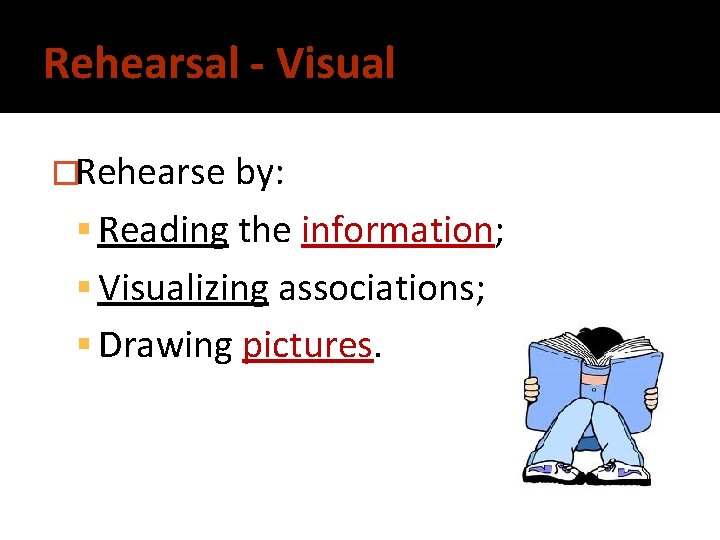
Rehearsal - Visual �Rehearse by: Reading the information; Visualizing associations; Drawing pictures.
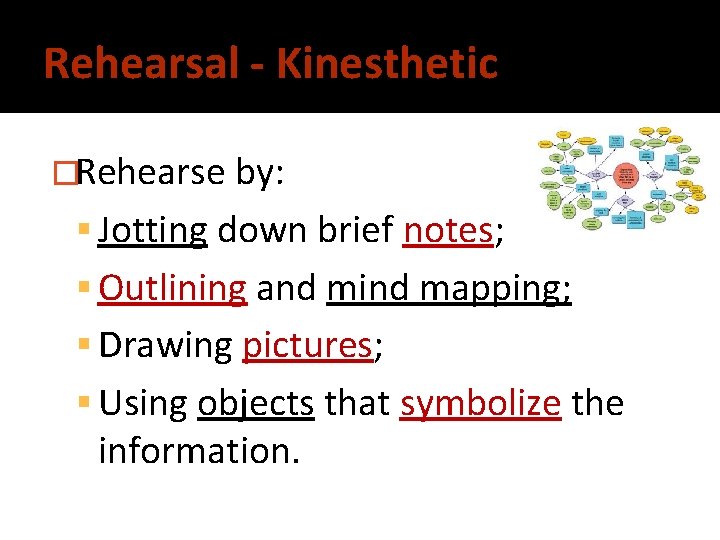
Rehearsal - Kinesthetic �Rehearse by: Jotting down brief notes; Outlining and mind mapping; Drawing pictures; Using objects that symbolize the information.
Summary �So there you have it, there are many ways to memorize information -find the ways that work best for you, and put them to good use!
- Slides: 17