
Membranes Chapter 6 Outline Phospholipid Bilayer Fluid Mosaic
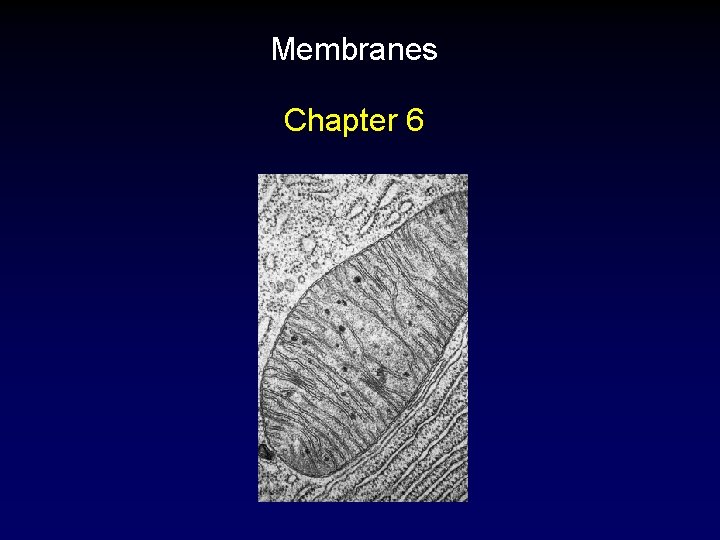
Membranes Chapter 6
Outline • • Phospholipid Bilayer Fluid Mosaic Model Membrane Proteins Diffusion Facilitated Diffusion Osmosis – Osmotic Balance Bulk Transport Active Transport 2 2
Phospholipid Bilayer • Phospholipid has two fatty-acid chains attached to its backbone. – One end is strongly nonpolar while the other end is strongly polar. § polar head oriented toward water and nonpolar tails oriented away from water v bilayer is stable because water’s affinity for hydrogen bonding never stops 3 3
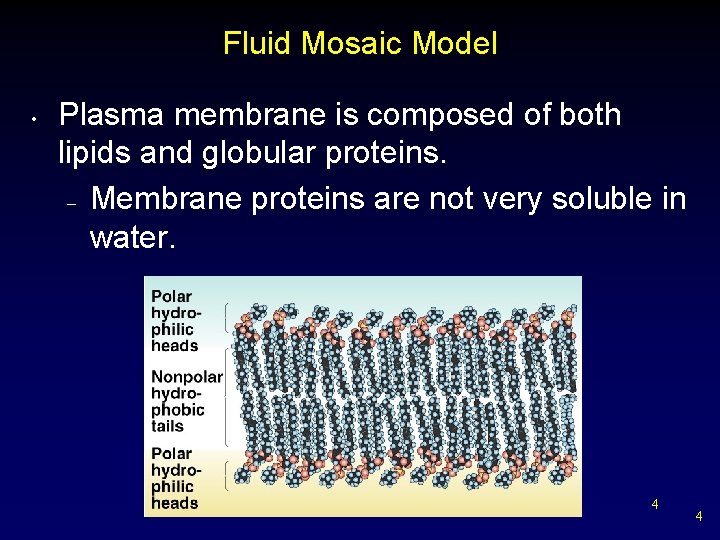
Fluid Mosaic Model • Plasma membrane is composed of both lipids and globular proteins. – Membrane proteins are not very soluble in water. 4 4

Cell Membrane • Cell membrane components – phospholipid bilayer – transmembrane proteins – interior protein network – cell surface markers 5 5
Membrane Proteins • • • transporters enzymes cell surface identity markers cell adhesion proteins attachments to cytoskeleton 6 6
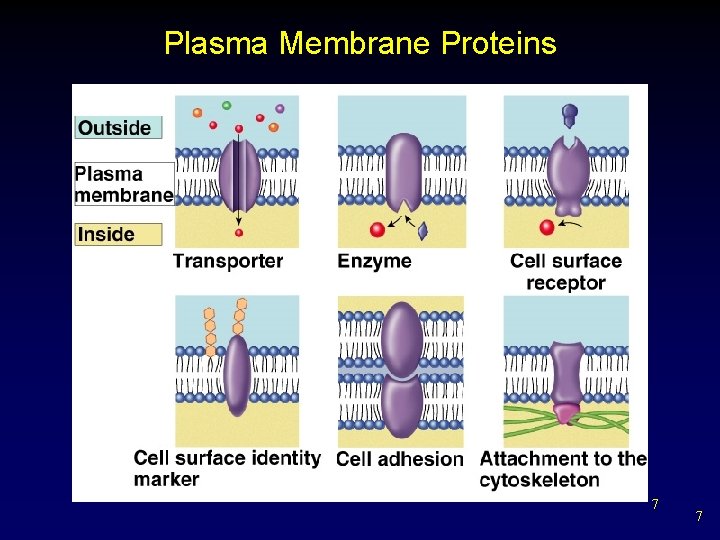
Plasma Membrane Proteins 7 7
Membrane Protein Structure • • Anchoring proteins in the bilayer Transmembrane proteins – single-pass anchors – multiple-pass channels and carriers – pores 8 8
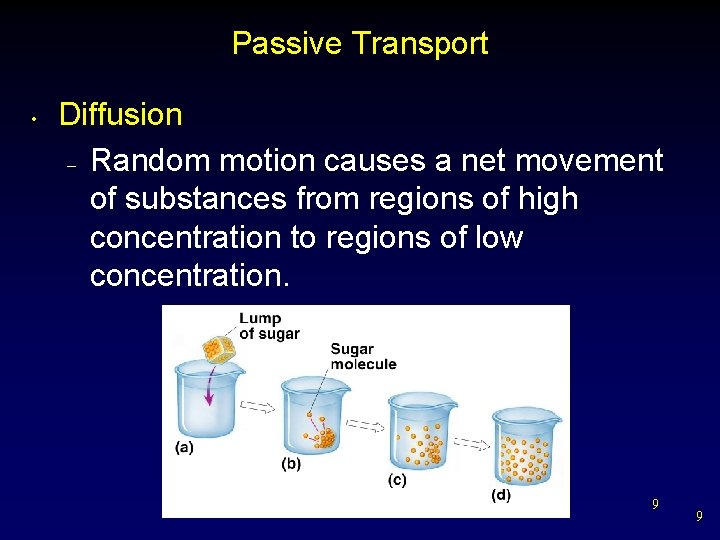
Passive Transport • Diffusion – Random motion causes a net movement of substances from regions of high concentration to regions of low concentration. 9 9
Selective Membrane Transport • Cell transport channels are selectively permeable, as only certain molecules are allowed to enter. – Ions cannot move between the cytoplasm of a cell and the extracellular fluid without the assistance of membrane transport proteins. § ion channels 10 10
Facilitated Diffusion • Carriers transport ions and other solutes across the plasma membrane. – Facilitate movement by physically binding molecules on one side of the membrane, and releasing them on the other. § essential characteristics v specific v passive v saturates 11 11
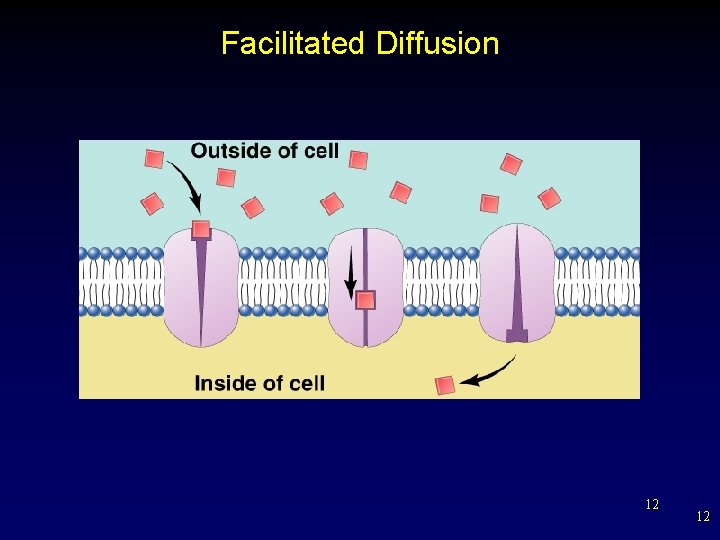
Facilitated Diffusion 12 12
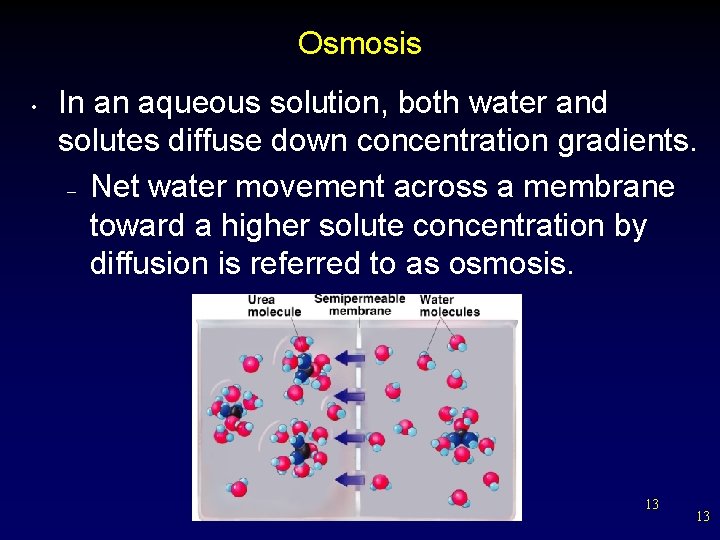
Osmosis • In an aqueous solution, both water and solutes diffuse down concentration gradients. – Net water movement across a membrane toward a higher solute concentration by diffusion is referred to as osmosis. 13 13
Osmosis • Osmotic concentration - concentration of all solutes in solution – Hyperosmotic - solution with the higher solute concentration – Hypoosmotic - solution with the lower solute concentration – Isosmotic - solute concentrations are equal 14 14
Osmotic Pressure • • Hydrostatic pressure - pressure of the cytoplasm pushing out against the cell membrane Osmotic pressure - pressure that must be applied to stop the osmotic movement of water across a membrane 15 15
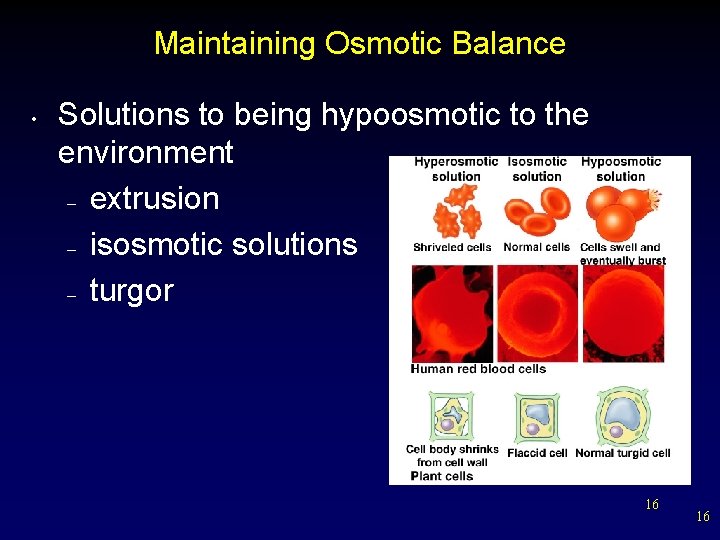
Maintaining Osmotic Balance • Solutions to being hypoosmotic to the environment – extrusion – isosmotic solutions – turgor 16 16
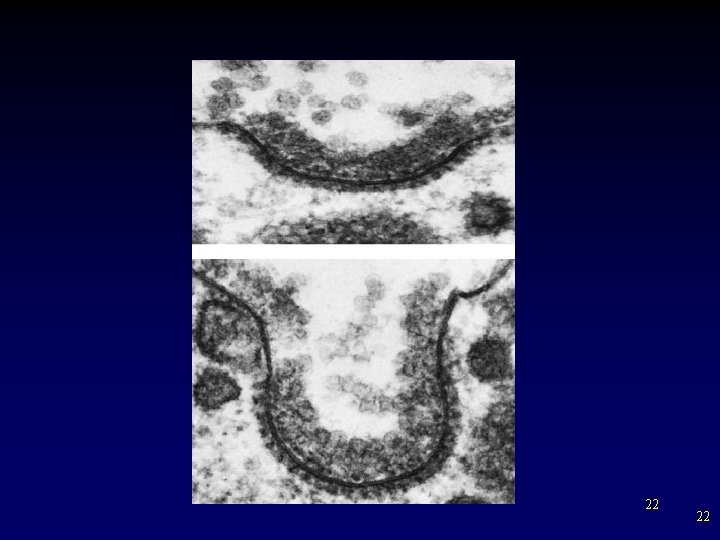
Bulk Transport • • Endocytosis - enveloping food – phagocytosis - material taken in is in particulate form – pinocytosis - material taken in is in liquid form – receptor-mediated - transport of specific molecules Exocytosis - discharge of material from vesicles at the cell surface 17 17
18 18
Active Transport • Active transport involves the expenditure of energy to move substance against their concentration gradient. – involves highly selective protein carriers within the membrane § sodium-potassium pump § coupled transport - using energy stored in a gradient of a different molecule 19 19
20 20
Summary • • Phospholipid Bilayer Fluid Mosaic Model Membrane Proteins Diffusion Facilitated Diffusion Osmosis – Osmotic Balance Bulk Transport Active Transport 21 21
22 22
- Slides: 22