
Membranes and Transport Biophysics Nernst Equation www kcl
Membranes and Transport Biophysics
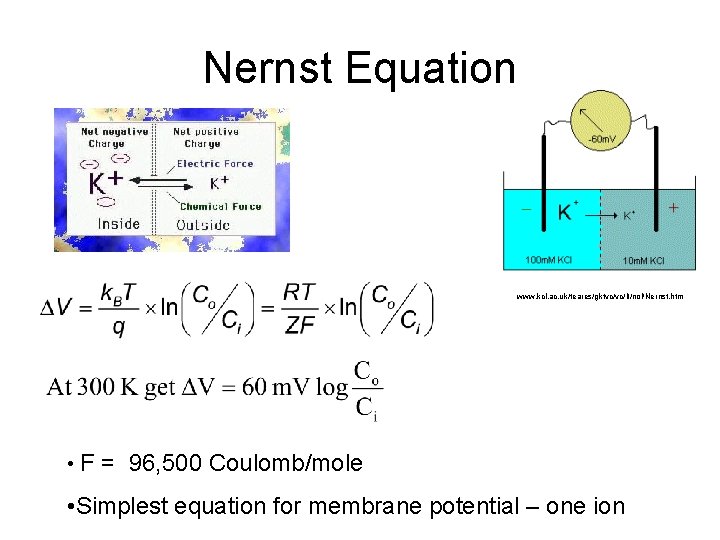
Nernst Equation www. kcl. ac. uk/teares/gktvc/vc/lt/nol/Nernst. htm • F = 96, 500 Coulomb/mole • Simplest equation for membrane potential – one ion
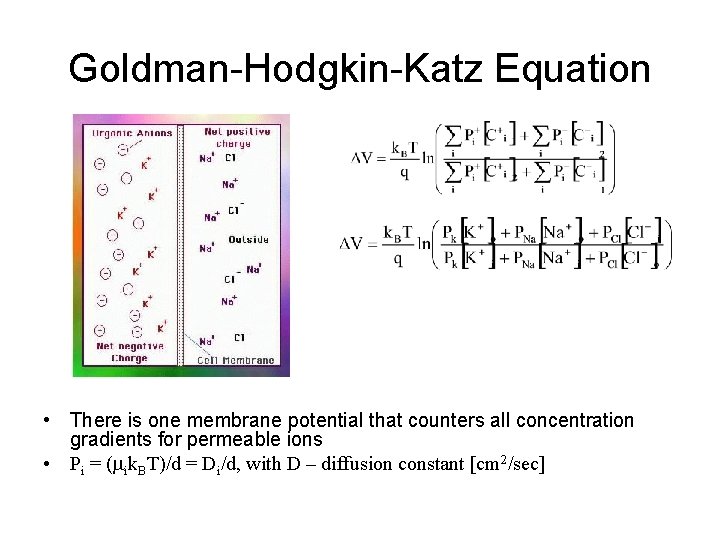
Goldman-Hodgkin-Katz Equation • There is one membrane potential that counters all concentration gradients for permeable ions • Pi = (mik. BT)/d = Di/d, with D – diffusion constant [cm 2/sec]
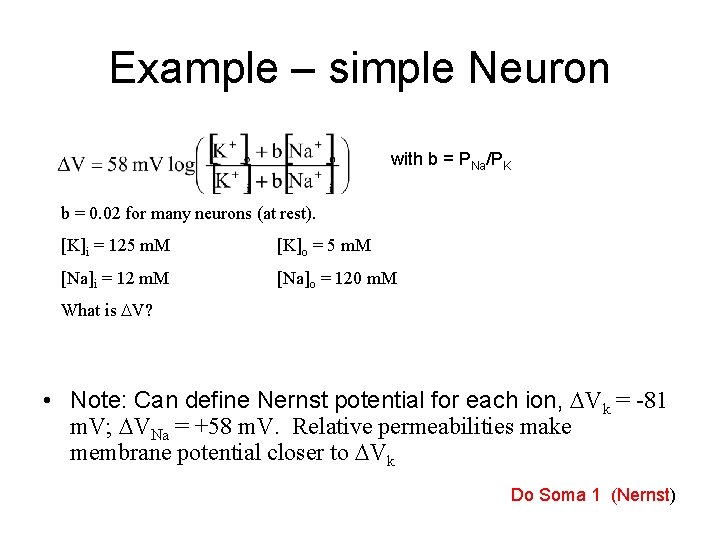
Example – simple Neuron with b = PNa/PK b = 0. 02 for many neurons (at rest). [K]i = 125 m. M [K]o = 5 m. M [Na]i = 12 m. M [Na]o = 120 m. M What is DV? • Note: Can define Nernst potential for each ion, DVk = -81 m. V; DVNa = +58 m. V. Relative permeabilities make membrane potential closer to DVk Do Soma 1 (Nernst)
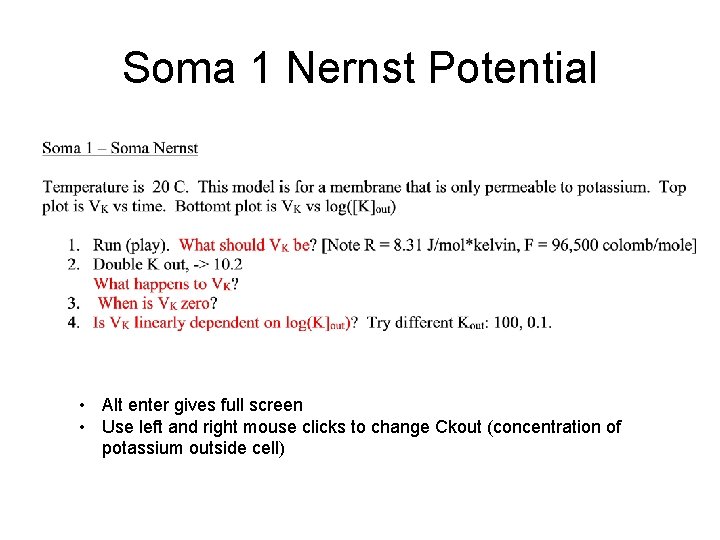
Soma 1 Nernst Potential • Alt enter gives full screen • Use left and right mouse clicks to change Ckout (concentration of potassium outside cell)
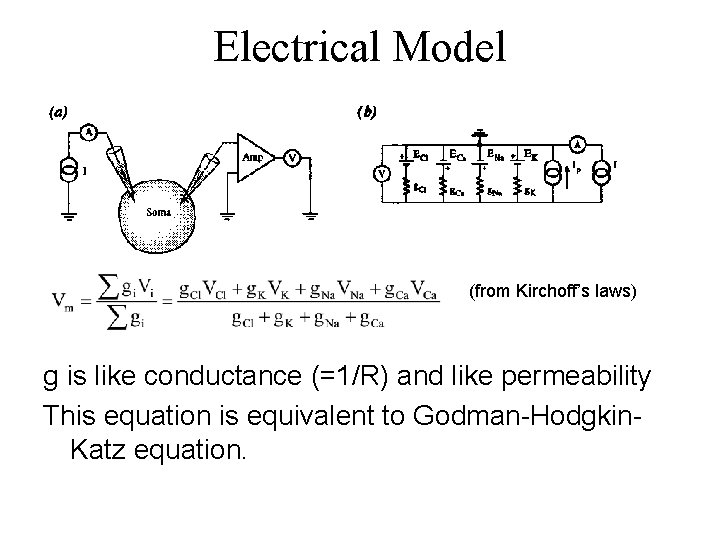
Electrical Model (from Kirchoff’s laws) g is like conductance (=1/R) and like permeability This equation is equivalent to Godman-Hodgkin. Katz equation.
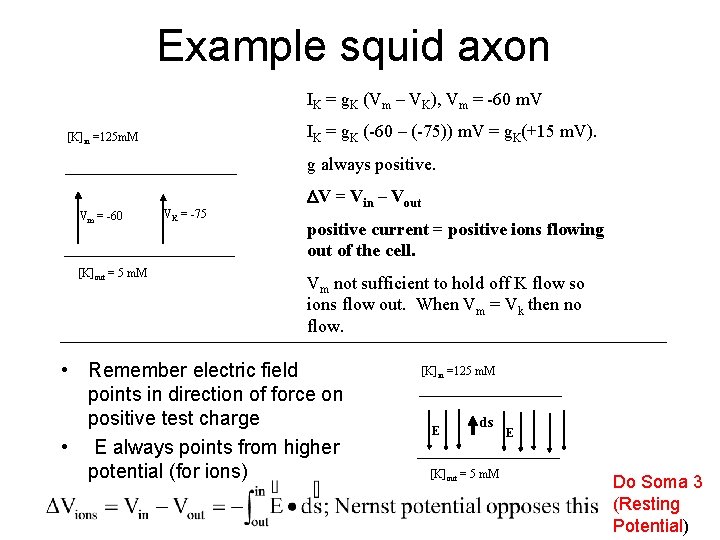
Example squid axon IK = g. K (Vm – VK), Vm = -60 m. V IK = g. K (-60 – (-75)) m. V = g. K(+15 m. V). [K]in =125 m. M g always positive. Vm = -60 [K]out = 5 m. M VK = -75 DV = Vin – Vout positive current = positive ions flowing out of the cell. Vm not sufficient to hold off K flow so ions flow out. When Vm = Vk then no flow. • Remember electric field points in direction of force on positive test charge • E always points from higher potential (for ions) [K]in =125 m. M E ds [K]out = 5 m. M E Do Soma 3 (Resting Potential)
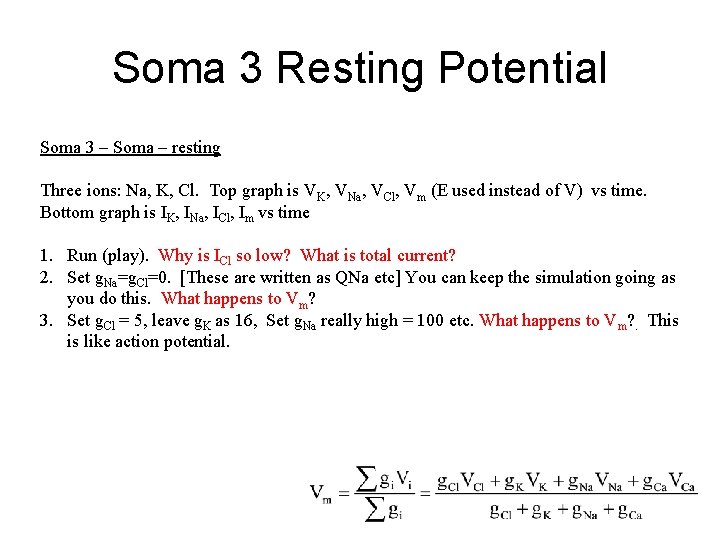
Soma 3 Resting Potential Soma 3 – Soma – resting Three ions: Na, K, Cl. Top graph is VK, VNa, VCl, Vm (E used instead of V) vs time. Bottom graph is IK, INa, ICl, Im vs time 1. Run (play). Why is ICl so low? What is total current? 2. Set g. Na=g. Cl=0. [These are written as QNa etc] You can keep the simulation going as you do this. What happens to Vm? 3. Set g. Cl = 5, leave g. K as 16, Set g. Na really high = 100 etc. What happens to Vm? . This is like action potential.
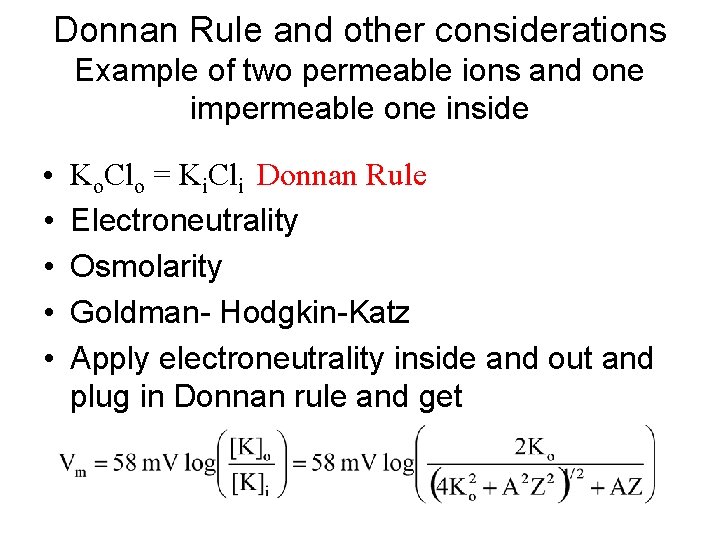
Donnan Rule and other considerations Example of two permeable ions and one impermeable one inside • • • Ko. Clo = Ki. Cli Donnan Rule Electroneutrality Osmolarity Goldman- Hodgkin-Katz Apply electroneutrality inside and out and plug in Donnan rule and get

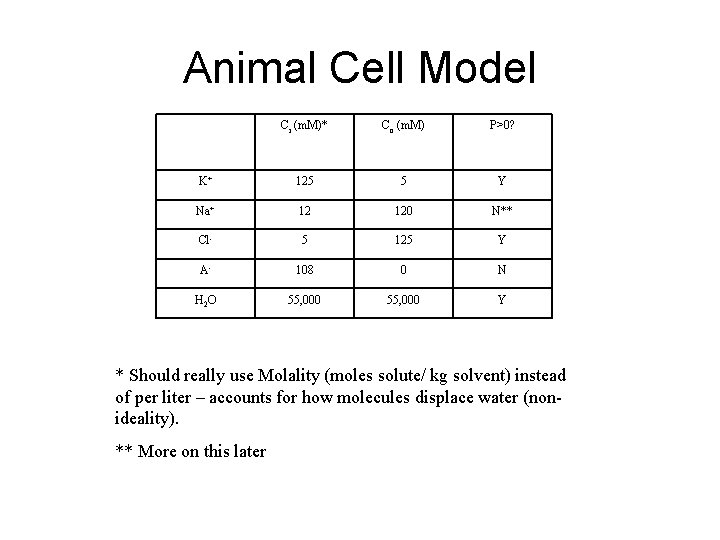
Animal Cell Model Ci (m. M)* Co (m. M) P>0? K+ 125 5 Y Na+ 12 120 N** Cl- 5 125 Y A- 108 0 N H 2 O 55, 000 Y * Should really use Molality (moles solute/ kg solvent) instead of per liter – accounts for how molecules displace water (nonideality). ** More on this later
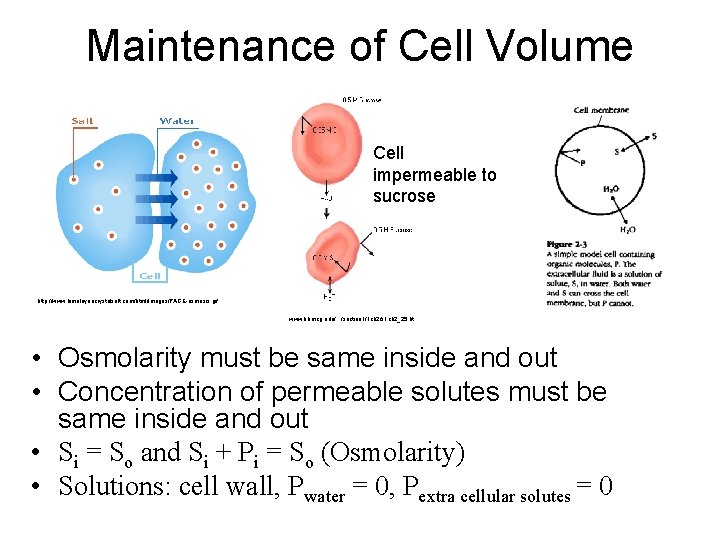
Maintenance of Cell Volume Cell impermeable to sucrose http: //www. himalayancrystalsalt. com/html/images/PAGE-osmosis. gif www. lib. mcg. edu/. . . /section 1/1 ch 2/s 1 ch 2_25. ht • Osmolarity must be same inside and out • Concentration of permeable solutes must be same inside and out • Si = So and Si + Pi = So (Osmolarity) • Solutions: cell wall, Pwater = 0, Pextra cellular solutes = 0
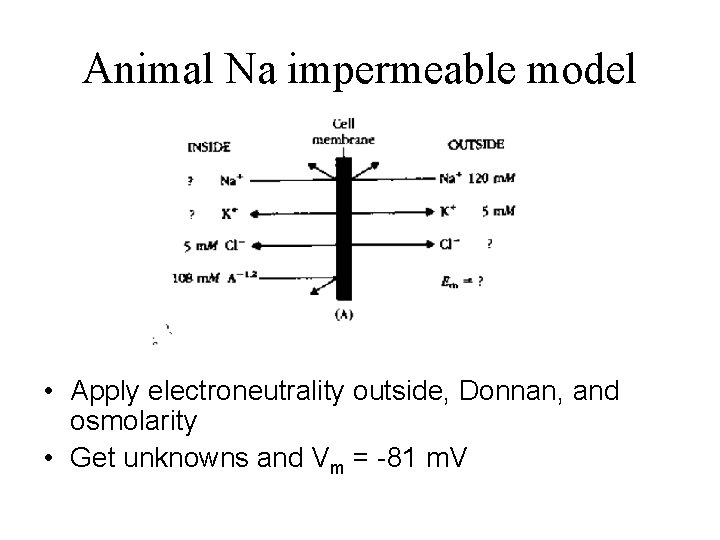
Animal Na impermeable model • Apply electroneutrality outside, Donnan, and osmolarity • Get unknowns and Vm = -81 m. V
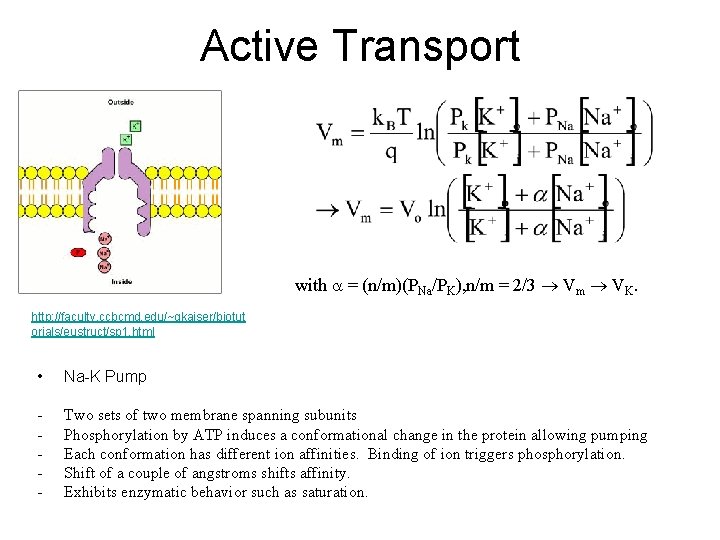
Active Transport with a = (n/m)(PNa/PK), n/m = 2/3 Vm VK. http: //faculty. ccbcmd. edu/~gkaiser/biotut orials/eustruct/sp 1. html • Na-K Pump - Two sets of two membrane spanning subunits Phosphorylation by ATP induces a conformational change in the protein allowing pumping Each conformation has different ion affinities. Binding of ion triggers phosphorylation. Shift of a couple of angstroms shifts affinity. Exhibits enzymatic behavior such as saturation.
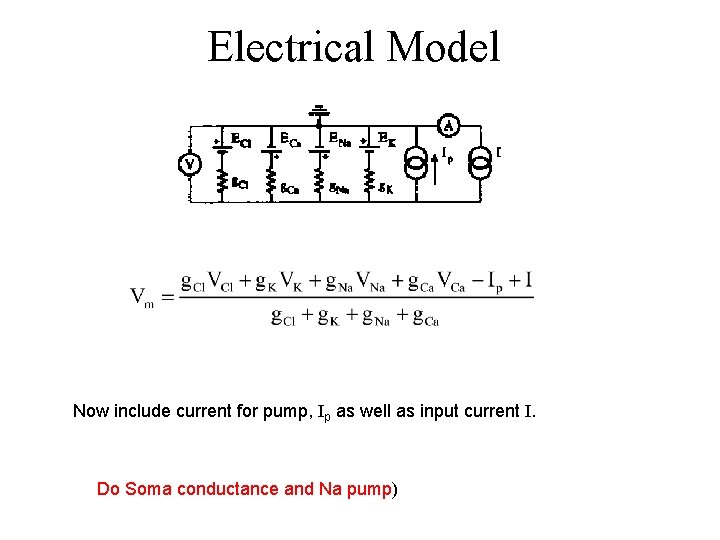
Electrical Model Now include current for pump, Ip as well as input current I. Do Soma conductance and Na pump)
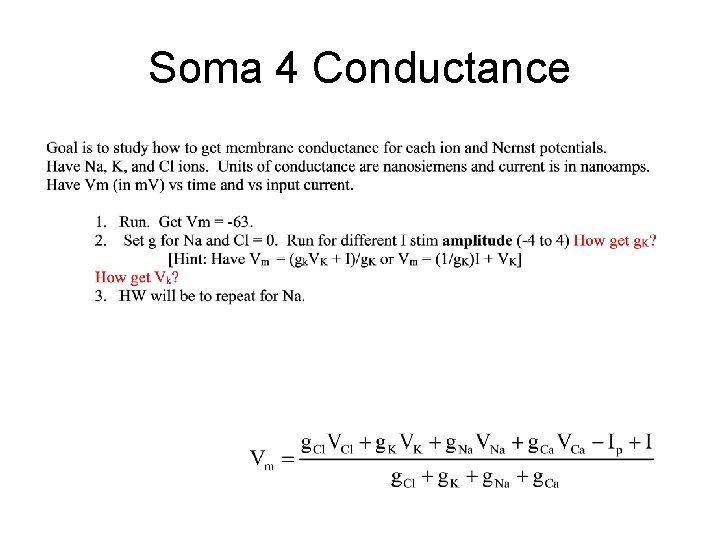
Soma 4 Conductance
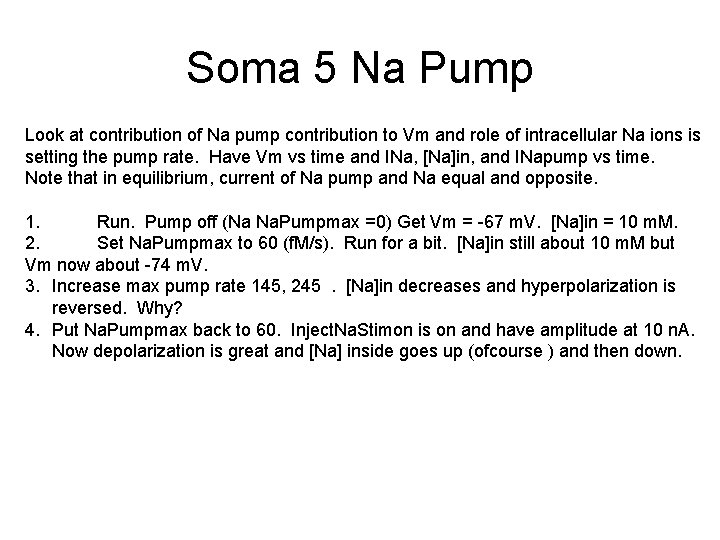
Soma 5 Na Pump Look at contribution of Na pump contribution to Vm and role of intracellular Na ions is setting the pump rate. Have Vm vs time and INa, [Na]in, and INapump vs time. Note that in equilibrium, current of Na pump and Na equal and opposite. 1. Run. Pump off (Na Na. Pumpmax =0) Get Vm = -67 m. V. [Na]in = 10 m. M. 2. Set Na. Pumpmax to 60 (f. M/s). Run for a bit. [Na]in still about 10 m. M but Vm now about -74 m. V. 3. Increase max pump rate 145, 245. [Na]in decreases and hyperpolarization is reversed. Why? 4. Put Na. Pumpmax back to 60. Inject. Na. Stimon is on and have amplitude at 10 n. A. Now depolarization is great and [Na] inside goes up (ofcourse ) and then down.
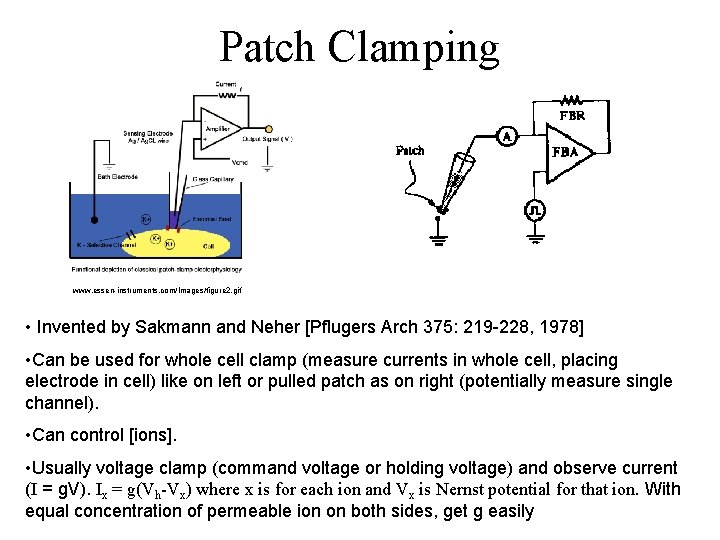
Patch Clamping www. essen-instruments. com/Images/figure 2. gif • Invented by Sakmann and Neher [Pflugers Arch 375: 219 -228, 1978] • Can be used for whole cell clamp (measure currents in whole cell, placing electrode in cell) like on left or pulled patch as on right (potentially measure single channel). • Can control [ions]. • Usually voltage clamp (command voltage or holding voltage) and observe current (I = g. V). Ix = g(Vh-Vx) where x is for each ion and Vx is Nernst potential for that ion. With equal concentration of permeable ion on both sides, get g easily
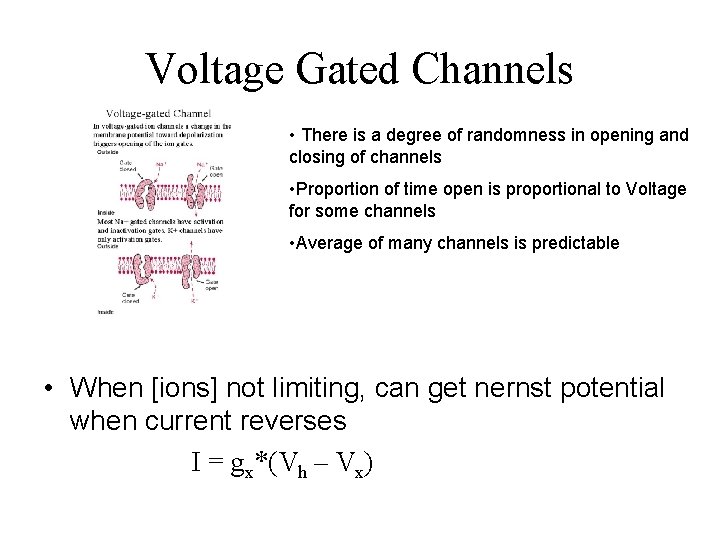
Voltage Gated Channels • There is a degree of randomness in opening and closing of channels • Proportion of time open is proportional to Voltage for some channels • Average of many channels is predictable • When [ions] not limiting, can get nernst potential when current reverses I = gx*(Vh – Vx)
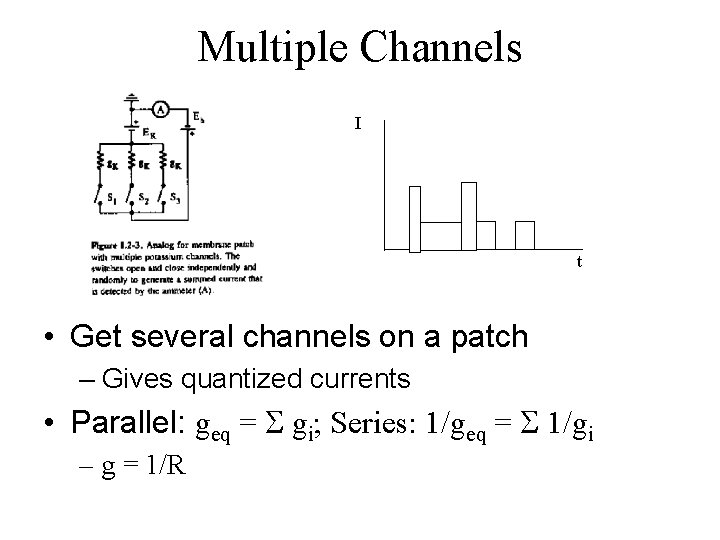
Multiple Channels I t • Get several channels on a patch – Gives quantized currents • Parallel: geq = S gi; Series: 1/geq = S 1/gi – g = 1/R
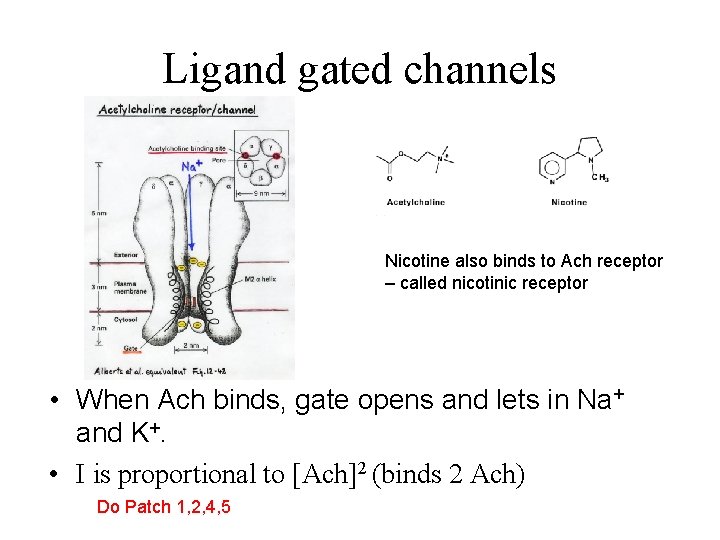
Ligand gated channels Nicotine also binds to Ach receptor – called nicotinic receptor • When Ach binds, gate opens and lets in Na+ and K+. • I is proportional to [Ach]2 (binds 2 Ach) Do Patch 1, 2, 4, 5
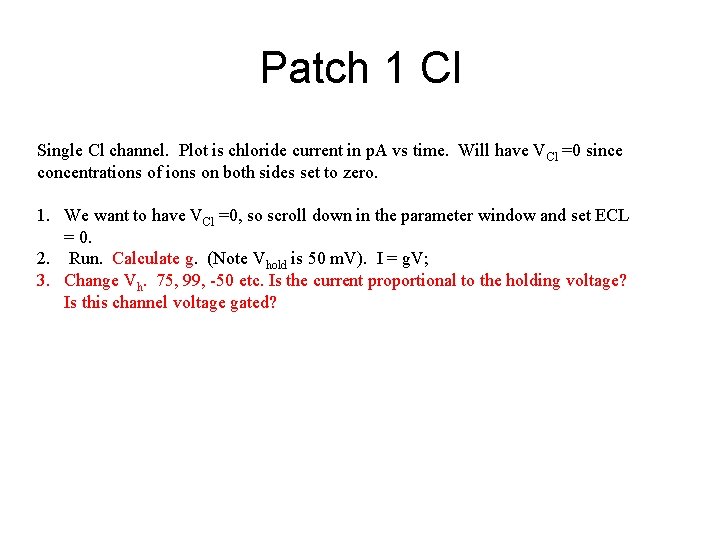
Patch 1 Cl Single Cl channel. Plot is chloride current in p. A vs time. Will have VCl =0 since concentrations of ions on both sides set to zero. 1. We want to have VCl =0, so scroll down in the parameter window and set ECL = 0. 2. Run. Calculate g. (Note Vhold is 50 m. V). I = g. V; 3. Change Vh. 75, 99, -50 etc. Is the current proportional to the holding voltage? Is this channel voltage gated?
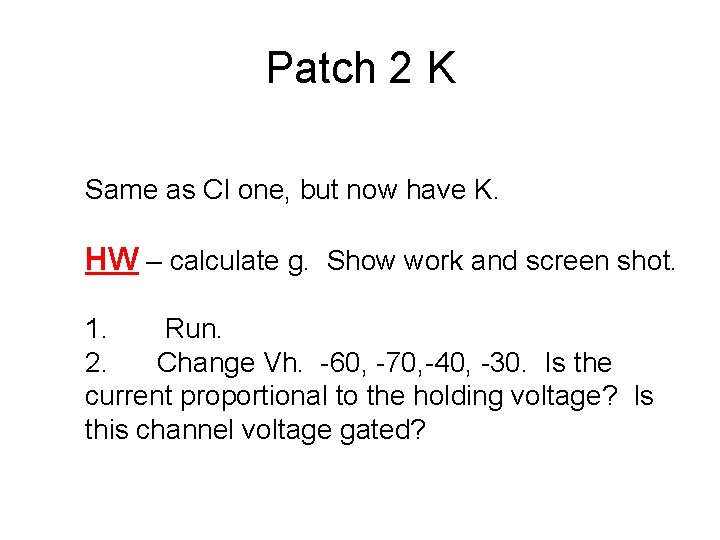
Patch 2 K Same as Cl one, but now have K. HW – calculate g. Show work and screen shot. 1. Run. 2. Change Vh. -60, -70, -40, -30. Is the current proportional to the holding voltage? Is this channel voltage gated?
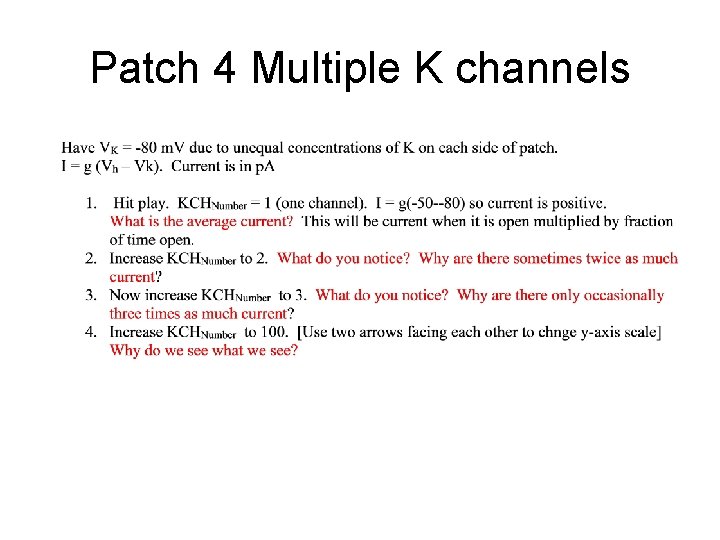
Patch 4 Multiple K channels
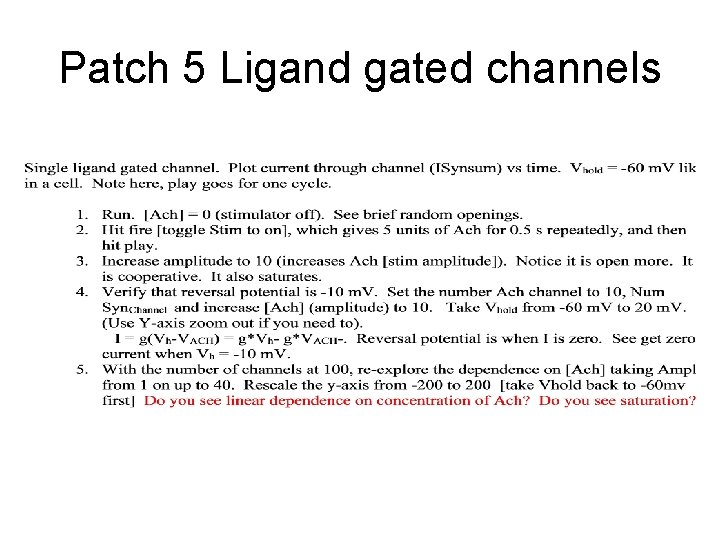
Patch 5 Ligand gated channels
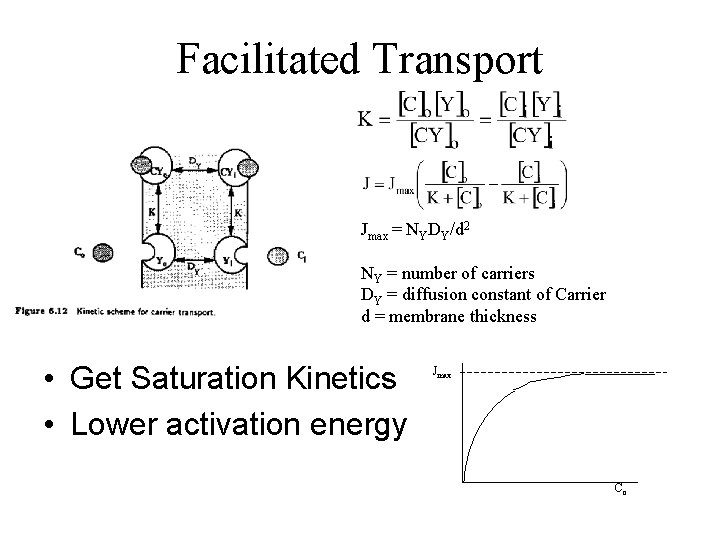
Facilitated Transport Jmax = NYDY/d 2 NY = number of carriers DY = diffusion constant of Carrier d = membrane thickness • Get Saturation Kinetics • Lower activation energy Jmax Co
- Slides: 26