
Membrane Structure and Function Chs 8 and 11
Membrane Structure and Function Chs. 8 and 11
Cell Membrane – Introduction n Separates the living cell from its nonliving surroundings n 8 nm thick n Controls traffic into and out of the cell (selectively permeable) n Composed of lipids (phospholipids) and proteins, but include some carbohydrates
Cell Membrane – Introduction n Phospholipids and most other membrane constituents are amphipathic molecules n Amphipathic molecules have both hydrophobic and hydrophilic regions n Described by the fluid mosaic model
Membrane Model Development n 1895 – Charles Overton; hypothesized membranes made of lipids n Observed lipid-soluble substances move across membrane easier than lipid-nonsoluble substances
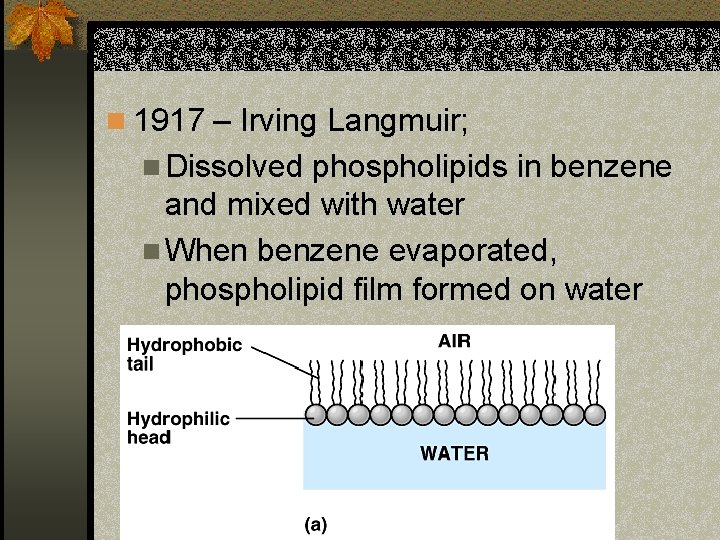
n 1917 – Irving Langmuir; n Dissolved phospholipids in benzene and mixed with water n When benzene evaporated, phospholipid film formed on water
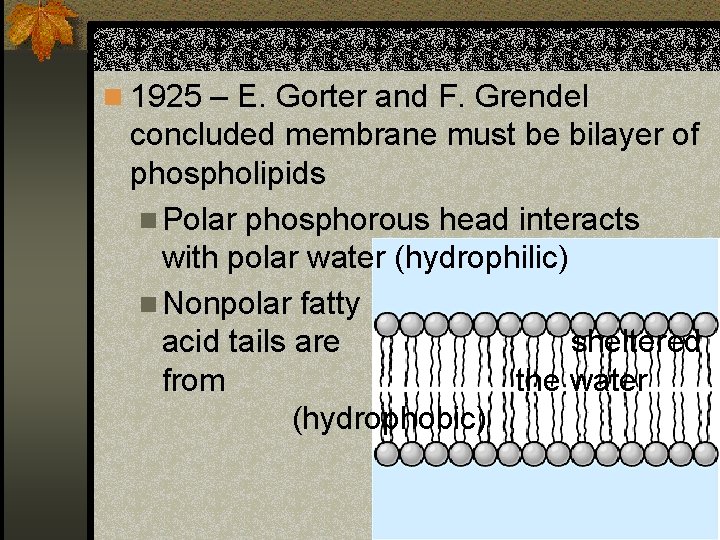
n 1925 – E. Gorter and F. Grendel concluded membrane must be bilayer of phospholipids n Polar phosphorous head interacts with polar water (hydrophilic) n Nonpolar fatty acid tails are sheltered from the water (hydrophobic)
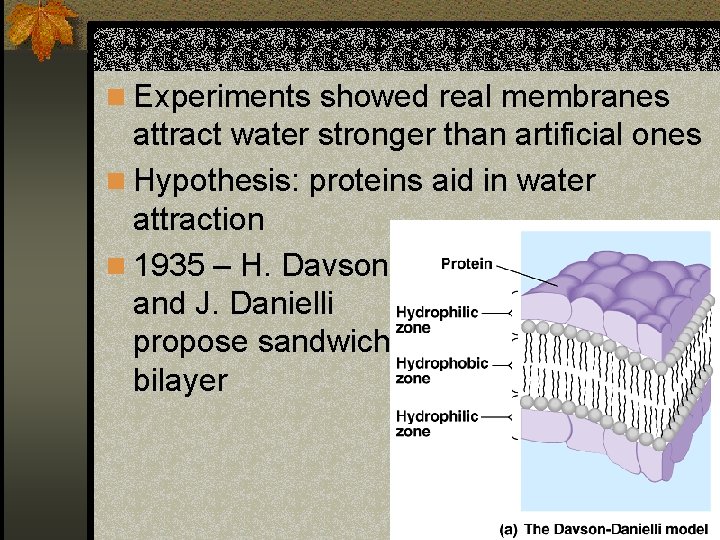
n Experiments showed real membranes attract water stronger than artificial ones n Hypothesis: proteins aid in water attraction n 1935 – H. Davson and J. Danielli propose sandwich model: bilayer between layers of proteins
n Davson-Danielli model considered dominant, even after EM images n Two problems: n Membranes differed in size, composition, and stained appearance n Membrane proteins are amphipathic; can’t be on surface only
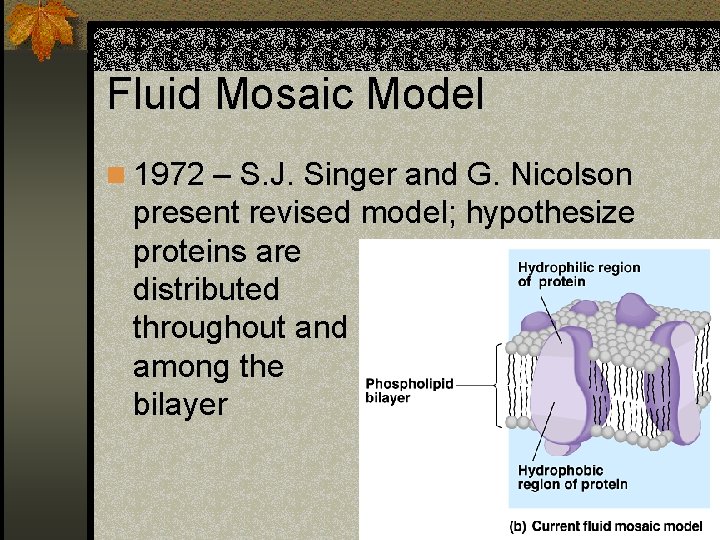
Fluid Mosaic Model n 1972 – S. J. Singer and G. Nicolson present revised model; hypothesize proteins are distributed throughout and among the bilayer
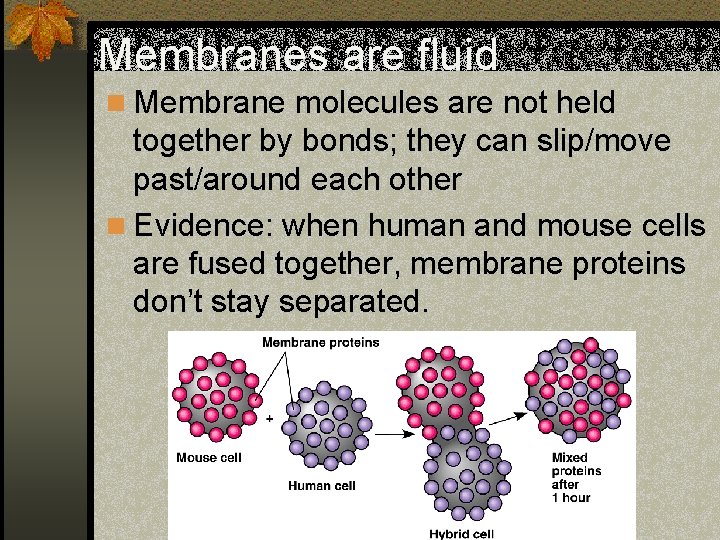
Membranes are fluid n Membrane molecules are not held together by bonds; they can slip/move past/around each other n Evidence: when human and mouse cells are fused together, membrane proteins don’t stay separated.
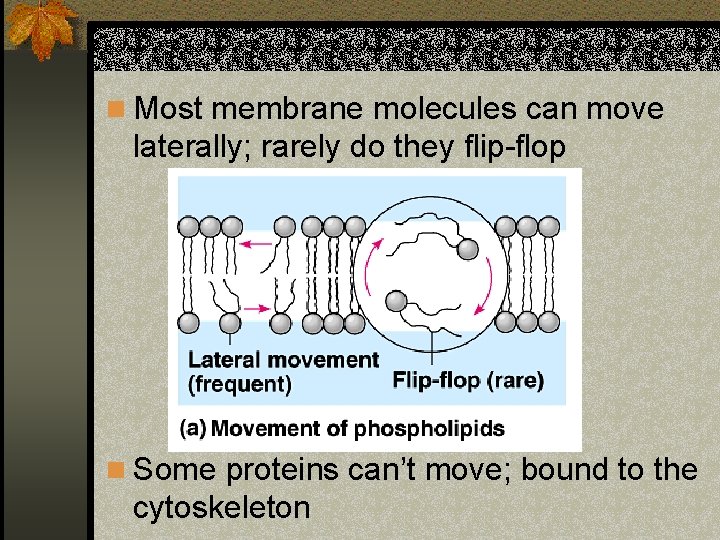
n Most membrane molecules can move laterally; rarely do they flip-flop n Some proteins can’t move; bound to the cytoskeleton
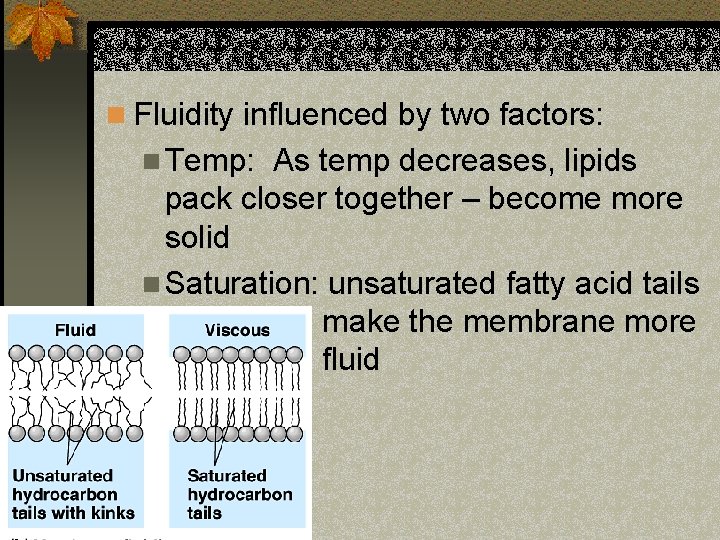
n Fluidity influenced by two factors: n Temp: As temp decreases, lipids pack closer together – become more solid n Saturation: unsaturated fatty acid tails make the membrane more fluid

n Cholesterol is wedged in the plasma membrane n Warm temps: it restrains the movement of phospholipids and reduces fluidity n Cool temps: it maintains fluidity by preventing tight packing
Membranes are mosaics
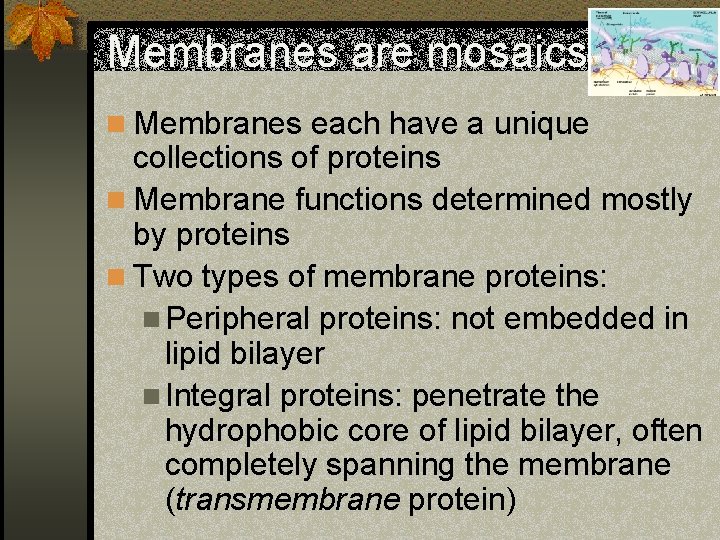
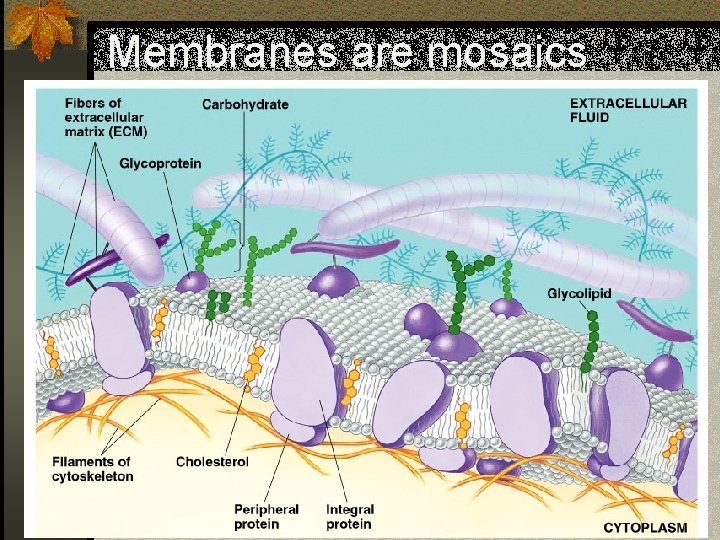
Membranes are mosaics n Membranes each have a unique collections of proteins n Membrane functions determined mostly by proteins n Two types of membrane proteins: n Peripheral proteins: not embedded in lipid bilayer n Integral proteins: penetrate the hydrophobic core of lipid bilayer, often completely spanning the membrane (transmembrane protein)

Membranes are mosaics n Membranes have distinctive inside and outside faces n The outer surface has carbohydrates n This asymmetrical orientation begins during synthesis of new membrane in the endoplasmic reticulum
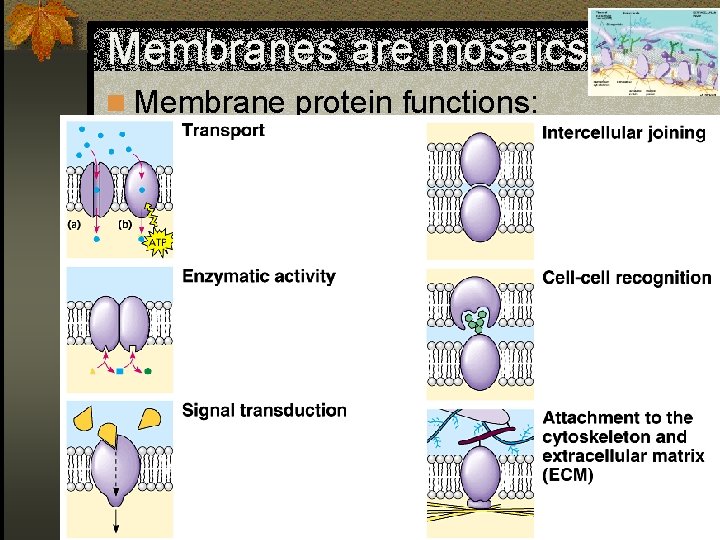
Membranes are mosaics n Membrane protein functions:
Cell-Cell Recognition n Ability of a cell to distinguish one type of neighboring cell from another n The membrane plays the key role in cell -cell recognition n Cells recognize other cells from surface molecules, often carbs, on membrane n Glycolipids n Glycoproteins (more common)
Cell-Cell Recognition n Carbs on external side of membrane vary from species to species, individual to individual, and even from cell type to cell type within the same individual n Variation marks each cell type as distinct n The four human blood groups (A, B, AB, and O) differ in the external carbohydrates on red blood cells n It is also the basis for rejection of foreign cells by the immune system n This attribute is important in cell sorting and organization as tissues and organs in development
Transport n Membranes act as gatekeepers (selectively permeable) n Select based on size and charge n Small, uncharged atoms/molecules don’t have problems n Large and/or charged atoms/molecules do have problems n Proteins can help transport
Transport Proteins n Each transport protein is specific as to the substances that it will translocate n Some act like a channel or tunnel through the membrane n Others bind to their specific molecules and physically carry them across the membrane
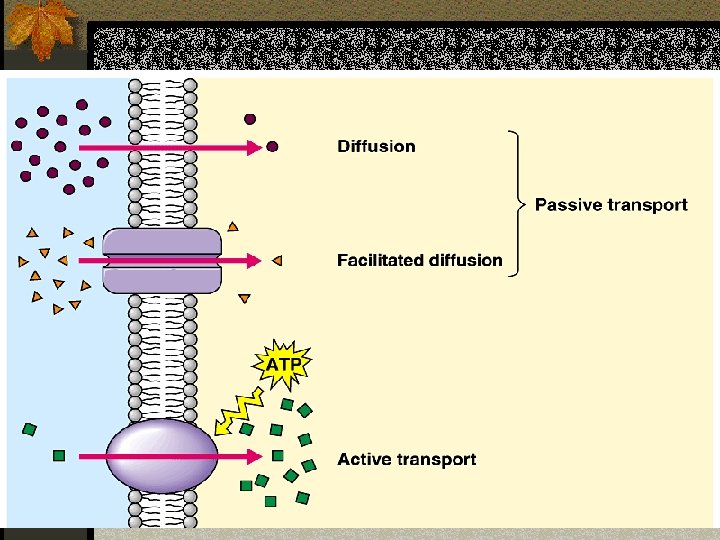
Passive Transport n No E required n Requires gradient (separation of concentrations) n Movement from areas of Hi to Low (down, along, or with) concentrations n Movement continues even after equilibrium is reached n Rate of diffusion depends on size and charge of molecules (interaction with the membrane)
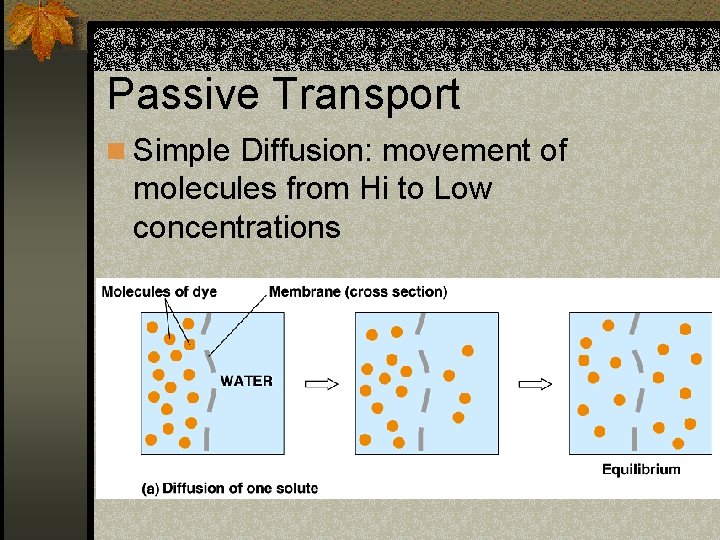
Passive Transport n Simple Diffusion: movement of molecules from Hi to Low concentrations
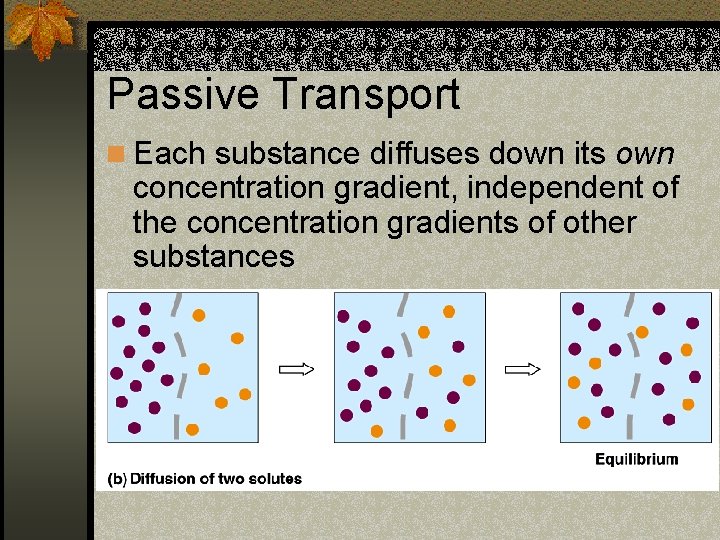
Passive Transport n Each substance diffuses down its own concentration gradient, independent of the concentration gradients of other substances
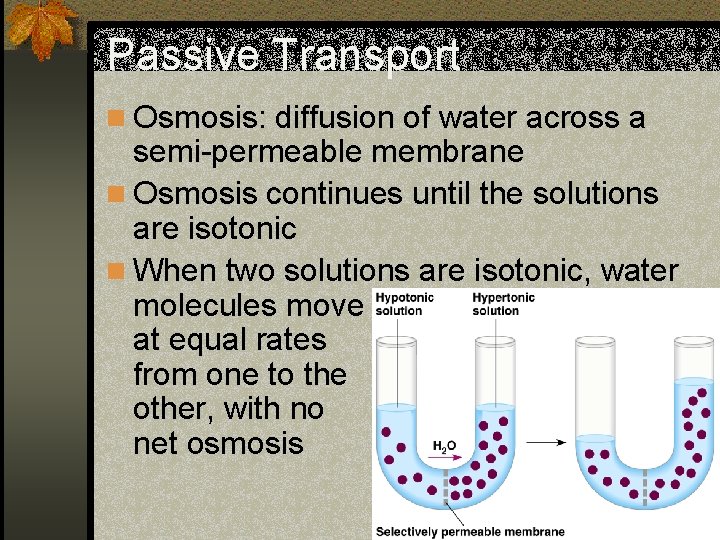
Passive Transport n Osmosis: diffusion of water across a semi-permeable membrane n Osmosis continues until the solutions are isotonic n When two solutions are isotonic, water molecules move at equal rates from one to the other, with no net osmosis
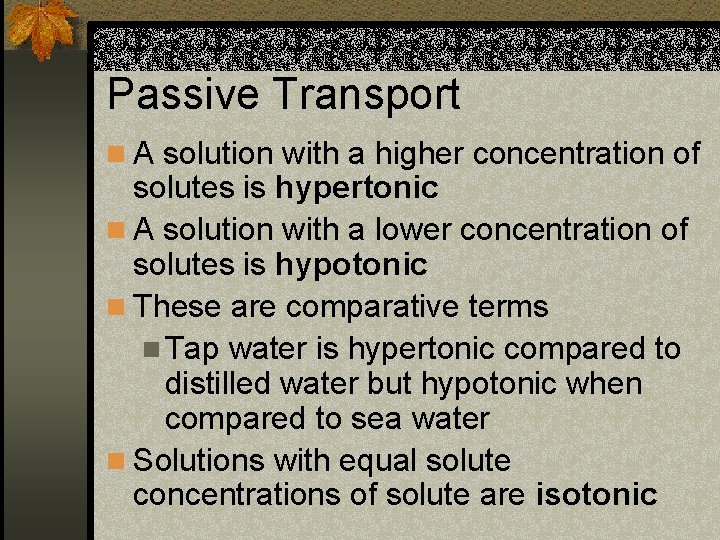
Passive Transport n A solution with a higher concentration of solutes is hypertonic n A solution with a lower concentration of solutes is hypotonic n These are comparative terms n Tap water is hypertonic compared to distilled water but hypotonic when compared to sea water n Solutions with equal solute concentrations of solute are isotonic
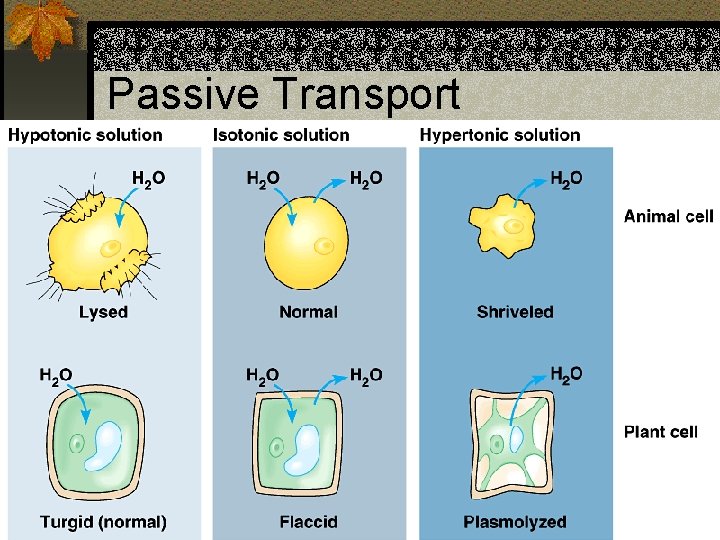
Passive Transport
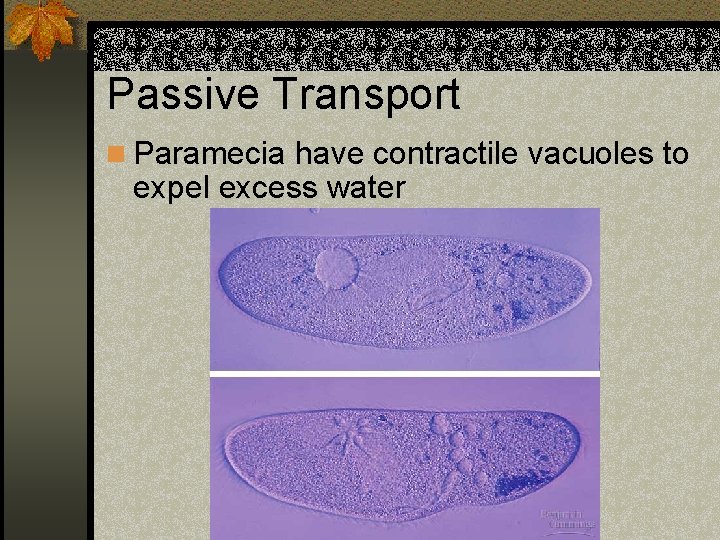
Passive Transport n Paramecia have contractile vacuoles to expel excess water
Passive Transport n Facilitated diffusion: diffusion using “helper” molecules n Those atoms and molecules that were too big or charged can still move down their concentration gradient (hi to low)
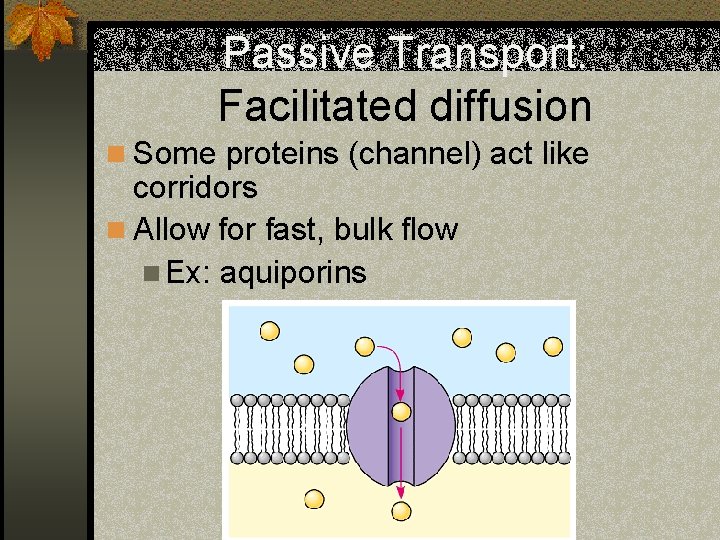
Passive Transport: Facilitated diffusion n Some proteins (channel) act like corridors n Allow for fast, bulk flow n Ex: aquiporins
Passive Transport: Facilitated diffusion n Some channel proteins (gated channels) open or close depending on the presence or absence of a physical or chemical stimulus n The chemical stimulus is usually different from the transported molecule n Ex: when neurotransmitters bind to specific gated channels on the receiving neuron, these channels open n This allows sodium ions into a nerve cell n When the neurotransmitters are not present, the channels are closed
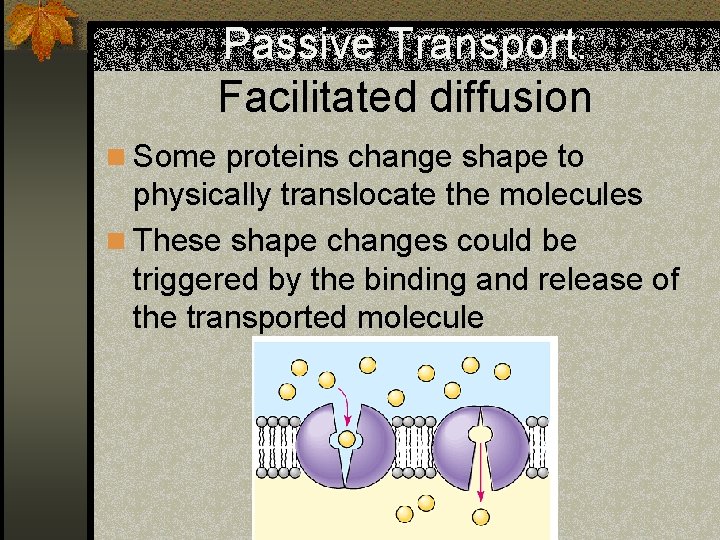
Passive Transport: Facilitated diffusion n Some proteins change shape to physically translocate the molecules n These shape changes could be triggered by the binding and release of the transported molecule
n Transport proteins are much like enzymes n They may have specific binding sites for the solute n Transport proteins can become saturated when they are translocating passengers as fast as they can n Transport proteins can be inhibited by molecules that resemble the normal “substrate” n When these bind to the transport proteins, they outcompete the normal substrate for transport
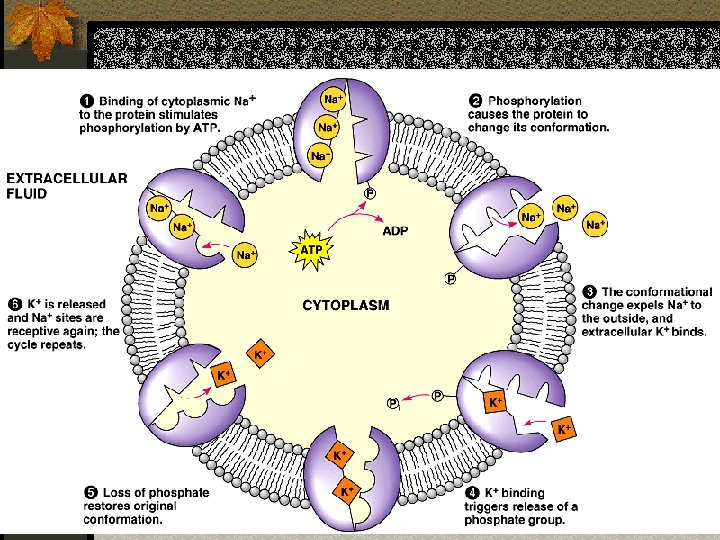
Active Transport n Requires E (ATP) n Movement of molecules against or up their concentration gradients n Low to Hi n Performed by receptor proteins
Active Transport n The sodium-potassium pump actively maintains the gradient of sodium (Na+) and potassium ions (K+) across the membrane n Typically, an animal cell has higher concentrations of K+ and lower concentrations of Na+ inside the cell n The sodium-potassium pump uses the E of one ATP to pump three Na+ out and two K+ in
Ions keep separate charges across a membrane n Membrane potential: voltage difference across the membrane n Electrochemical gradient n Gradient due to concentrations of ions n Gradient due to membrane potential n electrogenic pumps generate voltage gradient
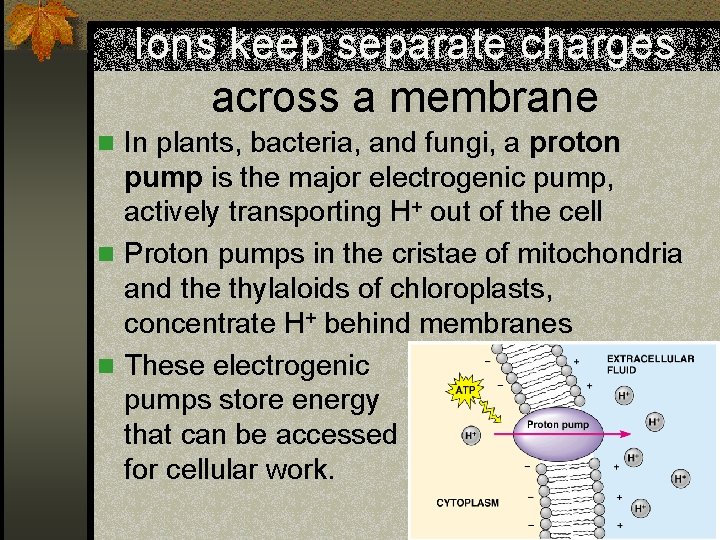
Ions keep separate charges across a membrane n In plants, bacteria, and fungi, a proton pump is the major electrogenic pump, actively transporting H+ out of the cell n Proton pumps in the cristae of mitochondria and the thylaloids of chloroplasts, concentrate H+ behind membranes n These electrogenic pumps store energy that can be accessed for cellular work.
Cotransport n A single ATP-powered pump that transports one solute can indirectly drive the active transport of several other solutes through cotransport via a different protein n As the solute that has been actively transported diffuses back passively through a transport protein, its movement can be coupled with the active transport of another substance against its concentration gradient
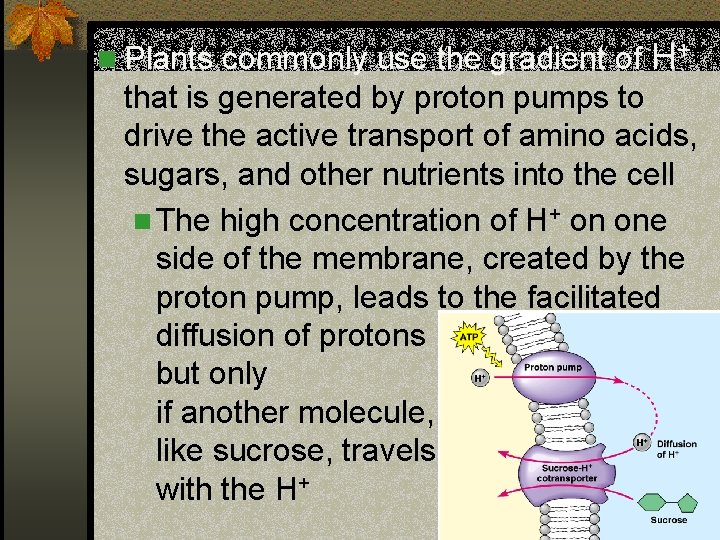
n Plants commonly use the gradient of H+ that is generated by proton pumps to drive the active transport of amino acids, sugars, and other nutrients into the cell n The high concentration of H+ on one side of the membrane, created by the proton pump, leads to the facilitated diffusion of protons back, but only if another molecule, like sucrose, travels with the H+
Endo- vs. Exocytosis n Both move large molecules into/out of the cell n Both use vesicles n Reverse processes of each other
Endocytosis n A small area of the plasma membrane sinks inward to form a pocket n The pocket deepens, pinches in, and forms a vesicle containing the material that had been outside the cell
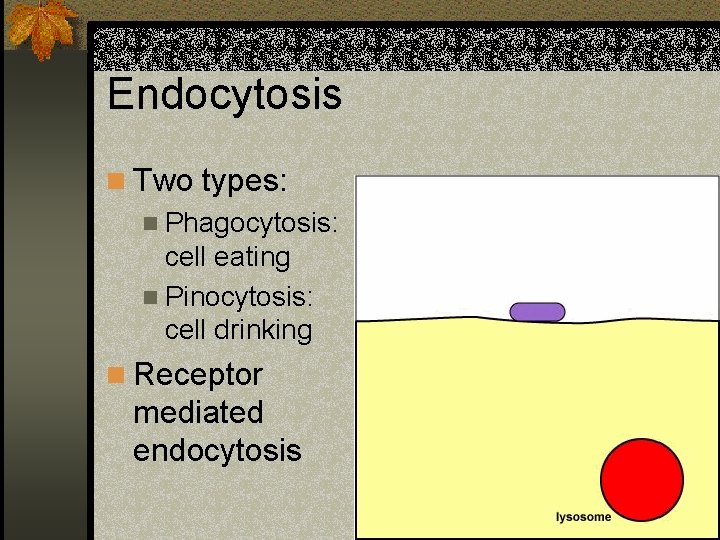
Endocytosis n Two types: n Phagocytosis: cell eating n Pinocytosis: cell drinking n Receptor mediated endocytosis
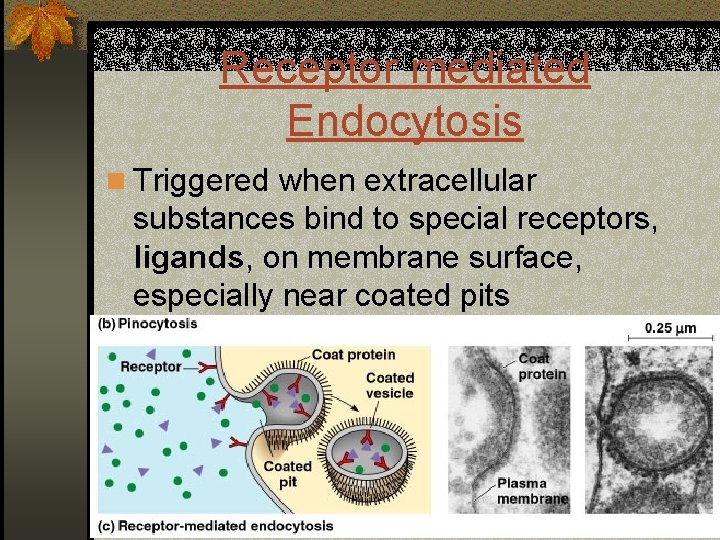
Receptor mediated Endocytosis n Triggered when extracellular substances bind to special receptors, ligands, on membrane surface, especially near coated pits
- Slides: 45