
Membership Inference Attacks Against Machine Learning Models Reza

Membership Inference Attacks Against Machine Learning Models Reza Shokri, Marco Stronati, Congzheng Song, Vitaly Shmatikov
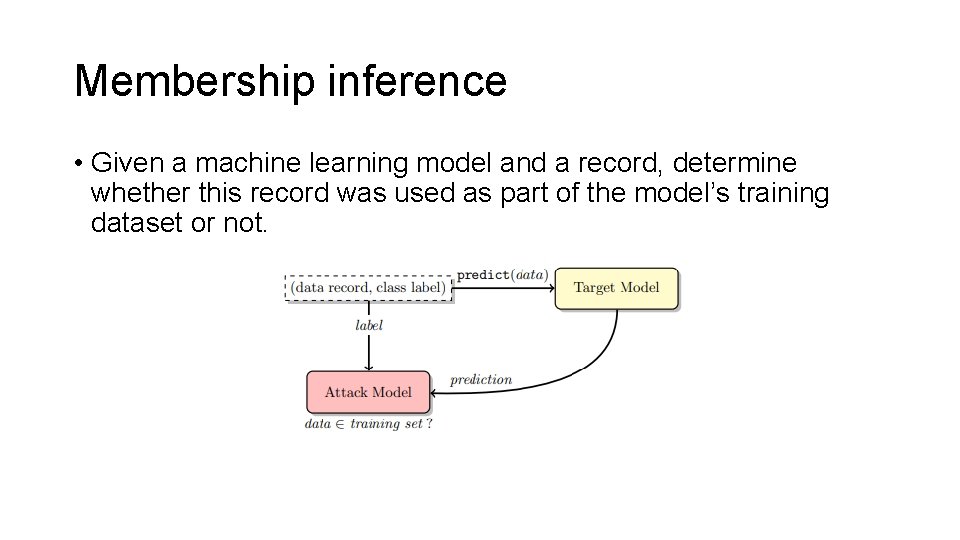
Membership inference • Given a machine learning model and a record, determine whether this record was used as part of the model’s training dataset or not.
What we have? • Training data’s info: • • Another part of training data. (1) Training data’s distribution / noisy training data. (2) Statistic infos. (3) Nothing. (4) • Model’s info: • Model’s structure and training algorithm. (1) • Black-box query access to the target model. (2)

Key point: Mimic • We purposed to mimic target model’s behavior. • Shadow model !!! Why not just one shadow model ?
Shadow models’ food • Everything seems easy now. . . • but how to obtain the training data of shadow model? • We need to ensure the synthetic data should be from the same distribution of private training data. • Purposed method: • Model-based synthesis • Statistics-based synthesis • Noisy real data
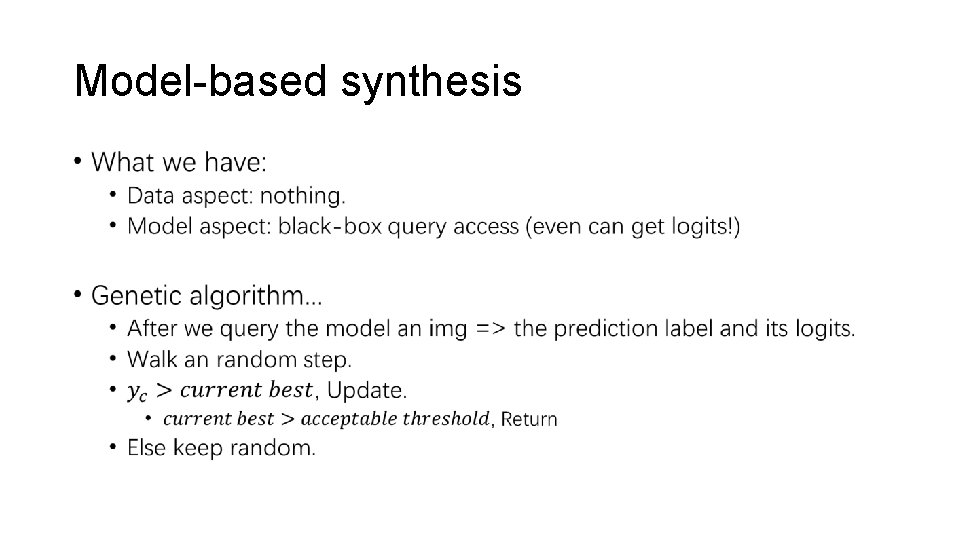
Model-based synthesis •
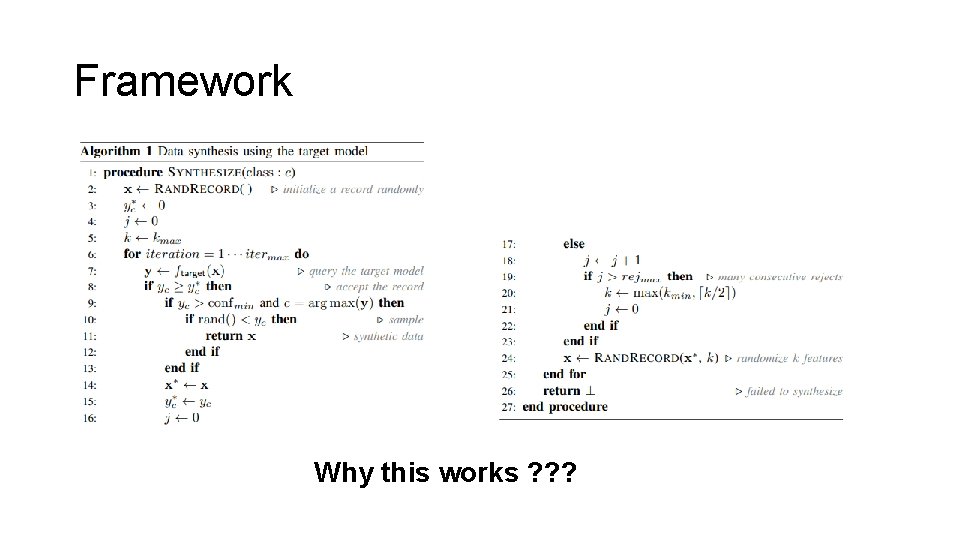
Framework Why this works ? ? ?
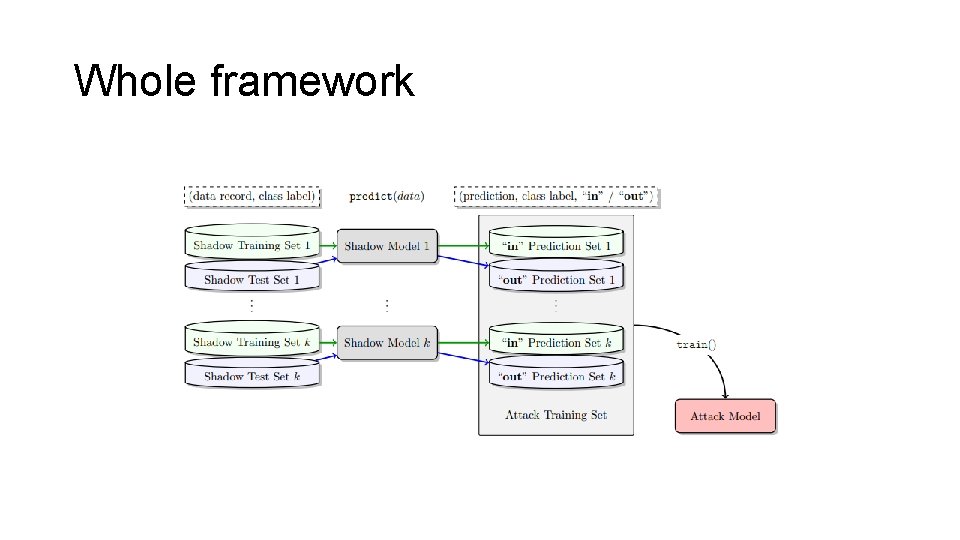
Whole framework
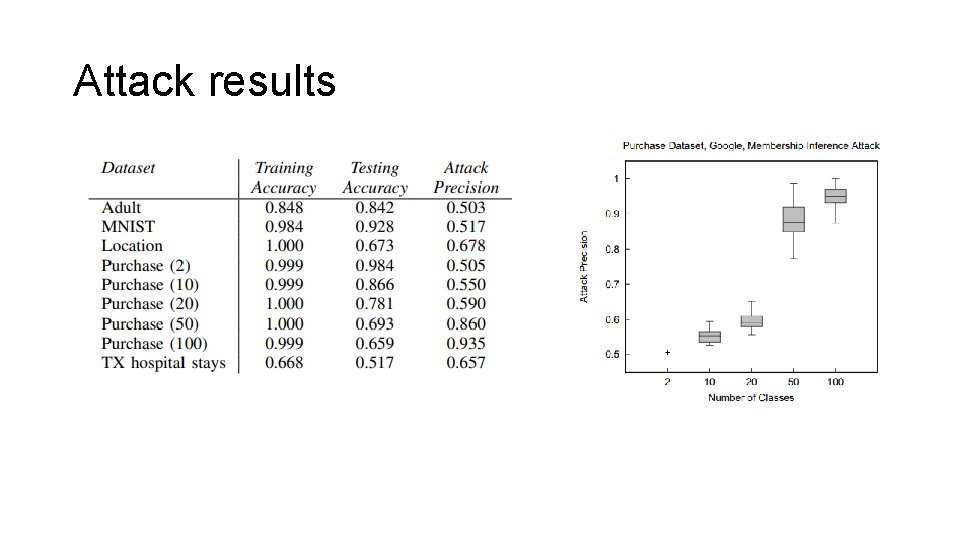
Attack results
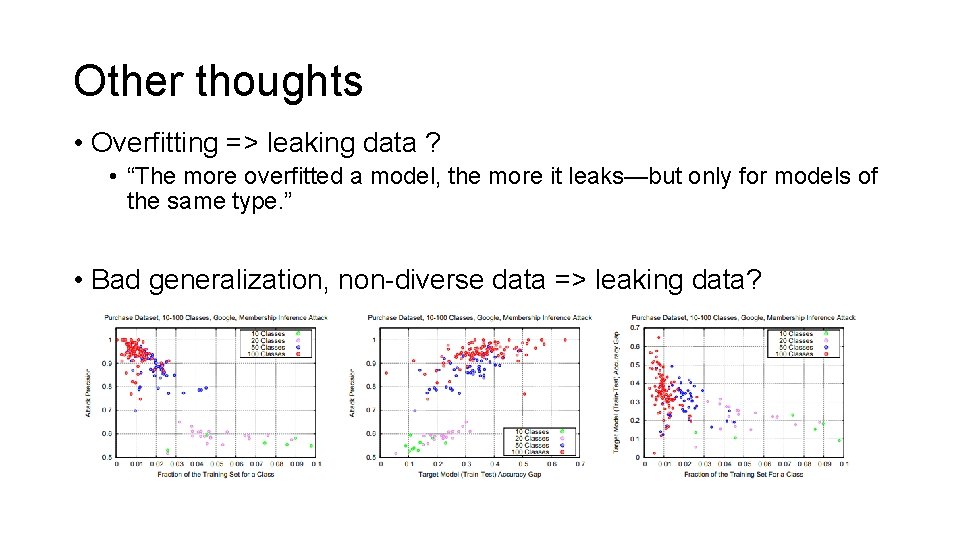
Other thoughts • Overfitting => leaking data ? • “The more overfitted a model, the more it leaks—but only for models of the same type. ” • Bad generalization, non-diverse data => leaking data?
Privacy in Pharmacogenetics: An End-to-End Case Study of Personalized Warfarin Dosing Matthew Fredrikson∗, Eric Lantz∗, Somesh Jha∗, Simon Lin†, David Page∗, Thomas Ristenpart∗
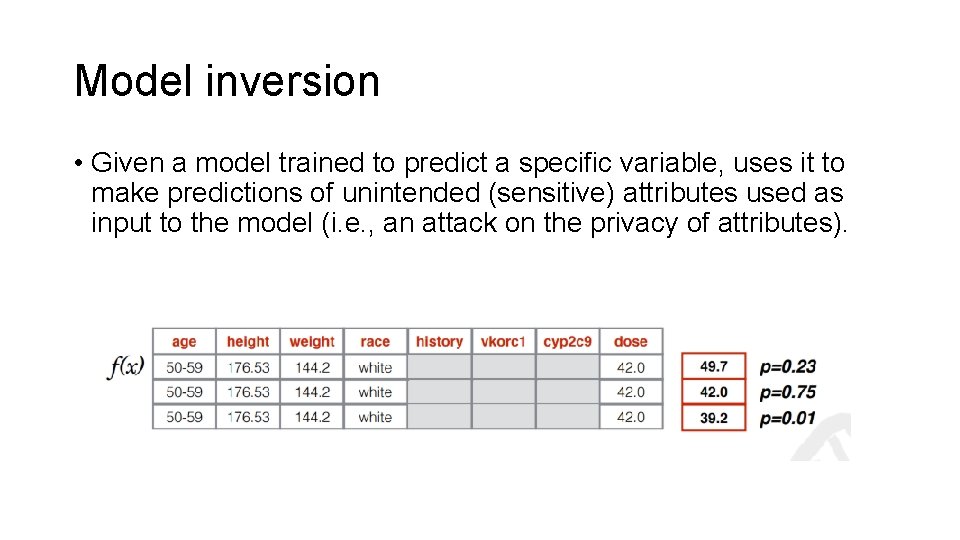
Model inversion • Given a model trained to predict a specific variable, uses it to make predictions of unintended (sensitive) attributes used as input to the model (i. e. , an attack on the privacy of attributes).
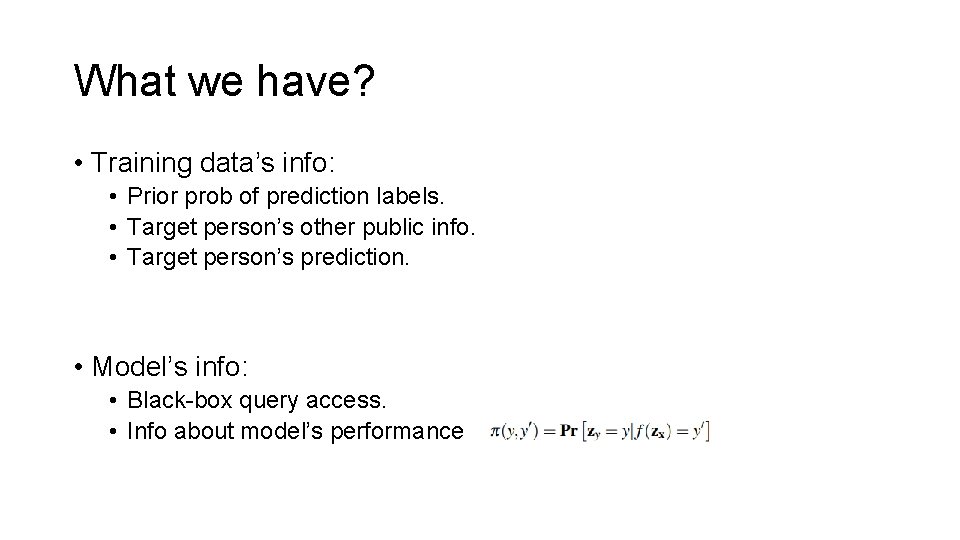
What we have? • Training data’s info: • Prior prob of prediction labels. • Target person’s other public info. • Target person’s prediction. • Model’s info: • Black-box query access. • Info about model’s performance
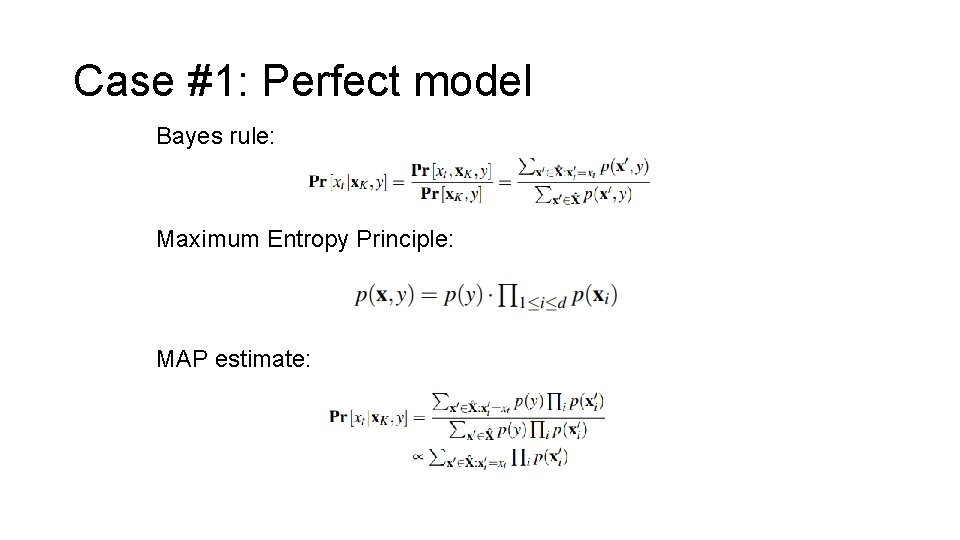
Case #1: Perfect model Bayes rule: Maximum Entropy Principle: MAP estimate:
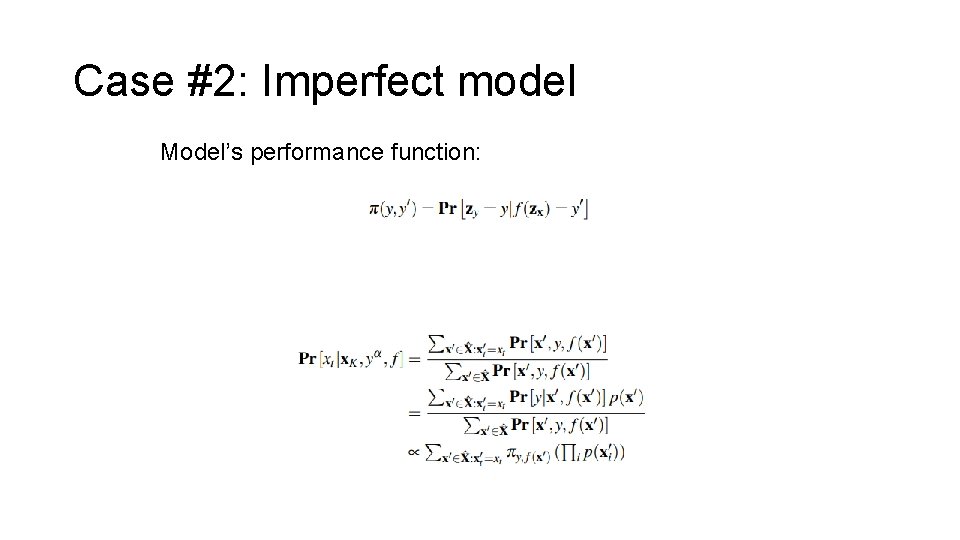
Case #2: Imperfect model Model’s performance function:
Model Inversion Attacks that Exploit Confidence Information and Basic Countermeasures Matt Fredrikson, Somesh Jha, Thomas Ristenpart
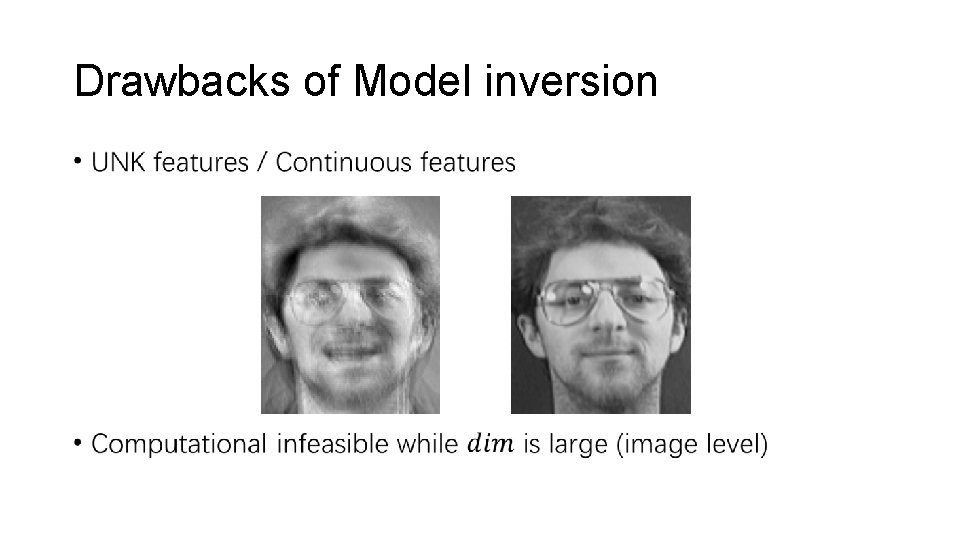
Drawbacks of Model inversion •
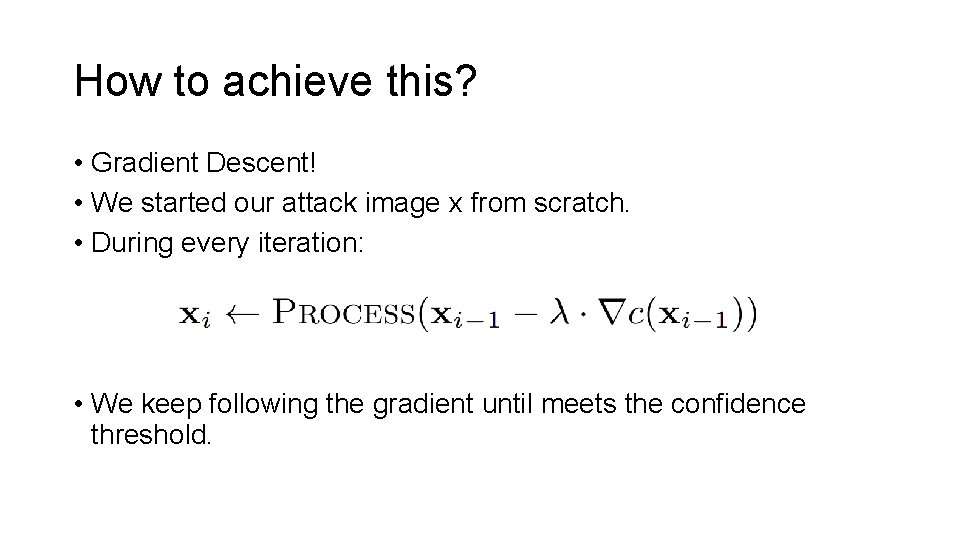
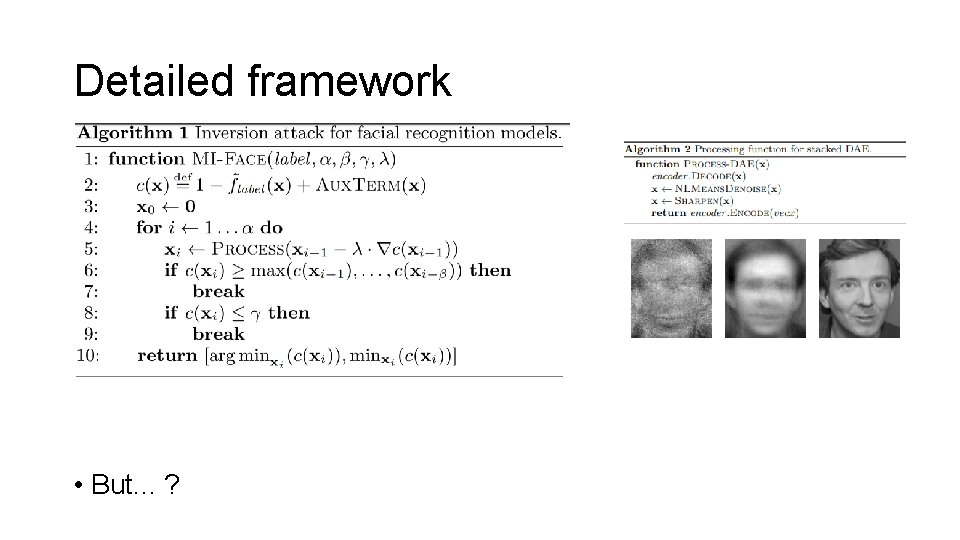
How to achieve this? • Gradient Descent! • We started our attack image x from scratch. • During every iteration: • We keep following the gradient until meets the confidence threshold.
Detailed framework • But. . . ?
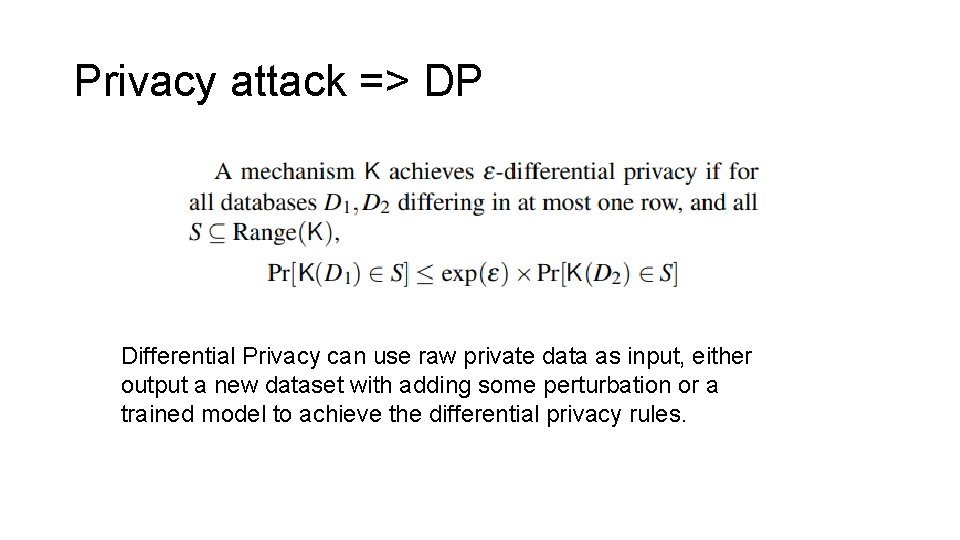
Privacy attack => DP Differential Privacy can use raw private data as input, either output a new dataset with adding some perturbation or a trained model to achieve the differential privacy rules.
- Slides: 20