
MEM 351 Dynamic Systems Lab Representations Transfer Functions
MEM 351 – Dynamic Systems Lab Representations: Transfer Functions Poles and Zeros
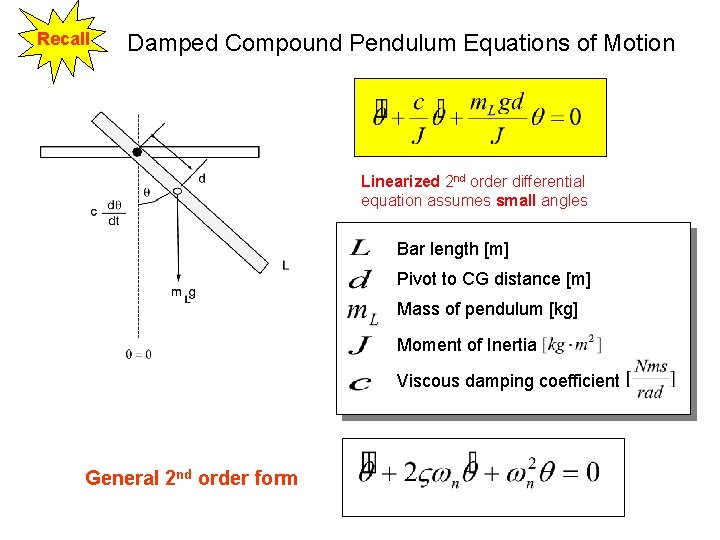
Recall Damped Compound Pendulum Equations of Motion Linearized 2 nd order differential equation assumes small angles Bar length [m] Pivot to CG distance [m] Mass of pendulum [kg] Moment of Inertia Viscous damping coefficient General 2 nd order form

Tedious Math: Time domain differential equation 2 nd order damped system Yields complex roots Time domain solution (1) Small real root will yield long settling times Can be shown: Time constant (2) 2% settling time

Easier Math I: Laplace Domain • Voltage applied to motor • Propeller spins, creating lift force • Lift on lever arm r creates torque • Pendulum rotates angle
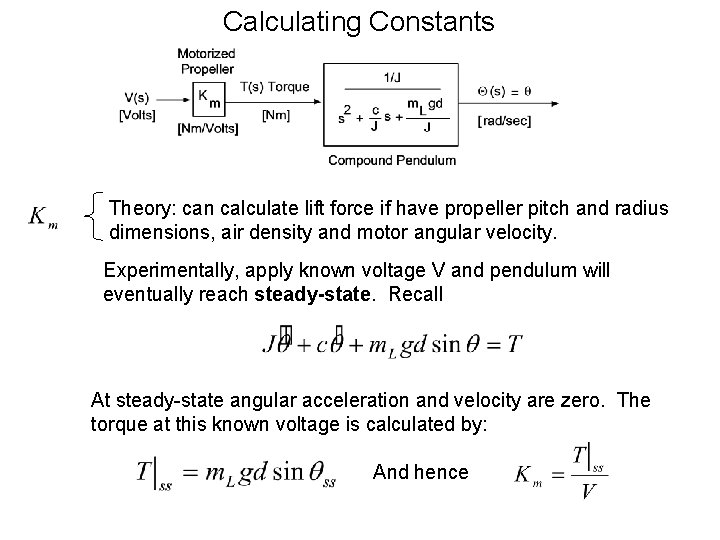
Calculating Constants Theory: can calculate lift force if have propeller pitch and radius dimensions, air density and motor angular velocity. Experimentally, apply known voltage V and pendulum will eventually reach steady-state. Recall At steady-state angular acceleration and velocity are zero. The torque at this known voltage is calculated by: And hence
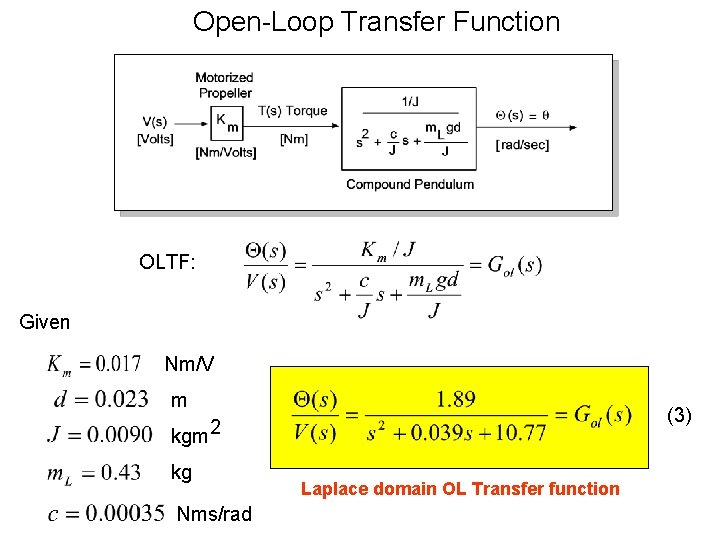
Open-Loop Transfer Function OLTF: Given Nm/V m (3) kgm 2 kg Nms/rad Laplace domain OL Transfer function
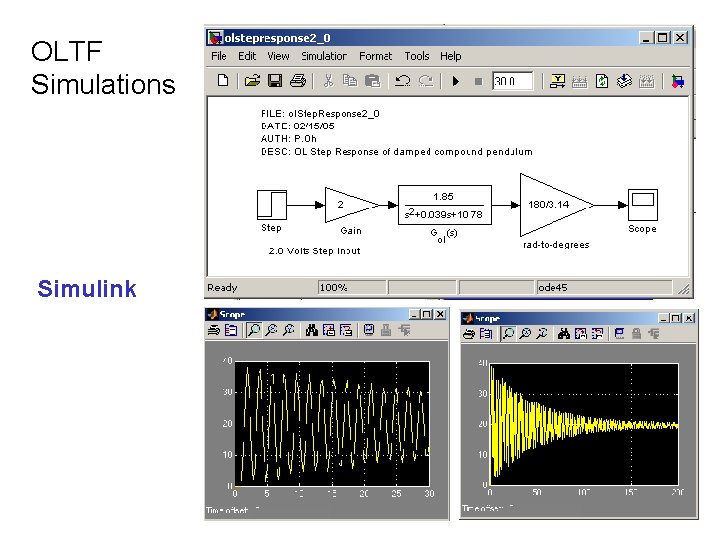
OLTF Simulations Simulink
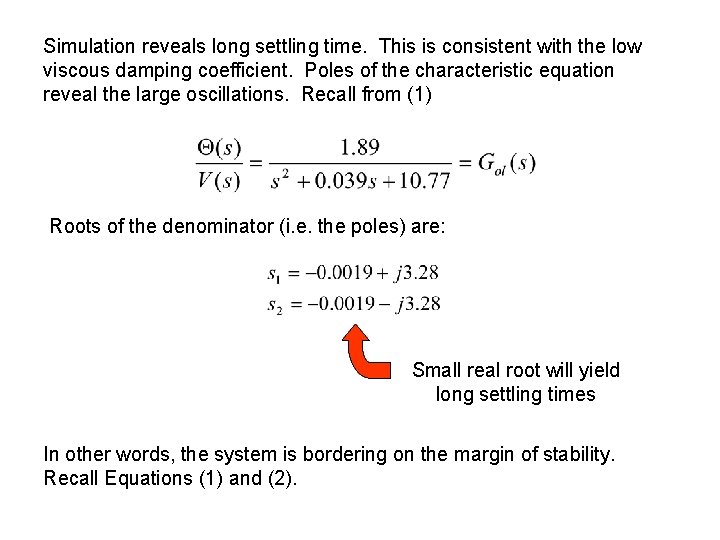
Simulation reveals long settling time. This is consistent with the low viscous damping coefficient. Poles of the characteristic equation reveal the large oscillations. Recall from (1) Roots of the denominator (i. e. the poles) are: Small real root will yield long settling times In other words, the system is bordering on the margin of stability. Recall Equations (1) and (2).
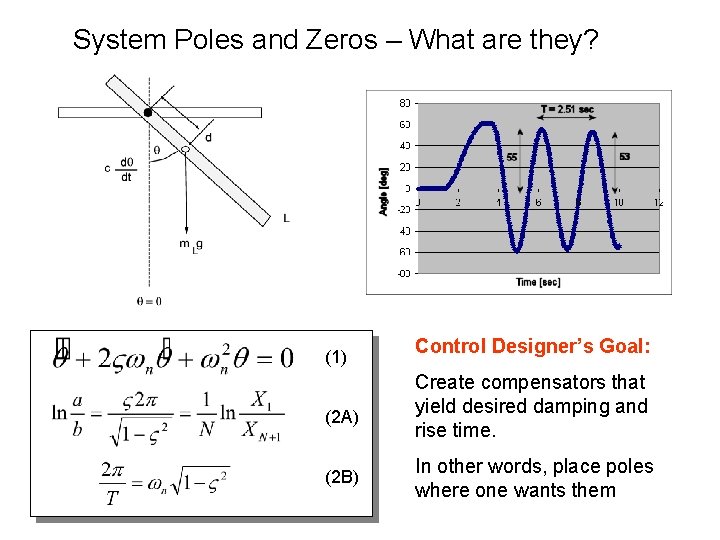
System Poles and Zeros – What are they? (1) (2 A) (2 B) Control Designer’s Goal: Create compensators that yield desired damping and rise time. In other words, place poles where one wants them
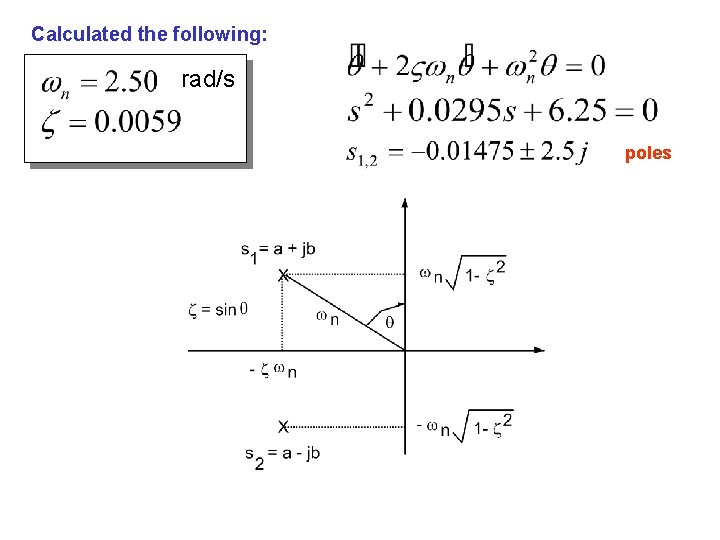
Calculated the following: rad/s poles
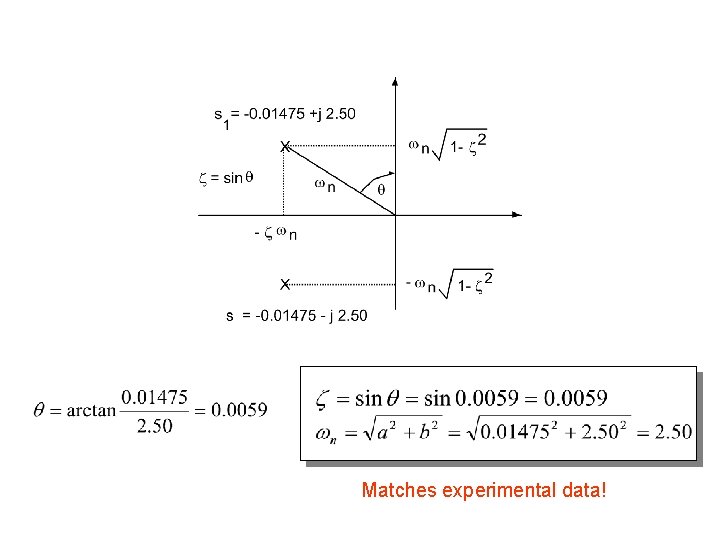
Matches experimental data!
Where are we going with this? It’s called the characteristic equation because it connotes system properties Poles are the roots of the characteristic equation. As such, the describe stability through and Question: can we alter the locations of the poles? If we can, then we change the characteristic of the system… Answer: This is exactly what the control engineer does. One popular method is called “pole placement” control
- Slides: 12