
Melody Characterization by a Fuzzy Rule System Pedro
Melody Characterization by a Fuzzy Rule System Pedro J. Ponce de León, David Rizo, José M. Iñesta (DLSI, Univ. Alicante) Rafael Ramírez (MTG, Univ. Pompeu Fabra, Barcelona) Spain
Introduction
What’s a melody? Melody is a somewhat elusive musical term that often refers to a central part of a music piece that catches most of the listener’s attention, and which the rest of music parts are subordinated to.
Motivation l Objective of this work: l To describe with readable linguistic labels what a melody is l And learn it automatically from a dataset
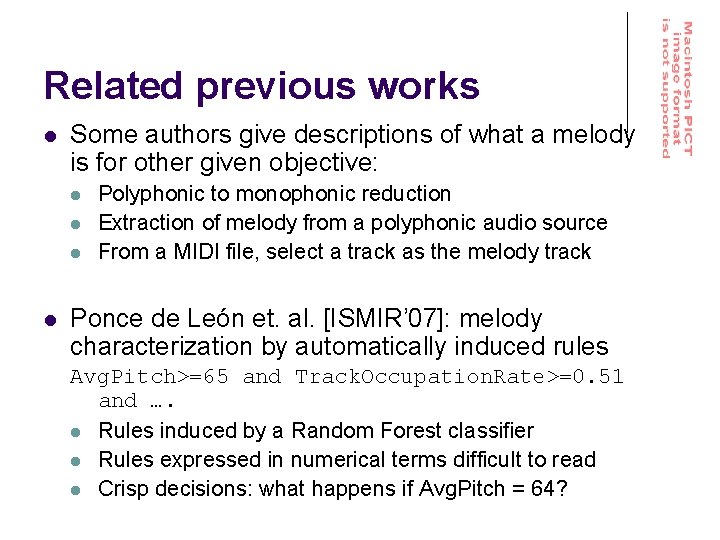
Related previous works l Some authors give descriptions of what a melody is for other given objective: l l Polyphonic to monophonic reduction Extraction of melody from a polyphonic audio source From a MIDI file, select a track as the melody track Ponce de León et. al. [ISMIR’ 07]: melody characterization by automatically induced rules Avg. Pitch>=65 and Track. Occupation. Rate>=0. 51 and …. l Rules induced by a Random Forest classifier l Rules expressed in numerical terms difficult to read l Crisp decisions: what happens if Avg. Pitch = 64?
Methodology
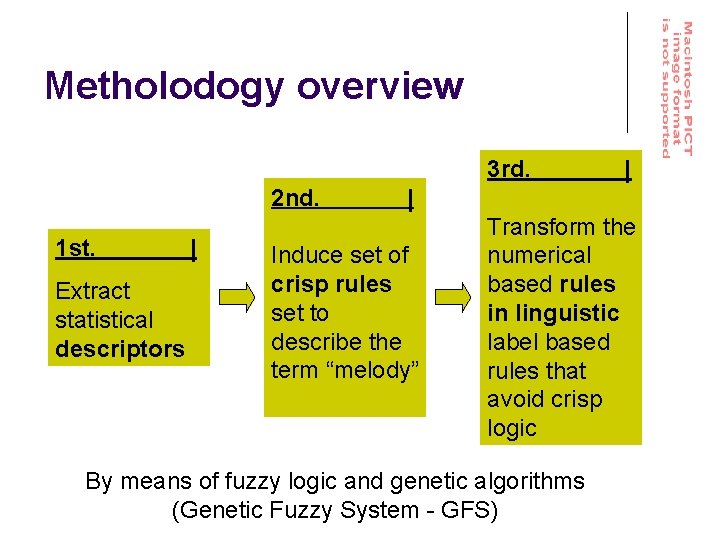
Metholodogy overview 3 rd. 2 nd. 1 st. Extract statistical descriptors | | | Induce set of crisp rules set to describe the term “melody” Transform the numerical based rules in linguistic label based rules that avoid crisp logic By means of fuzzy logic and genetic algorithms (Genetic Fuzzy System - GFS)
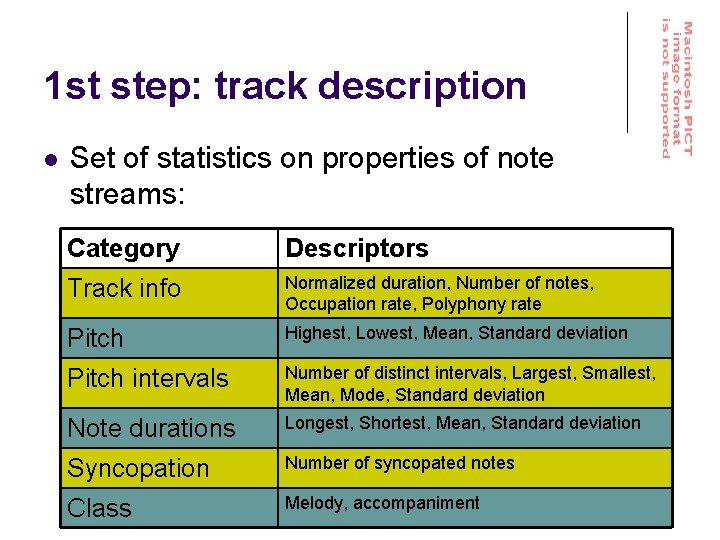
1 st step: track description l Set of statistics on properties of note streams: Category Descriptors Track info Normalized duration, Number of notes, Occupation rate, Polyphony rate Pitch Highest, Lowest, Mean, Standard deviation Pitch intervals Number of distinct intervals, Largest, Smallest, Mean, Mode, Standard deviation Note durations Longest, Shortest, Mean, Standard deviation Syncopation Number of syncopated notes Class Melody, accompaniment
2 nd step: crisp rule induction l Ripper algorithm (Cohen, 1995): l Sequential covering: generate rules one at a time until all positive examples are covered l Conditions are added to a rule: l to maximize an information gain measure. l until it covers no negative example.
3 rd step: from crisp rules to fuzzy rules l Data representation (descriptors) l l Crisp descriptor (e. g. avg. Pitch) fuzzy variable Fuzzy variable membership function parameters are optimized using a Genetic Fuzzy System l l Fuzzy Inference System (FIS) + Genetic Algorithm (GA) Rules l Fuzzify antecedents: (x > a) (x IS term 1) OR (x IS term 2) …
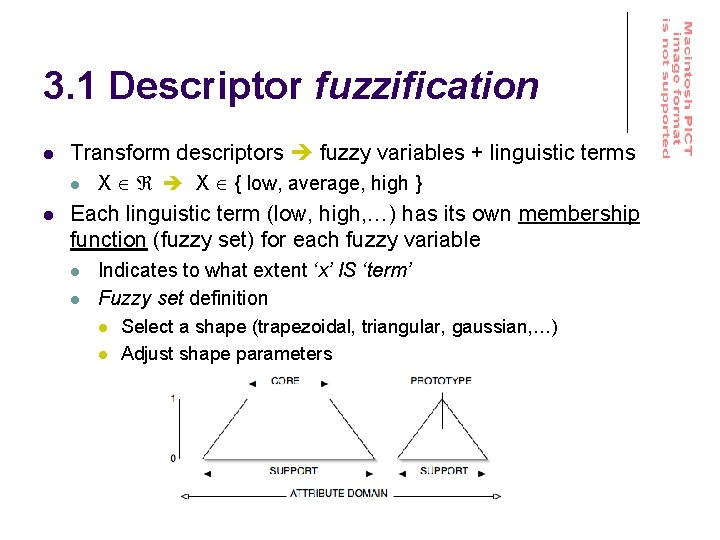
3. 1 Descriptor fuzzification l Transform descriptors fuzzy variables + linguistic terms l l X X { low, average, high } Each linguistic term (low, high, …) has its own membership function (fuzzy set) for each fuzzy variable l l Indicates to what extent ‘x’ IS ‘term’ Fuzzy set definition l l Select a shape (trapezoidal, triangular, gaussian, …) Adjust shape parameters
3. 1 Descriptor fuzzification l Most frequently used fuzzy variables: 5 terms l l Other: 3 terms l l l E. g. Track. Polyphony. Rate {none, low, average, high, all} E. g. Distinc. Intervals { few, average, alot } Fuzzy set shape: trapezoidal (degenerate to triangular) Fuzzy set parameters l Adjusted by a Genetic Fuzzy System
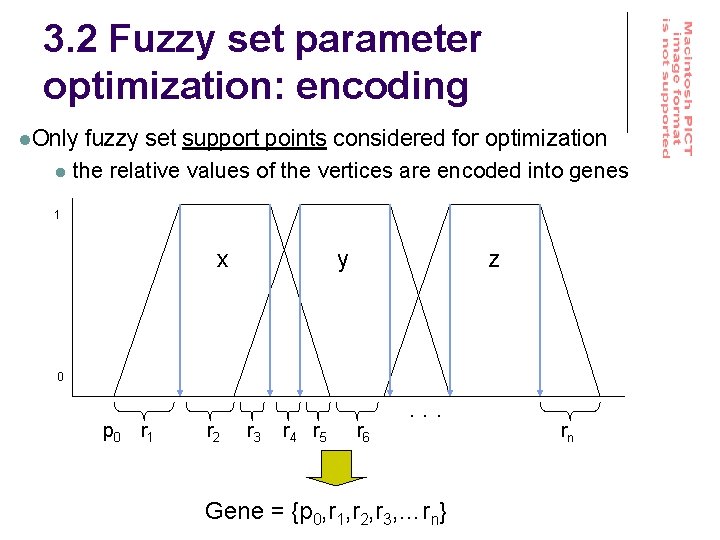
3. 2 Fuzzy set parameter optimization: encoding l. Only fuzzy set support points considered for optimization l the relative values of the vertices are encoded into genes 1 x y z 0 p 0 r 1 r 2 r 3 r 4 r 5 r 6 . . . Gene = {p 0, r 1, r 2, r 3, …rn} rn
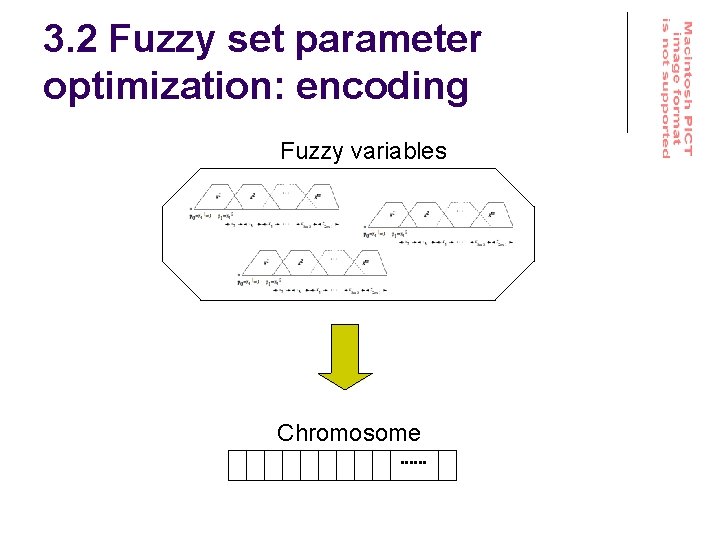
3. 2 Fuzzy set parameter optimization: encoding Fuzzy variables Chromosome
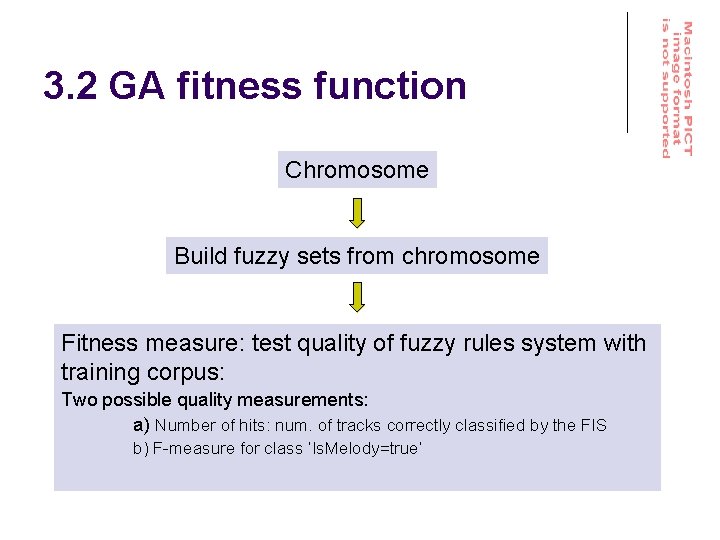
3. 2 GA fitness function Chromosome Build fuzzy sets from chromosome Fitness measure: test quality of fuzzy rules system with training corpus: Two possible quality measurements: a) Number of hits: num. of tracks correctly classified by the FIS b) F-measure for class ‘Is. Melody=true’
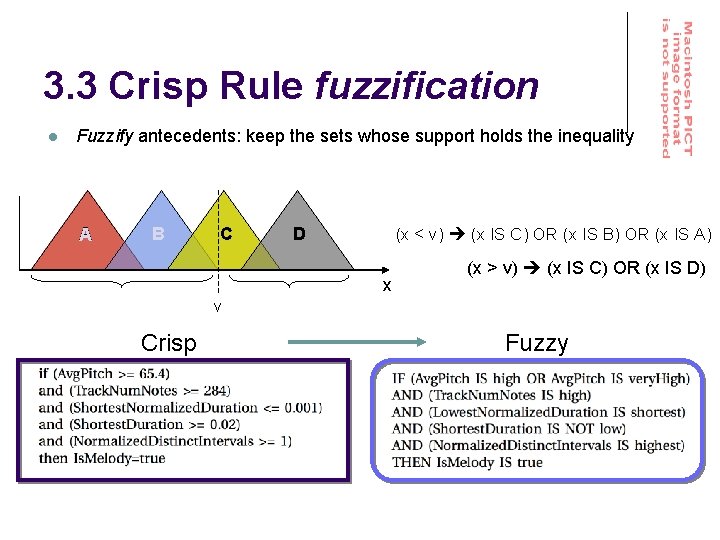
3. 3 Crisp Rule fuzzification l Fuzzify antecedents: keep the sets whose support holds the inequality A B C D (x < v) (x IS C) OR (x IS B) OR (x IS A) x (x > v) (x IS C) OR (x IS D) v Crisp Fuzzy
Experiments and results
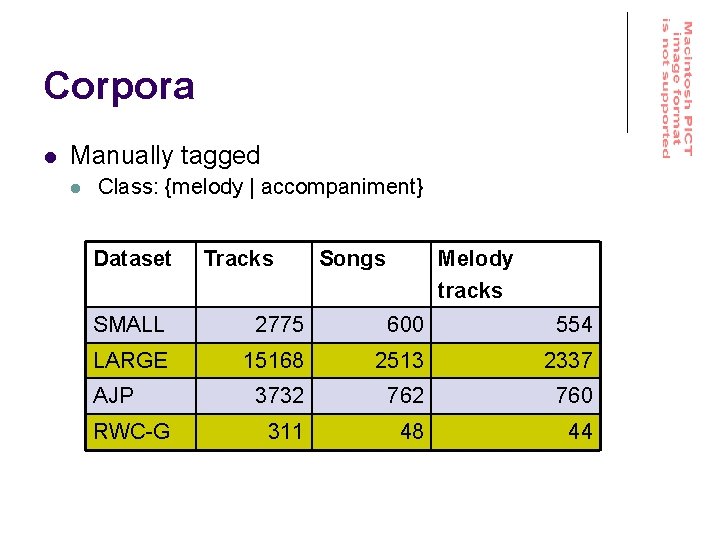
Corpora l Manually tagged l Class: {melody | accompaniment} Dataset Tracks Songs Melody tracks SMALL 2775 600 554 LARGE 15168 2513 2337 3732 760 311 48 44 AJP RWC-G
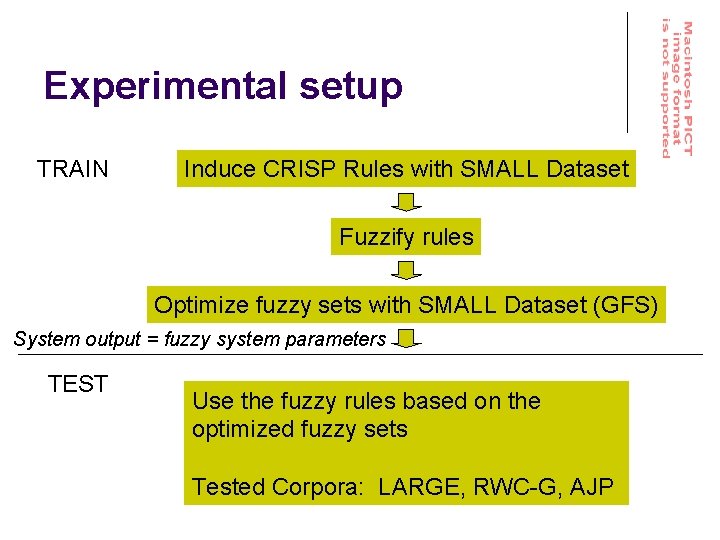
Experimental setup TRAIN Induce CRISP Rules with SMALL Dataset Fuzzify rules Optimize fuzzy sets with SMALL Dataset (GFS) System output = fuzzy system parameters TEST Use the fuzzy rules based on the optimized fuzzy sets Tested Corpora: LARGE, RWC-G, AJP

FIS optimization parameters Experiment parameter Values GA population size 100, 500, 1000 GA no. of generations 100, 500, 1000 GA mutation ratio none, 0. 05, 0. 1 GA selection strategy GA fitness metric Best one, Best 10%, Best 20% Hit count, F-measure Defuzzification threshold 0. 5, 0. 6, 0. 7
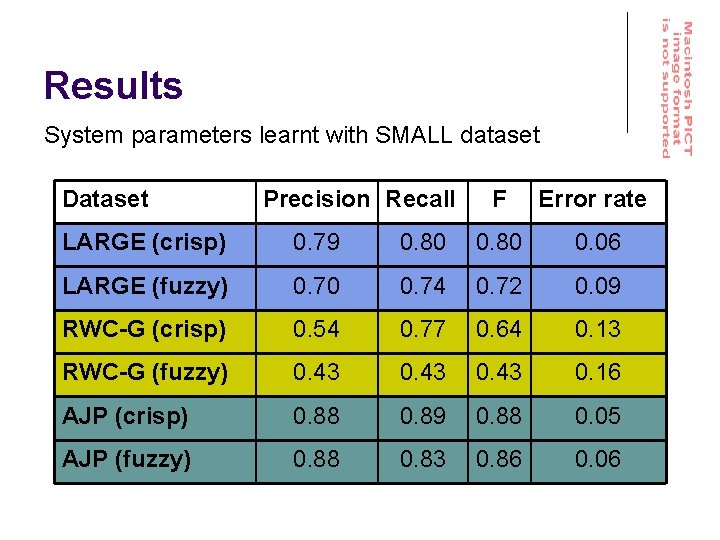
Results System parameters learnt with SMALL dataset Dataset Precision Recall F Error rate LARGE (crisp) 0. 79 0. 80 0. 06 LARGE (fuzzy) 0. 70 0. 74 0. 72 0. 09 RWC-G (crisp) 0. 54 0. 77 0. 64 0. 13 RWC-G (fuzzy) 0. 43 0. 16 AJP (crisp) 0. 88 0. 89 0. 88 0. 05 AJP (fuzzy) 0. 88 0. 83 0. 86 0. 06
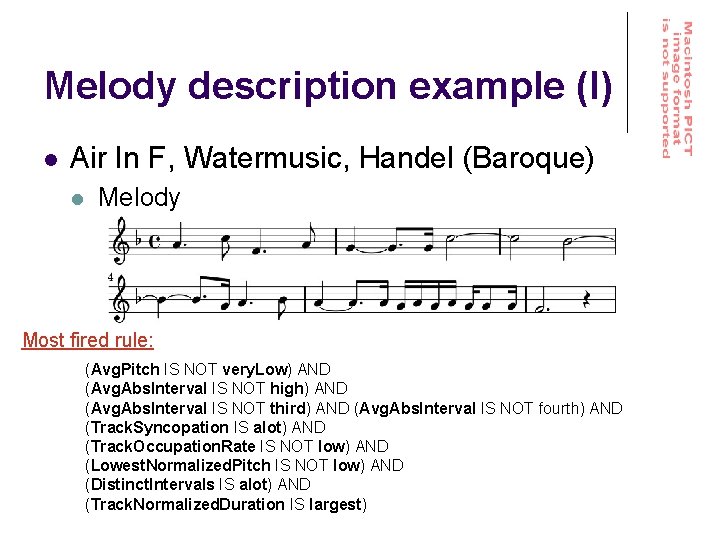
Melody description example (I) l Air In F, Watermusic, Handel (Baroque) l Melody Most fired rule: (Avg. Pitch IS NOT very. Low) AND (Avg. Abs. Interval IS NOT high) AND (Avg. Abs. Interval IS NOT third) AND (Avg. Abs. Interval IS NOT fourth) AND (Track. Syncopation IS alot) AND (Track. Occupation. Rate IS NOT low) AND (Lowest. Normalized. Pitch IS NOT low) AND (Distinct. Intervals IS alot) AND (Track. Normalized. Duration IS largest)
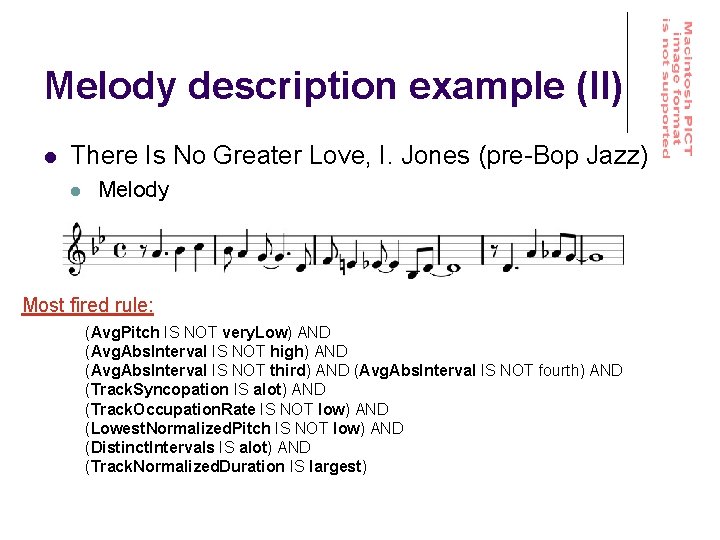
Melody description example (II) l There Is No Greater Love, I. Jones (pre-Bop Jazz) l Melody Most fired rule: (Avg. Pitch IS NOT very. Low) AND (Avg. Abs. Interval IS NOT high) AND (Avg. Abs. Interval IS NOT third) AND (Avg. Abs. Interval IS NOT fourth) AND (Track. Syncopation IS alot) AND (Track. Occupation. Rate IS NOT low) AND (Lowest. Normalized. Pitch IS NOT low) AND (Distinct. Intervals IS alot) AND (Track. Normalized. Duration IS largest)
Conclusions
Conclusions l l A melody fuzzy description system that is automatically induced from examples has been built The accuracy of this system is lower than that of the crisp rule system The readability of the rules have been improved We plan to improve the fuzzy rule system by: l l modifying the way it is optimized exploring different alternatives for rule fuzzification
- Slides: 25