
MEL 110 Development of surfaces 1 Development is


- Slides: 13
MEL 110 Development of surfaces 1
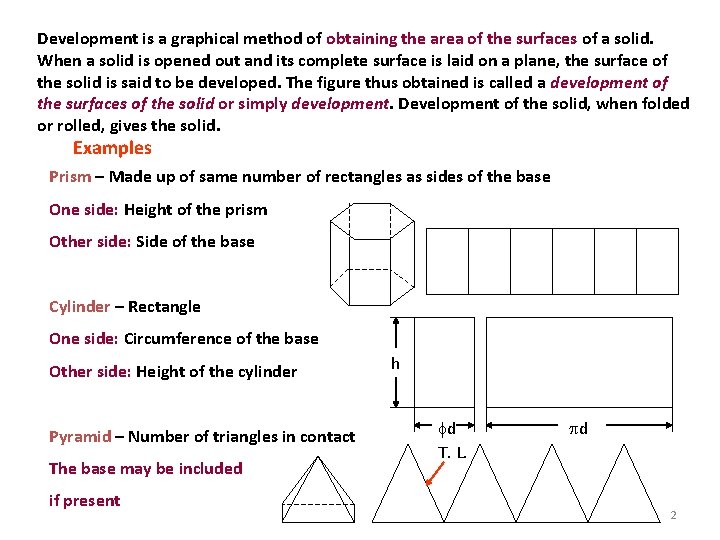
Development is a graphical method of obtaining the area of the surfaces of a solid. When a solid is opened out and its complete surface is laid on a plane, the surface of the solid is said to be developed. The figure thus obtained is called a development of the surfaces of the solid or simply development. Development of the solid, when folded or rolled, gives the solid. Examples Prism – Made up of same number of rectangles as sides of the base One side: Height of the prism Other side: Side of the base Cylinder – Rectangle One side: Circumference of the base Other side: Height of the cylinder Pyramid – Number of triangles in contact The base may be included if present h fd T. L. d 2
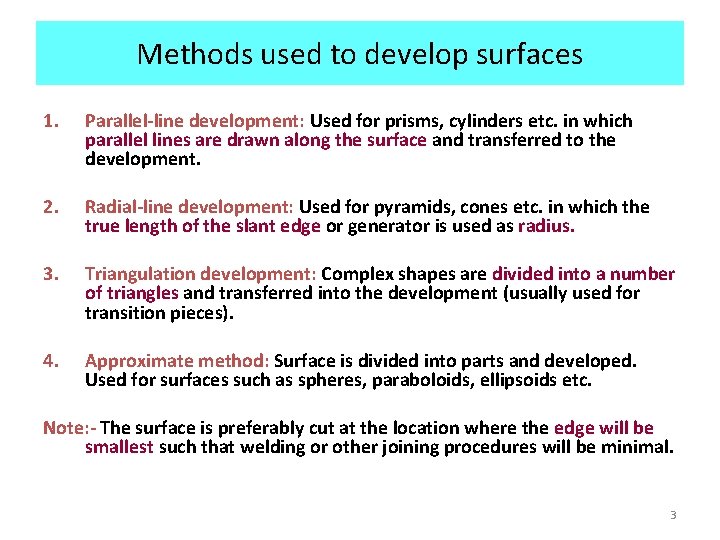
Methods used to develop surfaces 1. Parallel-line development: Used for prisms, cylinders etc. in which parallel lines are drawn along the surface and transferred to the development. 2. Radial-line development: Used for pyramids, cones etc. in which the true length of the slant edge or generator is used as radius. 3. Triangulation development: Complex shapes are divided into a number of triangles and transferred into the development (usually used for transition pieces). 4. Approximate method: Surface is divided into parts and developed. Used for surfaces such as spheres, paraboloids, ellipsoids etc. Note: - The surface is preferably cut at the location where the edge will be smallest such that welding or other joining procedures will be minimal. 3
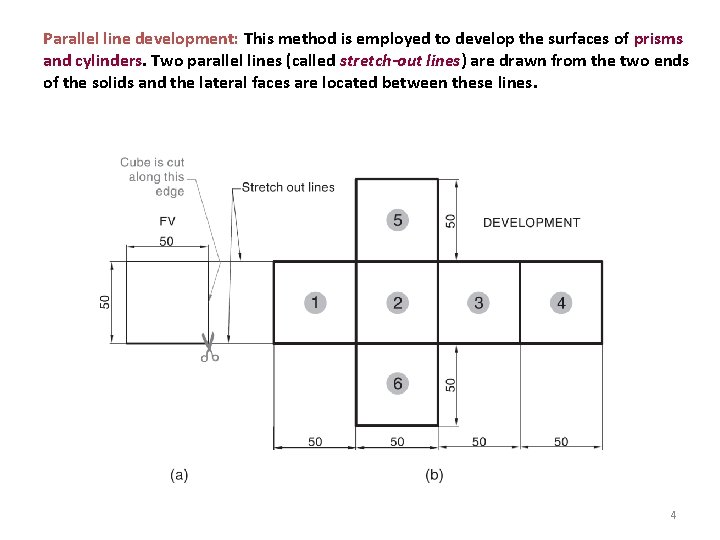
Parallel line development: This method is employed to develop the surfaces of prisms and cylinders. Two parallel lines (called stretch-out lines) are drawn from the two ends of the solids and the lateral faces are located between these lines. 4
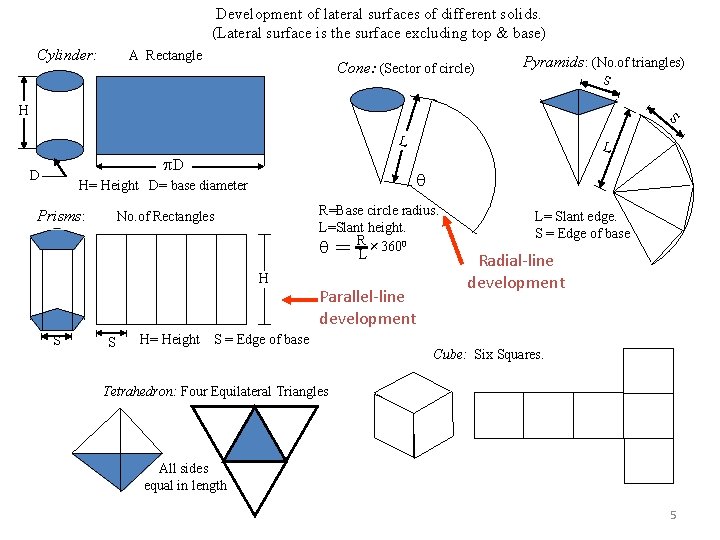
Development of lateral surfaces of different solids. (Lateral surface is the surface excluding top & base) A Rectangle Cone: (Sector of circle) Pyramids: (No. of triangles) L L S Cylinder: H S D D H= Height D= base diameter Prisms: = H S S H= Height + R=Base circle radius. L=Slant height. R 3600 L No. of Rectangles Parallel-line development S = Edge of base L= Slant edge. S = Edge of base Radial-line development Cube: Six Squares. Tetrahedron: Four Equilateral Triangles All sides equal in length 5
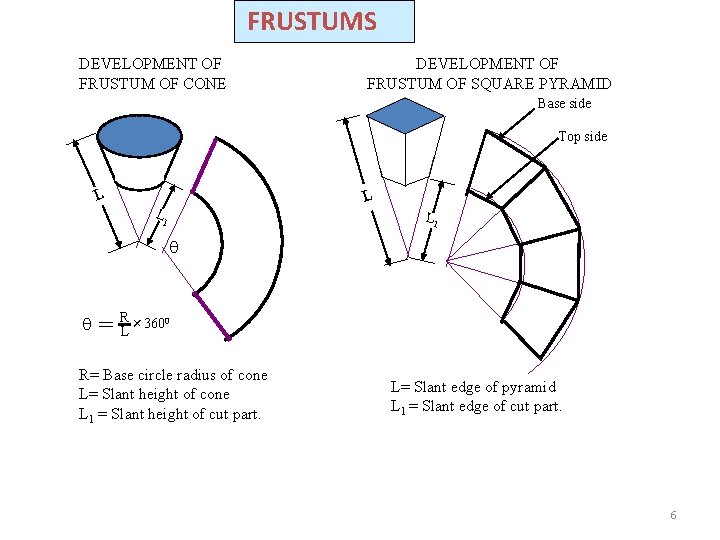
FRUSTUMS DEVELOPMENT OF FRUSTUM OF CONE DEVELOPMENT OF FRUSTUM OF SQUARE PYRAMID Base side Top side L L L 1 = R 3600 L + R= Base circle radius of cone L= Slant height of cone L 1 = Slant height of cut part. L= Slant edge of pyramid L 1 = Slant edge of cut part. 6
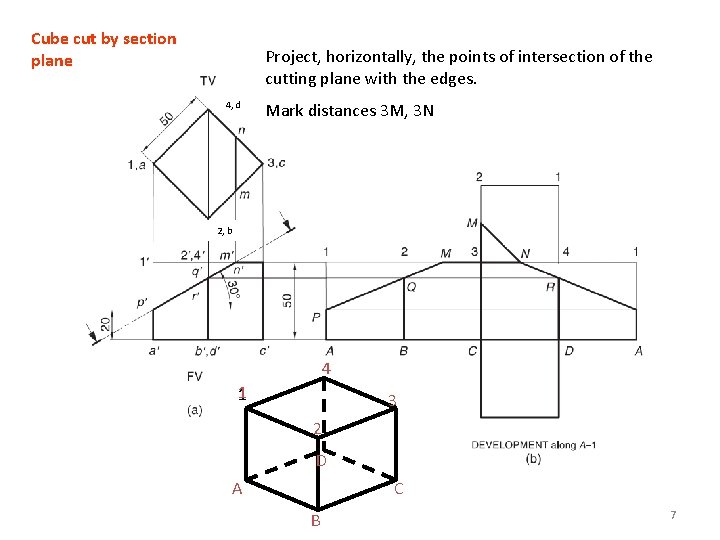
Cube cut by section plane Project, horizontally, the points of intersection of the cutting plane with the edges. 4, d Mark distances 3 M, 3 N 2, b 4 1 3 2 D A C B 7
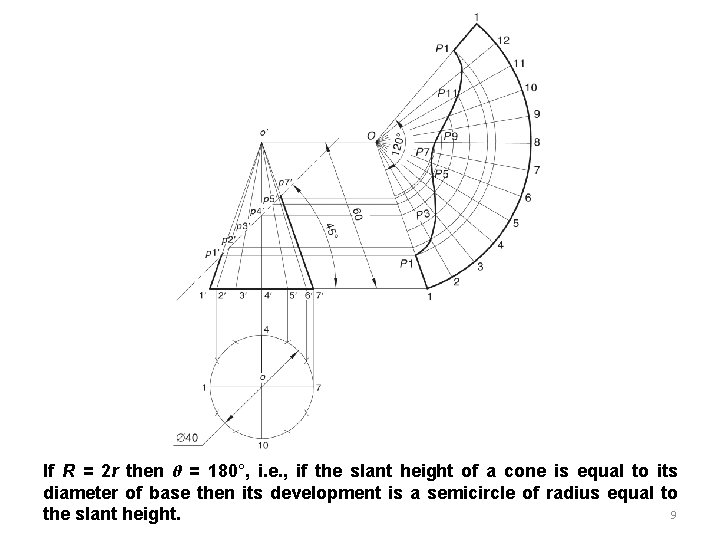
Draw the development of the lower portion of the cone surface cut by a plane. Cone base diameter is 40 mm and height is 50 mm. The cutting plane intersects the cone axis at an angle of 45 o and 20 mm below the vertex • Divide the cone in the top view and project the corresponding generator lines in the front view Radius of cone = R True lengths b 2, 2 o obtained by a auxiliary view method • Develop the complete surface of the cone by drawing an arc with radius = length of side generator of cone and length of arc = circumference of cone base o g 2 b f c d o e 1 b a 2 b c d • Mark the distances (true lengths) o 1, o 2…etc. in the development and T join them to get the development of the lower portion of the cone o 4’ l 3’ 2’ e fg 1 2 = R l 3600 + 3 4 • Obtain true lengths of o 1, o 2 etc. by auxiliary view, rotation method OR by projecting onto one of the side generators (which are in true length) F o 2 • Draw the corresponding generator lines l 3 4 a a b c d e f True length of (o 2, o 3) = (o 2’, o 3’) etc. g Length of arc = circumference of base of cone 8
If R = 2 r then θ = 180°, i. e. , if the slant height of a cone is equal to its diameter of base then its development is a semicircle of radius equal to 9 the slant height.
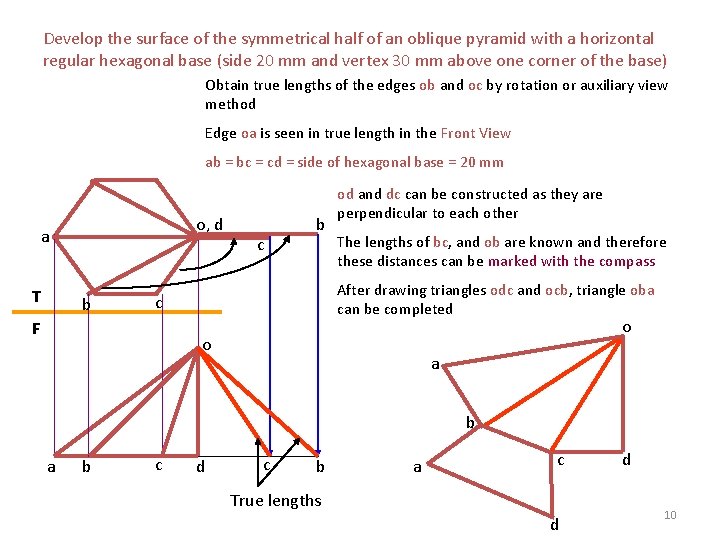
Develop the surface of the symmetrical half of an oblique pyramid with a horizontal regular hexagonal base (side 20 mm and vertex 30 mm above one corner of the base) Obtain true lengths of the edges ob and oc by rotation or auxiliary view method Edge oa is seen in true length in the Front View ab = bc = cd = side of hexagonal base = 20 mm o, d a T b c b The lengths of bc, and ob are known and therefore these distances can be marked with the compass After drawing triangles odc and ocb, triangle oba can be completed c F od and dc can be constructed as they are perpendicular to each other o o a b c d c b a c True lengths d d 10
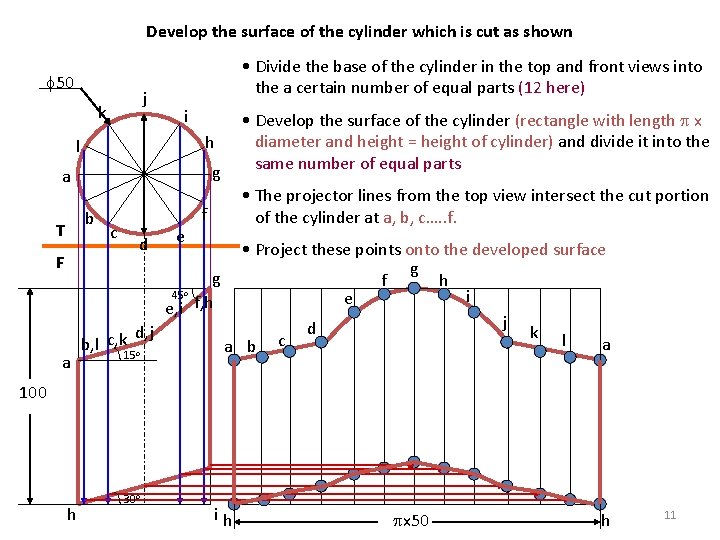
Develop the surface of the cylinder which is cut as shown f 50 j k • Divide the base of the cylinder in the top and front views into the a certain number of equal parts (12 here) i h l g a b T F a c • The projector lines from the top view intersect the cut portion of the cylinder at a, b, c…. . f. f d • Develop the surface of the cylinder (rectangle with length x diameter and height = height of cylinder) and divide it into the same number of equal parts e • Project these points onto the developed surface g g f h 45 o i e e, i f, h j d d, j k l b, l c, k 15 o a a b c 100 h 30 o ih x 50 h 11
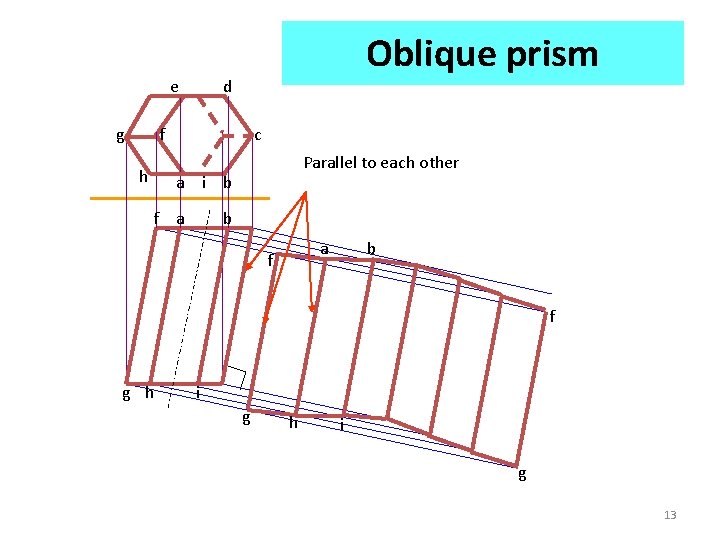
e g Oblique prism d f h c Parallel to each other a i b f a b a f b f g h i g 13