
Mekelle University College of Business and Economics Department
Mekelle University College of Business and Economics Department of Marketing Management • Teaching Material For The Course Strategic Marketing Management Undergraduate Regular Bachelors Degree Course Title: Strategic Marketing Management Course Code: Mktm 3112 Module Name: Strategic Marketing and Entrepreneurship Credit Hours: 4 Year/Semester: Year III Semester II Academic Year: 2019/20 instructor name: Absera Naizgi Abrha
CHAPTER ONE 1. OVERVIEW OF STRATEGIC MARKETING § Concept of Strategic Marketing Strategic marketing management is a system designed to help management both precipitate and make strategic decisions, as well as create strategic visions. A strategic decision involves the creation, change, or retention of a strategy. § In contrast to a tactical decision, a strategic decision is usually costly in terms of the resources and time required to reverse or change it. § § Strategic market management, or simply, strategic management, is motivated by the assumption that the planning cycle is inadequate to deal with the rapid rate of change that can occur in a firm’s external environment.
• Gary Hamel and C. K. Prahalad argue that managers should have a clear and shared understanding of how their industry may be different in 10 years and a strategy for competing in that world. They challenge managers to evaluate the extent to which • Management has a distinctive and farsighted view, rather than a conventional and reactive view, about the future. • Senior management focuses on regenerating core strategies rather than on reengineering core processes. • Competitors view the company as a rule maker rather than a rule follower. • The company’s strength is in innovation and growth rather than in operational efficiency. • The company is mostly out in front rather than catching up.
Cont’d • Within a given environment, marketing strategy deals essentially with the interplay of three forces known as the strategic three Cs: • the customer • the competition • and the corporation WHY STRATEGIC MARKETING MANAGEMENT? Precipitate the consideration of strategic choices. Force a long range view. Make visible the resource allocation decision. Aid strategic analysis and decision making.
Cont’d Provide a strategic management and control system. Provide both horizontal and vertical communication and coordination systems. Help a business cope with change. Characteristics of Strategic Marketing § Emphasis on long-term implications § Corporate inputs § Varying roles for different products/markets § External Market Orientation § Proactive Strategies § Importance of the Information System § Knowledge Management
Cont’d § § § Online Analysis and Decision Making Entrepreneurial Thrust Implementation Global Realities Empirical Research
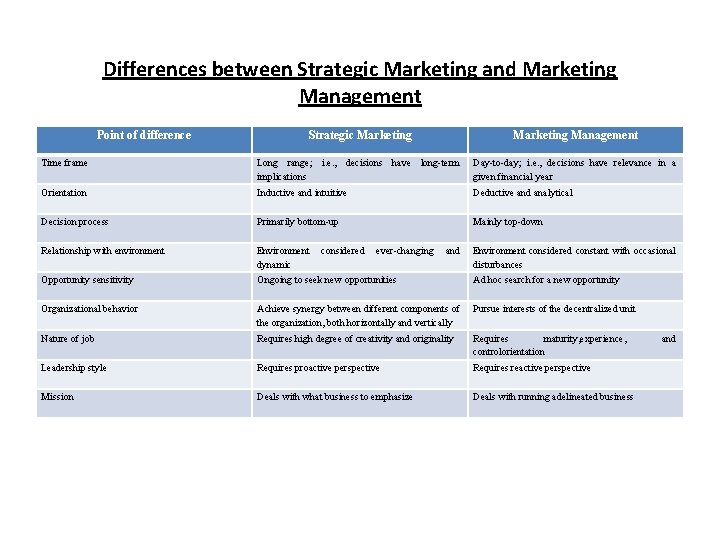
Differences between Strategic Marketing and Marketing Management Point of difference Strategic Marketing Management Time frame Long range; i. e. , decisions have long-term implications Day-to-day; i. e. , decisions have relevance in a given financial year Orientation Inductive and intuitive Deductive and analytical Decision process Primarily bottom-up Mainly top-down Relationship with environment Environment dynamic Opportunity sensitivity Ongoing to seek new opportunities Ad hoc search for a new opportunity Organizational behavior Achieve synergy between different components of the organization, both horizontally and vertically Pursue interests of the decentralized unit Nature of job Requires high degree of creativity and originality Requires maturity, experience, controlorientation Leadership style Requires proactive perspective Requires reactive perspective Mission Deals with what business to emphasize Deals with running adelineated business considered ever-changing and Environment considered constant with occasional disturbances and
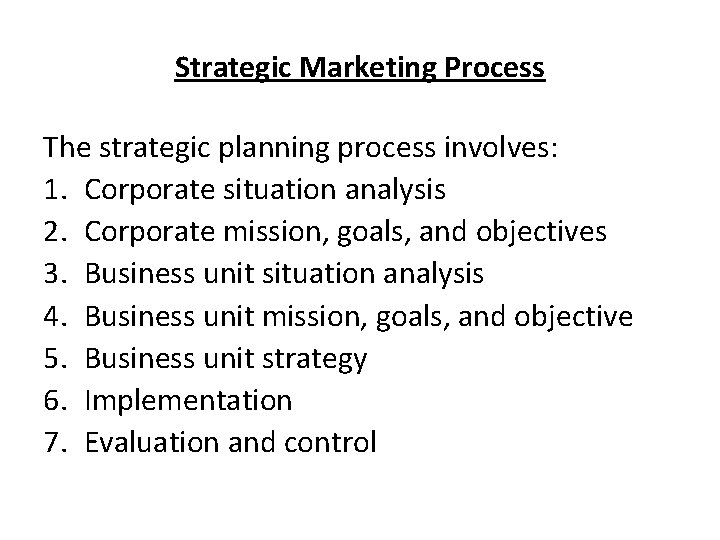
Strategic Marketing Process The strategic planning process involves: 1. Corporate situation analysis 2. Corporate mission, goals, and objectives 3. Business unit situation analysis 4. Business unit mission, goals, and objective 5. Business unit strategy 6. Implementation 7. Evaluation and control
CHAPTER TWO 2. MARKETING AUDIT AND ENVIRONMENTAL ANALYSIS • The marketing audit is in a number of ways the true starting point for the strategic marketing planning process, since it is through the audit that the strategist arrives at a measure both of environmental opportunities and threats and of the organization’s marketing capability. • Thus marketing audit is defined as a means by which a company can identify its own strengths and weaknesses as they relate to external opportunities and threats. It is thus a way of helping management to select a position in that environment based on known factors.
Cont’d Given this, the three major elements and potential benefits of the marketing audit can be seen to be: The detailed analysis of the external environment and internal situation The objective evaluation of past performance and present activities The clearer identification of future opportunities and threats. Structure and focus of marketing audit • In terms of its structure, the marketing audit consists of three major and detailed diagnostic steps. These involve a review of: 1. The organization’s environment (opportunities and threats) 2. Its marketing systems (strengths and weaknesses) 3. Its marketing activities. Stages of the audit Table 2. 1 Cannon’s five stages of audit (next page)
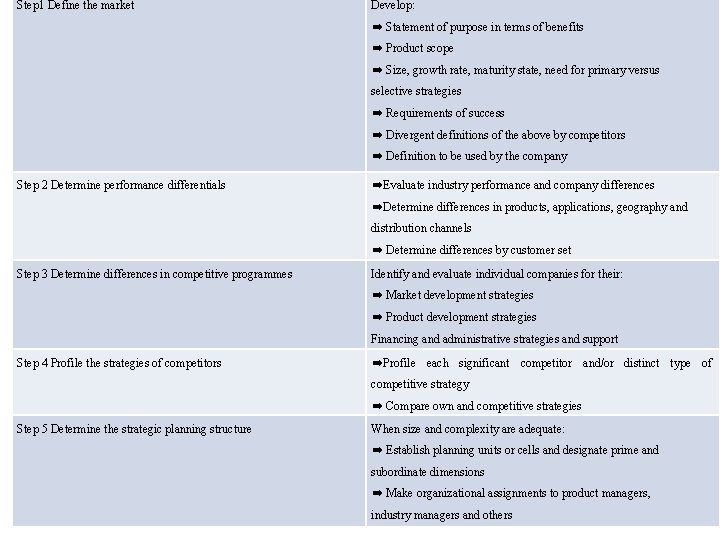
Step 1 Define the market Develop: ➡ Statement of purpose in terms of benefits ➡ Product scope ➡ Size, growth rate, maturity state, need for primary versus selective strategies ➡ Requirements of success ➡ Divergent definitions of the above by competitors ➡ Definition to be used by the company Step 2 Determine performance differentials ➡Evaluate industry performance and company differences ➡Determine differences in products, applications, geography and distribution channels ➡ Determine differences by customer set Step 3 Determine differences in competitive programmes Identify and evaluate individual companies for their: ➡ Market development strategies ➡ Product development strategies Financing and administrative strategies and support Step 4 Profile the strategies of competitors ➡Profile each significant competitor and/or distinct type of competitive strategy ➡ Compare own and competitive strategies Step 5 Determine the strategic planning structure When size and complexity are adequate: ➡ Establish planning units or cells and designate prime and subordinate dimensions ➡ Make organizational assignments to product managers, industry managers and others
Conducting effective audits • The characteristic of effective audits is that if they are to be worthwhile they should be comprehensive, systematic, independent and conducted on a regular basis. Components of the audit Within the general framework of the external and internal audits, there is the need to focus upon six specific dimensions. These are: 1. The marketing environment audit; This involves an analysis of the major macro-economic forces and trends within the organization’s task environment, including markets, customers, competitors, distributors, dealers and suppliers.
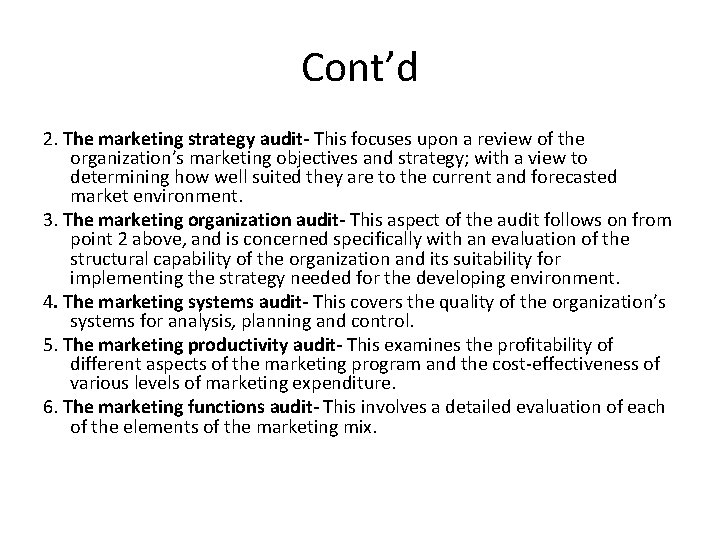
Cont’d 2. The marketing strategy audit- This focuses upon a review of the organization’s marketing objectives and strategy; with a view to determining how well suited they are to the current and forecasted market environment. 3. The marketing organization audit- This aspect of the audit follows on from point 2 above, and is concerned specifically with an evaluation of the structural capability of the organization and its suitability for implementing the strategy needed for the developing environment. 4. The marketing systems audit- This covers the quality of the organization’s systems for analysis, planning and control. 5. The marketing productivity audit- This examines the profitability of different aspects of the marketing program and the cost-effectiveness of various levels of marketing expenditure. 6. The marketing functions audit- This involves a detailed evaluation of each of the elements of the marketing mix.
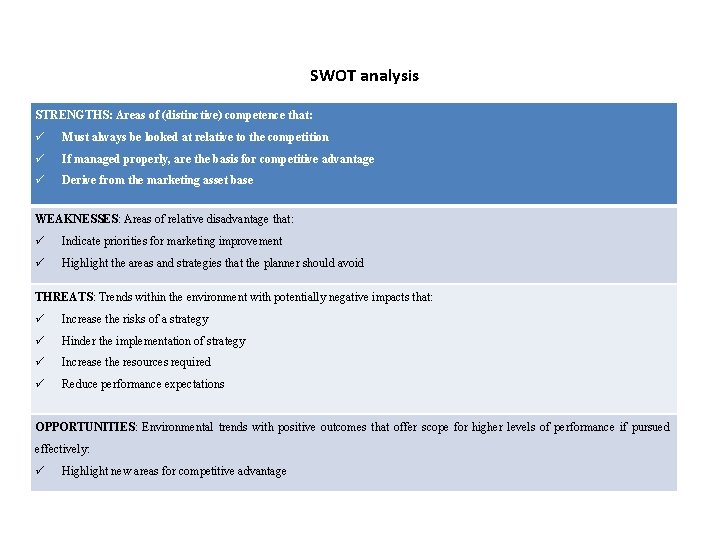
SWOT analysis STRENGTHS: Areas of (distinctive) competence that: Must always be looked at relative to the competition If managed properly, are the basis for competitive advantage Derive from the marketing asset base WEAKNESSES: Areas of relative disadvantage that: Indicate priorities for marketing improvement Highlight the areas and strategies that the planner should avoid THREATS: Trends within the environment with potentially negative impacts that: Increase the risks of a strategy Hinder the implementation of strategy Increase the resources required Reduce performance expectations OPPORTUNITIES: Environmental trends with positive outcomes that offer scope for higher levels of performance if pursued effectively: Highlight new areas for competitive advantage
The political, economic, social and technological (PEST) environments • Effective marketing planning is based on two important analytical ingredients. Ø First, market opportunity must be analyzed and, Ø second, the company’s ability to take advantage of these opportunities and cope with threats must be assessed. Ø Under the first heading, there are four basic building blocks:
Cont’d • Customers must be analyzed to determine how the market can be segmented and what the requirements of each segment are • Competitors must be identified and their individual strategies understood • Environmental trends (social, economic, political, technological) affecting the market must be isolated and forecasted • Market characteristics in terms of the evolution of supply and demand their interaction must be understood.
A. The political (and legal) environment • is composed of laws, pressure groups and government agencies, all of which exert some sort of influence and constraint on organizations and individuals in society. • This legislation has been designed to achieve a number of purposes, including: Protecting companies from each other so that the size and power of one organization to damage another is limited Protecting consumers from unfair business practice by ensuring that certain safety standards are met, that advertising is honest, and that generally companies are not able to take advantage of the possible ignorance, naivety and gullibility of consumers Protecting society at large from irresponsible business behavior
B. The economic and physical environments • The economic environment is typically seen as a constraint, since the ability of a company to exert any sort of influence on this element of the environment is, to all intents and purposes, negligible. • The sorts of changes that are currently taking place in the economic environment can be identified as: I. An increase in real income growth II. Continuing inflationary pressures III. Changes in the savings/debt ratio IV. Concern over levels of Third World debt V. Different consumer expenditure patterns
C. The social, cultural and demographic environments • In doing this, arguably the most useful and indeed logical starting point is that of demography, since not only is demographic change readily identifiable, but it is the size, structure and trends of a population that ultimately exert the greatest influence on demand. • There are several reasons for this, the two most significant of which are, first, that there is a strong relationship between population and economic growth and, second, that it is the absolute size of the population that acts as the boundary condition determining potential or primary demand.
Cont’d • a variety of other equally important and farreaching changes are currently taking place, including: v The growth in the number of one-person households; v A rise in the number of two-person cohabitant households; v. An increase in the number of group households v. A much greater degree of social mobility
D. The technological environment • Technological advance needs to be seen as a force for ‘creative destruction’ in that the development of new products or concepts has an often fatal knockout effect on an existing product. • Therefore the areas to which the marketing planner should pay attention include: o The accelerating pace of technological change o Unlimited innovational opportunities o Higher research and development budgets o A concentration of effort in some industries on minor product improvements o A greater emphasis upon the regulation of technological change
CHAPTER THREE COMPETITIVE ANALYSIS • Competitive analysis should be a central element of the marketing planning process, with detailed attention being paid to each competitor’s apparent objectives, resources, capabilities, perceptions and competitive stance, as well as to their marketing plans and the individual elements of the marketing mix. • Recognition of these points leaves the strategist needing to answer five questions: • 1. Against whom are we competing? • 2. What strengths and weaknesses do they possess? • 3. What are their objectives? • 4. What strategies are they pursuing and how successful are they? • 5. How are they likely to behave and, in particular, how are they likely to react to offensivemoves?
Intensity, or Degree, of Competition • • • • The degree of competition in a market depends on the moves and counter moves of various firms active in the market. Intense competitive activity may or may not be injurious to the industry as a whole. For example, while a price war may result in lower profits for all members of an industry, an advertising battle may increase demand actually be mutually beneficial. The following are the factors that affect the intensity of competition in the marketplace: Opportunity Potential Ease of Entry Nature of Product Exit Barriers Homogeneity of the Market Industry Structure Commitment to the Industry Feasibility of Technological Innovations Scale Economies Economic Climate Diversity of Firms
Against whom are we competing? A. Identifying present competitors and new entrants • Although the answer to the question of who it is that a company is competing against might appear straightforward, the range of actual and potential competitors faced by a company is often far broader than appears to be the case at first sight. • in general, companies tend to overestimate the capabilities of large competitors and either underestimate or ignore those of smaller ones.
Cont’d • It is possible to see competition operating at four levels: • 1. Brand competition: A company sees its competitors as other companies that offer similar products and services to the same customers at similar prices. • 2. Industry competition: A company sees its competitors as all companies that make the same product or class of products. • 3. Form competition: A company sees its competitors as all companies that manufacture products that supply the same service. • 4. Generic competition: A company sees its competitors as all companies that compete for the same consumer dollars.
B. The industry perspective of competition • An industry is seen to consist of firms offering a product or class of products or services that are close substitutes for one another; a close substitute in these circumstances is seen to be a product for which there is a high cross-elasticity of demand. • An industry can typically be categorized in terms of five types: • 1. An absolute monopoly, in which, because of patents, licenses, scale economics or some other factor, only one firm provides the product or service. 2. A differentiated oligopoly, where a few firms produce products that are partially differentiated. 3. A pure oligopoly, in which a few firms produce broadly the same commodity. 4. Monopolistic competition, in which the industry has many firms offering a differentiated product or service. 5. Pure competition, in which numerous firms offer broadly the same product or service. • •
C. The market perspective of competition • As an alternative to the industry perspective of competition, which takes as its starting point companies making the same product or offering the same service, we can focus on companies that try to satisfy the same customer needs or that serve the same customer groups. . Identifying and evaluating competitors’ strengths and weaknesses By this stage it should be apparent that the identification and evaluation of competitors’ strengths, weaknesses and capabilities is at the very heart of a well-developed competitive strategy.
Evaluating competitive relationships and analyzing how organizations compete • In essence, five types of relationship can develop between an organization and its competitors: • 1. Conflict: where the firm sets out to destroy, damage or force the competitor out of the market. • 2. Competition: where two or more firms are trying to achieve the same goals and penetrate the same markets with broadly similar product offers.
Cont’d • • 3. Coexistence: where the various players act largely independently of others in the market. This may in turn be due to the marketing planner being unaware of the competition; recognizing them but choosing to ignore them; or behaving on the basis that each firm has certain territorial rights that, tacitly, each player agrees not to infringe. 4. Cooperation: where one or more firms work together to achieve interdependent goals. Typically, this is done on the basis of exchanging information, licensing arrangements, joint ventures and through trade associations. 5. Collusion: although typically illegal, has as its purpose that of damaging another organization or, more frequently, ensuring that profit margins and the status quo are maintained. Given this, any analysis of how firms compete falls into four parts: 1. What is each competitor’s current strategy? 2. How are competitors performing? 3. What are their strengths and weaknesses? 4. What can we expect from each competitor in the future?
Identifying competitors’ objectives • Each competitor has a variety of objectives, each of which has a different weight. These objectives might typically include cash flow, technological leadership, market share growth, service leadership or overall market leadership. • Several factors are likely to influence this level of commitment, the five most important of which are likely to be: • 1. The proportion of company profits that this market sector generates • 2. The managerial perceptions of the market’s growth opportunities • 3. The levels of profitability that exist currently and that are expected to exist in the future • 4. Any interrelationships between this and any other product or market sector in which the organization operates • 5. Managerial cultures – in some companies, for example, any threat will be responded to aggressively almost irrespective of whether it is costeffective.
Identifying competitors’ likely response profiles • Although knowledge of a competitor’s size, objectives and capability (strengths and weaknesses) can provide the strategist with a reasonable understanding of possible responses to company moves such as price cuts, the launch of new products and so on, other factors need to be examined. • The issue of how a competitor is likely to behave in the future has two components. Firstly, how is a competitor likely to respond to the general changes taking place in the external environment and, in particular, in the marketplace? Secondly, how is that competitor likely to respond to specific competitive moves that we, or indeed any other company, might make?
Competitor analysis and the development of strategy • Given the nature of our comments so far, how then does the analysis of competitors feed in to the development of a strategy? Only rarely can marketing strategy be based just on the idea of winning and holding customers.
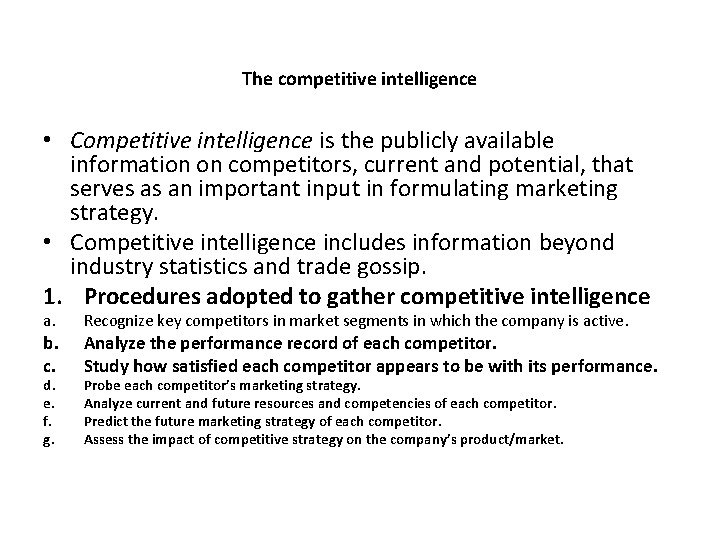
The competitive intelligence • Competitive intelligence is the publicly available information on competitors, current and potential, that serves as an important input in formulating marketing strategy. • Competitive intelligence includes information beyond industry statistics and trade gossip. 1. Procedures adopted to gather competitive intelligence a. Recognize key competitors in market segments in which the company is active. d. e. f. g. Probe each competitor’s marketing strategy. Analyze current and future resources and competencies of each competitor. Predict the future marketing strategy of each competitor. Assess the impact of competitive strategy on the company’s product/market. b. c. Analyze the performance record of each competitor. Study how satisfied each competitor appears to be with its performance.
2. Sources of competitive intelligence • Essentially, three sources of competitive intelligence can be distinguished: • (a) what competitors say about themselves, • (b) what others say about them, and • (c) what employees of the firm engaged in competitive analysis have observed and learned about competitors.
CHAPTER FOUR THE FORMULATION OF STRATEGY • Targeting and positioning strategy a. Evaluating market segments • To evaluate different market segments effectively it is necessary to systematically review two issues: the market attractiveness of the competing segments and the organization’s comparative ability to address the needs of that segment. • These fall under three broad headings: market factors, the nature of competition and the wider environmental factors.
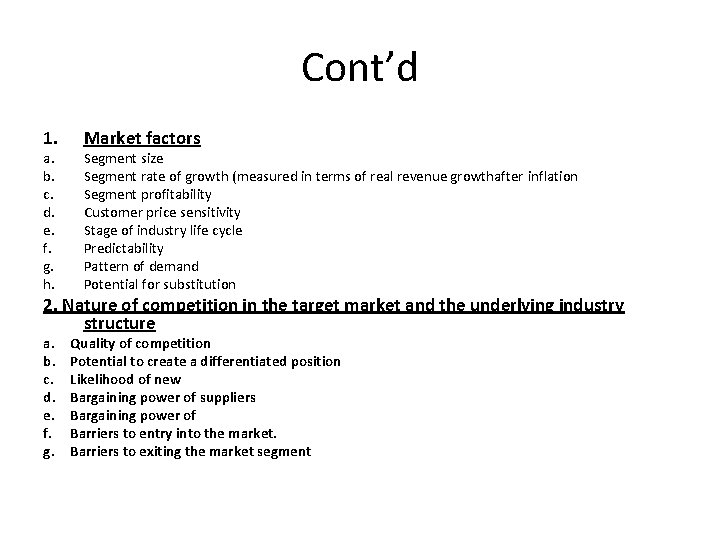
Cont’d 1. a. b. c. d. e. f. g. h. Market factors Segment size Segment rate of growth (measured in terms of real revenue growthafter inflation Segment profitability Customer price sensitivity Stage of industry life cycle Predictability Pattern of demand Potential for substitution 2. Nature of competition in the target market and the underlying industry structure a. b. c. d. e. f. g. Quality of competition Potential to create a differentiated position Likelihood of new Bargaining power of suppliers Bargaining power of Barriers to entry into the market. Barriers to exiting the market segment
Cont’d 3. Environmental factors a. b. c. d. e. Social Political Economic Technology Environmental Positioning and its alternatives • Having selected a target market or markets the organization then has to decide on what basis it will compete in the chosen segment or segments. • How best can it combine its assets and competencies to create a distinctive offering in the market? This has to be done in such a way that consumers can allocate a specific position to the company’s product or service within the market, relative to other products.
Cont’d • A brand can be positioned using a range of associations: • Product attributes. • Usage occasions. • Users. • Activities. • Personality. • Origin. • Competitors. • Product class. • Symbol Four factors are of critical importance for successful positioning(Jobber, 1995): • Credence • Competitiveness • Consistency • Clarity
Planning with SBUs • The idea of SBUs as the basis for planning first emerged in the 1960 s and gave recognition to the fact that the majority of companies operate a number of businesses, not all of which will necessarily be immediately apparent or identifiable. SBUs exhibit a number of characteristics, the three most important of which are that an SBU: • 1. It is a single business or a collection of related businesses that offer scope for independent planning and might feasibly stand alone from the rest of the organization. • 2. Has its own set of competitors • 3. Has a manager who has responsibility for strategic planning and profit performance, and control of profitinfluencing factors.
Cont’d Models of portfolio analysis A. The Boston Consulting Group’s growth–share matrix • Undoubtedly the best-known approach to portfolio analysis, the Boston Consulting Group’s (BCG) growth–share model involves SBUs being plotted on a matrix according to the rate of market growth and their market share relative to that of the largest competitor. a. Dogs (low share, low growth); Dogs are those businesses that have a weak market share in a low-growth market. Typically they generate either a low profit or return a loss. b. Question marks (low share, high growth) • Question marks are businesses operating in high-growth markets but with a low relative market share. Theygenerally require considerable sums of cash since the firm needs to invest in plant, equipment and manpowerto keep up with market developments.
Cont’d c. Stars (high share, high growth) • Stars are those products which have moved to the position of leadership in a high growth market. Their cash needs are often high with the cash being spent in order to maintain market growth and keep competitors at bay. d. Cash cows (high share, low growth) • When the rate of market growth begins to fall, stars typically become the company‘s cash cows. The termcash cow is derived from the fact that it is these products which generate considerable sums of cash for theorganization but which, because of the lower rate of growth, use relatively little. Because of the SBU‘sposition in the market, economies of scale are often considerable and profit margins high.
Cont’d • • Having identified the shape of the portfolio, the planner needs then to consider theobjectives, strategy and budget for each SBU. In essence, four major strategies can bepursued: 1. Build. In following a building strategy, the primary objective is to increase the SBU’smarket share in order to strengthen its position. In doing this, short-term earningsand profits are quite deliberately forsaken in the expectation that long-term returnswill be far greater. It is a strategy that is best suited to question marks, so that theybecome stars. • 2. Hold. The primary objective in this case is to maintain the current share. It is the strategythat typically is used for cash cows to ensure they continue to generate the maximumamounts of cash. • 3. Harvest. By following a harvesting strategy, management tries to increase short-termcash flows as far as possible, even at the expense of the SBU’s longer-term future. It isa strategy best suited to cash cows that are weak or are in a market with seeminglyonly a limited future life. • 4. Divest or terminate. The essential objective here is to rid the organization of SBUs that actas a drain on profits or to realize resources that can be used to greater effect elsewhere inthe business. It is a strategy that, again, is often used for question marks and dogs.
Porter’s three generic competitive strategies a. Overall cost leadership- By pursuing a strategy of cost leadership, the organization concentrates upon achieving the lowest costs of production and distribution so that it has the capability of setting its prices at a lower level than its competitors. b. Differentiation- By pursuing a strategy of differentiation, the organization gives emphasis to a particular element of the marketing mix that is seen by customers to be important and, as a result, provides a meaningful basis for competitive advantage. c. Focus-The third of the generic strategies identified by Porter involves the organization in concentratingits efforts upon one or more narrow market segments, rather than pursuing abroader-based strategy.
Strategies for leaders, followers, challengers, and nichers • Market leader- In the majority of industries there is one firm that is generally recognized to be the leader. • Market challengers and followers- Firms with a slightly smaller market share can adopt one of two stances. They may choose to adopt an aggressive stance and attack other firms, including the market leader, in an attempt to gain share and perhaps dominance(market challengers), or they may adopt a less aggressive stance in order to maintain the status quo (market followers). • Market nichers- Virtually every industry has a series of small firms that survive, and indeed often prosper, by choosing to specialize in parts of the market that are too limited in size and potential to be of real interest to larger firms.
CHAPTER FIVE 5. THE STRATEGIC MANAGEMENT OF THE MARKETING MIX 1. Product decisions and strategy • Because the product is at the very heart of marketing strategy, the need to manage it strategically is of paramount importance, since how well this is done is the key both to the organization’s overall financial performance and to the gaining and retaining of market share. • We can identify four types of product strategy: a. A market leader product strategy b. A leadership challenging product strategy, which might translate, initially at least, into ‘the strategy of the fast second’, whereby the firm allows the existing leader to incur the costs and risks of developing a new product and then moves in rapidly after the launch with a copy or an improved version of the product c. A product following strategy d. A me-too product strategy.
Cont’d • Approaches to price setting • in some industries at least, organizations have little choice other than to follow the prices set by the market leader leads to the hypothesis that there are two types of firm: 1. Price-takers, which, by virtue of their size and market position, lack of product differentiation or passive organizational culture, are either unable or unwilling to adopt a proactive pricing stance. As a result, they follow the lead set by one or more larger and more aggressive organizations within the industry. 2. Price-makers, which, largely as the result of their size and power within the market, are able to determine the levels and patterns of price that others then follow.
Cont’d • Deciding on the pricing objectives Pricing objectives can be; • 1. Survival. • 2. Return on investment. • 3. Market stabilization. • 4. The maintenance and improvement of market position. • 5. Meeting or following competition. • 6. Pricing to reflect product differentiation. • 7. Market skimming. • 8. Market penetration • 9. Early cash recovery. • 10. Discouraging others from entering the market.
Cont’d Promotion and marketing communications • For many organizations marketing communications represent the most visible face of the organization. The question of how the communications program is to be managed is therefore a fundamental part of the strategic marketing task. • marketing strategist needs to pay attention when developing the guidelines for the communications program. In doing this, the marketing planner needs to take account of eight areas:
Cont’d 1. The nature and detail of the target audience(s)2. The short- and long-term communications objective(s) 3. The messages that are to be used 4. The communication channels that will carry the message • 5. the budget • 6 and 7. The mix of communication tools that is to be used and how the elements of the promotions mix are to be integrated and how, in turn, the promotions mix is to be integrated with the marketing mix • 8. How the results of the campaign are to be measured- • •
Cont’d Distribution strategies and the distribution plan • Channel management- embraces the analysis, planning, organizing and controlling of an enterprise’s channel of distribution. Key decisions in channel management 1. Formulating the channel strategy 2. Designing the channel structure • ➡ Intensive distribution, often sought by manufacturers of high-volume, low-value products in mass demand for which the typical pattern of buying behavior is that of habit and convenience. • ➡Selective distribution, used by manufacturers of consumer durables for which the typical pattern of buying behavior is that of ‘shopping around’. Most consumers will make an effort to compare the offerings available in different outlets. • ➡Exclusive distribution, which arises when the producer limits the number of intermediaries more strictly to one per geographical area.
Cont’d • 3. Selecting the channel members • • In developing this part of the distribution plan consideration needs to be given to: ➡Economic criteria, which will reflect the pattern and levels of costs, sales revenue andprofit. As each alternative channel configuration is likely to produce different levelsof sales revenue and costs, the best alternative is not necessarily that producing themost or the least respectively, but the one which produces the best relationshipbetween the two – i. e. profit. ➡Control criteria, which relate to the degree of influence, motivation and conflictamong channel members. For example, an agent who handles many different manufacturers’lines will probably not be seen favorably by manufacturer “A” because theagent will put his own interests ahead of A’s in endeavoring to sell any line – notjust A’s – and this can lead to friction. ➡Adaptive criteria, by which the manufacturer is able to preserve some flexibility inresponding to changing conditions. Long-term franchise agreements are antitheticalto adaptive behavior within distribution channels. ➡End-user considerations, since it would not be helpful to select intermediaries notfavored by customers further down the supply chain ➡Product characteristics, including the complexity, special application requirements, servicing needs and so forth that channel members must be competent to handle ➡Manufacturer’s capability and resources, which are reflected in bargaining power andchannel control. • • •

• THE END!
- Slides: 52