
MEK 400 Experimental methods in fluid mechanics Introduction


- Slides: 38
MEK 400 – Experimental methods in fluid mechanics Introduction to Particle Image Velocimetry (PIV) 26. 2. 2013 J. Kristian Sveen (IFE/FACE/Ui. O)
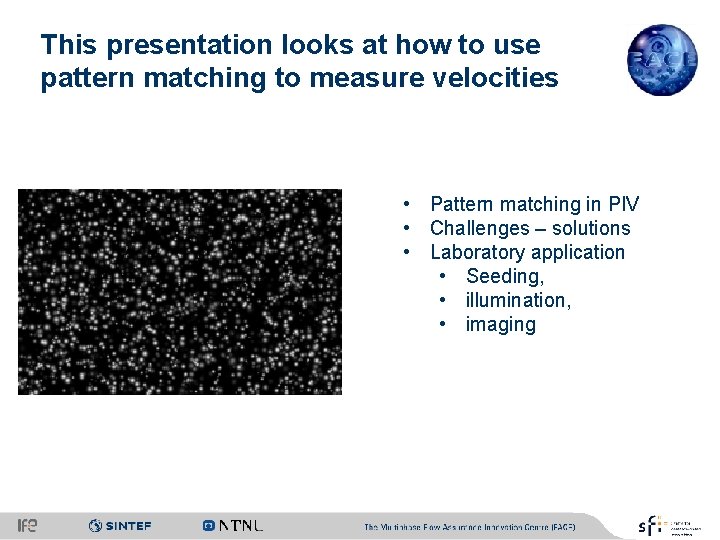
This presentation looks at how to use pattern matching to measure velocities • Pattern matching in PIV • Challenges – solutions • Laboratory application • Seeding, • illumination, • imaging
The human brain is great at matching patterns Computers perhaps a little less great
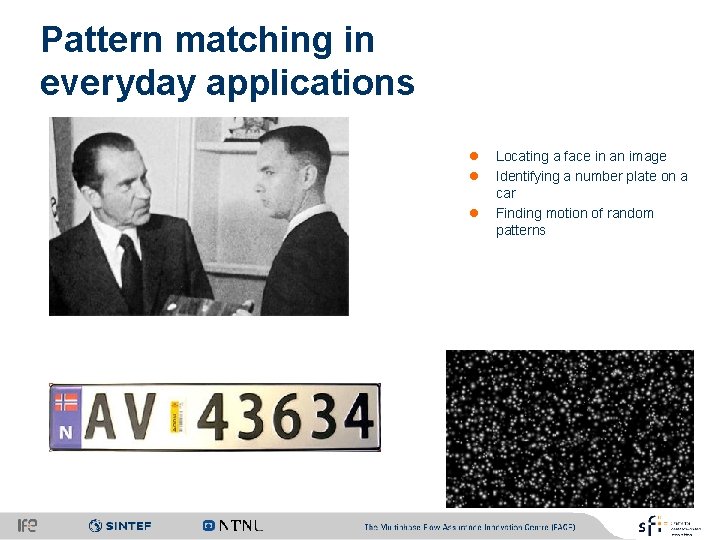
Pattern matching in everyday applications l l l Locating a face in an image Identifying a number plate on a car Finding motion of random patterns
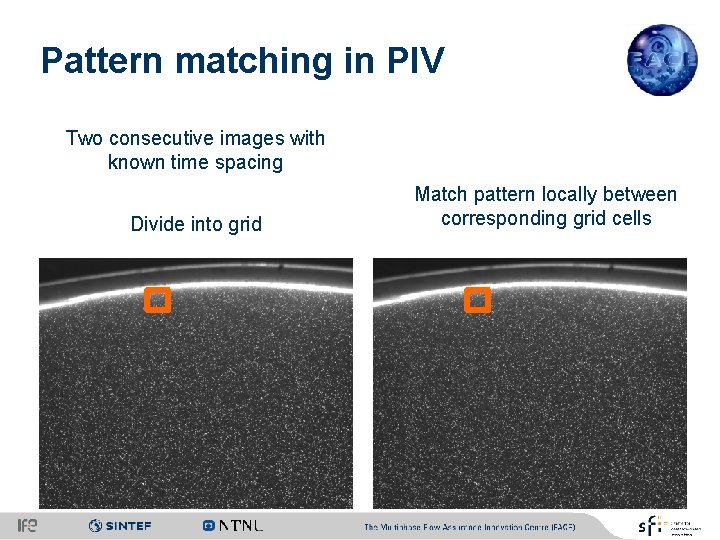
Pattern matching in PIV Two consecutive images with known time spacing Divide into grid Match pattern locally between corresponding grid cells
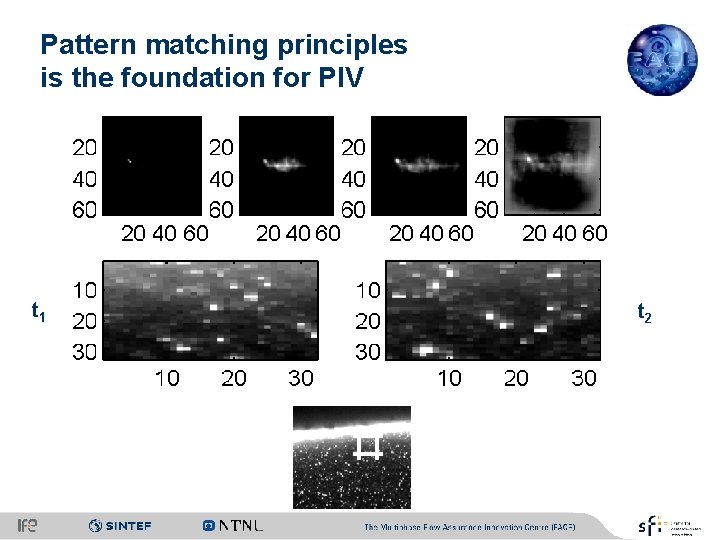
Pattern matching principles is the foundation for PIV t 1 t 2
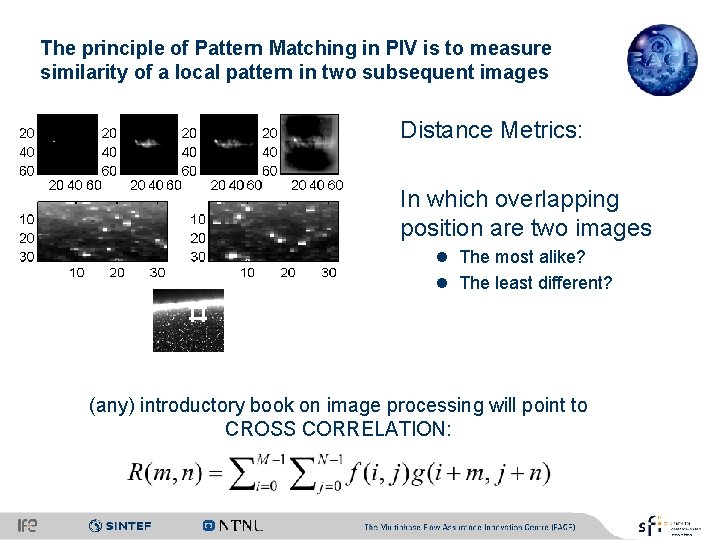
The principle of Pattern Matching in PIV is to measure similarity of a local pattern in two subsequent images Distance Metrics: In which overlapping position are two images l The most alike? l The least different? (any) introductory book on image processing will point to CROSS CORRELATION:
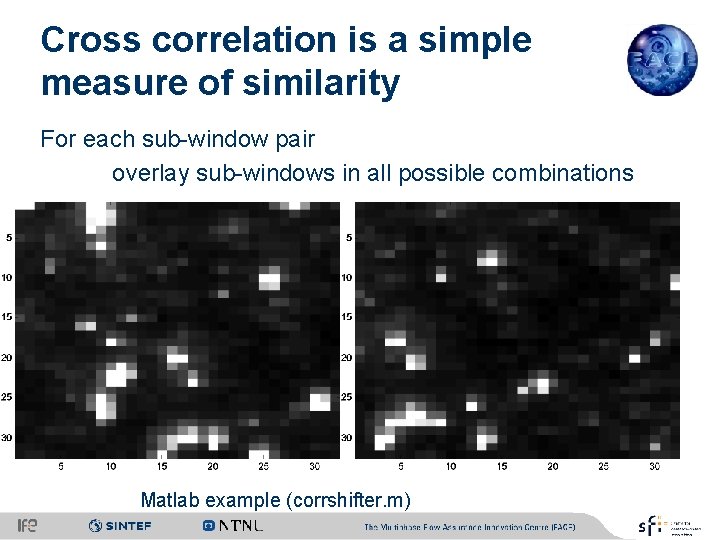
Cross correlation is a simple measure of similarity For each sub-window pair overlay sub-windows in all possible combinations Matlab example (corrshifter. m)
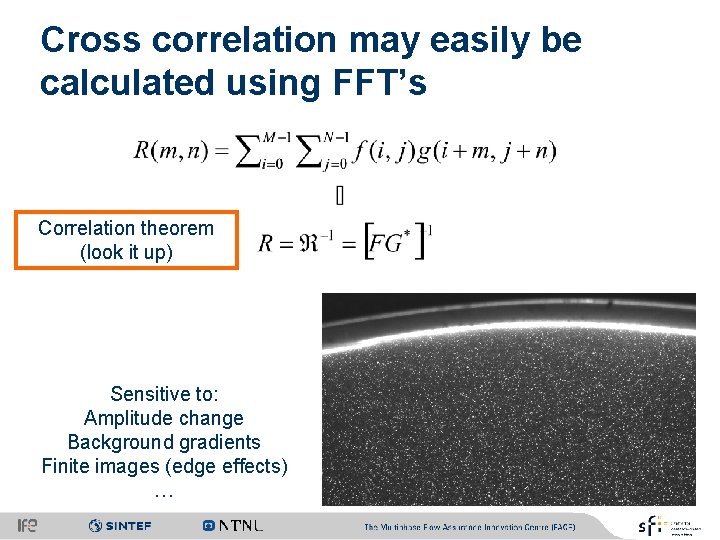
Cross correlation may easily be calculated using FFT’s Correlation theorem (look it up) Sensitive to: Amplitude change Background gradients Finite images (edge effects) …
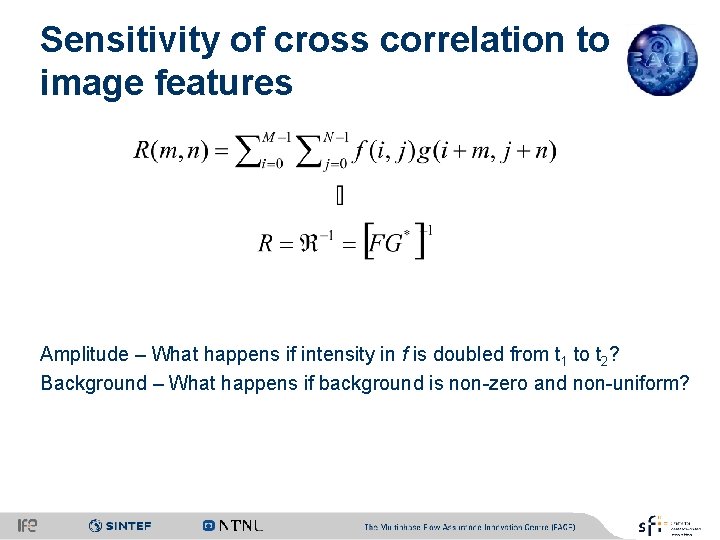
Sensitivity of cross correlation to image features Amplitude – What happens if intensity in f is doubled from t 1 to t 2? Background – What happens if background is non-zero and non-uniform?
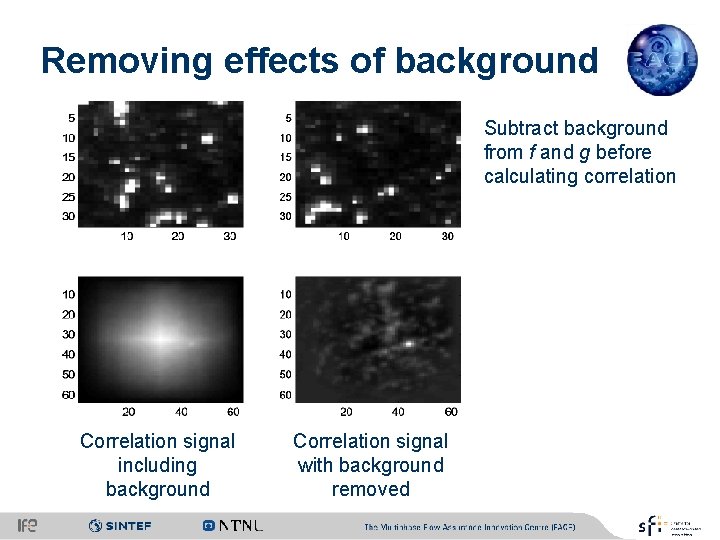
Removing effects of background Subtract background from f and g before calculating correlation Correlation signal including background Correlation signal with background removed
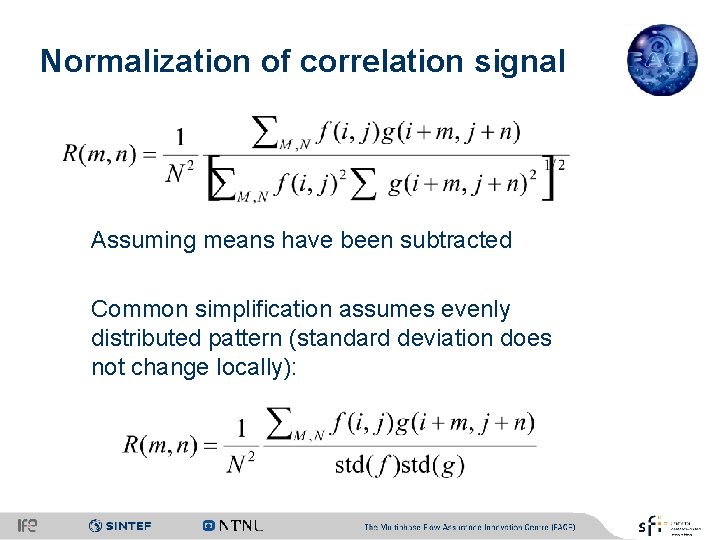
Normalization of correlation signal Assuming means have been subtracted Common simplification assumes evenly distributed pattern (standard deviation does not change locally):
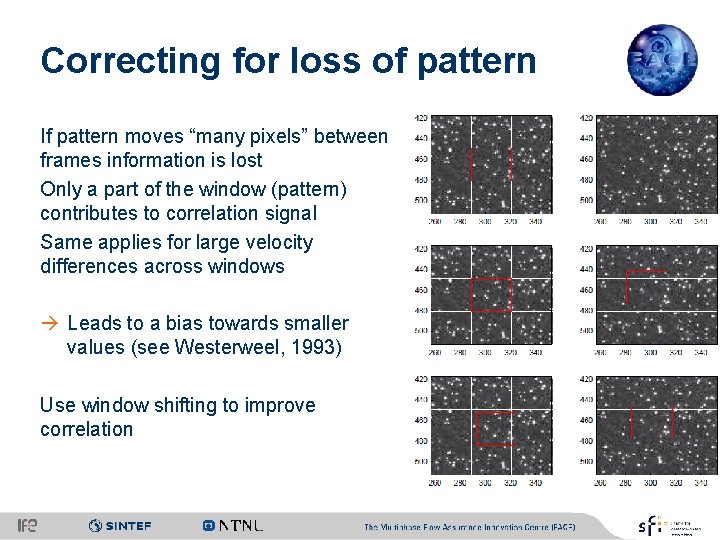
Correcting for loss of pattern If pattern moves “many pixels” between frames information is lost Only a part of the window (pattern) contributes to correlation signal Same applies for large velocity differences across windows Leads to a bias towards smaller values (see Westerweel, 1993) Use window shifting to improve correlation
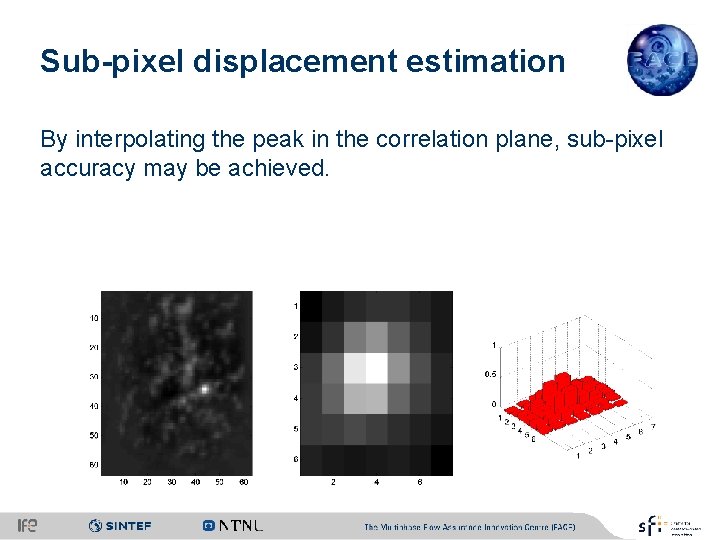
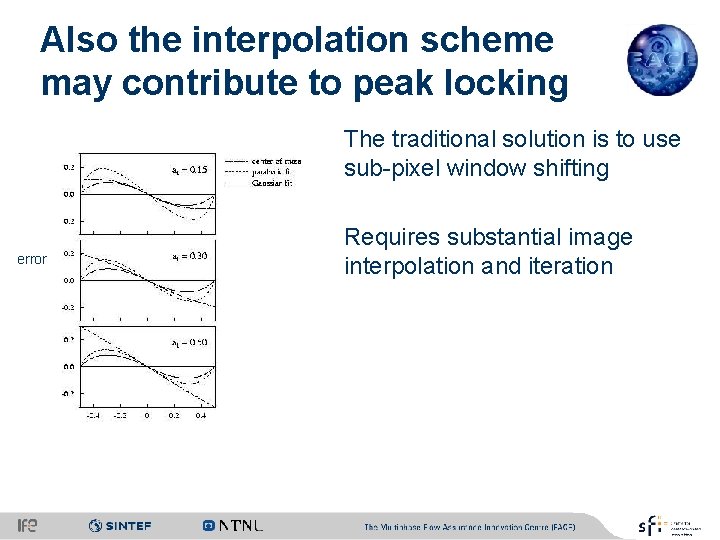
Sub-pixel displacement estimation By interpolating the peak in the correlation plane, sub-pixel accuracy may be achieved.
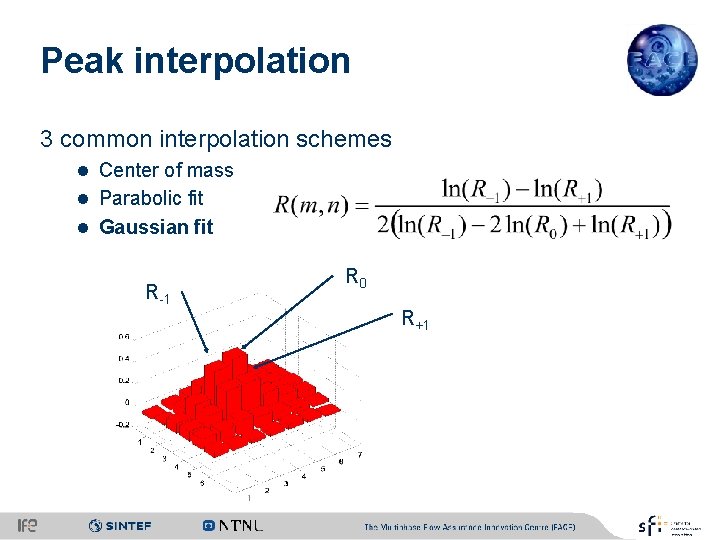
Peak interpolation 3 common interpolation schemes l Center of mass l Parabolic fit l Gaussian fit R-1 R 0 R+1
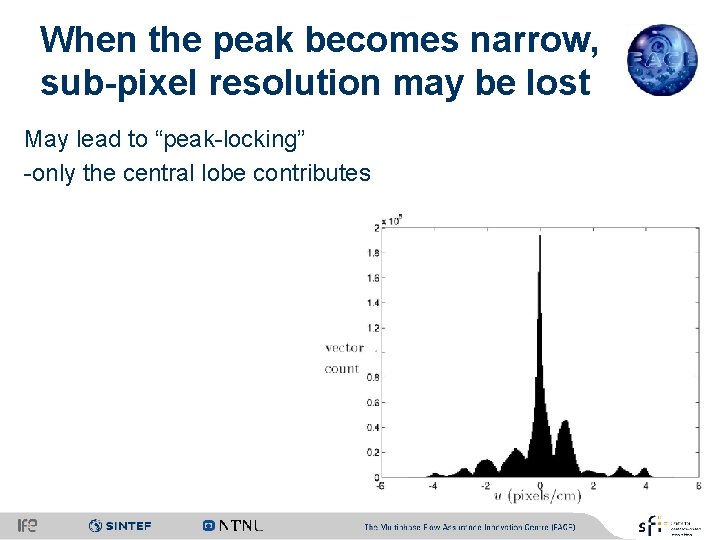
When the peak becomes narrow, sub-pixel resolution may be lost May lead to “peak-locking” -only the central lobe contributes
Also the interpolation scheme may contribute to peak locking The traditional solution is to use sub-pixel window shifting error Requires substantial image interpolation and iteration
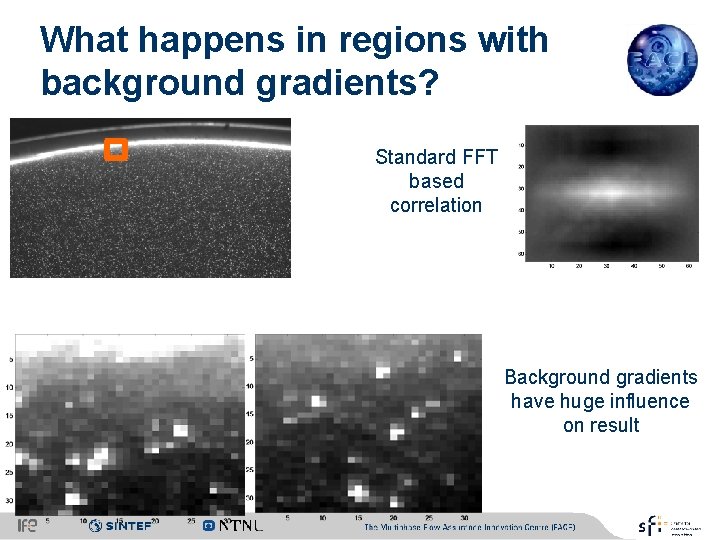
What happens in regions with background gradients? Standard FFT based correlation Background gradients have huge influence on result
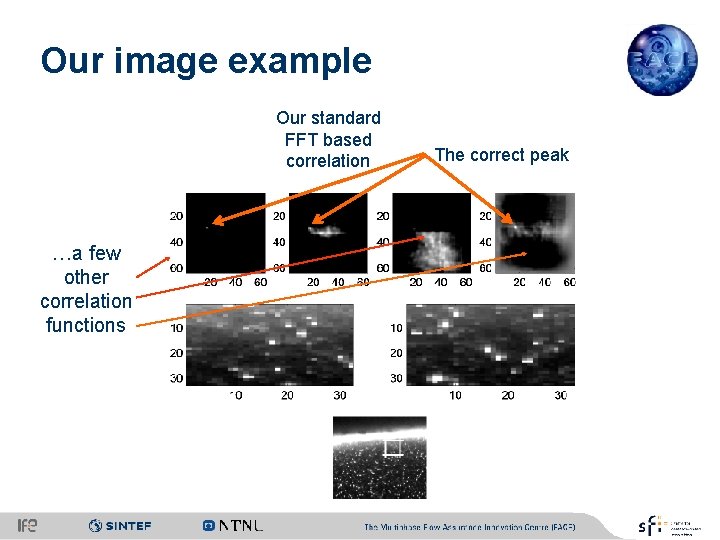
Our image example Our standard FFT based correlation …a few other correlation functions The correct peak
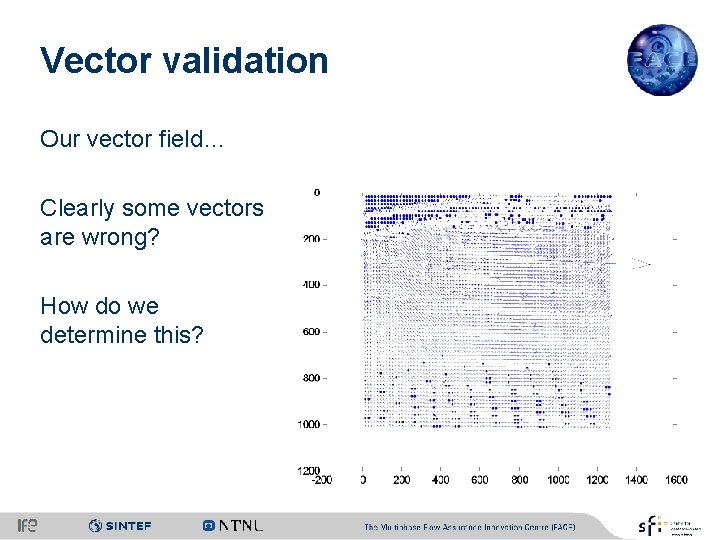
Vector validation Our vector field… Clearly some vectors are wrong? How do we determine this?
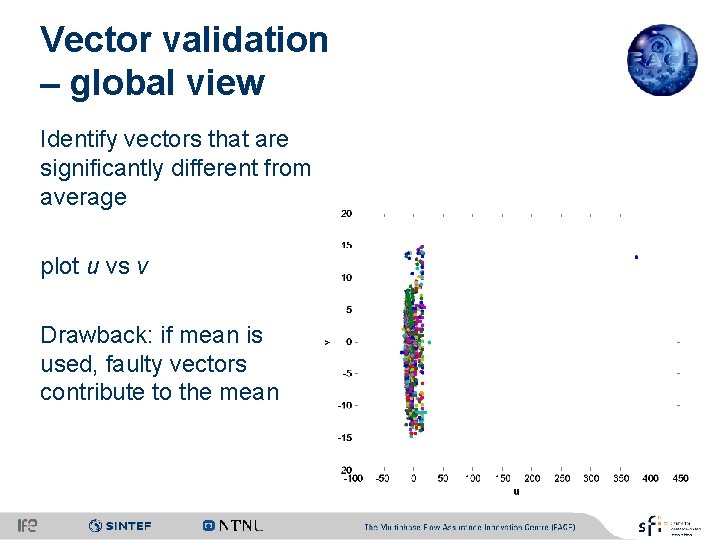
Vector validation – global view Identify vectors that are significantly different from average plot u vs v Drawback: if mean is used, faulty vectors contribute to the mean
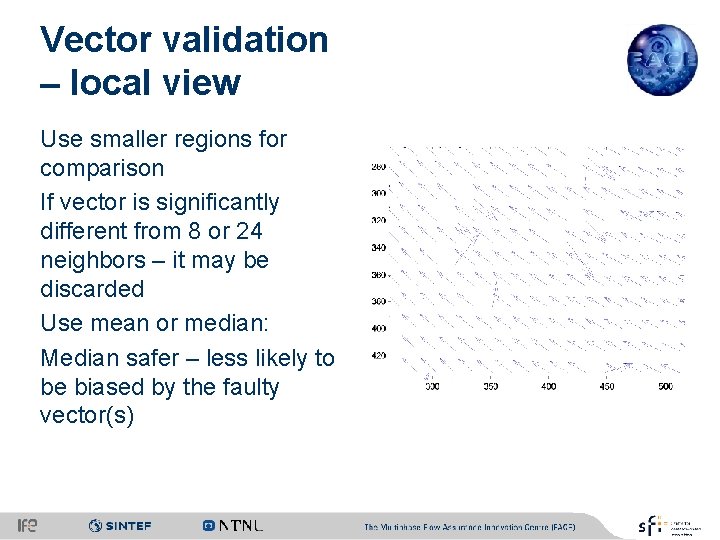
Vector validation – local view Use smaller regions for comparison If vector is significantly different from 8 or 24 neighbors – it may be discarded Use mean or median: Median safer – less likely to be biased by the faulty vector(s)
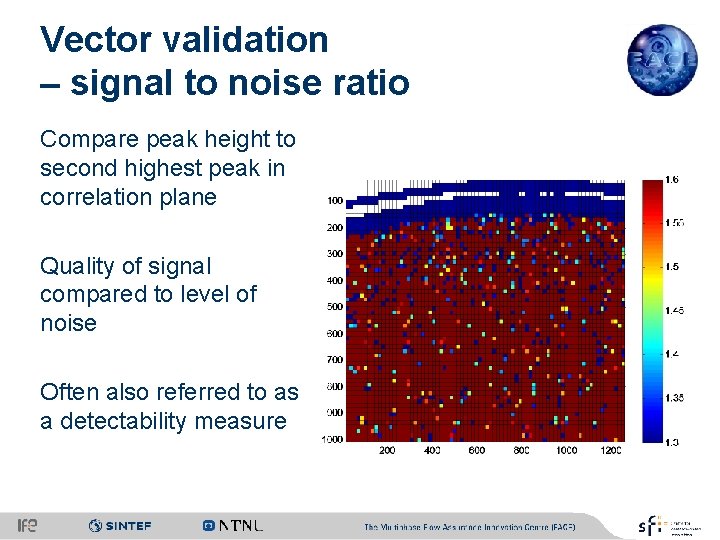
Vector validation – signal to noise ratio Compare peak height to second highest peak in correlation plane Quality of signal compared to level of noise Often also referred to as a detectability measure
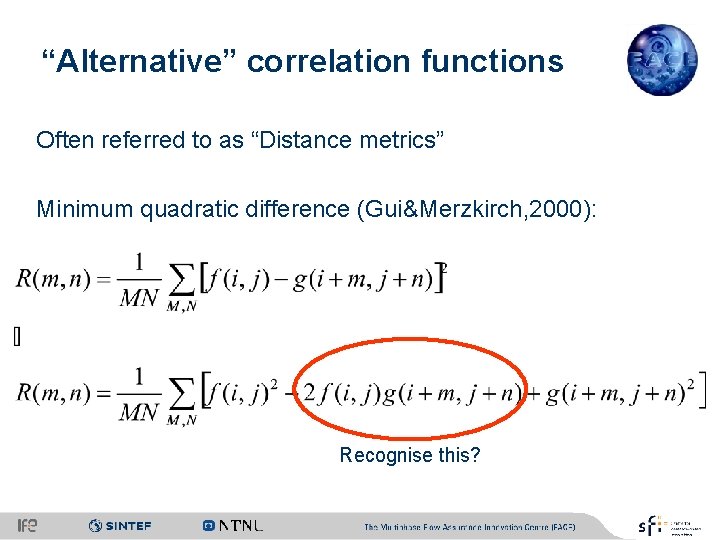
“Alternative” correlation functions Often referred to as “Distance metrics” Minimum quadratic difference (Gui&Merzkirch, 2000): Recognise this?
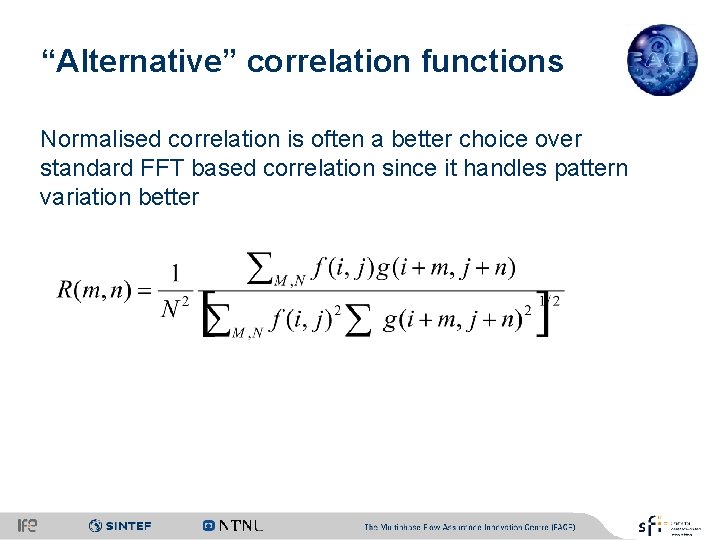
“Alternative” correlation functions Normalised correlation is often a better choice over standard FFT based correlation since it handles pattern variation better
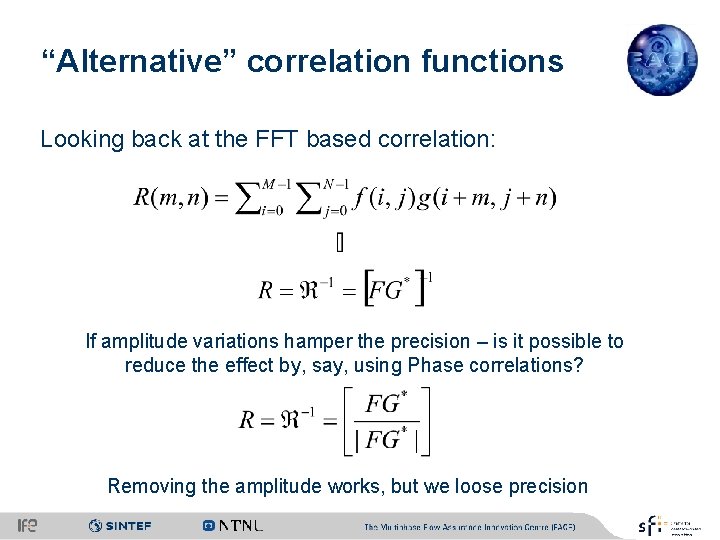
“Alternative” correlation functions Looking back at the FFT based correlation: If amplitude variations hamper the precision – is it possible to reduce the effect by, say, using Phase correlations? Removing the amplitude works, but we loose precision
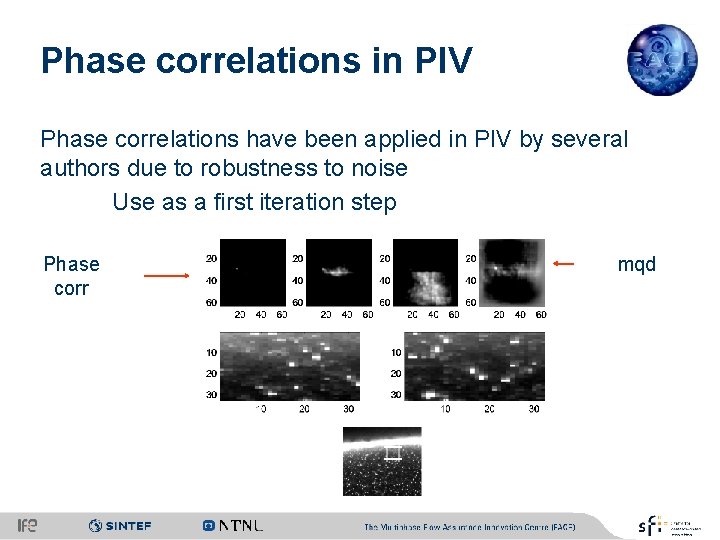
Phase correlations in PIV Phase correlations have been applied in PIV by several authors due to robustness to noise Use as a first iteration step Phase corr mqd
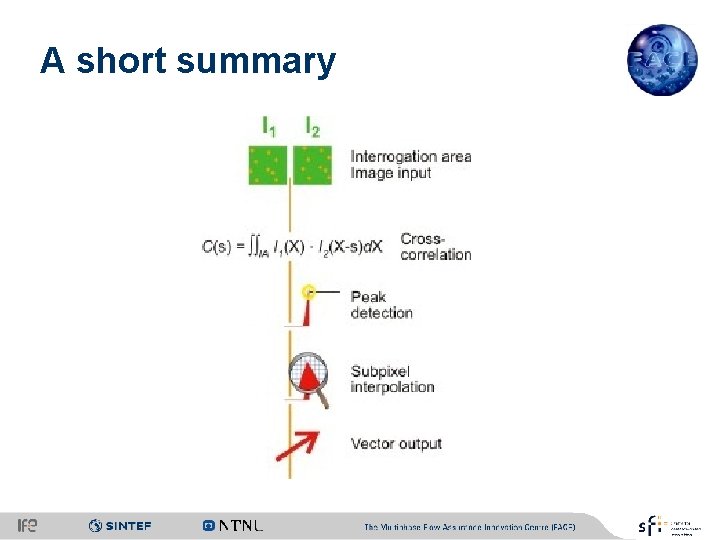
A short summary
PIV in the laboratory
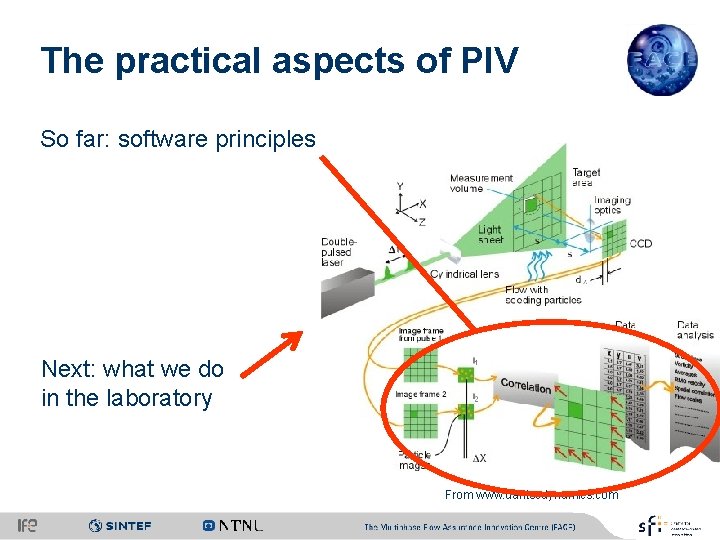
The practical aspects of PIV So far: software principles Next: what we do in the laboratory From www. dantecdynamics. com
Seeding of flow For pattern matching to work, we need l A pattern l Images of the pattern Ludwig Prandtl used particles in visualization experiments in the 1920’s and 1930’s - Small aluminum particles See www. dlr. de
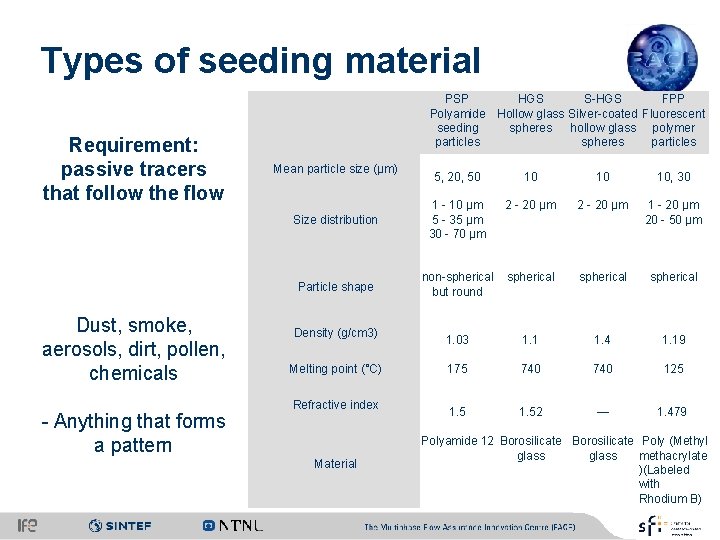
Types of seeding material Requirement: passive tracers that follow the flow Mean particle size (µm) Size distribution Particle shape Dust, smoke, aerosols, dirt, pollen, chemicals - Anything that forms a pattern Density (g/cm 3) Melting point (°C) Refractive index Material PSP HGS S-HGS FPP Polyamide Hollow glass Silver-coated Fluorescent seeding spheres hollow glass polymer particles spheres particles 5, 20, 50 10 10 10, 30 1 - 10 µm 5 - 35 µm 30 - 70 µm 2 - 20 µm 1 - 20 µm 20 - 50 µm non-spherical but round spherical 1. 03 1. 1 1. 4 1. 19 175 740 125 1. 52 — 1. 479 Polyamide 12 Borosilicate Poly (Methyl glass methacrylate )(Labeled with Rhodium B)
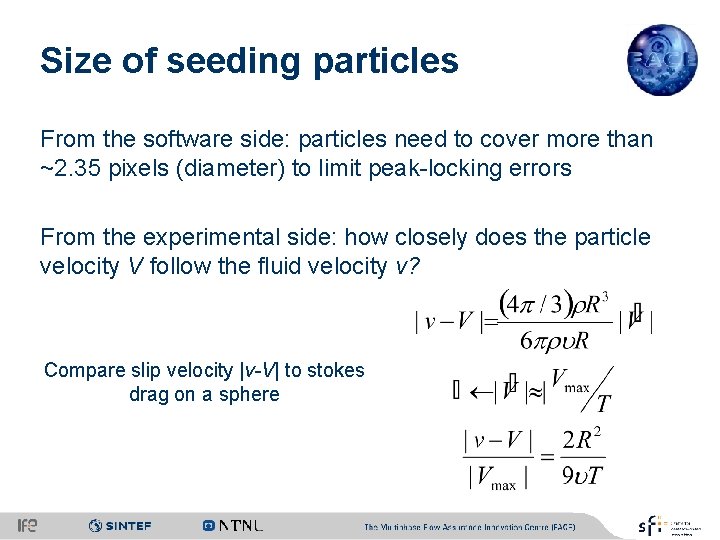
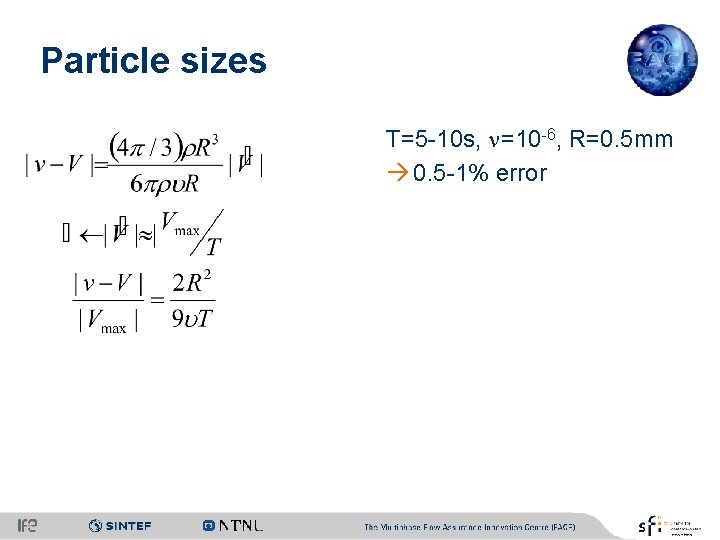
Size of seeding particles From the software side: particles need to cover more than ~2. 35 pixels (diameter) to limit peak-locking errors From the experimental side: how closely does the particle velocity V follow the fluid velocity v? Compare slip velocity |v-V| to stokes drag on a sphere
Particle sizes T=5 -10 s, n=10 -6, R=0. 5 mm 0. 5 -1% error
Imaging We need to accurately acquire two consecutive images with a known time spacing With a 10 cmx 10 cm imaging area (Field of View), imaged by a camera with 1000 x 1000 pixels, implies 100 pixels per centimetre. A flow of just 10 cm/second = 1000 pixels per second To recover this in a 32 x 32 interrogation window, the pattern should ideally move less than 16 pixels (why? ) 16 p / 1000 p/s = 16 mseconds between frames 62. 5 frames per second (if regular camera)
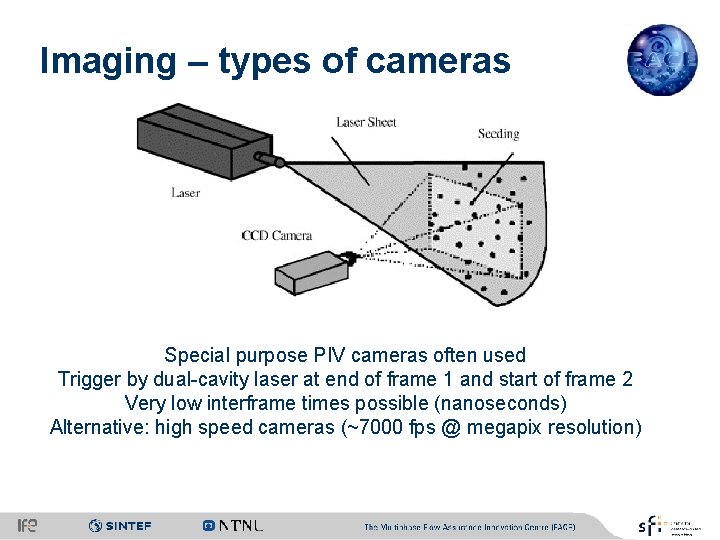
Imaging – types of cameras Special purpose PIV cameras often used Trigger by dual-cavity laser at end of frame 1 and start of frame 2 Very low interframe times possible (nanoseconds) Alternative: high speed cameras (~7000 fps @ megapix resolution)
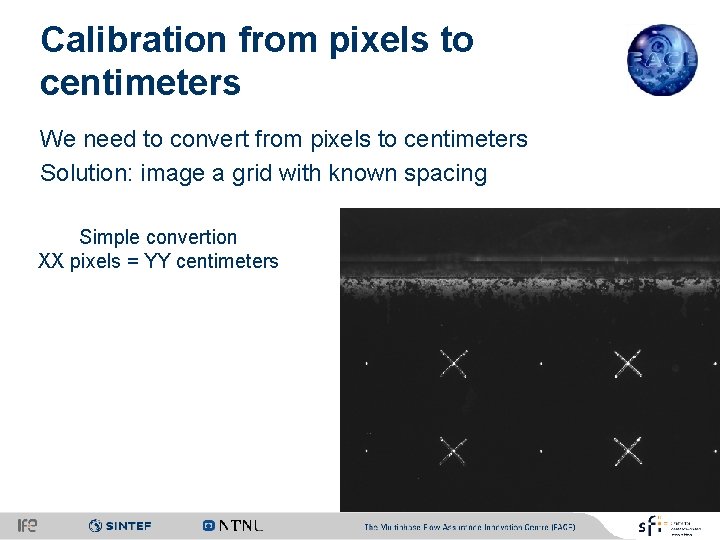
Calibration from pixels to centimeters We need to convert from pixels to centimeters Solution: image a grid with known spacing Simple convertion XX pixels = YY centimeters
Writing your own PIV code Simple PIV