
MEIOSIS THE SEX CELLS BEGINS Well hello there
MEIOSIS-- THE SEX CELLS BEGINS
Well hello there boys and girls. I am Mr. Bee and I am here to give you “the talk”. You know, the talk that your parents always dread giving to you. Oh and don’t worry I can’t sting I’m a male bee. To warm up please listen to this nice 50’s song. Let me tell you 'bout the birds and the bees and the flowers and the trees, the moon up above, and the thing called love.
You may not realize it but you have inherited your genetic characteristics from your parents. You are a product of the genes of your dad’s chromosomes that were packaged in his gamete called the sperm and your mother’s chromosomes that were packaged in her gamete called the egg. In animals the gametes (sex cells) are special, they are called HAPLOID CELLS(designated as n). They do not have matching pairs of chromosomes like normal body cells. Ahem!! Excuse me but I am doing a presentation here!! Let's talk about sex, baby Let's talk about you and me Let's talk about all the good things And the bad things that may be Let's talk about sex
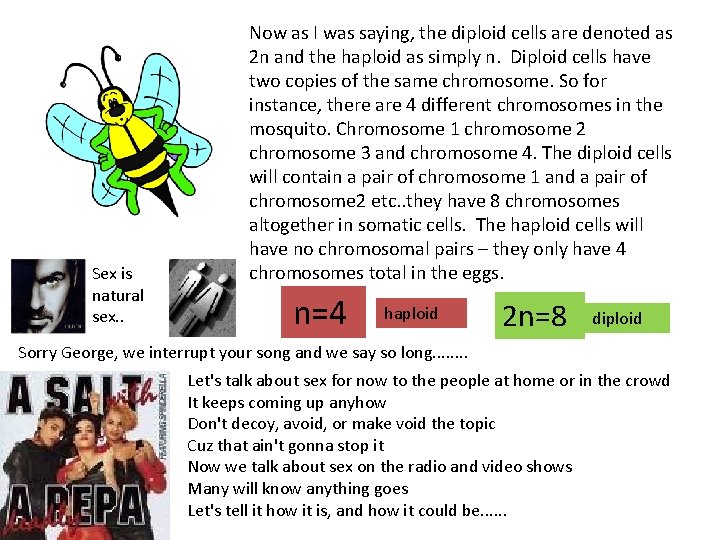
Sex is natural sex. . Now as I was saying, the diploid cells are denoted as 2 n and the haploid as simply n. Diploid cells have two copies of the same chromosome. So for instance, there are 4 different chromosomes in the mosquito. Chromosome 1 chromosome 2 chromosome 3 and chromosome 4. The diploid cells will contain a pair of chromosome 1 and a pair of chromosome 2 etc. . they have 8 chromosomes altogether in somatic cells. The haploid cells will have no chromosomal pairs – they only have 4 chromosomes total in the eggs. n=4 haploid 2 n=8 diploid Sorry George, we interrupt your song and we say so long. . . . Let's talk about sex for now to the people at home or in the crowd It keeps coming up anyhow Don't decoy, avoid, or make void the topic Cuz that ain't gonna stop it Now we talk about sex on the radio and video shows Many will know anything goes Let's tell it how it is, and how it could be. . .
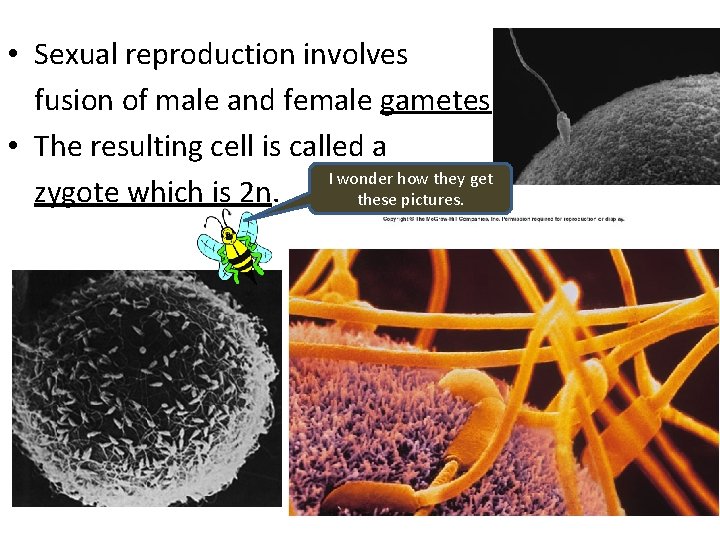
• Sexual reproduction involves fusion of male and female gametes. • The resulting cell is called a I wonder how they get zygote which is 2 n. these pictures.
So once again as a summary. . . • In humans, only gametes are haploid. • All other human cells are diploid: somatic cells • The new organism will form from the zygote. The zygote needs 2 copies of each chromosome, and NO MORE. • 1 copy of mom’s DNA and 1 copy of dad’s • More than 2 copies of ANY chromosome is BAD NEWS! (e. g. : trisomy 21)
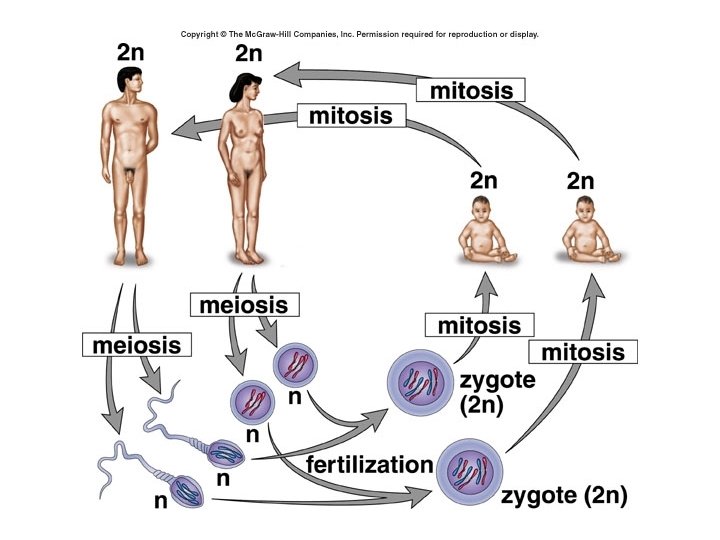
So in order to make haploid cells out of diploid cells there must be a special cell division process. This generates the egg and the sperm and the process is called MEIOSIS. Sometimes meiosis to produce eggs is referred to as oogenesis and meiosis to produce sperm as spermatogenesis Now it’s time to look at the meiosis process. Keep in mind how important this is as it keeps the number of chromosomes within a species constant. Without this process, sexual combinations could lead to all kinds of different chromosomal numbers and the natural world would be extremely chaotic.
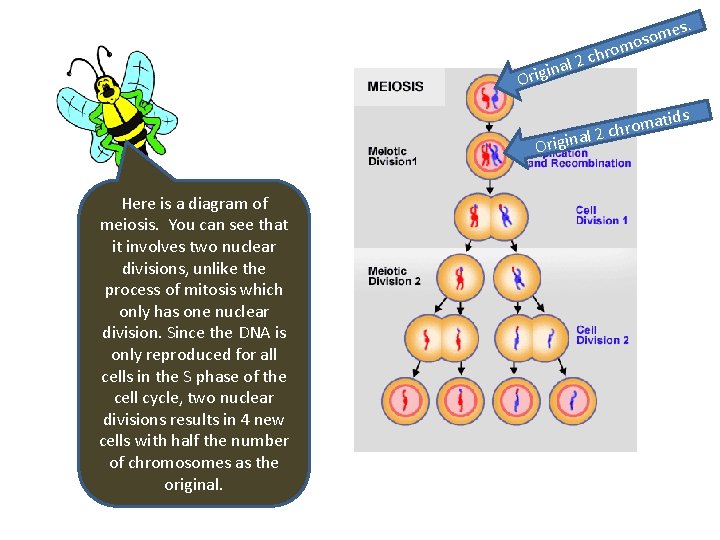
rom ch nal 2 i Orig es. m o os atids m o r h nal 2 c Origi Here is a diagram of meiosis. You can see that it involves two nuclear divisions, unlike the process of mitosis which only has one nuclear division. Since the DNA is only reproduced for all cells in the S phase of the cell cycle, two nuclear divisions results in 4 new cells with half the number of chromosomes as the original.
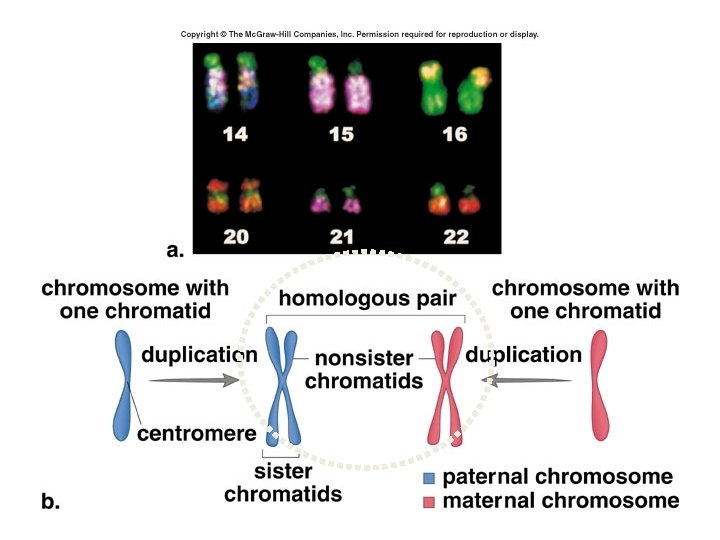
All of our cells (except mature gametes) have 2 copies of each chromosome. One copy of each chromosome is maternal, and the other copy is paternal.
MEIOSIS I is a reduction division!!
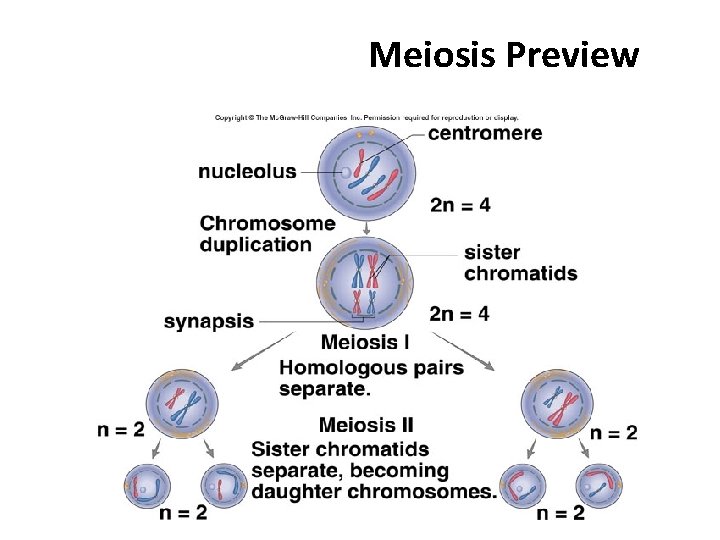
Meiosis Preview
Importance of meiosis • Meiosis keeps the number of chromosomes constant generation after generation. • Without meiosis, the number of chromosomes would continue to increase each generation. • Each generation: 1 sperm (23 chromosomes) + 1 egg (23 chromosomes) = 1 zygote (46 chromosomes) • The new zygote grows by mitosis. Each new cell has 46 chromosomes.
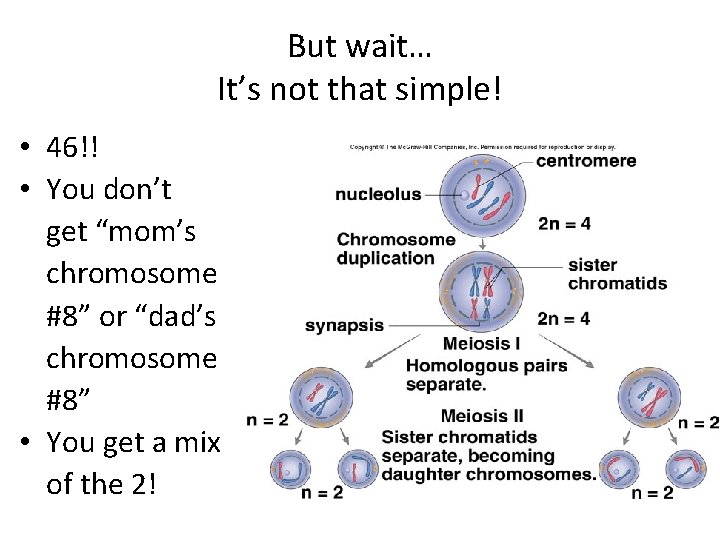
But wait… It’s not that simple! • 46!! • You don’t get “mom’s chromosome #8” or “dad’s chromosome #8” • You get a mix of the 2!
That “mix” is accomplished by genetic recombination. • 3 methods of genetic recombination: – 1. crossing over – 2. independent assortment – 3. fertilization
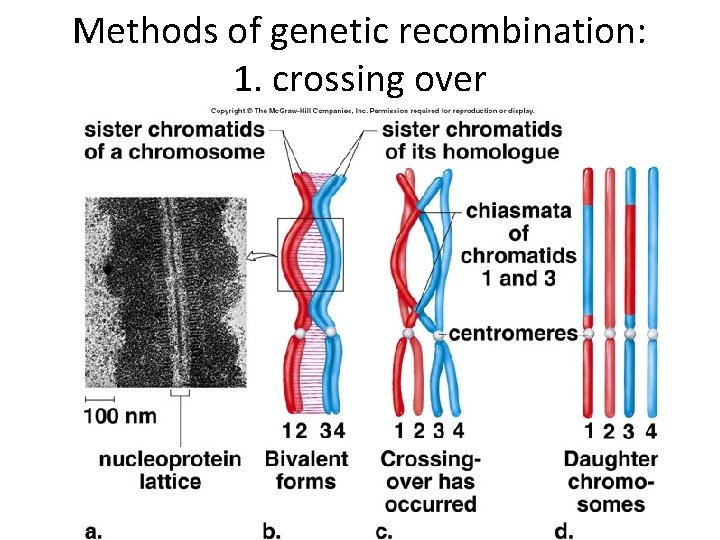
Methods of genetic recombination: 1. crossing over
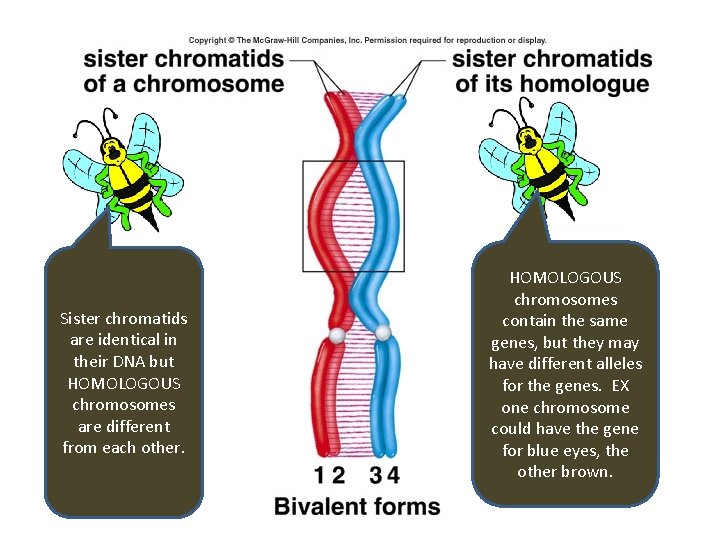
Homologous chromosomes align. Sister chromatids are identical in their DNA but HOMOLOGOUS chromosomes are different from each other. HOMOLOGOUS chromosomes contain the same genes, but they may have different alleles for the genes. EX one chromosome could have the gene for blue eyes, the other brown.
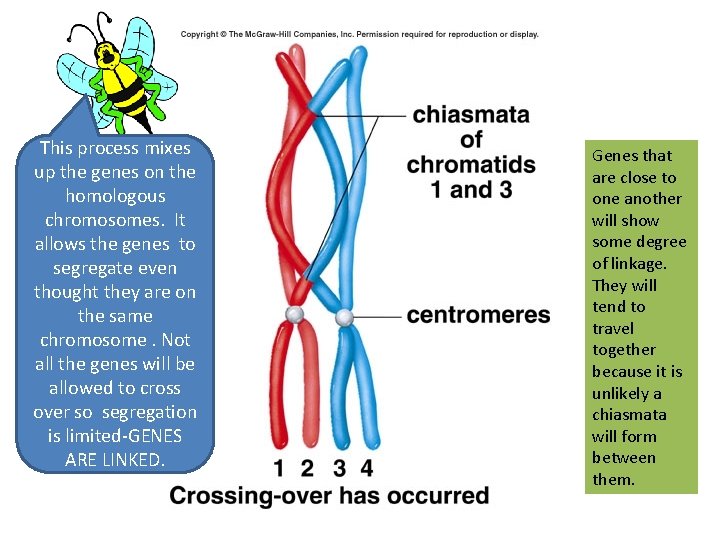
This process mixes up the genes on the homologous chromosomes. It allows the genes to segregate even thought they are on the same chromosome. Not all the genes will be allowed to cross over so segregation is limited-GENES ARE LINKED. Genes that are close to one another will show some degree of linkage. They will tend to travel together because it is unlikely a chiasmata will form between them.
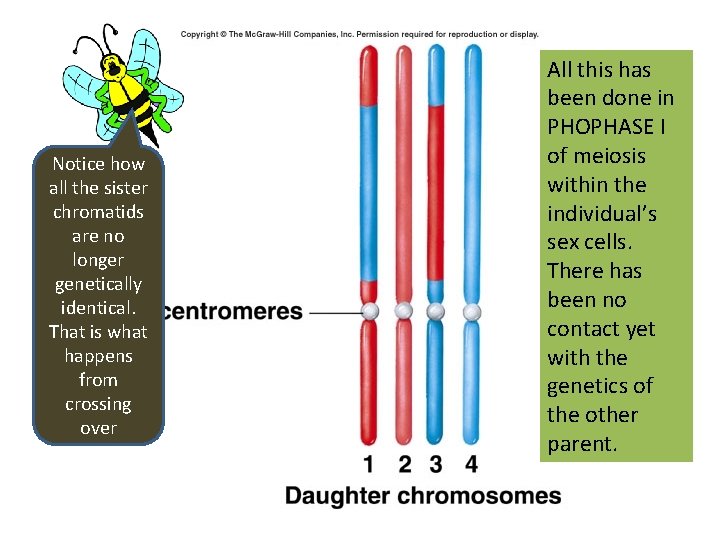
Notice how all the sister chromatids are no longer genetically identical. That is what happens from crossing over All this has been done in PHOPHASE I of meiosis within the individual’s sex cells. There has been no contact yet with the genetics of the other parent.
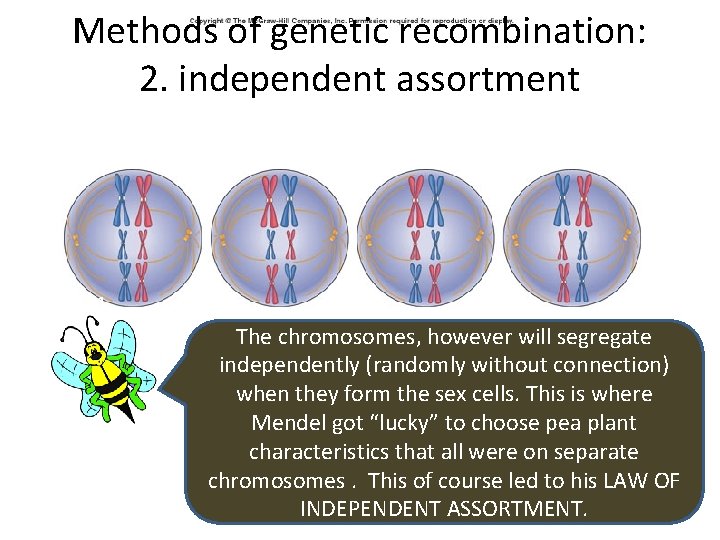
Methods of genetic recombination: 2. independent assortment 1 2 3 The chromosomes, however will segregate independently (randomly without connection) when they form the sex cells. This is where Mendel got “lucky” to choose pea plant characteristics that all were on separate chromosomes. This of course led to his LAW OF INDEPENDENT ASSORTMENT.
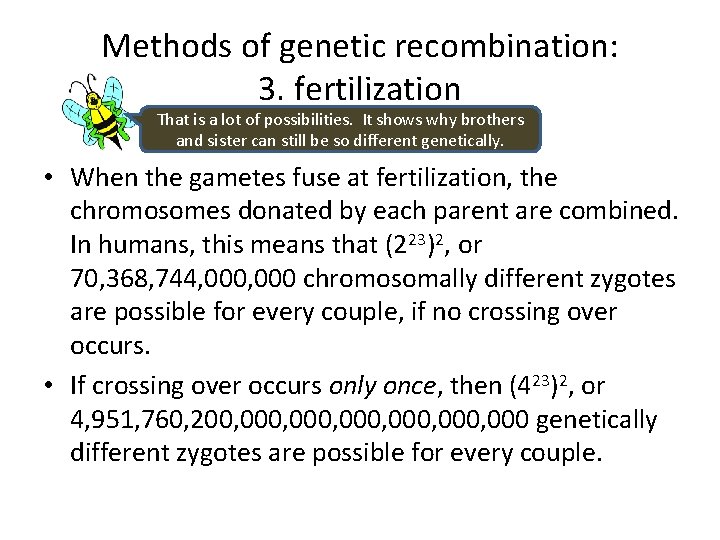
Methods of genetic recombination: 3. fertilization That is a lot of possibilities. It shows why brothers and sister can still be so different genetically. • When the gametes fuse at fertilization, the chromosomes donated by each parent are combined. In humans, this means that (223)2, or 70, 368, 744, 000 chromosomally different zygotes are possible for every couple, if no crossing over occurs. • If crossing over occurs only once, then (423)2, or 4, 951, 760, 200, 000, 000 genetically different zygotes are possible for every couple.
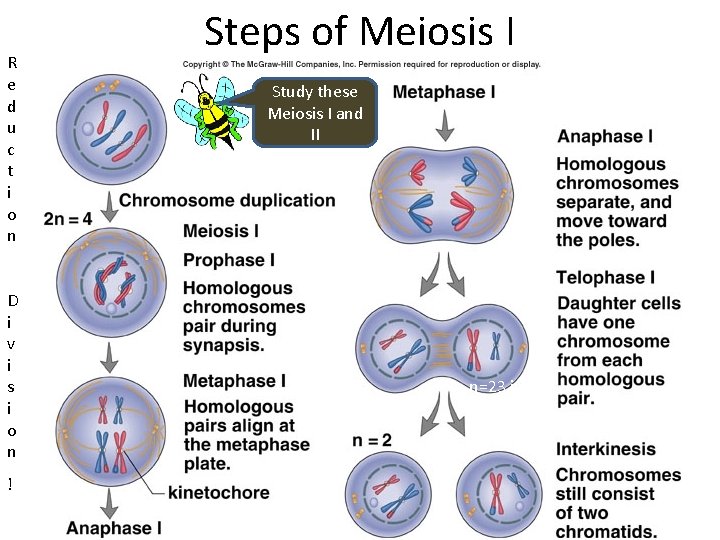
R e d u c t i o n D i v i s i o n ! Steps of Meiosis I Study these In humans, n=23, so I and Meiosis 2 n=46. II n=23 in humans
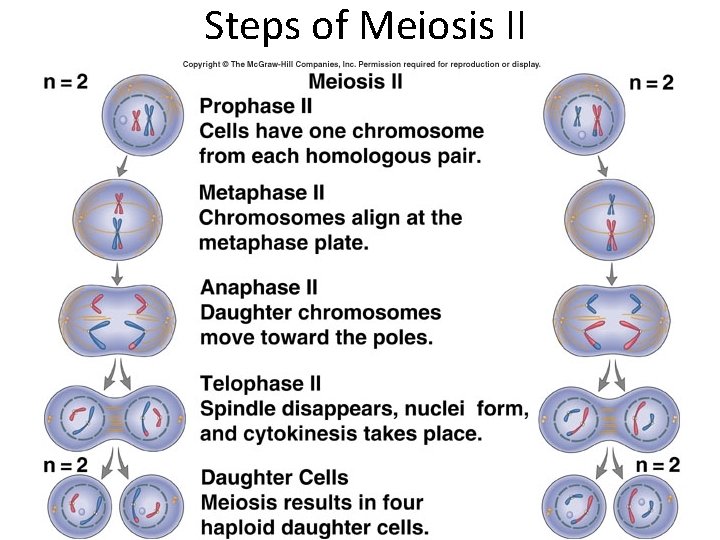
Steps of Meiosis II
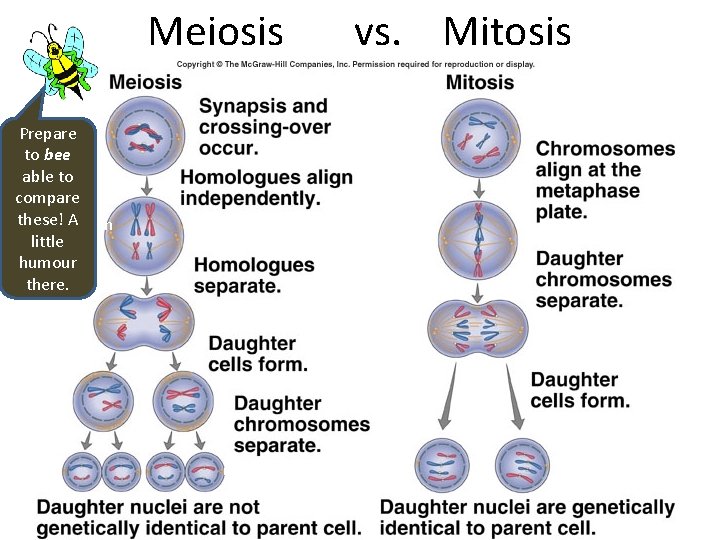
Meiosis Prepare to bee able to compare these! (Line. Aup in little 23 pairs. ) humour there. vs. Mitosis (All 46) (23 in each) (All 46)
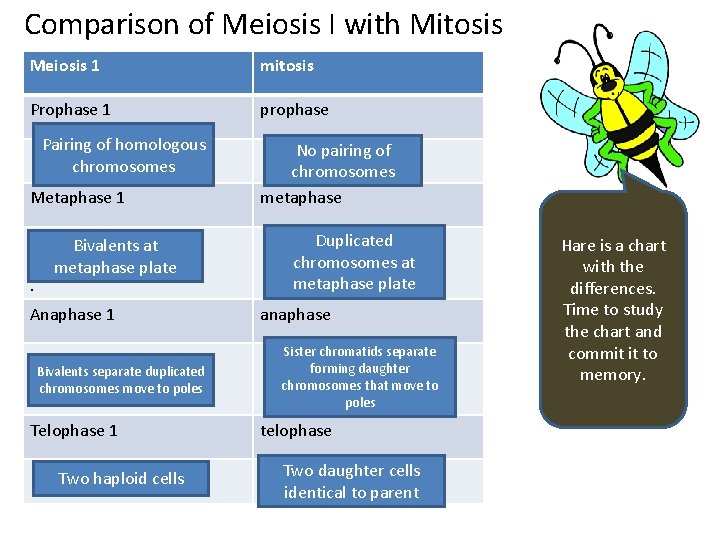
Comparison of Meiosis I with Mitosis Meiosis 1 mitosis Prophase 1 prophase Pairing of homologous chromosomes Metaphase 1. . . Bivalents at metaphase plate Anaphase 1. Bivalents separate duplicated. chromosomes move to poles. Telophase 1 Two haploid cells No pairing of chromosomes metaphase Duplicated chromosomes at metaphase plate anaphase Sister chromatids separate forming daughter chromosomes that move to poles telophase Two daughter cells identical to parent Hare is a chart with the differences. Time to study the chart and commit it to memory.
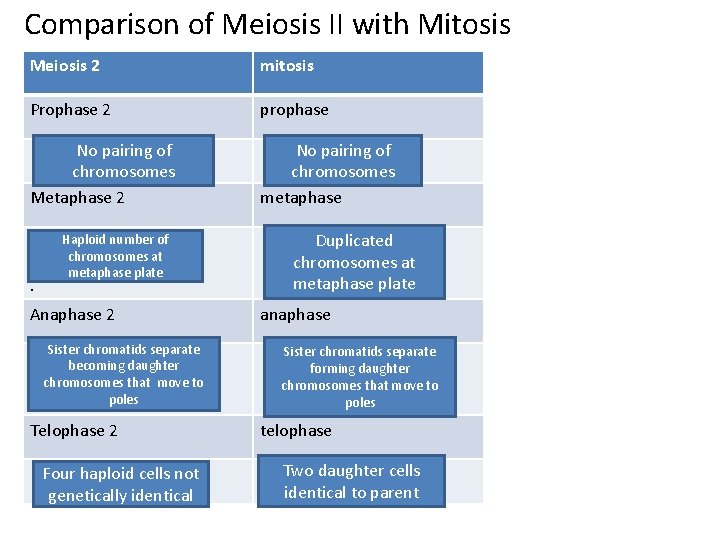
Comparison of Meiosis II with Mitosis Meiosis 2 mitosis Prophase 2 prophase No pairing of chromosomes Metaphase 2 No pairing of chromosomes metaphase . . . Haploid number of chromosomes at metaphase plate Anaphase 2. . . Sister chromatids separate becoming daughter chromosomes that move to poles Telophase 2 Four haploid cells not genetically identical Duplicated chromosomes at metaphase plate anaphase Sister chromatids separate forming daughter chromosomes that move to poles telophase Two daughter cells identical to parent
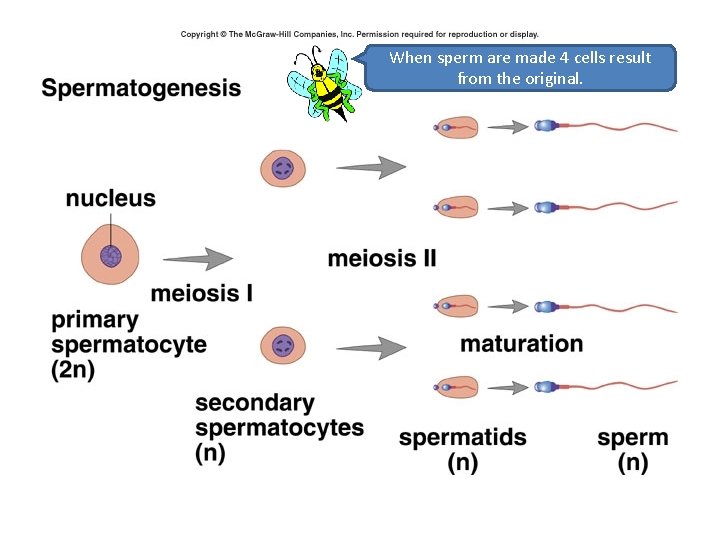
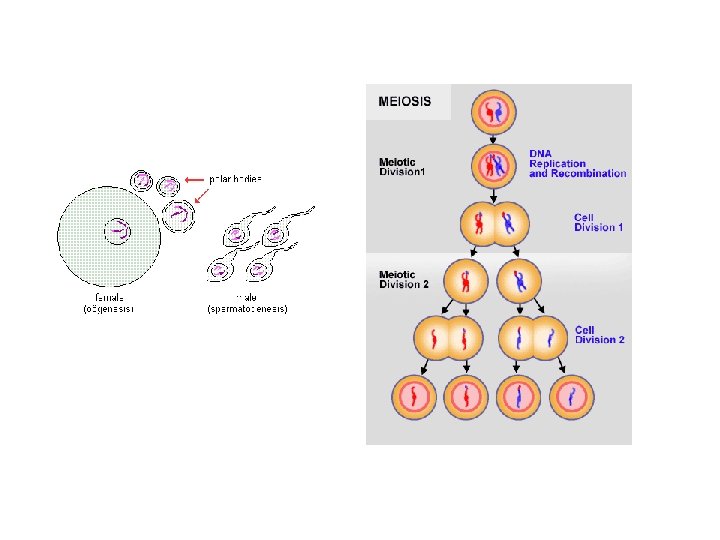
When sperm are made 4 cells result from the original.
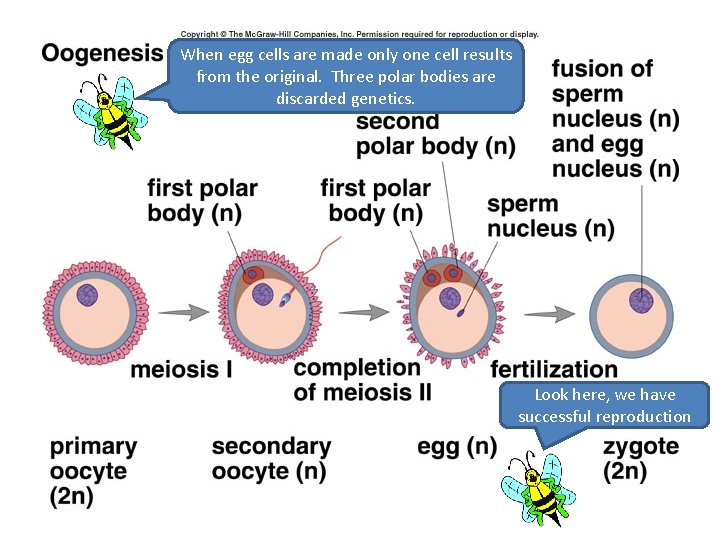
When egg cells are made only one cell results from the original. Three polar bodies are discarded genetics. Look here, we have successful reproduction
Stem cells • Stem cells are cells that are undifferentiated • Translation: they haven’t been assigned a job yet. No specific genes turned on. • These cells can be influenced to become ANY TYPE OF CELL, given the right cues. • Found in embryos, also to some degree in adult tissues.
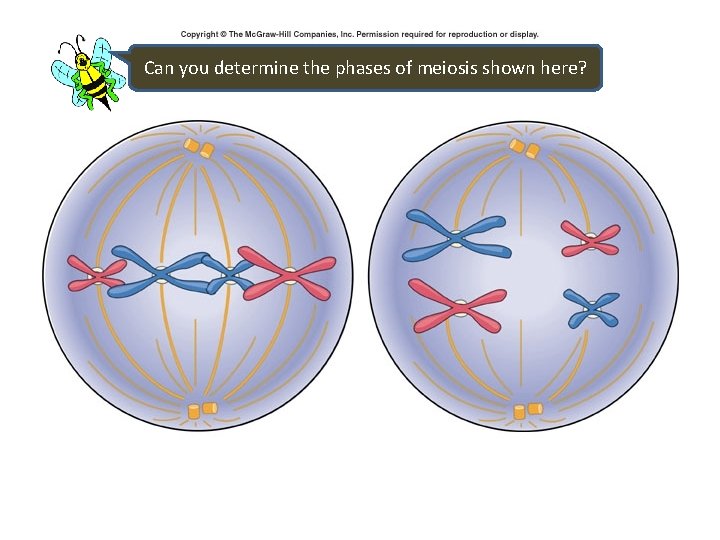
Can you determine the phases of meiosis shown here?
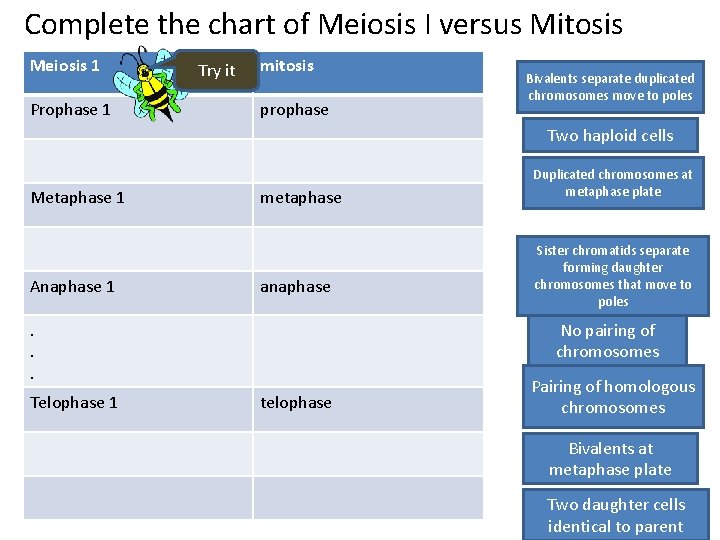
Complete the chart of Meiosis I versus Mitosis Meiosis 1 Prophase 1 Try it mitosis prophase Bivalents separate duplicated chromosomes move to poles Two haploid cells Metaphase 1 Anaphase 1 metaphase anaphase Sister chromatids separate forming daughter chromosomes that move to poles No pairing of chromosomes . . . Telophase 1 Duplicated chromosomes at metaphase plate telophase Pairing of homologous chromosomes Bivalents at metaphase plate Two daughter cells identical to parent
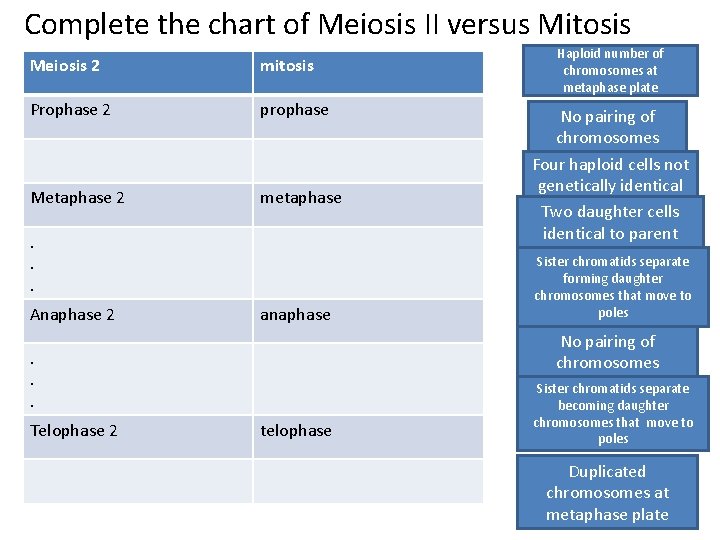
Complete the chart of Meiosis II versus Mitosis Meiosis 2 mitosis Prophase 2 prophase Metaphase 2 metaphase . . . Anaphase 2 anaphase No pairing of chromosomes Four haploid cells not genetically identical Two daughter cells identical to parent Sister chromatids separate forming daughter chromosomes that move to poles No pairing of chromosomes . . . Telophase 2 Haploid number of chromosomes at metaphase plate telophase Sister chromatids separate becoming daughter chromosomes that move to poles Duplicated chromosomes at metaphase plate
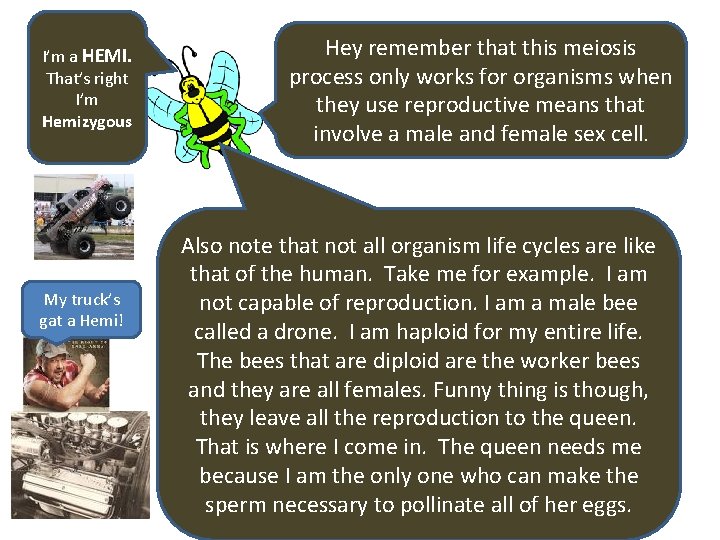
I’m a HEMI. That’s right I’m Hemizygous My truck’s gat a Hemi! Hey remember that this meiosis process only works for organisms when they use reproductive means that involve a male and female sex cell. Also note that not all organism life cycles are like that of the human. Take me for example. I am not capable of reproduction. I am a male bee called a drone. I am haploid for my entire life. The bees that are diploid are the worker bees and they are all females. Funny thing is though, they leave all the reproduction to the queen. That is where I come in. The queen needs me because I am the only one who can make the sperm necessary to pollinate all of her eggs.
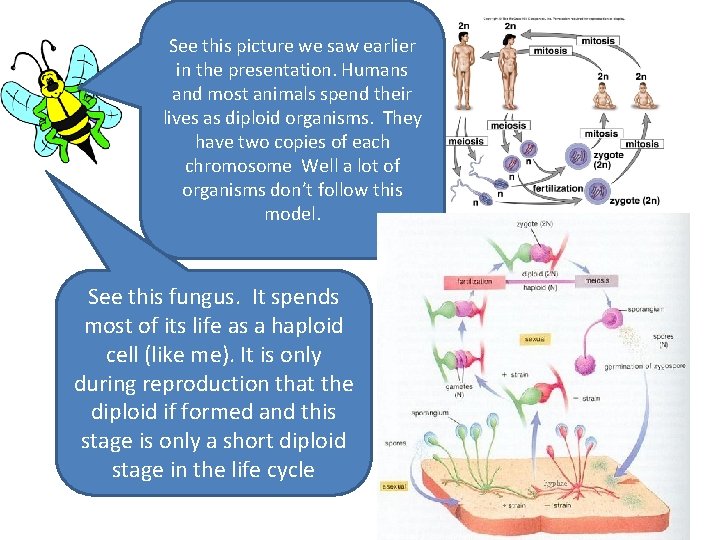
See this picture we saw earlier in the presentation. Humans and most animals spend their lives as diploid organisms. They have two copies of each chromosome Well a lot of organisms don’t follow this model. See this fungus. It spends most of its life as a haploid cell (like me). It is only during reproduction that the diploid if formed and this stage is only a short diploid stage in the life cycle
Well that’s all I have time for. See you.
- Slides: 36