
MEIOSIS Parents can produce many types of offspring
- Slides: 41
MEIOSIS
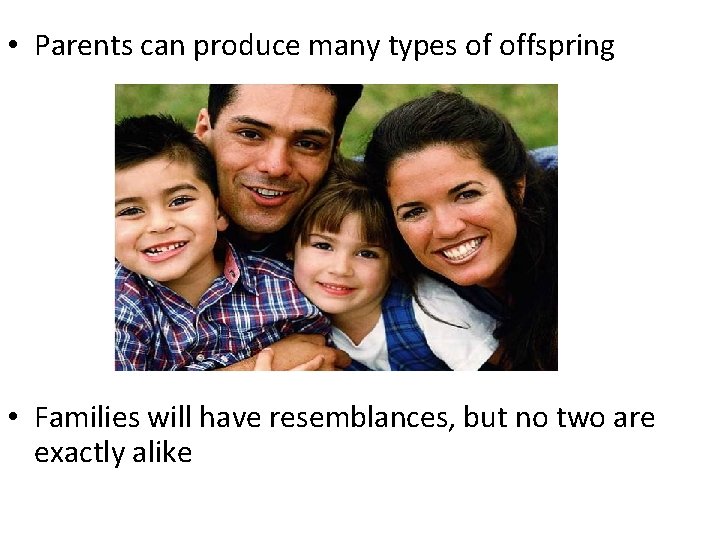
• Parents can produce many types of offspring • Families will have resemblances, but no two are exactly alike
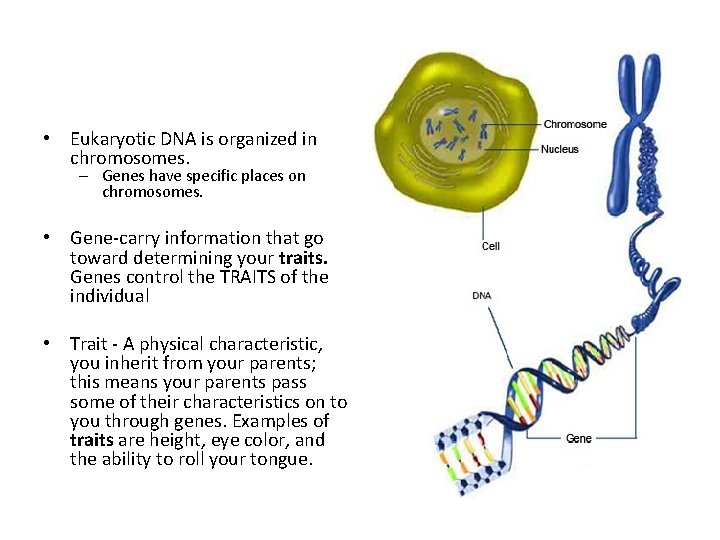
• Eukaryotic DNA is organized in chromosomes. – Genes have specific places on chromosomes. • Gene-carry information that go toward determining your traits. Genes control the TRAITS of the individual • Trait - A physical characteristic, you inherit from your parents; this means your parents pass some of their characteristics on to you through genes. Examples of traits are height, eye color, and the ability to roll your tongue.
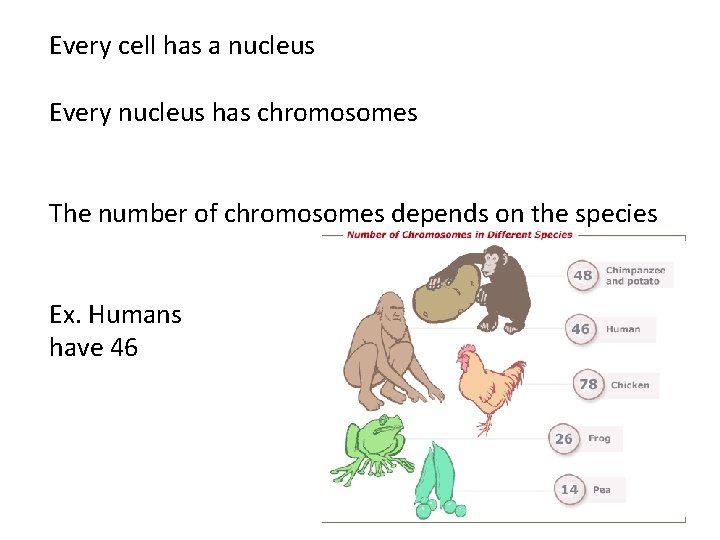
Every cell has a nucleus Every nucleus has chromosomes The number of chromosomes depends on the species Ex. Humans have 46
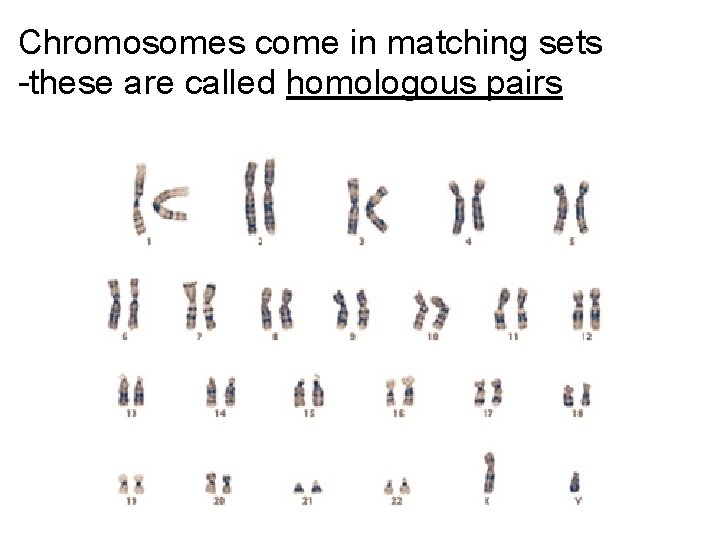
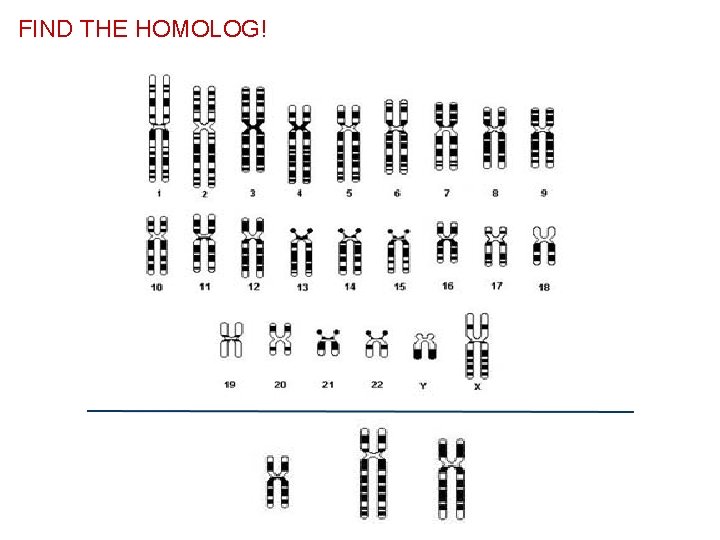
Chromosomes come in matching sets -these are called homologous pairs
Chromosomes and Chromosome Number • Human body cells have 46 chromosomes • Each parent contributes 23 chromosomes • Homologous chromosomes—one of two paired chromosomes, one from each parent – Pairs 1 -22 • Humans have 23 pairs of homologous chromosomes. 22 pairs of autosomes 1 pair of sex chromosomes
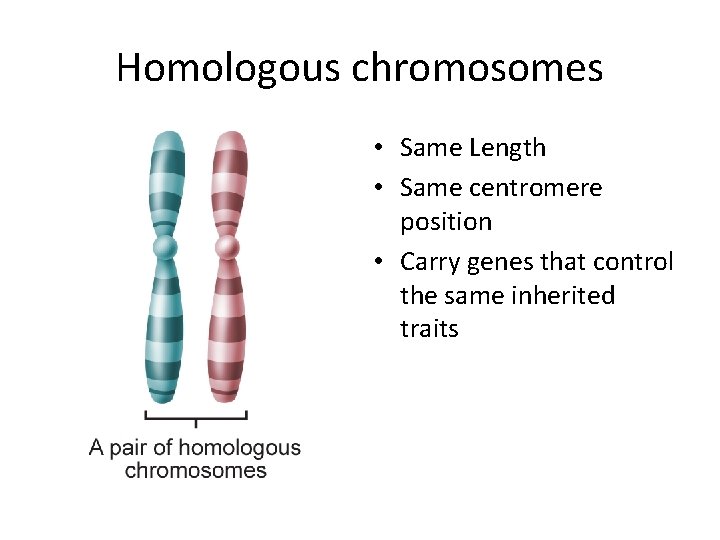
Homologous chromosomes • Same Length • Same centromere position • Carry genes that control the same inherited traits
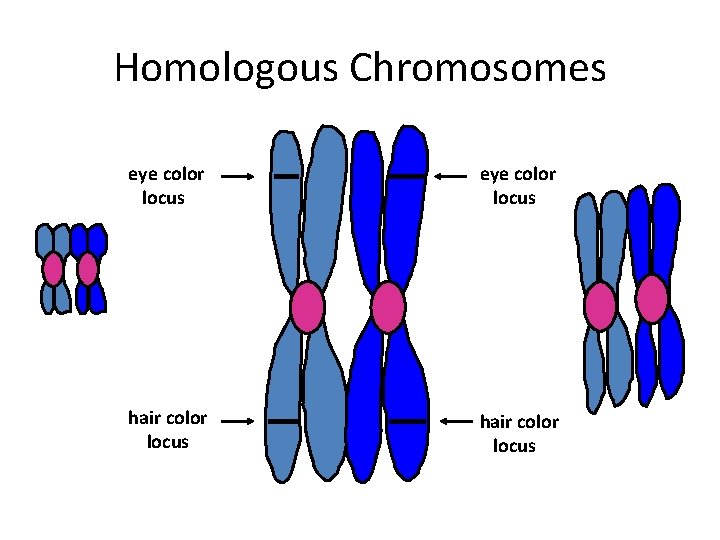
Homologous Chromosomes eye color locus hair color locus
FIND THE HOMOLOG!
• A somatic cell is any biological cell forming the body of an organism, somatic cells make up all the internal organs, skin, bones, blood, and connective tissue. • By contrast, gametes are cells that fuse during sexual reproduction, for organisms that reproduce sexually. Sperm and egg cell.
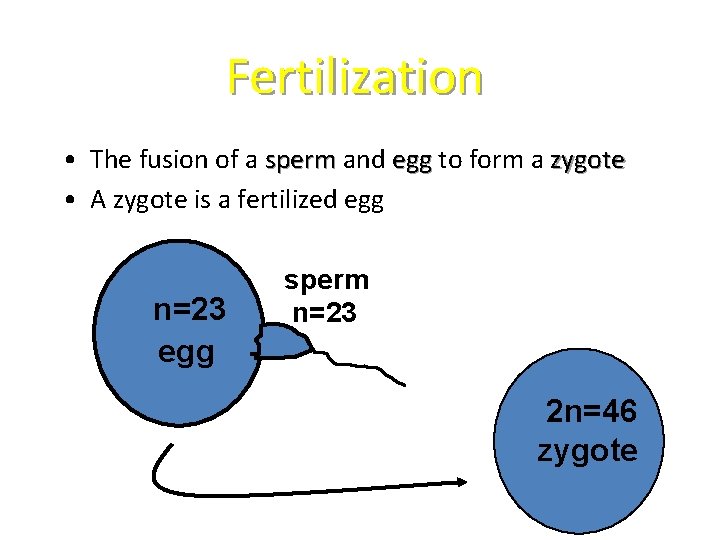
Fertilization • The fusion of a sperm and egg to form a zygote • A zygote is a fertilized egg n=23 egg sperm n=23 2 n=46 zygote
• A haploid cell has only one set of chromosomes N • A diploid cell has two sets of chromosomes 2 N. • In human, the somatic cells are diploid, and the gametes are haploid. • Human cheek cells have 46 chromosomes. (Diploid) • Human sex cells have 23 chromosomes. (Haploid)
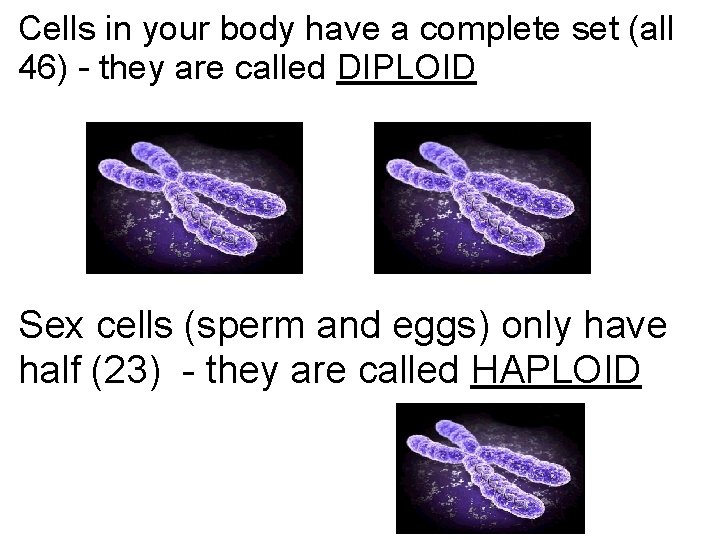
Cells in your body have a complete set (all 46) - they are called DIPLOID Sex cells (sperm and eggs) only have half (23) - they are called HAPLOID
• In humans, a diploid cell contains a total of 46 chromosomes, while haploid cells have 23 homologous chromosome pairs • All sex cells must reduce their chromosome number as they divide. This reduction division is called meiosis and changes the chromosome number from Diploid to Haploid. ---During Meiosis diploid cells are reduced to haploid cells Diploid (2 n) Haploid (n) • When mitosis produces 2 identical daughter cells, both the parent and daughter cells referred to as diploid while in meiosis a diploid cell divides twice to produce 4 daughter cells that are considered haploid.
What is the difference between Diploid and Haploid? • Haploid cells contain only one set of chromosomes and diploid cells contain two sets of chromosomes. • Haploid cells are produced by meiosis, and diploid cells are produced by mitosis. • Diploid cells have the same number of chromosomes as the parent cell, and haploid cells have only a half of the number of chromosomes as the parent cell. • Diploid cells are genetically identical to the parent cell, and haploid cells are not genetically identical to the parent cell. • Haploid cells are important in sexual reproduction, and diploid cells are important in growth, asexual reproduction and genetic stability.
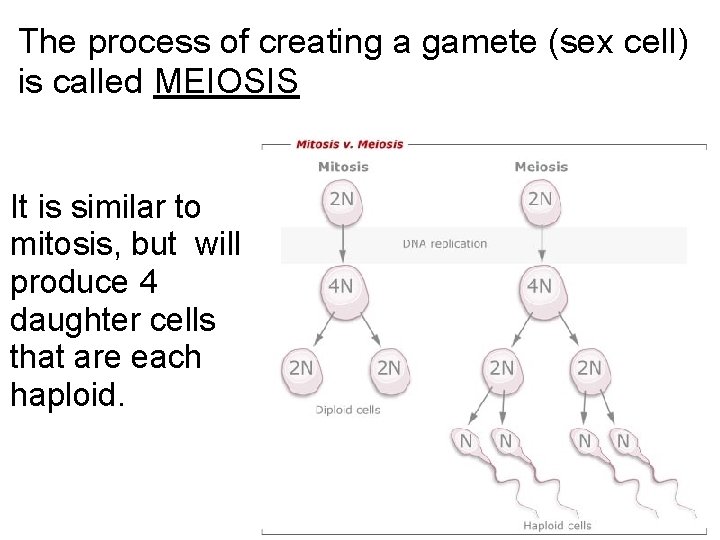
The process of creating a gamete (sex cell) is called MEIOSIS It is similar to mitosis, but will produce 4 daughter cells that are each haploid.
Why do we need meiosis? • Meiosis is necessary to halve the number of chromosomes going into the sex cells Why halve the chromosomes in gametes? • At fertilization the male and female sex cells will provide ½ of the chromosomes each – so the offspring has genes from both parents
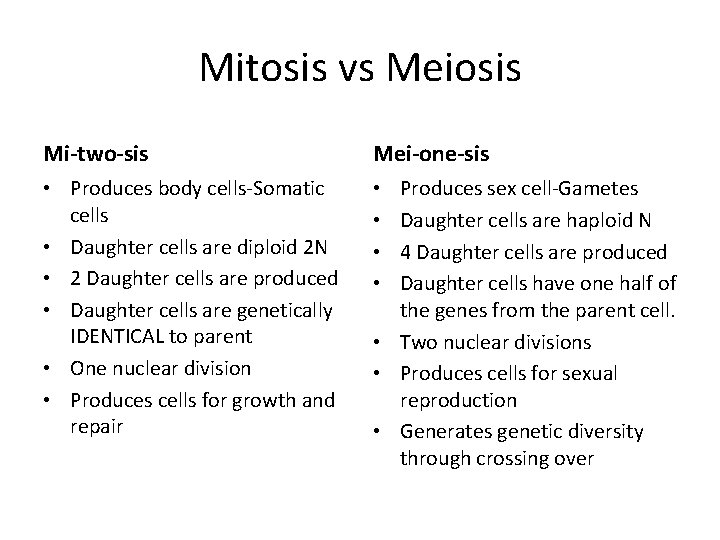
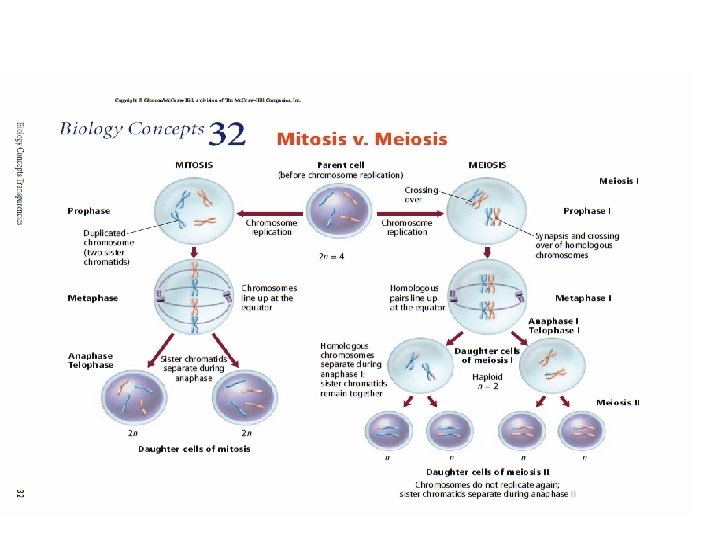
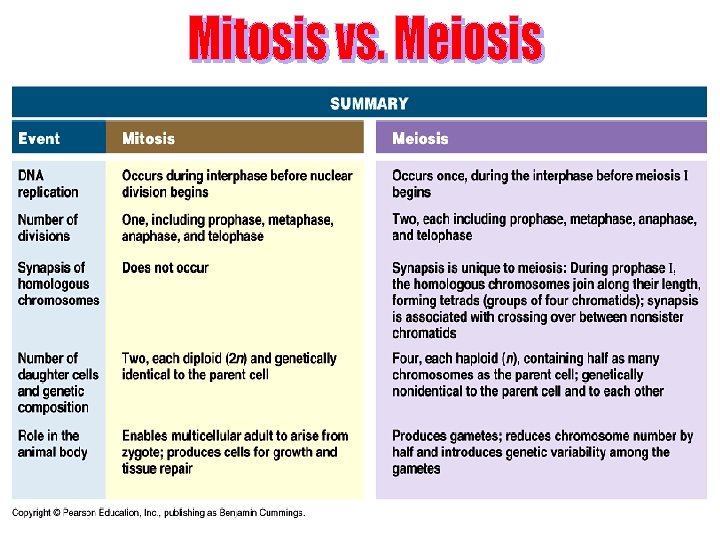
Mitosis vs Meiosis Mi-two-sis Mei-one-sis • Produces body cells-Somatic cells • Daughter cells are diploid 2 N • 2 Daughter cells are produced • Daughter cells are genetically IDENTICAL to parent • One nuclear division • Produces cells for growth and repair • • Produces sex cell-Gametes Daughter cells are haploid N 4 Daughter cells are produced Daughter cells have one half of the genes from the parent cell. • Two nuclear divisions • Produces cells for sexual reproduction • Generates genetic diversity through crossing over
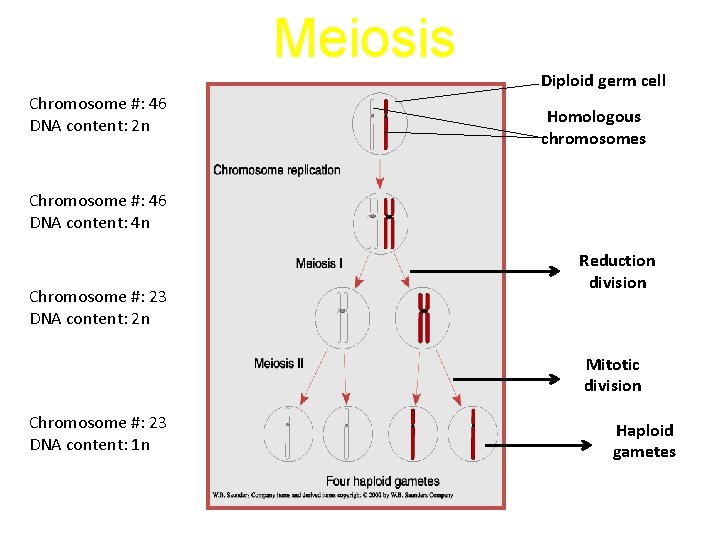
Meiosis Diploid germ cell Chromosome #: 46 DNA content: 2 n Homologous chromosomes Chromosome #: 46 DNA content: 4 n Chromosome #: 23 DNA content: 2 n Reduction division Mitotic division Chromosome #: 23 DNA content: 1 n Haploid gametes
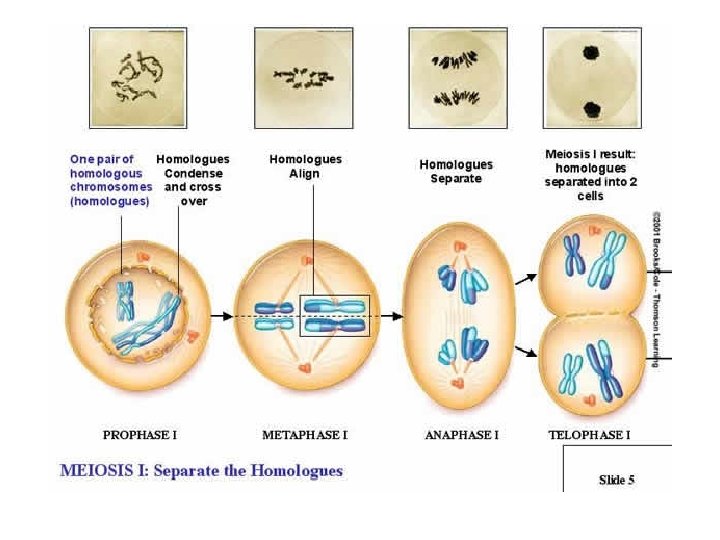
Meiosis • Has 2 stages – Meiosis 1, This is the stage where the chromosomes nuber is halved – Includes 4 stages • • Prophase 1 Metaphase 1 Anaphase 1 Telophase 1 – Meiosis 2
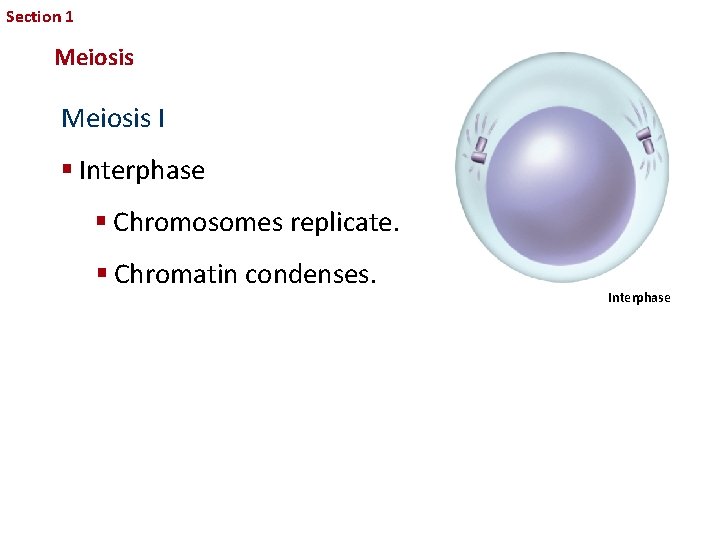
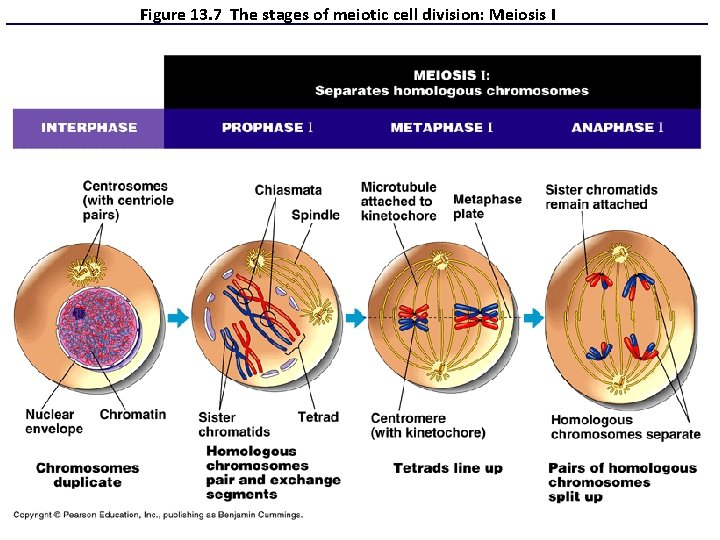
Section 1 Sexual Reproduction and Genetics Meiosis I § Interphase § Chromosomes replicate. § Chromatin condenses. Interphase
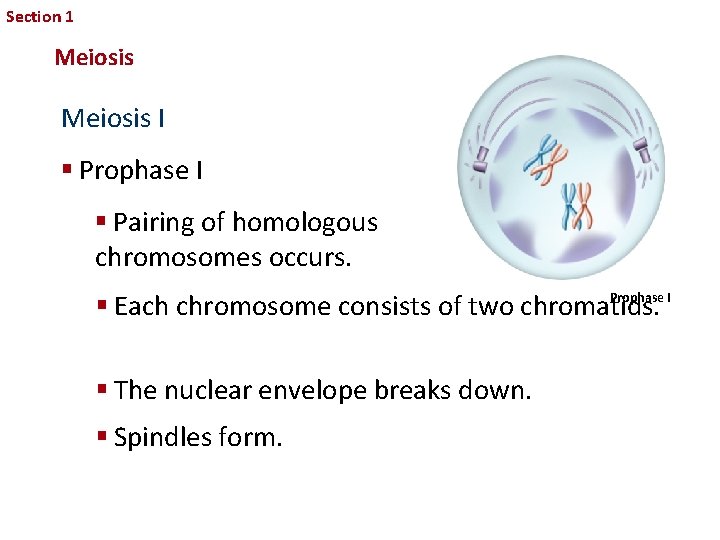
Section 1 Sexual Reproduction and Genetics Meiosis I § Prophase I § Pairing of homologous chromosomes occurs. Prophase I § Each chromosome consists of two chromatids. § The nuclear envelope breaks down. § Spindles form.
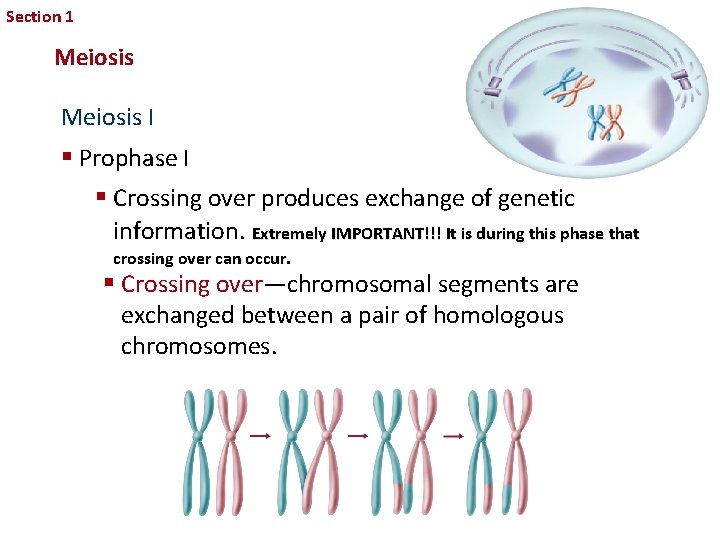
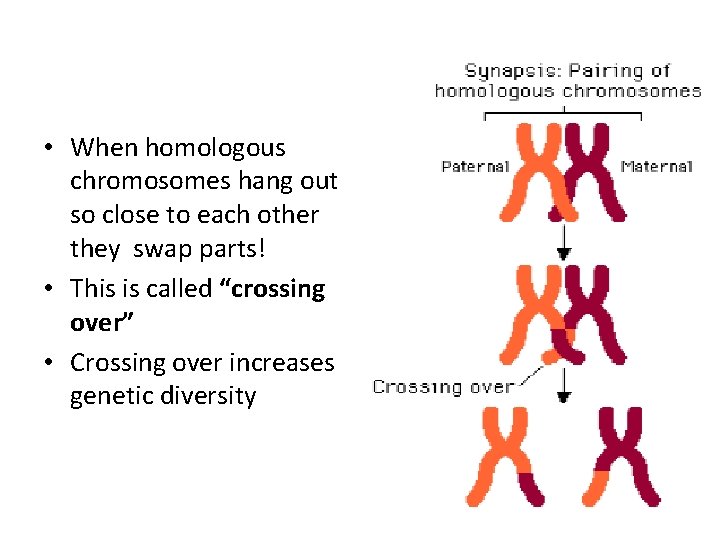
Section 1 Sexual Reproduction and Genetics Meiosis I § Prophase I § Crossing over produces exchange of genetic information. Extremely IMPORTANT!!! It is during this phase that crossing over can occur. § Crossing over—chromosomal segments are exchanged between a pair of homologous chromosomes.
• When homologous chromosomes hang out so close to each other they swap parts! • This is called “crossing over” • Crossing over increases genetic diversity
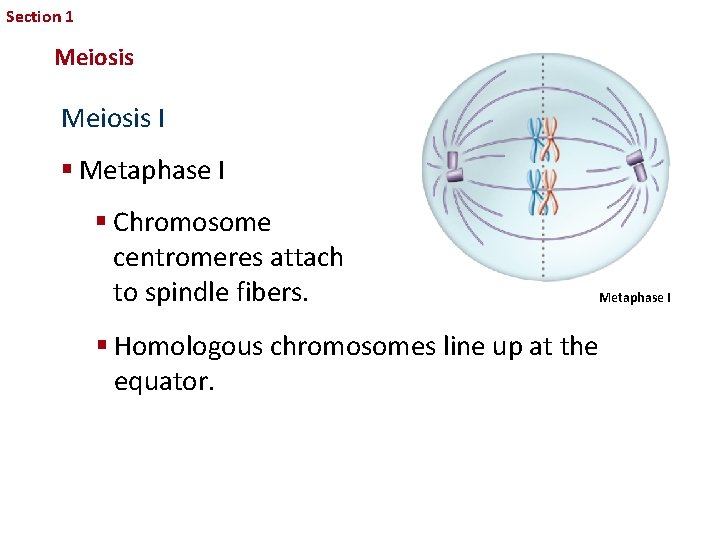
Section 1 Sexual Reproduction and Genetics Meiosis I § Metaphase I § Chromosome centromeres attach to spindle fibers. Metaphase I § Homologous chromosomes line up at the equator.
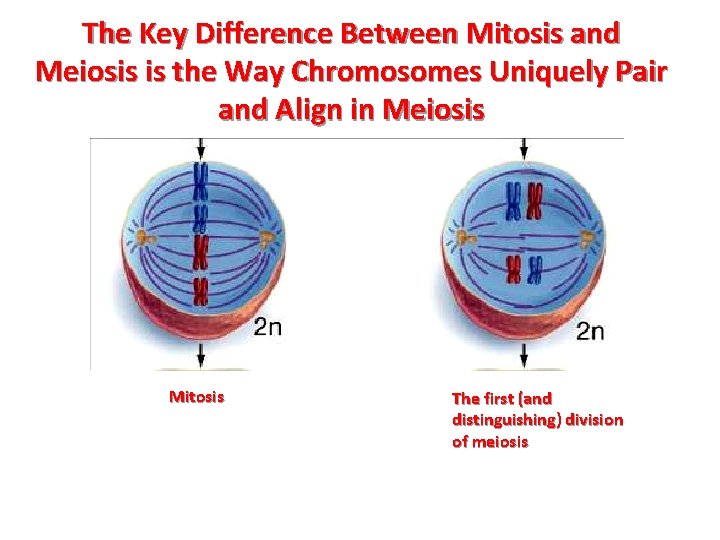
The Key Difference Between Mitosis and Meiosis is the Way Chromosomes Uniquely Pair and Align in Meiosis Mitosis The first (and distinguishing) division of meiosis
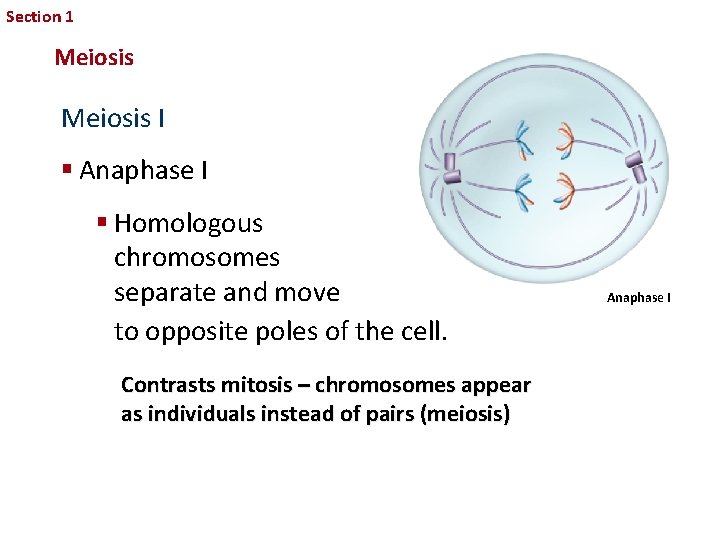
Section 1 Sexual Reproduction and Genetics Meiosis I § Anaphase I § Homologous chromosomes separate and move to opposite poles of the cell. Contrasts mitosis – chromosomes appear as individuals instead of pairs (meiosis) Anaphase I
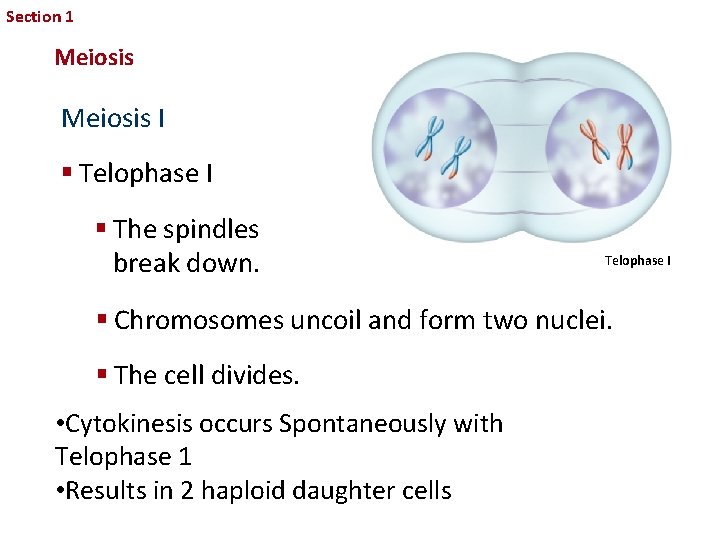
Section 1 Sexual Reproduction and Genetics Meiosis I § Telophase I § The spindles break down. Telophase I § Chromosomes uncoil and form two nuclei. § The cell divides. • Cytokinesis occurs Spontaneously with Telophase 1 • Results in 2 haploid daughter cells
Figure 13. 7 The stages of meiotic cell division: Meiosis I
After Meiosis 1… • Homologous chromosomes have been separated • Two non-identical daughter cells have been formed • The chromosomes number has been cut in half
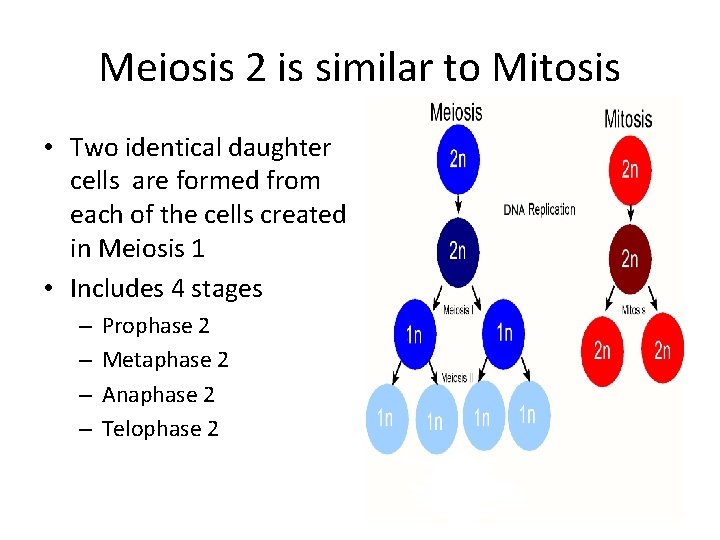
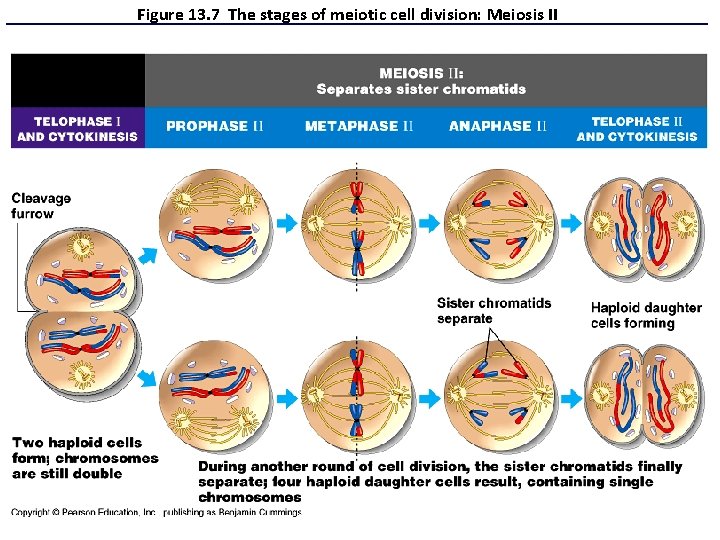
Meiosis 2 is similar to Mitosis • Two identical daughter cells are formed from each of the cells created in Meiosis 1 • Includes 4 stages – – Prophase 2 Metaphase 2 Anaphase 2 Telophase 2
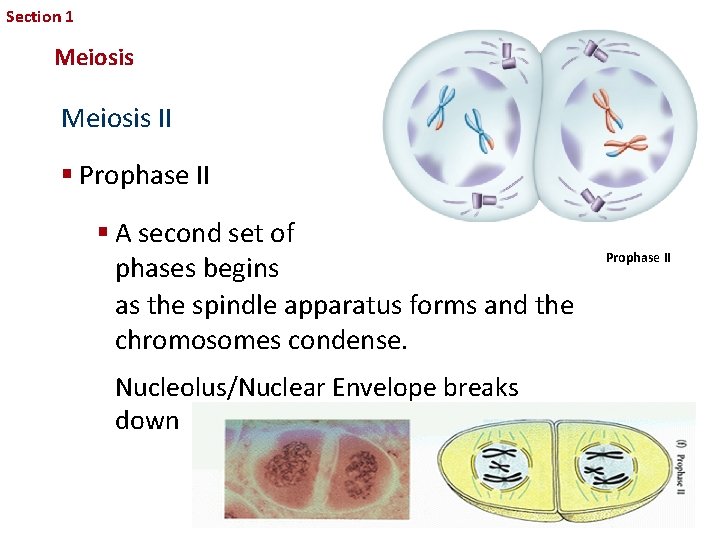
Section 1 Sexual Reproduction and Genetics Meiosis II § Prophase II § A second set of phases begins as the spindle apparatus forms and the chromosomes condense. Nucleolus/Nuclear Envelope breaks down Prophase II
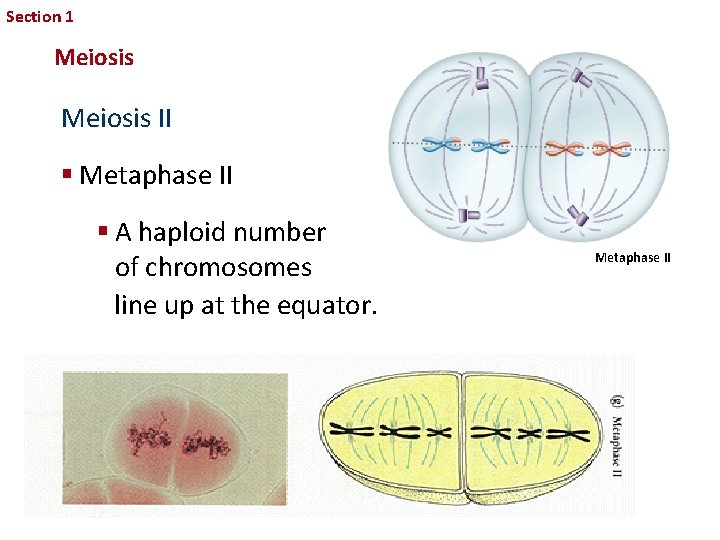
Section 1 Sexual Reproduction and Genetics Meiosis II § Metaphase II § A haploid number of chromosomes line up at the equator. Metaphase II
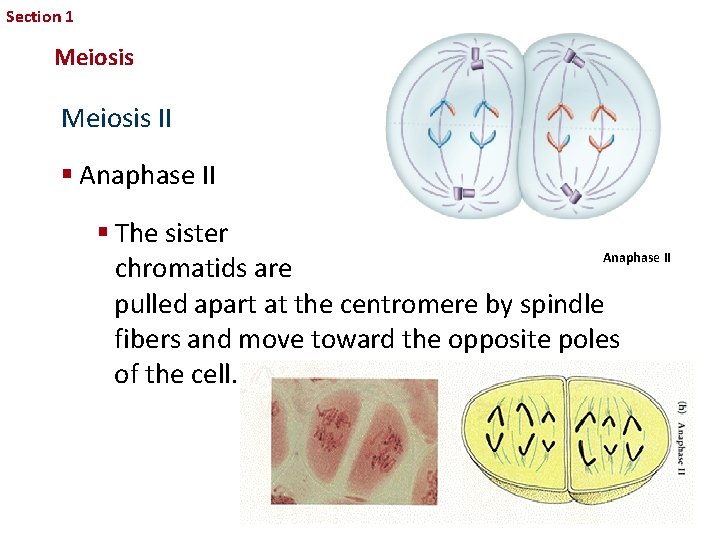
Section 1 Sexual Reproduction and Genetics Meiosis II § Anaphase II § The sister Anaphase II chromatids are pulled apart at the centromere by spindle fibers and move toward the opposite poles of the cell.
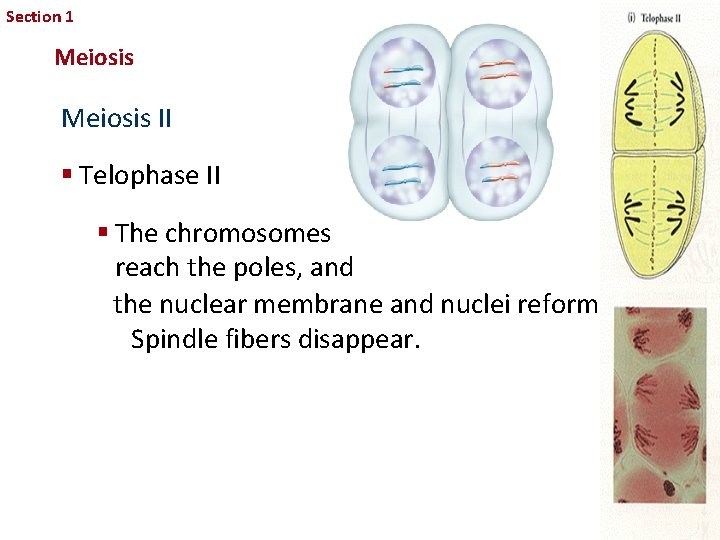
Section 1 Sexual Reproduction and Genetics Meiosis II § Telophase II § The chromosomes Telophase II reach the poles, and the nuclear membrane and nuclei reform. Spindle fibers disappear.
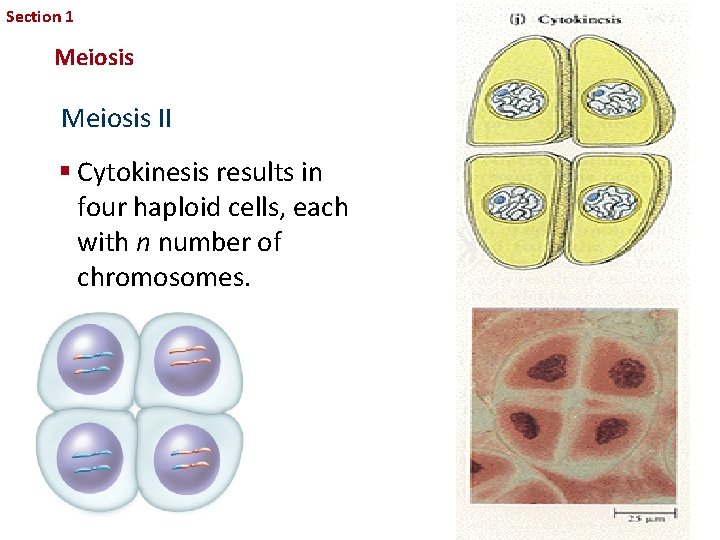
Section 1 Sexual Reproduction and Genetics Meiosis II § Cytokinesis results in four haploid cells, each with n number of chromosomes. Cytokinesis
Figure 13. 7 The stages of meiotic cell division: Meiosis II
Section 1 Sexual Reproduction and Genetics Meiosis The Importance of Meiosis § Meiosis consists of two sets of divisions § Produces four haploid daughter cells that are not identical § Results in genetic variation