
Meiosis Gamete Production Day One Chromosomes and Meiosis
- Slides: 50
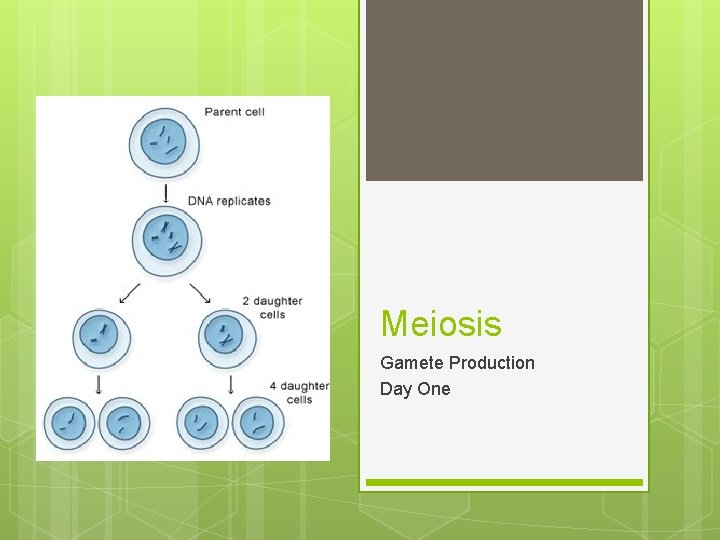
Meiosis Gamete Production Day One
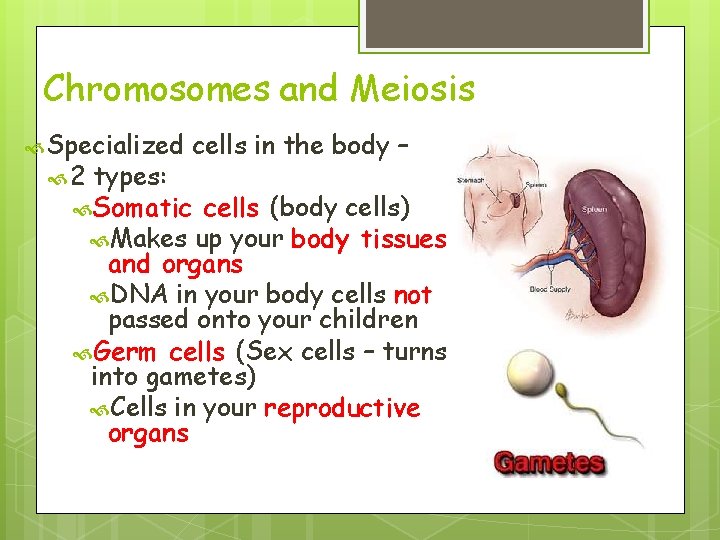
Chromosomes and Meiosis Specialized 2 cells in the body – types: Somatic cells (body cells) Makes up your body tissues and organs DNA in your body cells not passed onto your children Germ cells (Sex cells – turns into gametes) Cells in your reproductive organs
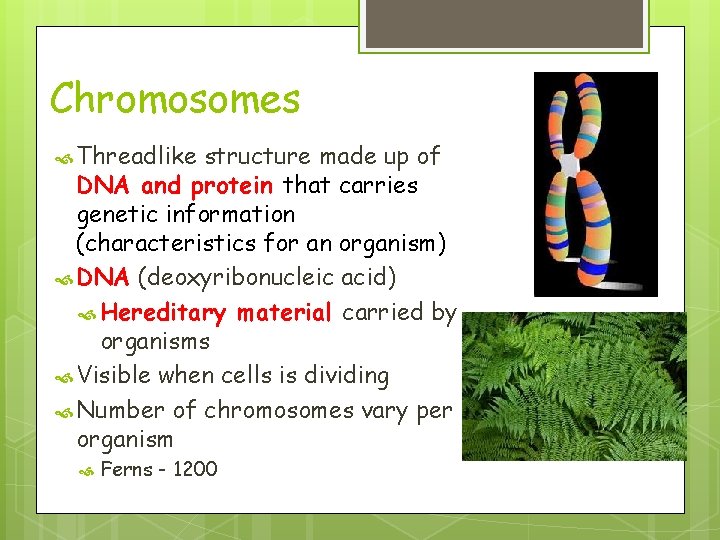
Chromosomes Threadlike structure made up of DNA and protein that carries genetic information (characteristics for an organism) DNA (deoxyribonucleic acid) Hereditary material carried by organisms Visible when cells is dividing Number of chromosomes vary per organism Ferns - 1200
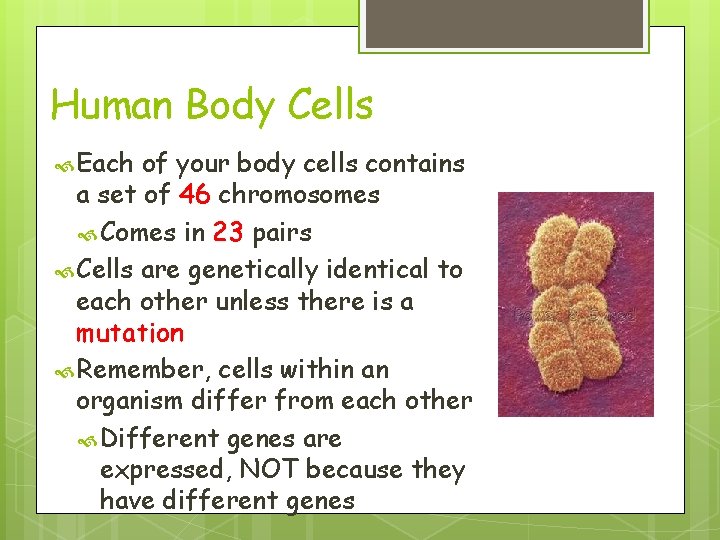
Human Body Cells Each of your body cells contains a set of 46 chromosomes Comes in 23 pairs Cells are genetically identical to each other unless there is a mutation Remember, cells within an organism differ from each other Different genes are expressed, NOT because they have different genes
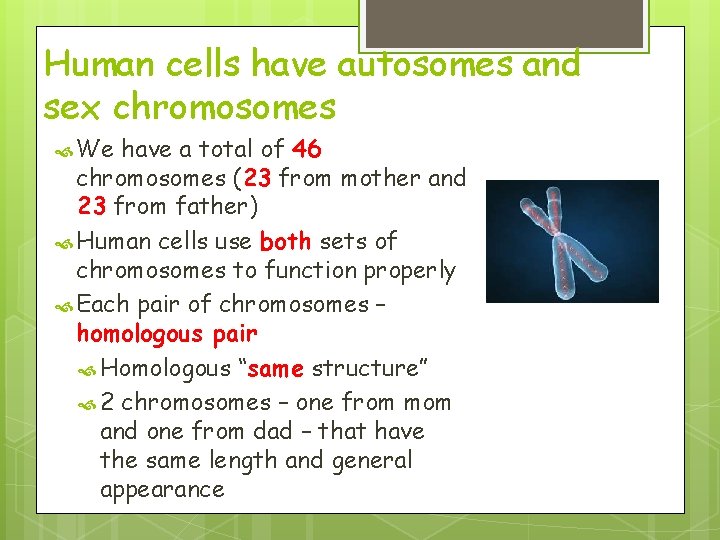
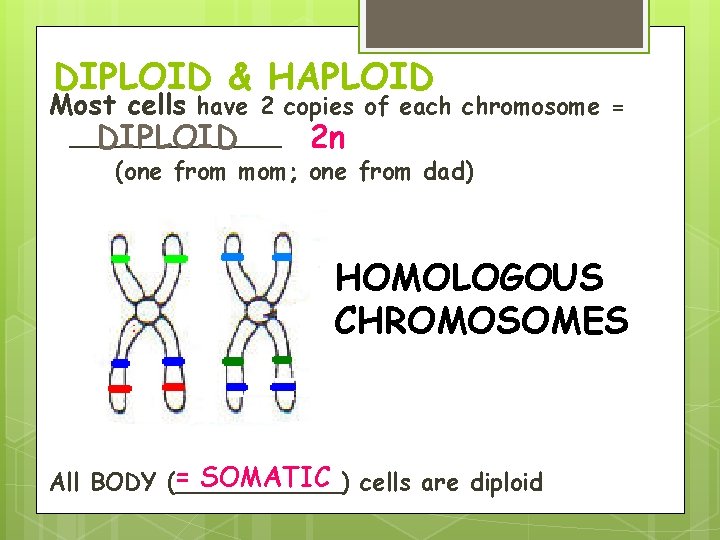
Human cells have autosomes and sex chromosomes We have a total of 46 chromosomes (23 from mother and 23 from father) Human cells use both sets of chromosomes to function properly Each pair of chromosomes – homologous pair Homologous “same structure” 2 chromosomes – one from mom and one from dad – that have the same length and general appearance
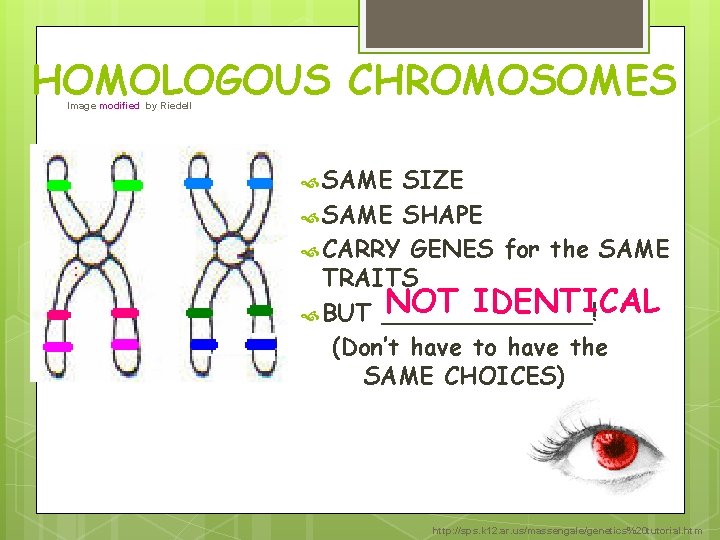
HOMOLOGOUS CHROMOSOMES Image modified by Riedell SAME SIZE SAME SHAPE CARRY GENES for the SAME TRAITS NOT IDENTICAL BUT _______! (Don’t have to have the SAME CHOICES) http: //sps. k 12. ar. us/massengale/genetics%20 tutorial. htm
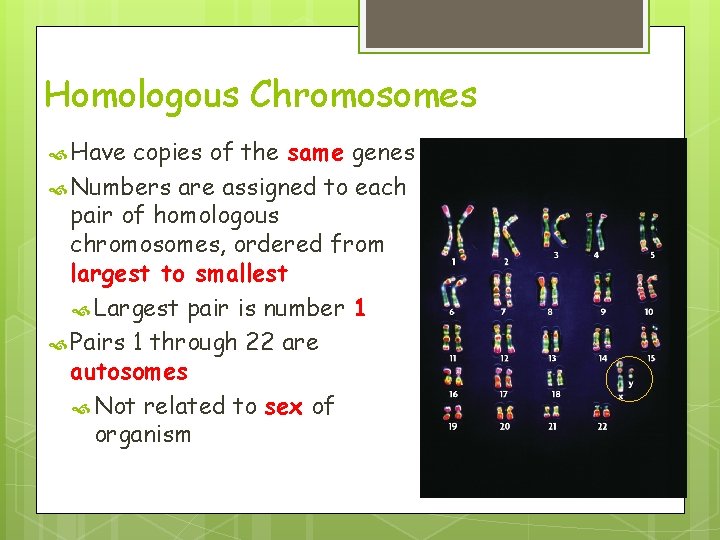
Homologous Chromosomes Have copies of the same genes Numbers are assigned to each pair of homologous chromosomes, ordered from largest to smallest Largest pair is number 1 Pairs 1 through 22 are autosomes Not related to sex of organism
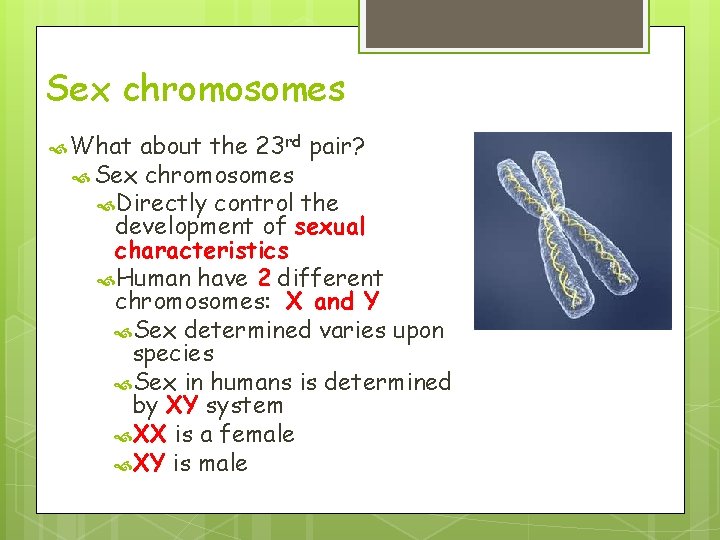
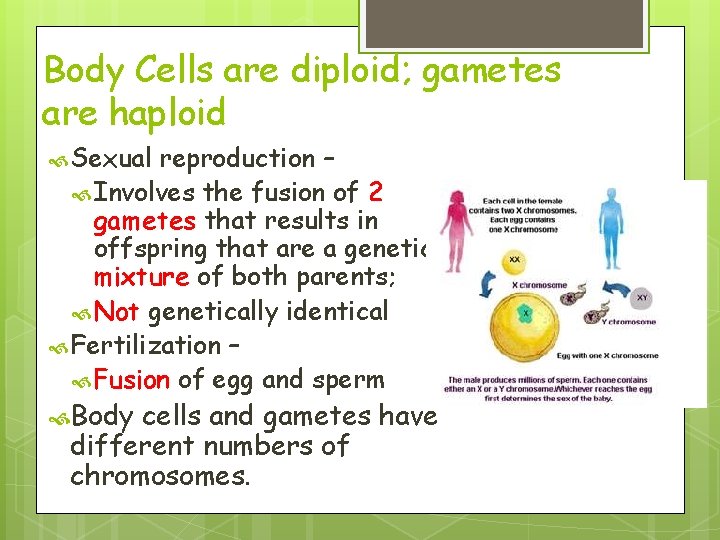
Sex chromosomes What about the 23 rd pair? Sex chromosomes Directly control the development of sexual characteristics Human have 2 different chromosomes: X and Y Sex determined varies upon species Sex in humans is determined by XY system XX is a female XY is male
Body Cells are diploid; gametes are haploid Sexual reproduction – Involves the fusion of 2 gametes that results in offspring that are a genetic mixture of both parents; Not genetically identical Fertilization – Fusion of egg and sperm Body cells and gametes have different numbers of chromosomes.
DIPLOID & HAPLOID Most cells have 2 copies of each chromosome = _______ DIPLOID 2 n (one from mom; one from dad) HOMOLOGOUS CHROMOSOMES = SOMATIC cells are diploid All BODY (______)
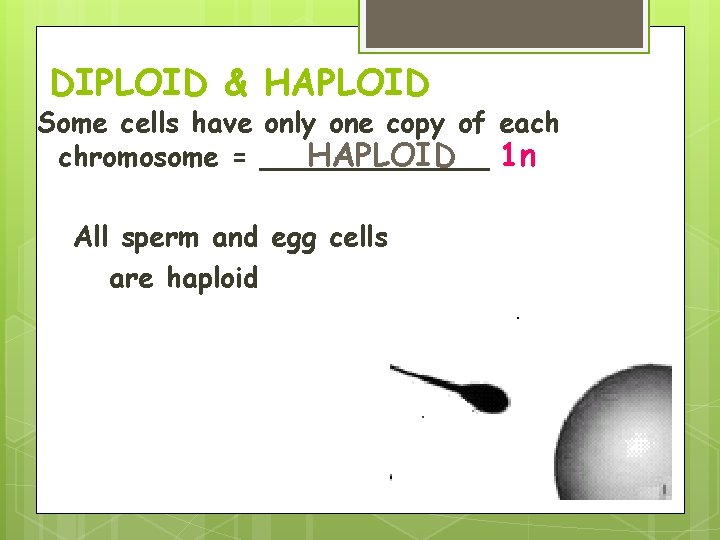
DIPLOID & HAPLOID Some cells have only one copy of each chromosome = _______ HAPLOID 1 n All sperm and egg cells are haploid
Remember from Chapter 1: CHARACTERISTICS OF LIVING THINGS REPRODUCE ALL LIVING THINGS _____
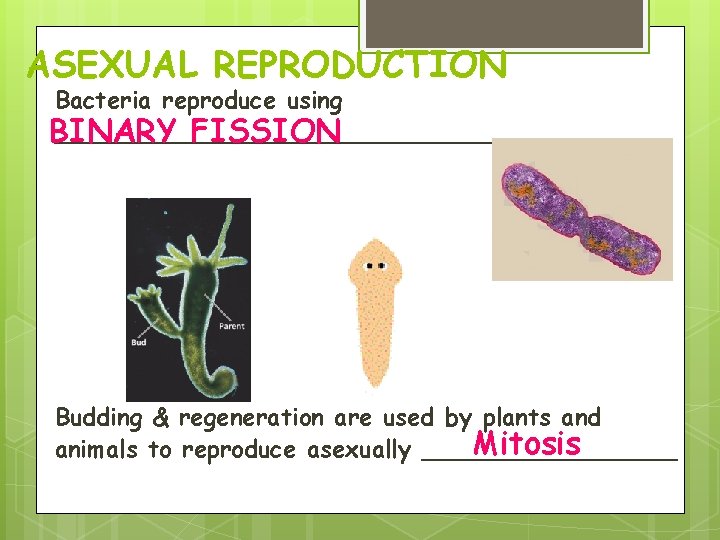
ASEXUAL REPRODUCTION Bacteria reproduce using _________________ BINARY FISSION Budding & regeneration are used by plants and Mitosis animals to reproduce asexually _________
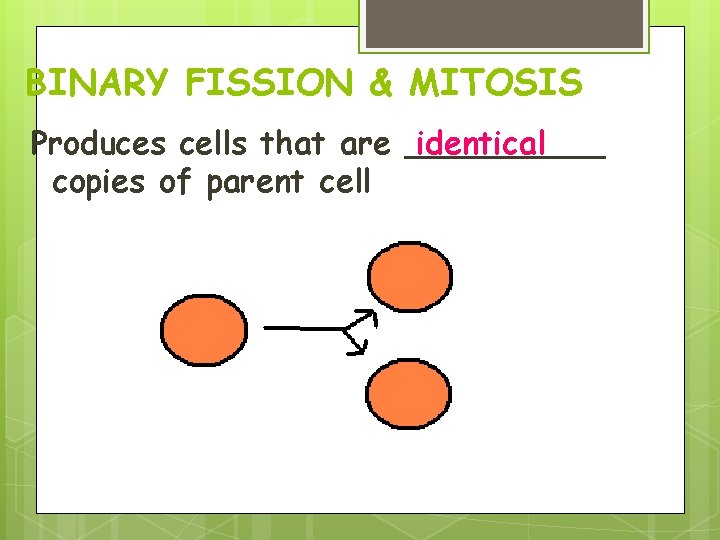
BINARY FISSION & MITOSIS Produces cells that are _____ identical copies of parent cell
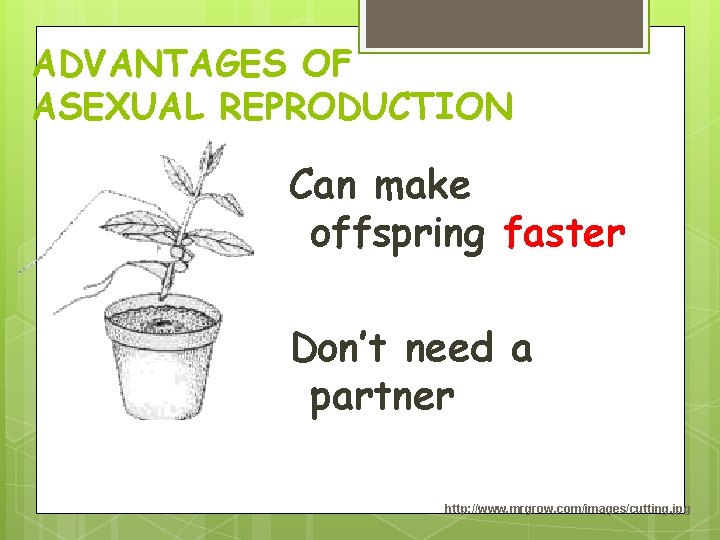
ADVANTAGES OF ASEXUAL REPRODUCTION Can make offspring faster Don’t need a partner http: //www. mrgrow. com/images/cutting. jpg
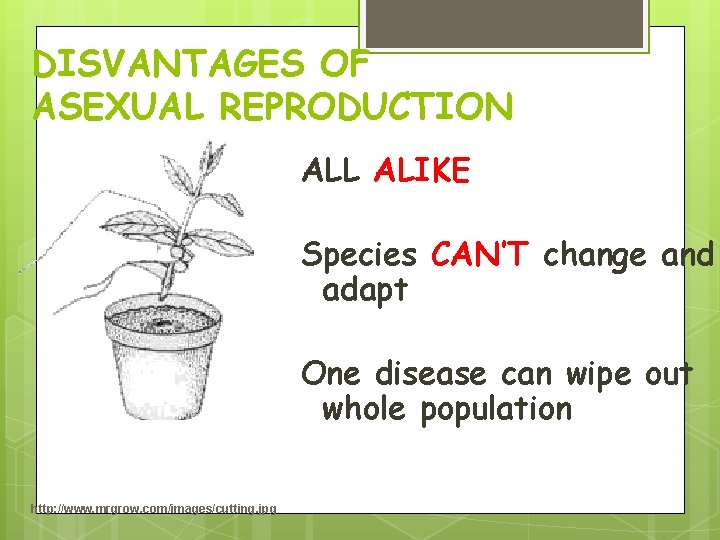
DISVANTAGES OF ASEXUAL REPRODUCTION ALL ALIKE Species CAN’T change and adapt One disease can wipe out whole population http: //www. mrgrow. com/images/cutting. jpg
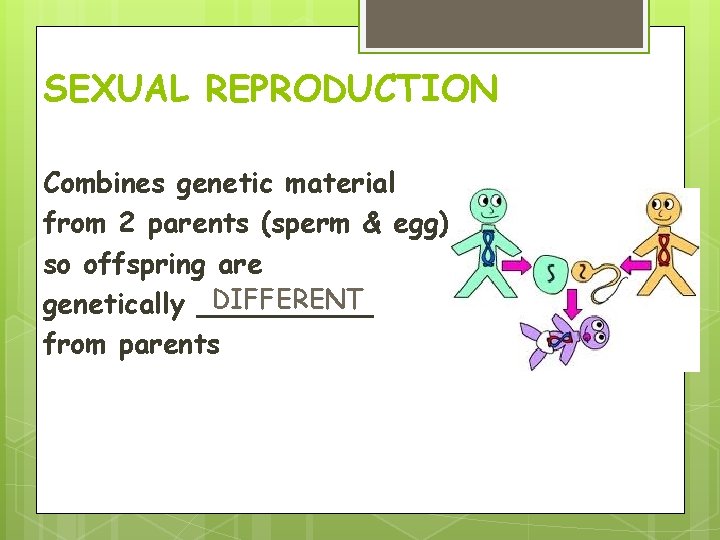
SEXUAL REPRODUCTION Combines genetic material from 2 parents (sperm & egg) so offspring are DIFFERENT genetically _____ from parents
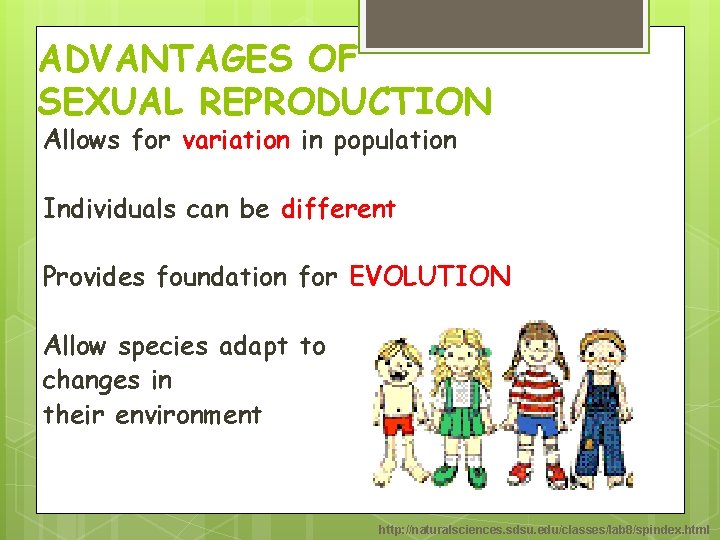
ADVANTAGES OF SEXUAL REPRODUCTION Allows for variation in population Individuals can be different Provides foundation for EVOLUTION Allow species adapt to changes in their environment http: //naturalsciences. sdsu. edu/classes/lab 8/spindex. html
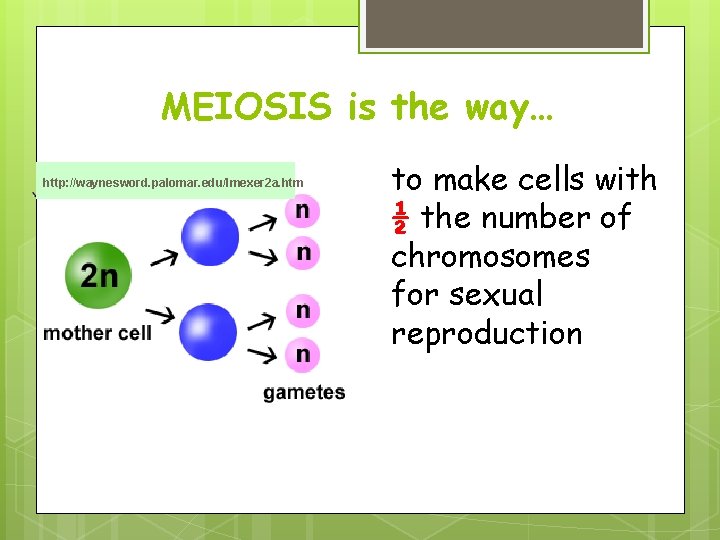
MEIOSIS is the way… http: //waynesword. palomar. edu/lmexer 2 a. htm to make cells with ½ the number of chromosomes for sexual reproduction
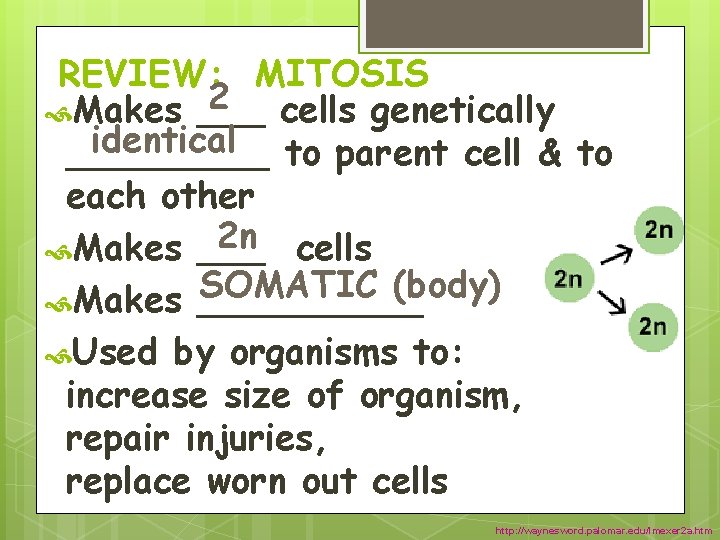
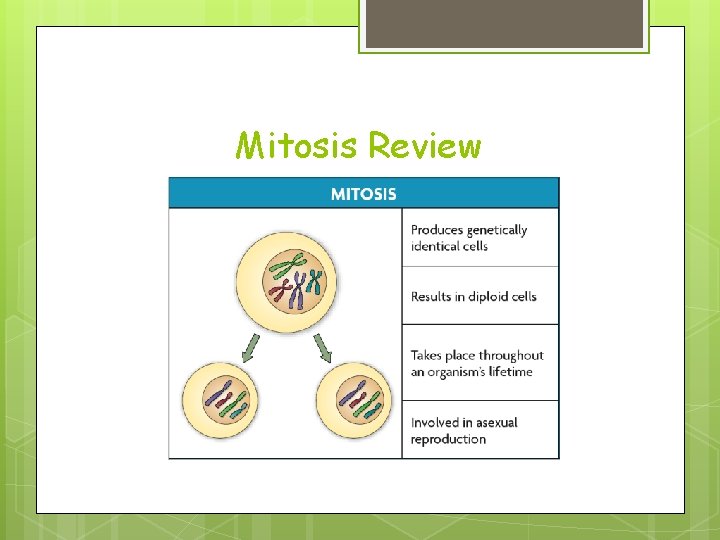
REVIEW: MITOSIS 2 cells genetically Makes ___ identical _____ to parent cell & to each other 2 n Makes ___ cells SOMATIC (body) Makes _____ Used by organisms to: increase size of organism, repair injuries, replace worn out cells http: //waynesword. palomar. edu/lmexer 2 a. htm
Mitosis Review
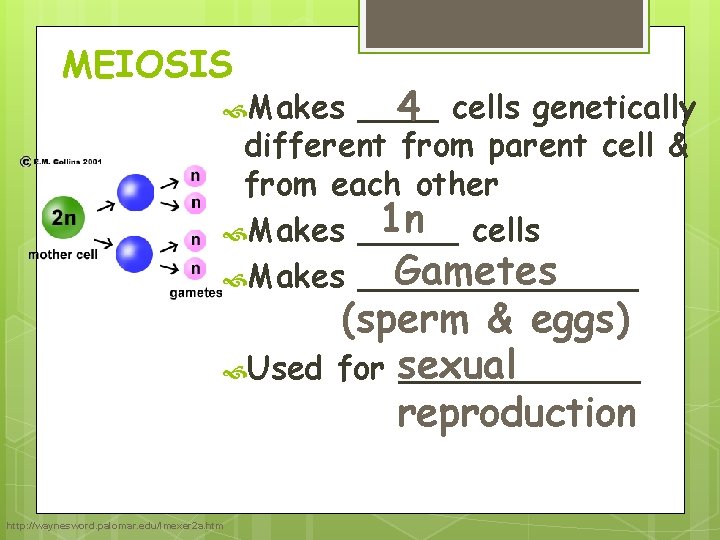
MEIOSIS ____ 4 cells genetically different from parent cell & from each other 1 n cells Makes _____ Gametes Makes _______ Makes Used http: //waynesword. palomar. edu/lmexer 2 a. htm (sperm & eggs) for sexual ______ reproduction
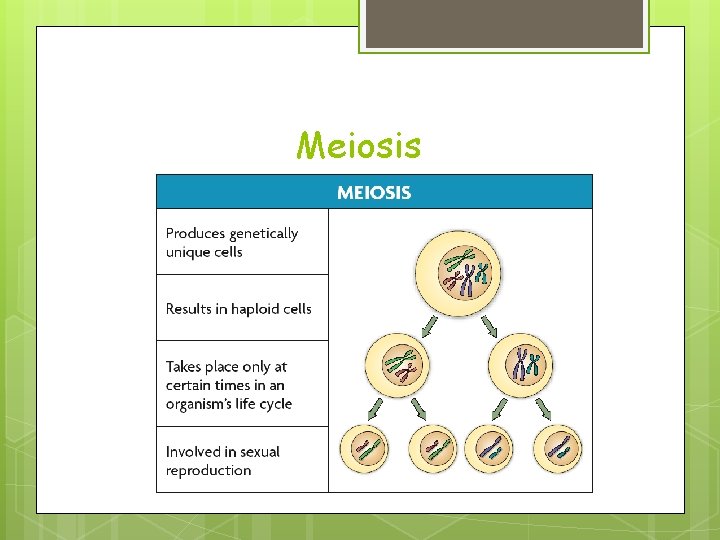
Meiosis
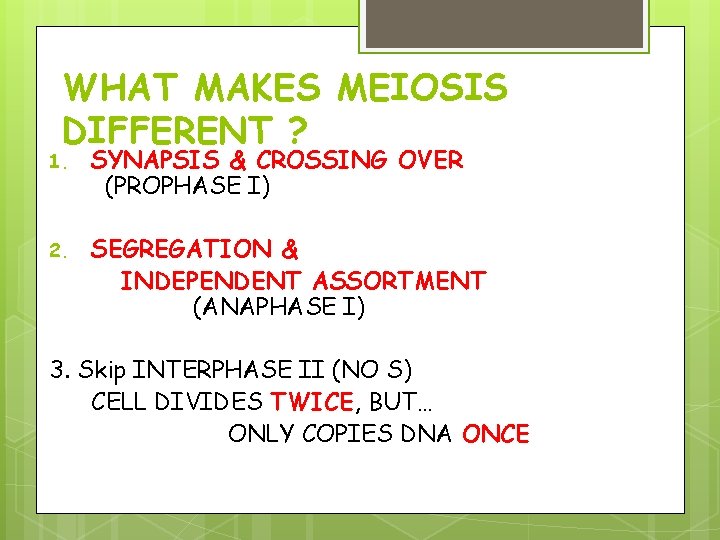
WHAT MAKES MEIOSIS DIFFERENT ? 1. SYNAPSIS & CROSSING OVER (PROPHASE I) 2. SEGREGATION & INDEPENDENT ASSORTMENT (ANAPHASE I) 3. Skip INTERPHASE II (NO S) CELL DIVIDES TWICE, BUT… ONLY COPIES DNA ONCE
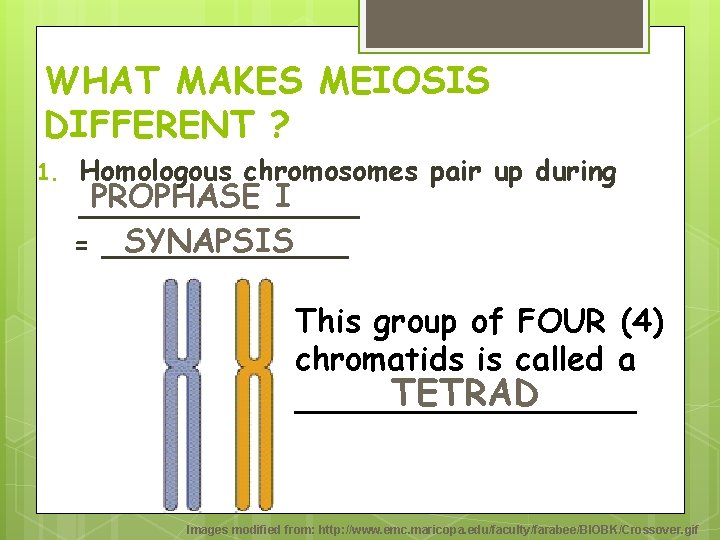
WHAT MAKES MEIOSIS DIFFERENT ? 1. Homologous chromosomes pair up during PROPHASE I ________ SYNAPSIS = _______ This group of FOUR (4) chromatids is called a TETRAD _________ Images modified from: http: //www. emc. maricopa. edu/faculty/farabee/BIOBK/Crossover. gif
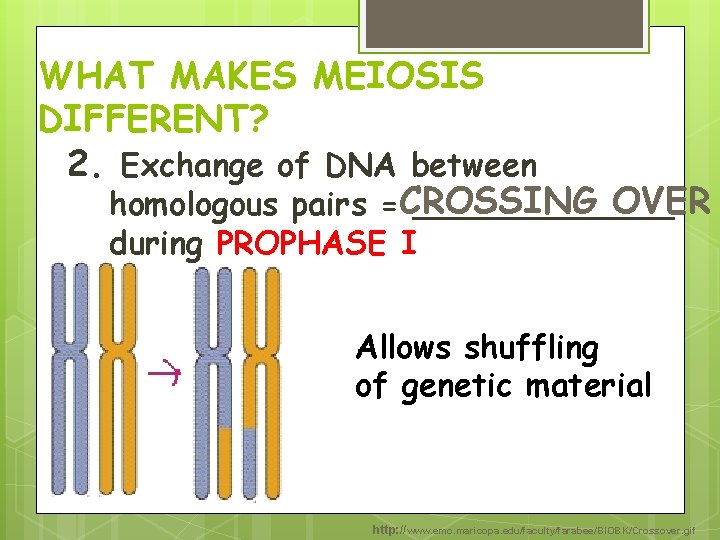
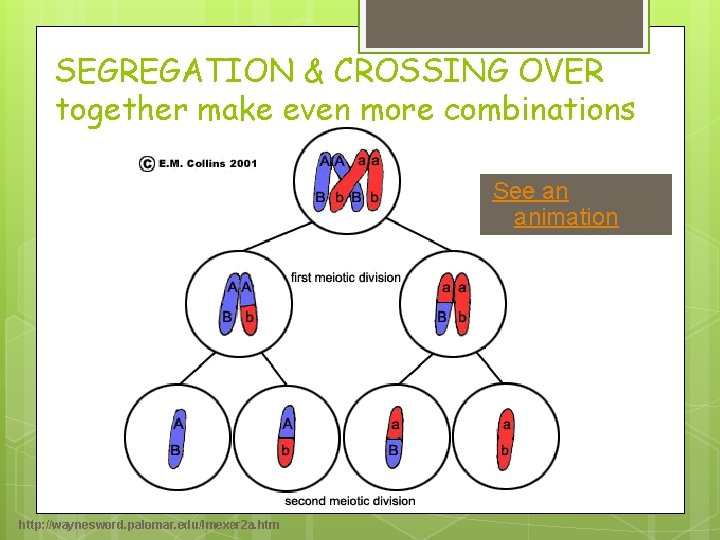
WHAT MAKES MEIOSIS DIFFERENT? 2. Exchange of DNA between OVER homologous pairs =CROSSING _______ during PROPHASE I Allows shuffling of genetic material http: //www. emc. maricopa. edu/faculty/farabee/BIOBK/Crossover. gif
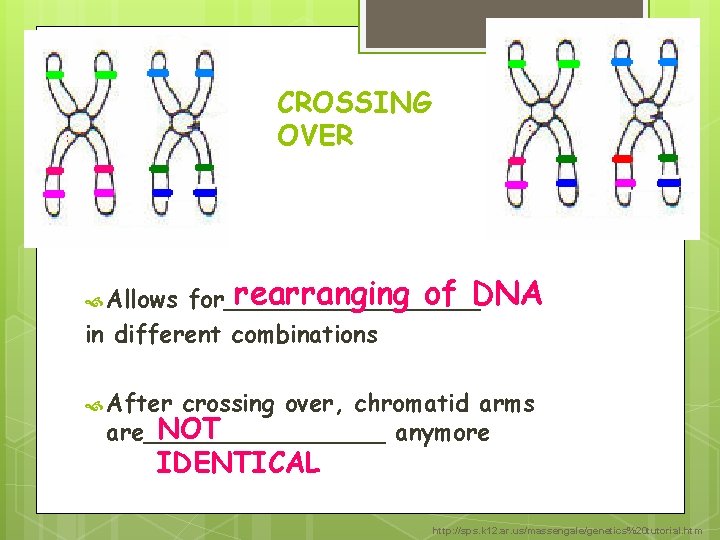
CROSSING OVER rearranging of DNA for_________ in different combinations Allows After crossing over, chromatid arms NOT are________ anymore IDENTICAL http: //sps. k 12. ar. us/massengale/genetics%20 tutorial. htm
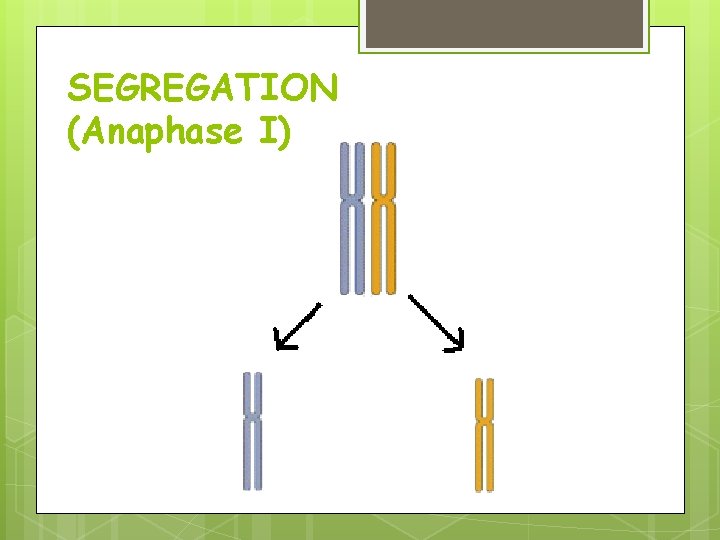
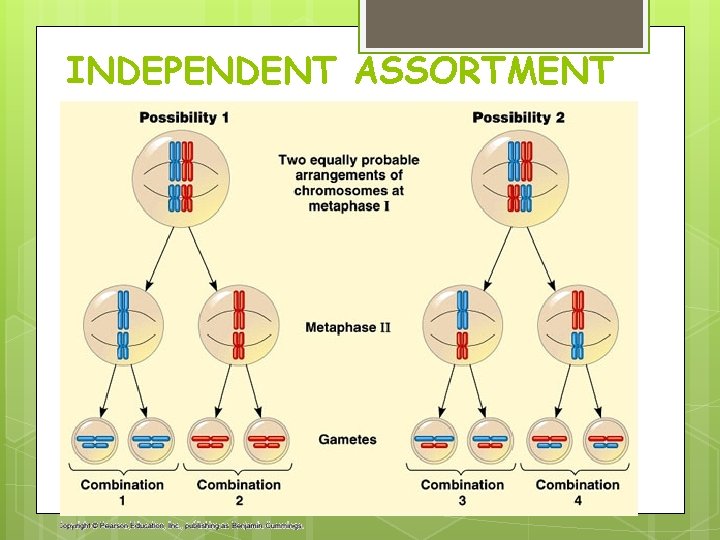
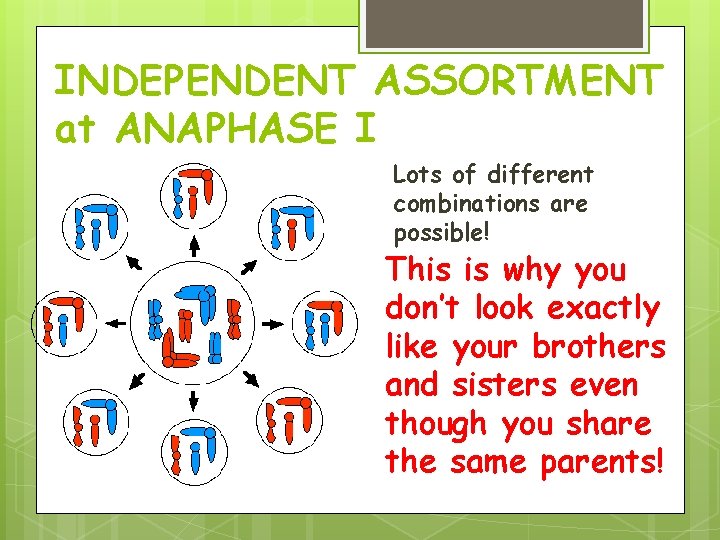
WHAT MAKES MEIOSIS DIFFERENT ? 3. Separation during ANAPHASE I SEGREGATION & INDEPENDENT ASSORTMENT Separates gene choices and allows shuffling of genetic material
SEGREGATION (Anaphase I)
SEGREGATION & CROSSING OVER together make even more combinations See an animation http: //waynesword. palomar. edu/lmexer 2 a. htm
INDEPENDENT ASSORTMENT
INDEPENDENT ASSORTMENT at ANAPHASE I Lots of different combinations are possible! This is why you don’t look exactly like your brothers and sisters even though you share the same parents!
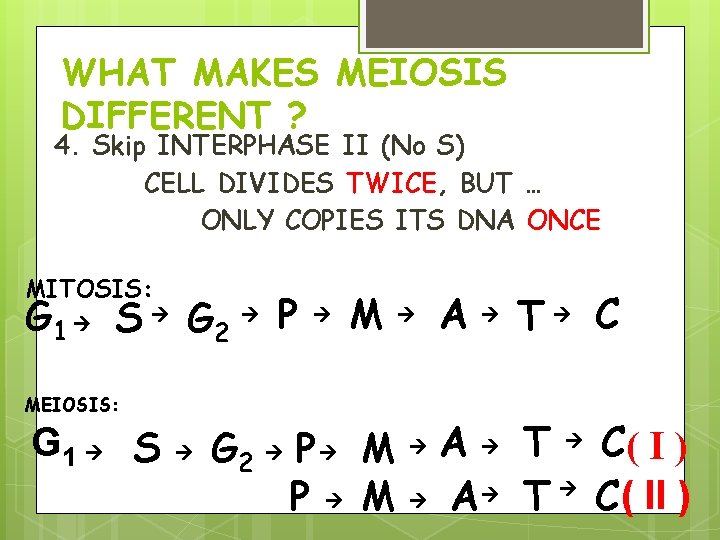
WHAT MAKES MEIOSIS DIFFERENT ? 4. Skip INTERPHASE II (No S) CELL DIVIDES TWICE, BUT … ONLY COPIES ITS DNA ONCE MITOSIS: G 1 S G 2 P M MEIOSIS: G 1 S G 2 P M A T C A T C( I ) A T C( II )
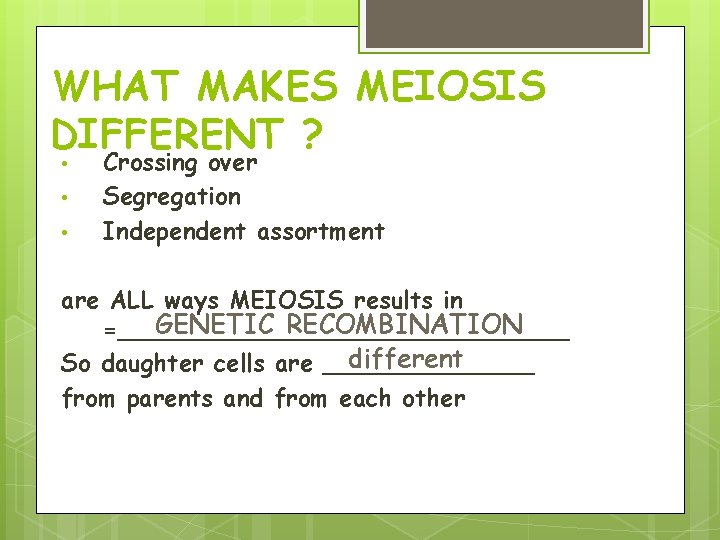
WHAT MAKES MEIOSIS DIFFERENT ? • • • Crossing over Segregation Independent assortment are ALL ways MEIOSIS results in GENETIC RECOMBINATION =_______________ different So daughter cells are _______ from parents and from each other
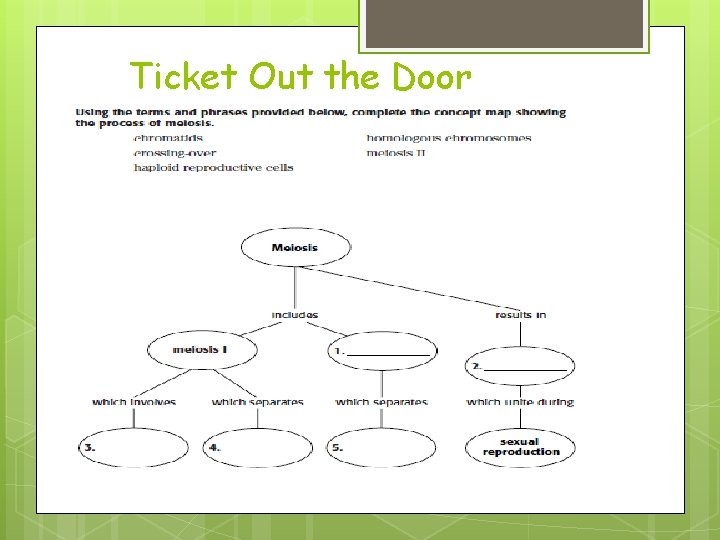
Ticket out the Door 1. 2. 3. 4. 5. What are somatic cells and germ cells? How many chromosomes do your body cells have? How many pairs of chromosomes do your body cells have? What is the difference between autosomes and sex chromosomes? What are three points that make meiosis different from mitosis?
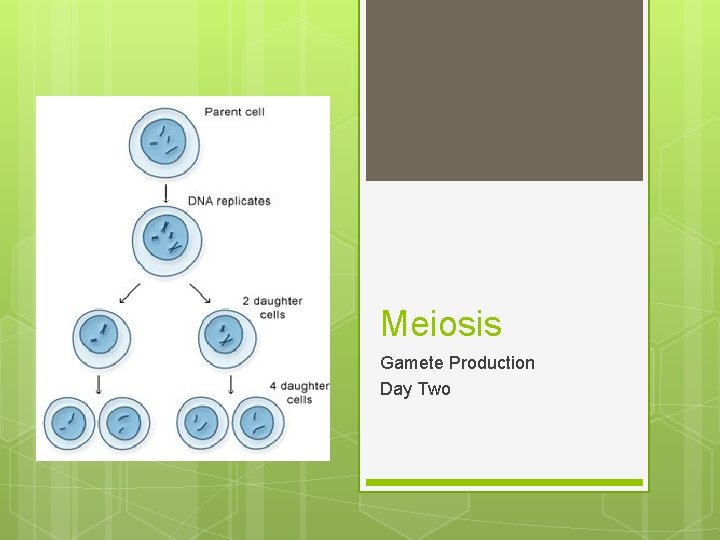
Meiosis Gamete Production Day Two
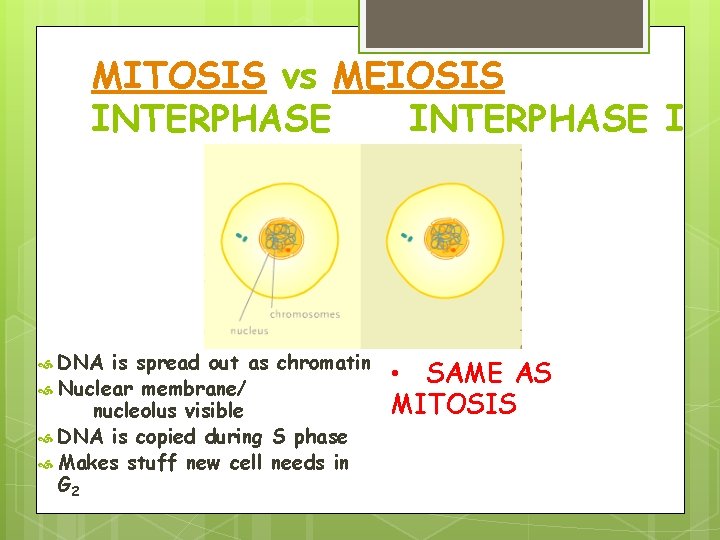
MITOSIS vs MEIOSIS INTERPHASE I DNA is spread out as chromatin Nuclear membrane/ nucleolus visible DNA is copied during S phase Makes stuff new cell needs in G 2 • SAME AS MITOSIS
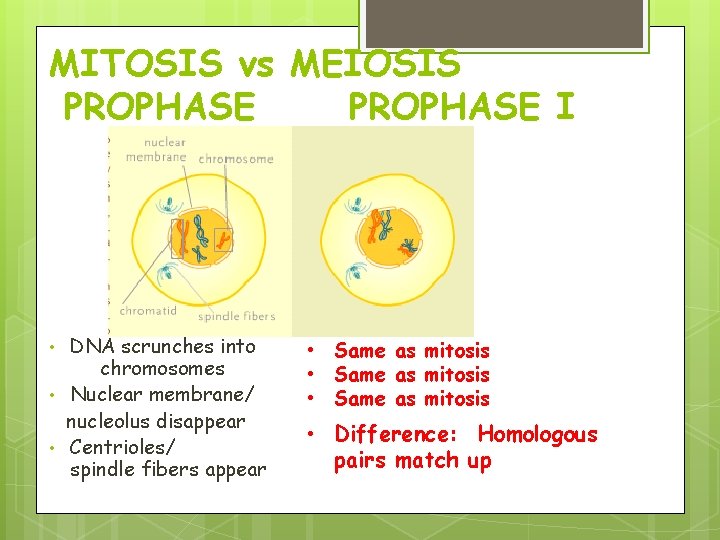
MITOSIS vs MEIOSIS PROPHASE I • • • DNA scrunches into chromosomes Nuclear membrane/ nucleolus disappear Centrioles/ spindle fibers appear • Same as mitosis • Difference: Homologous pairs match up
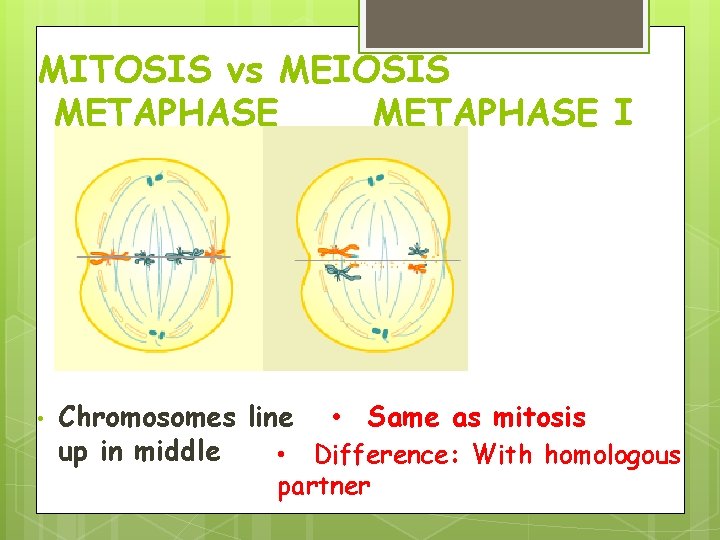
MITOSIS vs MEIOSIS METAPHASE I • Chromosomes line • Same as mitosis up in middle • Difference: With homologous partner
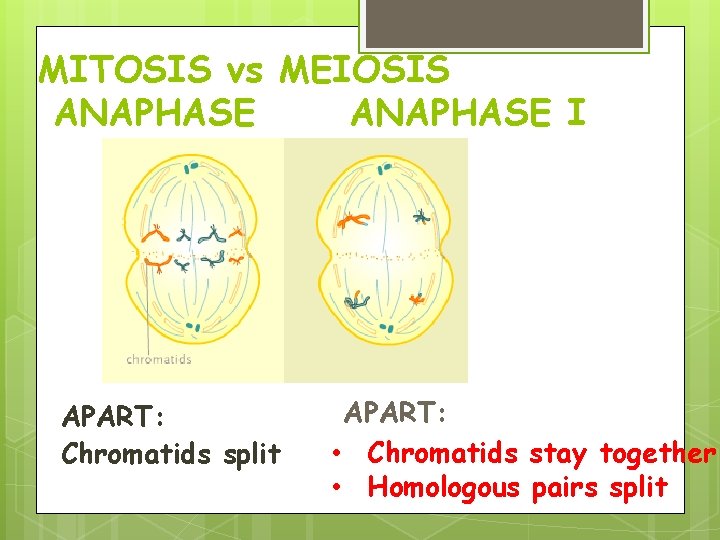
MITOSIS vs MEIOSIS ANAPHASE I APART: Chromatids split APART: • Chromatids stay together • Homologous pairs split
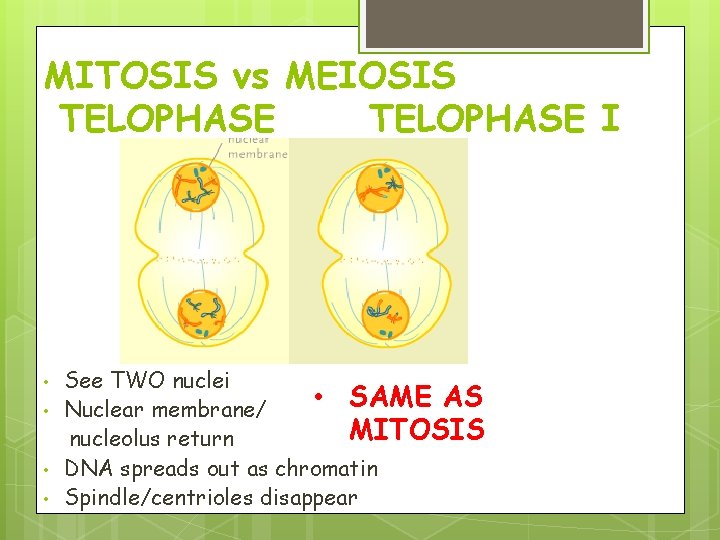
MITOSIS vs MEIOSIS TELOPHASE I • • See TWO nuclei • SAME AS Nuclear membrane/ MITOSIS nucleolus return DNA spreads out as chromatin Spindle/centrioles disappear
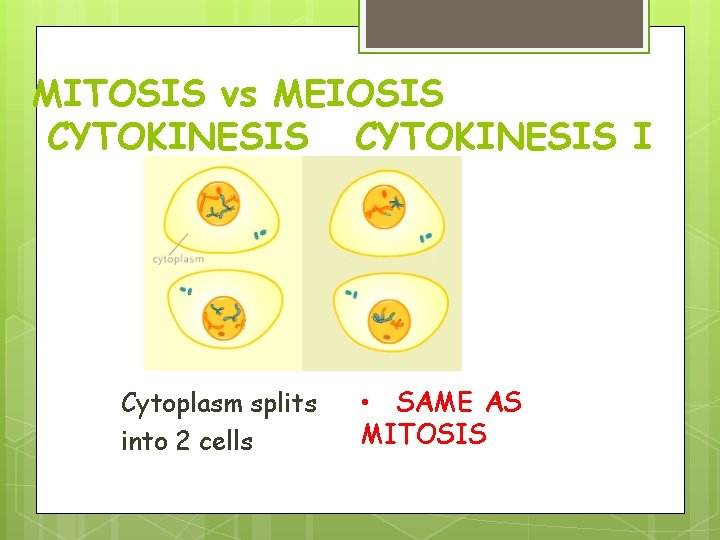
MITOSIS vs MEIOSIS CYTOKINESIS I Cytoplasm splits into 2 cells • SAME AS MITOSIS
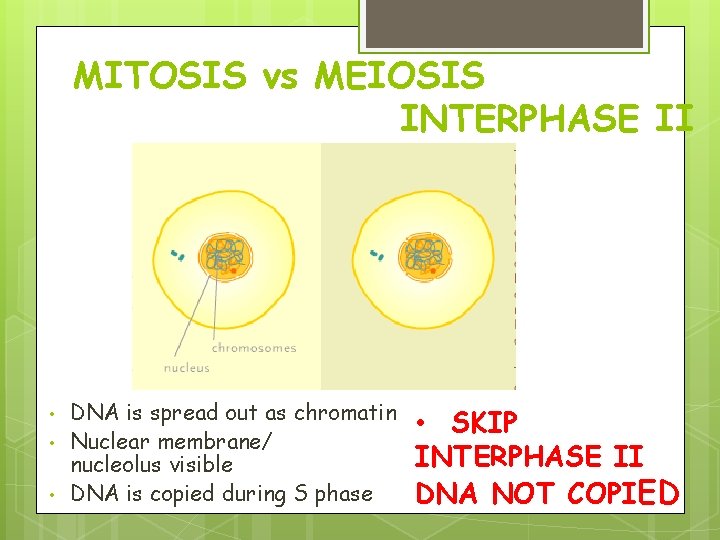
MITOSIS vs MEIOSIS INTERPHASE II • • • DNA is spread out as chromatin Nuclear membrane/ nucleolus visible DNA is copied during S phase • SKIP INTERPHASE II DNA NOT COPIED
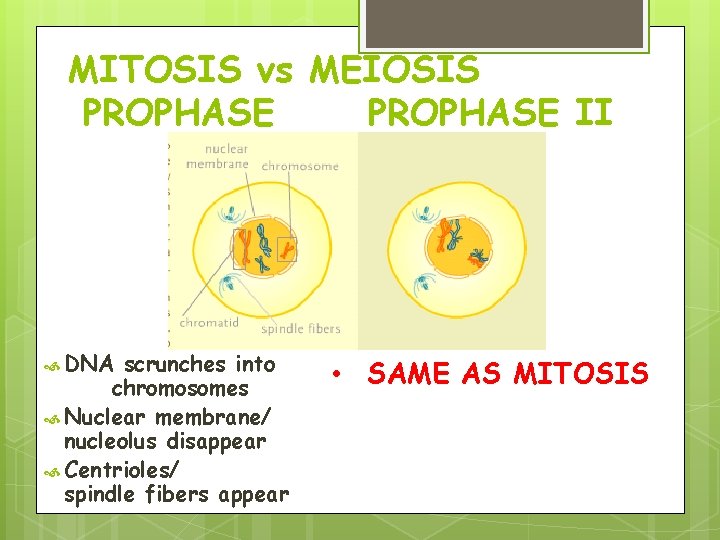
MITOSIS vs MEIOSIS PROPHASE II DNA scrunches into chromosomes Nuclear membrane/ nucleolus disappear Centrioles/ spindle fibers appear • SAME AS MITOSIS
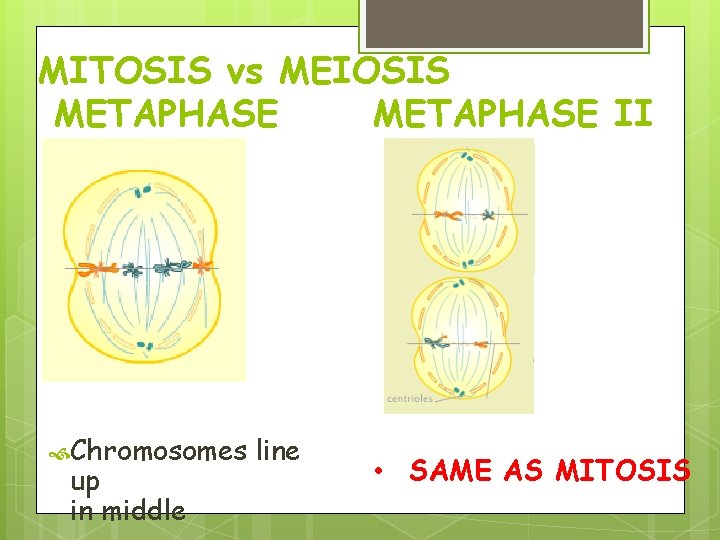
MITOSIS vs MEIOSIS METAPHASE II Chromosomes up in middle line • SAME AS MITOSIS
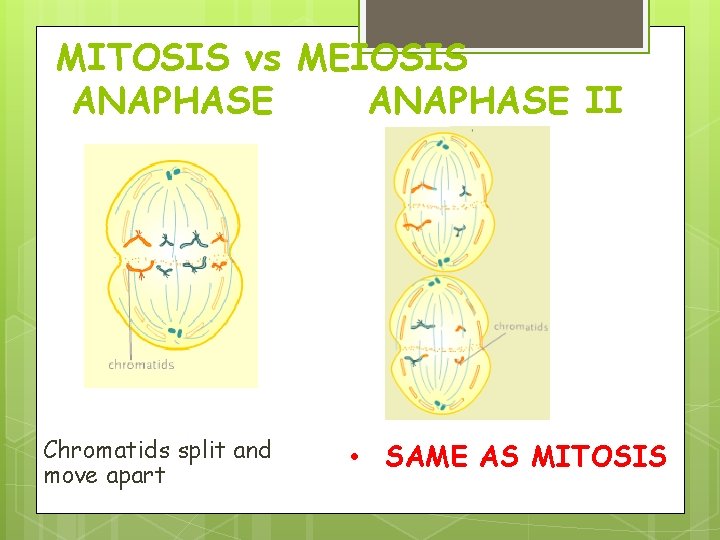
MITOSIS vs MEIOSIS ANAPHASE II Chromatids split and move apart • SAME AS MITOSIS
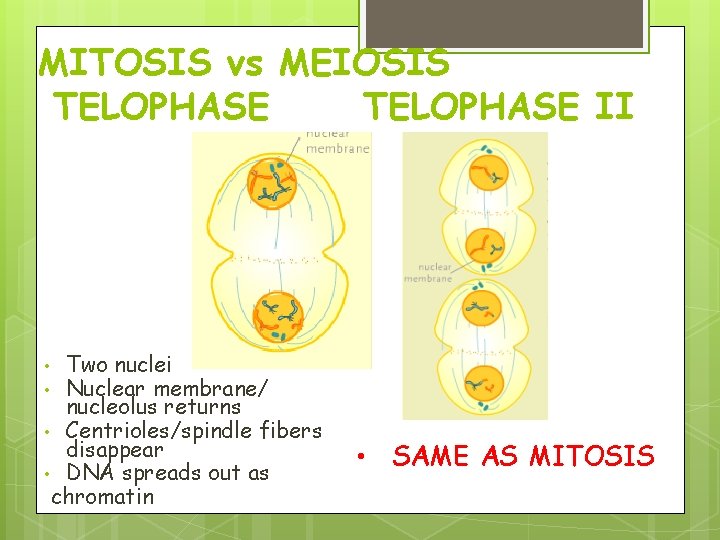
MITOSIS vs MEIOSIS TELOPHASE II Two nuclei Nuclear membrane/ nucleolus returns • Centrioles/spindle fibers disappear • DNA spreads out as chromatin • • • SAME AS MITOSIS
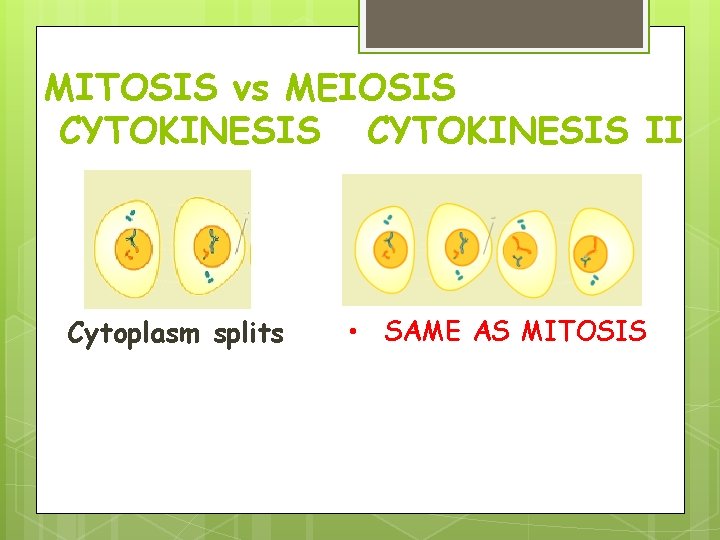
MITOSIS vs MEIOSIS CYTOKINESIS II Cytoplasm splits • SAME AS MITOSIS
Meiosis Animations Meiosis Animation - Sumanas Meiosis - Mc. Graw Hill Meiosis Animation
Ticket Out the Door