
Meiosis and Sexual Reproduction Some basic facts Sexual
Meiosis and Sexual Reproduction

Some basic facts… Sexual Reproduction - involves the production __________ gametes and of special sex cells, called ________ fusion the ________ (joining together) of their nuclei ________. This fusion creates a fertilized zygote egg called a ________. Male gametes or sex cells are generally small and motile - in many organisms they are called the sperm ________. Female gametes or sex cells are generally larger and non-motile - in many organisms they are egg ova called the ________ or ________. In sexual reproduction, the offspring produced Not identical are ________ to either parent. They show combinations of both parents. This is called Genetic variation (important in the evolution of ________ organisms).
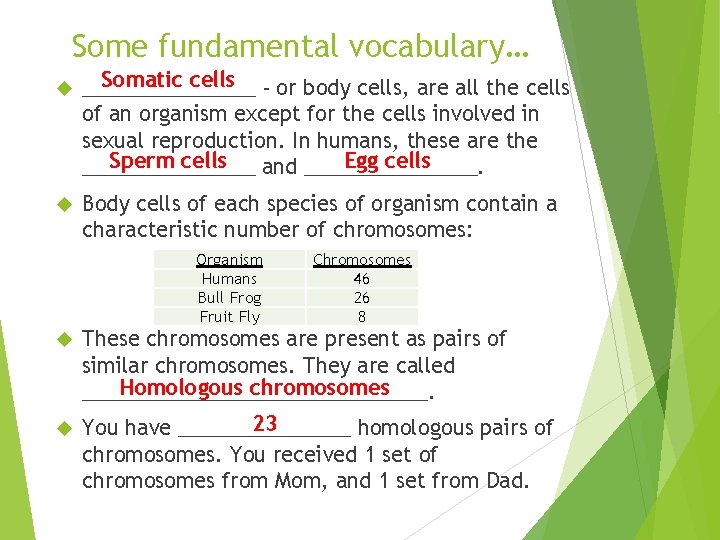
Some fundamental vocabulary… Somatic cells - or body cells, are all the cells ________ of an organism except for the cells involved in sexual reproduction. In humans, these are the Egg cells Sperm cells ________ and ________. Body cells of each species of organism contain a characteristic number of chromosomes: Organism Humans Bull Frog Fruit Fly Chromosomes 46 26 8 These chromosomes are present as pairs of similar chromosomes. They are called Homologous chromosomes _______________. 23 You have ________ homologous pairs of chromosomes. You received 1 set of chromosomes from Mom, and 1 set from Dad.
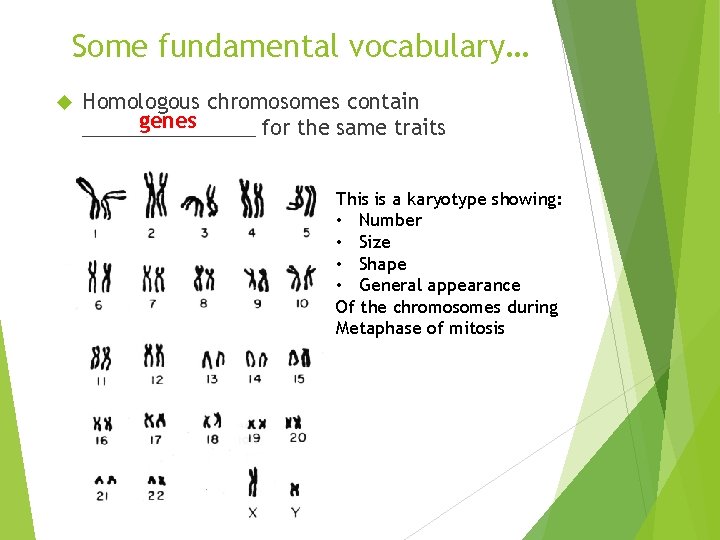
Some fundamental vocabulary… Homologous chromosomes contain genes ________ for the same traits This is a karyotype showing: • Number • Size • Shape • General appearance Of the chromosomes during Metaphase of mitosis
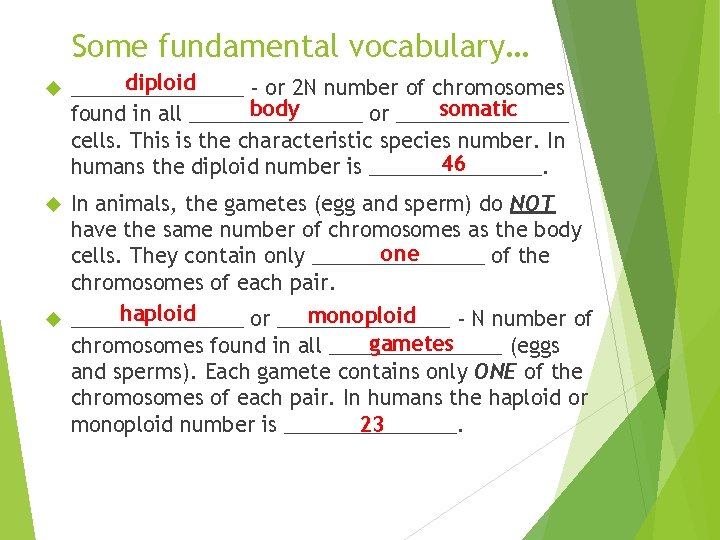
Some fundamental vocabulary… diploid ________ - or 2 N number of chromosomes body somatic found in all ________ or ________ cells. This is the characteristic species number. In 46 humans the diploid number is ________. In animals, the gametes (egg and sperm) do NOT have the same number of chromosomes as the body one cells. They contain only ________ of the chromosomes of each pair. haploid monoploid ________ or ________ - N number of gametes chromosomes found in all ________ (eggs and sperms). Each gamete contains only ONE of the chromosomes of each pair. In humans the haploid or monoploid number is ________. 23
Some fundamental vocabulary… For example: A species has 10 chromosomes (diploid number). They received one set of 5 ________ (haploid number) from 5 Mom, and one set of ________ (haploid number) from Dad. meiosis ________ - or REDUCTION DIVISION is a type of cell division that occurs only in Sex cells or gametes __________. Daughter cells As a result of meiosis the ________ half receive only ________ the number of chromosomes present in the body cells. Meiosis is necessary so the chromosome Not doubled each time the number is ________ egg and sperm unite.
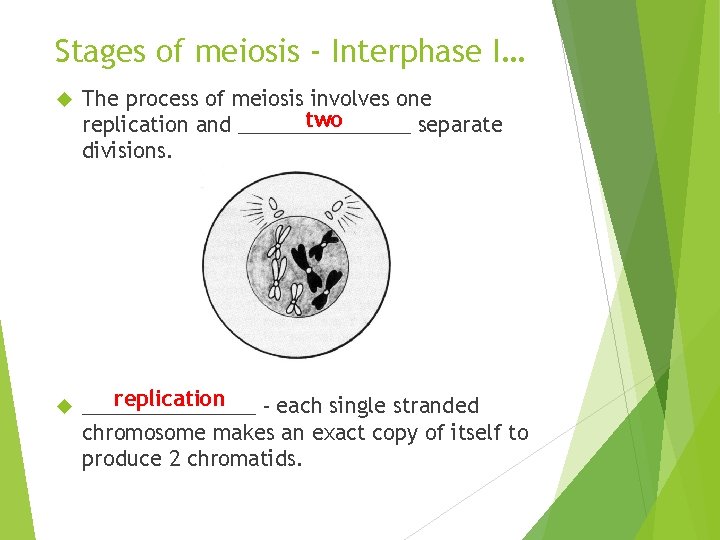
Stages of meiosis - Interphase I… The process of meiosis involves one two replication and ________ separate divisions. replication ________ - each single stranded chromosome makes an exact copy of itself to produce 2 chromatids.
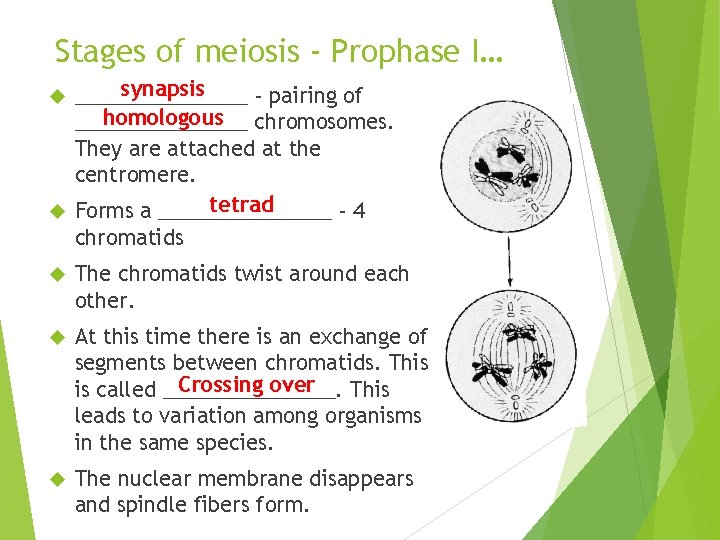
Stages of meiosis - Prophase I… synapsis ________ - pairing of homologous chromosomes. ________ They are attached at the centromere. tetrad Forms a ________ -4 chromatids The chromatids twist around each other. At this time there is an exchange of segments between chromatids. This Crossing over is called ________. This leads to variation among organisms in the same species. The nuclear membrane disappears and spindle fibers form.
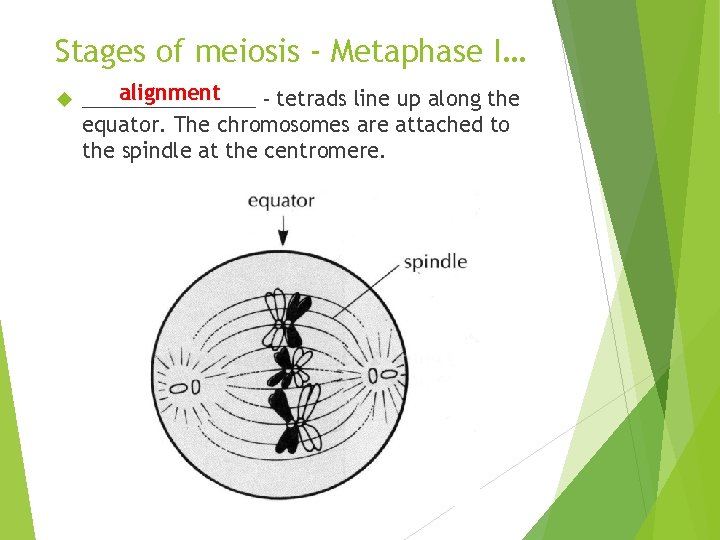
Stages of meiosis - Metaphase I… alignment ________ - tetrads line up along the equator. The chromosomes are attached to the spindle at the centromere.
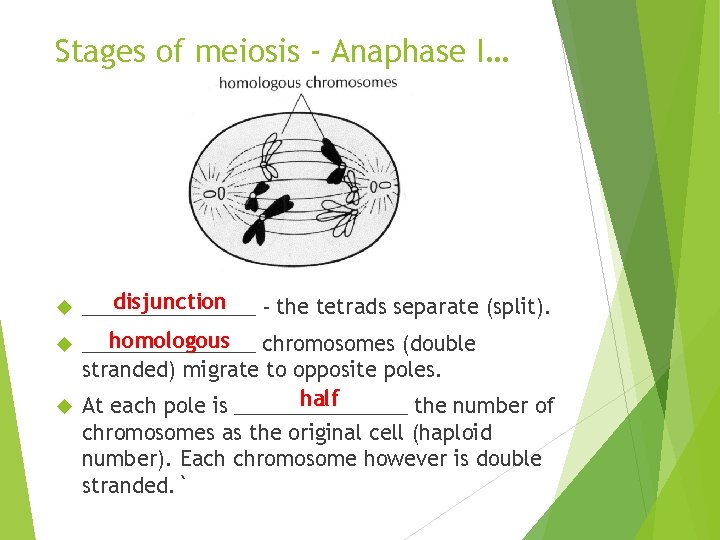
Stages of meiosis - Anaphase I… disjunction ________ - the tetrads separate (split). homologous chromosomes (double ________ stranded) migrate to opposite poles. half At each pole is ________ the number of chromosomes as the original cell (haploid number). Each chromosome however is double stranded. `
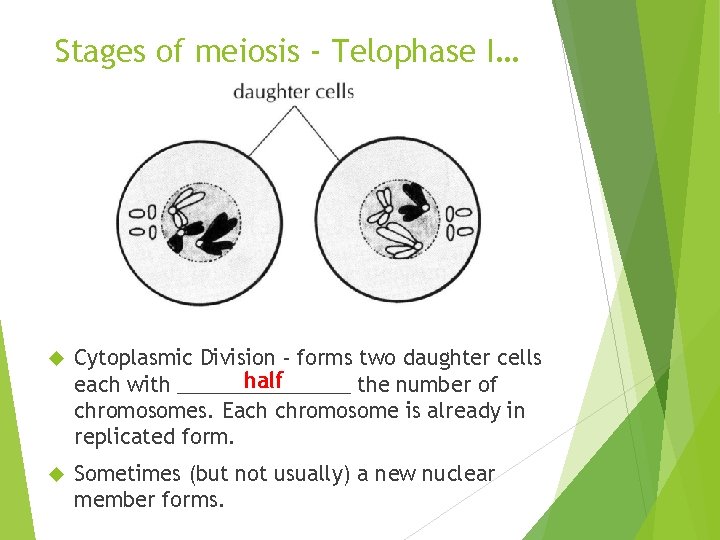
Stages of meiosis - Telophase I… Cytoplasmic Division - forms two daughter cells half each with ________ the number of chromosomes. Each chromosome is already in replicated form. Sometimes (but not usually) a new nuclear member forms.
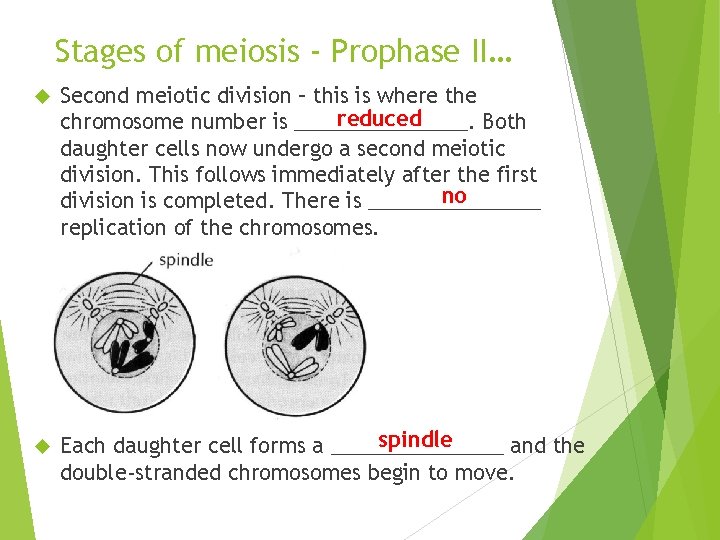
Stages of meiosis - Prophase II… Second meiotic division – this is where the reduced chromosome number is ________. Both daughter cells now undergo a second meiotic division. This follows immediately after the first no division is completed. There is ________ replication of the chromosomes. spindle Each daughter cell forms a ________ and the double-stranded chromosomes begin to move.
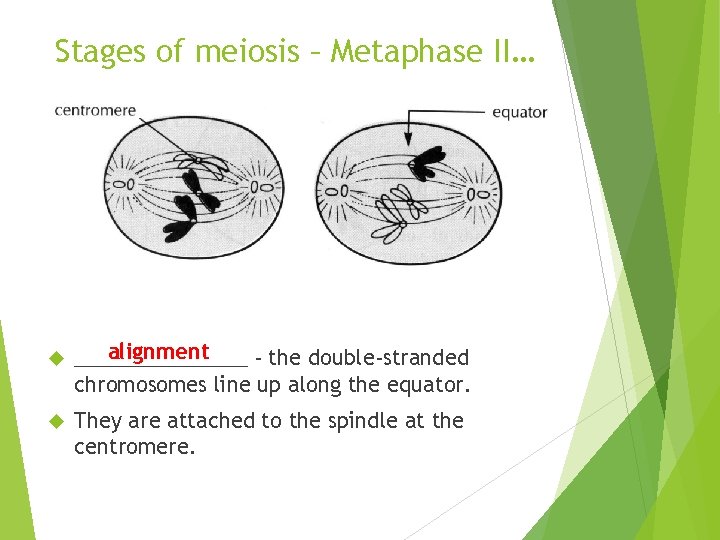
Stages of meiosis – Metaphase II… alignment ________ - the double-stranded chromosomes line up along the equator. They are attached to the spindle at the centromere.
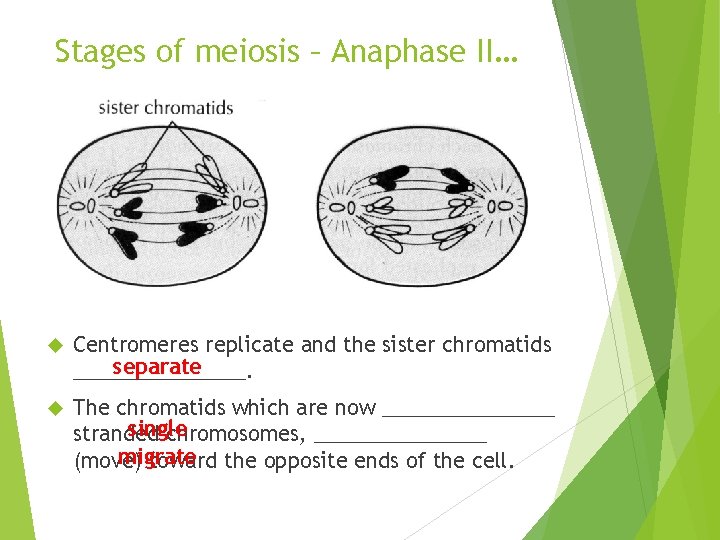
Stages of meiosis – Anaphase II… Centromeres replicate and the sister chromatids separate ________. The chromatids which are now ________ single stranded chromosomes, ________ migrate (move) toward the opposite ends of the cell.
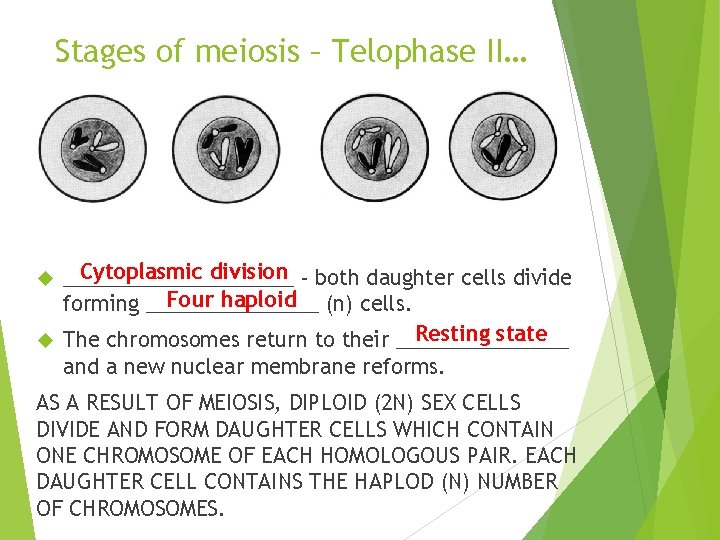
Stages of meiosis – Telophase II… Cytoplasmic division - both daughter cells divide __________ Four haploid (n) cells. forming ________ Resting state The chromosomes return to their ________ and a new nuclear membrane reforms. AS A RESULT OF MEIOSIS, DIPLOID (2 N) SEX CELLS DIVIDE AND FORM DAUGHTER CELLS WHICH CONTAIN ONE CHROMOSOME OF EACH HOMOLOGOUS PAIR. EACH DAUGHTER CELL CONTAINS THE HAPLOD (N) NUMBER OF CHROMOSOMES.
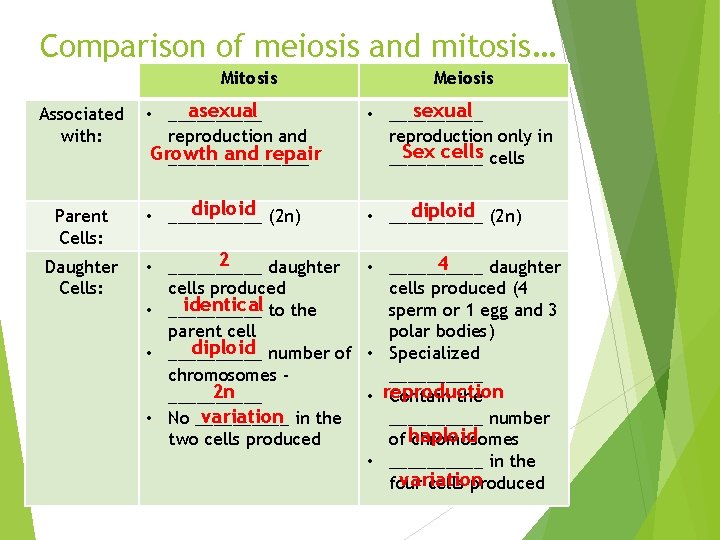
Comparison of meiosis and mitosis… Mitosis Associated with: Parent Cells: Daughter Cells: Meiosis asexual • _____ reproduction and Growth and repair ________ sexual • _____ reproduction only in Sex cells __________ diploid (2 n) • _____ 2 4 • __________ daughter cells produced (4 identical to the • _____ sperm or 1 egg and 3 parent cell polar bodies) diploid number of • Specialized • _____ chromosomes _____ 2 n _____ • reproduction Contain the variation in the • No __________ number two cells produced of haploid chromosomes • _____ in the variation four cells produced
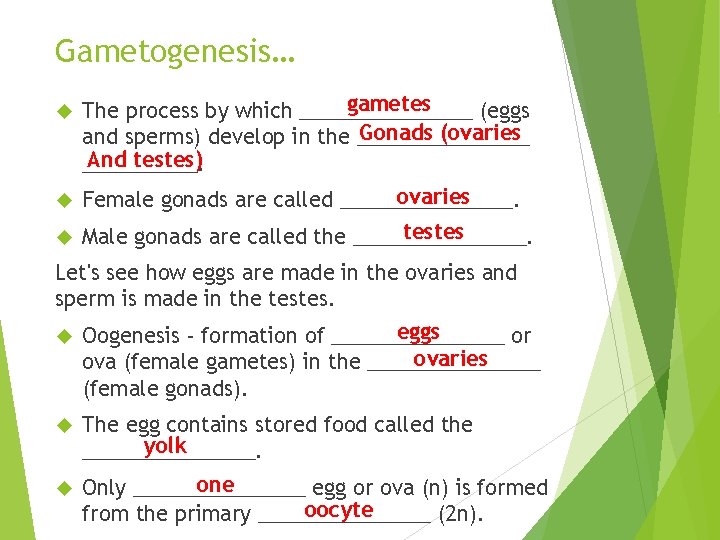
Gametogenesis… gametes The process by which ________ (eggs Gonads (ovaries and sperms) develop in the ________ And testes) _____. ovaries Female gonads are called ________. testes Male gonads are called the ________. Let's see how eggs are made in the ovaries and sperm is made in the testes. eggs Oogenesis - formation of ________ or ovaries ova (female gametes) in the ________ (female gonads). The egg contains stored food called the yolk ________. one Only ________ egg or ova (n) is formed oocyte from the primary ________ (2 n).
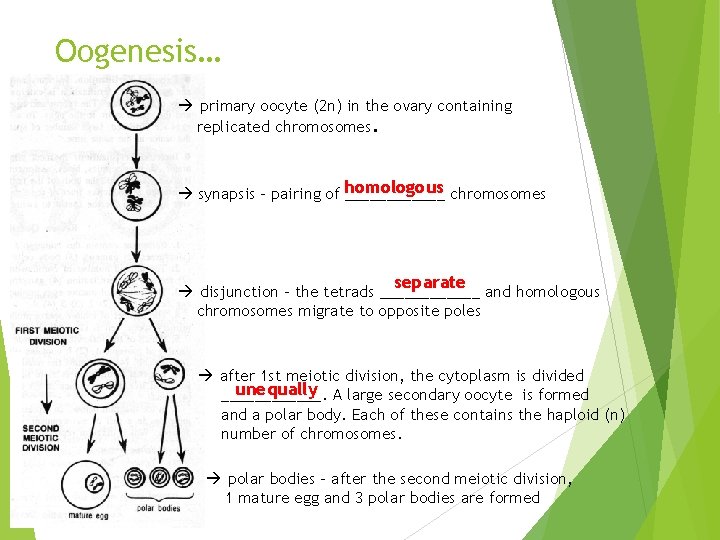
Oogenesis… primary oocyte (2 n) in the ovary containing replicated chromosomes. synapsis - pairing of homologous ______ chromosomes separate disjunction - the tetrads ______ and homologous chromosomes migrate to opposite poles after 1 st meiotic division, the cytoplasm is divided unequally A large secondary oocyte is formed ______. and a polar body. Each of these contains the haploid (n) number of chromosomes. polar bodies - after the second meiotic division, 1 mature egg and 3 polar bodies are formed
Oogenesis… The polar bodies form as a result of unequal cytoplasm They will division of the _____. disintegrate and die. * AS A RESULT OF OOGENESIS, 1 MATURE EGG CELL AND 3 POLAR BODIES ARE FORMED. THE EGG CONTAINS THE HAPLOID (N) OR MONOPLOID NUMBER OF CHROMOSOMES
Spermatogenesis… spermatogenesis __________ - formation of sperm (male gametes) in the _____ testes _____ (male gonads). four _____ sperm (n) are formed from the spermatocyte (2 n). primary ________ cytoplasm divides _____ equally creating The _____ four _____ sperm cells.
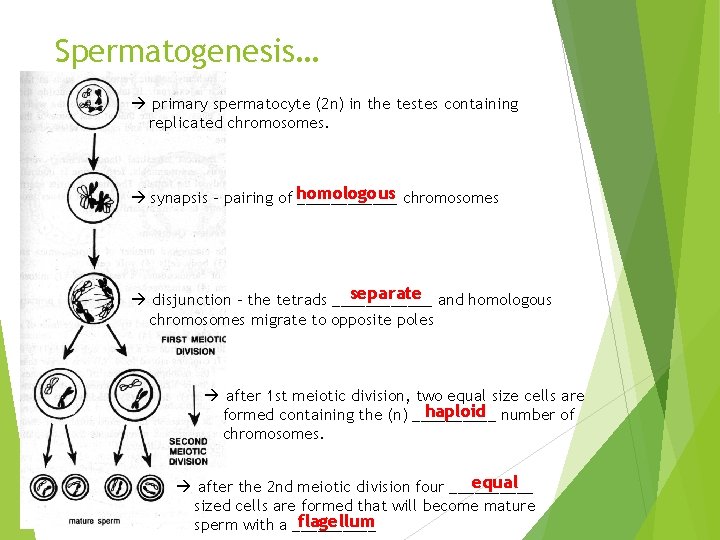
Spermatogenesis… primary spermatocyte (2 n) in the testes containing replicated chromosomes. synapsis - pairing of homologous ______ chromosomes separate and homologous disjunction - the tetrads ______ chromosomes migrate to opposite poles after 1 st meiotic division, two equal size cells are haploid number of formed containing the (n) _____ chromosomes. equal after the 2 nd meiotic division four _____ sized cells are formed that will become mature flagellum sperm with a _____
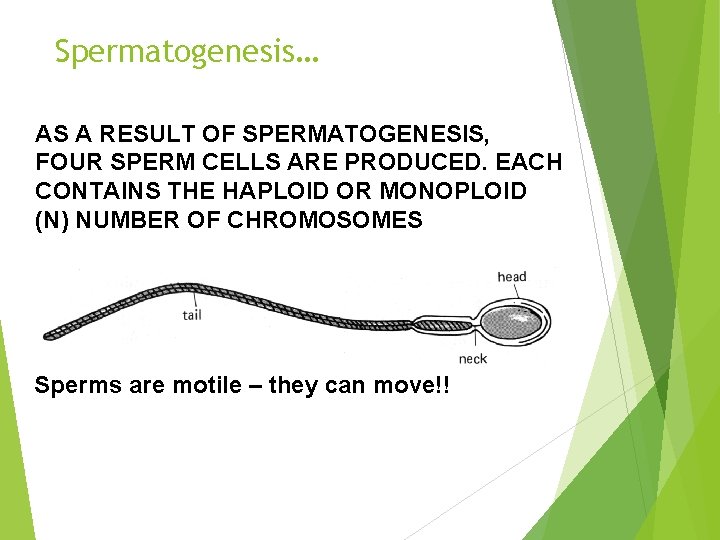
Spermatogenesis… AS A RESULT OF SPERMATOGENESIS, FOUR SPERM CELLS ARE PRODUCED. EACH CONTAINS THE HAPLOID OR MONOPLOID (N) NUMBER OF CHROMOSOMES Sperms are motile – they can move!!
- Slides: 22