
Meiosis and Sexual Reproduction Section 1 Reproduction Meiosis
- Slides: 16
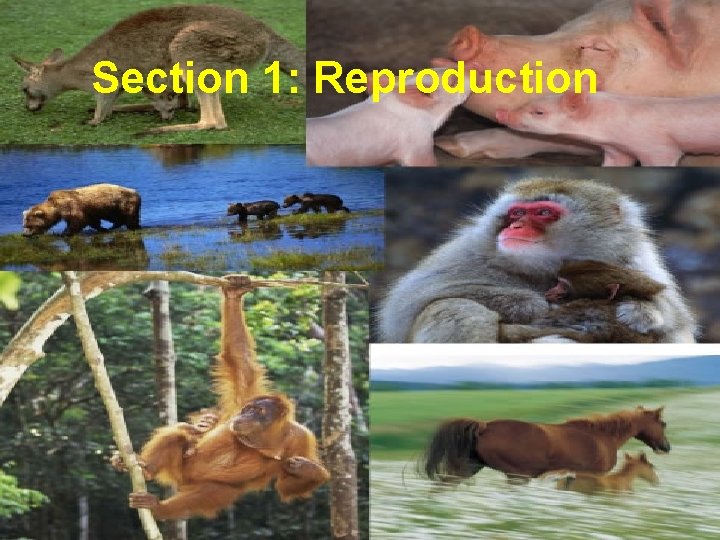
Meiosis and Sexual Reproduction Section 1: Reproduction
Meiosis and Sexual Reproduction Section 1 Asexual Reproduction • 1) In asexual reproduction, a single parent passes a complete copy of all its genetic information to each of its offspring. • 2) An individual formed by asexual reproduction is genetically identical to its parent. • 3) Prokaryotes (1 -celled organisms) reproduce asexually by a kind of cell division called binary fission (splitting into equally sized pieces of the main cell). • 4) Many unicellular organisms (both eukaryotes and prokaryotes) reproduce asexually.
Meiosis and Sexual Reproduction Section 1 • 5) Some multicellular eukaryotes, such as starfish, go through fragmentation. • 6) Fragmentation is a kind of reproduction in which the body breaks into several pieces and some or all of these fragments regrow missing parts and develop into complete adults. • https: //www. youtube. com/watch? v=d 5 d. OSya. KWTQ • 7) Other animals, such as the hydra, go through budding. In budding, new individuals split off/grow out from existing ones. https: //www. youtube. com/watch? v=zt. PAGISk. O 7 E 8) Some plants, such as potatoes, can form whole new plants from parts of stems. Other plants (ferns, etc) can reproduce from roots or leaves.
Meiosis and Sexual Reproduction Section 1 • Some crustaceans, such as water fleas, reproduce by parthenogenesis. • 9) Parthenogenesis is a process in which a female makes a viable egg that grows into an adult without being fertilized by a male. Sexual Reproduction • 10) Most eukaryotic organisms reproduce sexually. • 11) In sexual reproduction, two parents give genetic material to produce offspring that are genetically different from their parents. • 12) Each parent produces a reproductive cell, called a gamete. A gamete from one parent fuses with a gamete from the other.
Meiosis and Sexual Reproduction Section 1 Sexual Reproduction, continued • 13) The resulting cell, called a zygote, has a combination of genetic material from both parents. This process is called fertilization. • 14) Because both parents give genetic material, the offspring has traits of both parents but is not exactly like either parent.
Meiosis and Sexual Reproduction Section 1 Germ Cells and Somatic Cells • 15) The cells of a multicellular organism are often specialized for certain functions. • 16) Cells that are specialized for sexual reproduction are called germ cells. • 17) Only germ cells can produce gametes. • 18) Other body cells are called somatic cells. Somatic cells do not participate in sexual reproduction.
Meiosis and Sexual Reproduction Section 1 Advantages of Sexual Reproduction • 19) Asexual reproduction is the simplest, most efficient method of reproduction. • 20) Asexual reproduction allows organisms to produce many offspring in a short period of time without using energy to make gametes or to find a mate. • 21) Disadvantage of asexual reproduction: The genetic material of these organisms varies little between individuals, so they may be at a disadvantage in a changing environment (evolving).
Meiosis and Sexual Reproduction Section 1 Advantages of Sexual Reproduction • 22) Sexual reproduction, in contrast, produces genetically diverse (different) individuals. • 23) Main advantage of sexual reproduction: A population of diverse organisms is more likely to have some individuals that survive a major environmental change. The major disadvantage is that it is much more involved and complicated and allows more opportunity for mutations or problems.
Meiosis and Sexual Reproduction Section 1 Chromosome Number • Each chromosome has thousands of genes that play an important role in determining how an organism develops and functions. • 24) Each species has a specific number of chromosomes. An organism must have exactly the right number of chromosomes. • 25) If an organism has too many or too few chromosomes, the organism may not develop and function properly. (Down’s Syndrome for example)
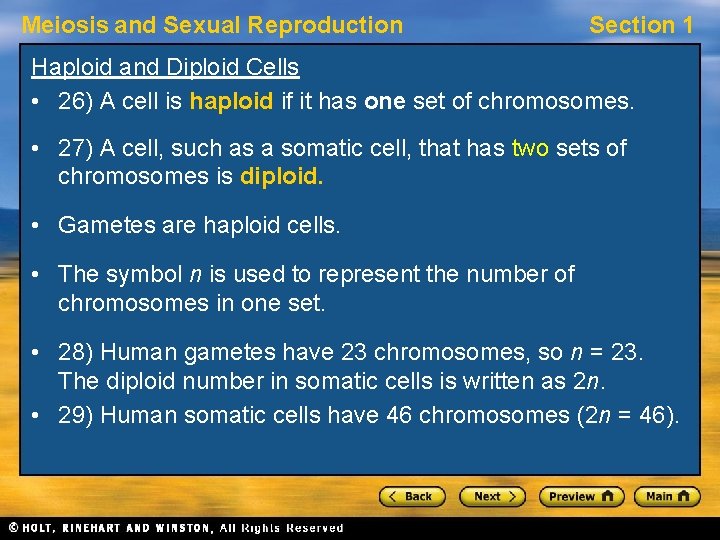
Meiosis and Sexual Reproduction Section 1 Haploid and Diploid Cells • 26) A cell is haploid if it has one set of chromosomes. • 27) A cell, such as a somatic cell, that has two sets of chromosomes is diploid. • Gametes are haploid cells. • The symbol n is used to represent the number of chromosomes in one set. • 28) Human gametes have 23 chromosomes, so n = 23. The diploid number in somatic cells is written as 2 n. • 29) Human somatic cells have 46 chromosomes (2 n = 46).
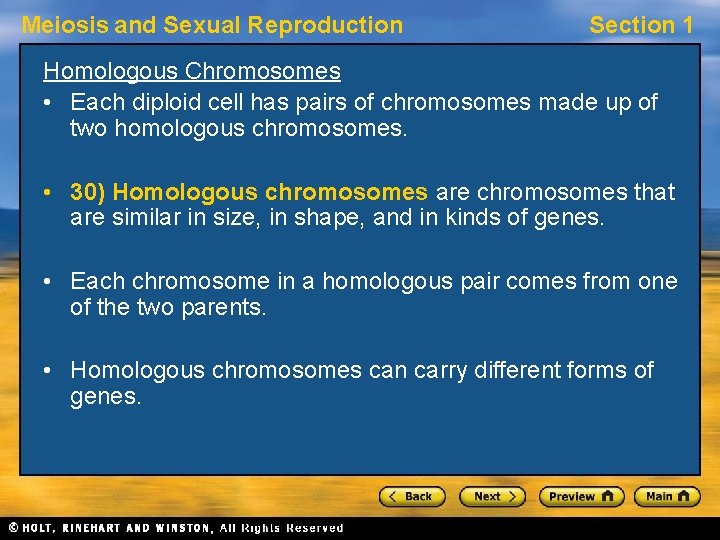
Meiosis and Sexual Reproduction Section 1 Homologous Chromosomes • Each diploid cell has pairs of chromosomes made up of two homologous chromosomes. • 30) Homologous chromosomes are chromosomes that are similar in size, in shape, and in kinds of genes. • Each chromosome in a homologous pair comes from one of the two parents. • Homologous chromosomes can carry different forms of genes.
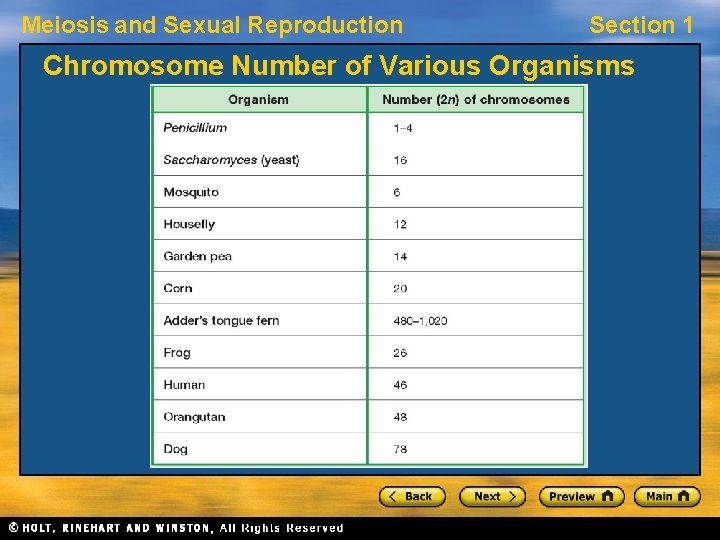
Meiosis and Sexual Reproduction Section 1 Chromosome Number of Various Organisms
Meiosis and Sexual Reproduction Section 1 Autosomes and Sex Chromosomes • Autosomes are chromosomes with genes that do not determine the sex of an individual. • Sex chromosomes have genes that determine the sex of an individual. • 32) In humans and many other organisms, the two sex chromosomes are referred to as the X and Y chromosomes.
Meiosis and Sexual Reproduction Section 1 Who determines the gender of an offspring? • The genes that cause a zygote to develop into a male are located on the Y chromosome. • 33) Human males have one X chromosome and one Y chromosome (XY male), and human females have two X chromosomes (XX female). One of these chromosomes will be passed on by each parent organism. Therefore the male parent is the one that determines the gender of the offspring. Why?
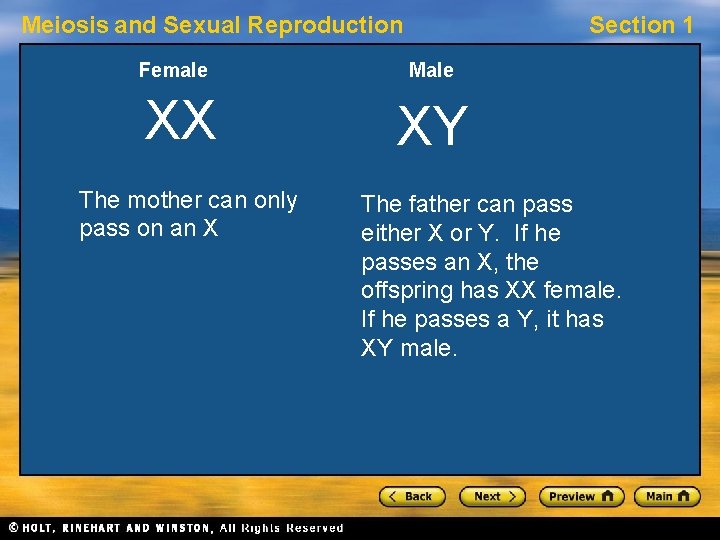
Meiosis and Sexual Reproduction Female XX The mother can only pass on an X Section 1 Male XY The father can pass either X or Y. If he passes an X, the offspring has XX female. If he passes a Y, it has XY male.
Meiosis and Sexual Reproduction Section 1 Summary • An individual formed by asexual reproduction is genetically identical to its parent. • In sexual reproduction, two parents give genetic material to produce offspring that are genetically different from their parents. • Each chromosome has thousands of genes that play an important role in determining how an organism develops and functions.