
Meiosis and Mendel Biology Chapter 6 Dr Altstiel
Meiosis and Mendel Biology Chapter 6 Dr. Altstiel
Meiosis • Objectives – Summarize the events that occur during meiosis. – Relate crossing-over, independent assortment, and random fertilization to genetic variation. – Compare spermatogenesis and oogenesis.

Number and structure of Chromosomes affect development • Humans have 2 copies of 23 different chromosomes (46 total) – Homologous chromosomes are similar in size, shape and genes – Each one in a set comes from mom; other from dad

Chromosome Number • Karyotype – a set of chromosomes. Humans have 23 pairs of chromosomes = 46. – Diploid – when cells in the body contain 23 pairs of chromosomes. Practically all cells in the body are diploid. • Diploid Number = 2 n • Humans, 2 n = 46 – Haploid – cells that contain only one copy of each chromosome. • Haploid Number = n • Humans, n = 23 • Zygote – fusion of two haploid gametes by a process called fertilization – a diploid zygote is a fertilized egg.

• Diploid cells (somatic body cells) contains two sets of chromosomes • Haploid cells (sex cells) contains one set of chromosomes • Two haploid sex cells come together during fertilization and make a diploid zygote

Sex Chromosome • Determines whether you are male or female. Sex chromosomes designated as either X or Y. – Female = XX • Can only produce eggs that contain an X chromosome. – Male = XY • Can produce sperm with either an X or Y chromosome. Therefore, male’s sperm is sex determiner. • Autosomes – chromosomes not directly involved in determining the sex of an individual (22 pairs).

Formation of Haploid Cells • Meiosis – a form of cell division that halves the number of chromosomes when forming specialized reproductive cells, such as gametes and spores. – Involves two divisions of the nucleus – meiosis I and meiosis II.

Meiosis • Meiosis is a two-stage form of nuclear division in which the chromosome number is halved. – Meiosis I – reduces the chromosome number by half. – Meiosis II – separates identical copies of chromosomes.
Steps of Meiosis 1. Prophase I – chromosomes condense, and nuclear envelope breaks down. Crossing-over may occur. Crossing-over – when a portion of a chromatid on one homologous chromosome are broken and exchanged with the corresponding chromatid portions of the other homologous chromosome. 2. 3. 4. Metaphase I – Pairs of homologous chromosomes moved by the spindle to the equator of the cell. Anaphase I – Homologous chromosomes separate. Telophase I – Individual chromosomes gather at each of the poles. Cytokinesis occurs resulting in two cells.

Steps of Meiosis Cont. 5. Prophase II – a new spindle forms around the chromosomes. 6. Metaphase II – Chromosomes line up along the equator. 7. Anaphase II – the centromeres divide, and chromatids move to opposite poles of the cell. 8. Telophase II – a nuclear envelope forms around each set of chromosomes. Spindle breaks down, and cytokinesis occurs. The result of meiosis is 4 haploid cells.
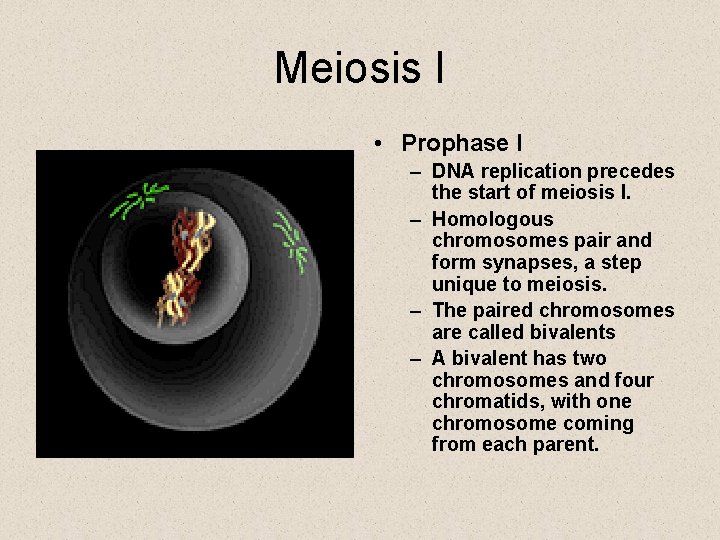
Meiosis I • Prophase I – DNA replication precedes the start of meiosis I. – Homologous chromosomes pair and form synapses, a step unique to meiosis. – The paired chromosomes are called bivalents – A bivalent has two chromosomes and four chromatids, with one chromosome coming from each parent.

Meiosis I Continued • Metaphase I – Bivalents align at the metaphase plate. – The orientation is random, with either parental homologue on a side. This means that there is a 50 -50 chance for the daughter cells to get either the mother's or father's homologue for each chromosome.

Meiosis I Continued • Anaphase I – Chromosomes, each with two chromatids, move to separate poles. – Each of the daughter cells is now haploid (23 chromosomes), but each chromosome has two chromatids.

Meiosis I Continued • Telophase I – Nuclear envelopes may reform, or the cell may quickly start meiosis 2.
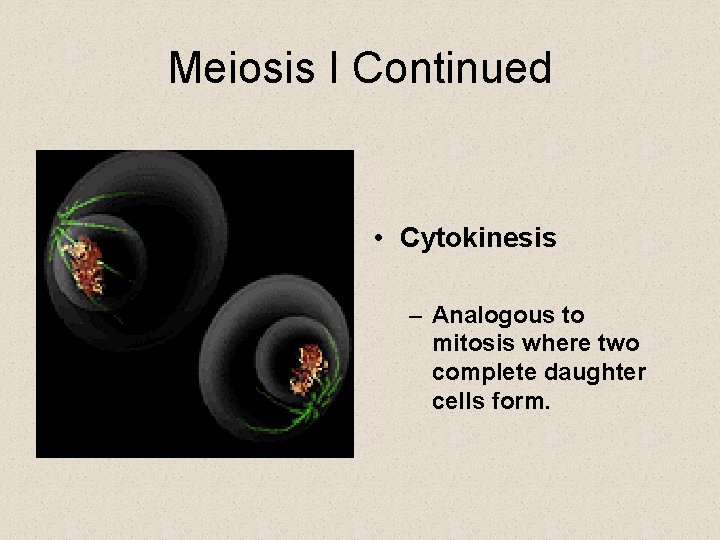
Meiosis I Continued • Cytokinesis – Analogous to mitosis where two complete daughter cells form.

Meiosis II

Meiosis II Continued

Meiosis II Continued

Meiosis II Continued

Meiosis II Continued
Phases of Meiosis

Class Work • Directed Reading: Meiosis

Meiosis and Genetic Variation • Three Mechanisms that make key contributions to genetic variation: 1. Independent assortment 2. Crossing-over 3. Random fertilization

Independent Assortment • Each human gamete receives one chromosome from each of the 23 pairs of homologous chromosomes. • Which of the two chromosomes passed to the offspring is a matter of chance. • Independent Assortment – the random distribution of homologous chromosomes during meiosis – Each of the 23 pairs of chromosomes segregate independently. – Possibility of 223 different gene combinations. (8, 388, 608 possible combinations)

Crossing-Over • DNA exchange that occurs during crossing -over adds more recombination to independent assortment of chromosomes. Number of possible genetic combinations that can occur among gametes… virtually unlimited.

Crossing-Over DNA is exchanged between homologous chromosomes, resulting in genetic recombination.

Random Fertilization • The zygote that forms a new individual is created by the random joining of two gametes (each produced independently). • Number of possible genetic outcomes is (223)2 = 7. 04 X 1013.

Meiosis and Gamete Formation • Gametogenesis – meiosis is the primary event in the formation of gametes. – Spermatogenesis – process by which sperm is produced in male animals. • Occurs in the testes. • After completion of meiosis, four haploid cells are produced. – Sperm – four cells change in form and develop a tail. – Oogenesis – process by which gametes are produced in female animals. • Occurs in the ovaries. • Cytokinesis following meiosis I – cytoplasm divides unevenly resulting in a large cell (will become the ovum) and three polar bodies.

Homework • Correct Directed Reading for Section 1

Sexual and Asexual Reproduction • Asexual Reproduction – a single parent passes copies of all of its genes to each of its offspring – no fusion of haploid cells such as gametes. – Clone – an organism genetically identical to its parents. • Sexual Reproduction – two parents each form reproductive cells that have ½ the number of chromosomes. – Offspring have traits of both parents.

Alternation of Generations • Life-cycle that regularly alternates between a haploid and a diploid phase. – Plants, algae, some protists. • Sporophyte - diploid phase in the life-cycle of plants – the name of the spores that are produced. – Spore – a haploid reproductive cell produced by meiosis – give rise to multicellular individual called a gametophyte w/o joining with another cell. • Gametophyte – haploid phase – produces gametes by mitosis. Gametes fuse and give rise to the diploid phase.
- Slides: 31