
MEIC Ion Linac and PreBooster Design Bela Erdelyi
MEIC Ion Linac and Pre-Booster Design Bela Erdelyi Department of Physics, Northern Illinois University, and Physics Division, Argonne National Laboratory Review 09/2010 Page 1
Acknowledgements • Joint Work of • Bela Erdelyi (NIU/ANL) • Shashikant Manikonda (ANL) • Peter Ostroumov (ANL) • Sumana Abeyratne (NIU student) • With assistance from JLab staff (Y. Derbenev, Y. Zhang, G. Krafft, etc. ) Review 09/2010 Page 2
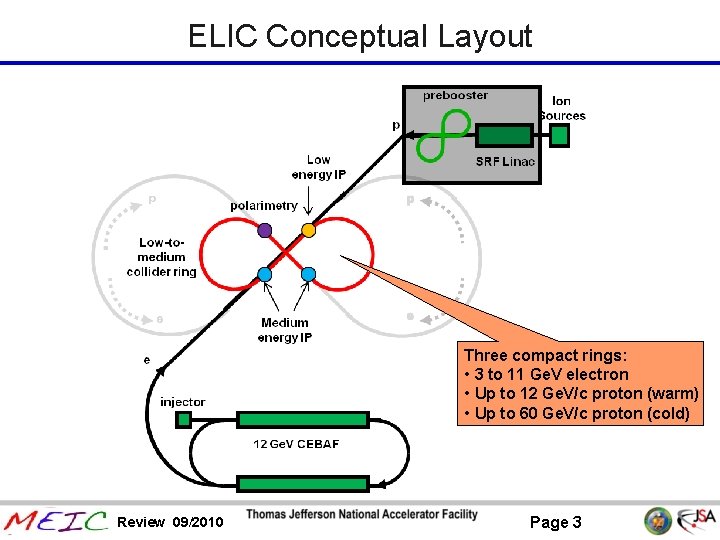
ELIC Conceptual Layout Three compact rings: • 3 to 11 Ge. V electron • Up to 12 Ge. V/c proton (warm) • Up to 60 Ge. V/c proton (cold) Review 09/2010 Page 3
Ion Linac for ELIC • Pulsed linac • Short Normal Conducting section: RFQ and IH structure • Followed by Superconducting section that contains • Stripper for heavy ions at 12 Me. V/u Review 09/2010 Page 4

Basic Parameters of the Linac • Linac layout Normal conducting Superconducting 80 Review 09/2010 Page 5
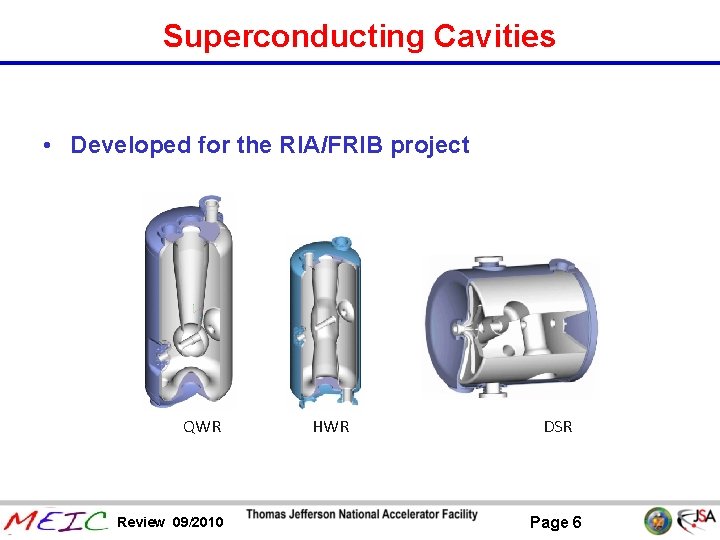
Superconducting Cavities • Developed for the RIA/FRIB project QWR Review 09/2010 HWR DSR Page 6
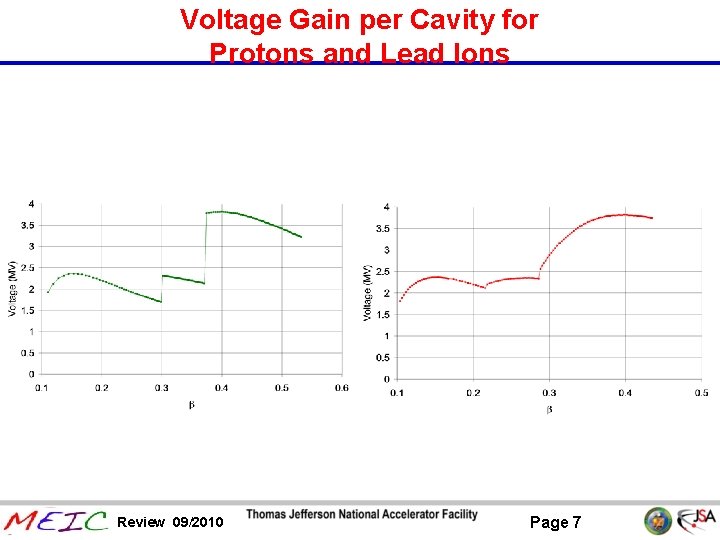
Voltage Gain per Cavity for Protons and Lead Ions Review 09/2010 Page 7
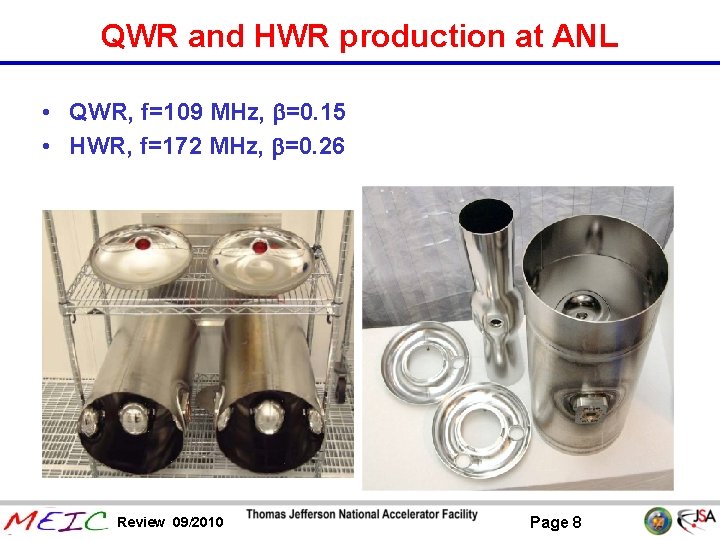
QWR and HWR production at ANL • QWR, f=109 MHz, =0. 15 • HWR, f=172 MHz, =0. 26 Review 09/2010 Page 8
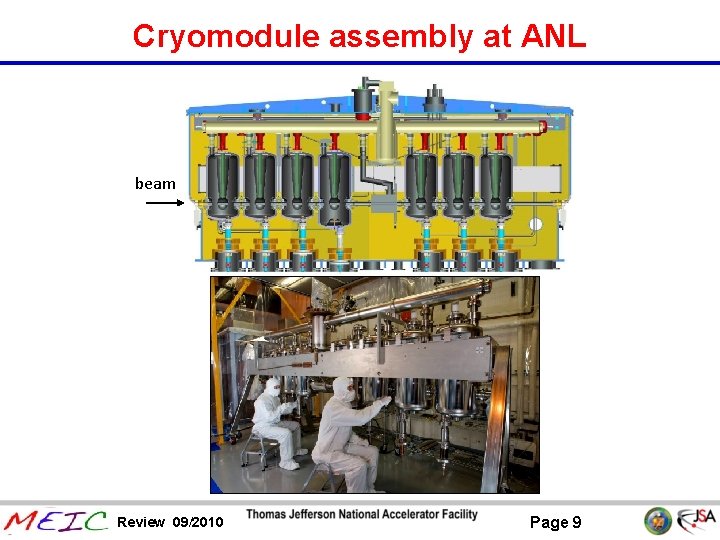
Cryomodule assembly at ANL beam Review 09/2010 Page 9
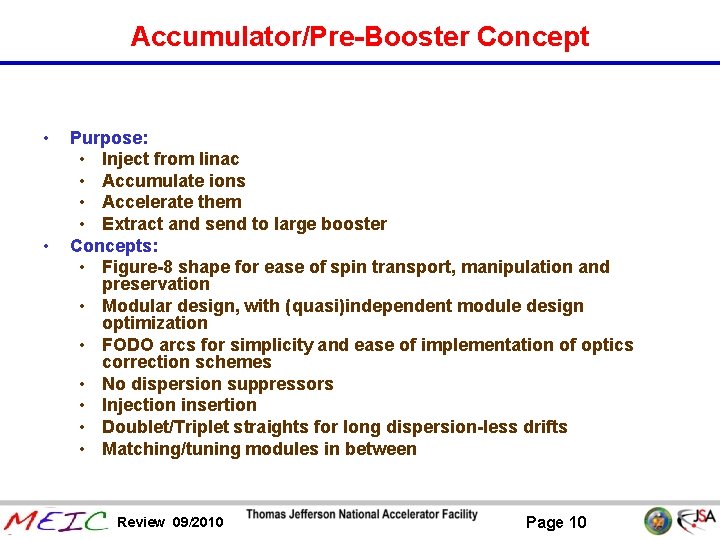
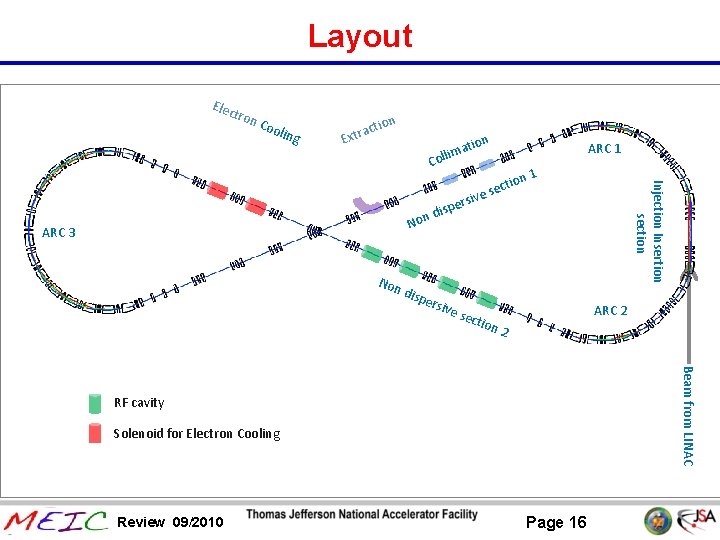
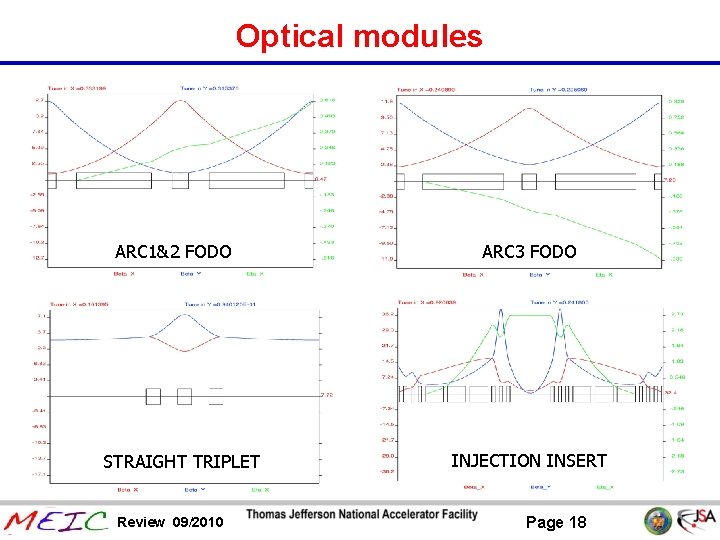
Accumulator/Pre-Booster Concept • • Purpose: • Inject from linac • Accumulate ions • Accelerate them • Extract and send to large booster Concepts: • Figure-8 shape for ease of spin transport, manipulation and preservation • Modular design, with (quasi)independent module design optimization • FODO arcs for simplicity and ease of implementation of optics correction schemes • No dispersion suppressors • Injection insertion • Doublet/Triplet straights for long dispersion-less drifts • Matching/tuning modules in between Review 09/2010 Page 10
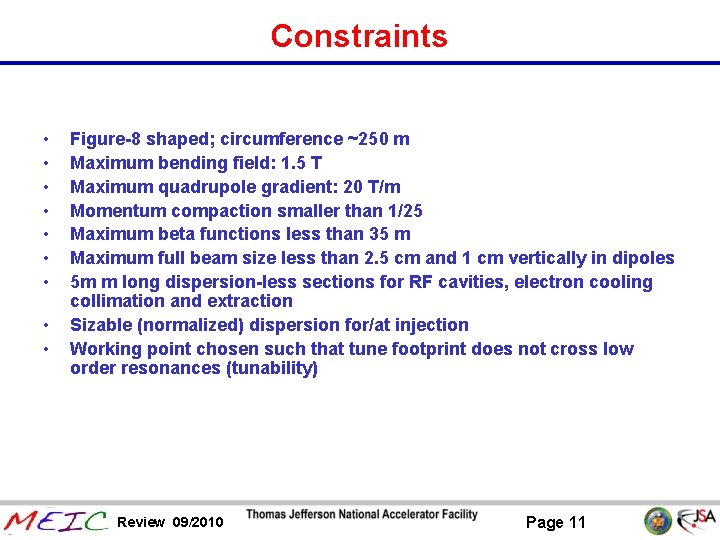
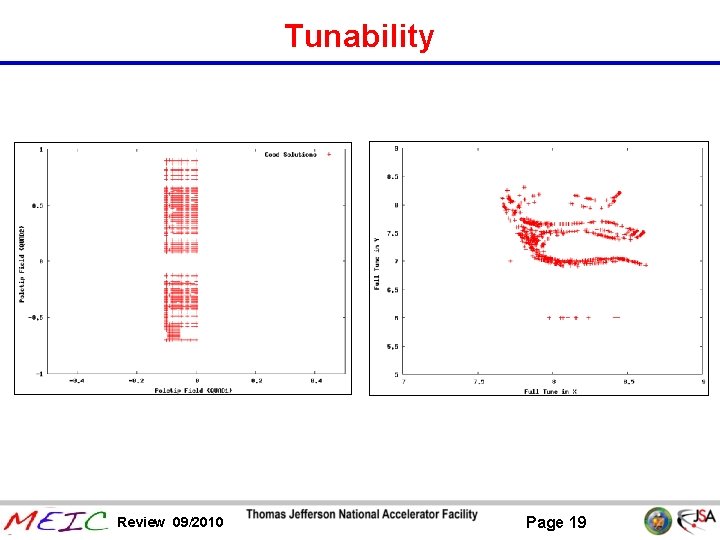
Constraints • • • Figure-8 shaped; circumference ~250 m Maximum bending field: 1. 5 T Maximum quadrupole gradient: 20 T/m Momentum compaction smaller than 1/25 Maximum beta functions less than 35 m Maximum full beam size less than 2. 5 cm and 1 cm vertically in dipoles 5 m m long dispersion-less sections for RF cavities, electron cooling collimation and extraction Sizable (normalized) dispersion for/at injection Working point chosen such that tune footprint does not cross low order resonances (tunability) Review 09/2010 Page 11
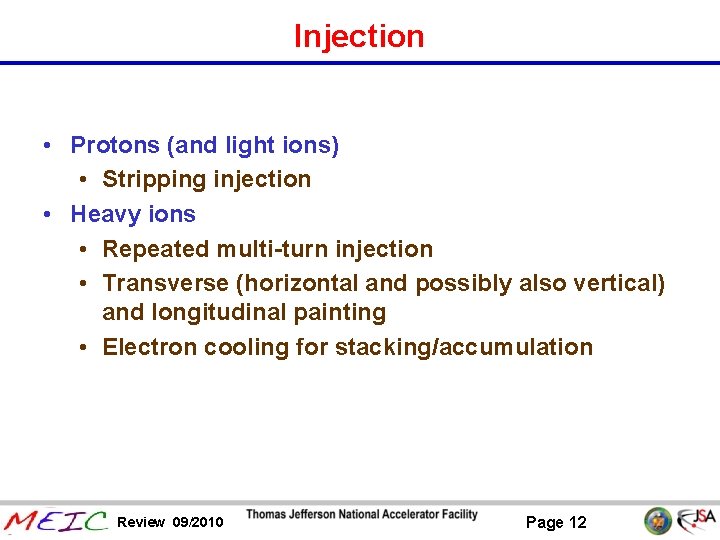
Injection • Protons (and light ions) • Stripping injection • Heavy ions • Repeated multi-turn injection • Transverse (horizontal and possibly also vertical) and longitudinal painting • Electron cooling for stacking/accumulation Review 09/2010 Page 12
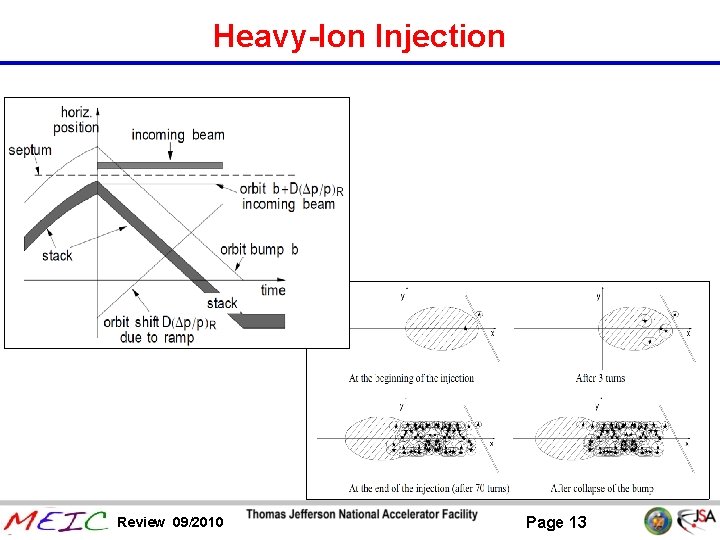
Heavy-Ion Injection Review 09/2010 Page 13
![Acceleration • h=1 • RF swing necessary is [0. 4, 2] MHz • 15](http://slidetodoc.com/presentation_image_h2/973e6f7f29bcd1fcfe81e186bcb777e8/image-14.jpg "Acceleration • h=1 • RF swing necessary is [0. 4, 2] MHz • 15")
Acceleration • h=1 • RF swing necessary is [0. 4, 2] MHz • 15 k. V per cavity • 50 k. V/turn => 3 -4 cavities • 56000 turns for 200 Me. V -> 3 Ge. V • Less than 80 ms acceleration time Review 09/2010 Page 14
Extraction • Conventional fast extraction Review 09/2010 Page 15
Layout Elec tron Coo ling tion ac Extr tion ARC 1 ima Coll n 1 Injection Insertion section ctio e se v ersi p s i nd No ARC 3 Non disp ersi v e se ARC 2 ctio n 2 Beam from LINAC RF cavity Solenoid for Electron Cooling Review 09/2010 Page 16
Review 09/2010 Page 17 Arc 2 Straight 2 Arc 3 Straight 1 Arc 1 Injection Linear Optics
Optical modules ARC 1&2 FODO STRAIGHT TRIPLET Review 09/2010 ARC 3 FODO INJECTION INSERT Page 18
Tunability Review 09/2010 Page 19
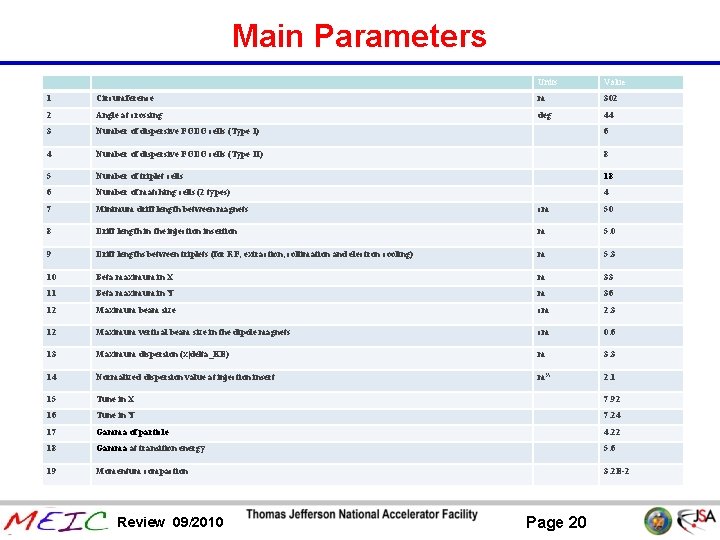
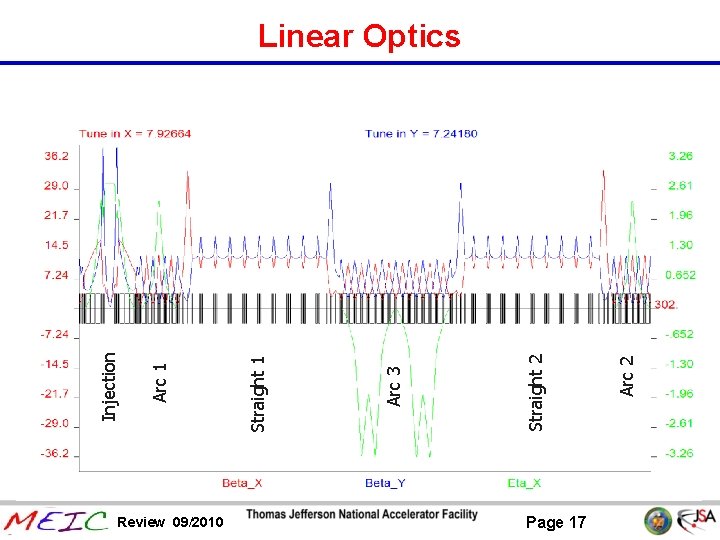
Main Parameters Units Value 1 Circumference m 302 2 Angle at crossing deg 44 3 Number of dispersive FODO cells (Type I) 6 4 Number of dispersive FODO cells (Type II) 8 5 Number of triplet cells 18 6 Number of matching cells (2 types) 4 7 Minimum drift length between magnets cm 50 8 Drift length in the injection insertion m 5. 0 9 Drift lengths between triplets (for RF, extraction, collimation and electron cooling) m 5. 3 10 Beta maximum in X m 33 11 Beta maximum in Y m 36 12 Maximum beam size cm 2. 3 12 Maximum vertical beam size in the dipole magnets cm 0. 6 13 Maximum dispersion (x|delta_KE) m 3. 3 14 Normalized dispersion value at injection insert m½ 2. 1 15 Tune in X 7. 92 16 Tune in Y 7. 24 17 Gamma of particle 4. 22 18 Gamma at transition energy 5. 6 19 Momentum compaction 3. 2 E-2 Review 09/2010 Page 20
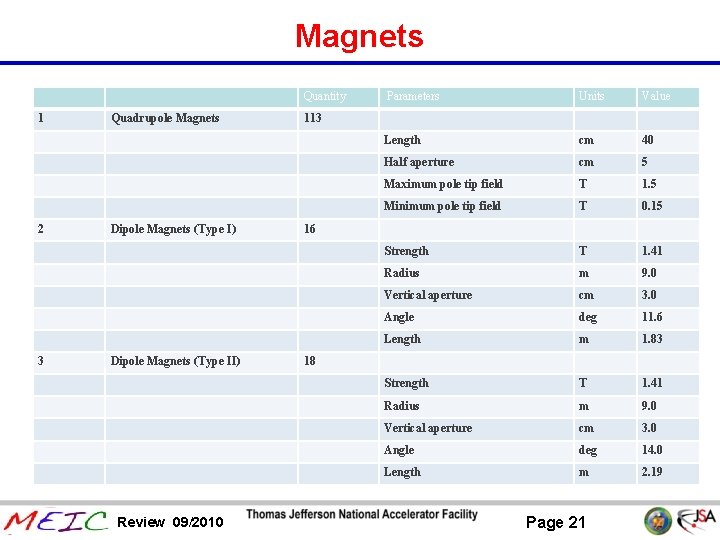
Magnets Quantity 1 2 3 Quadrupole Magnets Dipole Magnets (Type I) Dipole Magnets (Type II) Review 09/2010 Parameters Units Value Length cm 40 Half aperture cm 5 Maximum pole tip field T 1. 5 Minimum pole tip field T 0. 15 Strength T 1. 41 Radius m 9. 0 Vertical aperture cm 3. 0 Angle deg 11. 6 Length m 1. 83 Strength T 1. 41 Radius m 9. 0 Vertical aperture cm 3. 0 Angle deg 14. 0 Length m 2. 19 113 16 18 Page 21
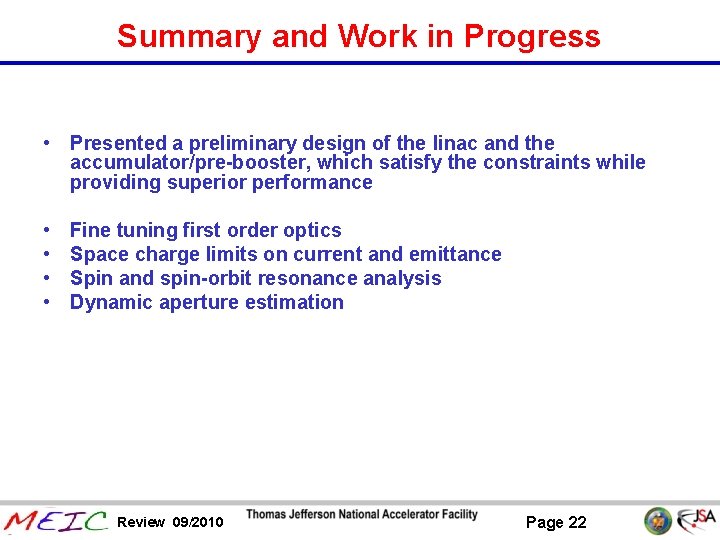
Summary and Work in Progress • Presented a preliminary design of the linac and the accumulator/pre-booster, which satisfy the constraints while providing superior performance • • Fine tuning first order optics Space charge limits on current and emittance Spin and spin-orbit resonance analysis Dynamic aperture estimation Review 09/2010 Page 22
BACKUP SLIDES Review 09/2010 Page 23
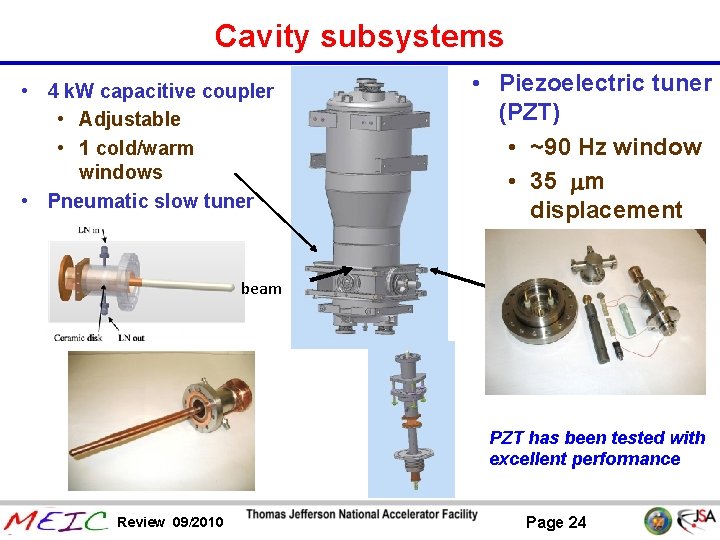
Cavity subsystems • 4 k. W capacitive coupler • Adjustable • 1 cold/warm windows • Pneumatic slow tuner • Piezoelectric tuner (PZT) • ~90 Hz window • 35 m displacement beam PZT has been tested with excellent performance Review 09/2010 Page 24
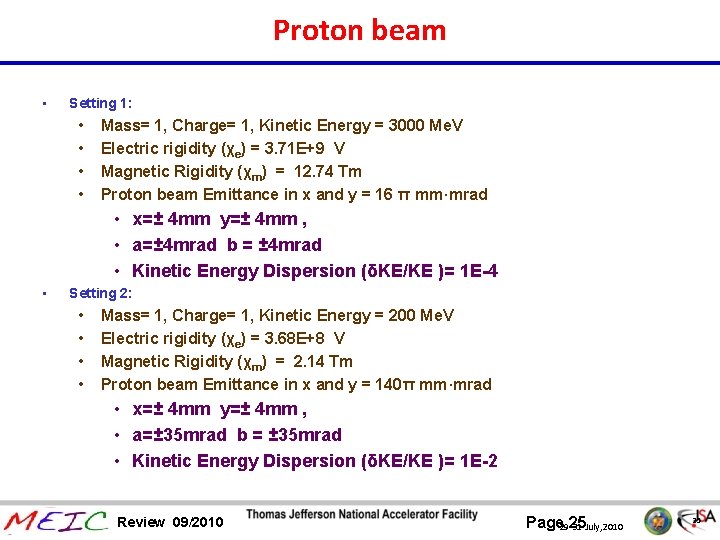
Proton beam • Setting 1: • • Mass= 1, Charge= 1, Kinetic Energy = 3000 Me. V Electric rigidity (χe) = 3. 71 E+9 V Magnetic Rigidity (χm) = 12. 74 Tm Proton beam Emittance in x and y = 16 π mm·mrad • x=± 4 mm y=± 4 mm , • a=± 4 mrad b = ± 4 mrad • Kinetic Energy Dispersion (δKE/KE )= 1 E-4 • Setting 2: • • Mass= 1, Charge= 1, Kinetic Energy = 200 Me. V Electric rigidity (χe) = 3. 68 E+8 V Magnetic Rigidity (χm) = 2. 14 Tm Proton beam Emittance in x and y = 140π mm·mrad • x=± 4 mm y=± 4 mm , • a=± 35 mrad b = ± 35 mrad • Kinetic Energy Dispersion (δKE/KE )= 1 E-2 Review 09/2010 Page 29 -31 25 July, 2010 25
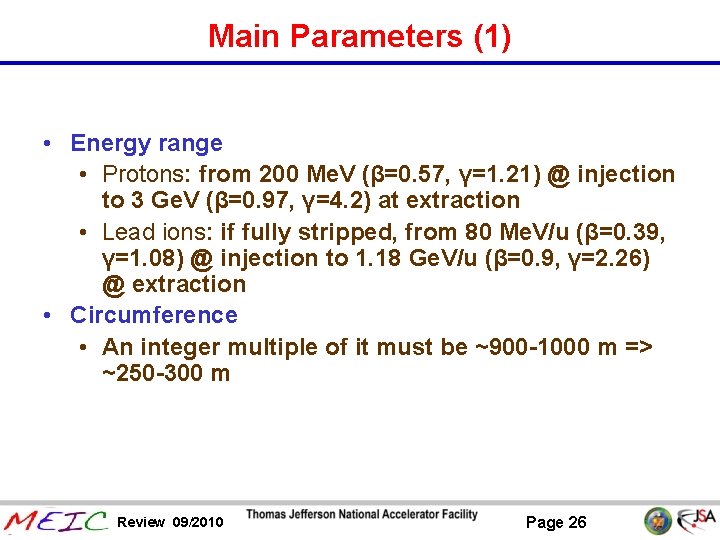
Main Parameters (1) • Energy range • Protons: from 200 Me. V (β=0. 57, γ=1. 21) @ injection to 3 Ge. V (β=0. 97, γ=4. 2) at extraction • Lead ions: if fully stripped, from 80 Me. V/u (β=0. 39, γ=1. 08) @ injection to 1. 18 Ge. V/u (β=0. 9, γ=2. 26) @ extraction • Circumference • An integer multiple of it must be ~900 -1000 m => ~250 -300 m Review 09/2010 Page 26
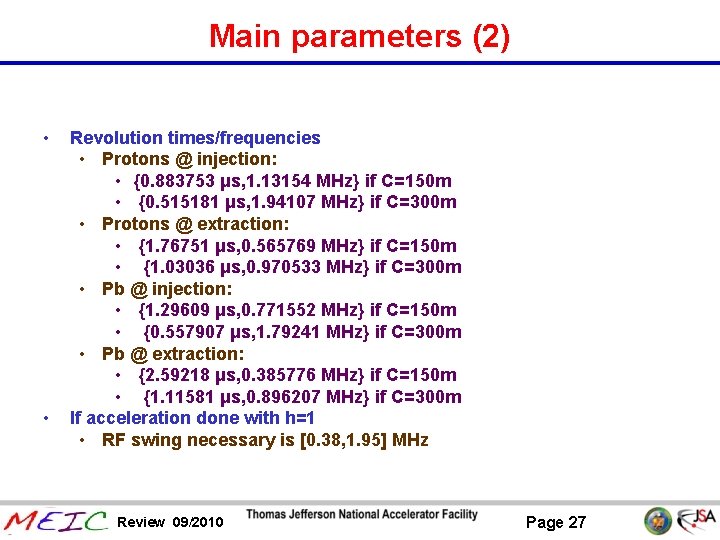
Main parameters (2) • • Revolution times/frequencies • Protons @ injection: • {0. 883753 μs, 1. 13154 MHz} if C=150 m • {0. 515181 μs, 1. 94107 MHz} if C=300 m • Protons @ extraction: • {1. 76751 μs, 0. 565769 MHz} if C=150 m • {1. 03036 μs, 0. 970533 MHz} if C=300 m • Pb @ injection: • {1. 29609 μs, 0. 771552 MHz} if C=150 m • {0. 557907 μs, 1. 79241 MHz} if C=300 m • Pb @ extraction: • {2. 59218 μs, 0. 385776 MHz} if C=150 m • {1. 11581 μs, 0. 896207 MHz} if C=300 m If acceleration done with h=1 • RF swing necessary is [0. 38, 1. 95] MHz Review 09/2010 Page 27
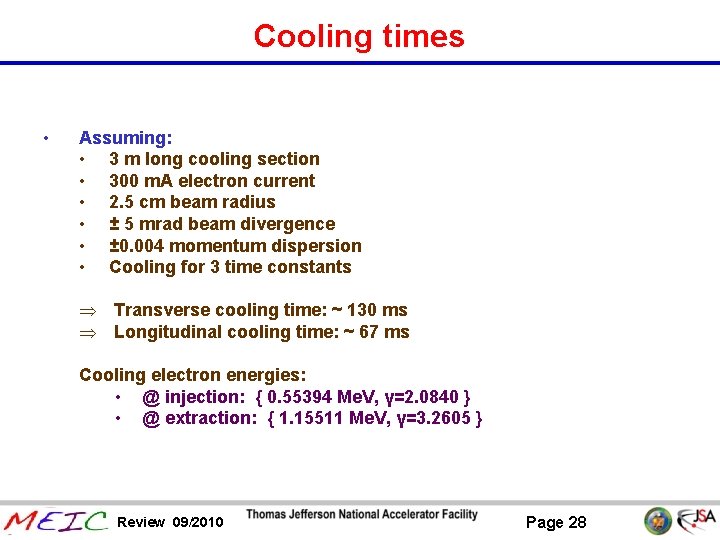
Cooling times • Assuming: • 3 m long cooling section • 300 m. A electron current • 2. 5 cm beam radius • ± 5 mrad beam divergence • ± 0. 004 momentum dispersion • Cooling for 3 time constants Þ Transverse cooling time: ~ 130 ms Þ Longitudinal cooling time: ~ 67 ms Cooling electron energies: • @ injection: { 0. 55394 Me. V, γ=2. 0840 } • @ extraction: { 1. 15511 Me. V, γ=3. 2605 } Review 09/2010 Page 28
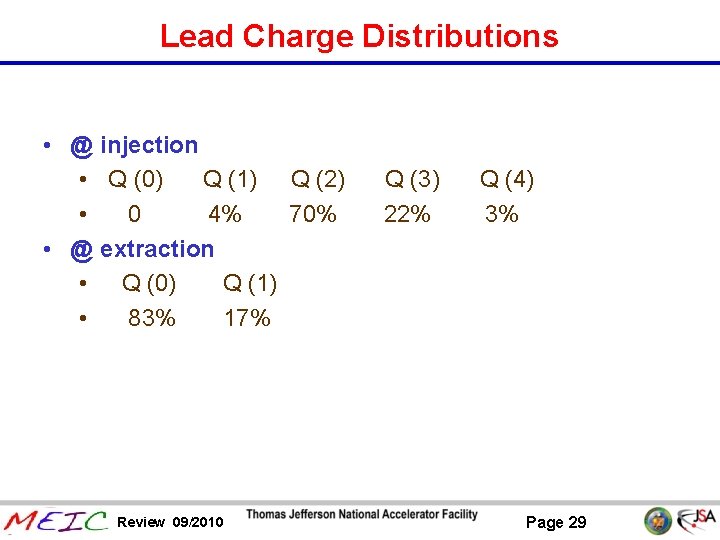
Lead Charge Distributions • @ injection • Q (0) Q (1) Q (2) • 0 4% 70% • @ extraction • Q (0) Q (1) • 83% 17% Review 09/2010 Q (3) 22% Q (4) 3% Page 29

Intensities • Protons • If assuming 1 A current, depending on circumference and injection/extraction: => N_p ~ [ 3 , 11 ] x 1012 • Lead ions • Under similar circumstances: => N_Pb ~ N_p / Q Review 09/2010 Page 30
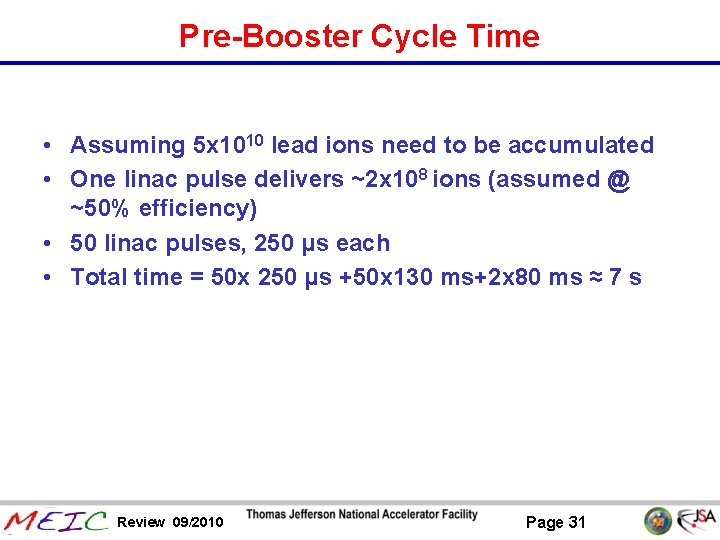
Pre-Booster Cycle Time • Assuming 5 x 10¹⁰ lead ions need to be accumulated • One linac pulse delivers ~2 x 10⁸ ions (assumed @ ~50% efficiency) • 50 linac pulses, 250 μs each • Total time = 50 x 250 μs +50 x 130 ms+2 x 80 ms ≈ 7 s Review 09/2010 Page 31
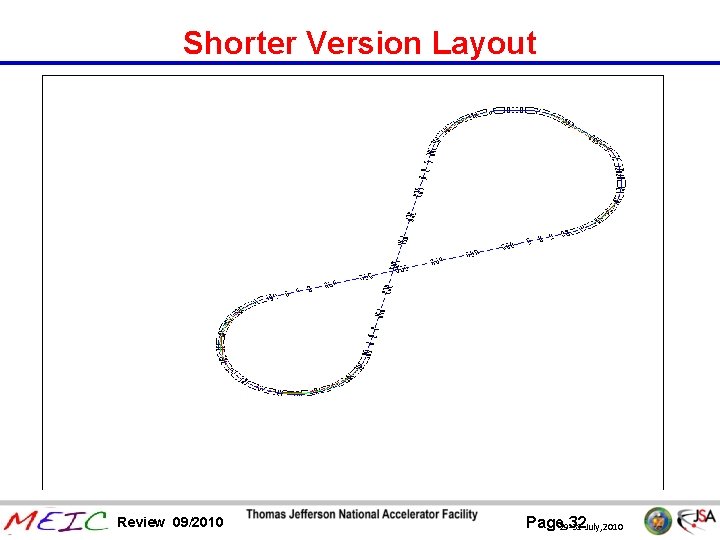
Shorter Version Layout Review 09/2010 Page 29 -31 32 July, 2010
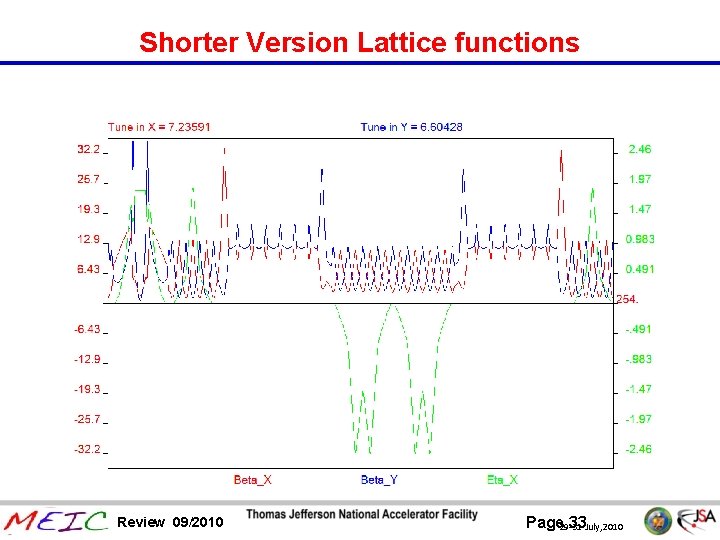
Shorter Version Lattice functions Review 09/2010 Page 29 -31 33 July, 2010
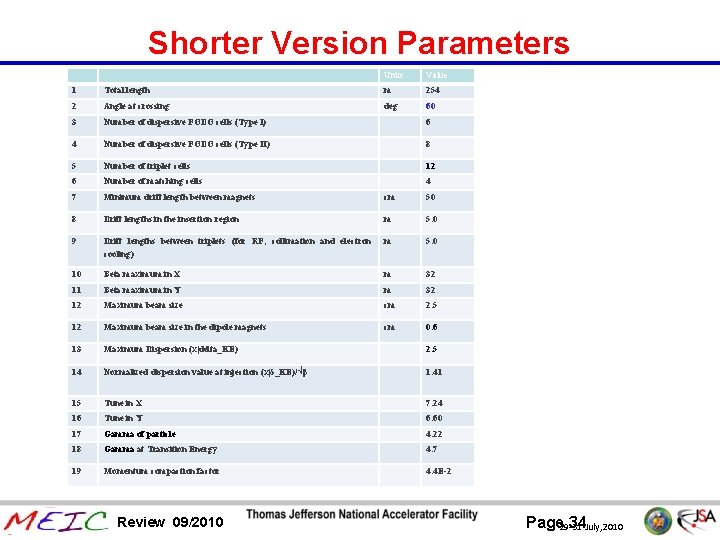
Shorter Version Parameters Units Value 1 Total length m 254 2 Angle at crossing deg 60 3 Number of dispersive FODO cells (Type I) 6 4 Number of dispersive FODO cells (Type II) 8 5 Number of triplet cells 12 6 Number of matching cells 7 Minimum drift length between magnets cm 50 8 Drift lengths in the insertion region m 5. 0 9 Drift lengths between triplets (for RF, collimation and electron cooling) m 5. 0 10 Beta maximum in X m 32 11 Beta maximum in Y m 32 12 Maximum beam size cm 2. 5 12 Maximum beam size in the dipole magnets cm 0. 6 13 Maximum Dispersion (x|delta_KE) 2. 5 14 Normalized dispersion value at injection (x|δ_KE)/√β 1. 41 15 Tune in X 7. 24 16 Tune in Y 6. 60 17 Gamma of particle 4. 22 18 Gamma at Transition Energy 4. 7 19 Momentum compaction factor 4. 4 E-2 Review 09/2010 4 Page 29 -31 34 July, 2010
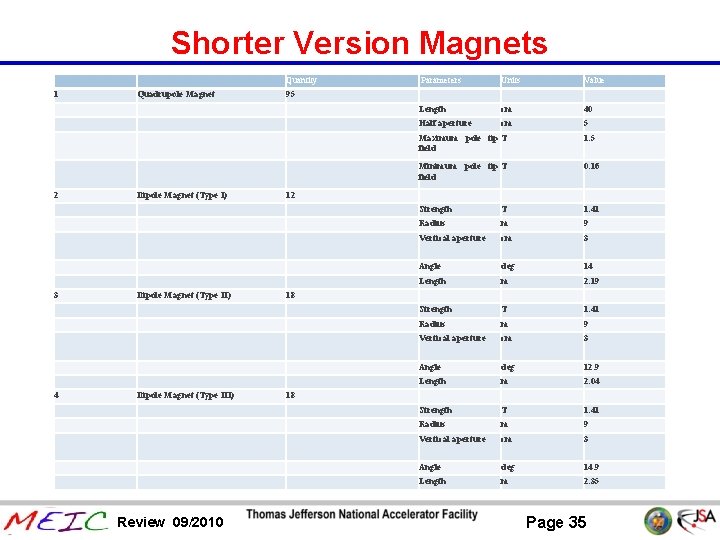
Shorter Version Magnets Quantity 1 2 3 4 Quadrupole Magnet Dipole Magnet (Type I) Dipole Magnet (Type III) Review 09/2010 Parameters Units Value Length cm 40 Half aperture cm 5 95 Maximum pole tip T field 1. 5 Minimum pole tip T field 0. 16 Strength T 1. 41 Radius m 9 Vertical aperture cm 3 Angle deg 14 Length m 2. 19 Strength T 1. 41 Radius m 9 Vertical aperture cm 3 Angle deg 12. 9 Length m 2. 04 Strength T 1. 41 Radius m 9 Vertical aperture cm 3 Angle deg 14. 9 Length m 2. 35 12 18 18 Page 35
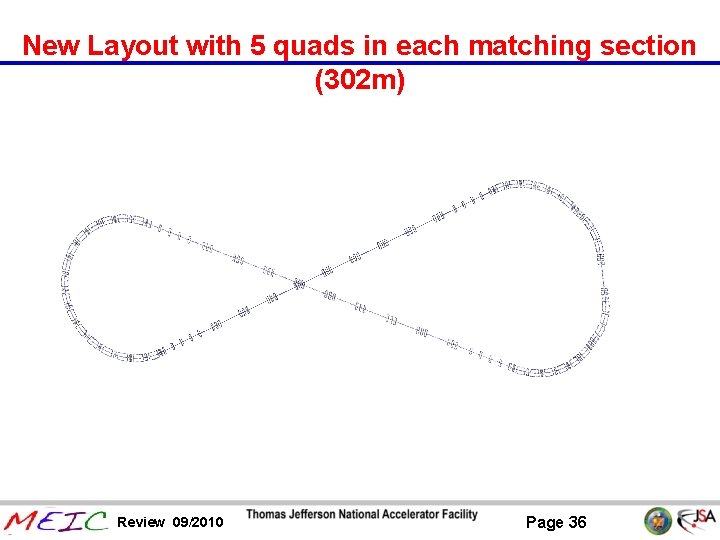
New Layout with 5 quads in each matching section (302 m) Review 09/2010 Page 36
- Slides: 36