
MEGN 537 Probabilistic Biomechanics Ch 7 First Order
MEGN 537 – Probabilistic Biomechanics Ch. 7 – First Order Reliability Methods Anthony J Petrella, Ph. D
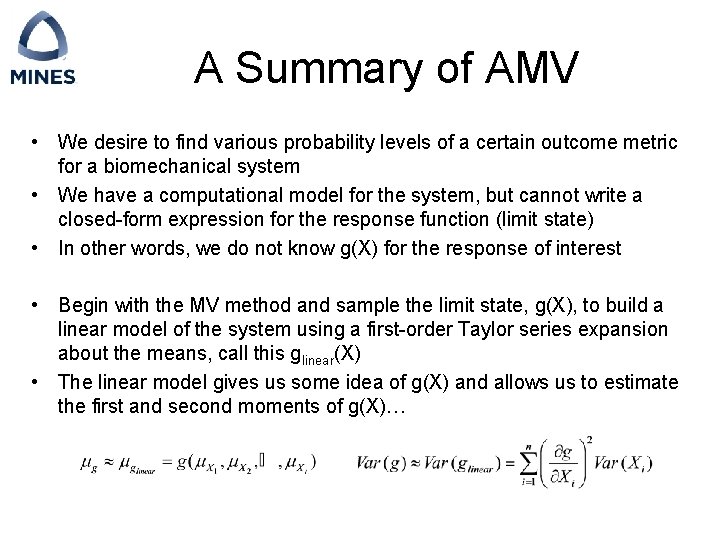
A Summary of AMV • We desire to find various probability levels of a certain outcome metric for a biomechanical system • We have a computational model for the system, but cannot write a closed-form expression for the response function (limit state) • In other words, we do not know g(X) for the response of interest • Begin with the MV method and sample the limit state, g(X), to build a linear model of the system using a first-order Taylor series expansion about the means, call this glinear(X) • The linear model gives us some idea of g(X) and allows us to estimate the first and second moments of g(X)…
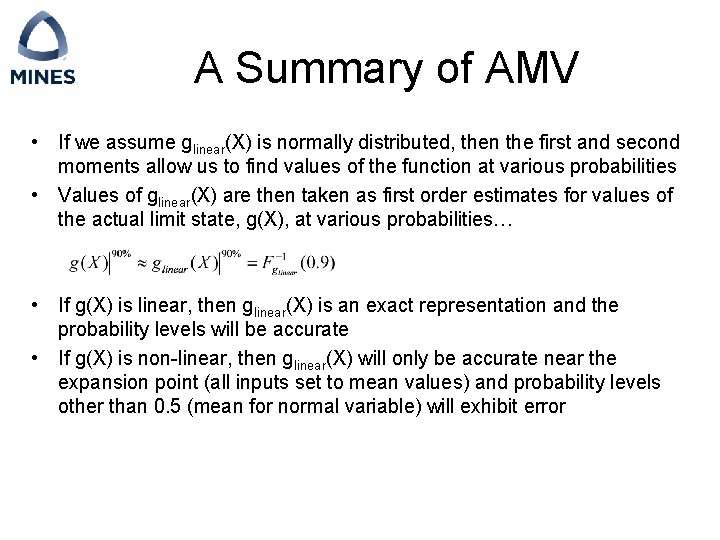
A Summary of AMV • If we assume glinear(X) is normally distributed, then the first and second moments allow us to find values of the function at various probabilities • Values of glinear(X) are then taken as first order estimates for values of the actual limit state, g(X), at various probabilities… • If g(X) is linear, then glinear(X) is an exact representation and the probability levels will be accurate • If g(X) is non-linear, then glinear(X) will only be accurate near the expansion point (all inputs set to mean values) and probability levels other than 0. 5 (mean for normal variable) will exhibit error
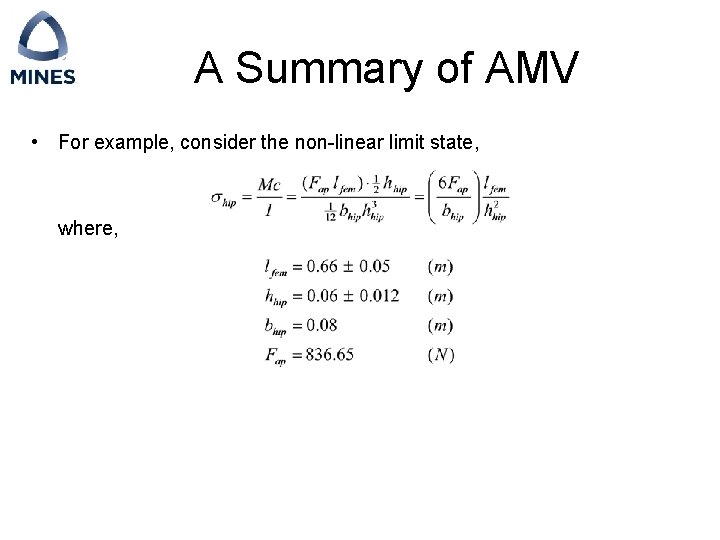
A Summary of AMV • For example, consider the non-linear limit state, where,
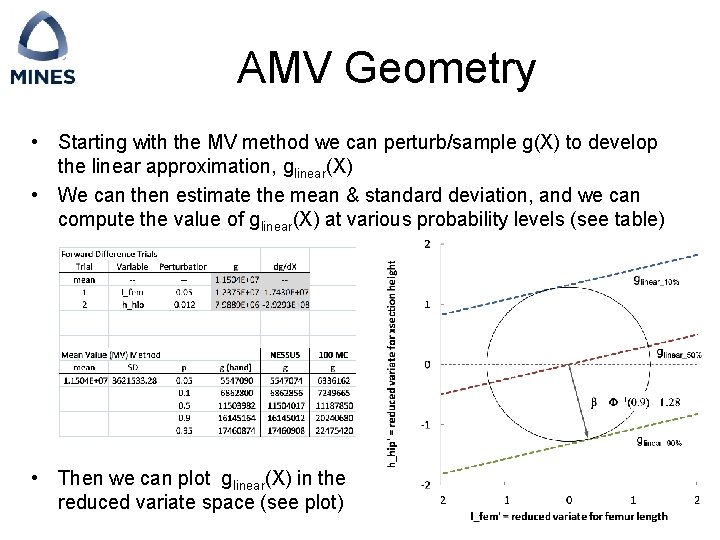
AMV Geometry • Starting with the MV method we can perturb/sample g(X) to develop the linear approximation, glinear(X) • We can then estimate the mean & standard deviation, and we can compute the value of glinear(X) at various probability levels (see table) • Then we can plot glinear(X) in the reduced variate space (see plot)
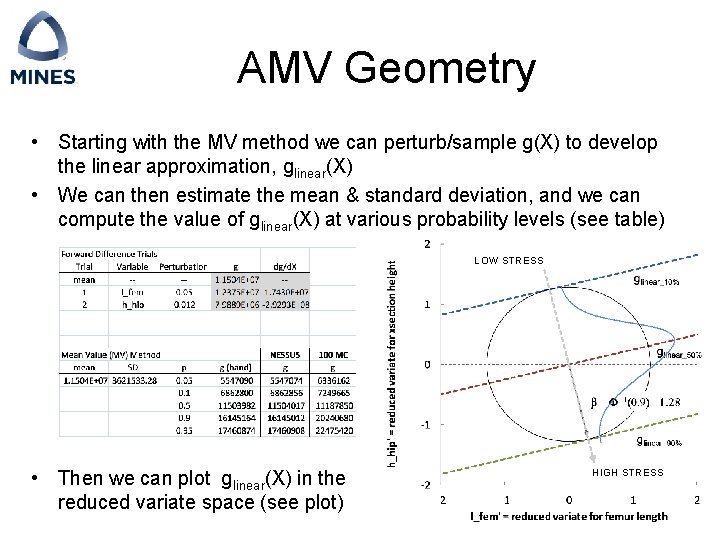
AMV Geometry • Starting with the MV method we can perturb/sample g(X) to develop the linear approximation, glinear(X) • We can then estimate the mean & standard deviation, and we can compute the value of glinear(X) at various probability levels (see table) LOW STRESS • Then we can plot glinear(X) in the reduced variate space (see plot) HIGH STRESS
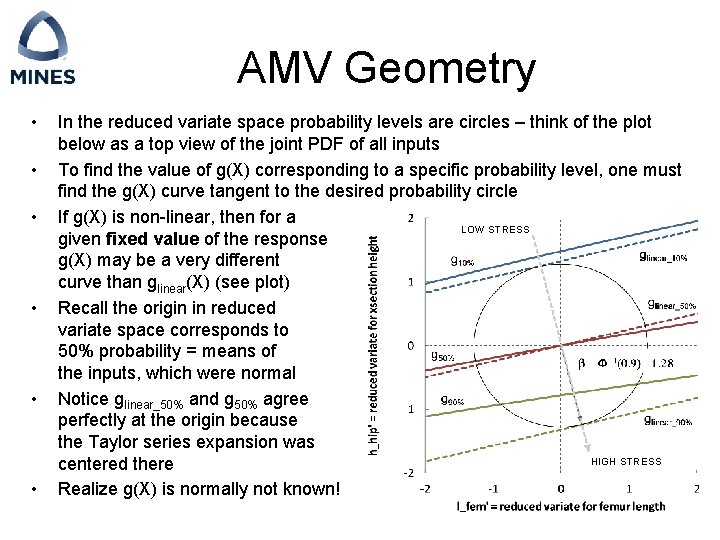
AMV Geometry • • • In the reduced variate space probability levels are circles – think of the plot below as a top view of the joint PDF of all inputs To find the value of g(X) corresponding to a specific probability level, one must find the g(X) curve tangent to the desired probability circle If g(X) is non-linear, then for a LOW STRESS given fixed value of the response g(X) may be a very different curve than glinear(X) (see plot) Recall the origin in reduced variate space corresponds to 50% probability = means of the inputs, which were normal Notice glinear_50% and g 50% agree perfectly at the origin because the Taylor series expansion was HIGH STRESS centered there Realize g(X) is normally not known!
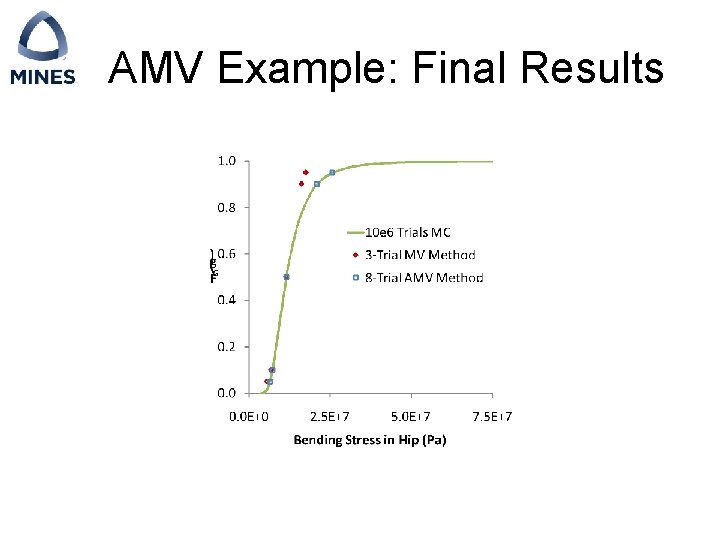
AMV Example: Final Results
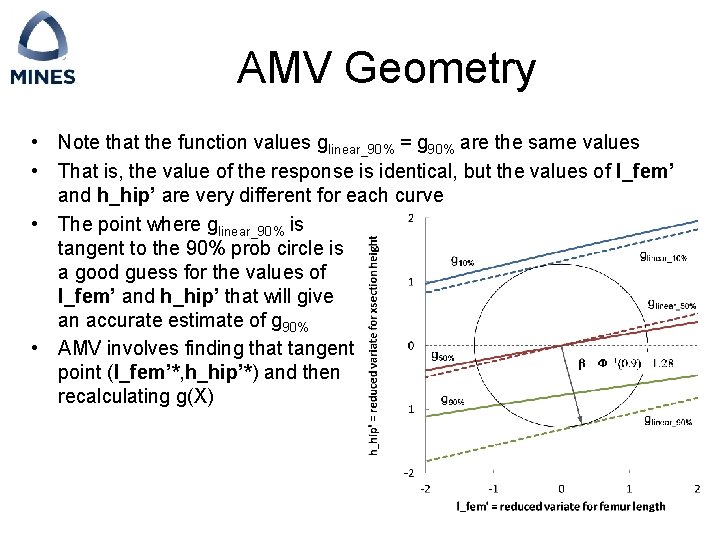
AMV Geometry • Note that the function values glinear_90% = g 90% are the same values • That is, the value of the response is identical, but the values of l_fem’ and h_hip’ are very different for each curve • The point where glinear_90% is tangent to the 90% prob circle is a good guess for the values of l_fem’ and h_hip’ that will give an accurate estimate of g 90% • AMV involves finding that tangent point (l_fem’*, h_hip’*) and then recalculating g(X)
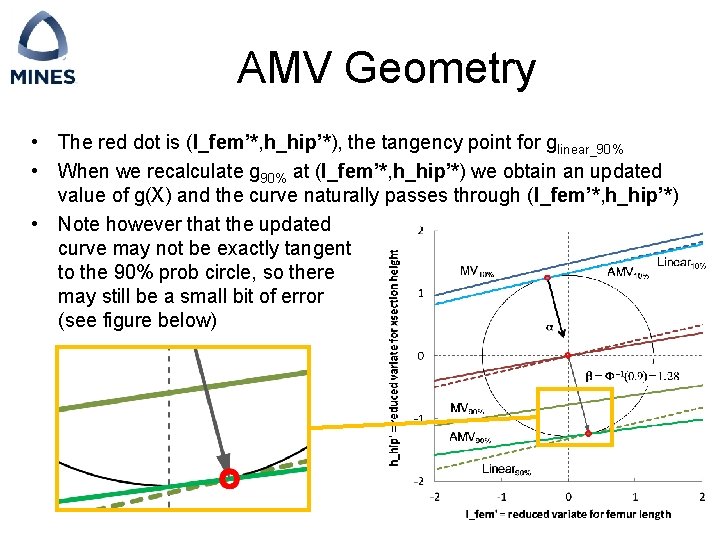
AMV Geometry • The red dot is (l_fem’*, h_hip’*), the tangency point for glinear_90% • When we recalculate g 90% at (l_fem’*, h_hip’*) we obtain an updated value of g(X) and the curve naturally passes through (l_fem’*, h_hip’*) • Note however that the updated curve may not be exactly tangent to the 90% prob circle, so there may still be a small bit of error (see figure below)
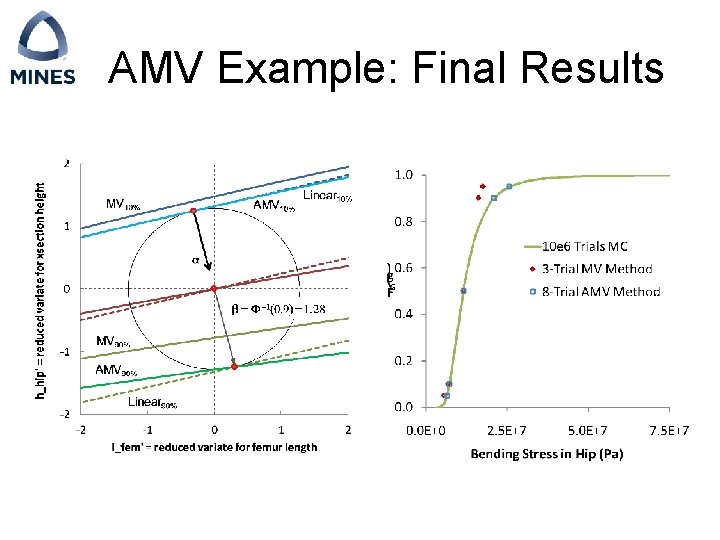
AMV Example: Final Results

Homework 6 - AMV • Your execution commands should look like this… copy. . pedal_data. mat copy. . pedal_trial_nessus. m copy. . unit. m matlab –wait -r pedal_prob_nessus del pedal_data. mat del pedal_trial_nessus. m del unit. m
- Slides: 12