
MEF Services Common Model LSO Legato Interface Profile

![Legato IPS Project Scope & Deliverables (all phases) • [L 64001_004] Interface Profile Specification](https://slidetodoc.com/presentation_image_h2/8531e0f4496e370371e30d47568da0b1/image-18.jpg "Legato IPS Project Scope & Deliverables (all phases) • [L 64001_004] Interface Profile Specification")
- Slides: 28
MEF Services Common Model & LSO Legato Interface Profile* In collaboration with ONAP External API project * Animated slides Karthik Sethuraman, NEC Jack Pugaczewski, Century. Link Andy Mayer, AT&T
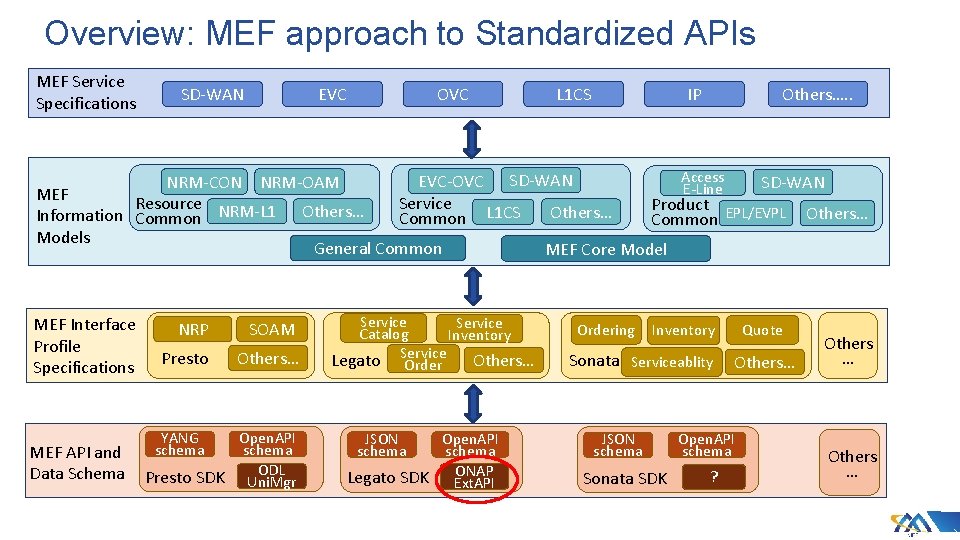
Overview: MEF approach to Standardized APIs MEF Service Specifications SD-WAN EVC OVC L 1 CS IP Others…. . Access EVC-OVC SD-WAN NRM-CON NRM-OAM SD-WAN E-Line MEF Service Resource Product EPL/EVPL Others… Information Common NRM-L 1 Others… Common L 1 CS Common Models General Common MEF Core Model MEF Interface Profile Specifications MEF API and Data Schema NRP SOAM Presto Others… Open. API schema ODL Presto SDK Uni. Mgr YANG schema Service Catalog Inventory Legato Service Others… Order Open. API schema ONAP Legato SDK Ext. API JSON schema Ordering Quote Inventory Sonata Serviceablity JSON schema Sonata SDK Others… Open. API schema ? Others …
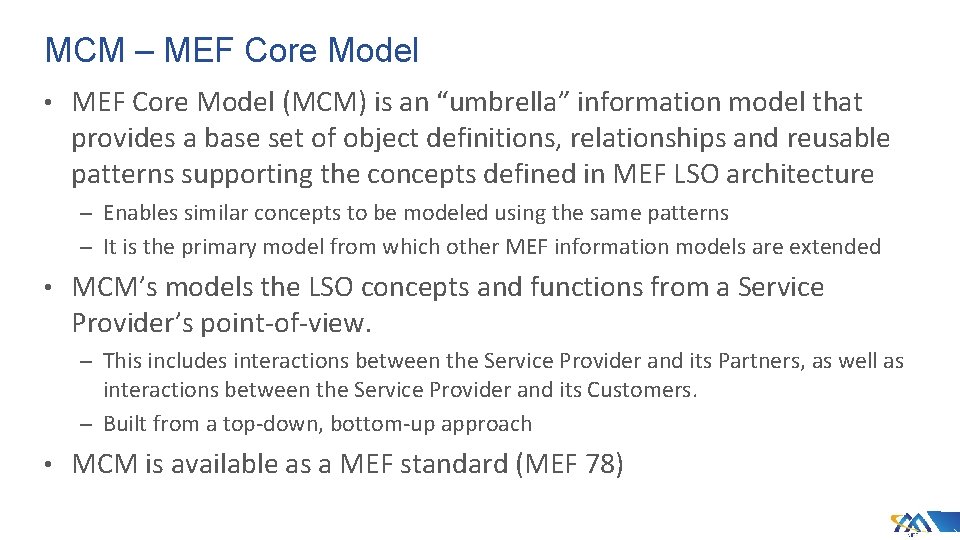
MCM – MEF Core Model • MEF Core Model (MCM) is an “umbrella” information model that provides a base set of object definitions, relationships and reusable patterns supporting the concepts defined in MEF LSO architecture – Enables similar concepts to be modeled using the same patterns – It is the primary model from which other MEF information models are extended • MCM’s models the LSO concepts and functions from a Service Provider’s point-of-view. – This includes interactions between the Service Provider and its Partners, as well as interactions between the Service Provider and its Customers. – Built from a top-down, bottom-up approach • MCM is available as a MEF standard (MEF 78)
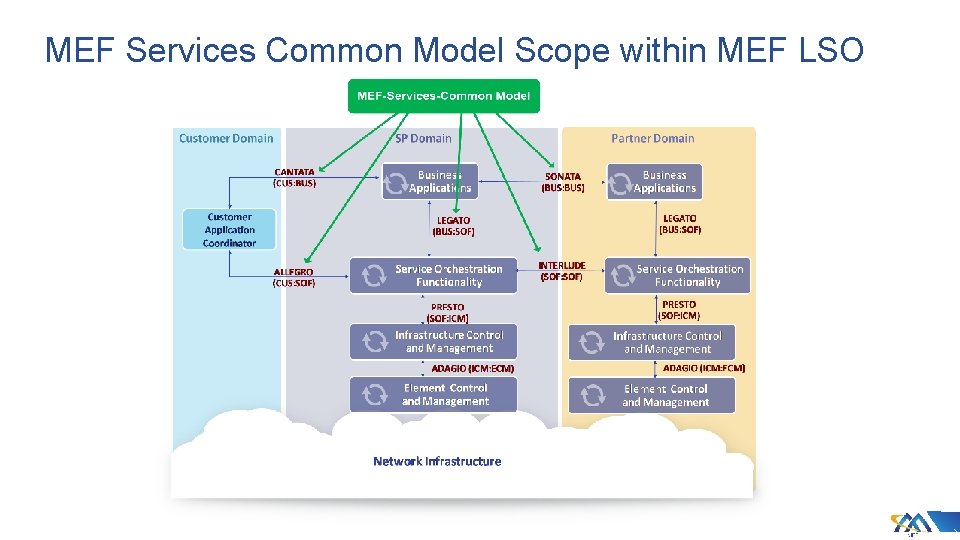
MEF Services Common Model Scope within MEF LSO
MSCM and other Model Relationships
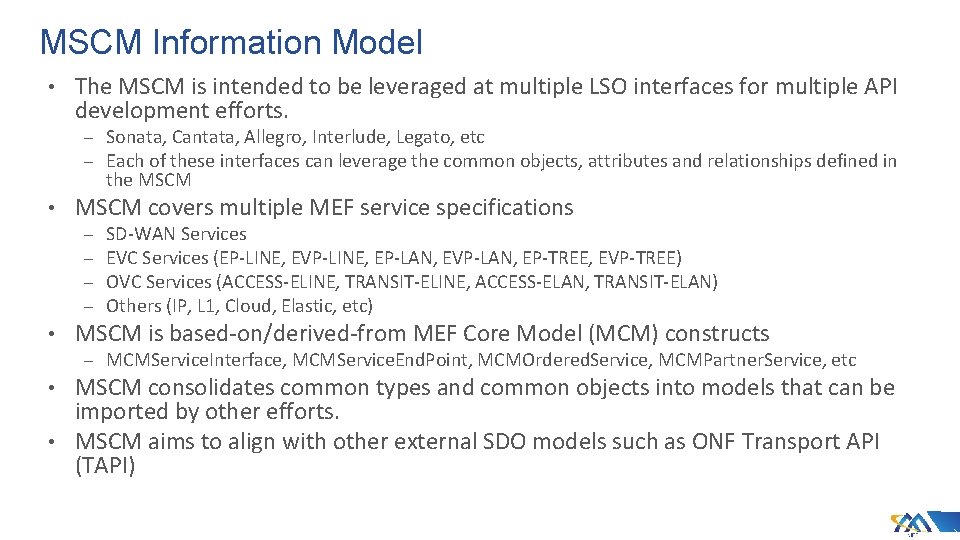
MSCM Information Model • The MSCM is intended to be leveraged at multiple LSO interfaces for multiple API development efforts. – Sonata, Cantata, Allegro, Interlude, Legato, etc – Each of these interfaces can leverage the common objects, attributes and relationships defined in the MSCM • MSCM covers multiple MEF service specifications – – SD-WAN Services EVC Services (EP-LINE, EVP-LINE, EP-LAN, EVP-LAN, EP-TREE, EVP-TREE) OVC Services (ACCESS-ELINE, TRANSIT-ELINE, ACCESS-ELAN, TRANSIT-ELAN) Others (IP, L 1, Cloud, Elastic, etc) • MSCM is based-on/derived-from MEF Core Model (MCM) constructs – MCMService. Interface, MCMService. End. Point, MCMOrdered. Service, MCMPartner. Service, etc • MSCM consolidates common types and common objects into models that can be imported by other efforts. • MSCM aims to align with other external SDO models such as ONF Transport API (TAPI)
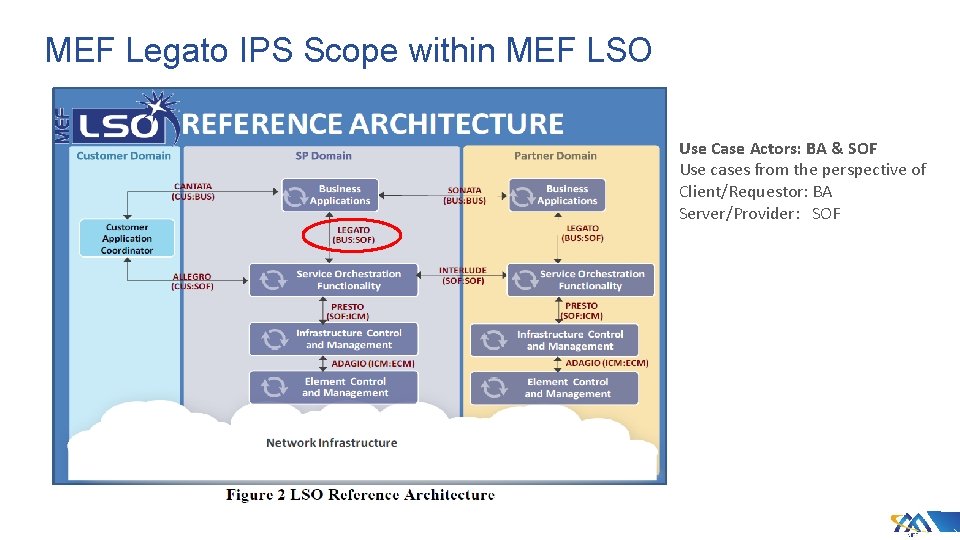
MEF Legato IPS Scope within MEF LSO Use Case Actors: BA & SOF Use cases from the perspective of Client/Requestor: BA Server/Provider: SOF
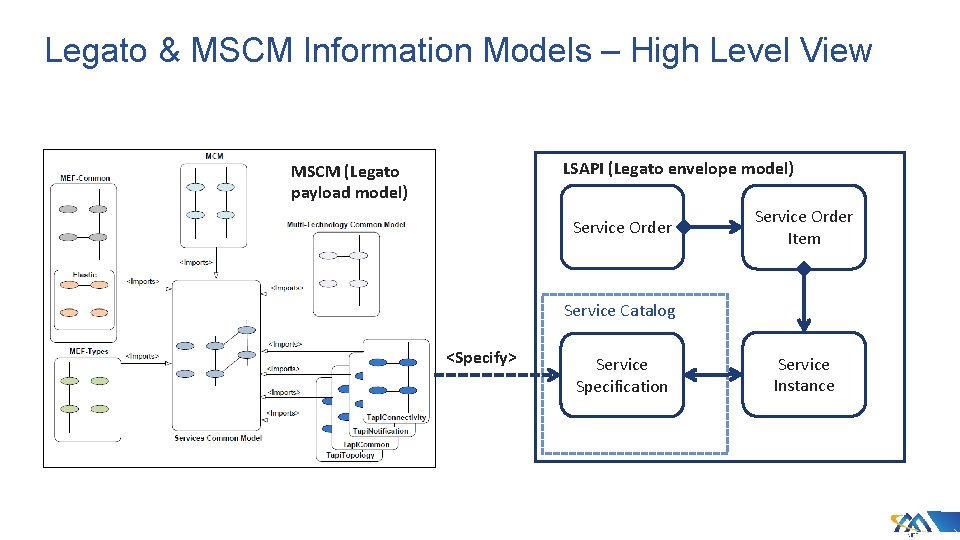
Legato & MSCM Information Models – High Level View LSAPI (Legato envelope model) MSCM (Legato payload model) Service Order Item Service Catalog <Specify> Service Specification Service Instance
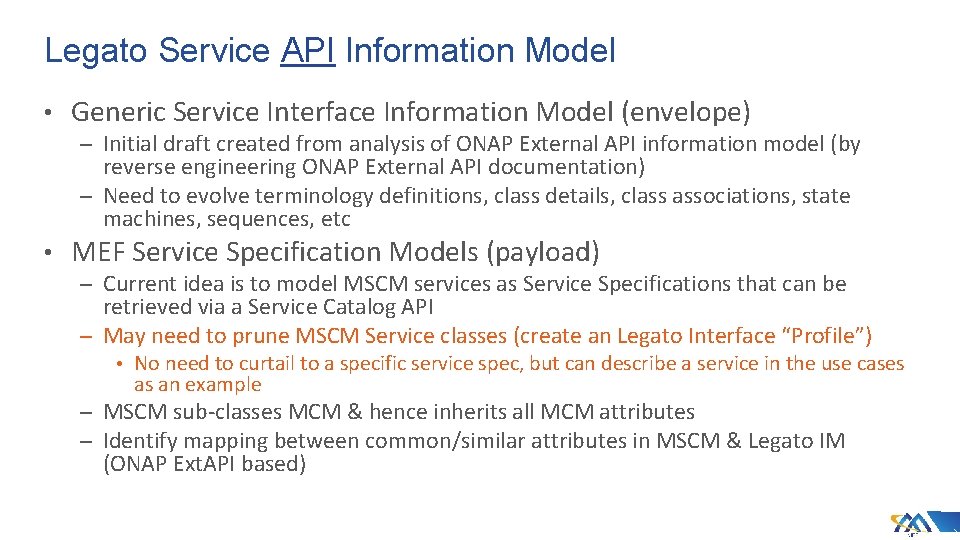
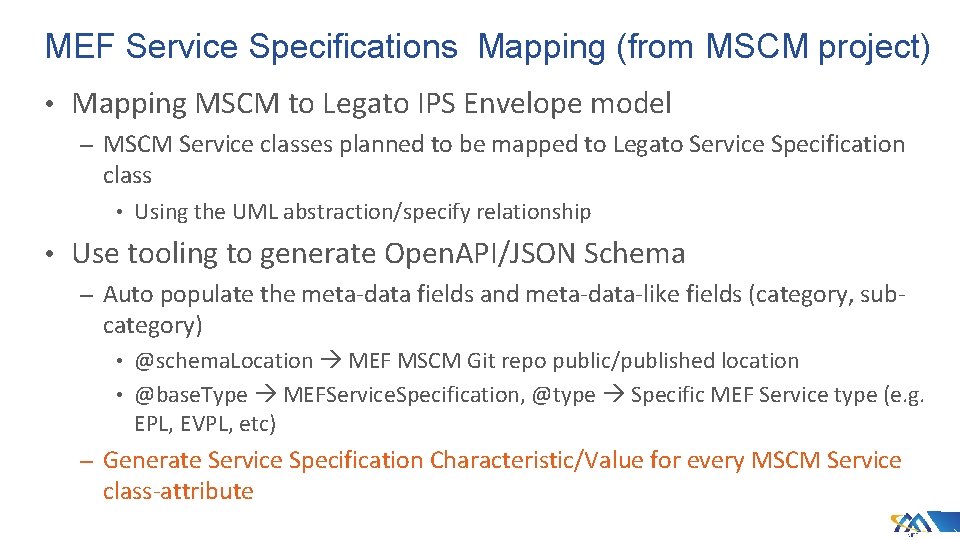
Legato Service API Information Model • Generic Service Interface Information Model (envelope) – Initial draft created from analysis of ONAP External API information model (by reverse engineering ONAP External API documentation) – Need to evolve terminology definitions, class details, class associations, state machines, sequences, etc • MEF Service Specification Models (payload) – Current idea is to model MSCM services as Service Specifications that can be retrieved via a Service Catalog API – May need to prune MSCM Service classes (create an Legato Interface “Profile”) • No need to curtail to a specific service spec, but can describe a service in the use cases as an example – MSCM sub-classes MCM & hence inherits all MCM attributes – Identify mapping between common/similar attributes in MSCM & Legato IM (ONAP Ext. API based)
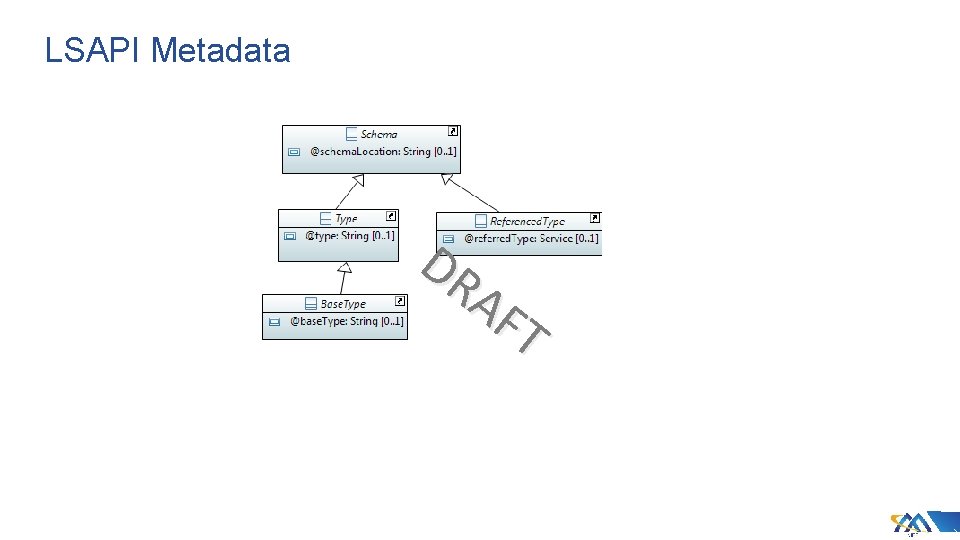
MEF Service Specifications Mapping (from MSCM project) • Mapping MSCM to Legato IPS Envelope model – MSCM Service classes planned to be mapped to Legato Service Specification class • Using the UML abstraction/specify relationship • Use tooling to generate Open. API/JSON Schema – Auto populate the meta-data fields and meta-data-like fields (category, sub- category) • @schema. Location MEF MSCM Git repo public/published location • @base. Type MEFService. Specification, @type Specific MEF Service type (e. g. EPL, EVPL, etc) – Generate Service Specification Characteristic/Value for every MSCM Service class-attribute
MSCM Additional Reference
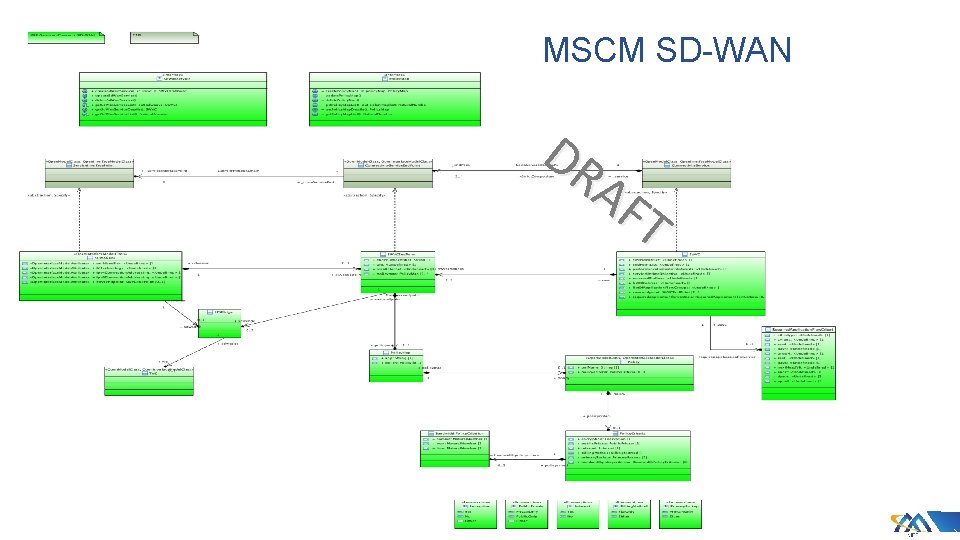
MSCM SD-WAN DR AF T
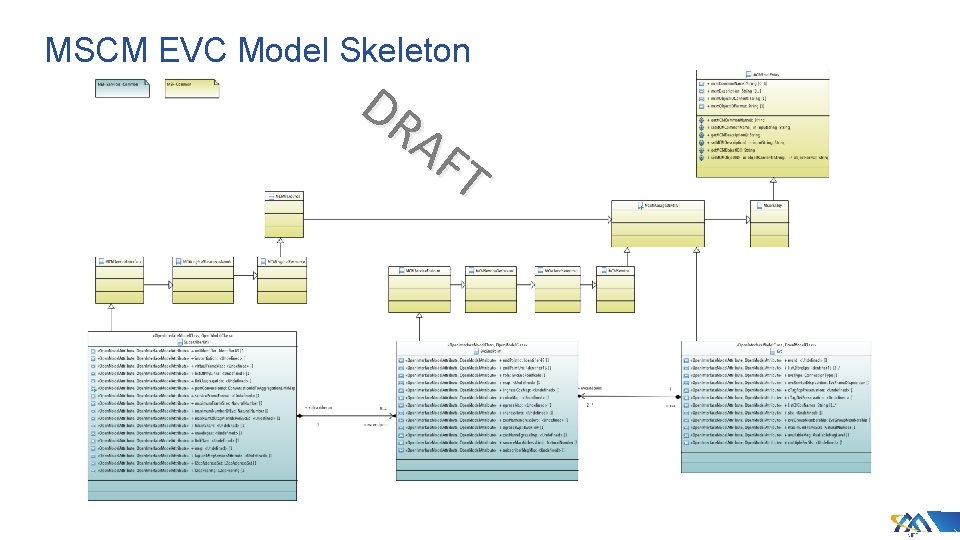
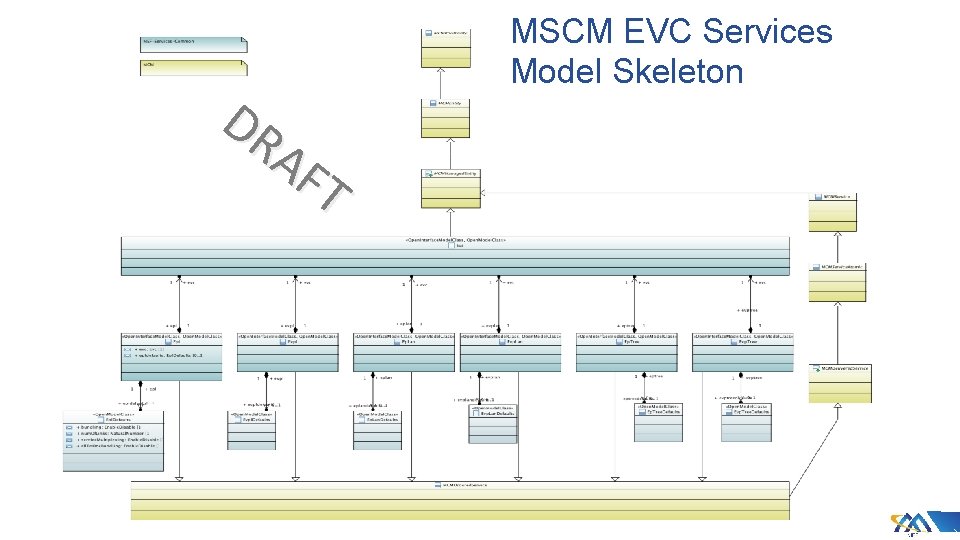
MSCM EVC Model Skeleton DR AF T
DR AF T MSCM EVC Services Model Skeleton
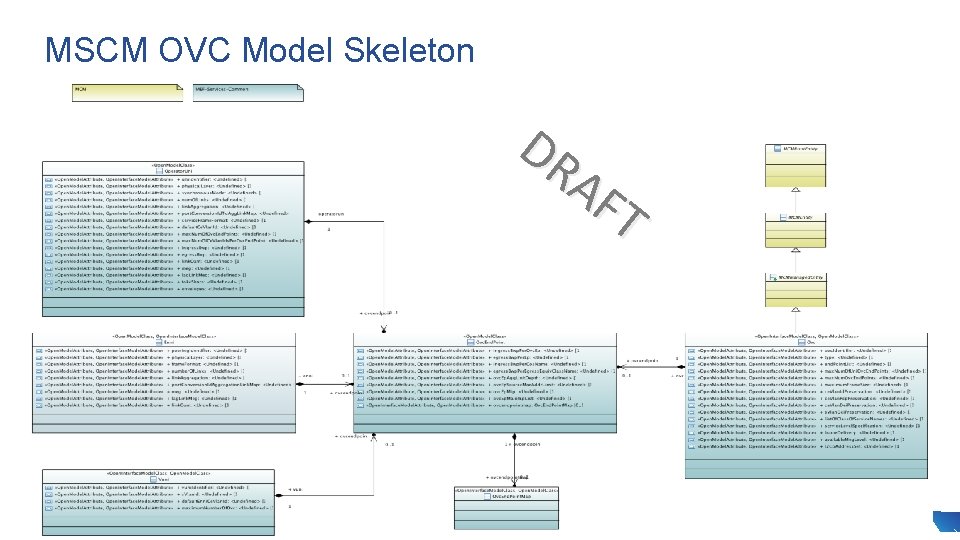
MSCM OVC Model Skeleton DR AF T
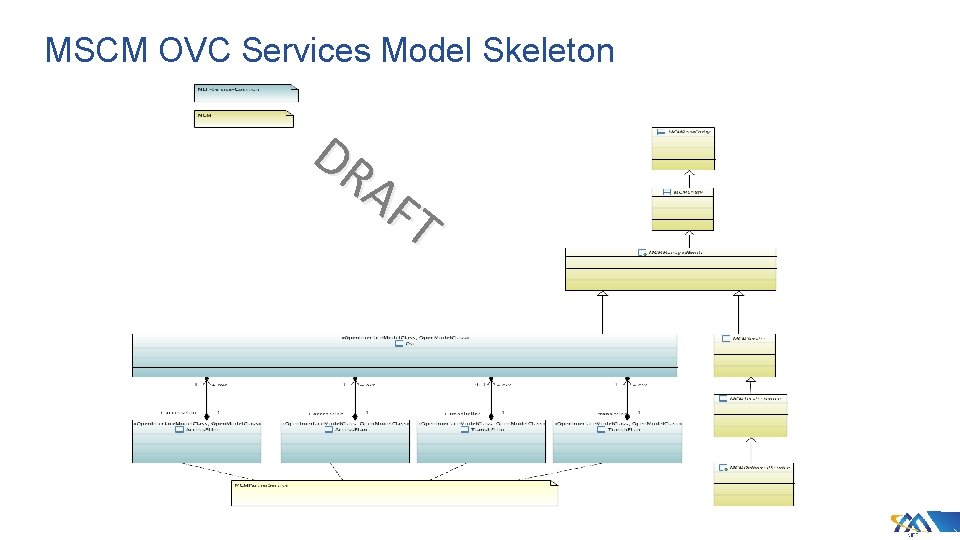
MSCM OVC Services Model Skeleton DR AF T
LSAPI Additional Reference
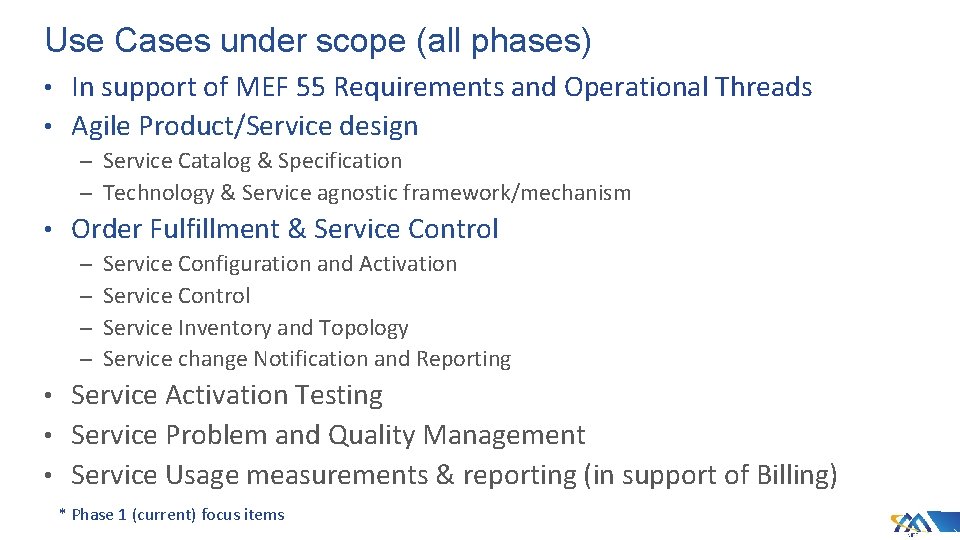
Legato IPS Project Scope & Deliverables (all phases) • [L 64001_004] Interface Profile Specification for MEF LSO Legato IRP covering – – – Service Catalog Service Ordering (including Service Instantiation) Service Inventory Service Topology Service Notification License Usage • Deliverables – Interface Profile Specification (IPS) • Terminology, Requirements & Use Cases • Information Model (Class, State & Sequence diagrams) – Interface Implementation Specification (IIS) • Project proposal calls out ONAP (Ext. API) • IM – API data-schema mapping • Guides & other stuff (plan to follow Sonata template ) – Software Artifacts • Papyrus UML + Gendoc output • Open. API/JSON schema * Phase 1 (current) focus items
Use Cases under scope (all phases) • In support of MEF 55 Requirements and Operational Threads • Agile Product/Service design – Service Catalog & Specification – Technology & Service agnostic framework/mechanism • Order Fulfillment & Service Control – Service Configuration and Activation – Service Control – Service Inventory and Topology – Service change Notification and Reporting • Service Activation Testing • Service Problem and Quality Management • Service Usage measurements & reporting (in support of Billing) * Phase 1 (current) focus items
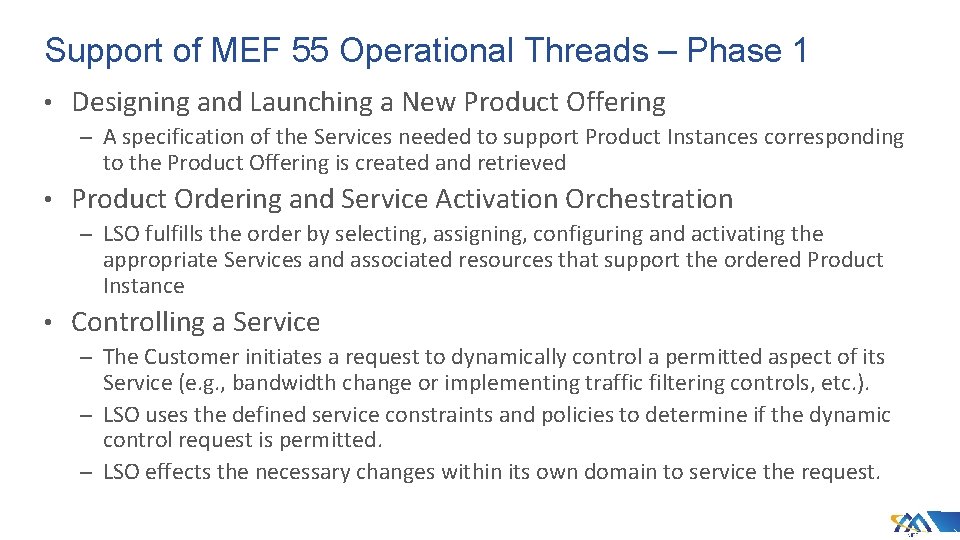
Support of MEF 55 Operational Threads – Phase 1 • Designing and Launching a New Product Offering – A specification of the Services needed to support Product Instances corresponding to the Product Offering is created and retrieved • Product Ordering and Service Activation Orchestration – LSO fulfills the order by selecting, assigning, configuring and activating the appropriate Services and associated resources that support the ordered Product Instance • Controlling a Service – The Customer initiates a request to dynamically control a permitted aspect of its Service (e. g. , bandwidth change or implementing traffic filtering controls, etc. ). – LSO uses the defined service constraints and policies to determine if the dynamic control request is permitted. – LSO effects the necessary changes within its own domain to service the request.
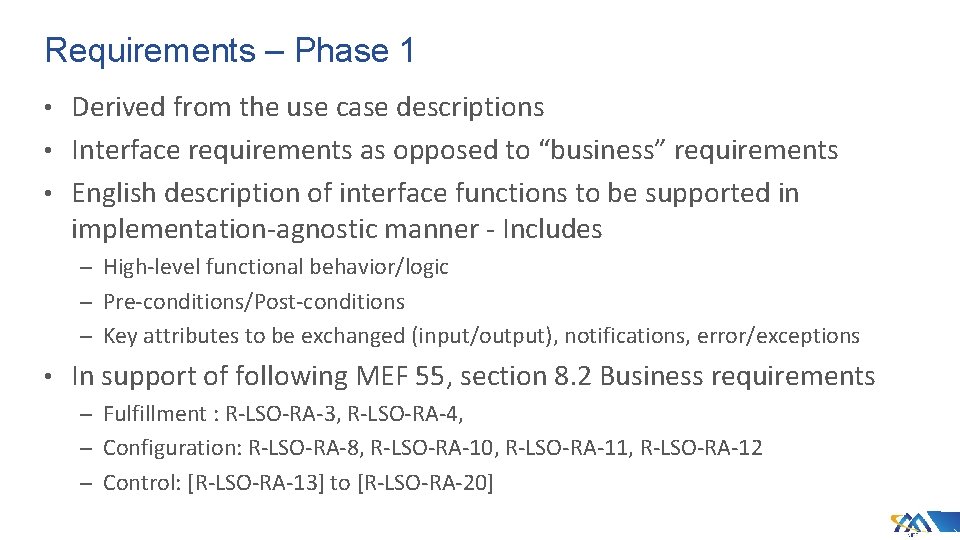
Requirements – Phase 1 • Derived from the use case descriptions • Interface requirements as opposed to “business” requirements • English description of interface functions to be supported in implementation-agnostic manner - Includes – High-level functional behavior/logic – Pre-conditions/Post-conditions – Key attributes to be exchanged (input/output), notifications, error/exceptions • In support of following MEF 55, section 8. 2 Business requirements – Fulfillment : R-LSO-RA-3, R-LSO-RA-4, – Configuration: R-LSO-RA-8, R-LSO-RA-10, R-LSO-RA-11, R-LSO-RA-12 – Control: [R-LSO-RA-13] to [R-LSO-RA-20]
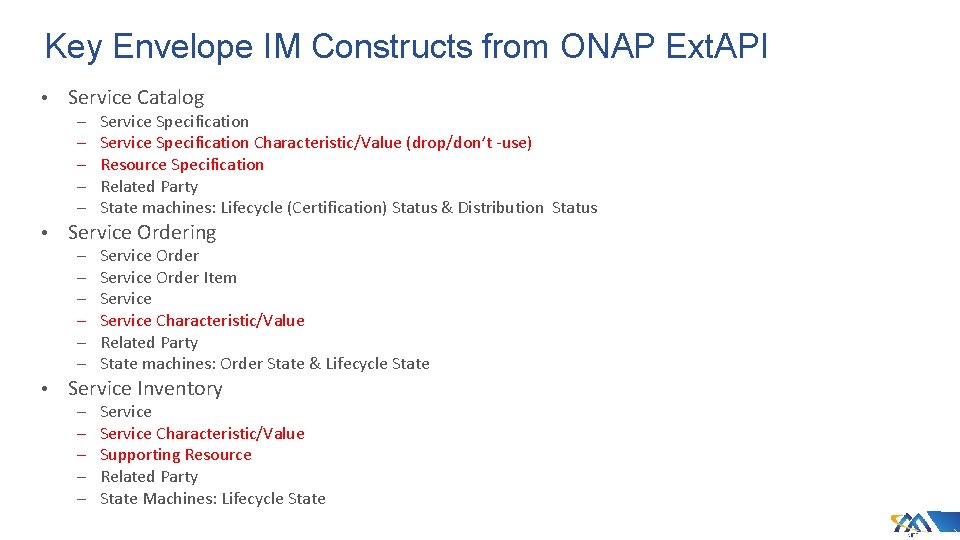
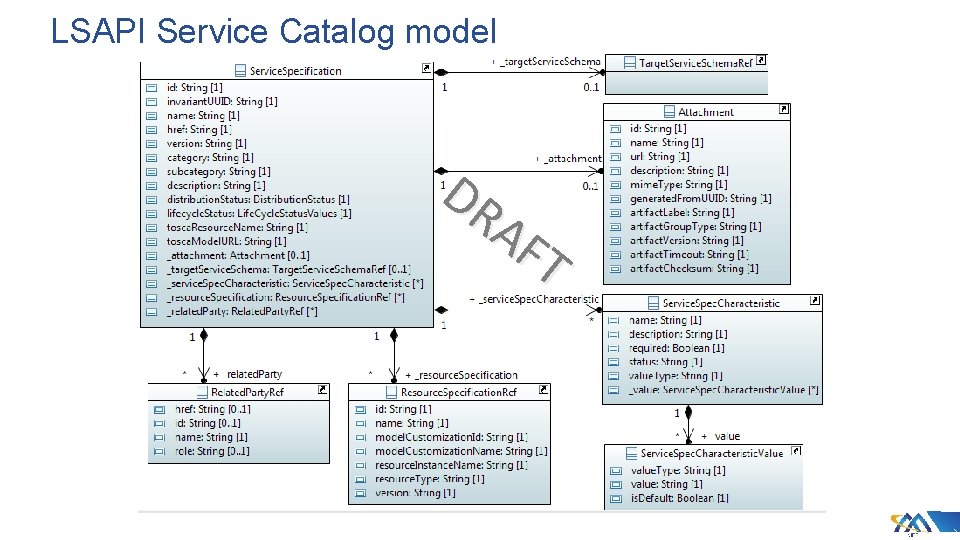
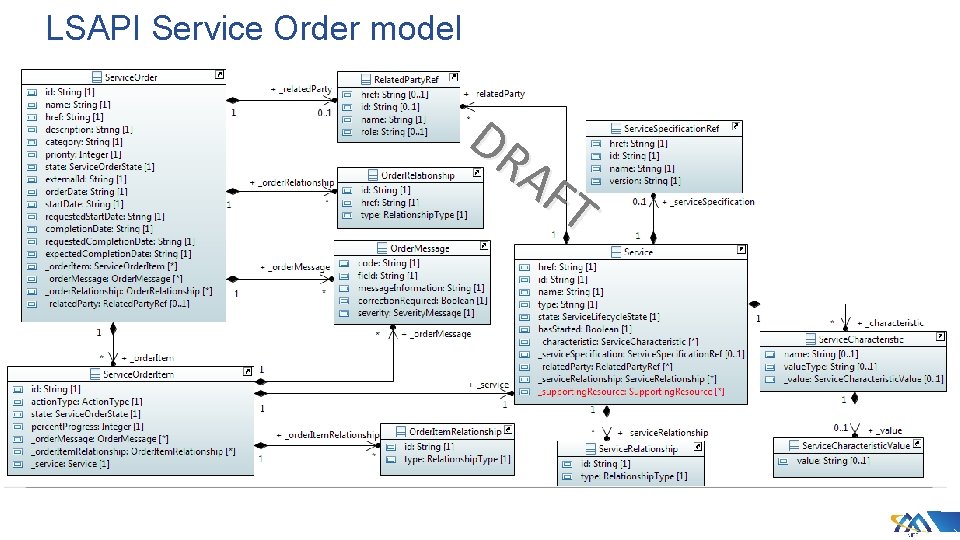
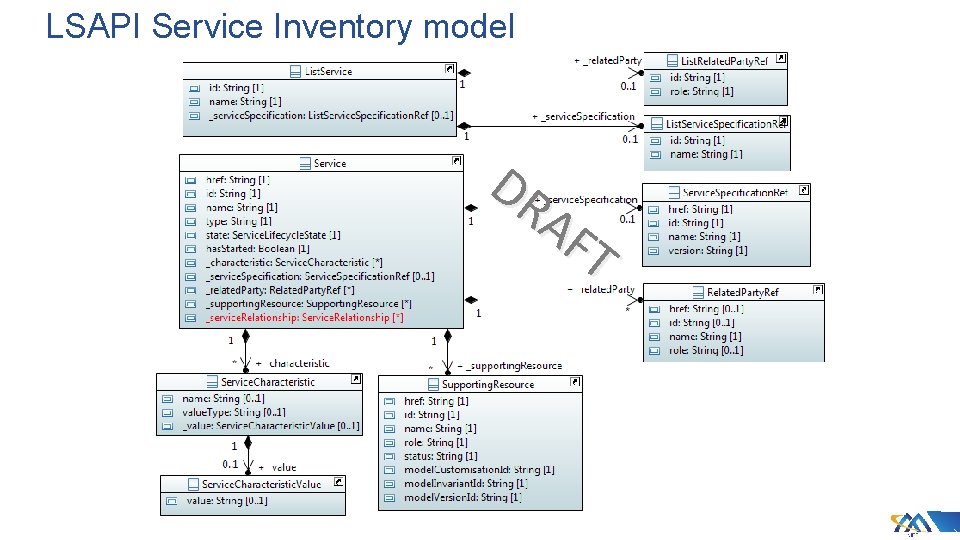
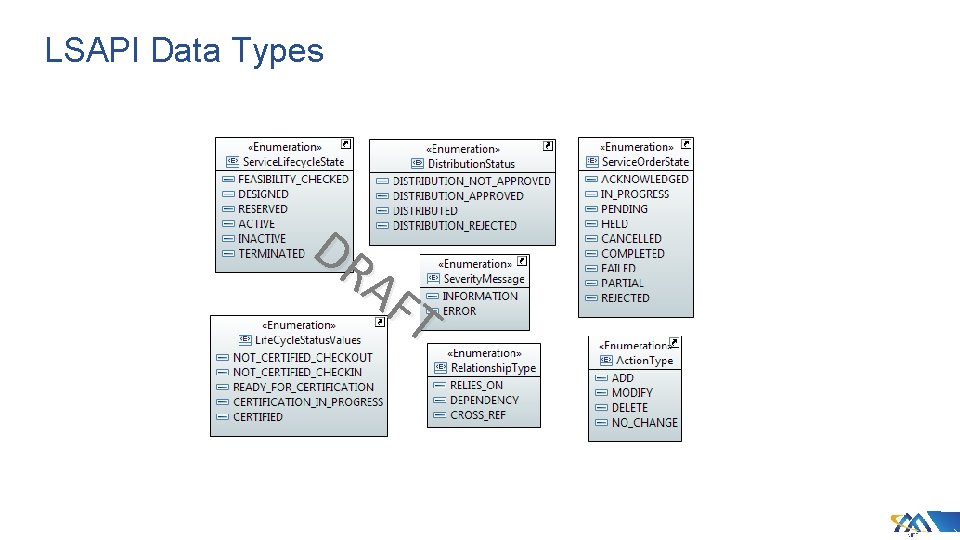
Key Envelope IM Constructs from ONAP Ext. API • Service Catalog – – – • Service Ordering – – – • Service Specification Characteristic/Value (drop/don’t -use) Resource Specification Related Party State machines: Lifecycle (Certification) Status & Distribution Status Service Order Item Service Characteristic/Value Related Party State machines: Order State & Lifecycle State Service Inventory – – – Service Characteristic/Value Supporting Resource Related Party State Machines: Lifecycle State
LSAPI Service Catalog model DR AF T
LSAPI Service Order model DR AF T
LSAPI Service Inventory model DR AF T
LSAPI Data Types DR AF T
LSAPI Metadata DR AF T
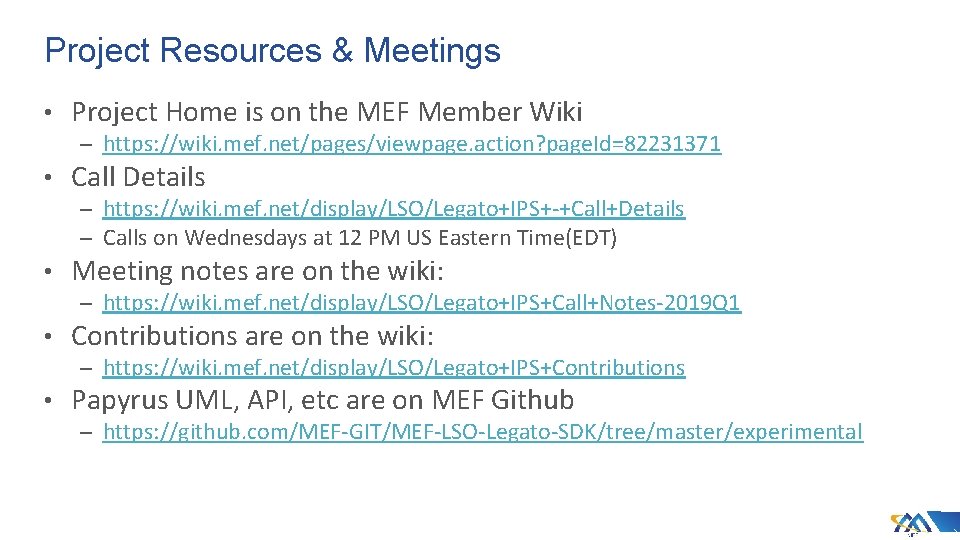
Project Resources & Meetings • Project Home is on the MEF Member Wiki – https: //wiki. mef. net/pages/viewpage. action? page. Id=82231371 • Call Details – https: //wiki. mef. net/display/LSO/Legato+IPS+-+Call+Details – Calls on Wednesdays at 12 PM US Eastern Time(EDT) • Meeting notes are on the wiki: – https: //wiki. mef. net/display/LSO/Legato+IPS+Call+Notes-2019 Q 1 • Contributions are on the wiki: – https: //wiki. mef. net/display/LSO/Legato+IPS+Contributions • Papyrus UML, API, etc are on MEF Github – https: //github. com/MEF-GIT/MEF-LSO-Legato-SDK/tree/master/experimental