
MEF Modeling Activities Putting Models in Context www


- Slides: 17
MEF Modeling Activities Putting Models in Context www. mef. net
Outline Challenges MEF’s Third Network Vision Lifecycle Service Orchestration (LSO) Models in context LSO. net Conclusions 2 www. mef. net
Challenges On-demand Services Quality Expectations Evolution of Networks and Services 3 www. mef. net
MEF’s Third Network Vision Enable agile networks Deliver assured connectivity services Orchestrated across network domains Between physical or virtual service endpoints 4 www. mef. net
Lifecycle Service Orchestration www. mef. net
Lifecycle Service Orchestration capabilities Backbone of the Lifecycle Services provided by The Third Network Provides orchestrated management and control of Connectivity Services 6 www. mef. net
Lifecycle Service Orchestration (cont) Defines product, service, and resource abstractions Abstracts complexity from applications and users of Connectivity Services Infrastructure-agnostic (WAN technologies, NFV, SDN) 7 www. mef. net
Models in Context www. mef. net
LSO Engineering Methodology Enables the transformation of LSO capabilities into interoperable, specific, consistent, and verifiable designs and implementations Generates re-usable engineering specifications and artifacts Captures LSO requirements, capabilities, functionality, behavior, processes, information, interfaces and APIs 9 www. mef. net
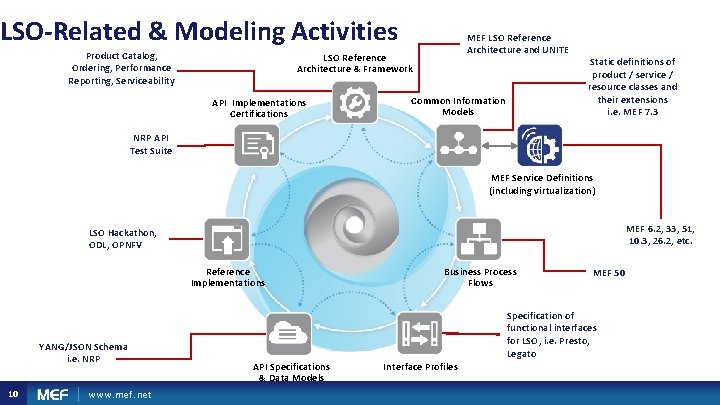
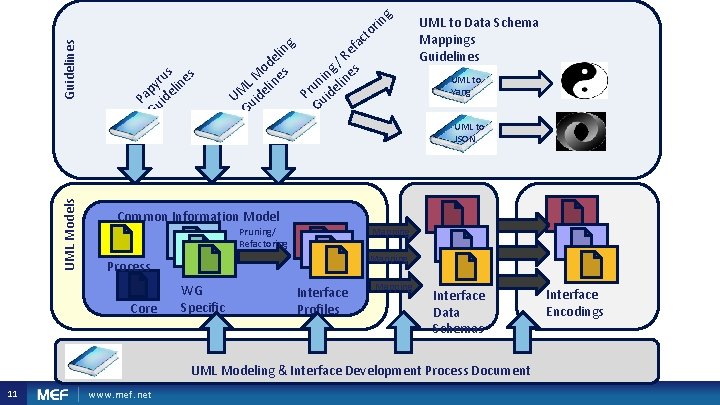
LSO-Related & Modeling Activities Product Catalog, Ordering, Performance Reporting, Serviceability MEF LSO Reference Architecture and UNITE LSO Reference Architecture & Framework API Implementations Certifications Common Information Models Static definitions of product / service / resource classes and their extensions i. e. MEF 7. 3 NRP API Test Suite MEF Service Definitions (including virtualization) MEF 6. 2, 33, 51, 10. 3, 26. 2, etc. LSO Hackathon, ODL, OPNFV Reference Implementations YANG/JSON Schema i. e. NRP 10 www. mef. net Business Process Flows MEF 50 Specification of functional interfaces for LSO, i. e. Presto, Legato API Specifications & Data Models Interface Profiles
Guidelines g us nes r py li Pa uide G in el d o s L M line UM uide G g in r o ct fa e /R s g n e ni elin u Pr uid G UML to Data Schema Mappings Guidelines UML to Yang UML Models UML to JSON Common Information Model Mapping Pruning/ Refactoring Mapping Process Core WG Specific Interface Profiles Mapping Interface Data Schemas UML Modeling & Interface Development Process Document 11 www. mef. net Interface Encodings
LSO Reference Architecture and Framework Expresses the vision of the MEF LSO capabilities Characterizes management and control domains/entities that enable LSO capabilities Layered architecture 12 www. mef. net
LSO Reference Architecture and Framework Management Interface Reference Points specify interactions between LSO components High level operational threads describe orchestrated Connectivity Service behavior and interactions among management entities 13 www. mef. net
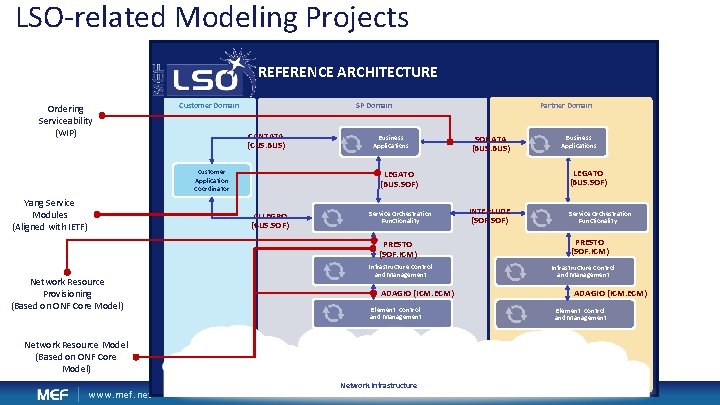
LSO-related Modeling Projects REFERENCE ARCHITECTURE Ordering Serviceability (WIP) Customer Domain SP Domain CANTATA (CUS: BUS) Customer Application Coordinator Yang Service Modules (Aligned with IETF) Business Applications ALLEGRO (CUS: SOF) Service Orchestration E Functionality Infrastructure Control and Management ADAGIO (ICM: ECM) Element Control and Management Network Resource Model (Based on ONF Core Model) www. mef. net SONATA (BUS: BUS) Network Infrastructure Business Applications LEGATO (BUS: SOF) PRESTO (SOF: ICM) Network Resource Provisioning (Based on ONF Core Model) Partner Domain INTERLUDE (SOF: SOF) Service Orchestration Functionality PRESTO (SOF: ICM) Infrastructure Control and Management ADAGIO (ICM: ECM) Element Control and Management
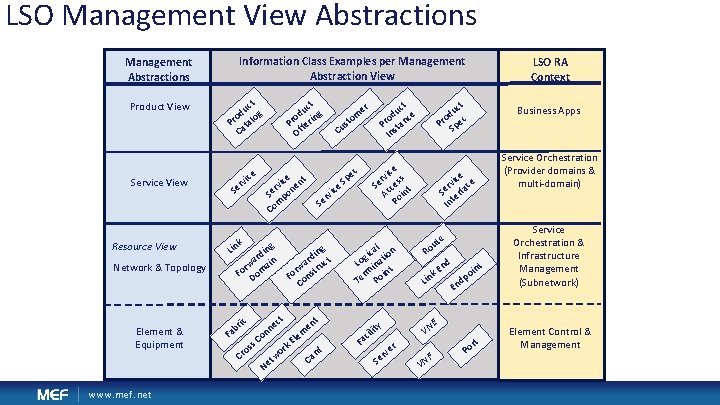
LSO Management View Abstractions Management Abstractions Product View Service View Resource View Network & Topology Element & Equipment www. mef. net Information Class Examples per Management Abstraction View t uc g d o Pr talo Ca t uc g d o n Pr feri Of e vic r Se ice t rv nen e S po m Co k Lin ing rd n a rw ai Fo Dom ric b Fa Cr s. C os Se t ec l ica tion g Lo ina t rm in Te Po t en k or w et e vic ss r Se cce t A oin P ec p S ice v r g din t r c a rw tru Fo ons C n on N st Cu m Ele rd Ca t uc d o Pr Spec ct du ce o Pr stan In er om Business Apps e vic ace r Se erf t In e ut Ro nd k. E Lin int o dp En E ity VN il ac F LSO RA Context r ve r Se F VN P t or Service Orchestration (Provider domains & multi-domain) Service Orchestration & Infrastructure Management (Subnetwork) Element Control & Management
MEF’s LSO. net LSO experimentation and incubation platform Support for LSO Hackathons OS/SDO collaboration environment Accelerates the development of data models and APIs 16 www. mef. net
Conclusions Alignment and Velocity are fundamental Our focus is on entities on the service, service management and resource layers Models and abstractions must be understood in the right context 17 www. mef. net