
Meeting the Needs of Aging Persons with Developmental
- Slides: 46
Meeting the Needs of Aging Persons with Developmental Disabilities Cross Network Collaboration for Florida Aging in Individuals with a Developmental Disability Module 3 ADRC Training Based on ADRC training developed by: Kathleen M. Bishop, Ph. D. , and Ron Lucchino, Ph. D. 1
Purpose of Module 3 q Understand aging as a normal process q Dispel myths about aging and developmental disabilities q Recognize how aging may increase risk factors for disease ADRC Training 2
Purpose of Module 3 q Understand aging with developmental disabilities is the overlap of aging and disabilities q Recognize how medications may affect adults with developmental disabilities ADRC Training 3
Meeting the Needs of Aging Persons with Developmental Disabilities Cross Network Collaboration for Florida What Is Aging? ADRC Training 4
Aging Factors q Determined by interaction of three factors § § § Life-long choices (diet, physical and mental exercise, self-esteem) Environment (physical, cultural and social) Genetics Successful aging from positive genes Negative aging from life-long or late-onset gene ADRC Training 5
Aging Changes q Age related: Common to everyone § Interventions may slow decline q Age associated: Not common to everyone § Associated with disease, disorders, poor lifestyle choices, negative environment § Controlled by individual choices ADRC Training 6
Aging in Adults with Developmental Disabilities q Interaction of pre-existing disability with factors of aging may result in: § Increased risk factors with earlier onset of symptoms § Increased risk for inappropriate medical treatment § Increased vulnerability to a more restrictive environment ADRC Training 7
Aging in Adults with Developmental Disabilities q Interaction of pre-existing disability with factors of aging may result in: § Increased challenging behaviors due to communication difficulties § Increased cost for treatment and interventions § Increased staff/family frustration due to lack of communication and knowledge ADRC Training 8
Meeting the Needs of Aging Persons with Developmental Disabilities Cross Network Collaboration for Florida Myths About Aging and Developmental Disability ADRC Training 9
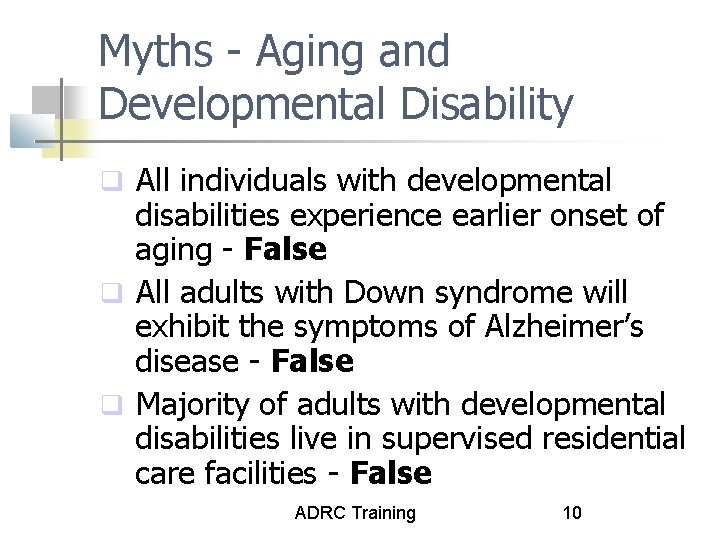
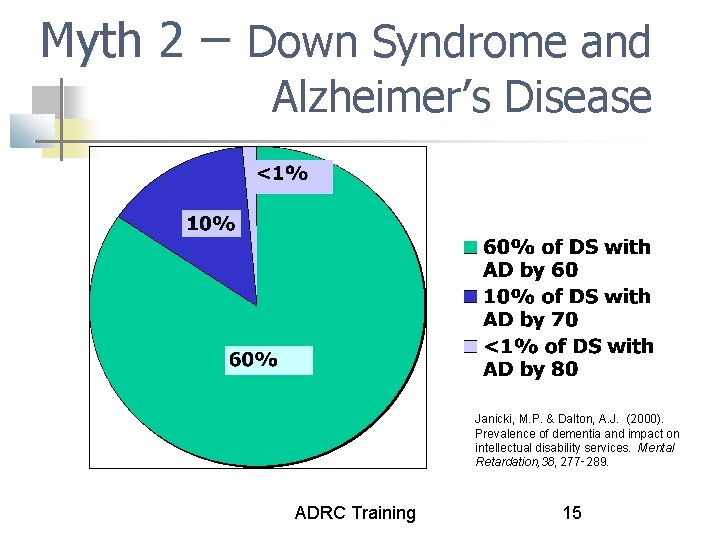
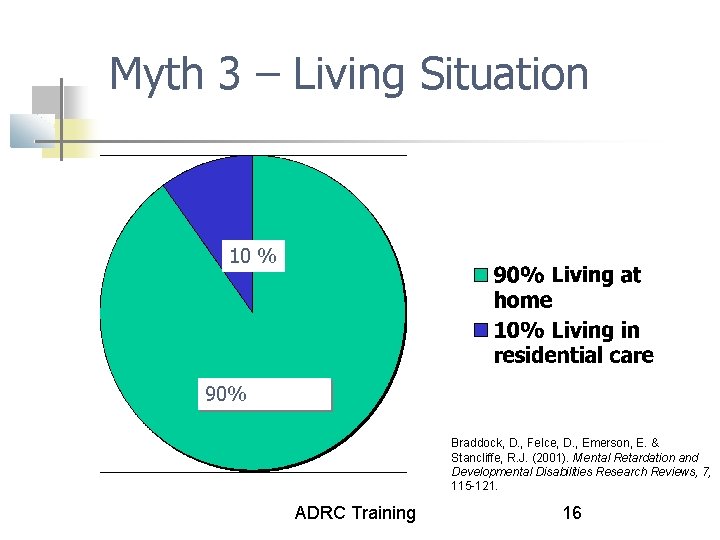
Myths - Aging and Developmental Disability q All individuals with developmental disabilities experience earlier onset of aging - False q All adults with Down syndrome will exhibit the symptoms of Alzheimer’s disease - False q Majority of adults with developmental disabilities live in supervised residential care facilities - False ADRC Training 10
Consequences of Myths q Affect quality of assessment and intervention q. Influence attitudes of staff, family, and providers q. Limit available choices and resources q. Affect quality of life ADRC Training 11
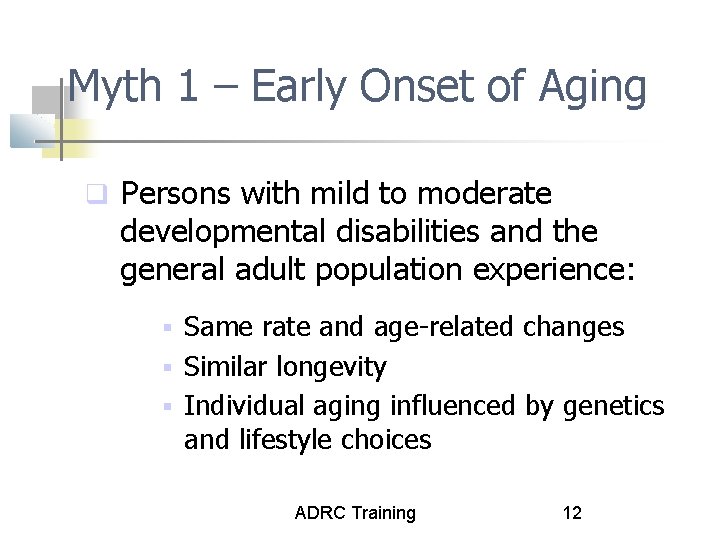
Myth 1 – Early Onset of Aging q Persons with mild to moderate developmental disabilities and the general adult population experience: § Same rate and age-related changes § Similar longevity § Individual aging influenced by genetics and lifestyle choices ADRC Training 12
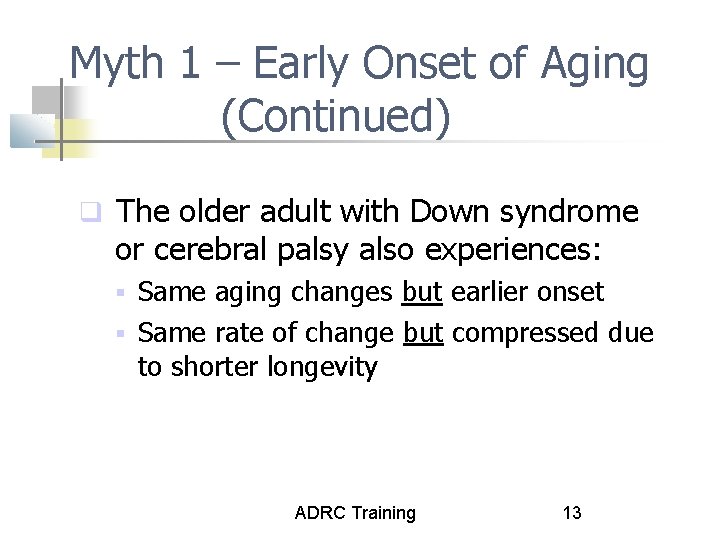
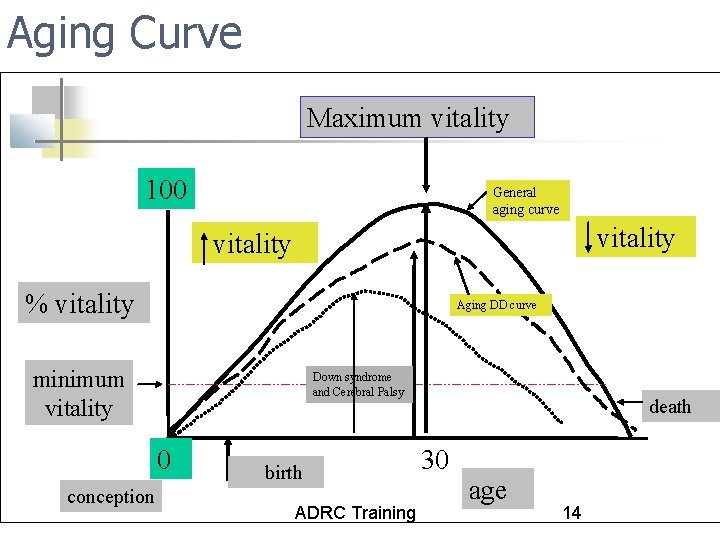
Myth 1 – Early Onset of Aging (Continued) q The older adult with Down syndrome or cerebral palsy also experiences: § Same aging changes but earlier onset § Same rate of change but compressed due to shorter longevity ADRC Training 13
Aging Curve Maximum vitality 100 General aging curve vitality % vitality Aging DD curve minimum vitality Down syndrome and Cerebral Palsy 0 conception birth ADRC Training death 30 age 14
Myth 2 – Down Syndrome and Alzheimer’s Disease Janicki, M. P. & Dalton, A. J. (2000). Prevalence of dementia and impact on intellectual disability services. Mental Retardation, 38, 277‑ 289. ADRC Training 15
Myth 3 – Living Situation 10 % 90% Braddock, D. , Felce, D. , Emerson, E. & Stancliffe, R. J. (2001). Mental Retardation and Developmental Disabilities Research Reviews, 7, 115 -121. ADRC Training 16
Meeting the Needs of Aging Persons with Developmental Disabilities Cross Network Collaboration for Florida Aging in Individuals with a Developmental Disability ADRC Training 17
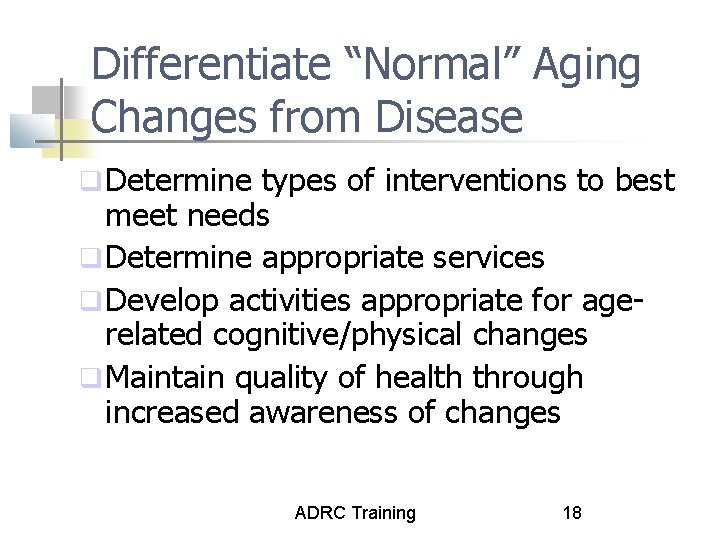
Differentiate “Normal” Aging Changes from Disease q Determine types of interventions to best meet needs q Determine appropriate services q Develop activities appropriate for agerelated cognitive/physical changes q Maintain quality of health through increased awareness of changes ADRC Training 18
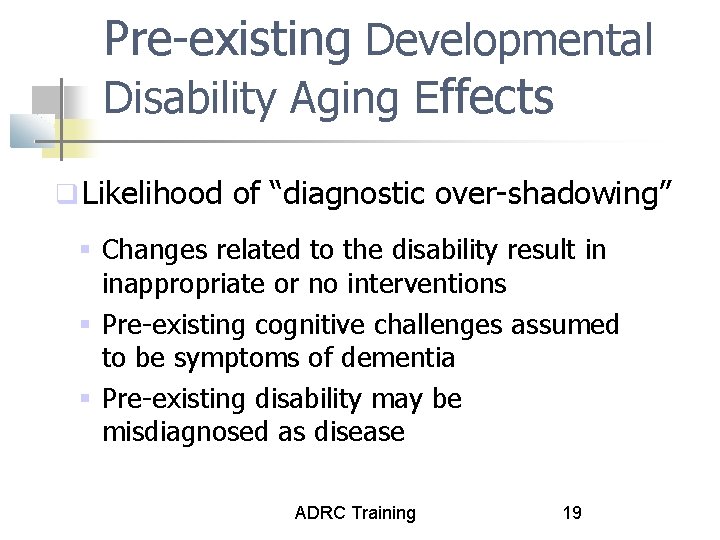
Pre-existing Developmental Disability Aging Effects q Likelihood of “diagnostic over-shadowing” § Changes related to the disability result in inappropriate or no interventions § Pre-existing cognitive challenges assumed to be symptoms of dementia § Pre-existing disability may be misdiagnosed as disease ADRC Training 19
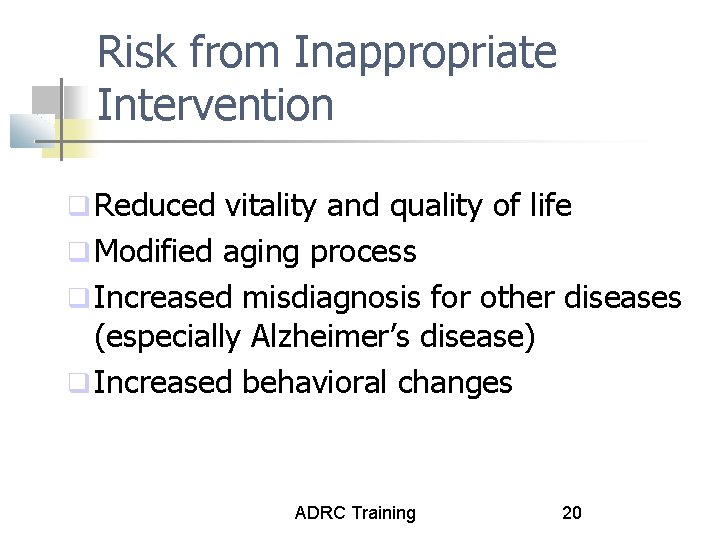
Risk from Inappropriate Intervention q Reduced vitality and quality of life q Modified aging process q Increased misdiagnosis for other diseases (especially Alzheimer’s disease) q Increased behavioral changes ADRC Training 20
Meeting the Needs of Aging Persons with Developmental Disabilities Cross Network Collaboration for Florida Age-Related Changes Everyone Experiences ADRC Training 21
Sensory Changes Affect the Older Adult q Reduced sensory acuity q Increased masking of sensory impairments q Reduced potential for quality of life and independence q Increased social isolation ADRC Training 22
How Is Hearing Affected by Aging? q Increased loss of high frequency sounds (children and females voices in particular) q Increased interference with hearing § Background sounds interfere with communication § Increased tinnitus – ringing in the ears ADRC Training 23
How is Vision Affected by Aging? q Increased glare (light reflection) sensitivity q Increased difficulty adjusting to reduced lighting q Increased difficulty with busy visual patterns ADRC Training 24
Effects of Hearing and Visual Impairments on Older People q Increased risk of falls q Decreased social interaction q Increased inappropriate behavior q Decreased verbal communication q Increased misdiagnosis of dementia ADRC Training 25
Other Age-related Changes in Older People q Reduced muscle mass by 15% § Increased risk of falls § Decreased ability for physical activities q Decreased thyroid function § Decreased body temperature § Increased symptoms of acute dementia ADRC Training 26
Other Age-related Changes in Older People q Reproductive system (male) § Enlarged prostate - reduced flow of urine and reduced ability to urinate q Reproductive system (female) § Decreased estrogen - menopause § Increased bone loss § Increased risk of depression § Increased risk of heart disease § Increased short-term memory impairment ADRC Training 27
Lesser Age-related Changes in Older People q IQ remains the same or increases q Personality remains the same q Ability to learn new skills remains the same q Long-term memory remains the same q Little change in memory recall ADRC Training 28
Meeting the Needs of Aging Persons with Developmental Disabilities Cross Network Collaboration for Florida Early Aging Changes Experienced by Adults with Down Syndrome and Cerebral Palsy ADRC Training 29
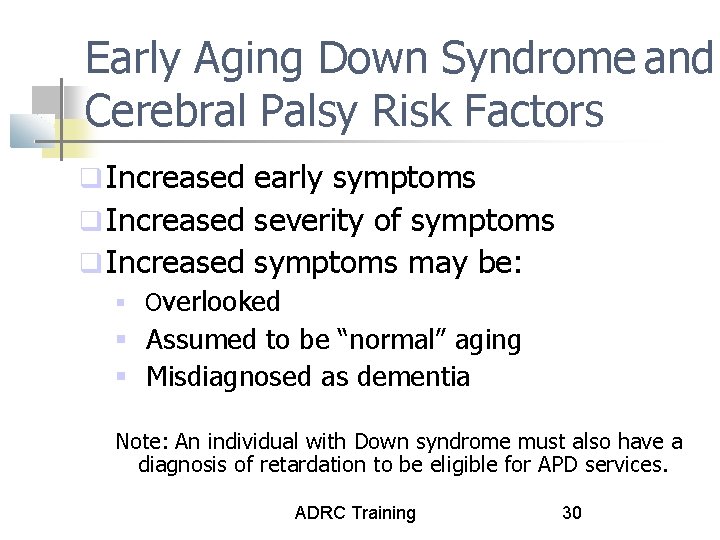
Early Aging Down Syndrome and Cerebral Palsy Risk Factors q Increased early symptoms q Increased severity of symptoms q Increased symptoms may be: § Overlooked § Assumed to be “normal” aging § Misdiagnosed as dementia Note: An individual with Down syndrome must also have a diagnosis of retardation to be eligible for APD services. ADRC Training 30
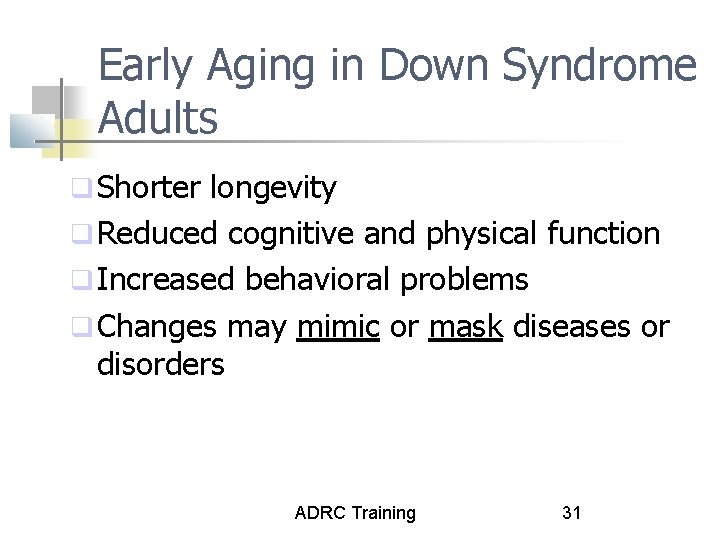
Early Aging in Down Syndrome Adults q Shorter longevity q Reduced cognitive and physical function q Increased behavioral problems q Changes may mimic or mask diseases or disorders ADRC Training 31
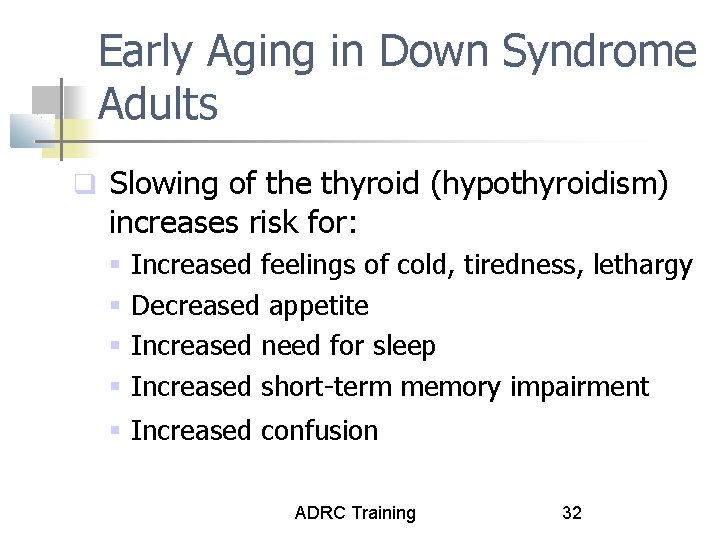
Early Aging in Down Syndrome Adults q Slowing of the thyroid (hypothyroidism) increases risk for: § § Increased feelings of cold, tiredness, lethargy Decreased appetite Increased need for sleep Increased short-term memory impairment § Increased confusion ADRC Training 32
Early Age-related Changes in Cerebral Palsy Adults q Decreased muscle strength after many years of no change q Increased risk for urinary tract infections and incontinence q Increased difficulty in swallowing q Reduced stamina q Increased fatigue ADRC Training 33
Meeting the Needs of Aging Persons with Developmental Disabilities Cross Network Collaboration for Florida Adverse Drug Reaction Risk Factors in Adults with Developmental Disabilities ADRC Training 34
Medication Risk Factors in Older Adults q Increased levels of medications in the blood for longer times q Increased use of multiple medications q Little understanding of medication interaction q Increased adverse drug reactions (ADRs) masking or mimicking dementia ADRC Training 35
Medication Risk Factors in Older Adults q Increased dosages of medications q Few studies of medication use in older adults with developmental disabilities q Few health care providers trained to identify adverse effects of medications ADRC Training 36
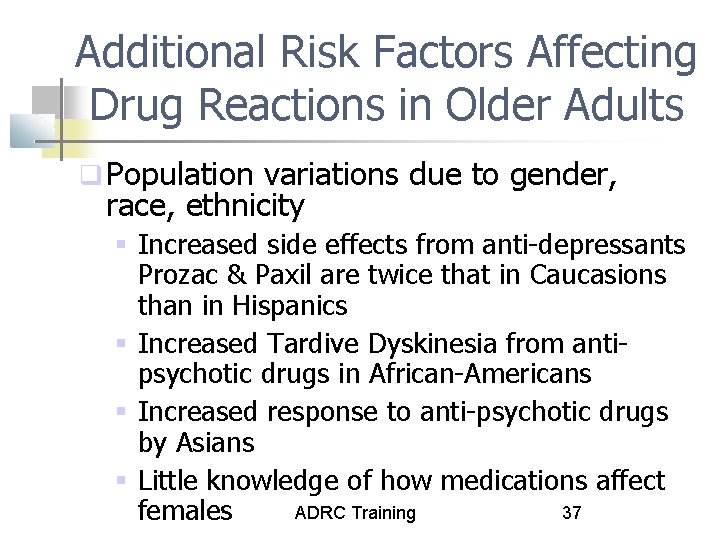
Additional Risk Factors Affecting Drug Reactions in Older Adults q Population variations due to gender, race, ethnicity § Increased side effects from anti-depressants Prozac & Paxil are twice that in Caucasions than in Hispanics § Increased Tardive Dyskinesia from antipsychotic drugs in African-Americans § Increased response to anti-psychotic drugs by Asians § Little knowledge of how medications affect ADRC Training 37 females
Additional Risk Factors Affecting Drug Reactions in Older Adults q Individual variations in response § Age-related differences q Disability specific variations in response q Older adults with developmental disabilities will “age into” medications with long-term use ADRC Training 38
Adverse Drug Reactions Affect Body Function q Examples of biological changes § Increased/decreased blood pressure § Increased urine retention or incontinence q Examples of behavioral changes § Increased risk for depression § Increased risk for paranoia ADRC Training 39
Adverse Drug Reactions Affect Body Function q Examples of neurological changes § Increased change in sleep patterns § Increased risk for seizures q Examples of decline in muscle coordination § Increased risk for muscle tremors § Decreased coordinated muscle movement ADRC Training 40
Adverse Drug Reactions That Mimic Dementia q Increased agitation q Increased anxiety q Increased behavioral changes q Increased decline in cognitive functioning ADRC Training 41
Adverse Drug Reactions That Mimic Dementia q Decreased communication skills q Increased disorientation to person, place or time q Increased loss of interest in normal activities ADRC Training 42
Adverse Drug Reactions That Mimic Dementia q Increased risk for confusion q Increased risk for delusions q Increased risk for depression, sadness q Increased risk for unexplained excitability q Increased risk for restlessness, wandering ADRC Training 43
Summary of Module 3 q Myths may affect how services are applied q Aging is experienced by everyone § Aging is an individual process § Influenced by genetics and lifestyle § Disabilities over-lay influences on aging ADRC Training 44
Summary of Module 3 q Increased risk of mimicking or masking diseases or disorders from early aging in adults with Down syndrome and cerebral palsy q Increased risk for adverse drug reactions that mimic or mask diseases ADRC Training 45
Group Discussion q Questions ADRC Training 46