
Meeting Purpose 1 Review the WVDOT TPM process

- Slides: 32
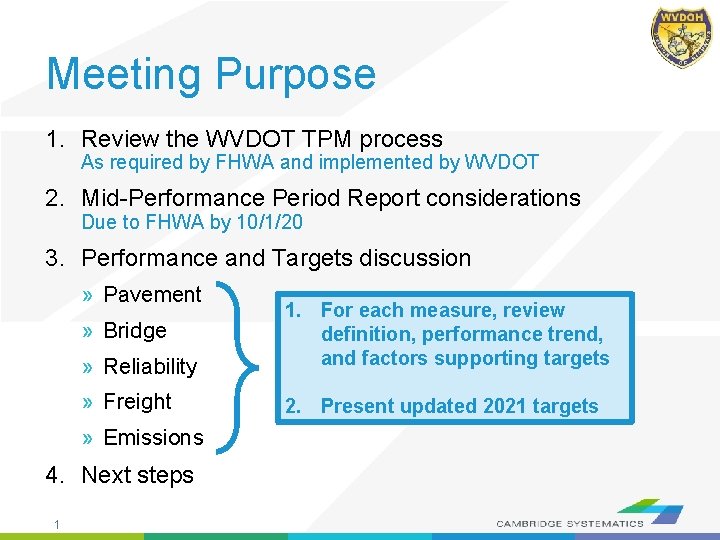
Meeting Purpose 1. Review the WVDOT TPM process As required by FHWA and implemented by WVDOT 2. Mid-Performance Period Report considerations Due to FHWA by 10/1/20 3. Performance and Targets discussion » Pavement » Reliability 1. For each measure, review definition, performance trend, and factors supporting targets » Freight 2. Present updated 2021 targets » Bridge » Emissions 4. Next steps 1
FHWA Transportation Performance Management Requirements Specific USDOT requirements specified through Federal code consistent with MAP-21 and the FAST Act and the WV response to date. 2
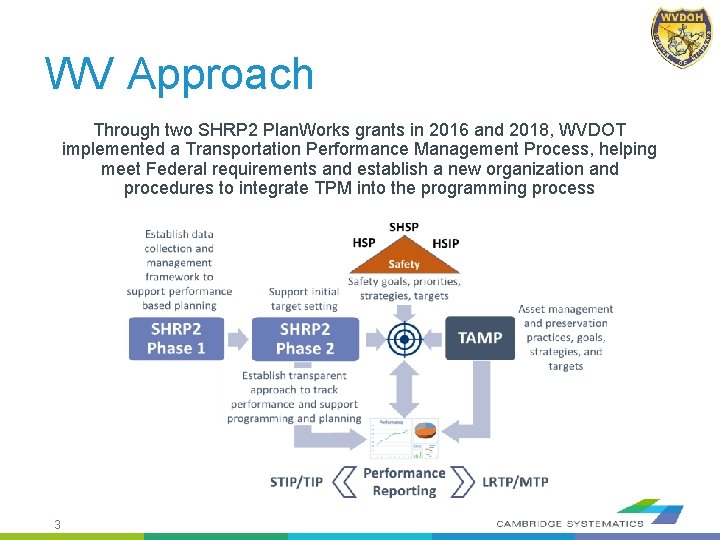
WV Approach Through two SHRP 2 Plan. Works grants in 2016 and 2018, WVDOT implemented a Transportation Performance Management Process, helping meet Federal requirements and establish a new organization and procedures to integrate TPM into the programming process 3
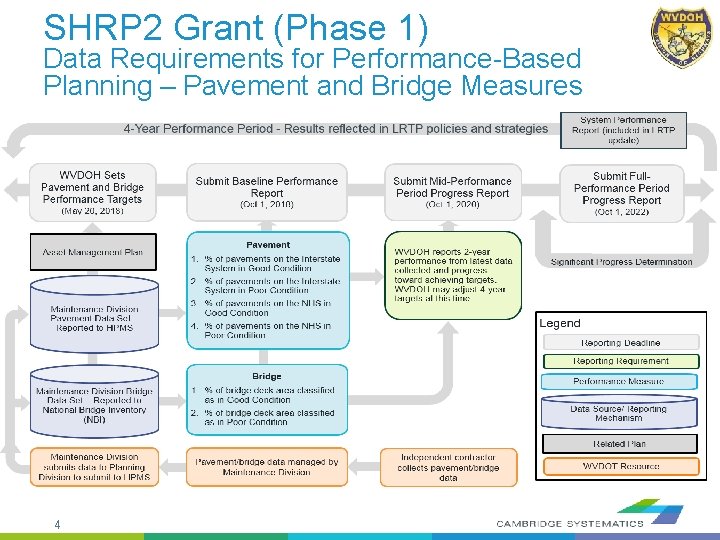
SHRP 2 Grant (Phase 1) Data Requirements for Performance-Based Planning – Pavement and Bridge Measures 4
FHWA Performance Measures Summary All public roads DOH to set targets and report performance annually through HSIP Interstate System and NHS Set targets and report performance biennially, submit performance data (NBI/HPMS) annually Interstate System and NHS DOH to set targets and report performance biennially, and submit performance data (HPMS/CMAQ) annually Focus of Mid-Performance Period Report 5
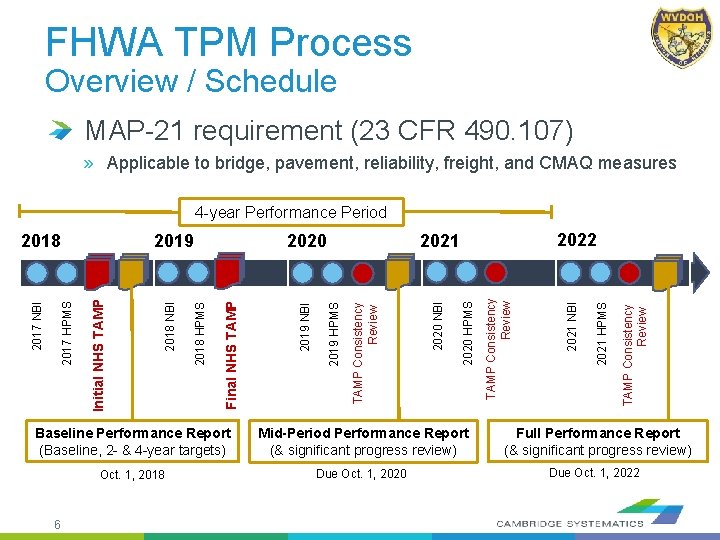
FHWA TPM Process Overview / Schedule MAP-21 requirement (23 CFR 490. 107) » Applicable to bridge, pavement, reliability, freight, and CMAQ measures 4 -year Performance Period TAMP Consistency Review 2021 HPMS 2021 NBI TAMP Consistency Review 2020 HPMS 2020 NBI TAMP Consistency Review 2019 HPMS 2019 NBI Final NHS TAMP 2018 HPMS 2018 NBI 2022 2021 2020 2019 Initial NHS TAMP 2017 HPMS 2017 NBI 2018 Baseline Performance Report (Baseline, 2 - & 4 -year targets) Mid-Period Performance Report (& significant progress review) Full Performance Report (& significant progress review) Oct. 1, 2018 Due Oct. 1, 2020 Due Oct. 1, 2022 6
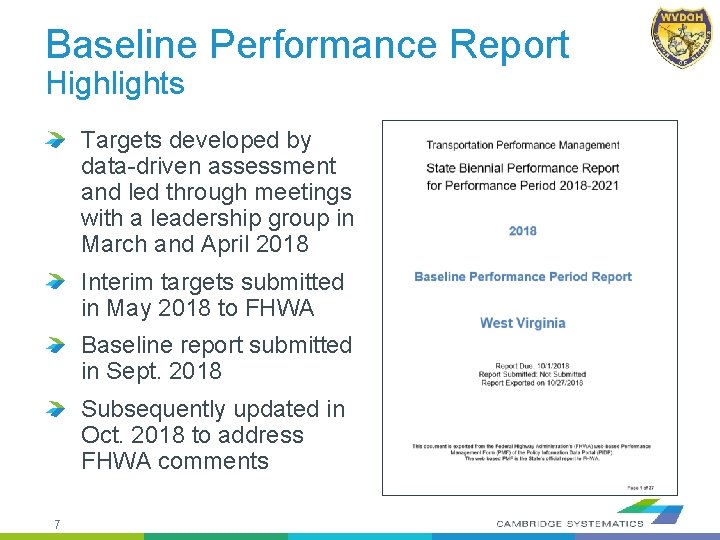
Baseline Performance Report Highlights Targets developed by data-driven assessment and led through meetings with a leadership group in March and April 2018 Interim targets submitted in May 2018 to FHWA Baseline report submitted in Sept. 2018 Subsequently updated in Oct. 2018 to address FHWA comments 7
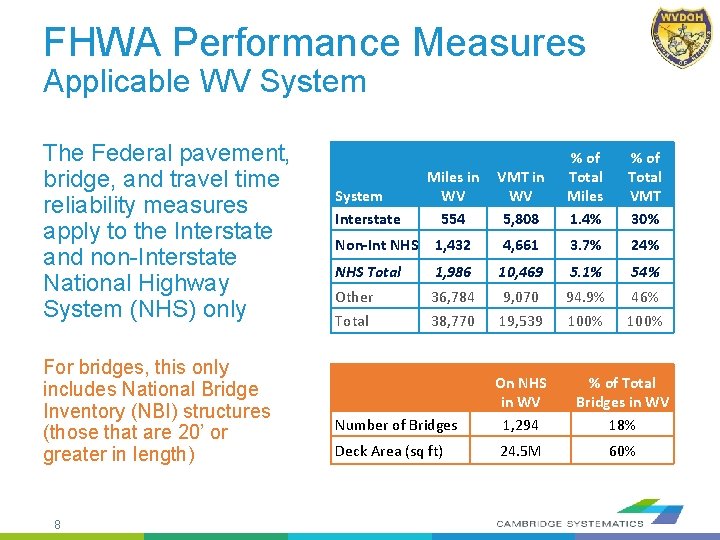
FHWA Performance Measures Applicable WV System The Federal pavement, bridge, and travel time reliability measures apply to the Interstate and non-Interstate National Highway System (NHS) only For bridges, this only includes National Bridge Inventory (NBI) structures (those that are 20’ or greater in length) 8 Miles in WV 554 VMT in WV 5, 808 % of Total Miles 1. 4% Non-Int NHS 1, 432 4, 661 3. 7% 24% NHS Total 1, 986 10, 469 5. 1% 54% Other 36, 784 9, 070 94. 9% 46% Total 38, 770 19, 539 100% System Interstate % of Total VMT 30% Number of Bridges On NHS in WV 1, 294 % of Total Bridges in WV 18% Deck Area (sq ft) 24. 5 M 60%
Mid-Performance Period Report Considerations Requirements, data, planning, and programming considerations for FHWA performance measure reporting and target setting. 9
Mid-Performance Period Report General Requirements Serves as a performance management “check-in”: » Effectiveness of the investment strategies developed and documented in the TAMP » Progress made toward 2 -year (2019) targets » Review of 4 -year (2021) targets established in 2018, and option to adjust » Accomplishments and planned activities through 2021 to make progress toward 4 -year targets » Optional discussion of extenuating circumstances (if progress toward 2 -year targets not made) 10
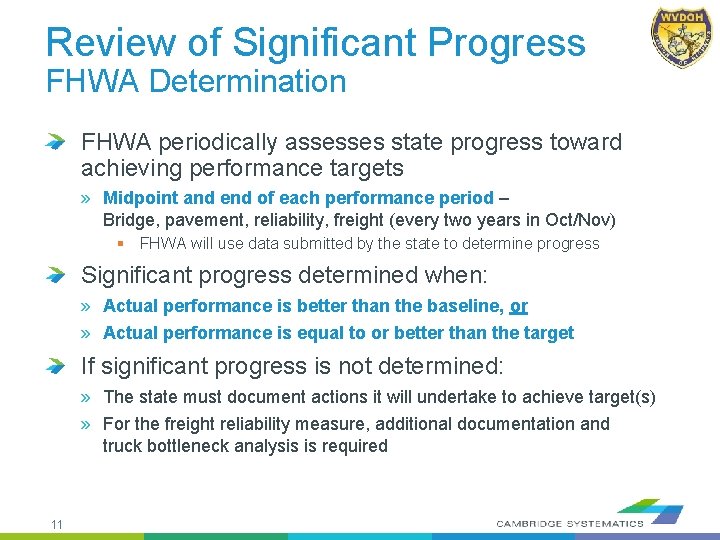
Review of Significant Progress FHWA Determination FHWA periodically assesses state progress toward achieving performance targets » Midpoint and end of each performance period – Bridge, pavement, reliability, freight (every two years in Oct/Nov) § FHWA will use data submitted by the state to determine progress Significant progress determined when: » Actual performance is better than the baseline, or » Actual performance is equal to or better than the target If significant progress is not determined: » The state must document actions it will undertake to achieve target(s) » For the freight reliability measure, additional documentation and truck bottleneck analysis is required 11
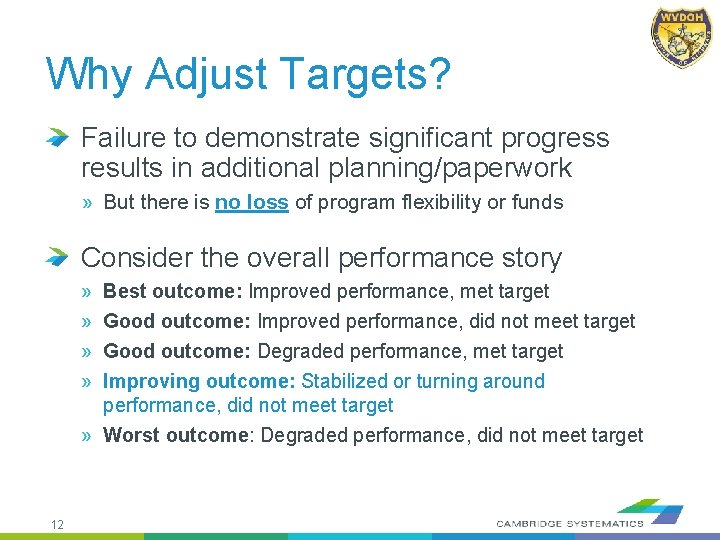
Why Adjust Targets? Failure to demonstrate significant progress results in additional planning/paperwork » But there is no loss of program flexibility or funds Consider the overall performance story » » Best outcome: Improved performance, met target Good outcome: Improved performance, did not meet target Good outcome: Degraded performance, met target Improving outcome: Stabilized or turning around performance, did not meet target » Worst outcome: Degraded performance, did not meet target 12
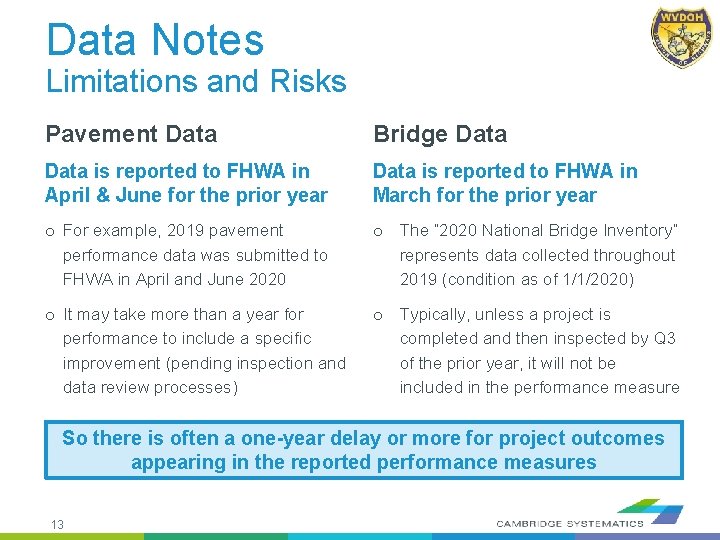
Data Notes Limitations and Risks Pavement Data Bridge Data is reported to FHWA in April & June for the prior year Data is reported to FHWA in March for the prior year o For example, 2019 pavement performance data was submitted to FHWA in April and June 2020 o The “ 2020 National Bridge Inventory” represents data collected throughout 2019 (condition as of 1/1/2020) o It may take more than a year for performance to include a specific improvement (pending inspection and data review processes) o Typically, unless a project is completed and then inspected by Q 3 of the prior year, it will not be included in the performance measure So there is often a one-year delay or more for project outcomes appearing in the reported performance measures 13
Performance and Targets Discussion Measure definitions, performance trends, target considerations, and target recommendations for the performance measures required in the Mid-Performance Period Report. 14
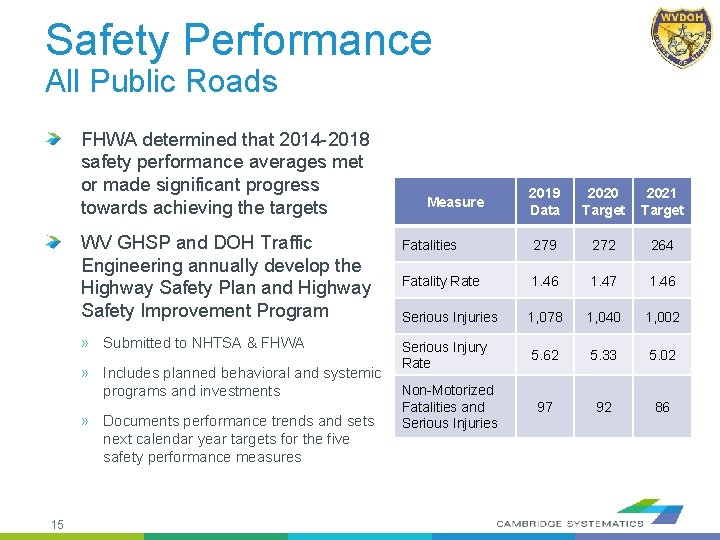
Safety Performance All Public Roads FHWA determined that 2014 -2018 safety performance averages met or made significant progress towards achieving the targets 2019 Data 2020 Target 2021 Target WV GHSP and DOH Traffic Engineering annually develop the Highway Safety Plan and Highway Safety Improvement Program Fatalities 279 272 264 Fatality Rate 1. 46 1. 47 1. 46 Serious Injuries 1, 078 1, 040 1, 002 » Submitted to NHTSA & FHWA Serious Injury Rate 5. 62 5. 33 5. 02 97 92 86 » Includes planned behavioral and systemic programs and investments » Documents performance trends and sets next calendar year targets for the five safety performance measures 15 Measure Non-Motorized Fatalities and Serious Injuries
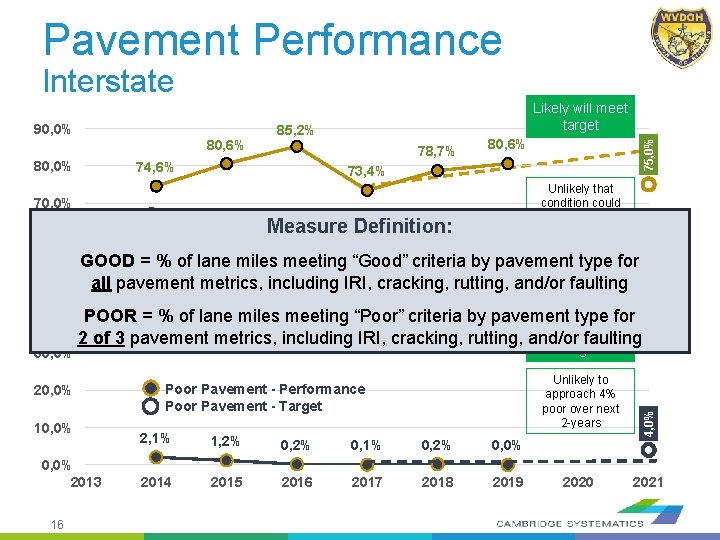
Pavement Performance Interstate 80, 6% 80, 0% Unlikely that condition could decrease by >5% good in 2 -years GOOD = % of lane miles meeting “Good” criteria by pavement type for all pavement metrics, including IRI, cracking, rutting, and/or faulting POOR = % of lane miles meeting “Poor” criteria by pavement type for Likely will meet 2 of 3 pavement metrics, including IRI, cracking, rutting, and/or faulting 20, 0% 10, 0% 2013 16 73, 4% target Unlikely to approach 4% poor over next 2 -years Poor Pavement - Performance Poor Pavement - Target 2, 1% 1, 2% 0, 1% 0, 2% 0, 0% 2014 2015 2016 2017 2018 2019 2020 4, 0% 30, 0% 80, 6% Good Pavement - Performance Definition: Good Pavement. Measure - Target 60, 0% 40, 0% 78, 7% 74, 6% 70, 0% 50, 0% 85, 2% 75, 0% 90, 0% Likely will meet target 2021
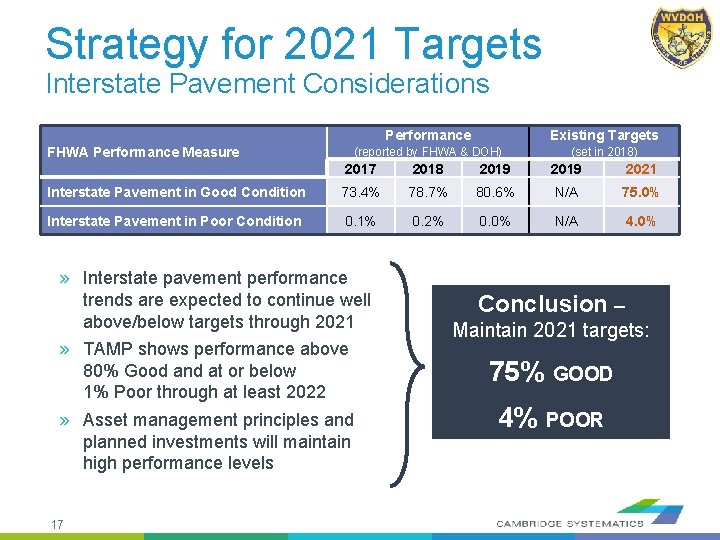
Strategy for 2021 Targets Interstate Pavement Considerations FHWA Performance Measure Performance Existing Targets (reported by FHWA & DOH) (set in 2018) 2017 2018 2019 2021 Interstate Pavement in Good Condition 73. 4% 78. 7% 80. 6% N/A 75. 0% Interstate Pavement in Poor Condition 0. 1% 0. 2% 0. 0% N/A 4. 0% » Interstate pavement performance trends are expected to continue well above/below targets through 2021 » TAMP shows performance above 80% Good and at or below 1% Poor through at least 2022 » Asset management principles and planned investments will maintain high performance levels 17 Conclusion – Maintain 2021 targets: 75% GOOD 4% POOR
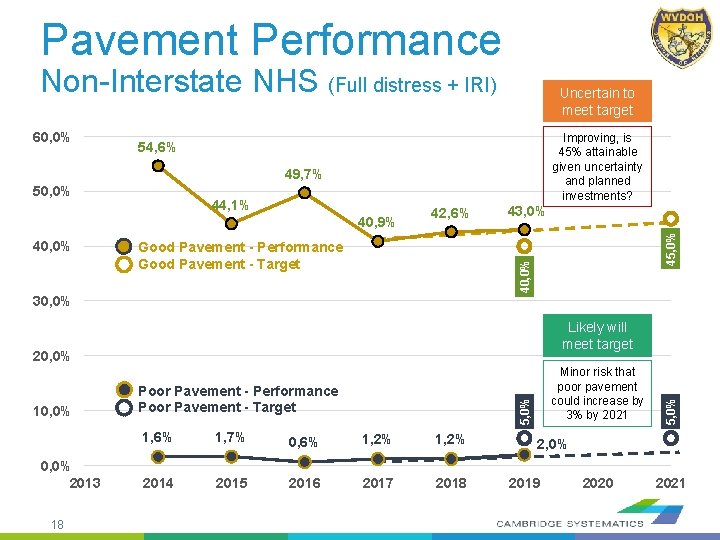
Pavement Performance Non-Interstate NHS (Full distress + IRI) 60, 0% Uncertain to meet target Improving, is 45% attainable given uncertainty and planned investments? 54, 6% 49, 7% 44, 1% 40, 9% Good Pavement - Performance Good Pavement - Target 43, 0% 40, 0% 42, 6% 45, 0% 50, 0% 30, 0% 20, 0% 2013 18 5, 0% 10, 0% Poor Pavement - Performance Poor Pavement - Target Minor risk that poor pavement could increase by 3% by 2021 1, 6% 1, 7% 0, 6% 1, 2% 2014 2015 2016 2017 2018 5, 0% Likely will meet target 2, 0% 2019 2020 2021
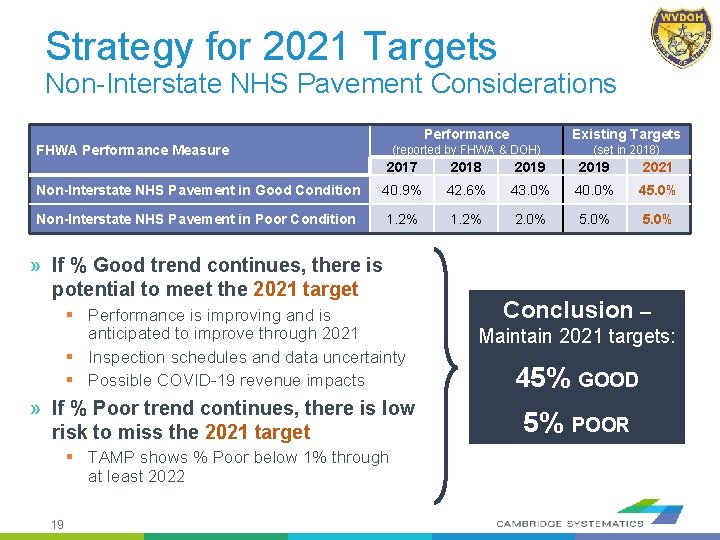
Strategy for 2021 Targets Non-Interstate NHS Pavement Considerations FHWA Performance Measure Performance Existing Targets (reported by FHWA & DOH) (set in 2018) 2017 2018 2019 2021 Non-Interstate NHS Pavement in Good Condition 40. 9% 42. 6% 43. 0% 40. 0% 45. 0% Non-Interstate NHS Pavement in Poor Condition 1. 2% 2. 0% 5. 0% » If % Good trend continues, there is potential to meet the 2021 target § Performance is improving and is anticipated to improve through 2021 § Inspection schedules and data uncertainty § Possible COVID-19 revenue impacts » If % Poor trend continues, there is low risk to miss the 2021 target § TAMP shows % Poor below 1% through at least 2022 19 Conclusion – Maintain 2021 targets: 45% GOOD 5% POOR
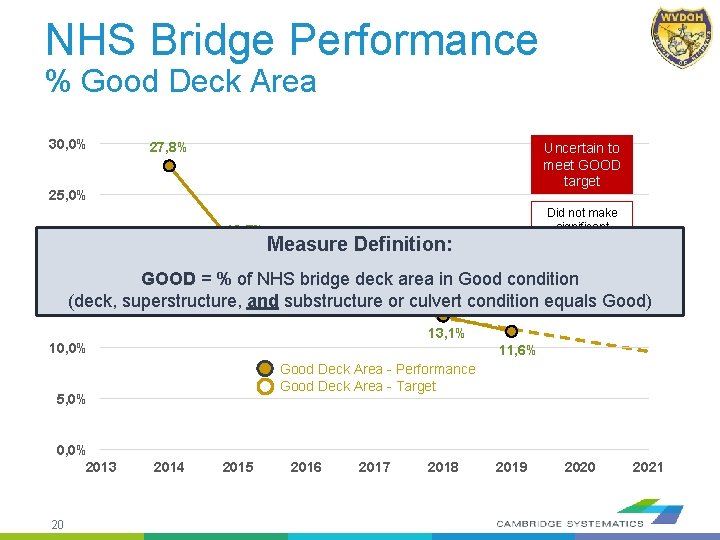
NHS Bridge Performance % Good Deck Area 27, 8% Uncertain to meet GOOD target 25, 0% 20, 0% Measure Definition: 14, 0% 19, 7% Did not make significant progress in 2019 and continuing condition downward trend 16, 0% 30, 0% GOOD = % of NHS 15, 3% bridge 13, 9% deck area in Good 15, 0% (deck, superstructure, and substructure or culvert condition equals Good) 13, 1% 10, 0% 11, 6% Good Deck Area - Performance Good Deck Area - Target 5, 0% 0, 0% 2013 20 2014 2015 2016 2017 2018 2019 2020 2021
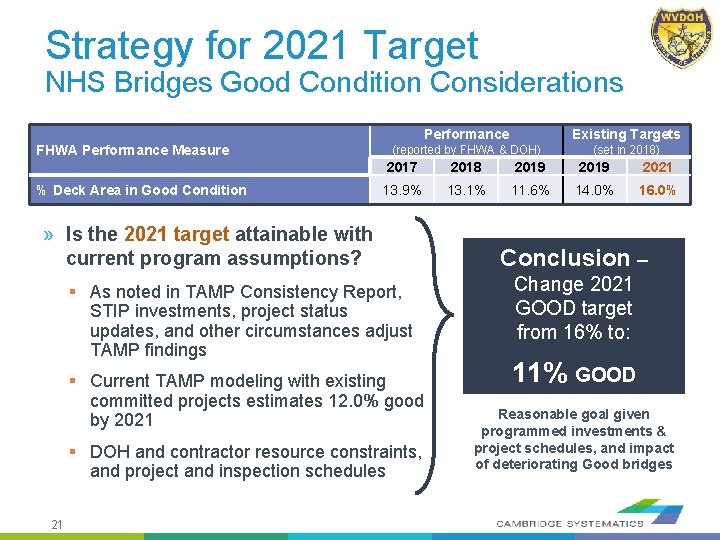
Strategy for 2021 Target NHS Bridges Good Condition Considerations FHWA Performance Measure % Deck Area in Good Condition Performance Existing Targets (reported by FHWA & DOH) (set in 2018) 2017 2018 2019 2021 13. 9% 13. 1% 11. 6% 14. 0% 16. 0% » Is the 2021 target attainable with current program assumptions? § As noted in TAMP Consistency Report, STIP investments, project status updates, and other circumstances adjust TAMP findings § Current TAMP modeling with existing committed projects estimates 12. 0% good by 2021 § DOH and contractor resource constraints, and project and inspection schedules 21 Conclusion – Change 2021 GOOD target from 16% to: 11% GOOD Reasonable goal given programmed investments & project schedules, and impact of deteriorating Good bridges
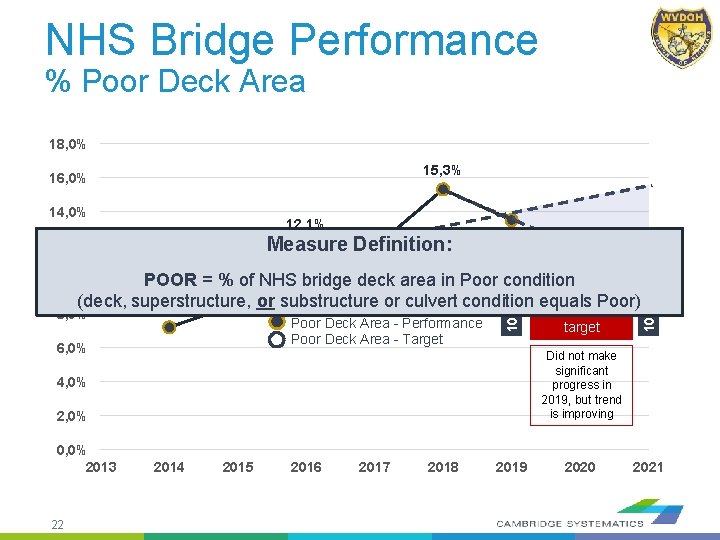
NHS Bridge Performance % Poor Deck Area 18, 0% 15, 3% 16, 0% 14, 0% 12, 1% Measure Definition: 12, 0% 13, 5% 11, 9% POOR = % of NHS bridge deck area in Poor condition 8, 6% Uncertain to (deck, superstructure, or substructure or culvert condition equals Poor) 7, 2% meet POOR Poor Deck Area - Performance Poor Deck Area - Target 6, 0% Did not make significant progress in 2019, but trend is improving 4, 0% 2, 0% 0, 0% 2013 22 target 10, 0% 8, 0% 10, 0% 2014 2015 2016 2017 2018 2019 2020 2021
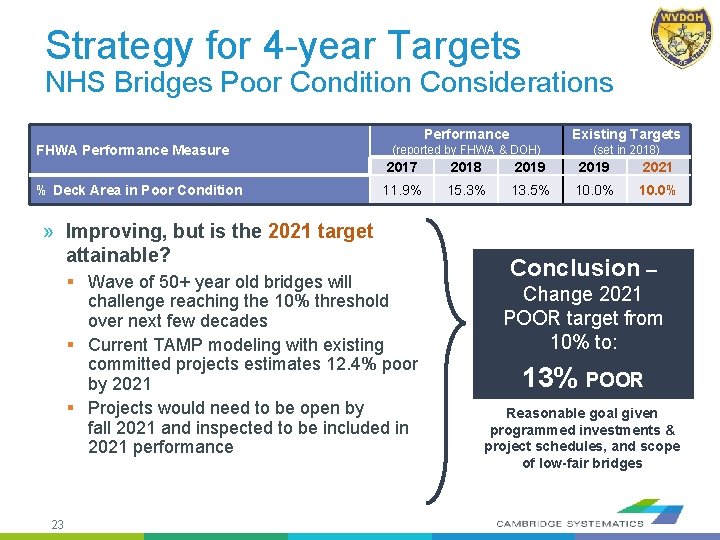
Strategy for 4 -year Targets NHS Bridges Poor Condition Considerations FHWA Performance Measure % Deck Area in Poor Condition Performance Existing Targets (reported by FHWA & DOH) (set in 2018) 2017 2018 2019 2021 11. 9% 15. 3% 13. 5% 10. 0% » Improving, but is the 2021 target attainable? § Wave of 50+ year old bridges will challenge reaching the 10% threshold over next few decades § Current TAMP modeling with existing committed projects estimates 12. 4% poor by 2021 § Projects would need to be open by fall 2021 and inspected to be included in 2021 performance 23 Conclusion – Change 2021 POOR target from 10% to: 13% POOR Reasonable goal given programmed investments & project schedules, and scope of low-fair bridges
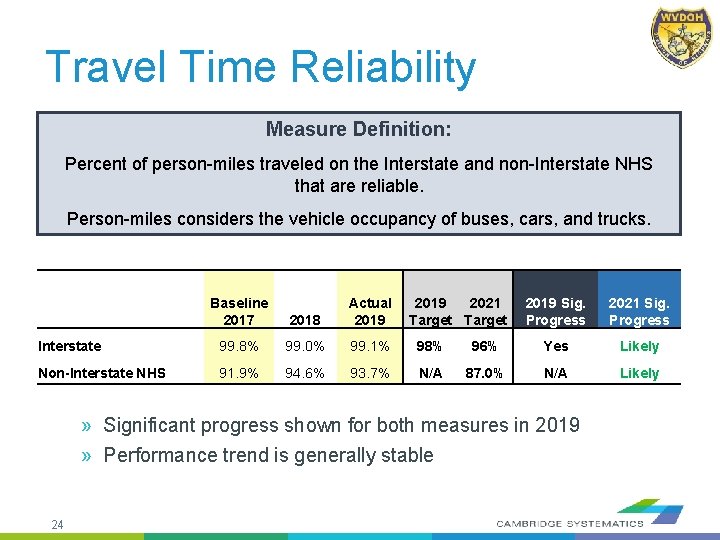
Travel Time Reliability Measure Definition: Percent of person-miles traveled on the Interstate and non-Interstate NHS that are reliable. Person-miles considers the vehicle occupancy of buses, cars, and trucks. Baseline 2017 2018 Actual 2019 2021 Target Interstate 99. 8% 99. 0% 99. 1% 98% Non-Interstate NHS 91. 9% 94. 6% 93. 7% N/A 2019 Sig. Progress 2021 Sig. Progress 96% Yes Likely 87. 0% N/A Likely » Significant progress shown for both measures in 2019 » Performance trend is generally stable 24
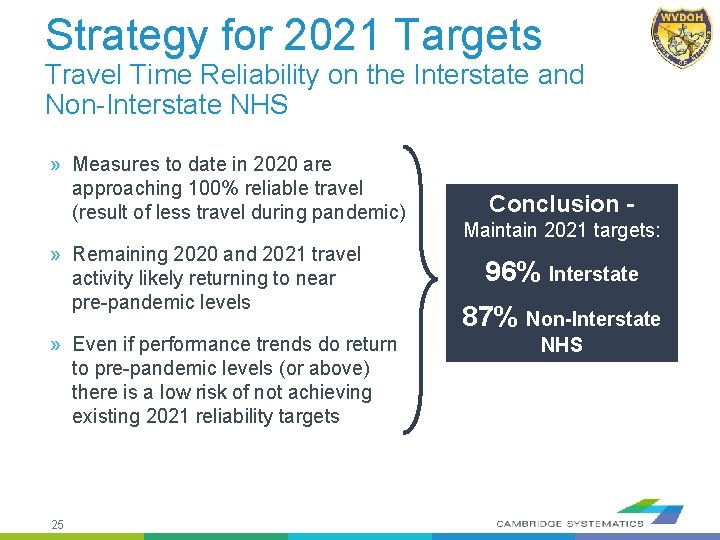
Strategy for 2021 Targets Travel Time Reliability on the Interstate and Non-Interstate NHS » Measures to date in 2020 are approaching 100% reliable travel (result of less travel during pandemic) » Remaining 2020 and 2021 travel activity likely returning to near pre-pandemic levels » Even if performance trends do return to pre-pandemic levels (or above) there is a low risk of not achieving existing 2021 reliability targets 25 Conclusion Maintain 2021 targets: 96% Interstate 87% Non-Interstate NHS
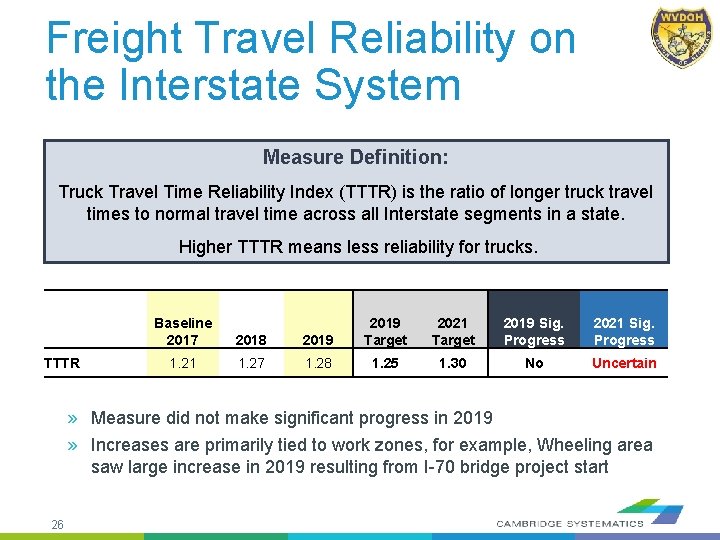
Freight Travel Reliability on the Interstate System Measure Definition: Truck Travel Time Reliability Index (TTTR) is the ratio of longer truck travel times to normal travel time across all Interstate segments in a state. Higher TTTR means less reliability for trucks. TTTR Baseline 2017 2018 1. 21 1. 27 2019 Target 2021 Target 2019 Sig. Progress 2021 Sig. Progress 1. 28 1. 25 1. 30 No Uncertain » Measure did not make significant progress in 2019 » Increases are primarily tied to work zones, for example, Wheeling area saw large increase in 2019 resulting from I-70 bridge project start 26
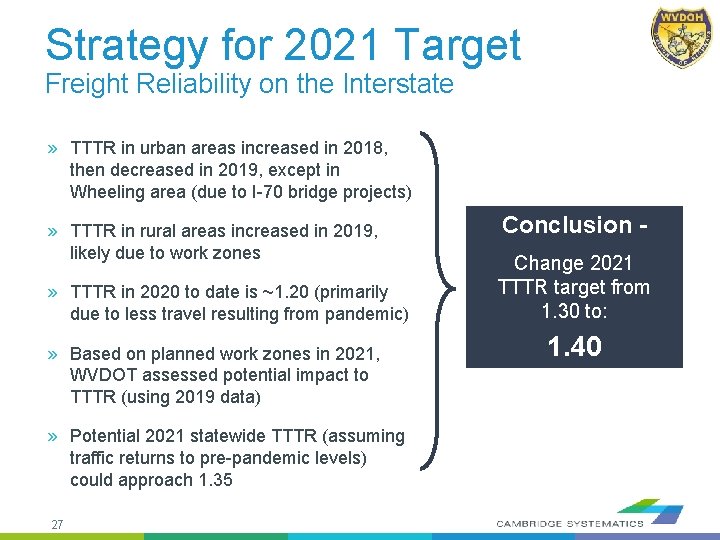
Strategy for 2021 Target Freight Reliability on the Interstate » TTTR in urban areas increased in 2018, then decreased in 2019, except in Wheeling area (due to I-70 bridge projects) » TTTR in rural areas increased in 2019, likely due to work zones » TTTR in 2020 to date is ~1. 20 (primarily due to less travel resulting from pandemic) » Based on planned work zones in 2021, WVDOT assessed potential impact to TTTR (using 2019 data) » Potential 2021 statewide TTTR (assuming traffic returns to pre-pandemic levels) could approach 1. 35 27 Conclusion Change 2021 TTTR target from 1. 30 to: 1. 40
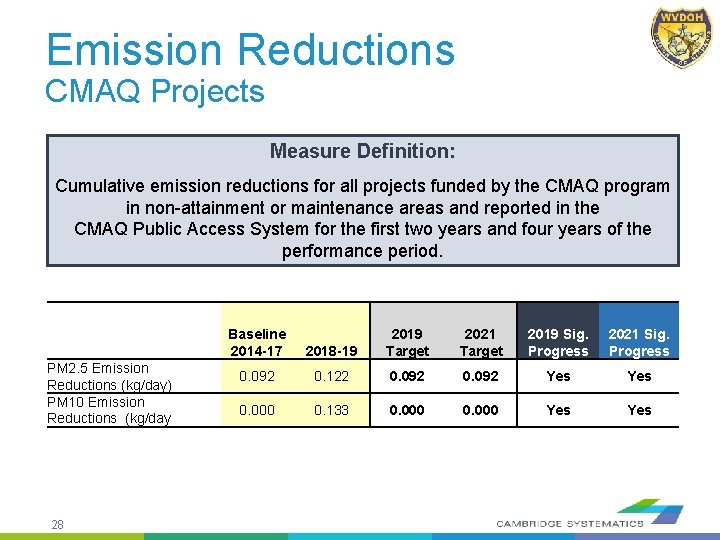
Emission Reductions CMAQ Projects Measure Definition: Cumulative emission reductions for all projects funded by the CMAQ program in non-attainment or maintenance areas and reported in the CMAQ Public Access System for the first two years and four years of the performance period. PM 2. 5 Emission Reductions (kg/day) PM 10 Emission Reductions (kg/day 28 Baseline 2014 -17 2018 -19 2019 Target 2021 Target 2019 Sig. Progress 2021 Sig. Progress 0. 092 0. 122 0. 092 Yes 0. 000 0. 133 0. 000 Yes
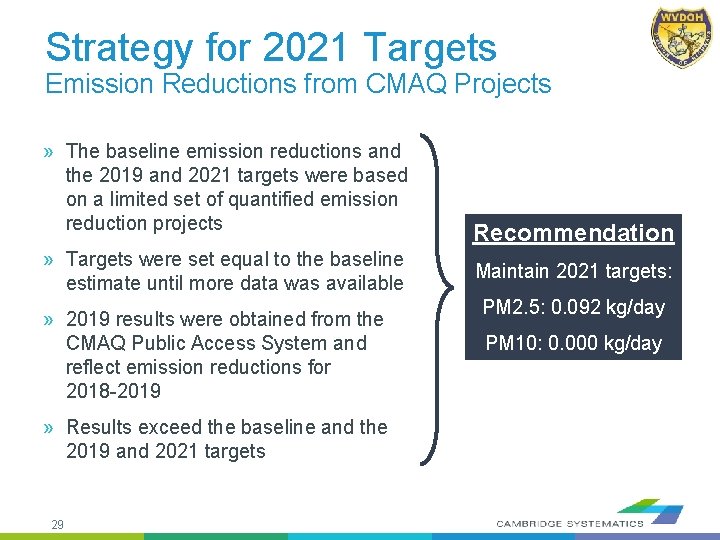
Strategy for 2021 Targets Emission Reductions from CMAQ Projects » The baseline emission reductions and the 2019 and 2021 targets were based on a limited set of quantified emission reduction projects » Targets were set equal to the baseline estimate until more data was available » 2019 results were obtained from the CMAQ Public Access System and reflect emission reductions for 2018 -2019 » Results exceed the baseline and the 2019 and 2021 targets 29 Recommendation Maintain 2021 targets: PM 2. 5: 0. 092 kg/day PM 10: 0. 000 kg/day
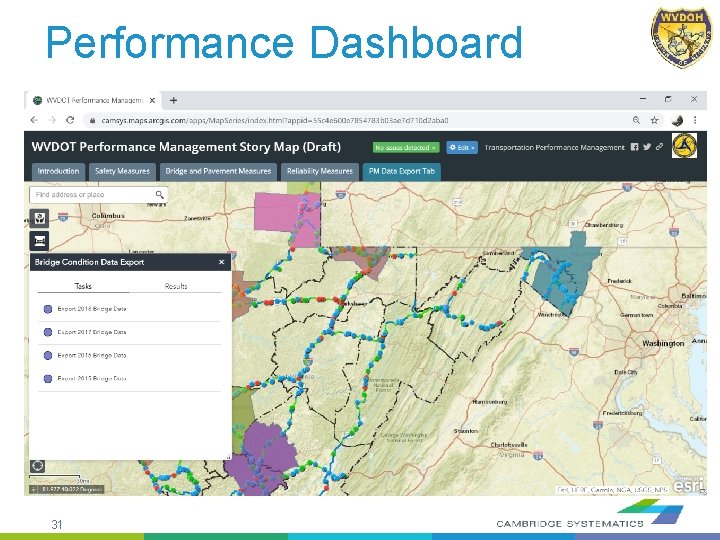
Ongoing Efforts Performance management is a continuous process » Performance Management Data Dashboard – share Federal measures and other statewide measures on a regular (annual) basis with MPOs and Districts » Trade-off Tool – based on scenarios from the pavement and bridge management systems, enable simple system level trade-off analysis between investment programs » Preparing for the next reporting/target setting cycle (2022) » Performance information also included in current planning and programming documents § Statewide long-range transportation plan system performance report § References in STIP and TIP amendments and TAMP updates 30
Performance Dashboard 31
Next Steps Complete Mid Performance Period Report » Incorporate outcome of today’s discussion » Submit to FHWA by October 1, 2020 Share performance data and targets with MPOs » MPOs incorporate into metropolitan long-range transportation plans and TIPs » MPOs must adopt updated targets and submit to DOH (within 180 days) Expand Performance Dashboard and continue trade-off tool testing 32