
MEETING 1 AN INTRODUCTION TO PRONUNCIATION Good pronunciation
- Slides: 9
MEETING 1 AN INTRODUCTION TO PRONUNCIATION
Good pronunciation is very important for good spoken communication. However you do not have to speak like a native English speaker to have good pronunciation. There are many different natural varieties of English pronunciation in Britain and around the world. The activities and resources in this lesson are designed to give an introduction to certain features of standard British English pronunciation, which is sometimes called Received Pronunciation (RP).
Below are some examples of words which are often pronounced differently in Britain and in the US. The usual British pronunciation is shown first, followed by the usual American pronunciation in brackets (there are of course many regional variations, so these differences may not apply in all areas): Ballet: ball-ay (ba-llay): stress is on the first part in Britain, but on the second part in America Clerk: Clark (clerk): rhymes with 'park' in Britain, but rhymes with 'work' in America Lever: lever (lever): rhymes with 'fever' in Britain, but it is often pronounced to rhyme with 'never' in America
Privacy: pri-va-see (pry-va-see): the 'i' is short in Britain (like the 'i' of 'image'), but long in America (like the 'i' of 'idea') Schedule: shed-yool (sked-yool): 'sch' is pronounced like 'sh' in 'ship' in Britain, but like 'sk' in 'skip' in America Tomato: to-maa-tow (to-may-tow): 'ma' is like the 'ma' of 'mark' in Britain, but like the 'ma' of 'make' in America; rhymes with potato in America, but not in Britain Vase: vaaz (vayz): rhymes with Mars in Britain, but with maze in America
The vowel sounds in American English are often quite different from those in British English, especially the "o" and "a" sounds, and the "r" at the end of a word. There are of course many regional variations. When compared with the sounds of Oxford English, the most obvious pronunciation differences are with people who come from the west and south of the US (for example: California or Texas), and are less obvious for people from the east or north (for example: New York or Washington). Ask a British and American person to say "bottle of water", and compare the "o" sound of "bottle" and the "a" and "r" sounds of "water".
When writing English we use the 26 letters of the alphabet. However, when speaking there are roughly 44 different sounds in English. These sounds are called phonemes. If you're concentrating on the sounds of English, you need 44 characters to represent them all. One way of doing this is to use the 'phonemic alphabet', which has some extra characters to represent the sounds in English for which there is no clear equivalent letter or letters.
Writing with phonemes You can use phonemes to write out the pronunciation of words and in many dictionaries for English learners you will see the pronunciation written out. To show that what is written are phonemes (sounds) and not letters phonemic transcriptions are written between slashes, / /. For example, the pronunciation of the word 'pet' is written: /pet/ There are different kinds of sounds, consonants and vowels.
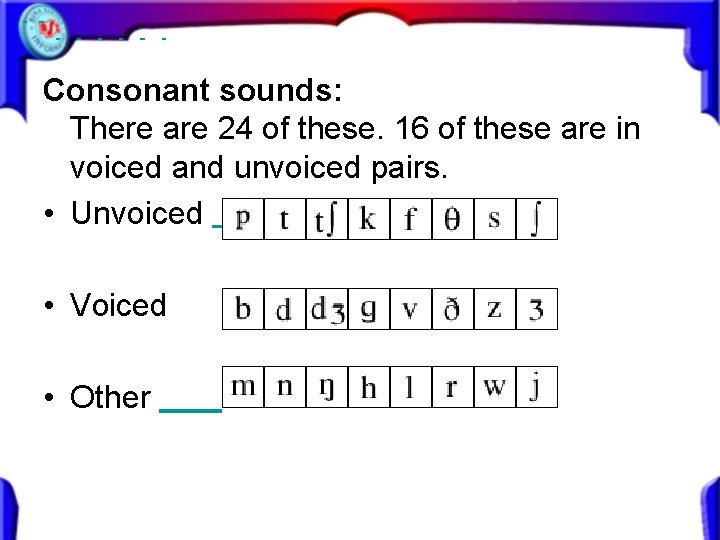
Consonant sounds: There are 24 of these. 16 of these are in voiced and unvoiced pairs. • Unvoiced • Voiced • Other
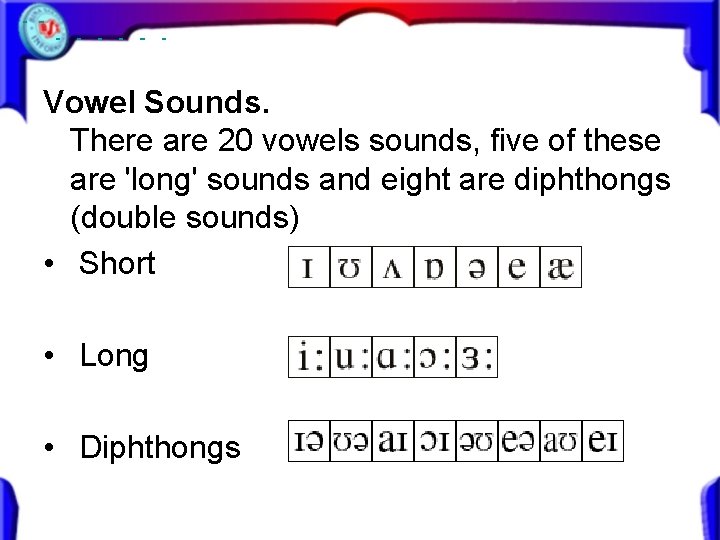
Vowel Sounds. There are 20 vowels sounds, five of these are 'long' sounds and eight are diphthongs (double sounds) • Short • Long • Diphthongs