
MEET THE TEAM Tim Newquist Eric Barkyoumb Andy
MEET THE TEAM Tim Newquist Eric Barkyoumb & Andy Western Fiesta Bowl Event Chair and Assistant Chairs Marcus Sipolt Fiesta Bowl Event Board of Directors Liaison Angel Guzman & Brittany Gilbert Fiesta Bowl Event Staff
MEET THE TEAM Bob Witwer & Keith Hughes Honeywell Hope Parker, Lauren Preble, & Shane Bycott ASU Polytechnic Campus Ira A. Fulton Schools of Engineering
PRIMARY MISSION OVERVIEW BRAND NEW MISSION FOR 2017! • The primary purpose of the Phobos Logistics Mission is to: • Provide a sustainable base for a colony of 24 people in 10 years • Provide a written description of the landing site, sequence of launches and sequence of construction of the Phobos Base
SECONDARY MISSION OVERVIEW The secondary logistics mission is to: • Develop an infrastructure to support Command, Control, and Communication (C 3) for robotics and humans on Mars. • Provide a well written description of the needed infrastructure on Phobos (facilities, equipment, etc. ) • Provide a written description of the location of the C 3 infrastructure including a description of why the location was selected • Provide a well written description of the crew skills, sequence of launches, and sequence of construction for the C 3 relative to the primary mission
HOW TO ENTER • Each team must submit: • A team must consist of: • Three to five students • Application • Team name • Students must be in grades fifth through eighth • Students’ names and coaches names • Can be a mix of grade levels • T-Shirt size for each student and coach • Team photograph (optional) • Media release forms DEADLINE TO APPLY: Friday, November 25, 2016
PRELIMINARY COMPETITION • Teams can choose from three dates: • Monday, February 6 th • Tuesday, February 7 th • Wednesday, February 8 th • Competition begins at 9 am and concludes at approximately 4 pm • Registration opens at 8 am • Day will include: • Registration • We will do our best to accommodate your first choice • Judging • Teams will be notified of their competition date in December • Lunch • Entertainment • Awards and Finalists
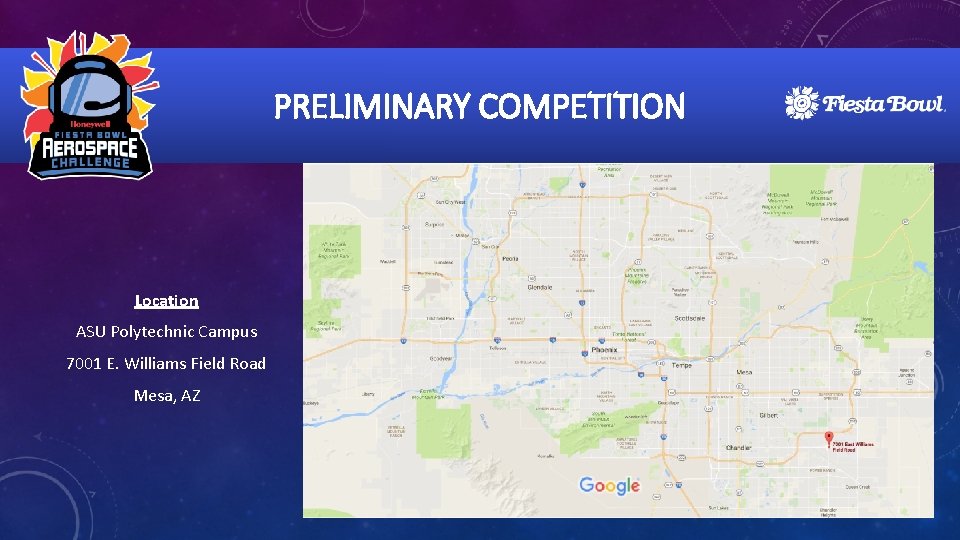
PRELIMINARY COMPETITION Location ASU Polytechnic Campus 7001 E. Williams Field Road Mesa, AZ
CONTEST OVERVIEW Each project should include: • Physical model • One 1 -meter project base • Module should fit in an 80 cm cube • Mission patch • Should include the team name, mission number and team member names • Must not exceed 30 cm in diameter • Presentation and display board – Summary of each category and project schedule • Written report including how the international Phobos Base will operate as a society and evolve as the Phobos base is constructed • Expense receipts (not to exceed $50)
CONTEST OVERVIEW • Project: Construct a scale model of an International Logistics Mission to colonize Phobos, a moon of Mars • Purpose: • Develop a plan to establish a sustainable base on Phobos with minimum support from Earth • Develop an infrastructure to support Command, Control, and Communication (C 3) for robotics and humans on Mars • Base must support a crew of 24 people within 10 years supported by nine launches per year from Earth • Each launch can transport six people or cargo in a module 4. 5 -meter diameter fairing with a length of 10 m. No mix or match. The maximum cargo weight per launch is 30 metric-tons
PROJECT REQUIREMENTS Physical Presentation • Each team should submit a physical model. The 3 -D model should be no larger than: • 1 x 1 meter square project base, module should fit in an 80 x 80 cm cube • Should include the following elements: • Model and base must not exceed the size requirements indicated above • Interior design & scale drawings (metric measurements) • Indication of time-phasing of base per year • Mission patch (the team name, mission number and team member names must not exceed 30 cm in diameter) • Phobos Base name • Display board – summary of each category and project schedule
PROJECT REQUIREMENTS Base Design Requirements • The physical model and written report should describe an International Phobos Base including the following instructions: • Habitation modules • Recreation modules • Power sources • Landing and launch site • Emergency plans • Food production and storage modules • Secondary mission support modules
PROJECT REQUIREMENTS Physiological Factors • Design should take into consideration factors necessary for human comfort and existence. Keep in mind that Earth-based support must be within the project constraints • Provide written descriptions of the following areas and factor these areas into your design and describe how they will be maintained through the construction of your base: • Air • Temperature • Gravity • Circadian rhythm • Food • Shielding • Water • Location • Waste
PROJECT REQUIREMENTS Consideration needs to be given on how the International Phobos Base will operate as a society and evolve as the Phobos base is constructed. Provide a written description of the following: • Personal qualifications • Job assignments • Organization • Art & aesthetic values • Background of culture • Recreation module & plan • Medical care • Language & communication
PROJECT REQUIREMENTS Written Presentation – provide a written description of following: • Describe the logistics in building your international Phobos Base in a written presentation • All written materials used to support your model must be made in hard copy • Your written presentation should address all aspects of both primary and secondary missions
JUDGING The preliminary competitions will take place over three days with each team presenting on one of the days All teams will be scored by several panels of judges. Judges will be scoring teams based on the following categories: • Physical presentation • Logistics planning • Base design • Physiological factors • Phobos base society • Primary mission • Secondary mission
JUDGING BREAKDOWN • Six preliminary judging categories (200 Total Points) • Physical presentation (35 points) • Base design requirements (30 points) • Physiological factors (35 points) • Society (35 points) • Primary mission (40 points) • Secondary mission (25 points) • Two Honorable Mention categories • Three Kids’ Choice Award categories
JUDGING - PRELIMINARY • Each team of judges will spend approximately five to seven minutes with each team • The two teams with the highest scores from each day will move on to the final competition • The advancing teams will leave their models and documentation with the competition organizers for safekeeping, with the materials being returned on the day of the final competition • No changes are allowed to the material, model, or the inclusion of audio/visual aids
JUDGING - FINALS The final competition will consist of: • Six teams delivering a 10 -minute oral presentation to a panel of judges • Prior to the presentation, each judge will review the models and documentation, awarding each team up to five points • Up to 31 points awarded for the oral presentation • In the event of a tie, the judges will be asked to rank the six finalists. The team with the greatest total score and highest rank will be the overall winner. All judges’ decisions are final
OTHER NOTES • Creativity, originality and research are key! • Teams can spend up to $50 max on their project – receipts are required • 3 -D printers are not permitted throughout the design process • The use of computers, tablets, mobile devices, etc. in the presentation are not permitted • Use of recycled materials is encouraged • A few tips: • Research requirements, make assumptions, estimate, plan, schedule and document • State the assumptions (communicating your thought process to the judges is key) • Provide sufficient detail – 3 ring binder with a tab for each judging category • Be sure the process makes sense • Please read the guidelines! • REMINDER: THIS YEAR’S COMPETITION HAS A BRAND NEW MISSION!!!
PRIZES & AWARDS • All participants receive a t-shirt, certificate and program • Finalists receive a team plaque • 12 teams will receive Honorable Mention prizes (four each day of preliminaries) • Nine teams will receive a Kids’ Choice Award (three each day of preliminaries)
GRAND PRIZE • VIP Trip • 2016 -2017 Trip: Scholarship to the weeklong U. S. Space and Rocket Center Space Camp in Huntsville, Alabama! This five-night adventure will be both educational and exhilarating and will incorporate both real-world applications of science, technology, engineering and math education • On-field presentation at one of college football’s premier bowl games, the Fiesta Bowl! The Fiesta Bowl is on December 30, 2017 at University of Phoenix Stadium
EDUCATOR RESOURCES • www. fiestabowl. org/events/aerospace-challenge • Includes: • Contest overview, rules and guidelines • Important dates and suggested timeline • Judging overview, categories and guidelines • Preliminary competition details • Support websites • Contest FAQs
MINIMUM RECOMMENDED TIMELINE • Week 1: Research and brainstorm project scope and solutions • Week 6: Detail primary mission • Week 2: Map out primary project solution • Week 7: Design of station interior and creation of scale drawings • Week 3: Determine physiological factors • Week 8: Secondary mission • Week 4: Determine base design requirements • Week 9: Building of model/verbal presentation • Week 5: Define society • Week 10: Review and adjust project
QUESTIONS? Email: aerospacechallenge@fiestabowl. org Call: 480 -736 -3919
- Slides: 25