
Meet the Teacher Evening 2020 Miss Reeves 6
- Slides: 20
Meet the Teacher Evening 2020 Miss Reeves (6 CR) and Miss Leonard (6 EL)
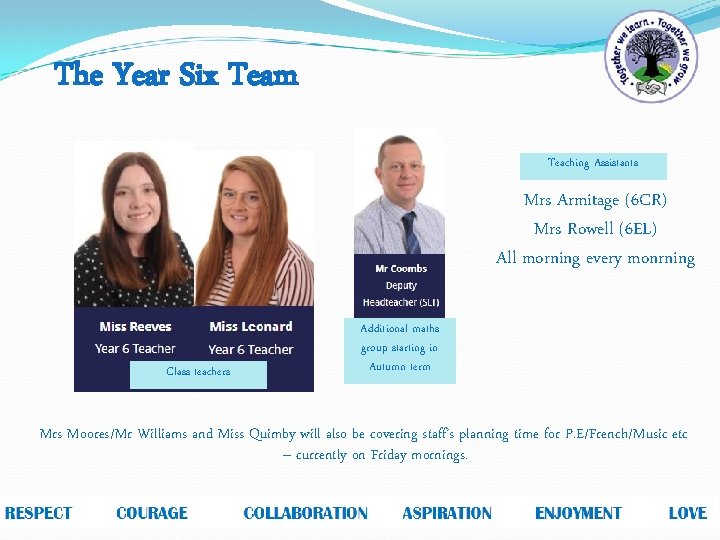
The Year Six Team Teaching Assistants Mrs Armitage (6 CR) Mrs Rowell (6 EL) All morning every monrning Class teachers Additional maths group starting in Autumn term Mrs Moores/Mr Williams and Miss Quimby will also be covering staff’s planning time for P. E/French/Music etc – currently on Friday mornings.
KS 2 Timings of the day 08: 40 08: 55 – 09: 00 10: 45 – 11: 05 12: 10 – 13: 00 15: 20 Gates open and children come straight in. Registration and lessons begin Y 6 Break time Lunchtime Home time via KS 2 gate Please help us to make a prompt start by ensuring your child is in school on time. *Lunchtimes currently run on a rota and so this time is subject to change very slightly.
Provisional dates for your diary Residential to Condover Hall – currently re-booked for w/c 8 th February 2021 Christmas Fayre – Friday November 27 th 2020 Summer Fayre – Friday 25 th June 2021 Y 6 SATs Week – w/c Monday 10 th May 2021 Additional meetings regarding Condover/SATs etc will be confirmed at a later date.
Contact with school staff If you need to contact us then please put a message in your child’s reading diary (and encourage them to show us!) Senior Leadership team open the gates each morning and are available should you need them at the beginning of the day. Please call the office if you have a more detailed query and we will arrange to call you back. Please note that class emails (used during school closures) are currently not used for parent communication.
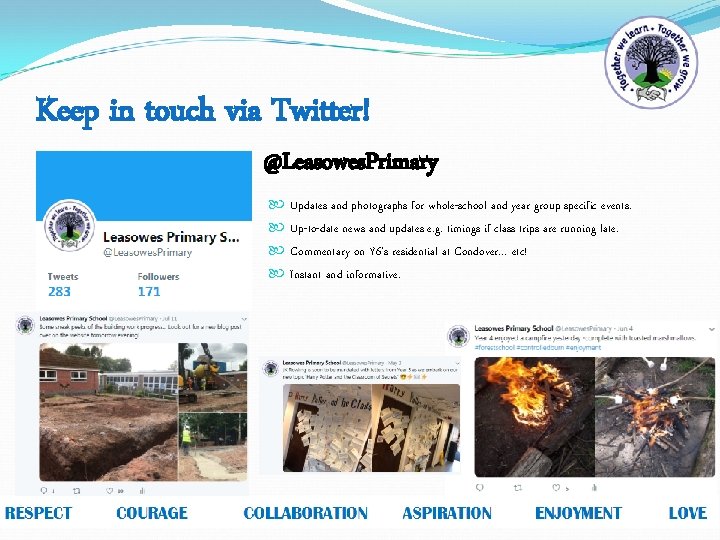
Keep in touch via Twitter! @Leasowes. Primary Updates and photographs for whole-school and year group specific events. Up-to-date news and updates e. g. timings if class trips are running late. Commentary on Y 6’s residential at Condover… etc! Instant and informative.
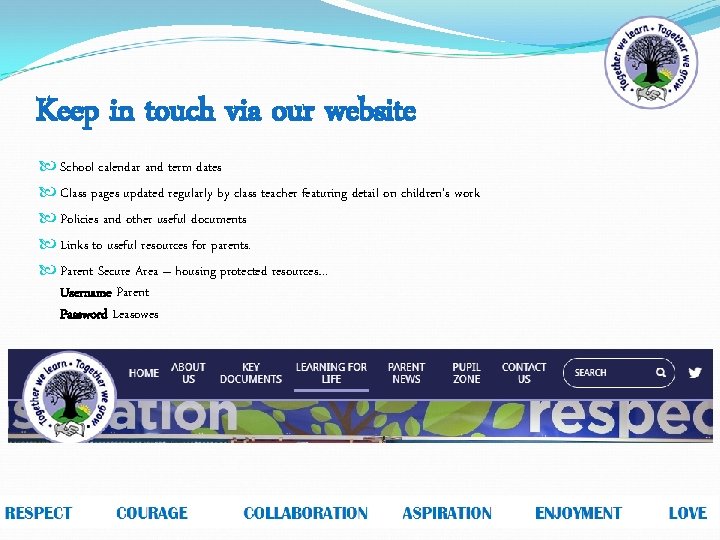
Keep in touch via our website School calendar and term dates Class pages updated regularly by class teacher featuring detail on children’s work Policies and other useful documents Links to useful resources for parents. Parent Secure Area – housing protected resources… Username Parent Password Leasowes
Timetables Class timetables are available on the year group page of the website. Be aware that specifically afternoon sessions may change, but where possible P. E. will remain the same. Learning for life Year group pages Typical Mornings: Core Subjects: Reading/GPS, Writing and Maths. Typical Afternoons: Science (Core Subject) + Geography, History, Art, Design & Technology, Computing, PSHE, PE and RE, Music and other topic related activities. All children will begin the afternoon with reading time or time to improve mathematical fluency. PE days: Wednesday and Friday with Mrs Moores/Mr Williams or a Y 6 class teacher PE: children must be able to remove earrings by themselves. All kits will be kept in lockers – we encourage that these are washed weekly. All of Y 6 take P. E one class after the other. Children change, separated by gender, at the beginning and end of the session.
Topics Conflict and Courage – a study of World Wars 1 and 2. Survival – Extreme Earth and extraordinary survivors. Groovy Greeks – mainly topic-based, whereas all other topics will link to Writing.
Reading books are vital! A few minutes every day where possible. Please ensure your children brings their reading diary to school each day. Encourage your child to read a wide variety of literature at home, including poetry and non-fiction. Discuss new and interesting vocabulary where you can, and encourage the use of dictionaries.
Homework Reading to be completed as often as possible. Spellings to be practised every week – tested on Monday and new spellings given following the test. Other homework, usually Grammar and Maths, will be set on a Wednesday, in on the following Monday. ‘Espresso’ website Username: student 27716 Password: leasowes Throughout the year, children may be signed up for other helpful websites e. g. SPAG. com. They will record usernames and passwords for these in the reading diaries.
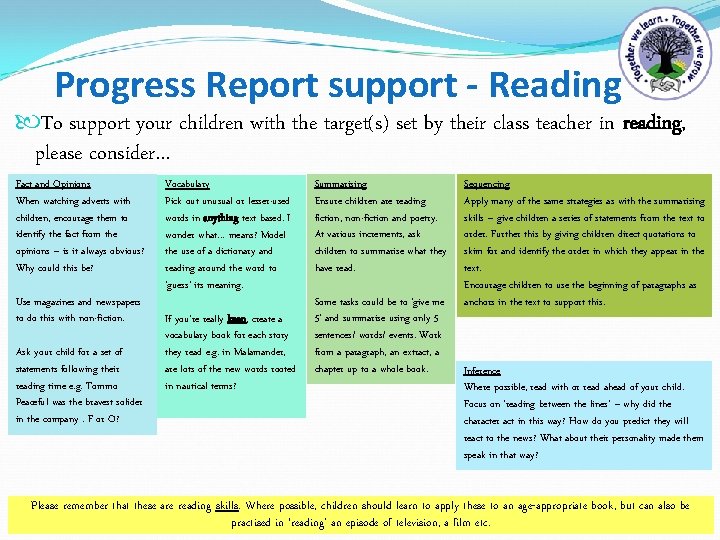
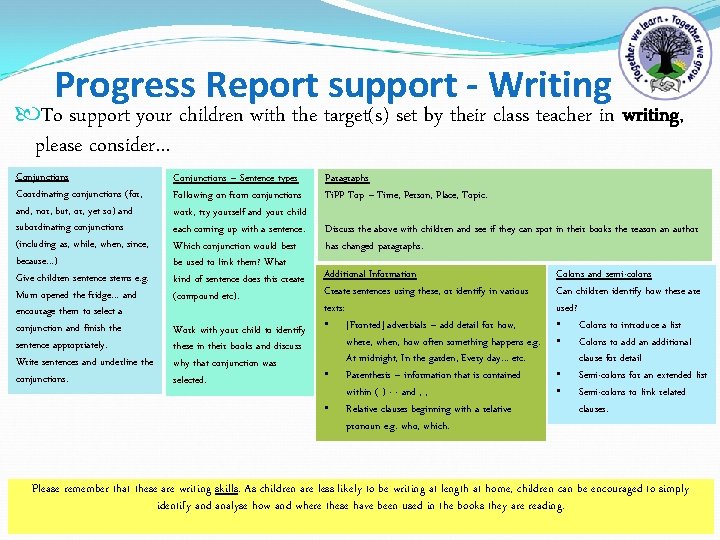
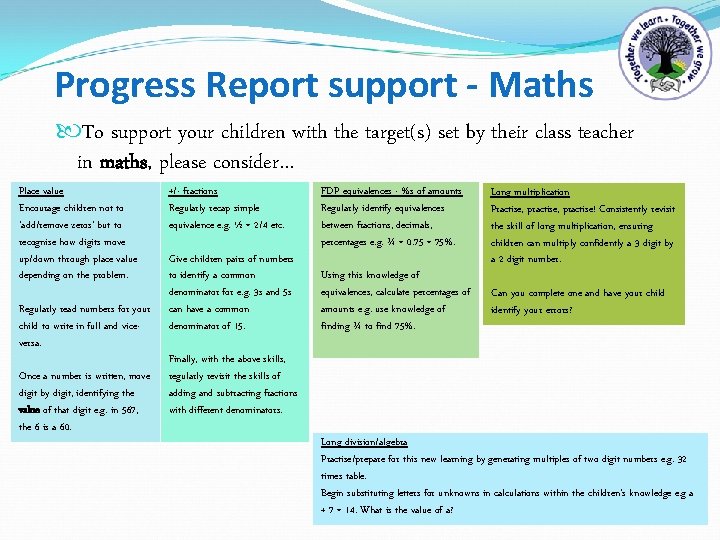
Autumn term progress reports Due to the Covid-19 Lockdown, it is likely that many of the children are behind the point in their learning that we would expect in a ‘normal’ year. Since the start of term, the teachers have been assessing the children, gathering information to give a clearer picture of where they are in their learning, and what gaps there are that need to be addressed. You will have received your child’s personal targets based on these assessments. Achieving these targets will enable your child to progress quicker, accessing the work set at school with more confidence. Working collaboratively will help us all to get the children back on track as soon as we can, maximising learning potential. The following slides detail ways you can support your child in the three areas.
Progress Report support - Reading To support your children with the target(s) set by their class teacher in reading, please consider… Fact and Opinions When watching adverts with children, encourage them to identify the fact from the opinions – is it always obvious? Why could this be? Use magazines and newspapers to do this with non-fiction. Ask your child for a set of statements following their reading time e. g. Tommo Peaceful was the bravest solider in the company. F or O? Vocabulary Pick out unusual or lesser-used words in anything text based. I wonder what… means? Model the use of a dictionary and reading around the word to ‘guess’ its meaning. If you’re really keen, create a vocabulary book for each story they read e. g. in Malamander, are lots of the new words rooted in nautical terms? Summarising Ensure children are reading fiction, non-fiction and poetry. At various increments, ask children to summarise what they have read. Some tasks could be to ‘give me 5’ and summarise using only 5 sentences/ words/ events. Work from a paragraph, an extract, a chapter up to a whole book. Sequencing Apply many of the same strategies as with the summarising skills – give children a series of statements from the text to order. Further this by giving children direct quotations to skim for and identify the order in which they appear in the text. Encourage children to use the beginning of paragraphs as anchors in the text to support this. Inference Where possible, read with or read ahead of your child. Focus on ‘reading between the lines’ – why did the character act in this way? How do you predict they will react to the news? What about their personality made them speak in that way? Please remember that these are reading skills. Where possible, children should learn to apply these to an age-appropriate book, but can also be practised in ‘reading’ an episode of television, a film etc.
Progress Report support - Writing To support your children with the target(s) set by their class teacher in writing, please consider… Conjunctions Coordinating conjunctions (for, and, nor, but, or, yet so) and subordinating conjunctions (including as, while, when, since, because…) Give children sentence stems e. g. Mum opened the fridge… and encourage them to select a conjunction and finish the sentence appropriately. Write sentences and underline the conjunctions. Conjunctions – Sentence types Following on from conjunctions work, try yourself and your child each coming up with a sentence. Which conjunction would best be used to link them? What kind of sentence does this create (compound etc). Work with your child to identify these in their books and discuss why that conjunction was selected. Paragraphs Ti. PP Top – Time, Person, Place, Topic. Discuss the above with children and see if they can spot in their books the reason an author has changed paragraphs. Additional Information Create sentences using these, or identify in various texts: • [Fronted] adverbials – add detail for how, where, when, how often something happens e. g. At midnight, In the garden, Every day… etc. • Parenthesis – information that is contained within ( ) - - and , , • Relative clauses beginning with a relative pronoun e. g. who, which. Colons and semi-colons Can children identify how these are used? • Colons to introduce a list • Colons to add an additional clause for detail • Semi-colons for an extended list • Semi-colons to link related clauses. Please remember that these are writing skills. As children are less likely to be writing at length at home, children can be encouraged to simply identify and analyse how and where these have been used in the books they are reading.
Progress Report support - Maths To support your children with the target(s) set by their class teacher in maths, please consider… Place value Encourage children not to ‘add/remove zeros’ but to recognise how digits move up/down through place value depending on the problem. Regularly read numbers for your child to write in full and viceversa. Once a number is written, move digit by digit, identifying the value of that digit e. g. in 567, the 6 is a 60. +/- fractions Regularly recap simple equivalence e. g. ½ = 2/4 etc. Give children pairs of numbers to identify a common denominator for e. g. 3 s and 5 s can have a common denominator of 15. FDP equivalences - %s of amounts Regularly identify equivalences between fractions, decimals, percentages e. g. ¾ = 0. 75 = 75%. Using this knowledge of equivalences, calculate percentages of amounts e. g. use knowledge of finding ¾ to find 75%. Long multiplication Practise, practise! Consistently revisit the skill of long multiplication, ensuring children can multiply confidently a 3 digit by a 2 digit number. Can you complete one and have your child identify your errors? Finally, with the above skills, regularly revisit the skills of adding and subtracting fractions with different denominators. Long division/algebra Practise/prepare for this new learning by generating multiples of two digit numbers e. g. 32 times table. Begin substituting letters for unknowns in calculations within the children’s knowledge e. g a + 7 = 14. What is the value of a?
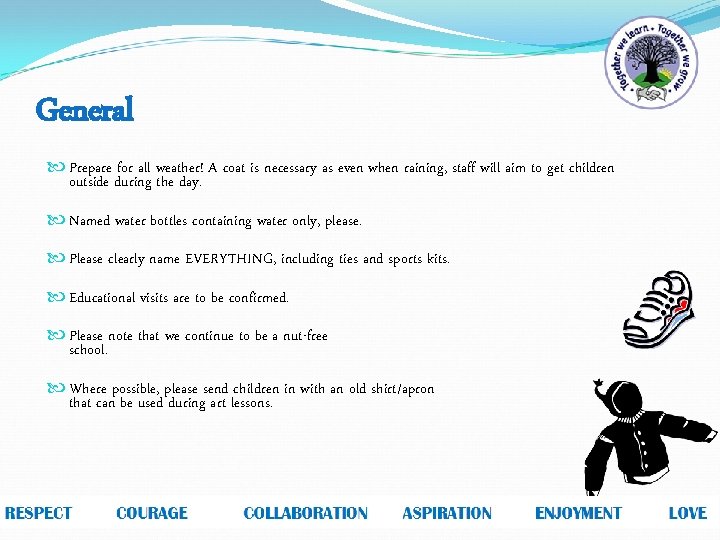
General Prepare for all weather! A coat is necessary as even when raining, staff will aim to get children outside during the day. Named water bottles containing water only, please. Please clearly name EVERYTHING, including ties and sports kits. Educational visits are to be confirmed. Please note that we continue to be a nut-free school. Where possible, please send children in with an old shirt/apron that can be used during art lessons.
Celebrate! House points Stickers Taking work to another teacher or Mrs Bettany Celebration assemblies Reward activity day at end of each half term. Outstanding raffle tickets are given for exemplary behaviour rather than individual excellent pieces of work. As in all year groups, we have high expectations of behaviour and our school values are key to that. Children are expected to always follow our Leasowes Charter.
Behaviour policy and sanctions Our behaviour policy was written to be linked to the school’s values and Leasowes charter. Traffic light system used throughout school linked to the end-of-half-term activities morning. This aims to reward good behaviour – children who largely remain on green or above have priority when choosing activities. This is monitored in class, with children moving their names to indicate rewards and sanctions. Persistent or serious behaviour is referred through Phase Leader including AHT Deputy Head teacher.
Pupil Premium Funding At present, the number of families applying for Pupil Premium (also known as Free School Meals) funds at Leasowes has dramatically decreased. We feel that this may be due to families thinking that it is now unnecessary to apply, due to their child receiving a Universal Free School Meal in EYFS and KS 1. Pupil Premium eligibility is a separate set of funding that when applied for will provide the school with around £ 1300 per year that can be spent on interventions and resources that will directly impact your child’s education. You can register your child for Free School Meals (Pupil Premium) if you are in receipt of the following: Income Support Income-based Jobseekers Allowance Income-related Employment and Support Allowance Support under Part VI of the Immigration and Asylum Act 1999 The Guarantee element of State Pension Credit Child Tax Credit, provided they are not entitled to Working Tax Credit and have an annual income (as assessed by HM Revenue & Customs) that does not exceed £ 16, 190 Working Tax Credit 'run-on' - the payment someone may receive for a further four weeks after they stop qualifying for Working Tax Credit If you would like any more information, please do not hesitate in contacting Staffordshire County Council on 0300 1118007, email freeschoolmeals@staffordshire. gov. uk or apply directly through https: //apps 2. staffordshire. gov. uk/web/fsmweb/
More Information Please advise us of… Any updates on a medical condition that your child has (asthma, allergies…) Please ensure all care plans have been returned to school. Photo permissions for the year will be communicated in due course. Calculation policy for maths – now your child is in a new school year, this may impact calculations. The policy is located on the website under Learning for Life – Curriculum – MATHS.