
Meet the microbes Microscopes are required to see
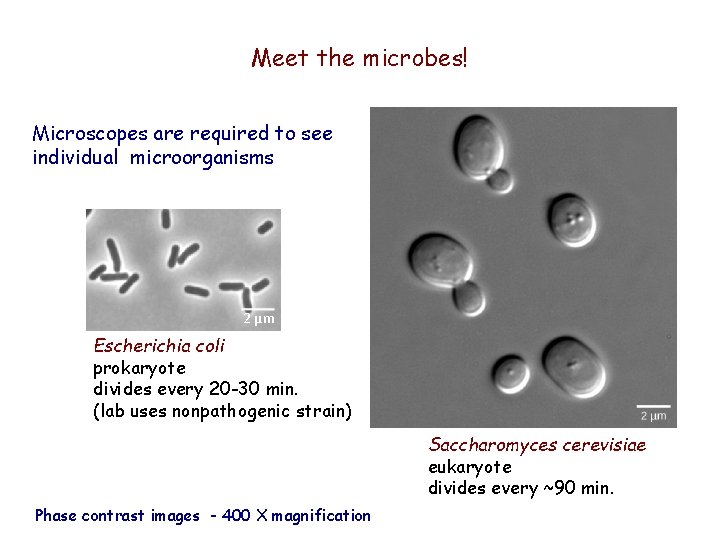
Meet the microbes! Microscopes are required to see individual microorganisms 2 µm Escherichia coli prokaryote divides every 20 -30 min. (lab uses nonpathogenic strain) Saccharomyces cerevisiae eukaryote divides every ~90 min. Phase contrast images - 400 X magnification
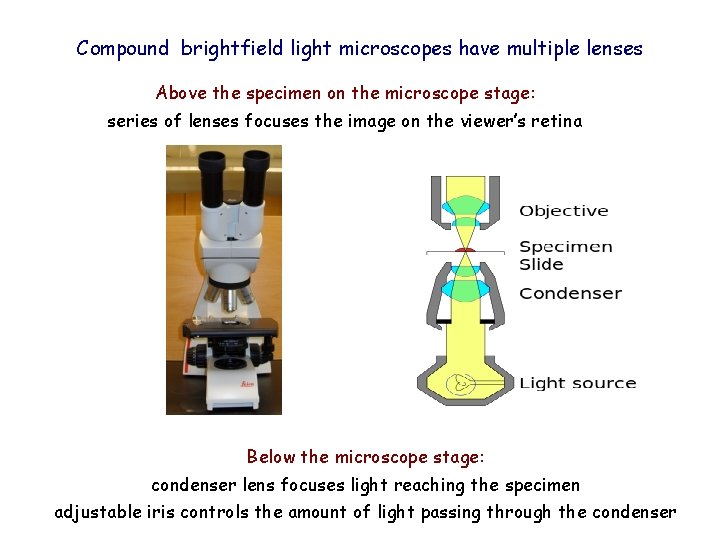
Compound brightfield light microscopes have multiple lenses Above the specimen on the microscope stage: series of lenses focuses the image on the viewer’s retina Below the microscope stage: condenser lens focuses light reaching the specimen adjustable iris controls the amount of light passing through the condenser
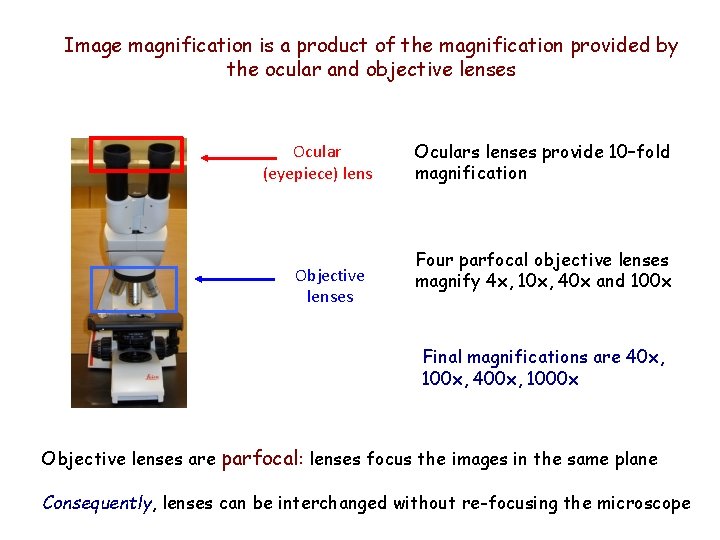
Image magnification is a product of the magnification provided by the ocular and objective lenses Ocular (eyepiece) lens Objective lenses Oculars lenses provide 10–fold magnification Four parfocal objective lenses magnify 4 x, 10 x, 40 x and 100 x Final magnifications are 40 x, 100 x, 400 x, 1000 x Objective lenses are parfocal: lenses focus the images in the same plane Consequently, lenses can be interchanged without re-focusing the microscope
How do I adjust the light microscope to visualize specimens? Why are stains used in light microscopy? What is an oil immersion lens and when is it used? How can S. cerevisiae and S. pombe be distinguished using light microscopy?
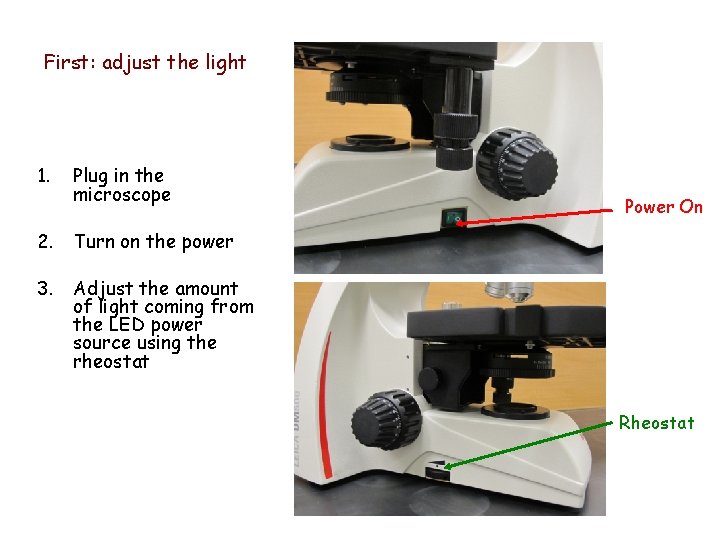
First: adjust the light 1. Plug in the microscope Power On 2. Turn on the power 3. Adjust the amount of light coming from the LED power source using the rheostat Rheostat
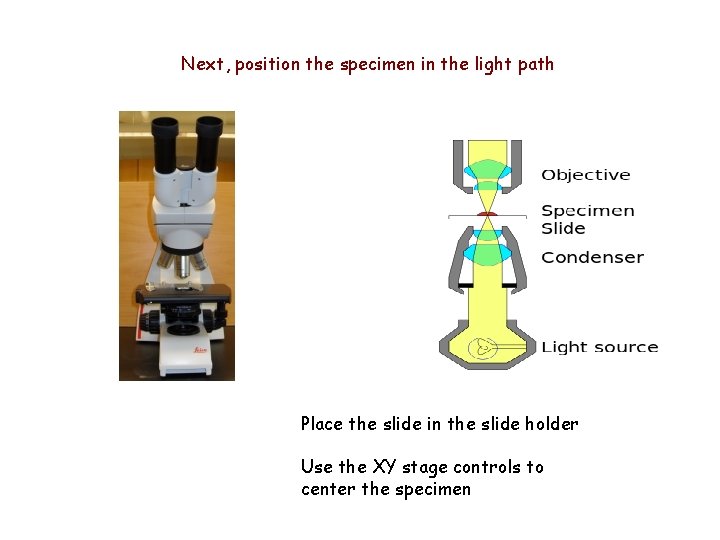
Next, position the specimen in the light path Place the slide in the slide holder Use the XY stage controls to center the specimen
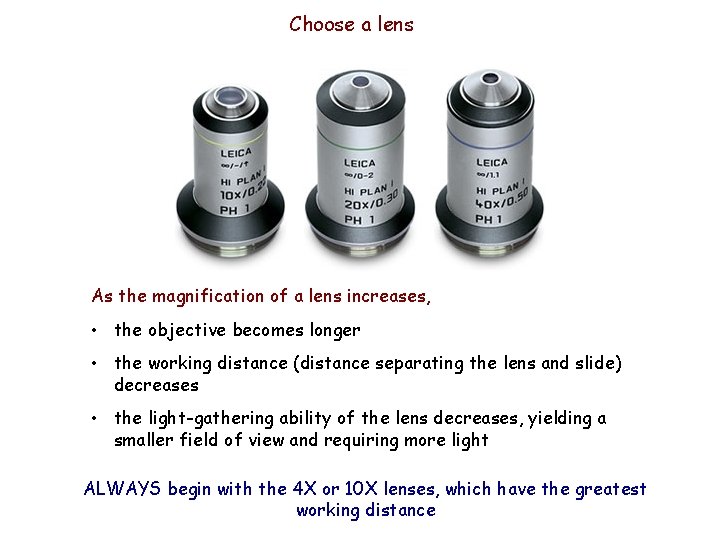
Choose a lens As the magnification of a lens increases, • the objective becomes longer • the working distance (distance separating the lens and slide) decreases • the light-gathering ability of the lens decreases, yielding a smaller field of view and requiring more light ALWAYS begin with the 4 X or 10 X lenses, which have the greatest working distance
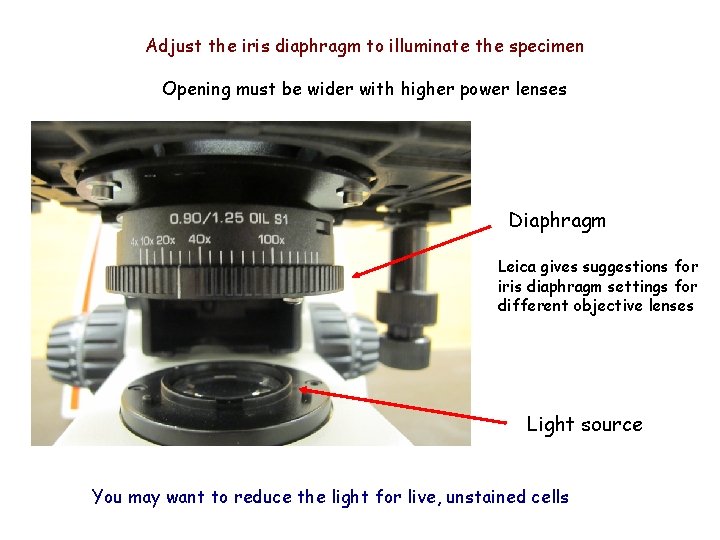
Adjust the iris diaphragm to illuminate the specimen Opening must be wider with higher power lenses Diaphragm Leica gives suggestions for iris diaphragm settings for different objective lenses Light source You may want to reduce the light for live, unstained cells
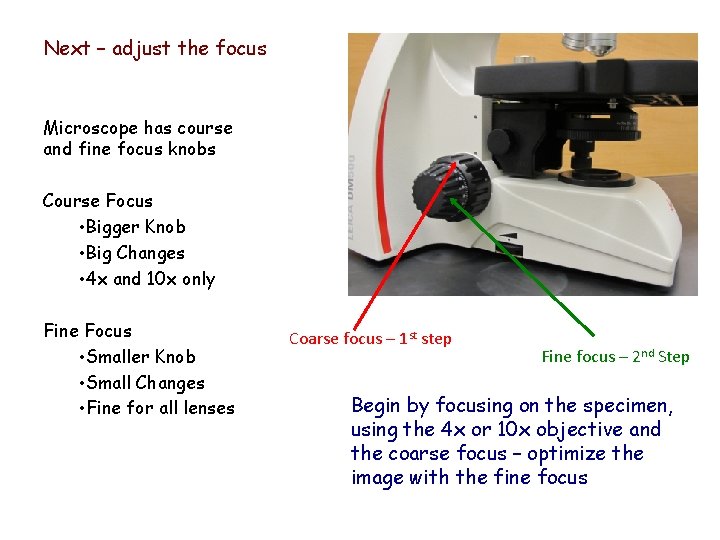
Next – adjust the focus Microscope has course and fine focus knobs Course Focus • Bigger Knob • Big Changes • 4 x and 10 x only Fine Focus • Smaller Knob • Small Changes • Fine for all lenses Coarse focus – 1 st step Fine focus – 2 nd Step Begin by focusing on the specimen, using the 4 x or 10 x objective and the coarse focus – optimize the image with the fine focus
How do I adjust the light microscope to visualize specimens? Why are stains used in light microscopy? What is an oil immersion objective and when is it used? How can S. cerevisiae and S. pombe be distinguished using light microscopy?
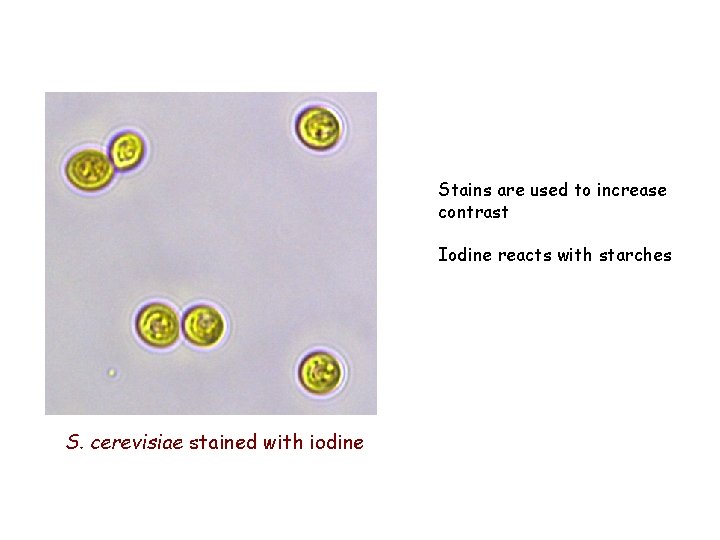
Stains are used to increase contrast Iodine reacts with starches S. cerevisiae stained with iodine
How do I adjust the light microscope to visualize specimens? Why are stains used in light microscopy? What is an oil immersion objective and when is it used? How can S. cerevisiae and S. pombe be distinguished using light microscopy?
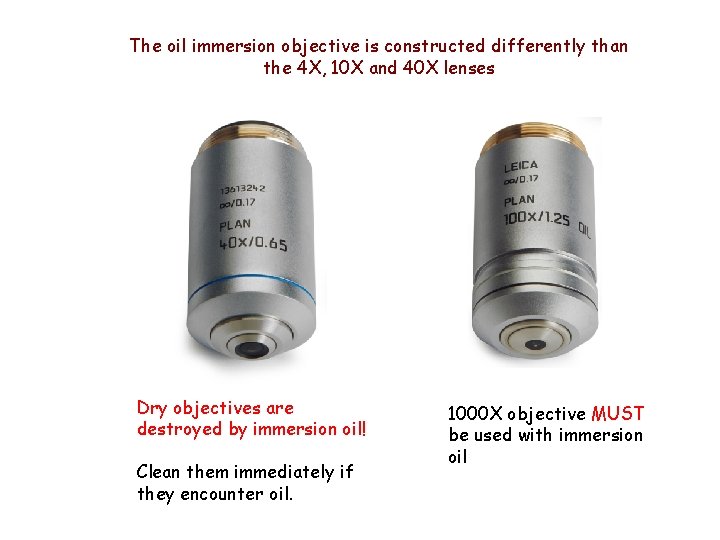
The oil immersion objective is constructed differently than the 4 X, 10 X and 40 X lenses Dry objectives are destroyed by immersion oil! Clean them immediately if they encounter oil. 1000 X objective MUST be used with immersion oil
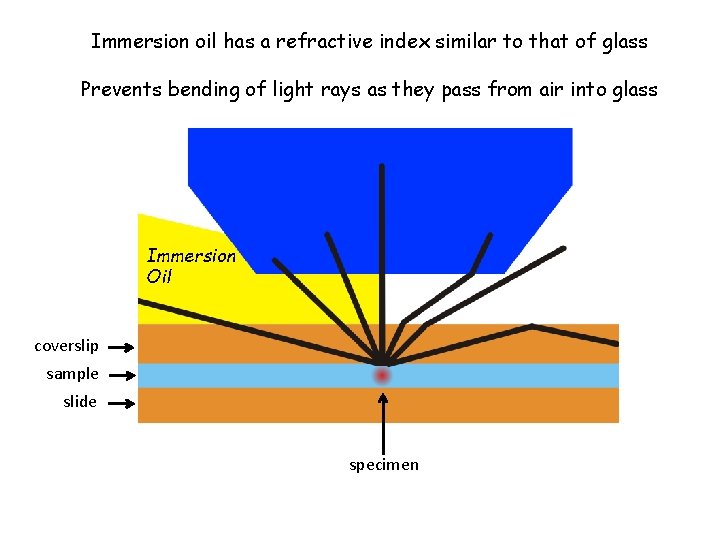
Immersion oil has a refractive index similar to that of glass Prevents bending of light rays as they pass from air into glass Immersion Oil coverslip sample slide specimen
How do I adjust the light microscope to visualize specimens? Why are stains used in light microscopy? What is an oil immersion objective and when is it used? How can S. cerevisiae and S. pombe be distinguished using light microscopy?
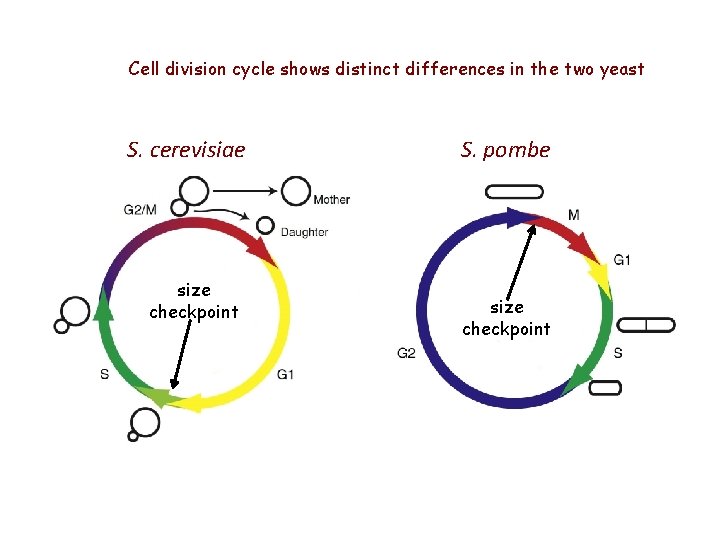
Cell division cycle shows distinct differences in the two yeast S. cerevisiae size checkpoint S. pombe size checkpoint
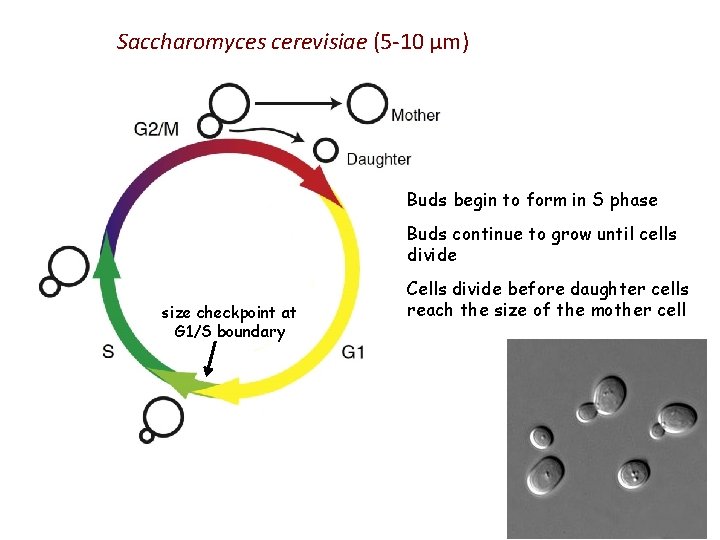
Saccharomyces cerevisiae (5 -10 µm) Buds begin to form in S phase Buds continue to grow until cells divide size checkpoint at G 1/S boundary Cells divide before daughter cells reach the size of the mother cell
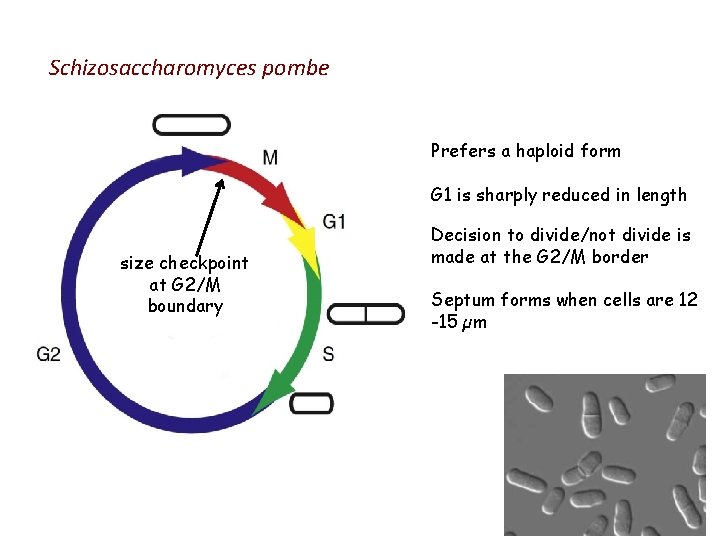
Schizosaccharomyces pombe Prefers a haploid form G 1 is sharply reduced in length size checkpoint at G 2/M boundary Decision to divide/not divide is made at the G 2/M border Septum forms when cells are 12 -15 µm
- Slides: 18