
MEEG Data What are we measuring Jason Taylor

- Slides: 19
M/EEG Data: What are we measuring? Jason Taylor MRC Cognition and Brain Sciences Unit (CBU) Cambridge Centre for Ageing and Neuroscience (Cam. CAN) 19 January 2011 | SPM M/EEG Course | Brussels [ Much stolen from James Kilner, Jérémie Mattout, Olaf Hauk ]
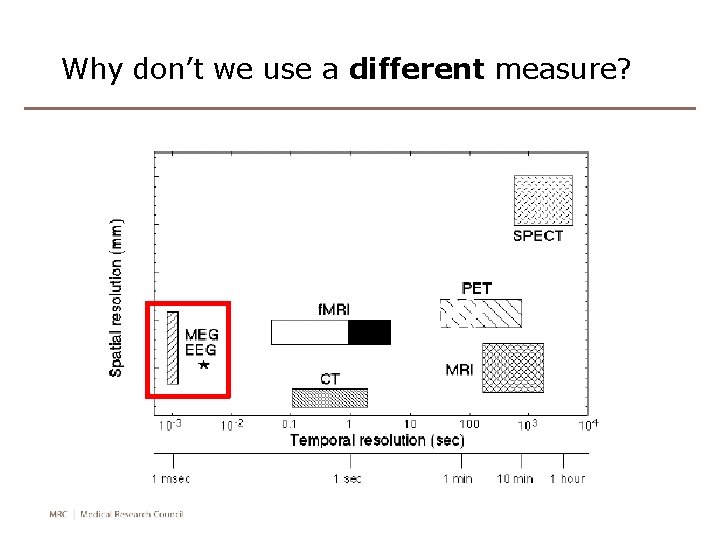
M/EEG: What are we measuring? • What do we want to measure? • How do we measure it? • What do we really measure? • What do we not measure? • Why don’t we use a different measure?
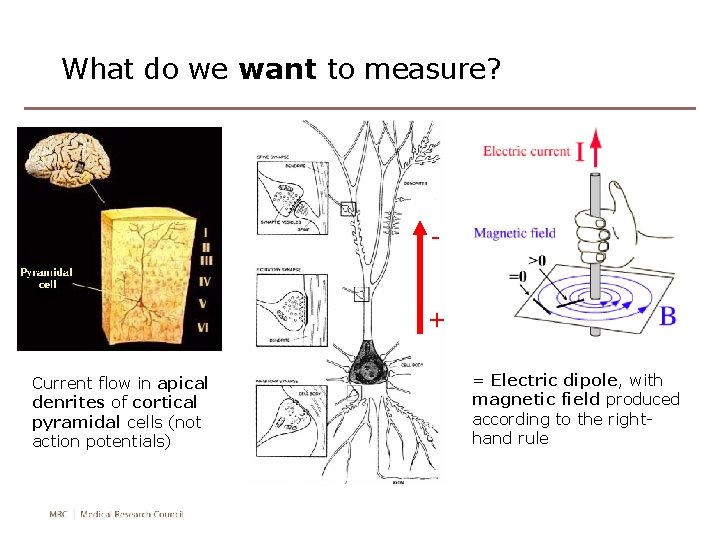
What do we want to measure? + Current flow in apical denrites of cortical pyramidal cells (not action potentials) = Electric dipole, with magnetic field produced according to the righthand rule
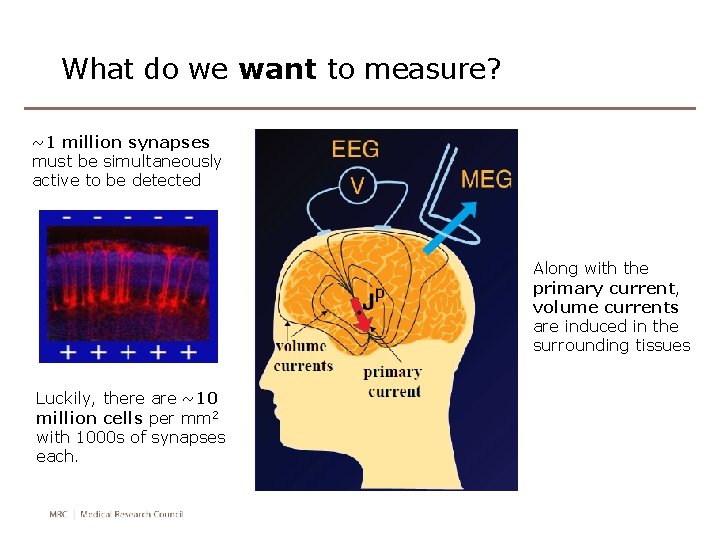
What do we want to measure? ~1 million synapses must be simultaneously active to be detected + Luckily, there are ~10 million cells per mm 2 with 1000 s of synapses each. Along with the primary current, volume currents are induced in the surrounding tissues
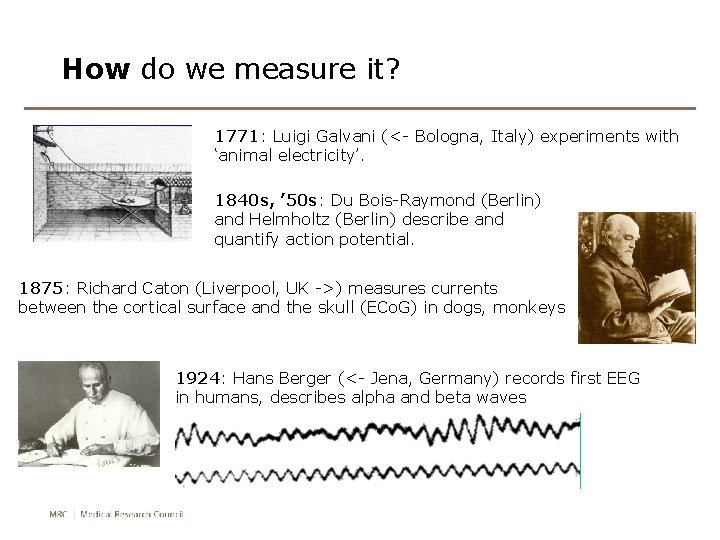
How do we measure it? 1771: Luigi Galvani (<- Bologna, Italy) experiments with ‘animal electricity’. 1840 s, ’ 50 s: Du Bois-Raymond (Berlin) and Helmholtz (Berlin) describe and quantify action potential. 1875: Richard Caton (Liverpool, UK ->) measures currents between the cortical surface and the skull (ECo. G) in dogs, monkeys 1924: Hans Berger (<- Jena, Germany) records first EEG in humans, describes alpha and beta waves
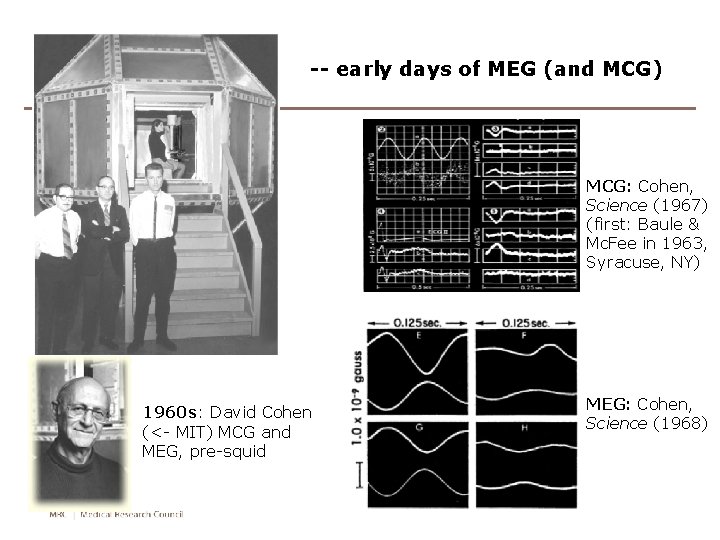
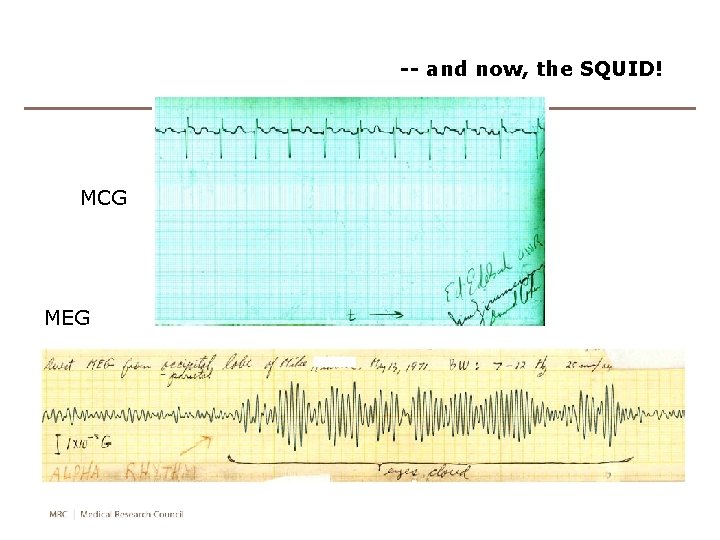
-- early days of MEG (and MCG) MCG: Cohen, Science (1967) (first: Baule & Mc. Fee in 1963, Syracuse, NY) 1960 s: David Cohen (<- MIT) MCG and MEG, pre-squid MEG: Cohen, Science (1968)
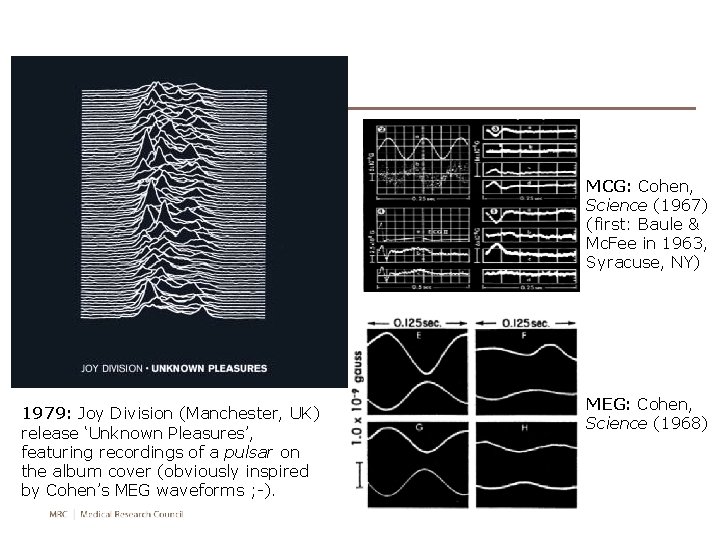
MCG: Cohen, Science (1967) (first: Baule & Mc. Fee in 1963, Syracuse, NY) 1979: Joy Division (Manchester, UK) release ‘Unknown Pleasures’, featuring recordings of a pulsar on the album cover (obviously inspired by Cohen’s MEG waveforms ; -). MEG: Cohen, Science (1968)
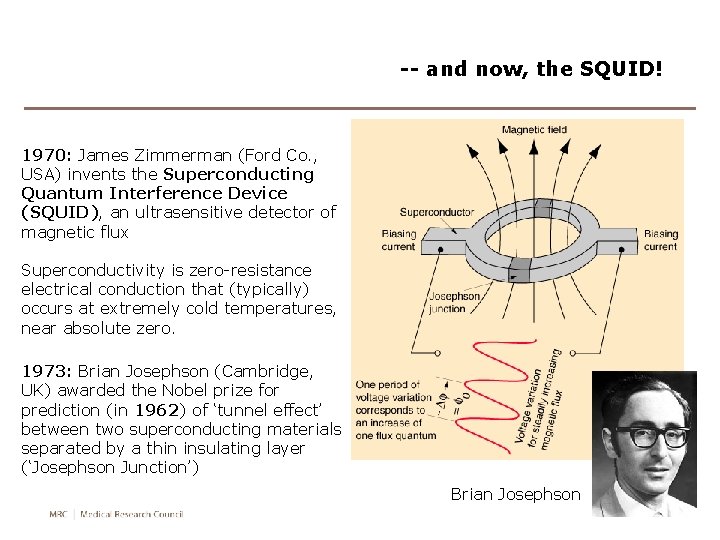
-- and now, the SQUID! 1970: James Zimmerman (Ford Co. , USA) invents the Superconducting Quantum Interference Device (SQUID), an ultrasensitive detector of magnetic flux Superconductivity is zero-resistance electrical conduction that (typically) occurs at extremely cold temperatures, near absolute zero. 1973: Brian Josephson (Cambridge, UK) awarded the Nobel prize for prediction (in 1962) of ‘tunnel effect’ between two superconducting materials separated by a thin insulating layer (‘Josephson Junction’) Brian Josephson
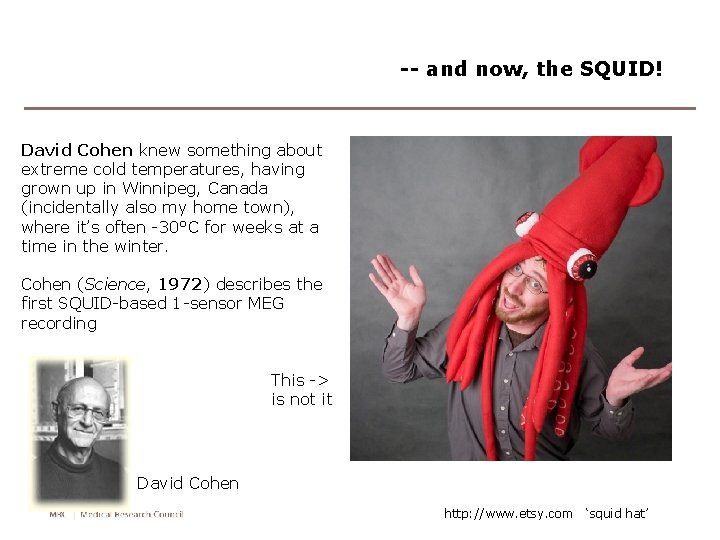
-- and now, the SQUID! David Cohen knew something about extreme cold temperatures, having grown up in Winnipeg, Canada (incidentally also my home town), where it’s often -30°C for weeks at a time in the winter. Cohen (Science, 1972) describes the first SQUID-based 1 -sensor MEG recording This -> is not it David Cohen http: //www. etsy. com ‘squid hat’
-- and now, the SQUID! MCG MEG
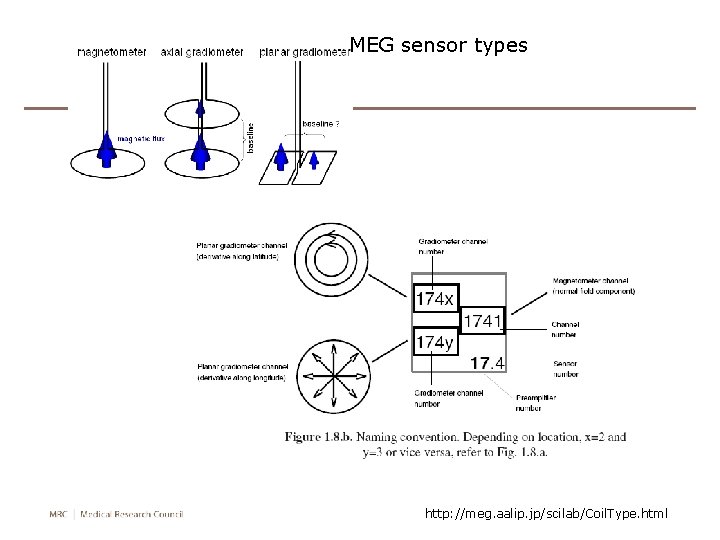
MEG sensor types http: //meg. aalip. jp/scilab/Coil. Type. html
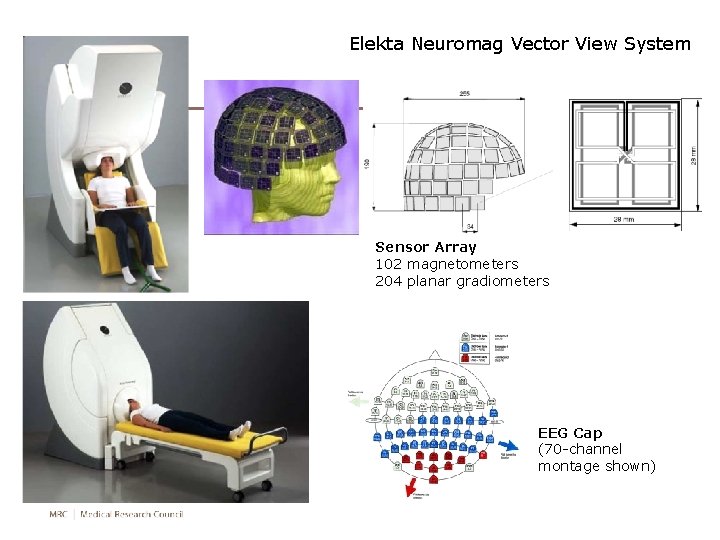
Elekta Neuromag Vector View System Sensor Array 102 magnetometers 204 planar gradiometers EEG Cap (70 -channel montage shown)
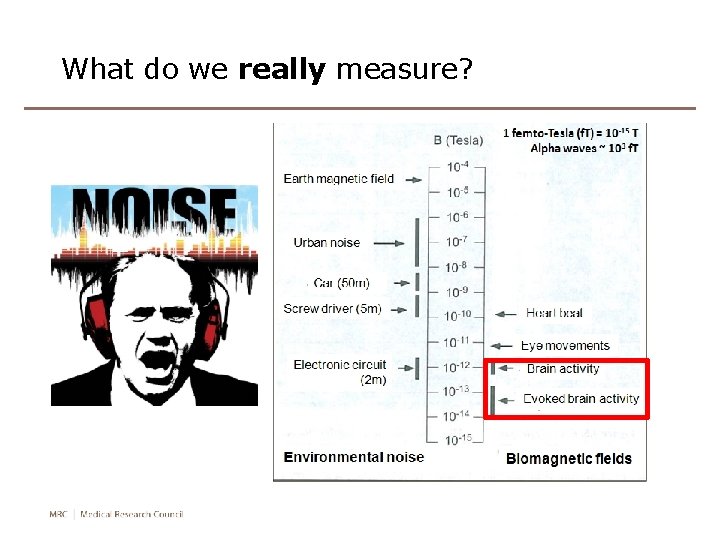
What do we really measure?
-- methods for removing/avoiding noise Independent Component Analysis (ICA) IC 1 VEOG MEG 1 Signal Space Separation (SSS) - Neuromag MEG 2 MEG 3 Magnetically shielded room (MSR) Plus: Filtering, averaging, robust averaging, … MEG 4 Before / After IC 1 removed
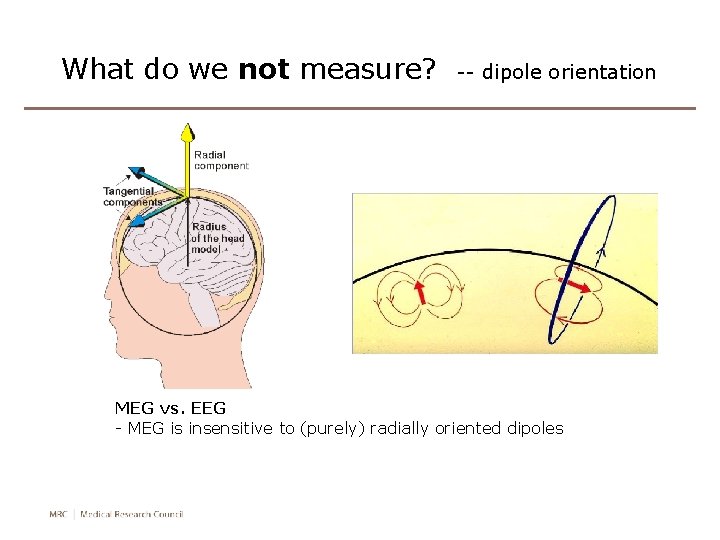
What do we not measure? -- dipole orientation MEG vs. EEG - MEG is insensitive to (purely) radially oriented dipoles
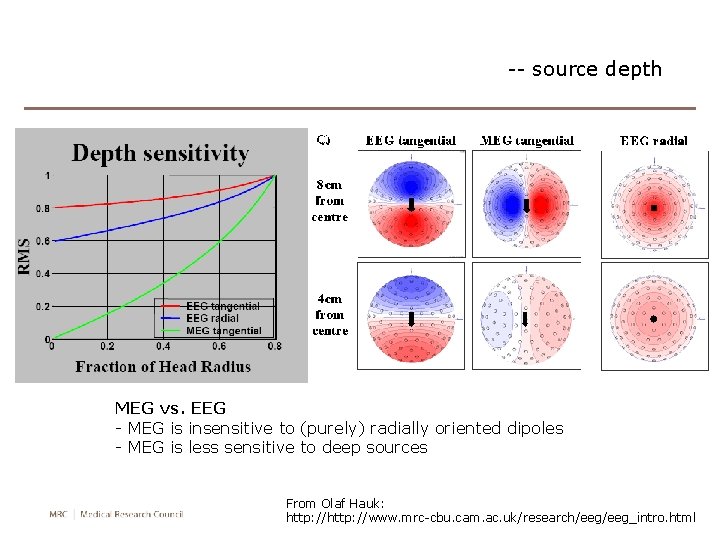
-- source depth MEG vs. EEG - MEG is insensitive to (purely) radially oriented dipoles - MEG is less sensitive to deep sources From Olaf Hauk: http: //www. mrc-cbu. cam. ac. uk/research/eeg_intro. html
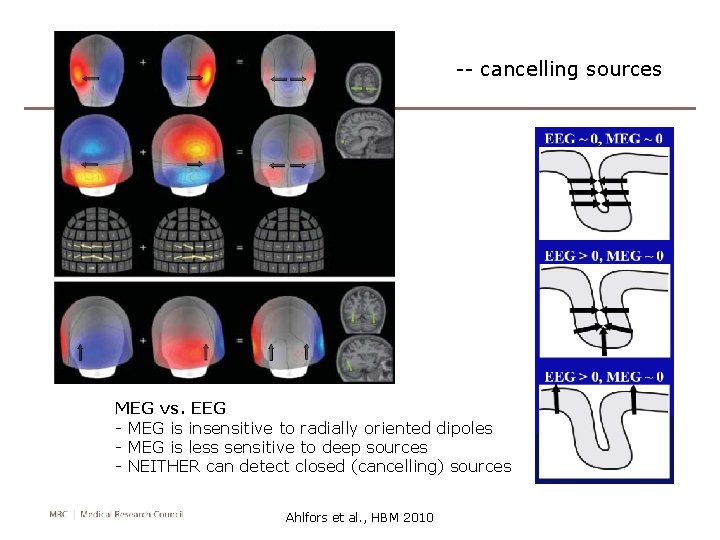
-- cancelling sources MEG vs. EEG - MEG is insensitive to radially oriented dipoles - MEG is less sensitive to deep sources - NEITHER can detect closed (cancelling) sources Ahlfors et al. , HBM 2010
Why don’t we use a different measure?
- The End • Thanks!