
Medium Term Budget Policy Statement 2007 Medium term
Medium Term Budget Policy Statement 2007
Medium term policy objectives To secure higher growth on a sustainable basis, we must focus on: 2 • Accelerating economic growth and the rate of investment • Creating more work opportunities • Investing in community services and growing the social wage • Improving the effectiveness of the state, including combating crime and promoting a service oriented culture • Building regional and international partnerships for growth and development
Economic growth has been good for South Africa • Living standards boosted by: – Higher wages, lower interest rates and personal income tax relief – Rising employment – Increased house and asset prices • Significant share of economic success redistributed through fiscus – The economy has boosted taxes and lowered interest rates - allowing government expenditure to grow strongly – Social wage consistently expanded – Transfers to households have grown – Public sector remuneration and employment recently boosted – Growth in capital spending has improved access to and quality of services 3
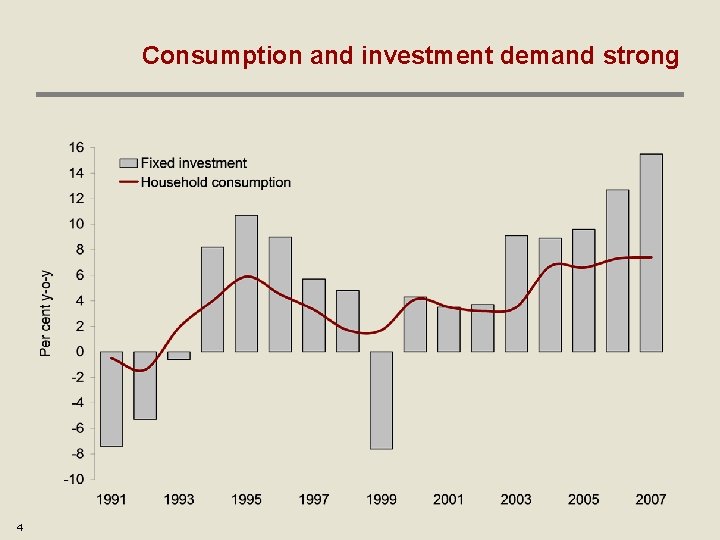
Consumption and investment demand strong 4
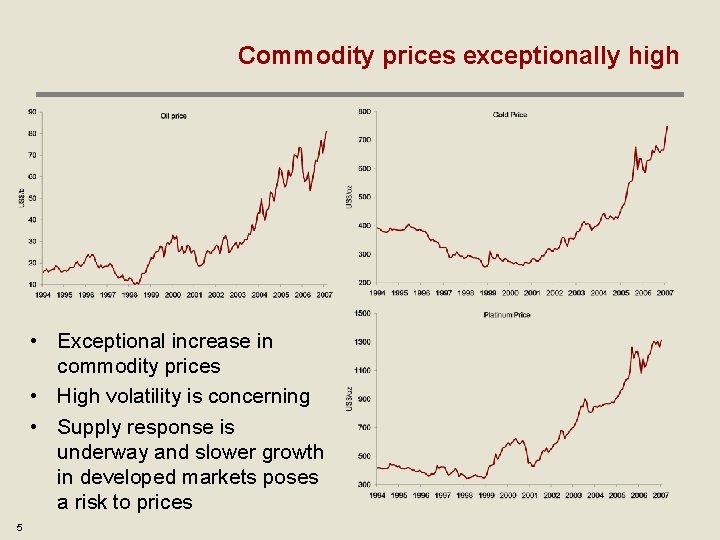
Commodity prices exceptionally high • Exceptional increase in commodity prices • High volatility is concerning • Supply response is underway and slower growth in developed markets poses a risk to prices 5
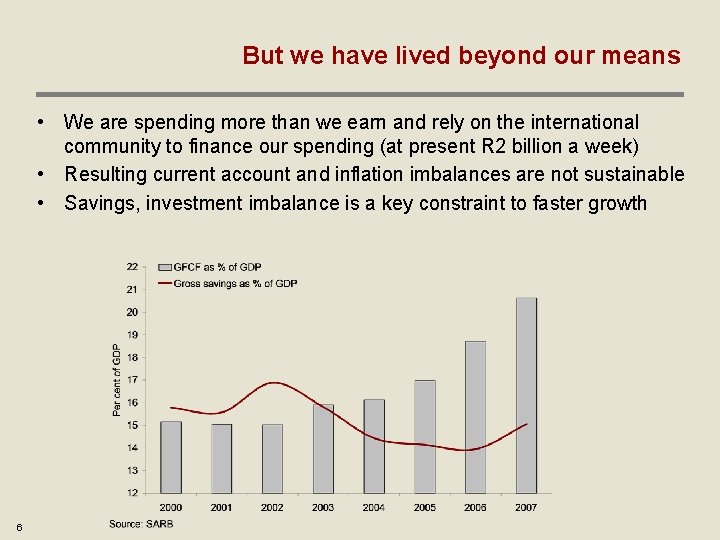
But we have lived beyond our means • We are spending more than we earn and rely on the international community to finance our spending (at present R 2 billion a week) • Resulting current account and inflation imbalances are not sustainable • Savings, investment imbalance is a key constraint to faster growth 6
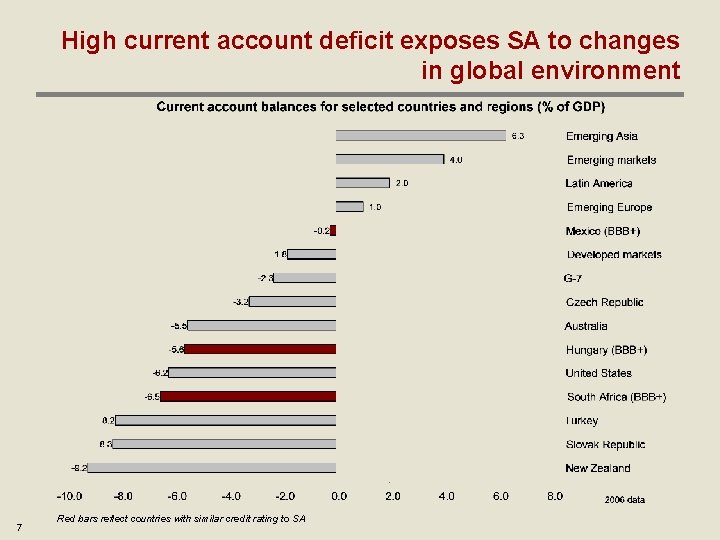
High current account deficit exposes SA to changes in global environment 7 Red bars reflect countries with similar credit rating to SA
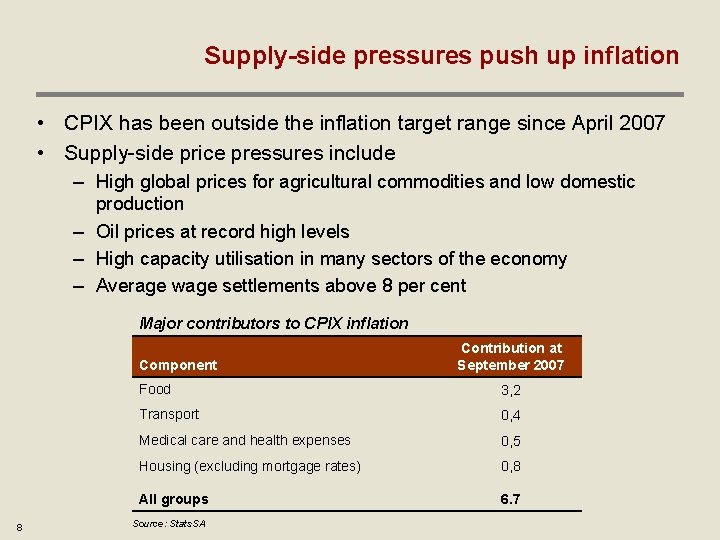
Supply-side pressures push up inflation • CPIX has been outside the inflation target range since April 2007 • Supply-side price pressures include – High global prices for agricultural commodities and low domestic production – Oil prices at record high levels – High capacity utilisation in many sectors of the economy – Average wage settlements above 8 per cent Major contributors to CPIX inflation Component 8 Contribution at September 2007 Food 3, 2 Transport 0, 4 Medical care and health expenses 0, 5 Housing (excluding mortgage rates) 0, 8 All groups 6. 7 Source: Stats. SA
Global risks now sharper • Greater risks of a global economic slowdown now than a year ago due to: – Slowing growth in the US – Unraveling of sub-prime mortgage crisis not yet over – Steps to curb inflation in China may slow growth there • What can be done to mitigate the risks? – Fiscal policy must contribute to the sustainability of economic growth and employment creation by ensuring that: • Fiscal decisions do not place excessive burdens on the economy • We save enough so we can increase demand to protect jobs and investment when the cycle turns • Fiscal policy does not add pressure to interest rates • The proposed fiscal framework attempts to balance these macroeconomic concerns with the microeconomic objectives of government 9
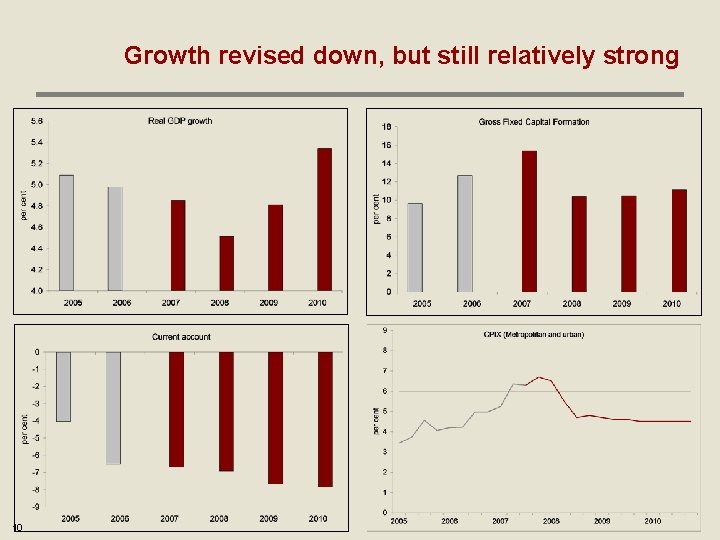
Growth revised down, but still relatively strong 10
Cyclical factors in revenue • To-date, we have implicitly taken account of cyclical factors in revenue to adjust fiscal policy • We introduce the concept of a structural budget balance, which adjusts the fiscal balance for: – Cyclical deviations in the rate of economic growth, interest rates and inflation – Cyclical changes to the composition of growth (e. g. higher consumption would mean more VAT receipts) – Changes to our terms of trade or to commodity prices (terms of trade reflect the ratio of export prices to import prices) • We estimate that in 2008/09, the cyclical component of our revenue is about R 22 billion or 1% of GDP. The proposed budget surplus for that year is R 16 billion, implying that we are only saving a proportion of cyclical revenue. 11
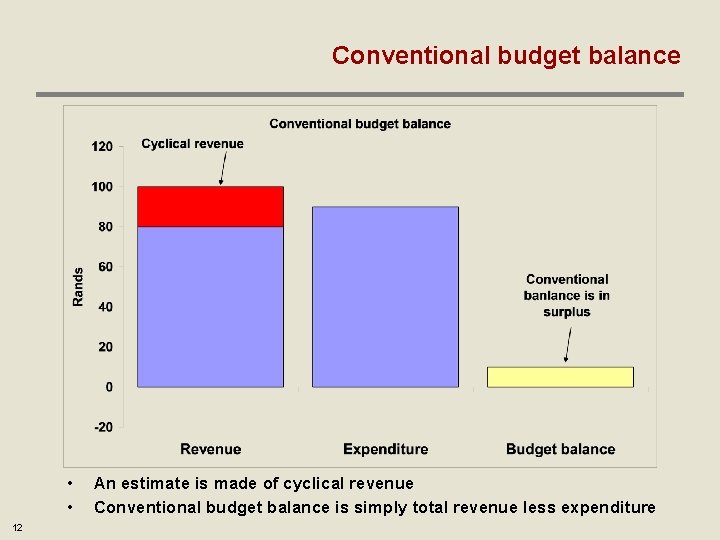
Conventional budget balance • • 12 An estimate is made of cyclical revenue Conventional budget balance is simply total revenue less expenditure
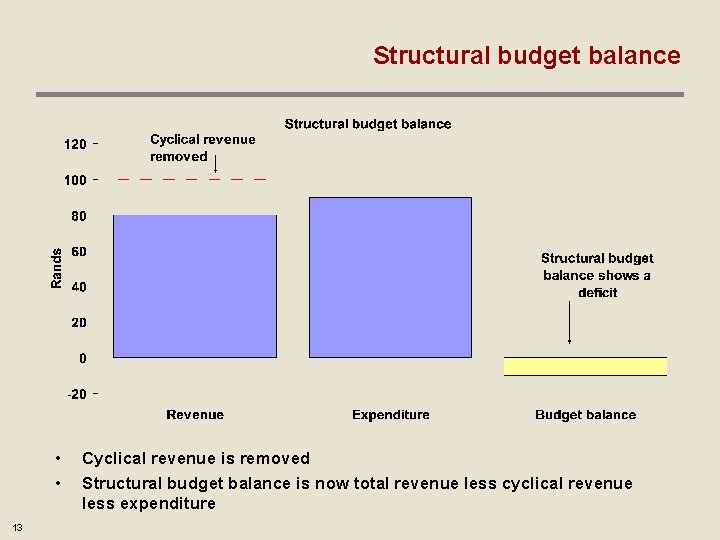
Structural budget balance • • 13 Cyclical revenue is removed Structural budget balance is now total revenue less cyclical revenue less expenditure
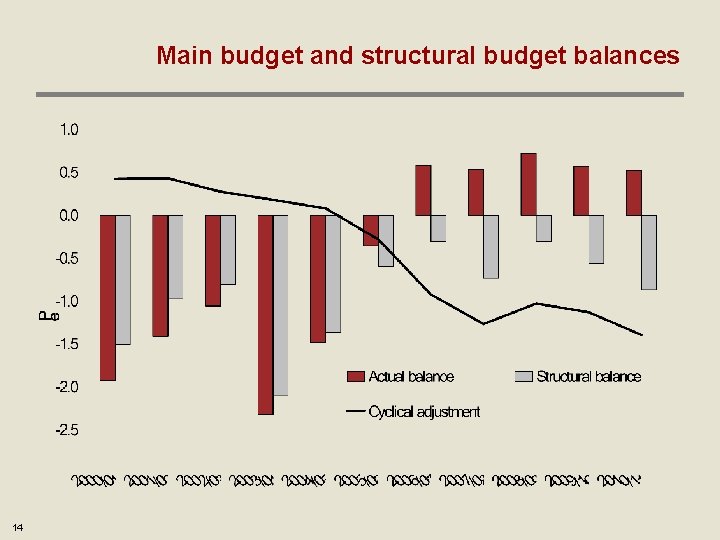
Main budget and structural budget balances 14
Why budget for a surplus? • A cyclical increase in revenue should be managed differently from a permanent increase • Given that capital spending is rising as a share of spending, the fiscal framework recommends that only part of that cyclical revenue be saved • By saving a part of the cyclical revenue, we also take some pressure off interest rates and the current account deficit, allowing for more balanced growth • Budget surpluses are used to: – Pay back debt which lowers debt service costs; or – Help in the process of building foreign exchange reserves, further cushioning the economy against external volatility • 15 The structural budget balance reflects a deficit rising to about 1% of GDP by 2010/11
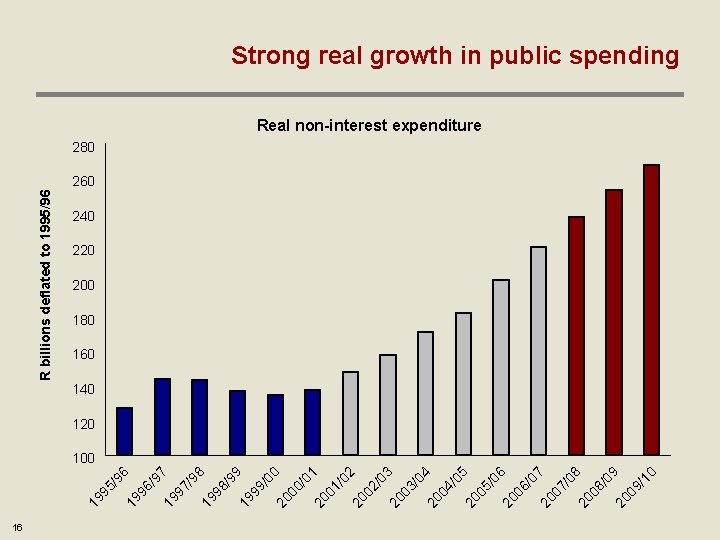
16 09 10 09 / 20 08 07 07 / 20 06 05 05 / 20 03 04 04 / 20 03 / 20 02 01 02 / 20 01 / 20 00 00 / 20 99 / 19 99 98 97 98 / 19 97 / 19 6 /9 96 / 19 19 95 R billions deflated to 1995/96 Strong real growth in public spending Real non-interest expenditure 280 260 240 220 200 180 160 140 120 100
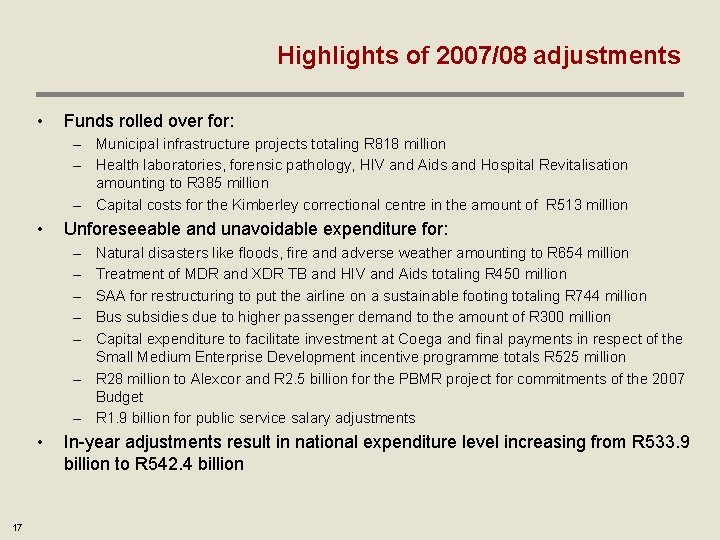
Highlights of 2007/08 adjustments • Funds rolled over for: – Municipal infrastructure projects totaling R 818 million – Health laboratories, forensic pathology, HIV and Aids and Hospital Revitalisation amounting to R 385 million – Capital costs for the Kimberley correctional centre in the amount of R 513 million • Unforeseeable and unavoidable expenditure for: – – – Natural disasters like floods, fire and adverse weather amounting to R 654 million Treatment of MDR and XDR TB and HIV and Aids totaling R 450 million SAA for restructuring to put the airline on a sustainable footing totaling R 744 million Bus subsidies due to higher passenger demand to the amount of R 300 million Capital expenditure to facilitate investment at Coega and final payments in respect of the Small Medium Enterprise Development incentive programme totals R 525 million – R 28 million to Alexcor and R 2. 5 billion for the PBMR project for commitments of the 2007 Budget – R 1. 9 billion for public service salary adjustments • 17 In-year adjustments result in national expenditure level increasing from R 533. 9 billion to R 542. 4 billion
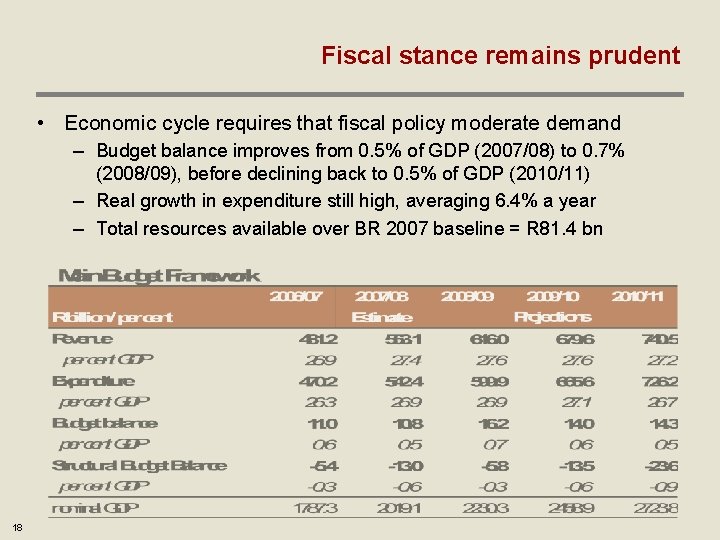
Fiscal stance remains prudent • Economic cycle requires that fiscal policy moderate demand – Budget balance improves from 0. 5% of GDP (2007/08) to 0. 7% (2008/09), before declining back to 0. 5% of GDP (2010/11) – Real growth in expenditure still high, averaging 6. 4% a year – Total resources available over BR 2007 baseline = R 81. 4 bn 18
Medium-term spending priorities • Investing in economic and social infrastructure • Improving the quality of education, health and other social services • Supporting job creation and expanding labour intensive programmes • Improving efficacy in the criminal justice sector • Raising the productive capacity of the economy through regulation and support for business 19
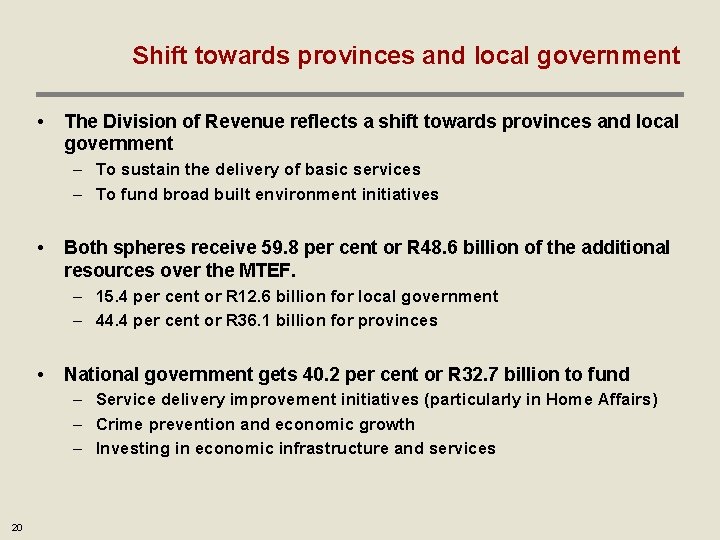
Shift towards provinces and local government • The Division of Revenue reflects a shift towards provinces and local government – To sustain the delivery of basic services – To fund broad built environment initiatives • Both spheres receive 59. 8 per cent or R 48. 6 billion of the additional resources over the MTEF. – 15. 4 per cent or R 12. 6 billion for local government – 44. 4 per cent or R 36. 1 billion for provinces • National government gets 40. 2 per cent or R 32. 7 billion to fund – Service delivery improvement initiatives (particularly in Home Affairs) – Crime prevention and economic growth – Investing in economic infrastructure and services 20
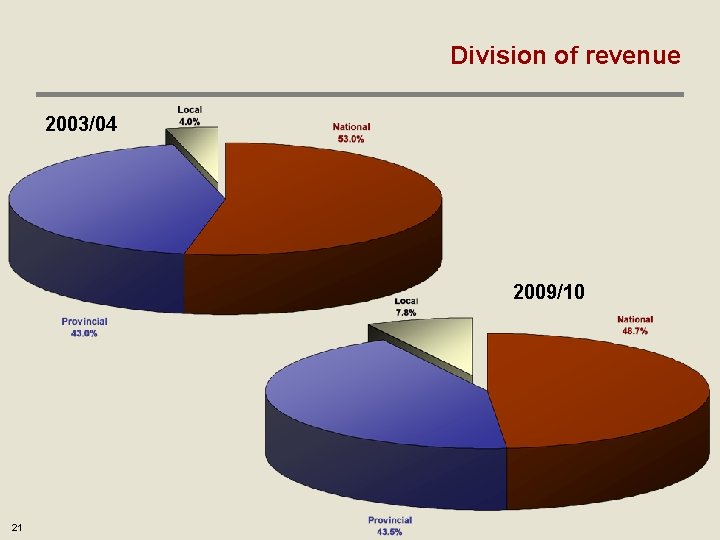
Division of revenue 2003/04 2009/10 21
Provincial priorities • R 11. 7 billion is to implement the recently concluded wage agreement – Including provision for OSD in the social sector – This is in addition to the R 12. 2 billion currently in provincial baselines • In education – Grade R; learners with special needs (inclusive education); LSM for grades 10 to 12 (NSM); education infrastructure needs • In health – General baseline adjustment to stabilise the public health system; TB (MDR and XDR); Comprehensive HIV and Aids strategy (preventative, HBC and ARVs); and hospital revitalisation • In social development – ECD (in collaboration with education); secure care services for children in conflict with the law; access home and community based care 22 • Roads, agriculture and SMME development • Housing and human settlements
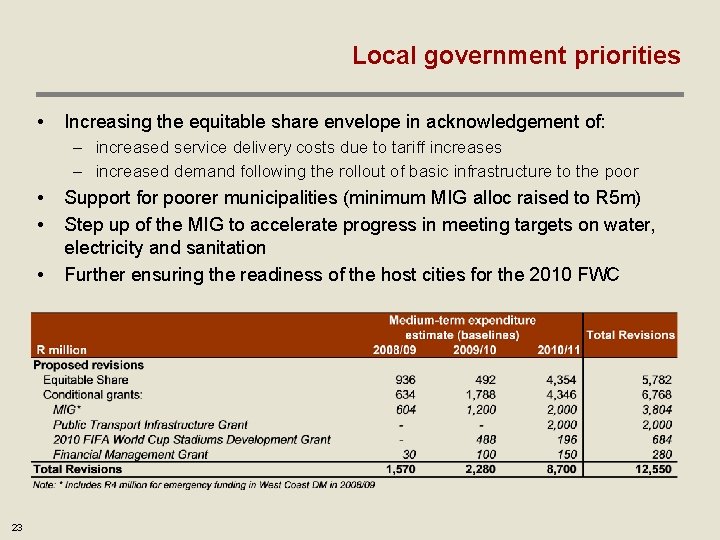
Local government priorities • Increasing the equitable share envelope in acknowledgement of: – increased service delivery costs due to tariff increases – increased demand following the rollout of basic infrastructure to the poor • • • 23 Support for poorer municipalities (minimum MIG alloc raised to R 5 m) Step up of the MIG to accelerate progress in meeting targets on water, electricity and sanitation Further ensuring the readiness of the host cities for the 2010 FWC
Policy conclusions • To meet our development objectives we must: – Invest in infrastructure and skills – Broaden access to household services and public transport – Expand the social wage and maintain a progressive social security system – Focus on microeconomic reforms to lower costs, reduce red tape and enhance labour absorption – Increase exports through productivity improvements and trade and industrial policy reforms – Improve the quality and breadth of public services – Cushion public spending from risk 24
- Slides: 24