
Medium energy ion scattering and elastic recoil detection

- Slides: 26
Medium energy ion scattering and elastic recoil detection analysis for processes in thin films and monolayers Lyudmila V. Goncharova, Sergey Dedyulin, Mitch Brocklebank Department of Physics and Astronomy, Western University , London, Ontario, Canada Collaborators: P. J. Simpson (UWO), J. Botton (Mc. Master U. ), D. Londheer (NRC) 1
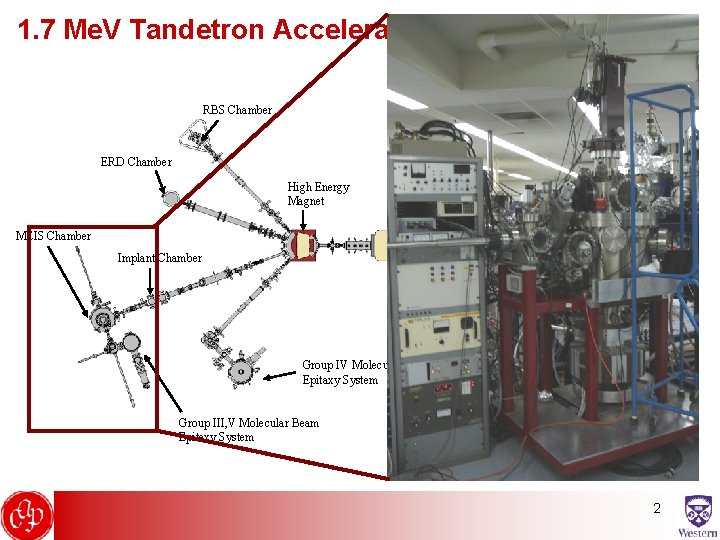
1. 7 Me. V Tandetron Accelerator Facility at UWO RBS Chamber ERD Chamber High Energy Magnet Tandetron Accelerator Injector Magnet Duoplasmatron Source MEIS Chamber Implant Chamber Sputter Source Group IV Molecular Beam Epitaxy System Group III, V Molecular Beam Epitaxy System 2
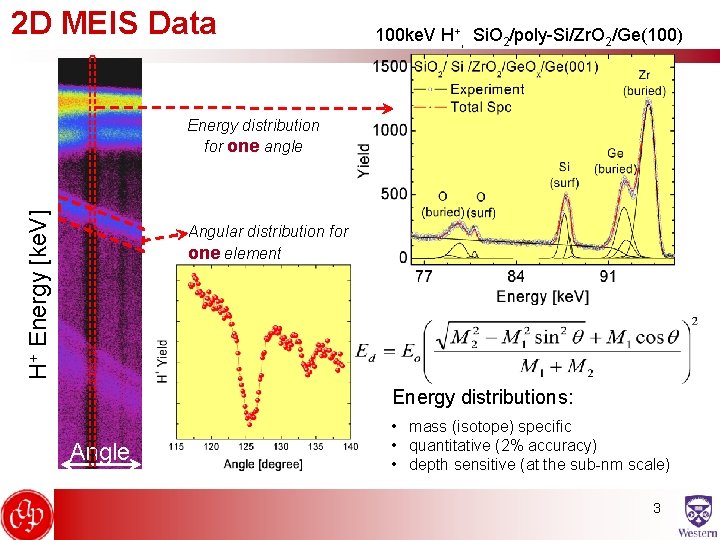
2 D MEIS Data 100 ke. V H+, Si. O 2/poly-Si/Zr. O 2/Ge(100) H+ Energy [ke. V] Energy distribution for one angle Angular distribution for one element Energy distributions: Angle • mass (isotope) specific • quantitative (2% accuracy) • depth sensitive (at the sub-nm scale) 3
Outline • Motivation • Medium Energy Ion Scattering (MEIS) - Nucleation and growth in Si and Ge quantum systems • Medium Energy Elastic Recoil Detection (ME-ERD) - H-terminated Si(001) - H in Hf. Si. Ox ultra-thin films /Si(001) • Conclusions and future directions 4
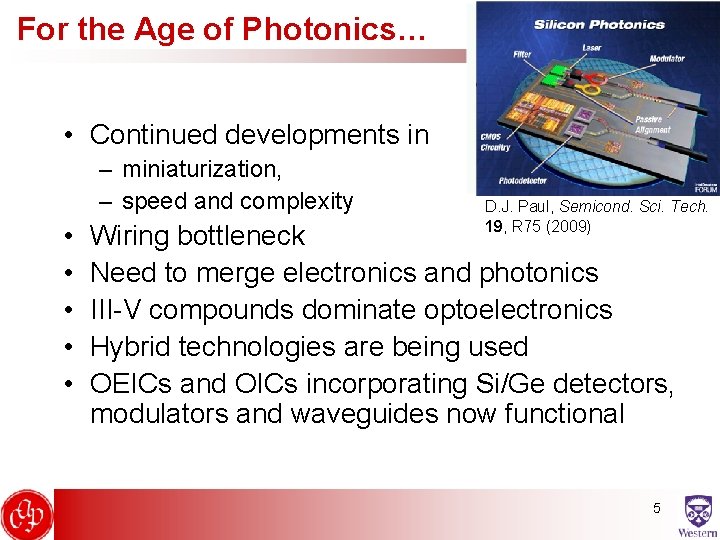
For the Age of Photonics… • Continued developments in – miniaturization, – speed and complexity • • • D. J. Paul, Semicond. Sci. Tech. 19, R 75 (2009) Wiring bottleneck Need to merge electronics and photonics III-V compounds dominate optoelectronics Hybrid technologies are being used OEICs and OICs incorporating Si/Ge detectors, modulators and waveguides now functional 5
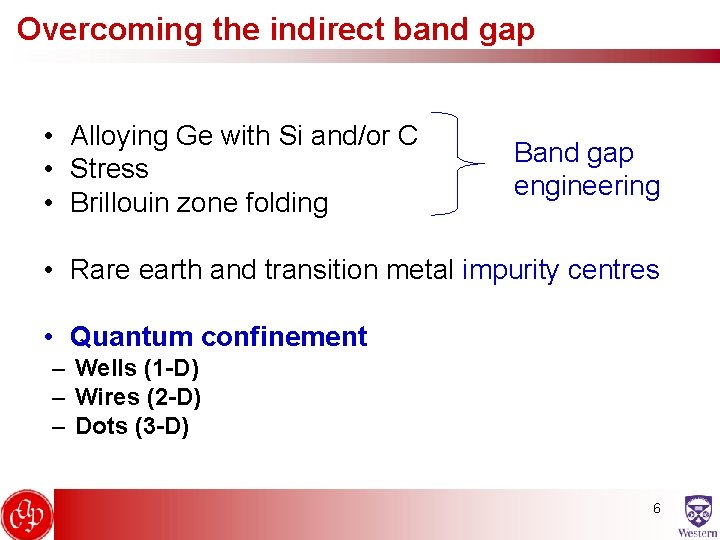
Overcoming the indirect band gap • Alloying Ge with Si and/or C • Stress • Brillouin zone folding Band gap engineering • Rare earth and transition metal impurity centres • Quantum confinement – Wells (1 -D) – Wires (2 -D) – Dots (3 -D) 6
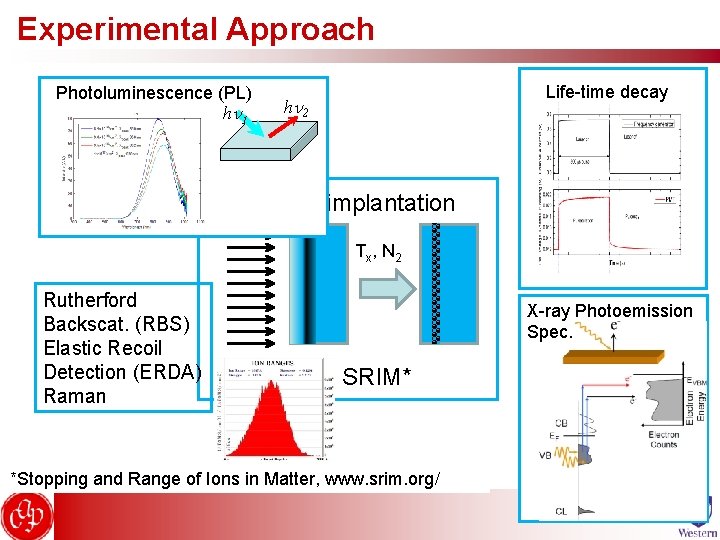
Experimental Approach Photoluminescence (PL) hn 1 Life-time decay hn 2 Ion beam implantation Tx , N 2 Rutherford Backscat. (RBS) Elastic Recoil Detection (ERDA) Raman X-ray Photoemission Spec. SRIM* *Stopping and Range of Ions in Matter, www. srim. org/ 7
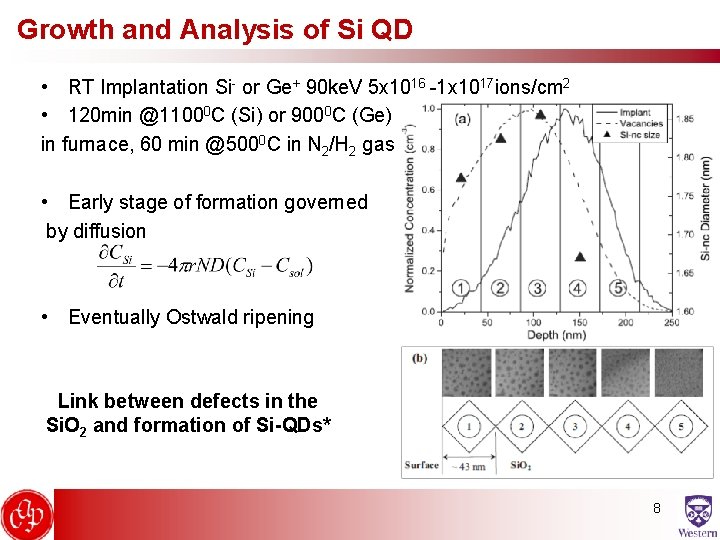
Growth and Analysis of Si QD • RT Implantation Si- or Ge+ 90 ke. V 5 x 10¹⁶ -1 x 10¹⁷ ions/cm 2 • 120 min @11000 C (Si) or 9000 C (Ge) in furnace, 60 min @5000 C in N 2/H 2 gas • Early stage of formation governed by diffusion • Eventually Ostwald ripening Link between defects in the Si. O 2 and formation of Si-QDs* 8
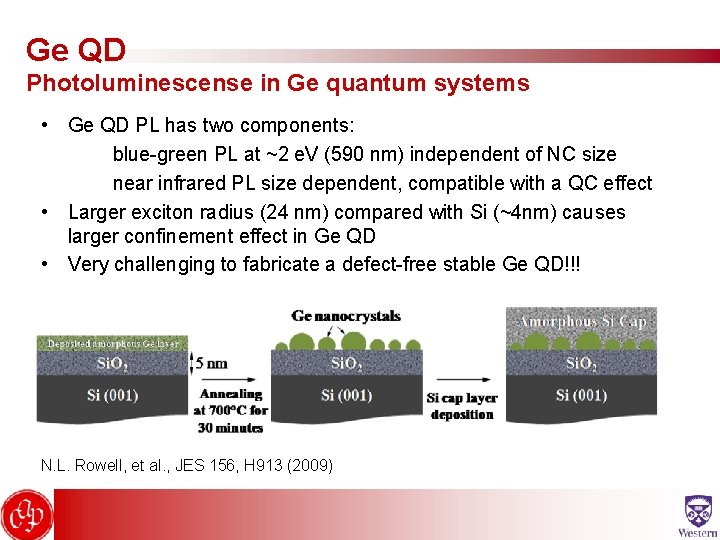
Ge QD Photoluminescense in Ge quantum systems • Ge QD PL has two components: blue-green PL at ~2 e. V (590 nm) independent of NC size near infrared PL size dependent, compatible with a QC effect • Larger exciton radius (24 nm) compared with Si (~4 nm) causes larger confinement effect in Ge QD • Very challenging to fabricate a defect-free stable Ge QD!!! N. L. Rowell, et al. , JES 156, H 913 (2009)
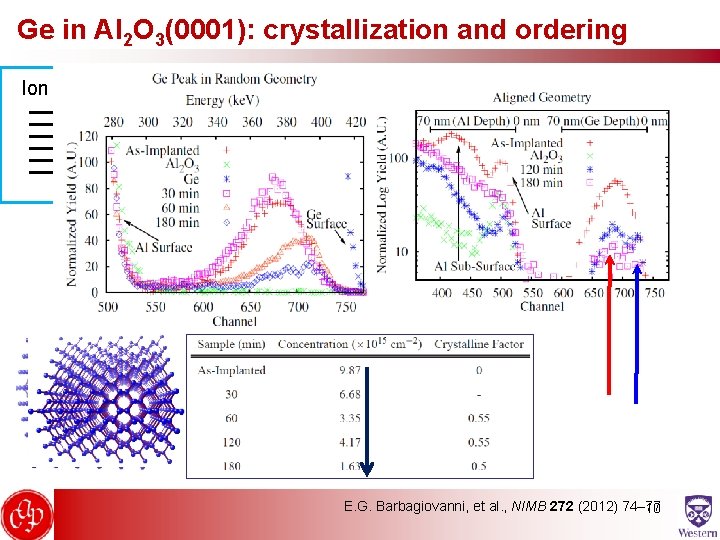
Ge in Al 2 O 3(0001): crystallization and ordering Ion beam implantation Tx , N 2 E. G. Barbagiovanni, et al. , NIMB 272 (2012) 74– 77 10
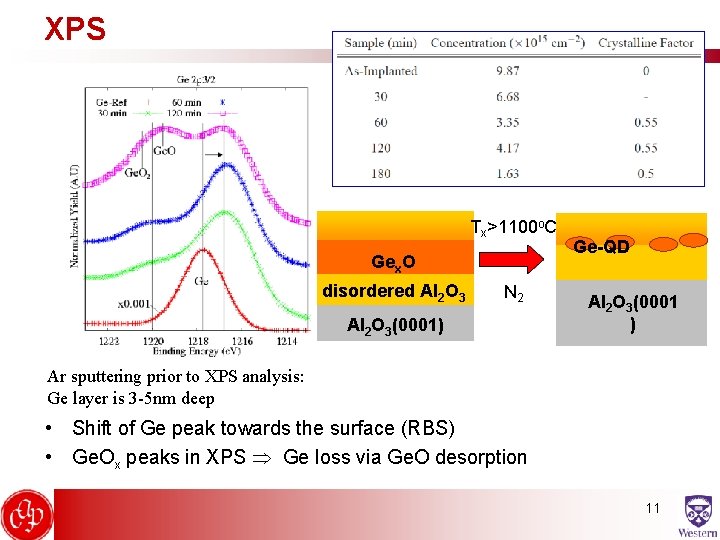
XPS Tx>1100 o. C Gex. O disordered Al 2 O 3 N 2 Al 2 O 3(0001) Ge-QD Al 2 O 3(0001 ) Ar sputtering prior to XPS analysis: Ge layer is 3 -5 nm deep • Shift of Ge peak towards the surface (RBS) • Ge. Ox peaks in XPS Ge loss via Ge. O desorption 11
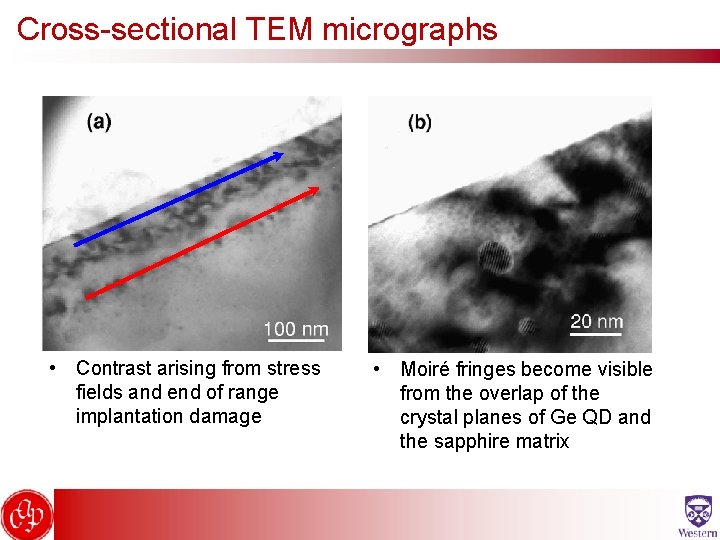
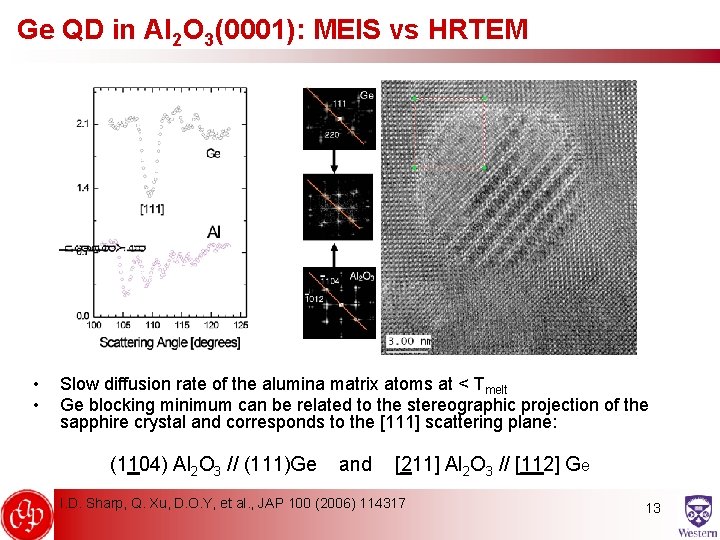
Cross-sectional TEM micrographs • Contrast arising from stress fields and end of range implantation damage • Moiré fringes become visible from the overlap of the crystal planes of Ge QD and the sapphire matrix
Ge QD in Al 2 O 3(0001): MEIS vs HRTEM • • Slow diffusion rate of the alumina matrix atoms at < Tmelt Ge blocking minimum can be related to the stereographic projection of the sapphire crystal and corresponds to the [111] scattering plane: (1104) Al 2 O 3 // (111)Ge and [211] Al 2 O 3 // [112] Ge I. D. Sharp, Q. Xu, D. O. Y, et al. , JAP 100 (2006) 114317 13
Outline • Motivation • Medium Energy Ion Scattering (MEIS) - Nucleation and growth in SI and Ge quantum systems • Medium Energy Elastic Recoil Detection (ME-ERD) - H-terminated Si(001) - H in Hf. Si. Ox ultra-thin films /Si(001) • Conclusions and future directions 14
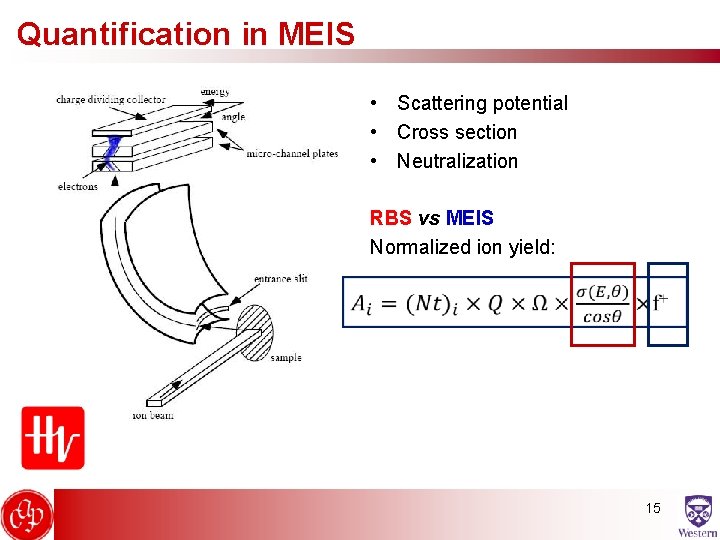
Quantification in MEIS • Scattering potential • Cross section • Neutralization RBS vs MEIS Normalized ion yield: 15
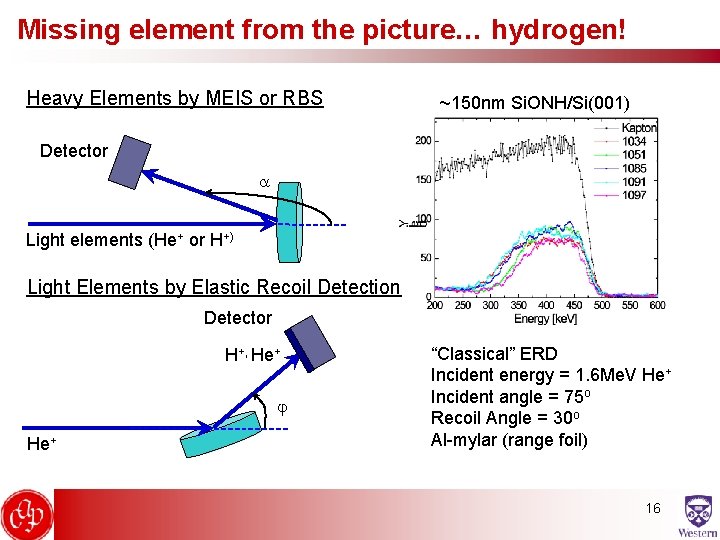
Missing element from the picture… hydrogen! Heavy Elements by MEIS or RBS ~150 nm Si. ONH/Si(001) Detector a Light elements (He+ or H+) Light Elements by Elastic Recoil Detection Detector H+, He+ “Classical” ERD Incident energy = 1. 6 Me. V He+ Incident angle = 75 o Recoil Angle = 30 o Al-mylar (range foil) 16
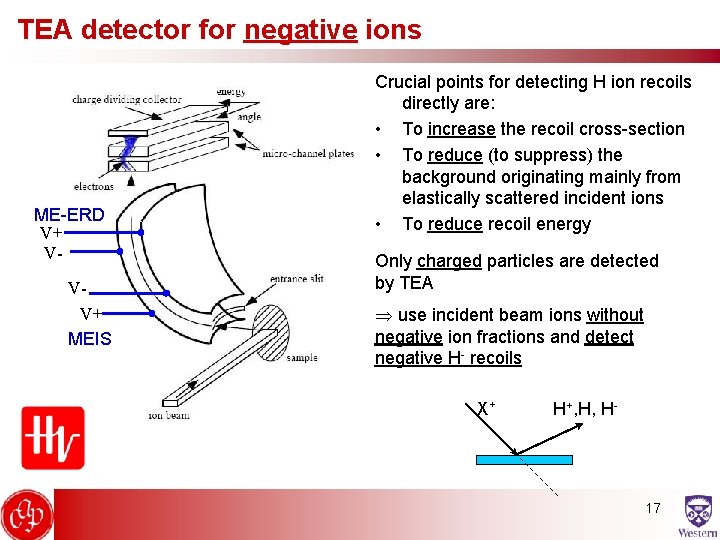
TEA detector for negative ions ME-ERD V+ VVV+ MEIS Crucial points for detecting H ion recoils directly are: • To increase the recoil cross-section • To reduce (to suppress) the background originating mainly from elastically scattered incident ions • To reduce recoil energy Only charged particles are detected by TEA use incident beam ions without negative ion fractions and detect negative H- recoils X+ H+, H, H- 17
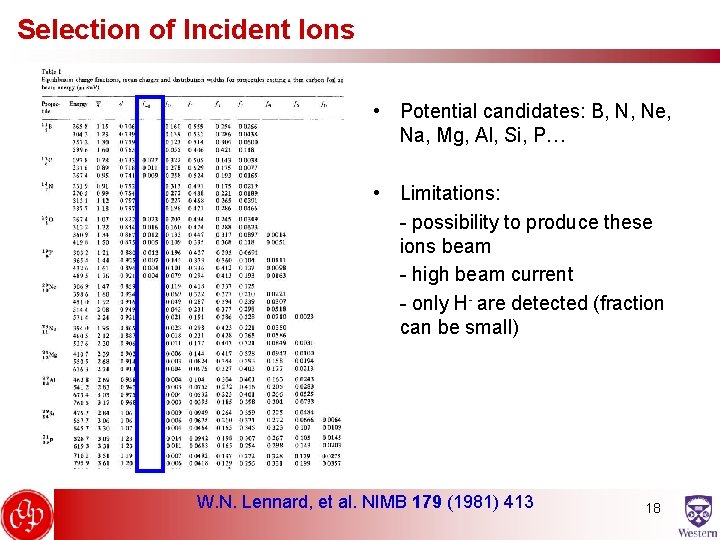
Selection of Incident Ions • Potential candidates: B, N, Ne, Na, Mg, Al, Si, P… • Limitations: - possibility to produce these ions beam - high beam current - only H- are detected (fraction can be small) W. N. Lennard, et al. NIMB 179 (1981) 413 18
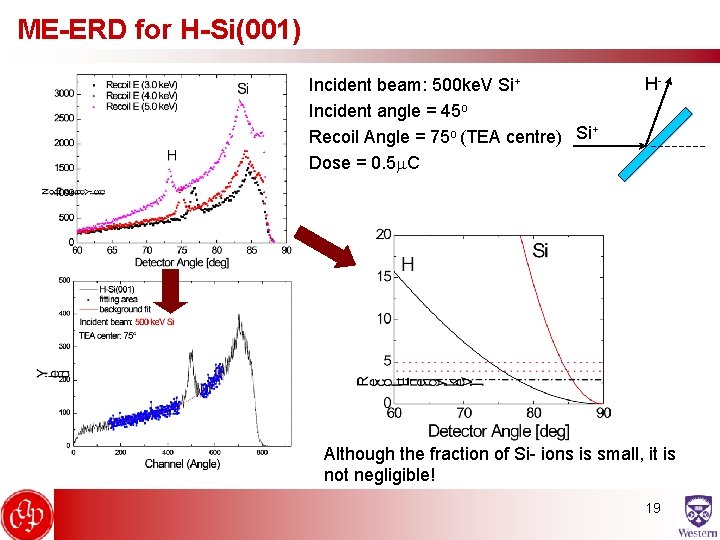
ME-ERD for H-Si(001) Incident beam: 500 ke. V Si+ Incident angle = 45 o + Recoil Angle = 75 o (TEA centre) Si Dose = 0. 5 m. C H- Although the fraction of Si- ions is small, it is not negligible! 19
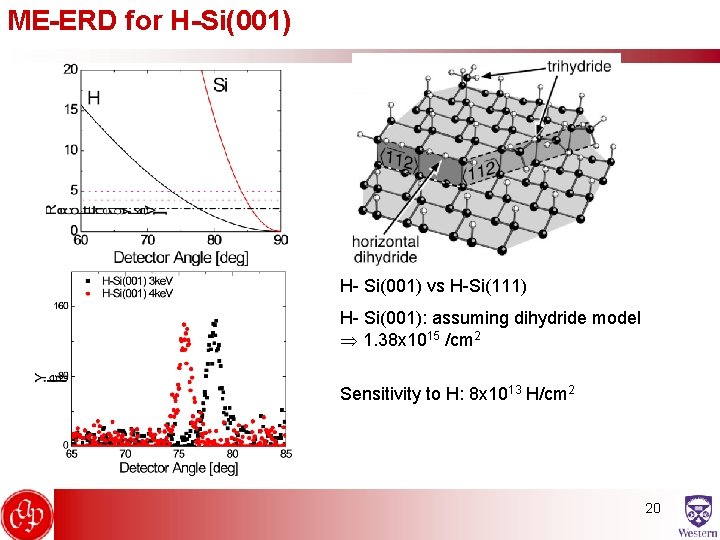
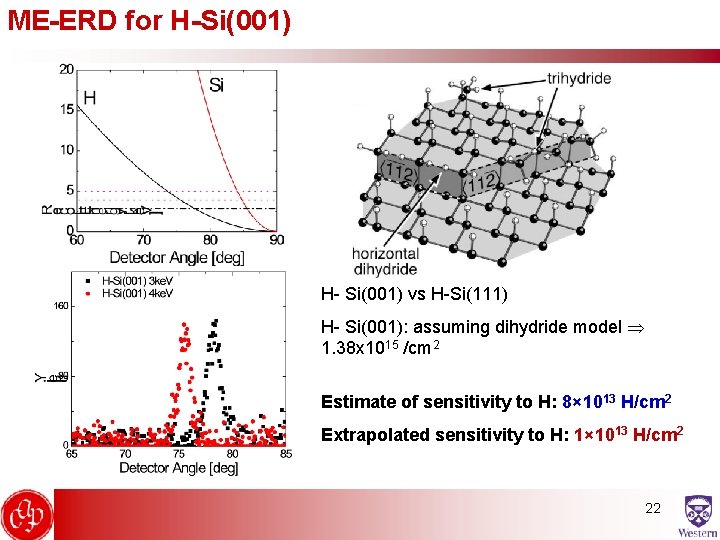
ME-ERD for H-Si(001) H- Si(001) vs H-Si(111) H- Si(001): assuming dihydride model 1. 38 x 1015 /cm 2 Sensitivity to H: 8 x 10¹³ H/cm 2 20
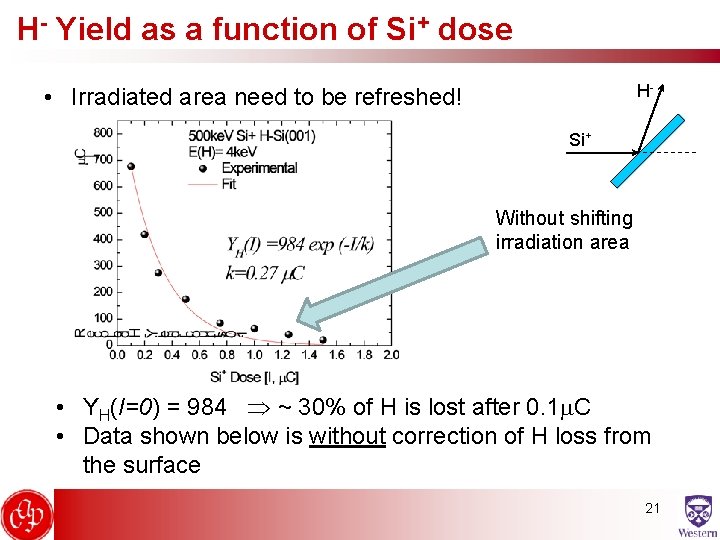
H- Yield as a function of Si+ dose H- • Irradiated area need to be refreshed! Si+ Without shifting irradiation area • YH(I=0) = 984 ~ 30% of H is lost after 0. 1 m. C • Data shown below is without correction of H loss from the surface 21
ME-ERD for H-Si(001) H- Si(001) vs H-Si(111) H- Si(001): assuming dihydride model 1. 38 x 1015 /cm 2 Estimate of sensitivity to H: 8× 10¹³ H/cm 2 Extrapolated sensitivity to H: 1× 10¹³ H/cm 2 22
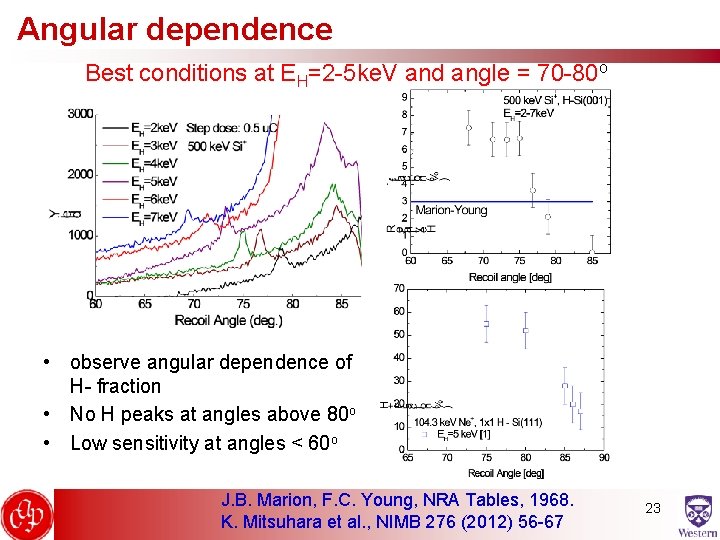
Angular dependence Best conditions at EH=2 -5 ke. V and angle = 70 -80 o • observe angular dependence of H- fraction • No H peaks at angles above 80 o • Low sensitivity at angles < 60 o J. B. Marion, F. C. Young, NRA Tables, 1968. K. Mitsuhara et al. , NIMB 276 (2012) 56 -67 23
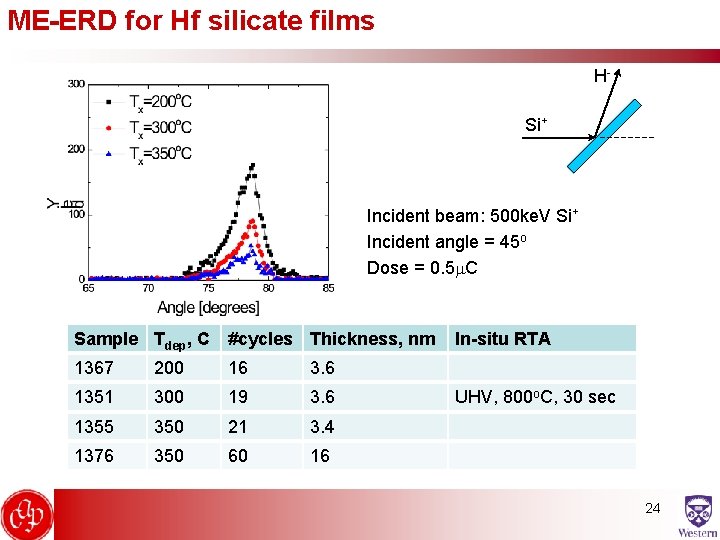
ME-ERD for Hf silicate films HSi+ Incident beam: 500 ke. V Si+ Incident angle = 45 o Dose = 0. 5 m. C Sample Tdep, C #cycles Thickness, nm 1367 200 16 3. 6 1351 300 19 3. 6 1355 350 21 3. 4 1376 350 60 16 In-situ RTA UHV, 800 o. C, 30 sec 24
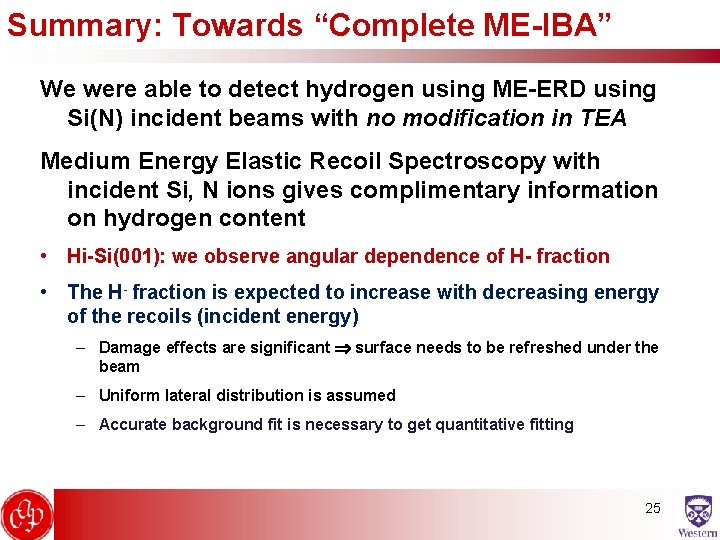
Summary: Towards “Complete ME-IBA” We were able to detect hydrogen using ME-ERD using Si(N) incident beams with no modification in TEA Medium Energy Elastic Recoil Spectroscopy with incident Si, N ions gives complimentary information on hydrogen content • Hi-Si(001): we observe angular dependence of H- fraction • The H- fraction is expected to increase with decreasing energy of the recoils (incident energy) – Damage effects are significant surface needs to be refreshed under the beam – Uniform lateral distribution is assumed – Accurate background fit is necessary to get quantitative fitting 25
Thank you! 26