
Medieval Europe Dark Ages to the Renaissance Life
- Slides: 34
Medieval Europe Dark Ages to the Renaissance
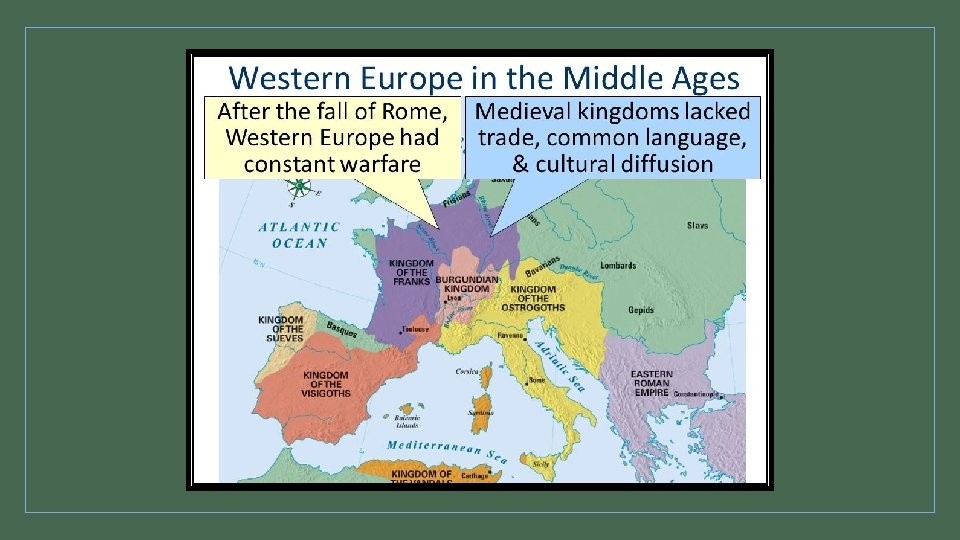
Life After the Fall of Rome • The last Latin speaking (non-Byzantine) emperor lost power in Rome in 476 CE • After this, centralized political authority, long distance trade, urbanization, & literacy slowly declined in Western Europe • Germanic tribes flooded into the region & established hundreds of small kingdoms and tribal chiefdoms • The political authority tended to be weak & dependent on ruler’s ability to provide protection • Borders & thrones shifted often as war between and within kingdoms was common
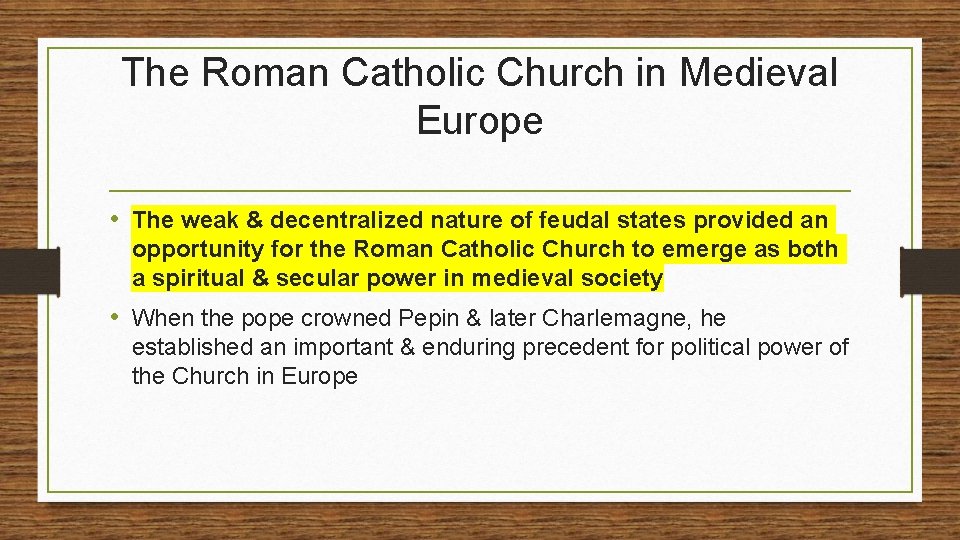
Unity Under the Carolingian Dyansty • A semblance of political unity & cultural revival emerged under the Carolingian Dynasty of the Franks • about 751 to 814 • The Carolingian kings gained & expanded power through alliance with Roman Catholic Church • The pope crowned the first Carolingian King, Pepin, the “king by grace of God. ” • This established a tradition of the pope claiming the right to confer secular political power on kings
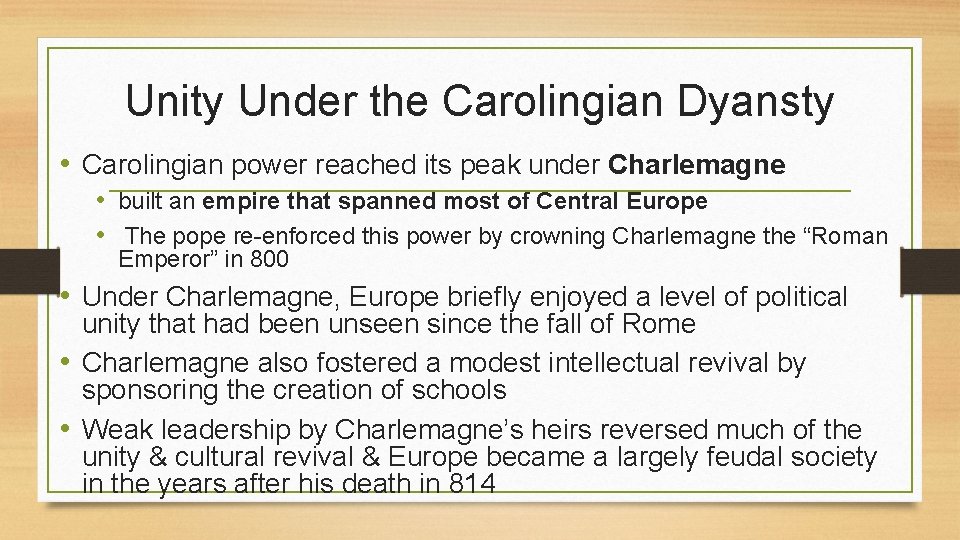
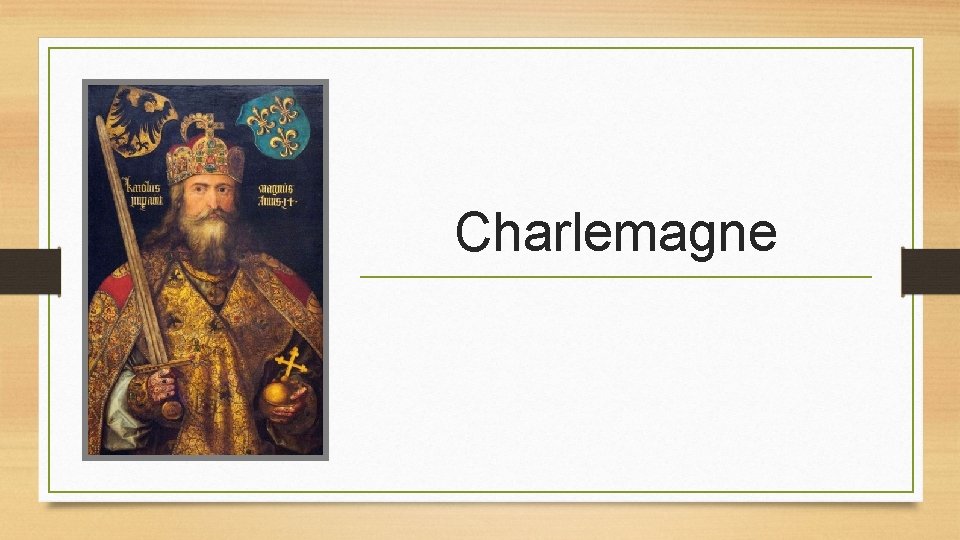
Unity Under the Carolingian Dyansty • Carolingian power reached its peak under Charlemagne • built an empire that spanned most of Central Europe • The pope re-enforced this power by crowning Charlemagne the “Roman Emperor” in 800 • Under Charlemagne, Europe briefly enjoyed a level of political unity that had been unseen since the fall of Rome • Charlemagne also fostered a modest intellectual revival by sponsoring the creation of schools • Weak leadership by Charlemagne’s heirs reversed much of the unity & cultural revival & Europe became a largely feudal society in the years after his death in 814
Charlemagne
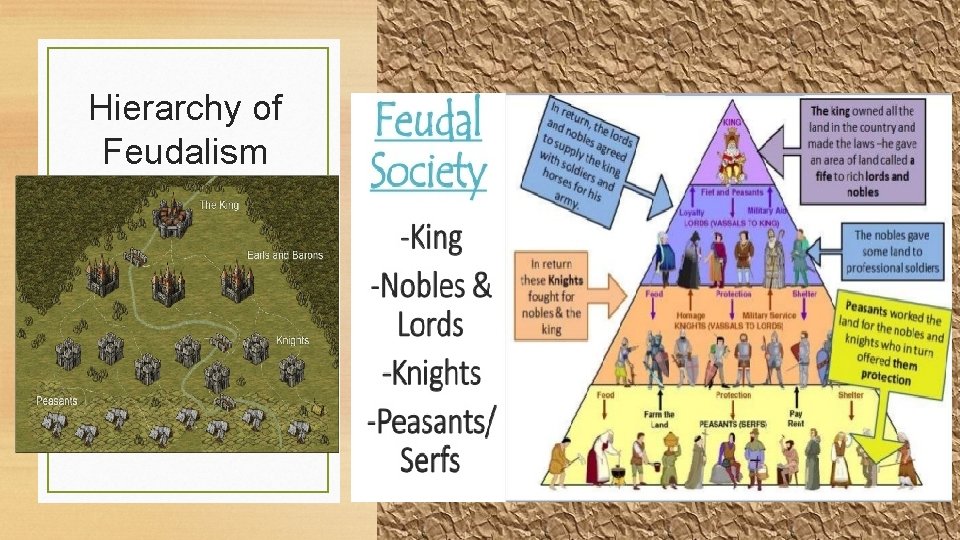
Feudal Europe • Feudalism took shape slowly & varied from place to place • In the past has been simplified into a strict hierarchy • kings granted lands to nobles • nobles granted lands to knights in exchange for oaths of loyalty & military service • Most modern historians see it as a gross simplification of a system that would be more accurately described as a web
Hierarchy of Feudalism
Feudal Europe • At its most basic level, feudalism was a system that linked landholding with military service • Kings did grant land (called fiefs) to vassal in exchange for military service and oaths of loyalty • land grants might be quite large, made to a lord who also received a title of nobility like duke or marquess. • land grants might also be small to a knight who served in the king’s personal army • Recipients of large land grants might in turn grant out fiefs to lesser nobles or knights who served in their personal army • It was not uncommon for kings, nobles & knights to be vassal to more than one lord having received land grants & possibly even titles from more than one person • The system became more complicated as it became hereditary over time • Titles of nobility & the fiefs might pass from one family to another through marriage
Feudal Europe • The original inhabitants of the land granted to these vassals became serfs in most of Europe. • As a serf they were legally bound to the land obliged to work as farmers for the lord • In other areas these inhabitants might be free peasant farmers who were free to leave but generally had no incentive to do so
Feudal Europe • Under feudalism Europe became highly decentralized • While long distance trade never completely disappeared, it was greatly reduced • the old Roman system of roads fell into disrepair • This decentralization forced much of Europe to become largely self-sufficient
Feudal Europe • Each feudal lord maintained a manor • The term manor is used to describe this self-sufficient economic system that developed on the feudal lord’s fief • most if not all of the basic necessities of life were produced here • The typical manor included the lord’s manor house, a church, workshops, a mill, a village of cottages for peasants or serfs, pastures for livestock & farmland • The peasants or serfs were obligated to provide labor to the lord & pay taxes • The lord was obligated to maintain order, provide housing & protect to
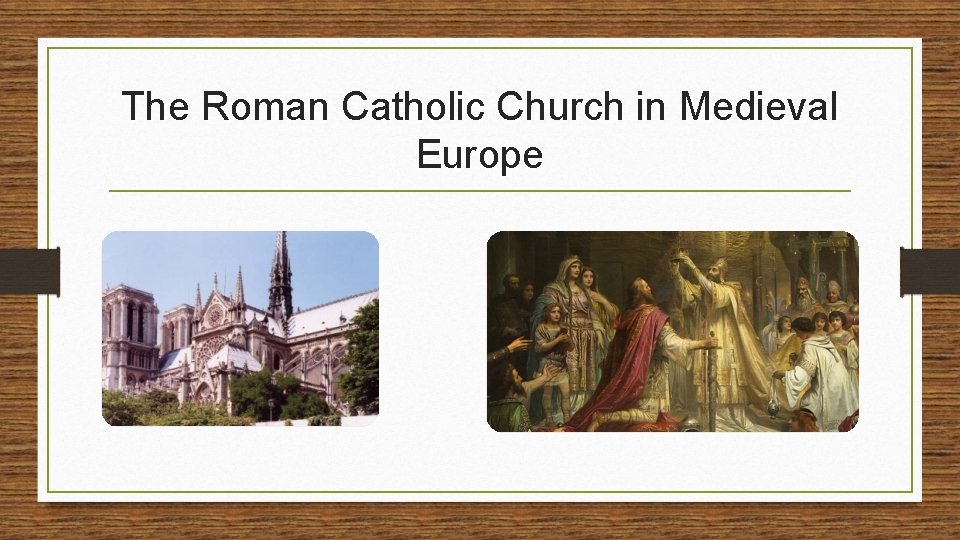
The Roman Catholic Church in Medieval Europe
Learning Target • I can explain the role of the Church in Medieval Europe.
The Roman Catholic Church in Medieval Europe • The weak & decentralized nature of feudal states provided an opportunity for the Roman Catholic Church to emerge as both a spiritual & secular power in medieval society • When the pope crowned Pepin & later Charlemagne, he established an important & enduring precedent for political power of the Church in Europe
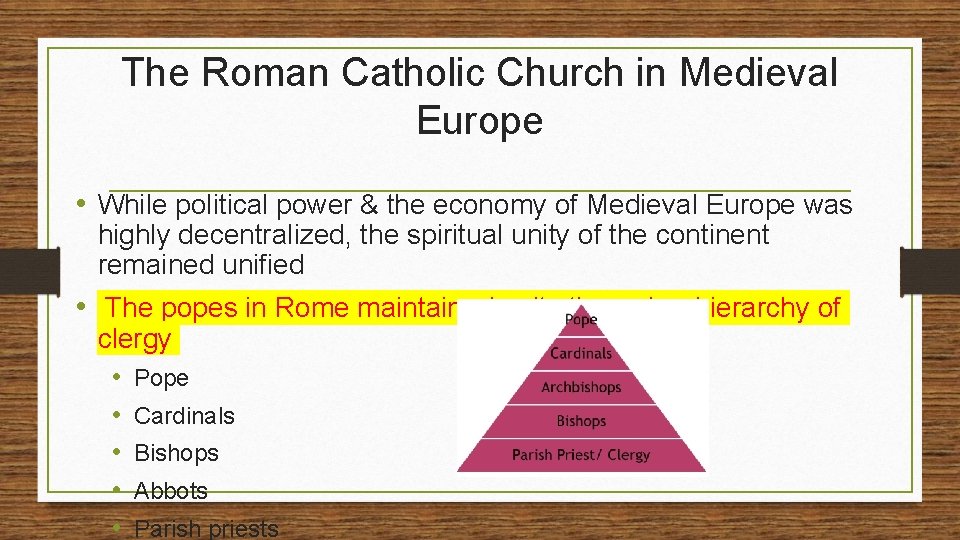
The Roman Catholic Church in Medieval Europe • While political power & the economy of Medieval Europe was highly decentralized, the spiritual unity of the continent remained unified • The popes in Rome maintained unity through a hierarchy of clergy • Pope • Cardinals • Bishops • Abbots • Parish priests
The Roman Catholic Church in Medieval Europe • The authority of the clergy over royalty, nobility & common people was reinforced by several factors • First, medieval Catholicism taught that only the clergy could interpret the scripture. • Reinforced by the fact bibles were written in Latin which most people could not read • Second, the clergy alone could administer 7 sacraments, or rituals, that the church said were required to achieve internal salvation in heaven • Third, the church enforced a law code (canon law), on all believers
The Roman Catholic Church in Medieval Europe • Canon law regulated the behavior of all church members • enforced by a network of courts that had the authority to arrest & punish violators • punishment of the most extreme forms of heresy included torture & execution. • The most powerful tool of the church in maintaining its power was the threat & use of excommunication & interdict. • Interdicts sometimes denied entire regions certain religious rites and/or sacrements • Excommunication expelled a believer from the church, thus denying them any opportunity to achieve eternal salvation & as a result condemning them to eternal punishment in hell
The Roman Catholic Church in Medieval Europe • In addition to political and religious authority, the church was also an important force in maintaining cultural unity in Europe. • While educational opportunities were rare in Medieval Europe, the network of Catholic monasteries did provide some opportunities for scholarship & research • Catholic church constructed several monumental gothic cathedrals during this period that endure as high points in European art & architecture to this day
Growth of Trade in the Medieval Period • The increase in trade & urbanization of Europe was precipitated by population growth that began around 800 • This population growth was the product of a mixture of climatic conditions & technological innovations which led to an increase in food supply • From about 800 to 1200, Europe experienced a warm spell that allowed a fairly dramatic increase in land available for cultivation & an extension of the growing season
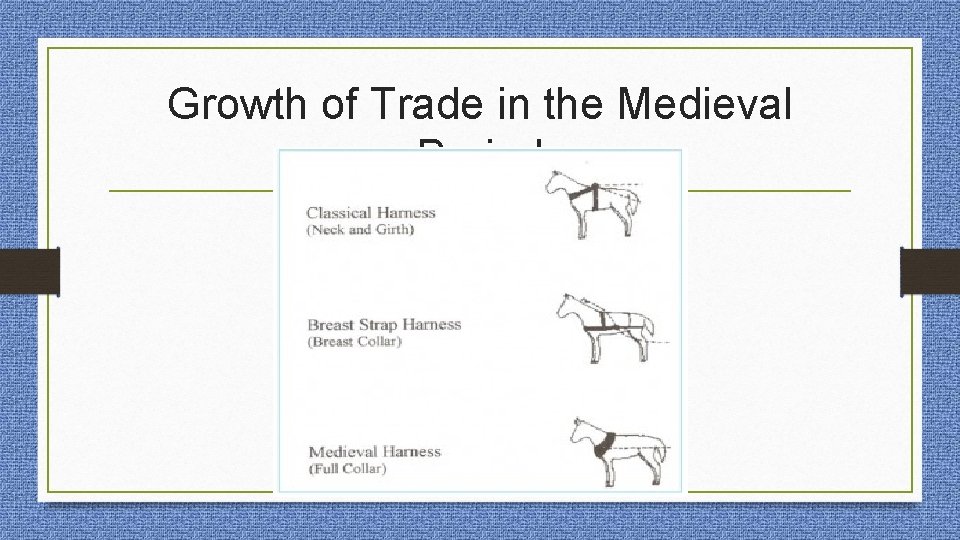
Growth of Trade in the Medieval Period • Sometime around 800, several new farming technologies were either developed or diffused to Europe from North Africa • These include the horse collar & breast-strap harness. • allowed Europeans to replace oxen with horses in agricultural work, a major advance because a horse can plow about 3 times faster than an ox
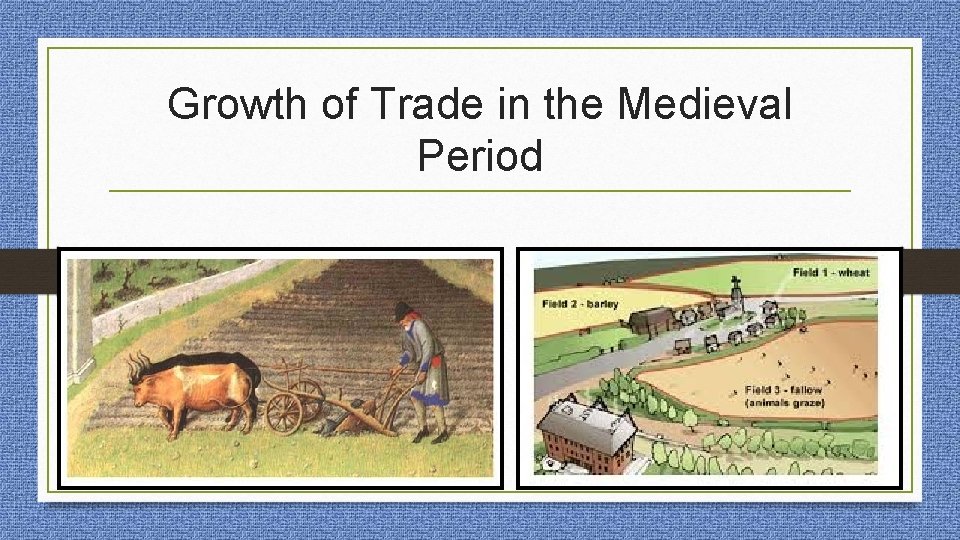
Growth of Trade in the Medieval Period • Other agricultural innovations include the heavy plow & the 3 field system • The heavy plow used a large metal blade to cut into the soil thus increasing the efficiency of farmer’s work • 3 field system improved efficiency by increasing the amount & fertility of land under cultivation • The mild climate & improvements in technology led to rapid population growth which in part spurred what historians term a commercial revolution in Europe around 1000.
Growth of Trade in the Medieval Period
Growth of Trade in the Medieval Period
Growth of Trade in the Medieval Period • During the early years of this commercial revolution regional fairs • • • emerged. Fairs were generally held on religious holidays in or near the few small towns that existed in Medieval Europe Peasants from nearby manors would travel to fairs to buy & sell goods Traveling merchants that brought exotic goods from the east As fairs became larger & more frequent they spurred the growth of towns. As towns grew, they became increasingly independent existing largely outside of the authority & traditions of the feudal system Towns grew into cities, particularly in areas with access to seaborne trade like Italy & Flanders.
Growth of Trade in the Medieval Period • At the height of this commercial revolution several new business institutions developed • included the guilds & banks • Guilds were organizations of merchants & artisans that worked together to regulate business practices to ensure the profitability & viability of their respective commodities • Banking provided loans & infrastructure for the monetization of the economy
Growth of Trade in the Medieval Period • The commercial revolution & urbanization in Europe gave birth to a new social class in the region • made up of artisans, merchants & bankers • lived in cities that were outside of the jurisdiction of the feudal system. • Many feudal monarchs attempted to bring these cities under their authority, but were successful • Cities like Venice & Florence became independent republics ruled by this new class that became known as
Growth of Trade in the Medieval • In 1347, a Genoese merchant fleet carrying the bubonic plague docked in Period Sicily, four years later the plague spread to almost all of Europe • killed about one-third of the population • Bubonic plague both fostered & reversed the trends set in motion by the commercial revolution • fear and death diminished populations in European cities, decreased trade and drove up prices • severely undermined the feudal system • led to economic growth & development • The massive deaths brought on by the plague increased demand for peasant labor which in turn increased their ability to demand higher wages. • When nobles refused to increase wages, serfs & peasants fought back in violent rebellions in England, France, Italy, and Belgium • Grip of nobility on the peasantry of Europe was weakened allowing greater freedom to pursue economic self-interest
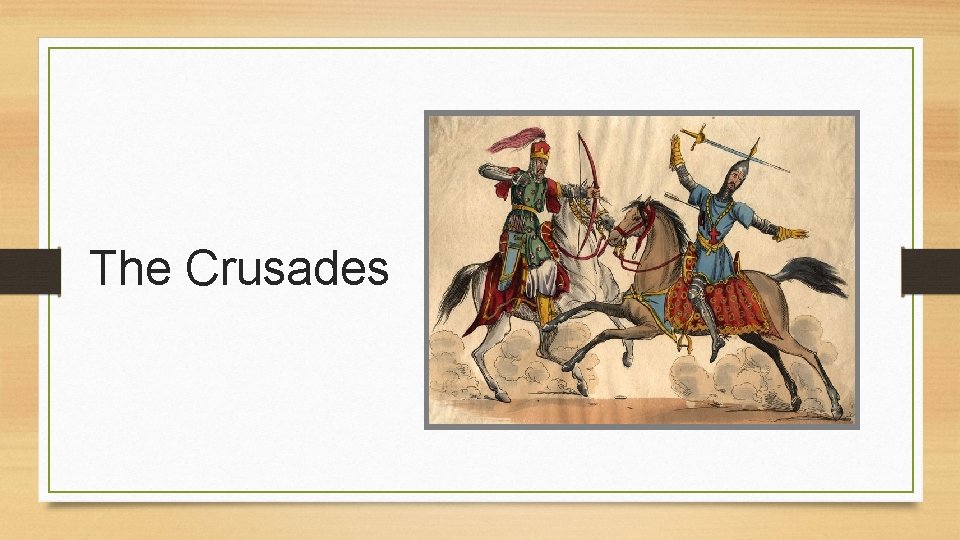
The Crusades
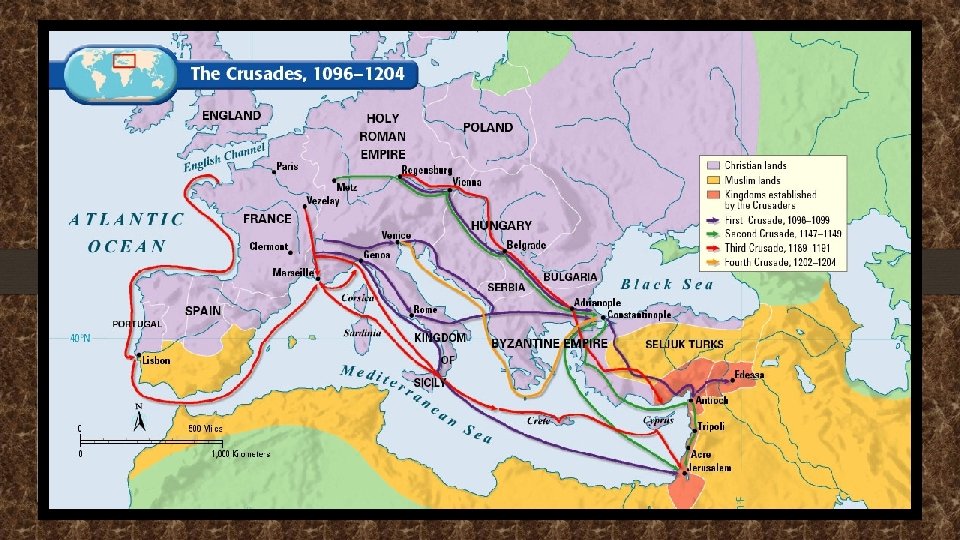
The Crusades • In 1037, the Seljuk Turks established an empire in the Middle East • Seljuk power threatened the Byzantine Empire by 1093 • led emperor to solicit help from Pope Urban II • Urban responded by calling for the first Crusade to free Jerusalem from Muslim rule. • The first Crusade set off in 1096 & lasted until 1099 • successfully drove Turks from Jerusalem • established 4 small Christian kingdoms in the Middle East • Success of first Crusaded short lived • in less than 100 years Jerusalem was back in the hands of the Muslim Turks • Christians of Europe organized several Crusades over next 300 years but were never able to retake Jerusalem
The Crusades
The Crusades • Motivation for the Crusades was a mix of genuine religious zealotry, economic self- interest, & political opportunism • Devout Christians found motivation in the fact that Seljuk Turks denied Christian pilgrims access to Jerusalem & pope’s promise of guaranteed salvation for all those who died on Crusade • Those seeking economic advantage hoped that Crusades would offer opportunities for booty & land • particularly inviting to the younger sons of nobles • Under feudal tradition, the oldest son inherited his father’s land & titles leaving little opportunity to younger brothers • The Crusades offered these young men a chance to obtain land & titles in newly conquered territory • Italian merchants sought profit from financing & transporting Crusader armies & hoped that success on the battlefield would bring Christian control of lucrative trade routes. • The popes hoped that Crusades would bring peace to Europe by uniting quarreling knights against a common enemy abroad & reinforce power of the papacy in
The Crusades • Stated goals of Crusades were only realized for a brief period, other effects on Europe long endured • The Crusades stimulated Mediterranean trade • The coastal Crusader states established in the first Crusade facilitated trade between Asia & Europe • exposure of Europeans to Asian goods while on Crusade increased demand for Asian commodities • Europeans were also exposed to Muslim scholarship while on Crusade • included translated works of many of the classical Greek philosophers • Many of these works had largely been forgotten in Europe & were only rediscovered by Europeans by way of Arab translations • Arab, Persian, & Greek scholarship helped spur an intellectual awakening in Europe in the early 15 th century
The Crusades • The Crusades also helped to undermine the feudal order in Europe. • The Crusades offered opportunities to all levels of society • Kings found greater power & influence as the armies consolidated under their leadership • Serfs gained freedom & sometimes wealth from participating in Crusades • A few lucky nobles gained titles & land in the short-lived Crusader States • To the east, the Crusades left a legacy of animosity • During the fourth Crusade, motivated by economic opportunity, Western European Christians sacked and looted Constantinople. This attack only increased the divide between the Roman Catholic Church & Eastern Orthodox Church • Years later in the 19 th and 20 th century the history of the European Crusades against the Muslim world became a tool of Turkish and Arab nationalism