
Medieval and Renaissance Science and the Scientific Revolution
- Slides: 52
Medieval and Renaissance Science, and the Scientific Revolution
Medieval Science as Precursor to Renaissance Science • Flowering of science in Christian West from 11 th to 14 th centuries • Not the “Dark Ages” (invention of the Renaissance) • Esoteric sciences like Hermeticism based on vertical causality were also introduced to the West through the Islamic world (yet another darshana to “finding God in all things)
Vertical Causality in Hermetic Philosophy & Science • “That which is lowest symbolizes that which is highest” • Correspondences between metals (“the lowest”) and astronomy (“the heavens”), the meaning of metallurgy, and another complementary path to “finding God in all things” • Hermetic corpus in Alexandria • Hermes (Idris and Enoch) • Jabir ibn Hayyan (Geber) • Alchemy and Shakespeare, Newton, Locke, Dee, “founding fathers, ” Jamestown
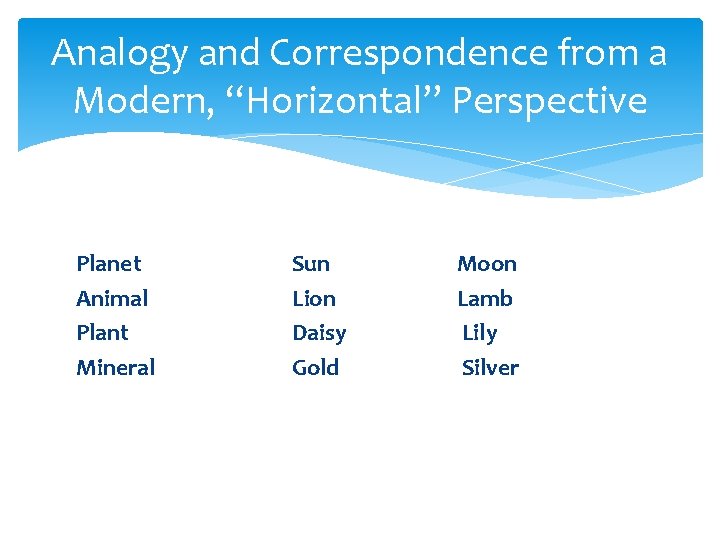
Analogy and Correspondence from a Modern, “Horizontal” Perspective Planet Animal Plant Mineral Sun Lion Daisy Gold Moon Lamb Lily Silver
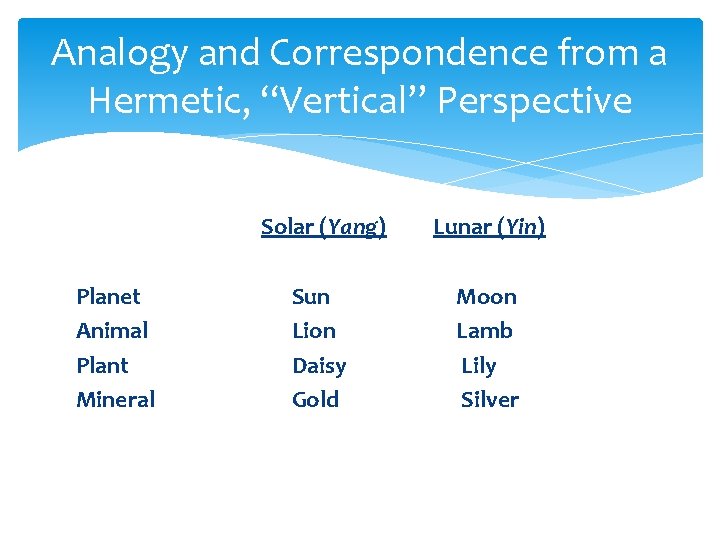
Analogy and Correspondence from a Hermetic, “Vertical” Perspective Planet Animal Plant Mineral Solar (Yang) Lunar (Yin) Sun Lion Daisy Gold Moon Lamb Lily Silver
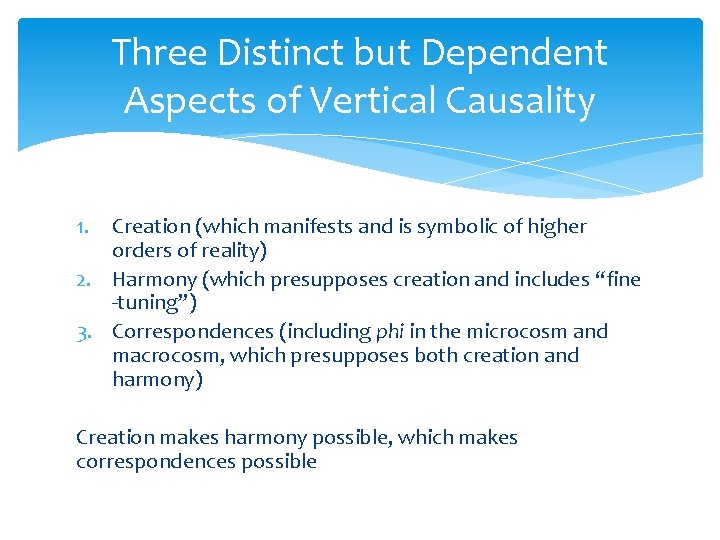
Three Distinct but Dependent Aspects of Vertical Causality 1. Creation (which manifests and is symbolic of higher orders of reality) 2. Harmony (which presupposes creation and includes “fine -tuning”) 3. Correspondences (including phi in the microcosm and macrocosm, which presupposes both creation and harmony) Creation makes harmony possible, which makes correspondences possible
Renaissance Science • Continuation of medieval science (not philosophy) • Education of St. Ignatius of Loyola, St. Francis Xavier, and the other early Jesuits at the University of Paris was infused with the interconnection between religion and science based on vertical causality • Occult sciences become more “popular” outwardly but misunderstood inwardly • Notion that the Renaissance implies a radical change in science (not philosophy) is incorrect • Role of exploration of the “New World”
Seeds of Decline in Grasping the Liberal Arts and “Sacred Science”: Nominalism vs. Realism • Denial of ability of intelligence to know universals and therefore the nature of things • Philosophical doubt about the relation between reason and revelation • Separation between religion and science
Five Figures in the Transition to Modern Science • • • Copernicus (1473 – 1543) Galileo (1564 – 1642) Descartes (1596 – 1650) Kepler (1571 – 1630) Newton (1642 – 1726)
Copernicus and Geocentric vs. Heliocentric Models • Copernicus provides theological reasons for the heliocentric model based on God’s love of simplicity • Heliocentric model based on the work of Nasir al-Din Tusi in the first international observatory in history in the School of Maraghah (13 th century – after the Mongol invasion) • Line of transmission to Copernicus – Orthodox priests in Maraghah who traveled to Krakow • al-Biruni – either model is scientifically acceptable, so science is indifferent on this question • Question for theology
Scientific Status of the Geocentric Model According to Einstein “The struggle, so violent in the early days of science, between the views of Ptolemy and Copernicus would then be quite meaningless. Either CS [coordinate system] could be used with equal justification. The two sentences, ‘the sun is at rest and the earth moves, ’ or ‘the sun moves and the earth is at rest, ’ would simply mean two different conventions concerning two different CS. ” Albert Einstein and Leopold Infeld, The Evolution of Physics: From Early Concepts to Relativity and Quanta (New York: Touchstone, 1966), 212. (Original copyright 1938)
Scientific Status of the Geocentric Model According to Hawking “So which is real, the Ptolemaic or Copernican system? Although it is not uncommon for people to say that Copernicus proved Ptolemy wrong, that is not true. As in the case of our normal view versus that of the goldfish, one can use either picture as a model of the universe, for our observations of the heavens can be explained by assuming either the earth or the sun to be at rest. ” Stephen Hawking and Leonard Mlodinow, The Grand Design (New York: Bantam, 2010), 41 -42
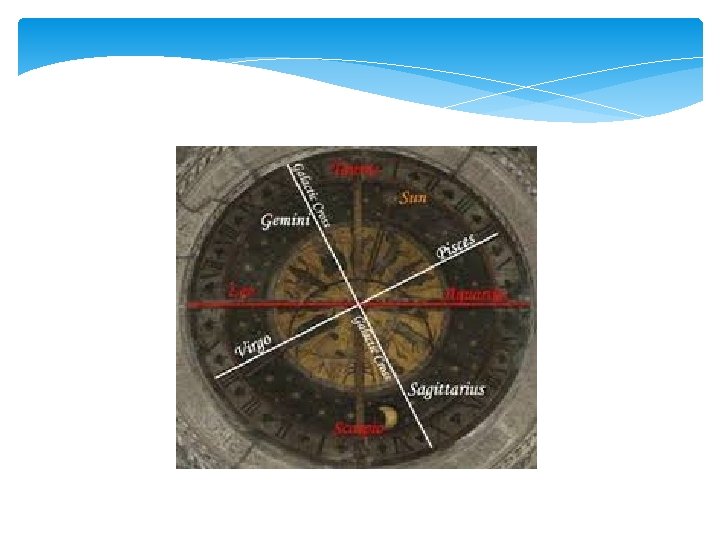
Scientific Status of the Geocentric Model According to the Cosmic Microwave Background Radiation (CMB) Map • The earth is at or near the center of the cosmos • The cosmos is not homogeneous as “Big Bang” theory would predict (“Big Bang Goes Big Bust” according to Washington Post headline) • The cosmos aligns with the “tilt” of the earth (ecliptic) on one hand the equator of the earth on the other hand • “X” marks the spot with three satellites of increasing accuracy confirming CMB Map • This has caused great consternation among scientists, since it implies the earth is in a special location with the entire cosmos “pointing” to us (with all this implies for who we are) – does this suggest the cosmos is not indifferent to us and that intelligent design and vertical causality are at work with earth as the locus of Revelation?
Lawrence Krauss on CMB Map After Second Probe (WMAP) Confirmation “But when you look at CMB map, you also see that the structure that is observed, is in fact, in a weird way, correlated with the plane of the earth around the sun. Is this Copernicus coming back to haunt us? That’s crazy. We’re looking out at the whole universe. There’s no way there should be a correlation of structure with our motion of the earth around the sun – the plane of the earth around the sun – the ecliptic. That would say we are truly the center of the universe. ”
Max Tegmark on CMB Map After Third Probe (Planck) Confirmation “When the first image comes up on the screen [of the most precise Planck mission], I lined it up with this cleaned image of the data that we had made way back in the past, and it all matches! This spot matches this spot, this one matches this spot… The ‘Axis of Evil’ is obviously there, because all the big spots are in the same places, so all these puzzling anomalies have survived, and the ‘Axis of Evil’ is still with us. And we have to actually ask what it means. … I have to confess that I was bothered by the fact that the ‘Axis of Evil’ seemed linked to a special direction in our solar system, and something in my gut was telling me that this might, even though I greatly trust the people on the WMAP team, that there might be something fishy in their analysis. But I also feel very strongly that I have to override my gut by using my brain, and by looking at data, and now we have completely independent data with better detectors, completely different people seeing the same thing, so there’s just no way that we can blame this on the WMAP team. … There’s a tip of an iceberg of something huge. ”
European Space Agency on the Planck Mission Findings “One of the most surprising findings is that the fluctuations in the cosmic microwave radiation (CMB) temperatures at large angular scales do not match those predicted by the standard [Big Bang] model. … Another is an asymmetry in the average temperatures on opposite hemispheres of the sky. This runs counter to the prediction made by the standard [Big Bang] model that the Universe should be broadly similar in any direction we look. …We see an almost perfect fit to the standard big bang model of cosmology but with intriguing features that force us to rethink some of our basic assumptions. ”
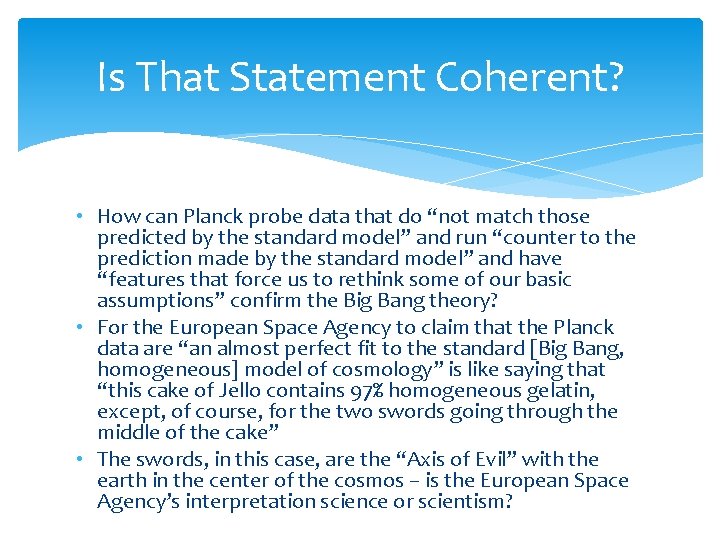
Is That Statement Coherent? • How can Planck probe data that do “not match those predicted by the standard model” and run “counter to the prediction made by the standard model” and have “features that force us to rethink some of our basic assumptions” confirm the Big Bang theory? • For the European Space Agency to claim that the Planck data are “an almost perfect fit to the standard [Big Bang, homogeneous] model of cosmology” is like saying that “this cake of Jello contains 97% homogeneous gelatin, except, of course, for the two swords going through the middle of the cake” • The swords, in this case, are the “Axis of Evil” with the earth in the center of the cosmos – is the European Space Agency’s interpretation science or scientism?
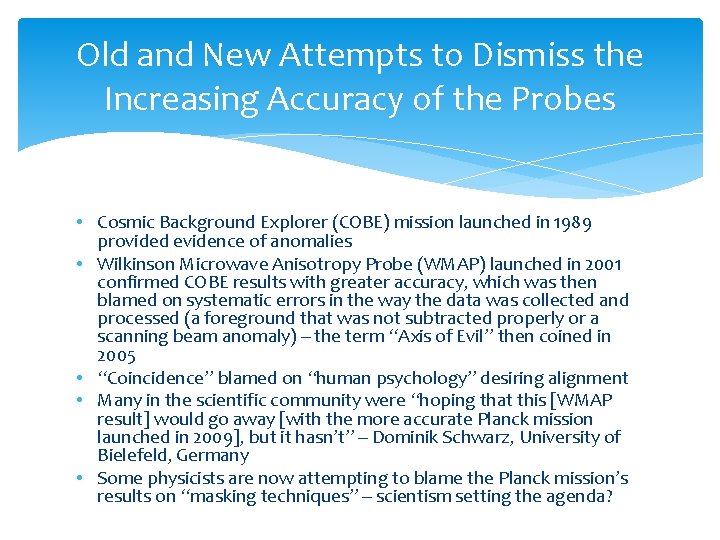
Old and New Attempts to Dismiss the Increasing Accuracy of the Probes • Cosmic Background Explorer (COBE) mission launched in 1989 provided evidence of anomalies • Wilkinson Microwave Anisotropy Probe (WMAP) launched in 2001 confirmed COBE results with greater accuracy, which was then blamed on systematic errors in the way the data was collected and processed (a foreground that was not subtracted properly or a scanning beam anomaly) – the term “Axis of Evil” then coined in 2005 • “Coincidence” blamed on “human psychology” desiring alignment • Many in the scientific community were “hoping that this [WMAP result] would go away [with the more accurate Planck mission launched in 2009], but it hasn’t” – Dominik Schwarz, University of Bielefeld, Germany • Some physicists are now attempting to blame the Planck mission’s results on “masking techniques” – scientism setting the agenda?
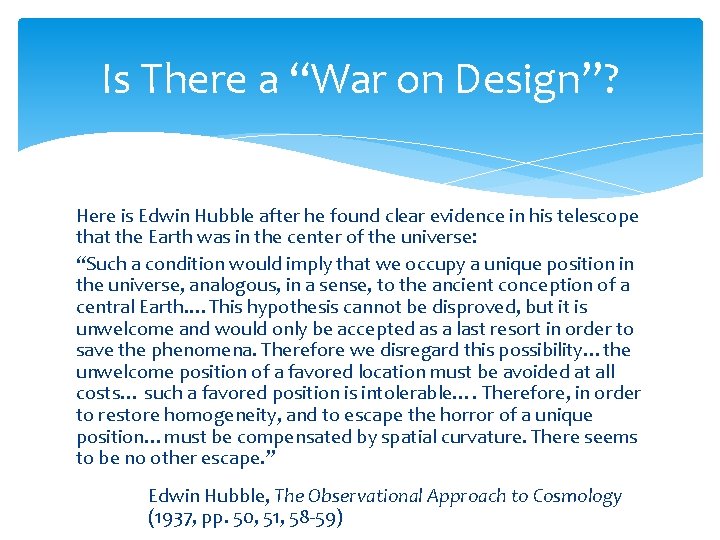
Is There a “War on Design”? Here is Edwin Hubble after he found clear evidence in his telescope that the Earth was in the center of the universe: “Such a condition would imply that we occupy a unique position in the universe, analogous, in a sense, to the ancient conception of a central Earth. …This hypothesis cannot be disproved, but it is unwelcome and would only be accepted as a last resort in order to save the phenomena. Therefore we disregard this possibility…the unwelcome position of a favored location must be avoided at all costs… such a favored position is intolerable…. Therefore, in order to restore homogeneity, and to escape the horror of a unique position…must be compensated by spatial curvature. There seems to be no other escape. ” Edwin Hubble, The Observational Approach to Cosmology (1937, pp. 50, 51, 58 -59)
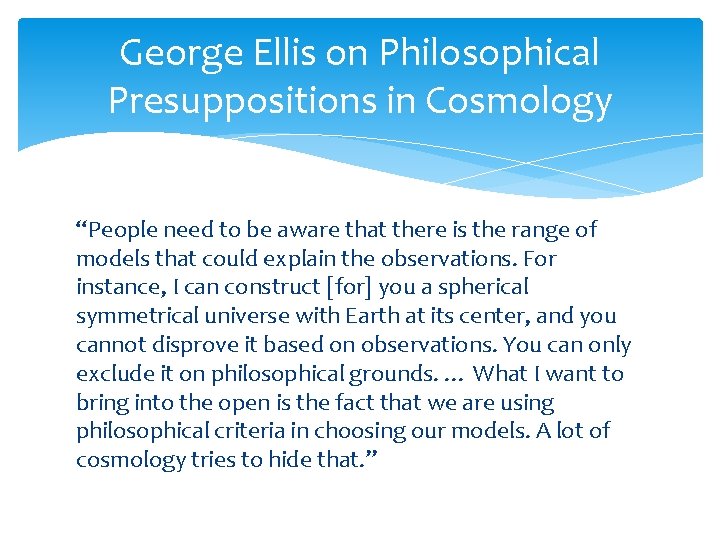
George Ellis on Philosophical Presuppositions in Cosmology “People need to be aware that there is the range of models that could explain the observations. For instance, I can construct [for] you a spherical symmetrical universe with Earth at its center, and you cannot disprove it based on observations. You can only exclude it on philosophical grounds. … What I want to bring into the open is the fact that we are using philosophical criteria in choosing our models. A lot of cosmology tries to hide that. ”
All Proofs of the Heliocentric Model Have Corresponding Geocentric Explanations • • • Foucault pendulum Stellar parallax Stellar aberration Bulge of the earth Retrograde motion “I have come to believe that the motion of the Earth cannot be detected by any optical experiment. ” Albert Einstein
Dark Matter? • There wasn’t enough matter to serve as the seeds of galaxies according to Big Bang cosmology • Hence a substance called “Dark Matter” was invented in order to compensate for the lack of baryonic (ordinary) matter • In the late 1970 s it was discovered that spiral galaxies were not rotating according to Newton’s laws of motion or Einstein’s theory of gravity as espoused in General Relativity – observations revealed that the galaxies were rotating ten times too fast for the amount of matter they contained and should have blown apart eons ago • Rather than question Newton’s and Einstein’s theories, or even whether these laws applied in deep space, modern cosmologists went back to the same Dark matter they had invented for the seeds of galaxies and claimed that the galaxies were surrounded by a halo of “Dark Matter” • Hence, another ad hoc invention – will this drama continue until so many ad hoc patches are foisted upon theory that it will eventually fall under its own weight?
Dark Energy? • In 1998, observations of supernova explosions forced cosmologists to conclude that the new rates of expansion of the universe necessarily exceed the speed of light, which speed limit all Big Bang cosmologists accept as valid • Modern cosmologists then claimed without empirical evidence that an unseen and undetectable energy pervaded the universe which was causing the accelerated expansion to save theory • Hence, the invention of “Dark Energy” • In order to allow the Big Bang model to survive, cosmologists make the astounding and unverified claim that the universe is composed of only 5% of the kind of matter and energy we can see or detect – we therefore live in a ghost universe • The alternative is simply to admit that the earth is in a special location, which requires neither Inflation, Dark matter, or Dark Energy, which is now admitted by some of today’s top scientists
Frithjof Schuon on Modern Science and the “War on Design” “Modern science, with its denial in practice or in principle of all that is really fundamental, and its subsequent rejection of the ‘one thing needful, ’ is like a planimetry that has no notion of the other directions. It shuts itself up entirely in physical reality or unreality, and there it accumulates an enormous mass of information, while at the same time committing itself to ever more complex conjectures. Starting out from the illusion that nature will end by yielding its ultimate secret and will allow itself to be reduced to some mathematical formula or other, this Promethean science everywhere runs up against enigmas which give the lie to its postulates and which appear as unforeseen fissures in this laboriously erected system. These fissures get plastered over with fresh hypotheses and the vicious cycle goes on unchecked, with all the threats we are aware of. ” Frithjof Schuon, Logic and Transcendence, pp. 57 -58
The Spiritual Symbolism of the Geocentric Model on Levels of Being “In order to be able to ‘situate’ the soul in relation to other cosmic realities or realms, one must refer to the cosmological scheme that represents the degrees of existence in the form of concentric circles or spheres. This scheme, which makes symbolical use of the geocentric conception of the visible universe, symbolically identifies the corporeal world with our terrestrial surroundings; around this center extends the sphere—or spheres—of the subtle or psychic world, surrounded in turn by the sphere of the world of pure Spirit. … Furthermore, each of these worlds is known and dominated by that which exceeds and surrounds it. It is from the immutable and formless background of the Spirit that the subtle realities become detached as forms, and it is the soul which, through its sensory faculties, knows the corporeal. ” Titus Burckhardt, The Essential Titus Burckhardt, pp. 48 -49
Spiritual Symbolism of the Geocentric Model According to Mystics “Meister Eckhart says, and so do other masters, that in the course of nature it is really the higher which is ever more ready to pour its power out into the lower than the lower is ready to receive it. The highest heaven, for instance, is turning far more rapidly than the rest which run against it. However fast the lower heavens race against the upper, in order to receive the influx from it, the highest heaven will go harder still both as to pace and influx. So God is vastly quicker to pour out His grace than man to take it in. There is no dearth of God with us; what dearth there is wholly ours who make not ready to receive His grace. ”
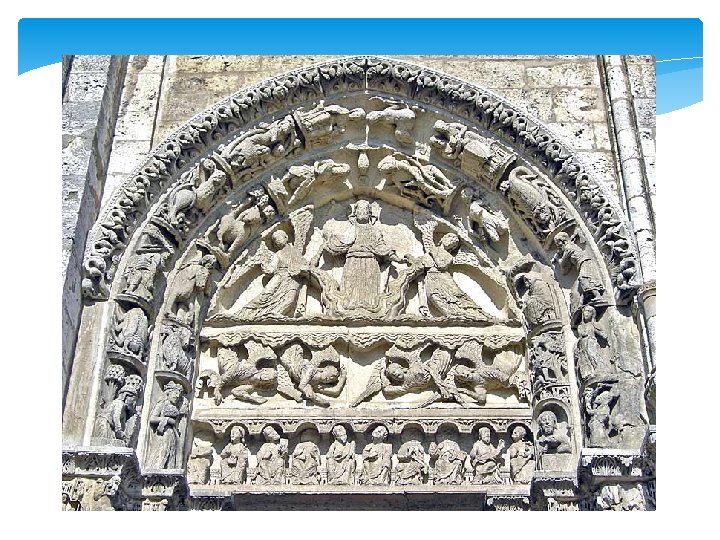
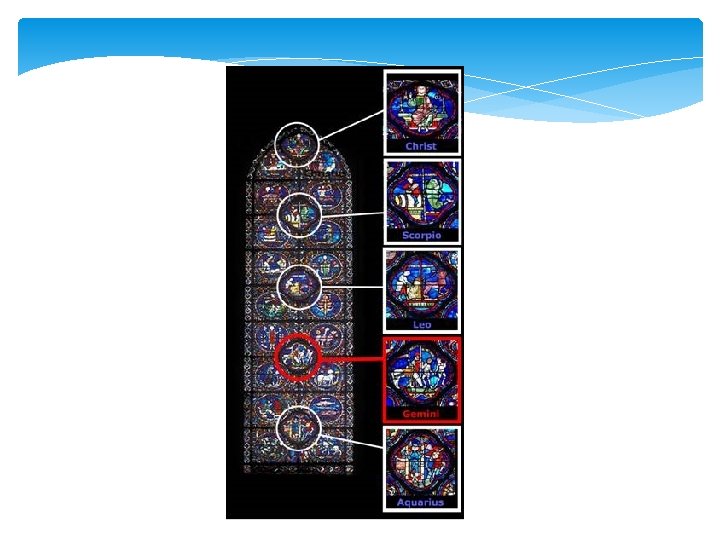
Spiritual Symbolism Reflected in Chartres Cathedral “It is thus doubly significant that on the tympanum of the left of the three doors [at the West of Chartres Cathedral] the signs of the zodiac are displayed. These belong to the unchanging heaven of the fixed stars and thus represent the kingdom of the Divine Spirit, to whom this door, with its representation of the ascension of Christ, is dedicated. The seven planets, on the other hand, govern, according to the ancient viewpoint, the world of the soul. And Mary is the human soul in all its perfection. By means of the signs of the zodiac … the arches surrounding the representation of Christ’s ascension (on the left hand door) can be seen to represent the firmament. Beside each of the twelve signs of the zodiac, the corresponding month is represented pictorially in the form of its natural activity. These natural activities—one for each month—are the terrestrial reflections of the twelve signs of the zodiac. From them one learns to what extent the course of human existence depends upon the heavens: in seedtime and harvest, in work and leisure; for the heavens, in their cycle, bring heat after cold, dry after wet, and thus keep life in being. ” Titus Burckhardt, Chartres and the Birth of the Cathedral, p. 69
Zodiac, Astrology, and the Correspondence between the Microcosm and Macrocosm “The first thing to be noted in regard to astrology is that the causality upon which it is based proves to be incurably vertical, and derives moreover from the highest reaches of the cosmos: the planets and constellations especially. And it brings man, the human microcosm, into the picture by way of his horoscope as defined by the position of the planets relative to the zodiac at the moment of birth. Now, the first misconception—generally upheld by friends and adversaries of astrology alike—is the notion that this horoscope refers to the effect of the aforesaid planetary configuration upon the soul: but such a one-sided picture is misleading, to say the least. One needs to understand, in the first place, that man does indeed constitute a ‘microcosm’—a universe in miniature as it were—which as such admits of an astrological description; and most importantly, that the time and place of his birth is by no means arbitrary or accidental. Whereas all are created in the ‘omnia simul’ of the Creative Act, we are born in time ‘when we ought to come into being’ as St. Augustine avers. There are no ‘accidents’ in that regard, no ‘rolling of the dice’: the planets and constellations, at the moment of our birth, do actually no more than announce—in the precise language of astrology—who it is that has now made his entry into this world. ” Wolfgang Smith, Physics and Vertical Causation, pp. 113 -114
Astrology as non-Predictive “The next thing to grasp is that, contrary to what is generally believed, astrology is not, strictly speaking, predictive in respect to human affairs: what it tells us in reference to the future has to do with trends, what Shakespeare refers to as ‘tides in the affairs of men’: there is no question here of an inexorable fate. On the other hand, by far the most accurate and potentially useful information astrology has to convey refers to who and what we are; and what above all matters is the stunning revelation that each of us is endowed with a unique constitution, expressible in astrological terms, which points to a likewise singular destiny as something given us to achieve. ” Wolfgang Smith, Physics and Vertical Causation, p. 114
Astrology and Christianity “In conclusion I wish to say a few words on whether the authentic claims of astrology accord with the teachings of Christianity, a question which seems generally to elicit more confusion than clarity. To begin with, I would point out that Scripture itself points to the existence of an authentic astrology, beginning in fact with Genesis 1. 4, which reads: ‘And God said, Let there be lights in the firmament of the heaven to divide the day from the night; and let them be for signs and for seasons, and for days and years. ’ It is clear that the ‘lights in the firmament’ refer not only to the two principal lights, namely the Sun and the Moon, but to celestial ‘lights’ in general, inclusive of planets and stars, all of which, moreover, are given us both for ‘signs’ and for ‘seasons. ’ To begin with the latter: this refers to what I have touched upon earlier by way of explaining the ‘qualitative’ content of time, which Genesis refers to here as ‘seasons. ’ By the term ‘signs, ’ on the other hand, the verse alludes evidently to an astrology: for where there are ‘signs, ’ there must in principle be an art or science to ‘read’ these signs, to decipher them. And as a matter of fact, such a science is referred to in Scripture, here and there, as a historical reality: recall, for instance, the words of the ‘wise men’ to Herod the king: ‘Where is he that is born King of the Jews? For we have seen his star in the east, and are come to worship him. ’ Most assuredly, Christ is no ordinary man! The point, however, is that if there were no such thing as a bona-fide astrology, the passage from St. Matthew would be void of sense. ” Wolfgang Smith, Physics and Vertical Causation, pp. 114 -115
Galileo • The telescope (based on the work of Ibn al-Haytham) – moons of Jupiter, phases of Venus, and so forth challenge the Ptolemaic view of the cosmos • New theory of motion is necessary to explain why objects do not fall far behind us when we throw them up if the earth is traveling at 19. 5 miles per second around the sun • Ibn Sina’s critique of Aristotle’s theory of violent motion, which Galileo read through a commentary of Ibn Bajja, leads to the solution
“The Galileo Affair” • Galileo trial and ultimate withdrawal of Church from the realm of nature, despite the fact that Galileo’s “proofs” were erroneous • Homogenous cosmos and the reduction of quality to quantity in the distinction between “primary” and “secondary” qualities • Removes music from the quadrivium to the humanities (music as “rhetorical” rather than “mathematical”) and truncates the meaning of the remaining sciences in the quadrivium to STEM disciplines
Secularization of Music “In Europe the idea of cosmic harmony took shape by means of a threefold classification – musica mundana or cosmic harmony, musica humana, which reflects the harmonious way in which our body and soul are bound together, and musica instrumentalis, or music in our restricted, present-day sense of the performance of singers or instrument players. The first two are perfect and attainable only by way of the intellect; the latter is an audible, necessarily imperfect imitation of the former. … By the turn of the seventeenth century, then, cosmic harmony was already in dire straits. Evidently, the humanist movement was a major agent of its distress. … The humanism-inspired search for the true nature of [late secular] Greek music also inadvertently opened the gates toward a major change of musical style, with profound consequences for musical practice. This made for a further blurring of the distinction between consonance and dissonance. ” Rens Bod, et al.
Were Scientists Different from Scholars of the Humanities? “One reason why I have decided to go into some elementary detail about the numerical aspects of cosmic harmony in this chapter is that at the time [16 th century] , scholars from all walks of life were occupied with them. Where in all this is the modern distinction between scientists on the one hand, and scholars from the humanities on the other? For the period here under scrutiny, these are not even viable categories. Zarlino’s redefinition, or rather saving operation, bound intricate number juggling, a choir master’s practice, pieces of current philosophizing, and humanist inspiration together in one vast edifice of, indeed, cosmic harmony. ” Rens Bod, et al.
Why Didn’t Heliocentrism Negatively Impact the Islamic World? • Either view acceptable and symbolism associated with the naked eye • Mulla Sadra on the integration of philosophy, theology, and science • Non-homogeneous cosmos
Kepler • Great musician interested in theology of music • Was searching for simplicity in the laws of planetary motion along Pythagorean lines, since musical notes are based on the ratio of small whole numbers (believed that God could not have created the world with complexity alone) • Kepler stated that the cosmos was dynamic and that he must seek harmonic relations, “for God whilst being a geometer, was not solely an architect—a fact which the ancient Pythagoreans had certainly apprehended. He was also, even primarily, a ‘musician’. ”
Kepler as a Pythagorean Figure • Greatly simplified the equations of planetary motion in a harmonic fashion by positing the sun as one of two foci of an ellipse in which, "The square of the periodic times [of motion] are to each other as the cubes of the mean distances” (ratios analogous to music) by using data from Tycho Brahe, who espoused a unique geocentric model • Inspiration for Kepler came while playing the cello • He thought he was discovering the harmony God placed in creation, with all this implies for the spiritual meaning of the heliocentric model
Kepler and Pythagorean Harmony • Explicitly connected these Divine patterns in planetary motion to music, stating, “The heavenly bodies are nothing but a continuous song for several voices (perceived by the intellect, not by the ear); a music which. . . sets landmarks in the immeasurable flow of time. ” • Quality of sound/music in what the ear discerns is not simply reducible to quantity such as the length of chords, bringing quality and quantity together in Pythagorean fashion in which number is not reducible to quantity in the Cartesian sense – Kepler stated he was so happy that he was able to praise God through his astronomy despite the fact he was unable to become a theologian • Kepler wrote Harmony of the Worlds on planetary motion in this Pythagorean spirit – although he quantified the laws of planetary motion, he did not deny their qualitative aspect, also stating that, “Geometry, coeternal with God and shining in the divine Mind, gave God the pattern. . . by which he laid out the world so that it might be best and most beautiful and finally most like the Creator. ”
Newton • Remarkable mathematician, physicist, and astronomer • Also interested in mysticism, comparative religion, and alchemy, which he practiced and tried to relate to the force of gravitation • Invented infinitesimal calculus (along with Leibniz) in order to study motion in a precise manner • Wrote the Principia in which he integrated these elements and synthesized work of preceding scientists into a unified view of celestial and terrestrial mechanics • Closed vs. open system and Proposition 43 on the center of mass of the cosmos (not the sun)
Newton and “Understanding the Mind of God” • Believed he was “reading the mind of God” by determining the original position of the planets (or the “initial condition” in physics) • Thought he had proven in a sense the existence of God in the Principia by showing that the initial condition of the movement of the planets could not have been done except through a supreme intelligence that made this possible • Called space the “sensorium of God”
Newton on “Ancient Wisdom” • Believed in the ancient wisdom of antiquity and did not believe he discovered anything “new” (even the notion of attraction between bodies, the principle behind the idea of gravity, was known by Ibn Sina and earlier philosopher-scientists, but they did not quantify it as Newton did) • Paradoxically, Newtonian mechanics becomes the model or paradigm for all sciences, separating religion from science and natural from moral laws, which is not what Newton believed • Unhappy at the end of his life with the implications of his work, knowing he had completed the process others would use for the mechanization of the universe • This has generated a big debate between scholars that had Newton been followed in his thought rather than his physics alone, there would never have been a “war” between religion and science that accelerated much further after his work • Broke up the entire framework of the relation of the sciences within the quadrivium and their interconnections with other sciences
Descartes vs. the Traditional Understanding of the Quadrivium • Far more rigorous philosopher than Galileo’s simple “primary vs. secondary qualities” • Never missed mass, but was the “father of modern philosophy” by dividing reality into res cogitans, the knowing subject in which intelligence is reduced to reason (as opposed to the intellect), and res extensa, the object that is known which is bereft of quality and reduced to pure quantity (leading to scientism) • Eliminated the qualitative aspect of the quadrivium, establishing the philosophy of modern science, the goal of which is to study only quantity (leading to quantum paradox, as we shall see)
Cartesian “Bifurcation” Cartesian “bifurcation” — a term coined by Alfred North Whitehead — constitutes a dichotomy which spuriously divides the perceived (res cogitans) and the extended (res extensa), giving rise to the notion that external reality can be fully characterized in quantitative terms. In light of the aforesaid “ontological distinction, ” this amounts to the reduction of the corporeal to the physical: the qualities we perceive via sensory perception are taken, in the Cartesian paradigm, to be mere mental ideation, while the quantitative or “extended” (i. e. , measurable) aspects of the world are taken to be what is truly fundamental. In other words, the quantitative is understood to have ontological priority over the qualitative, insofar as the latter is merely a “figure of thought. ” What is left in the “external” world are entities which can be accounted for without residue in mathematical terms. The world in which we find ourselves, wherein the grass is green and the bird sings its song, has thus been reduced to a fantasy. Wolfgang Smith
Some Important Implications of Cartesian Bifurcation • Irreducible duality between res cogitans and res extensa implies: • sollipsism if one asserts the primacy of res cogitans or • reduction of life and consciousness to “accidents” of matter if one asserts the primacy of res extensa • The problem of how the subject can know an object becomes intractable in modern philosophy after Descartes’ “bifurcation” • Descartes’ purely quantitative approach to mathematics destroyed the possibility of sacred space – why face Jerusalem? • Vacuum of sacred space and secular substitutes (pilgrimage to Disneyland or Elvis Presley’s house) • Descartes’ approach to mathematics was an abuse of Umar Khayyam’s contributions to analytical geometry mapping quadratic equations to a coordinate system by adding the reduction of quality to quantity
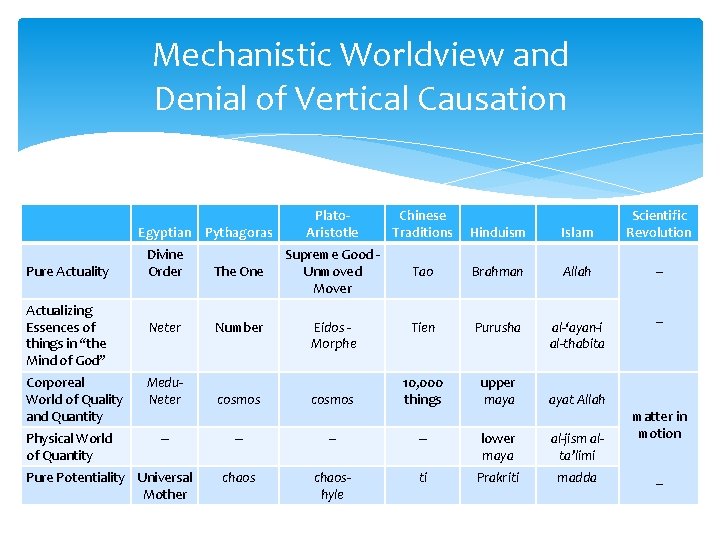
Mechanistic Worldview and Denial of Vertical Causation Egyptian Pythagoras Pure Actuality Actualizing Essences of things in “the Mind of God” Corporeal World of Quality and Quantity Physical World of Quantity Divine Order The One Neter Number Plato. Aristotle Chinese Traditions Hinduism Islam Scientific Revolution Supreme Good Unmoved Mover Tao Brahman Allah -- Tien Purusha al-‘ayan-i al-thabita -- upper maya ayat Allah Eidos Morphe Medu. Neter cosmos 10, 000 things -- -- lower maya al-jism alta’limi chaoshyle ti Prakriti madda Pure Potentiality Universal Mother matter in motion --
Some Consequences of the Scientific Revolution • Loss of faith in religion as a route to knowledge (retreat of religion to ethics at best along with the rise of scientism) • Denial of miracles (Christ could not walk on water because it violated the rules of Newtonian physics, for example) • Miracles are illogical if there is only one level of existence, but they are not illogical if there are multiple levels of existence • Each level has its own laws that cannot be broken within that level of existence • But higher level laws can protrude onto lower ones according to all traditional cosmologies • Reductionism in all sciences, since there was no place for religion, or even humans as traditionally understood – art, literature, and so forth were also subjective, making the trivium also spiritually insignificant (“the trivium becomes trivial, ” as later debates show) • Nature as an “it” devoid of spiritual meaning to be exploited • Environmental crisis, social escapism, and other crises unfold
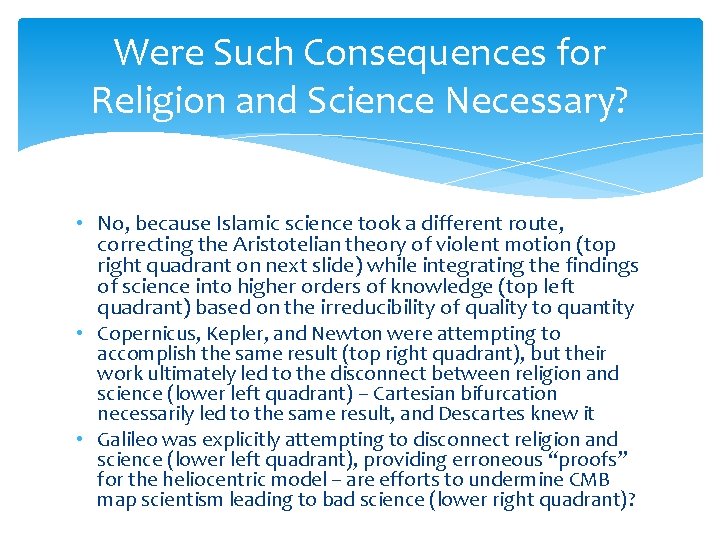
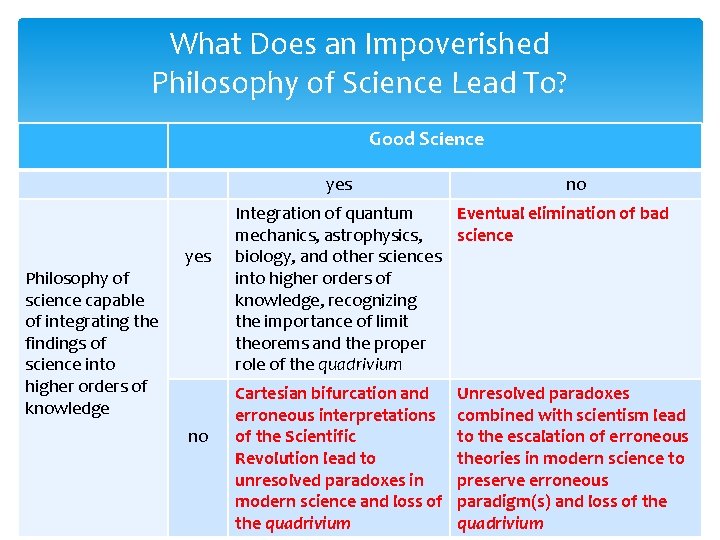
Were Such Consequences for Religion and Science Necessary? • No, because Islamic science took a different route, correcting the Aristotelian theory of violent motion (top right quadrant on next slide) while integrating the findings of science into higher orders of knowledge (top left quadrant) based on the irreducibility of quality to quantity • Copernicus, Kepler, and Newton were attempting to accomplish the same result (top right quadrant), but their work ultimately led to the disconnect between religion and science (lower left quadrant) – Cartesian bifurcation necessarily led to the same result, and Descartes knew it • Galileo was explicitly attempting to disconnect religion and science (lower left quadrant), providing erroneous “proofs” for the heliocentric model – are efforts to undermine CMB map scientism leading to bad science (lower right quadrant)?
What Does an Impoverished Philosophy of Science Lead To? Good Science yes Philosophy of science capable of integrating the findings of science into higher orders of knowledge yes no no Integration of quantum Eventual elimination of bad mechanics, astrophysics, science biology, and other sciences into higher orders of knowledge, recognizing the importance of limit theorems and the proper role of the quadrivium Cartesian bifurcation and erroneous interpretations of the Scientific Revolution lead to unresolved paradoxes in modern science and loss of the quadrivium Unresolved paradoxes combined with scientism lead to the escalation of erroneous theories in modern science to preserve erroneous paradigm(s) and loss of the quadrivium
Is “Methodological Naturalism” the Appropriate Approach to Science? “The philosophical doctrine of methodological naturalism, ” writes Alvin Plantinga, “holds that, for any study to qualify as ‘scientific, ’ it cannot refer to God’s creative activity or any sort of divine action. ” Based upon the description of Nature as the corporeality which presents itself to us in a spatio-temporal mode, methodological naturalism could be defined as the exclusion of all supernatural agency or causal principle from the “scientific” enterprise. As Richard Lewontin has famously put it: “We cannot allow a Divine Foot in the door. ” To differentiate methodological from philosophical or ontological naturalism, it can be said that the former proposes to do science as if there were no reality other than the spatio-temporal, the implication being that, even if there were such a reality, it would not affect the scientific enterprise. Such is the modern conception of science which contradicts the traditional as exemplified by the ancient sciences, inasmuch as the latter regarded the corporeal domain, specified by its own spatio-temporal conditions, as an ontological stratum within an ontological hierarchy, from which it cannot be separated in an absolute sense. ” Ali Sebetci