
Medicinski fakultet Sveuilita u Zagrebu Uenje i pamenje

Medicinski fakultet Sveučilišta u Zagrebu Učenje i pamćenje – pregled najvažnijih spoznaja i koncepata Izborni predmet Učenje i pamćenje Goran Šimić 10. travnja 2018.
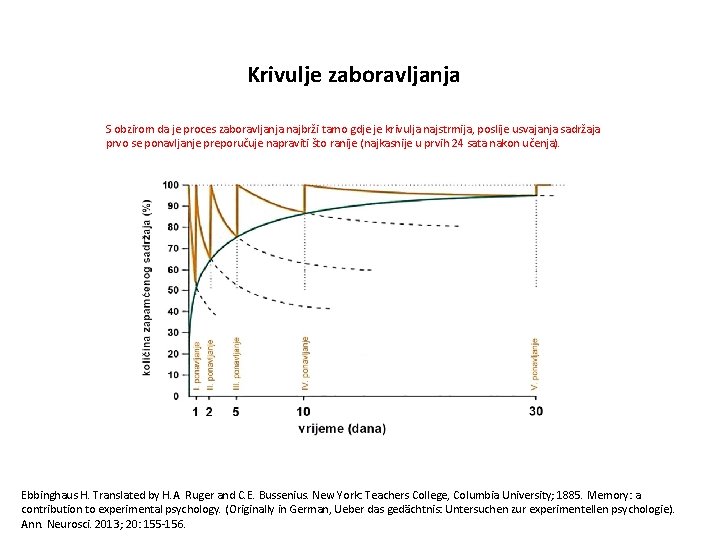
Krivulje zaboravljanja S obzirom da je proces zaboravljanja najbrži tamo gdje je krivulja najstrmija, poslije usvajanja sadržaja prvo se ponavljanje preporučuje napraviti što ranije (najkasnije u prvih 24 sata nakon učenja). Ebbinghaus H. Translated by H. A. Ruger and C. E. Bussenius. New York: Teachers College, Columbia University; 1885. Memory: a contribution to experimental psychology. (Originally in German, Ueber das gedächtnis: Untersuchen zur experimentellen psychologie). Ann. Neurosci. 2013; 20: 155 -156.
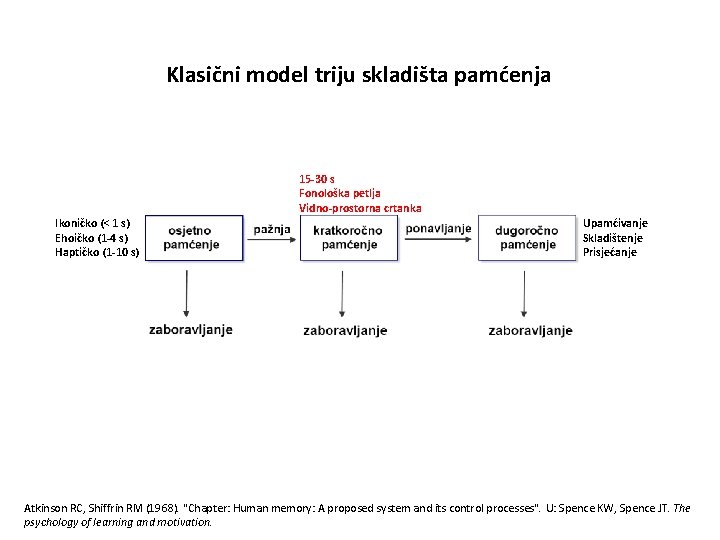
Klasični model triju skladišta pamćenja 15 -30 s Fonološka petlja Vidno-prostorna crtanka Ikoničko (< 1 s) Ehoičko (1 -4 s) Haptičko (1 -10 s) Upamćivanje Skladištenje Prisjećanje Atkinson RC, Shiffrin RM (1968). "Chapter: Human memory: A proposed system and its control processes". U: Spence KW, Spence JT. The psychology of learning and motivation.
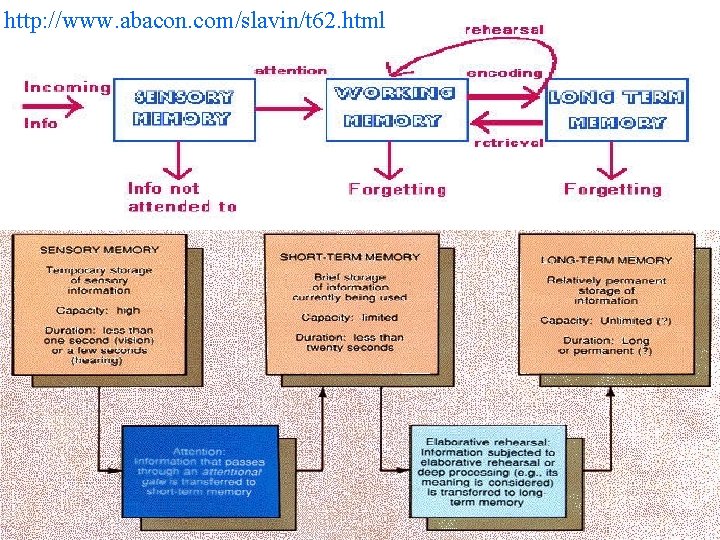
http: //www. abacon. com/slavin/t 62. html
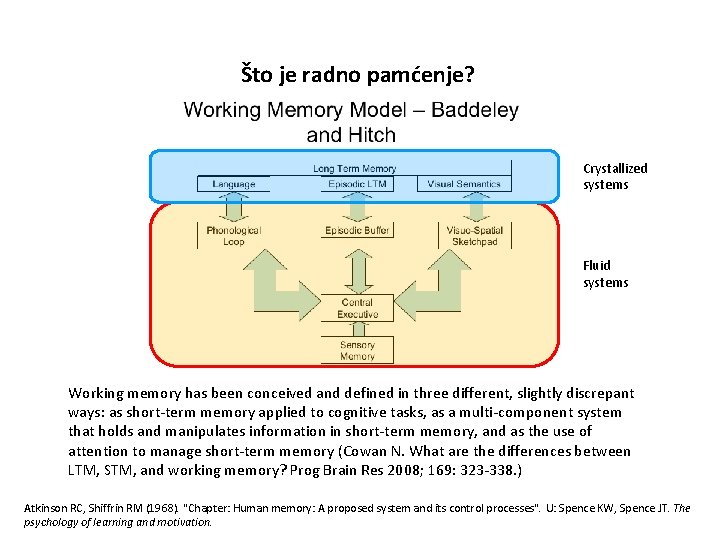
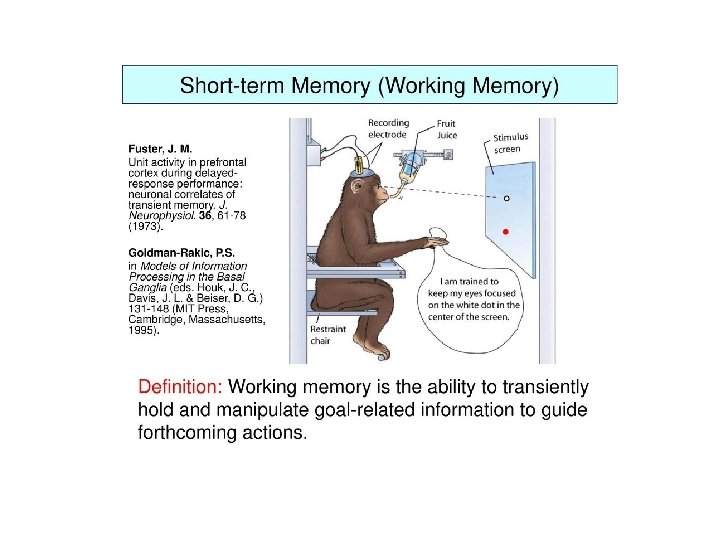
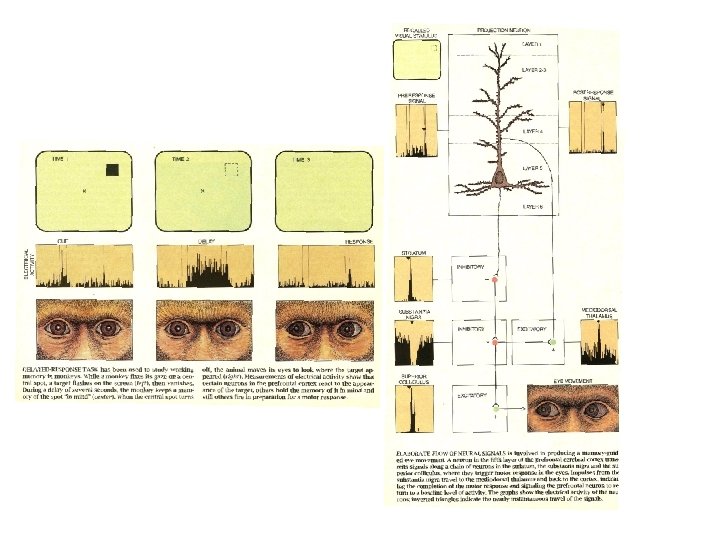
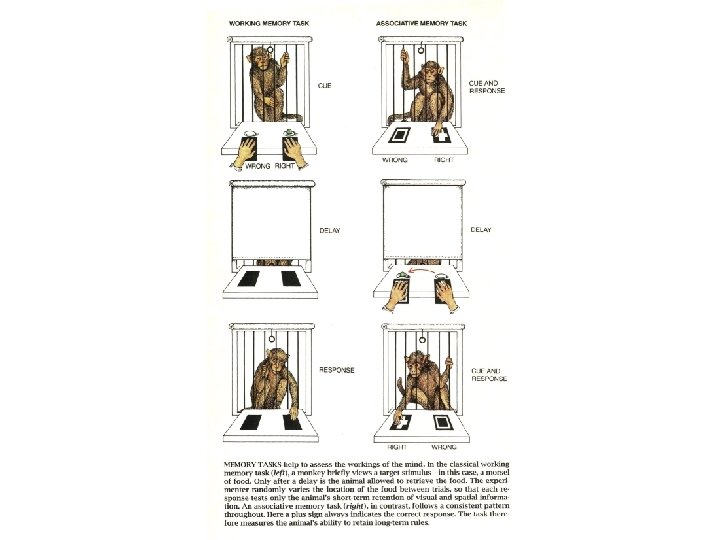
Što je radno pamćenje? Crystallized systems Fluid systems Working memory has been conceived and defined in three different, slightly discrepant ways: as short-term memory applied to cognitive tasks, as a multi-component system that holds and manipulates information in short-term memory, and as the use of attention to manage short-term memory (Cowan N. What are the differences between LTM, STM, and working memory? Prog Brain Res 2008; 169: 323 -338. ) Atkinson RC, Shiffrin RM (1968). "Chapter: Human memory: A proposed system and its control processes". U: Spence KW, Spence JT. The psychology of learning and motivation.
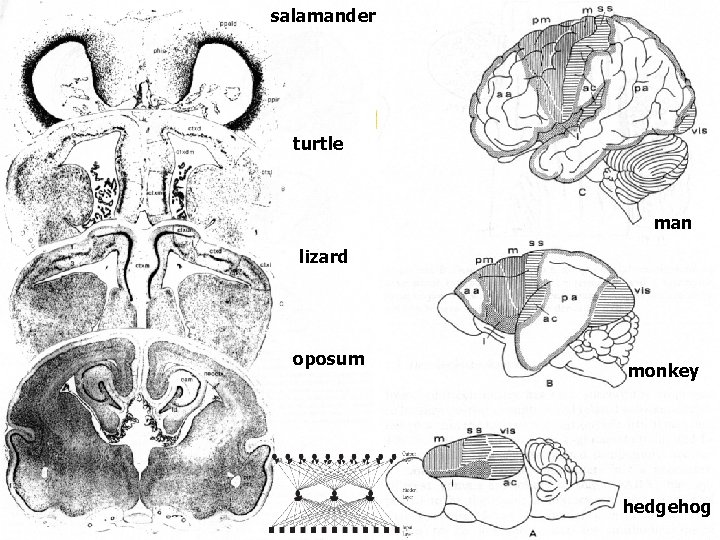
salamander turtle man lizard oposum monkey hedgehog
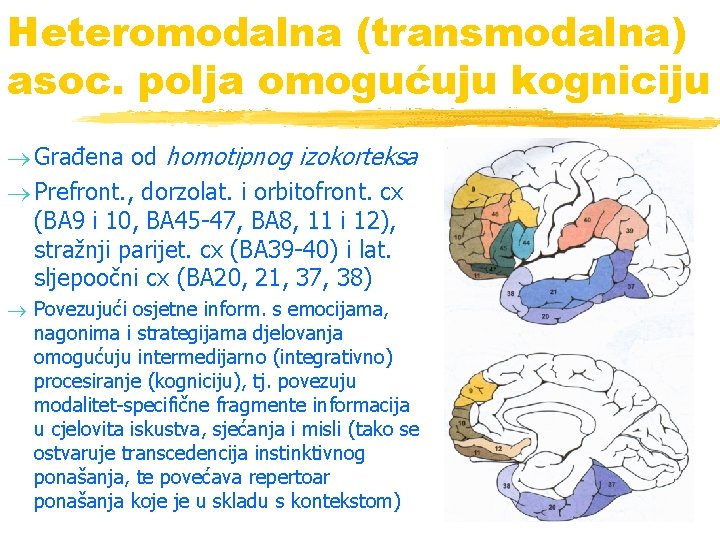
Heteromodalna (transmodalna) asoc. polja omogućuju kogniciju ® Građena od homotipnog izokorteksa ® Prefront. , dorzolat. i orbitofront. cx (BA 9 i 10, BA 45 -47, BA 8, 11 i 12), stražnji parijet. cx (BA 39 -40) i lat. sljepoočni cx (BA 20, 21, 37, 38) ® Povezujući osjetne inform. s emocijama, nagonima i strategijama djelovanja omogućuju intermedijarno (integrativno) procesiranje (kogniciju), tj. povezuju modalitet-specifične fragmente informacija u cjelovita iskustva, sjećanja i misli (tako se ostvaruje transcedencija instinktivnog ponašanja, te povećava repertoar ponašanja koje je u skladu s kontekstom)
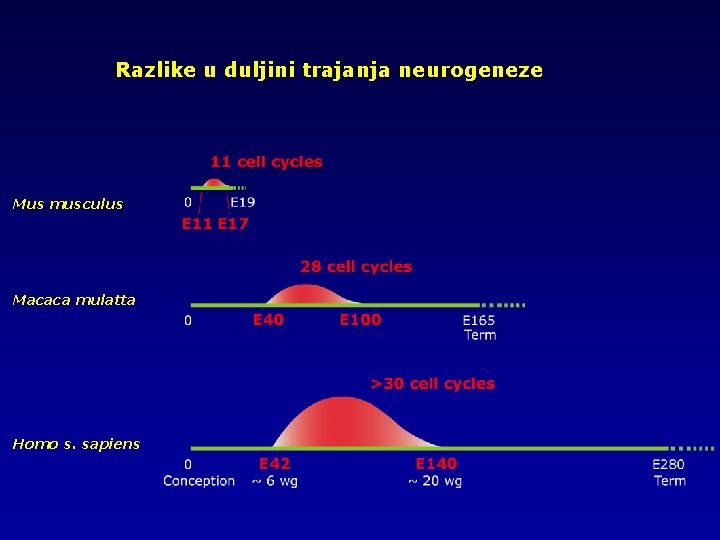
Razlike u duljini trajanja neurogeneze Mus musculus Macaca mulatta Homo s. sapiens
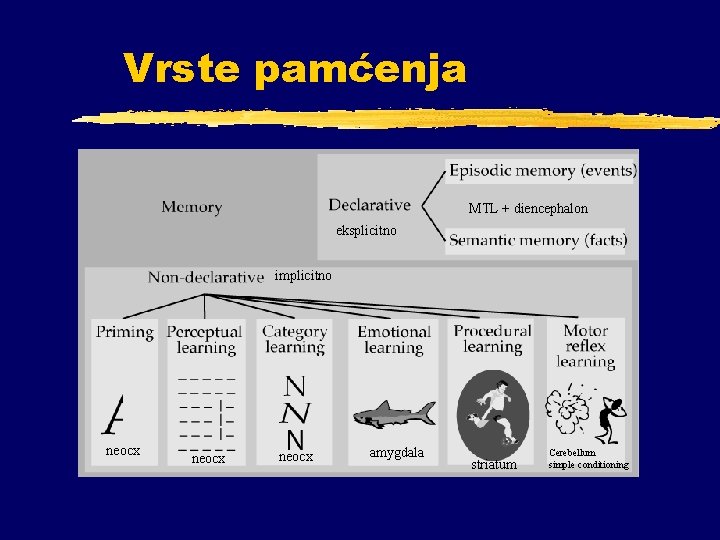
Vrste pamćenja MTL + diencephalon eksplicitno implicitno neocx amygdala striatum Cerebellum simple conditioning
Vrste DUGOTRAJNOG pamćenja DEKLARATIVNO - asocijacije istovremenih podražaja - semantičko (referentno) (znam što je to gitara) (EKSPLICITNO) višestruko je reprezentirano u moždanoj kori i temelji se na plastičnosti asocijativnih područja korteksa - epizodičko (autobiografsko) (sjećam se kad sam kupio svoju prvu gitaru) zavisi isljučivo o djelovanju hipokampalne formacije (činjenice), pa je i vulnerabilnije često sadrži afektivnu (emocionalnu) komponentu (kontekst) koja se pamti odvojeno (“source amnesia” - amnezija izvora, naročito kad je izvor nepouzdan, npr. mediji) REFLEKSIVNO (IMPLICITNO) - ne ovisi o svijesti i pažnji - ne može se verbalizirati, pa ga je teško opisati, npr. kako svirati gitaru - vještine i navike - jednostavno kondicioniranje - neasocijativni oblici učenja (habituacija, senzitizacija)
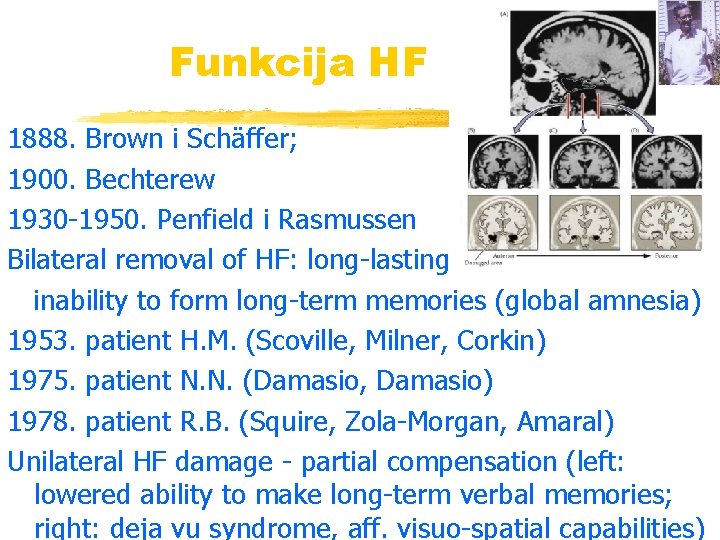
Funkcija HF 1888. Brown i Schäffer; 1900. Bechterew 1930 -1950. Penfield i Rasmussen Bilateral removal of HF: long-lasting inability to form long-term memories (global amnesia) 1953. patient H. M. (Scoville, Milner, Corkin) 1975. patient N. N. (Damasio, Damasio) 1978. patient R. B. (Squire, Zola-Morgan, Amaral) Unilateral HF damage - partial compensation (left: lowered ability to make long-term verbal memories; right: deja vu syndrome, aff. visuo-spatial capabilities)
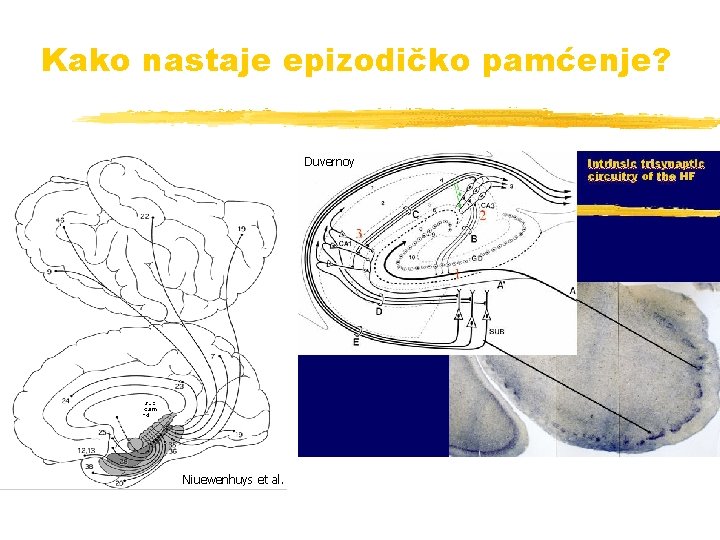
Kako nastaje epizodičko pamćenje? Duvernoy Niuewenhuys et al.
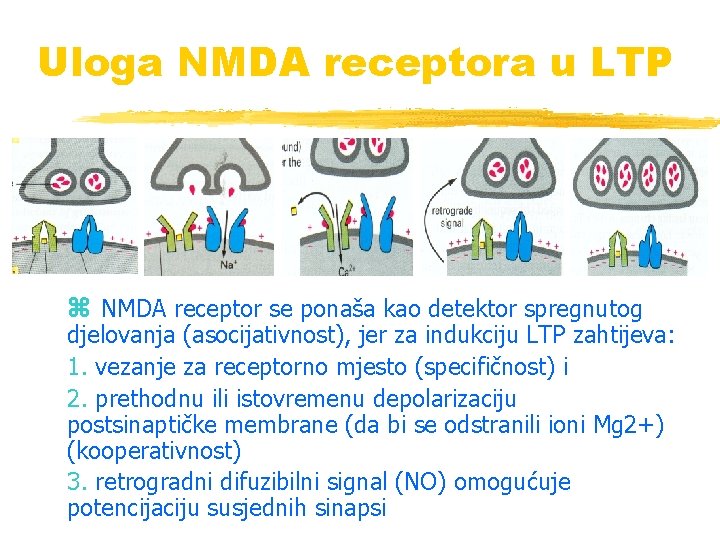
Uloga NMDA receptora u LTP z NMDA receptor se ponaša kao detektor spregnutog djelovanja (asocijativnost), jer za indukciju LTP zahtijeva: 1. vezanje za receptorno mjesto (specifičnost) i 2. prethodnu ili istovremenu depolarizaciju postsinaptičke membrane (da bi se odstranili ioni Mg 2+) (kooperativnost) 3. retrogradni difuzibilni signal (NO) omogućuje potencijaciju susjednih sinapsi
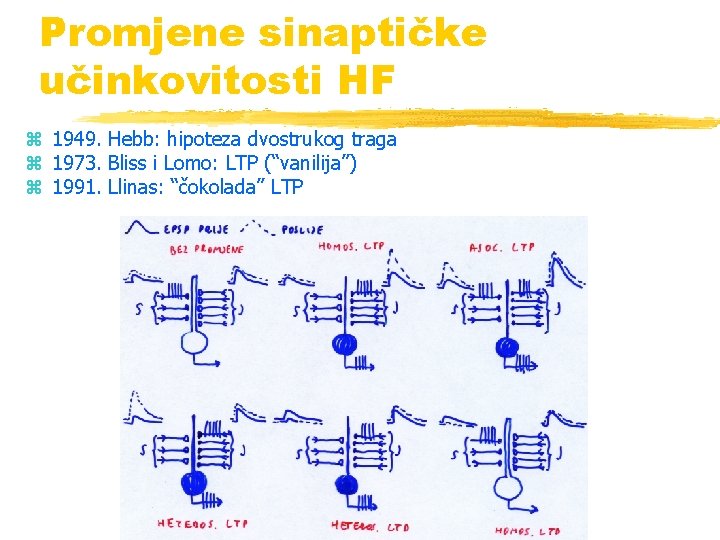
Promjene sinaptičke učinkovitosti HF z 1949. Hebb: hipoteza dvostrukog traga z 1973. Bliss i Lomo: LTP (“vanilija”) z 1991. Llinas: “čokolada” LTP
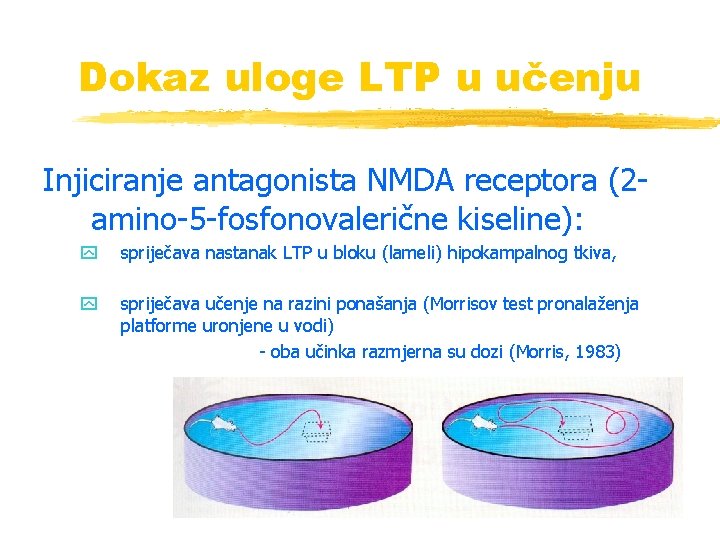
Dokaz uloge LTP u učenju Injiciranje antagonista NMDA receptora (2 amino-5 -fosfonovalerične kiseline): y spriječava nastanak LTP u bloku (lameli) hipokampalnog tkiva, y spriječava učenje na razini ponašanja (Morrisov test pronalaženja platforme uronjene u vodi) - oba učinka razmjerna su dozi (Morris, 1983)
Koliko je vremena potrebno za trajno zapamćivanje? Nakon stjecanja iskustva za konsolidaciju zapamćenog potrebno je najmanje 6 -8 tjedana (Squire, Zola-Morgan i Amaral, 1989 -1992) HF: 1. Povezuje informacije iz različitih područja Cx za vrijeme učenja, 2. Nakon razdoblja od 6 -8 tjedana konsolidira navedene informacije u neokorteks tako da postaju dostupne i neovisno od HF
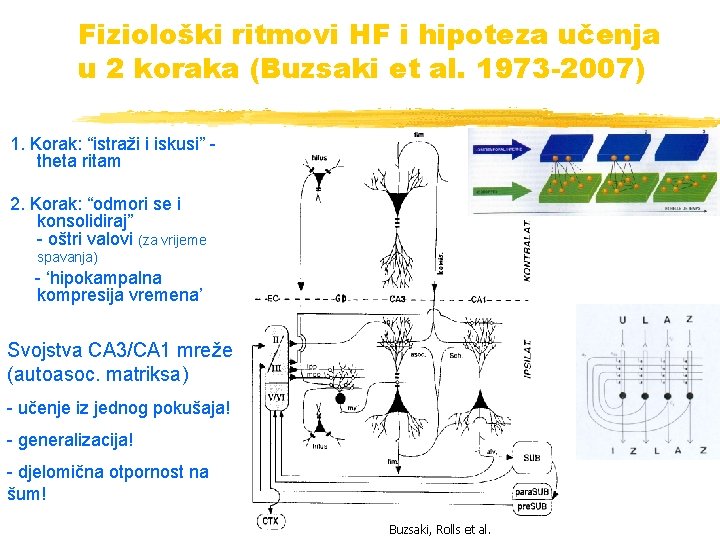
Fiziološki ritmovi HF i hipoteza učenja u 2 koraka (Buzsaki et al. 1973 -2007) 1. Korak: “istraži i iskusi” theta ritam 2. Korak: “odmori se i konsolidiraj” - oštri valovi (za vrijeme spavanja) - ‘hipokampalna kompresija vremena’ Svojstva CA 3/CA 1 mreže (autoasoc. matriksa) - učenje iz jednog pokušaja! - generalizacija! - djelomična otpornost na šum! Shema autoasoc. matriksa (Rolls, 2005) Buzsaki, Rolls et al.
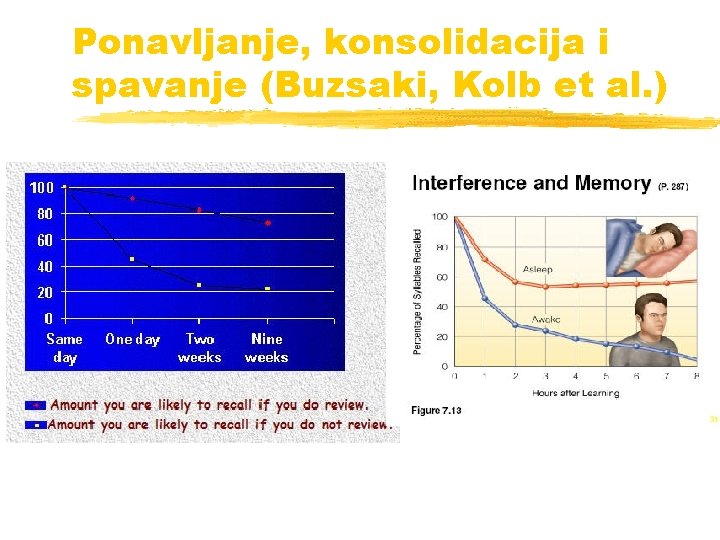
Ponavljanje, konsolidacija i spavanje (Buzsaki, Kolb et al. )
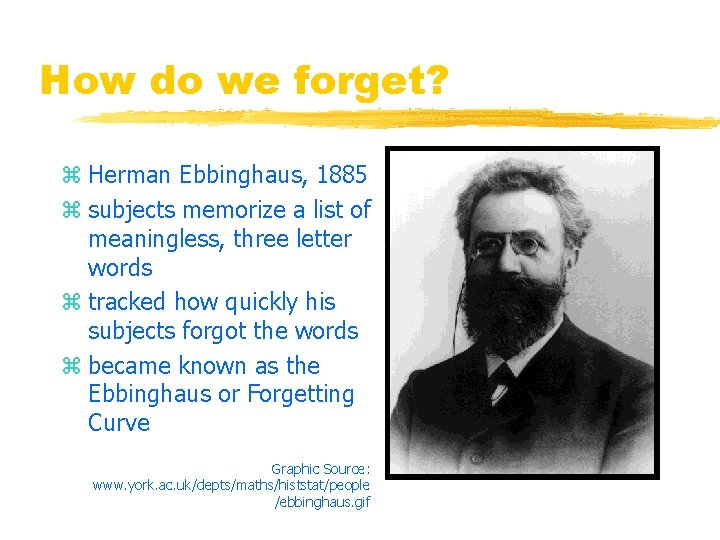
How do we forget? z Herman Ebbinghaus, 1885 z subjects memorize a list of meaningless, three letter words z tracked how quickly his subjects forgot the words z became known as the Ebbinghaus or Forgetting Curve Graphic Source: www. york. ac. uk/depts/maths/histstat/people /ebbinghaus. gif
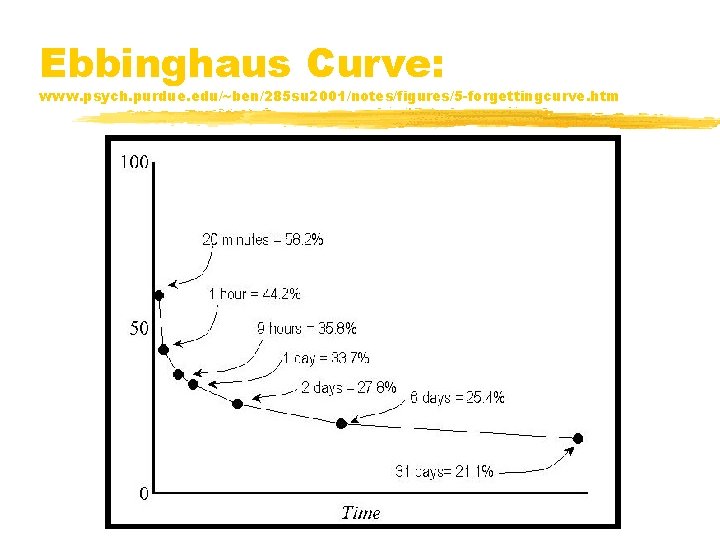
Ebbinghaus Curve: www. psych. purdue. edu/~ben/285 su 2001/notes/figures/5 -forgettingcurve. htm
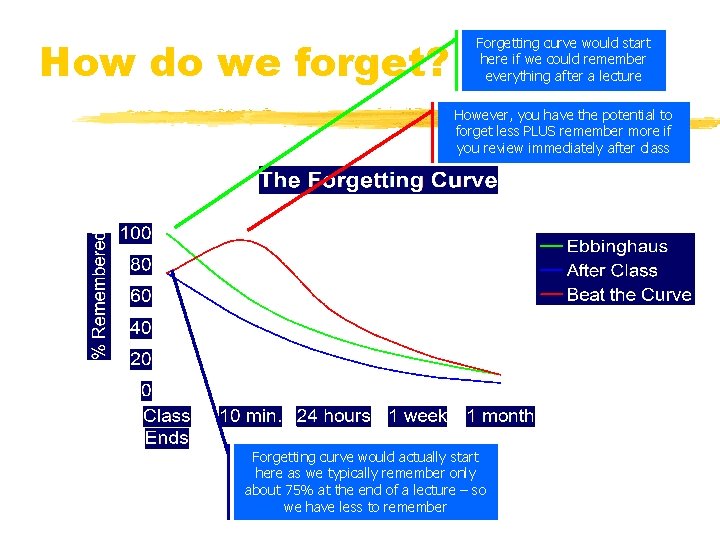
How do we forget? Forgetting curve would start here if we could remember everything after a lecture However, you have the potential to forget less PLUS remember more if you review immediately after class Forgetting curve would actually start here as we typically remember only about 75% at the end of a lecture – so we have less to remember
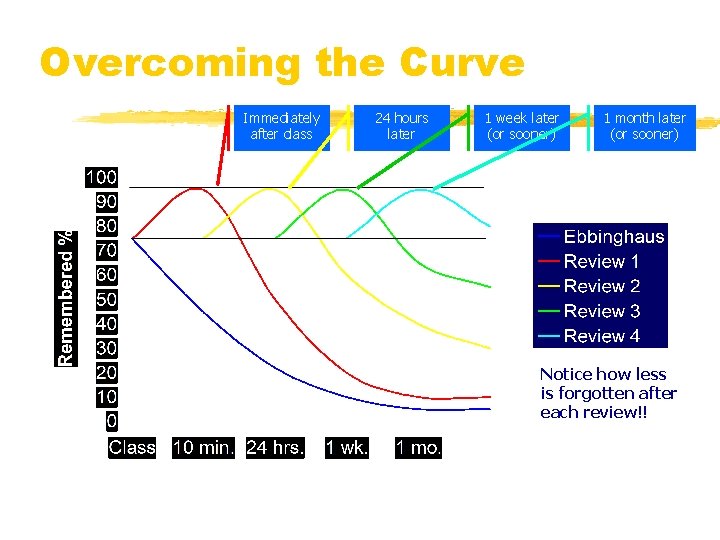
Overcoming the Curve Immediately after class 24 hours later 1 week later (or sooner) 1 month later (or sooner) Notice how less is forgotten after each review!!
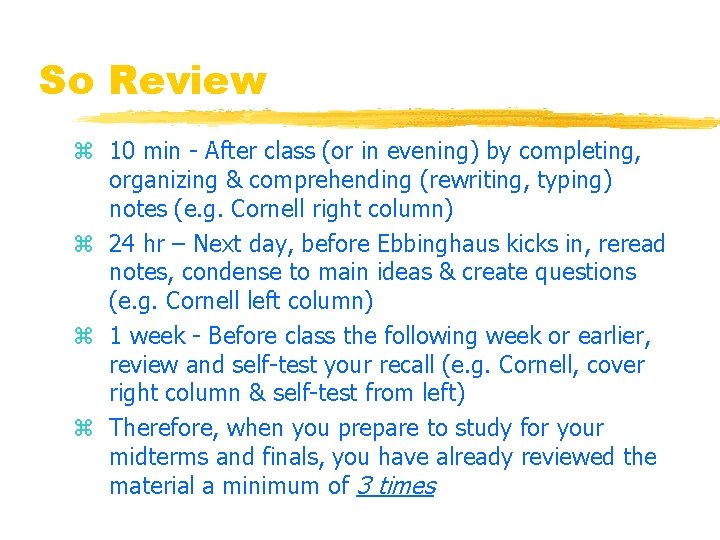
So Review z 10 min - After class (or in evening) by completing, organizing & comprehending (rewriting, typing) notes (e. g. Cornell right column) z 24 hr – Next day, before Ebbinghaus kicks in, reread notes, condense to main ideas & create questions (e. g. Cornell left column) z 1 week - Before class the following week or earlier, review and self-test your recall (e. g. Cornell, cover right column & self-test from left) z Therefore, when you prepare to study for your midterms and finals, you have already reviewed the material a minimum of 3 times
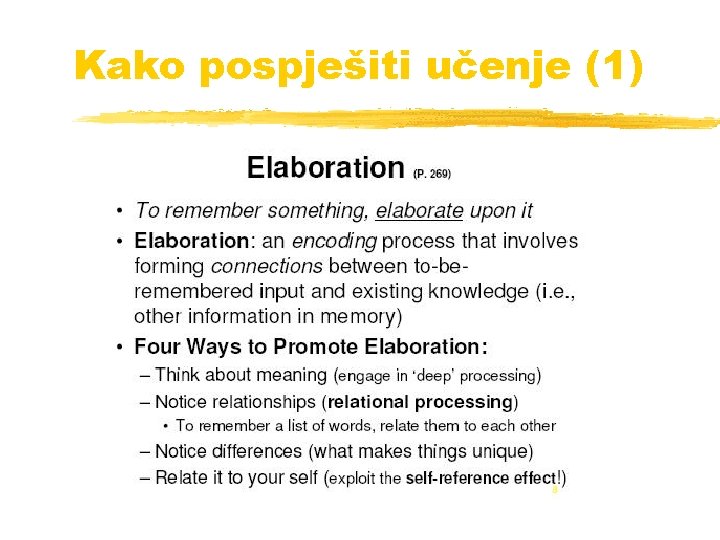
Kako pospješiti učenje (1)
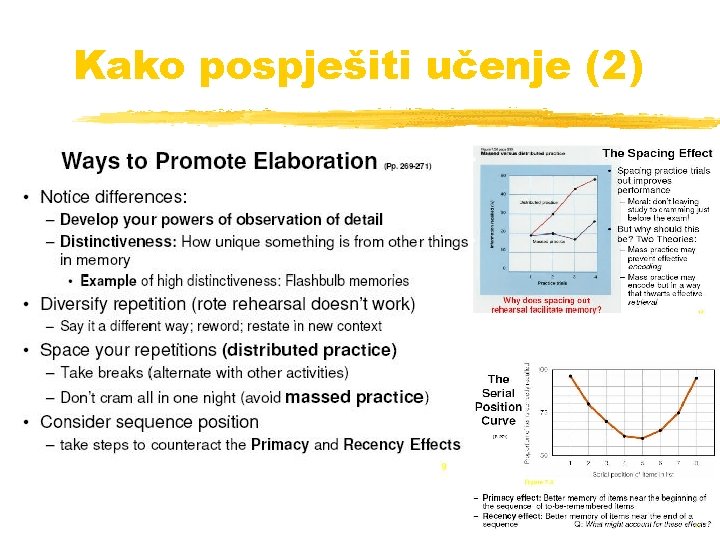
Kako pospješiti učenje (2)
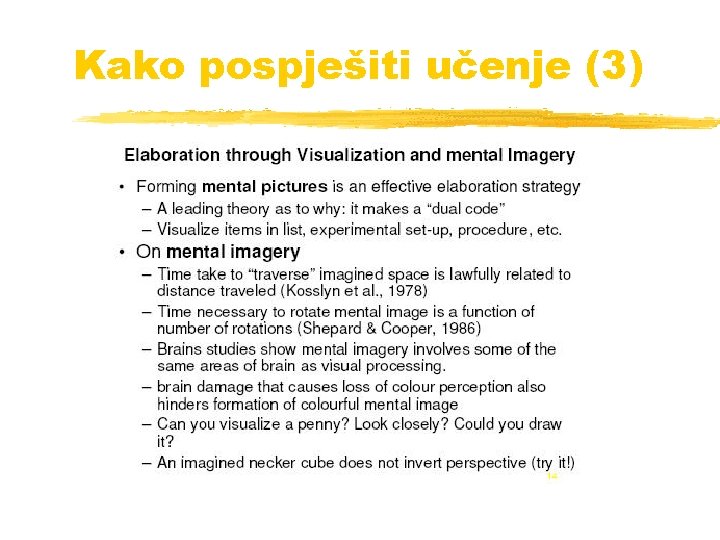
Kako pospješiti učenje (3)
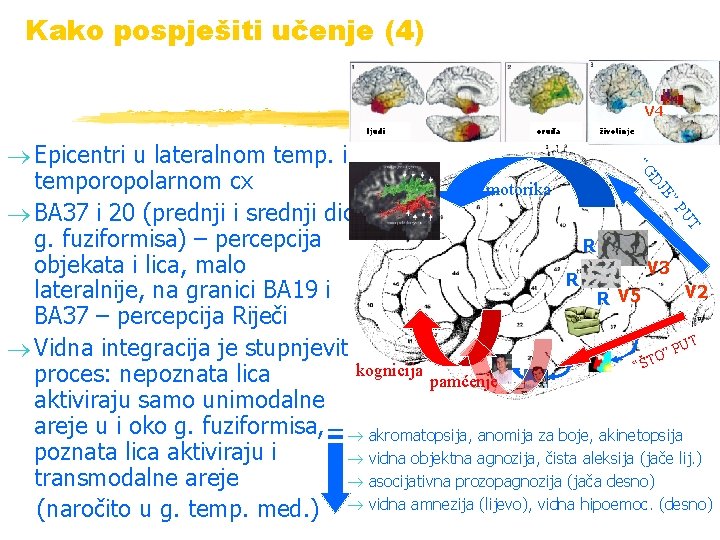
Kako pospješiti učenje (4) V 4 ljudi oruđa životinje “G ® Epicentri u lateralnom temp. i temporopolarnom cx motorika ® BA 37 i 20 (prednji i srednji dio g. fuziformisa) – percepcija R V 3 objekata i lica, malo V 3 R V 5 V 2 lateralnije, na granici BA 19 i R V 5 BA 37 – percepcija Riječi T PU ® Vidna integracija je stupnjevit ” O “ŠT kognicija proces: nepoznata lica pamćenje aktiviraju samo unimodalne L areje u i oko g. fuziformisa, ® akromatopsija, anomija za boje, akinetopsija poznata lica aktiviraju i ® vidna objektna agnozija, čista aleksija (jače lij. ) transmodalne areje ® asocijativna prozopagnozija (jača desno) (naročito u g. temp. med. ) ® vidna amnezija (lijevo), vidna hipoemoc. (desno) UT ”P E DJ
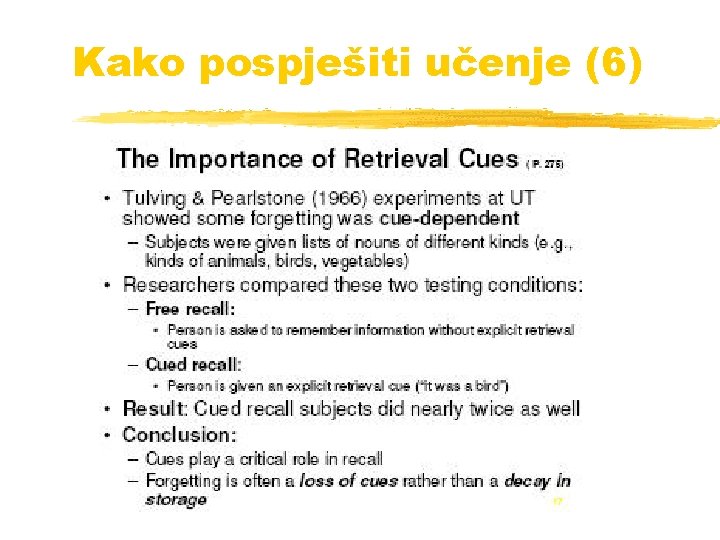
Kako pospješiti učenje (6)
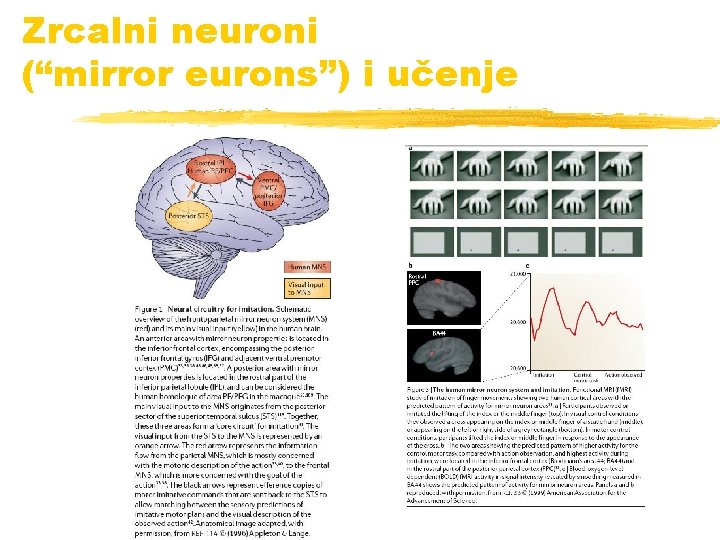
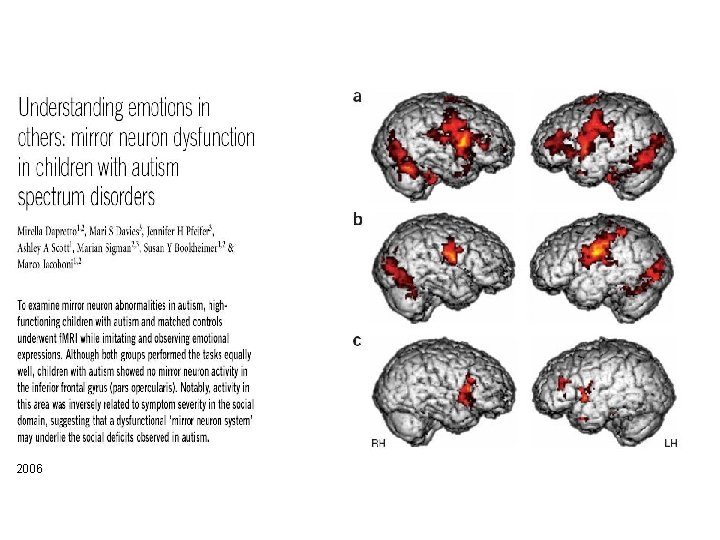
Zrcalni neuroni (“mirror eurons”) i učenje
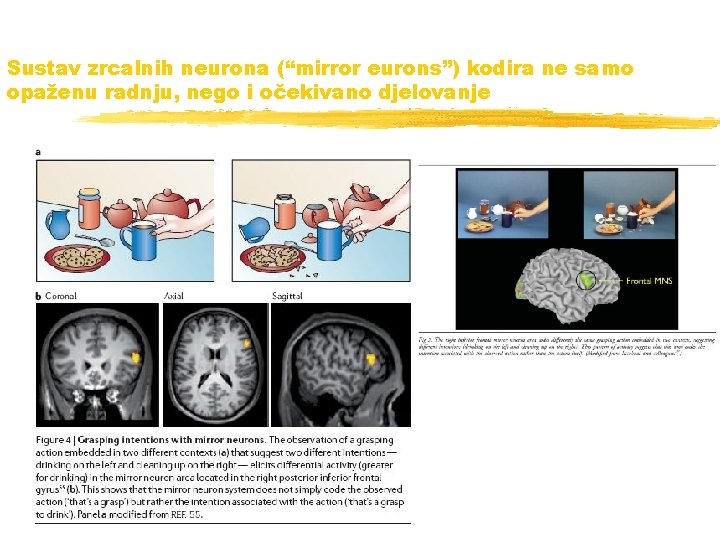
Sustav zrcalnih neurona (“mirror eurons”) kodira ne samo opaženu radnju, nego i očekivano djelovanje
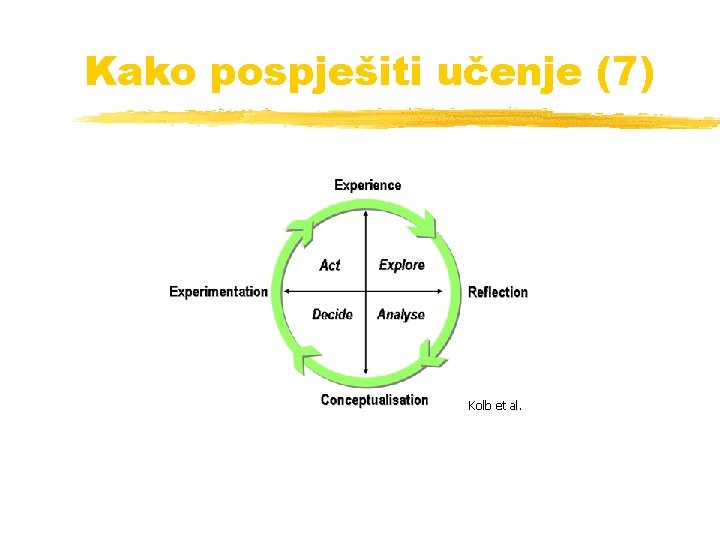
Kako pospješiti učenje (7) Kolb et al.
- Damage to the hippocampal formation interferes with contextual fear associations - Panic disorder, PTSD, obsessivecompulsive disorder, anxiety and fobias are all examples of classical fear conditioning Kolb B, Whishaw I (2008) Fundamentals of human neuropsychology.
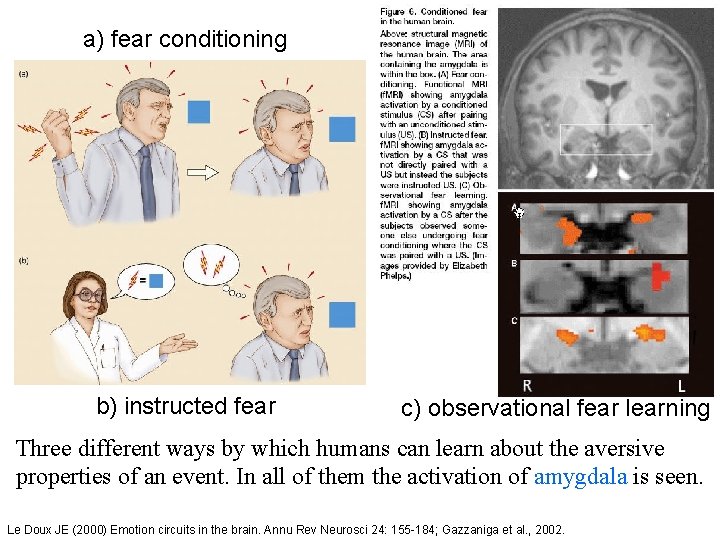
a) fear conditioning b) instructed fear c) observational fear learning Three different ways by which humans can learn about the aversive properties of an event. In all of them the activation of amygdala is seen. Le Doux JE (2000) Emotion circuits in the brain. Annu Rev Neurosci 24: 155 -184; Gazzaniga et al. , 2002.
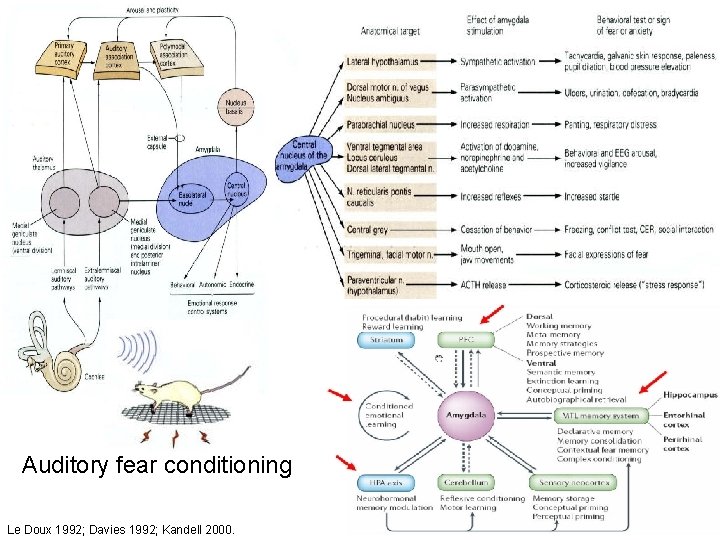
Auditory fear conditioning Le Doux 1992; Davies 1992; Kandell 2000.
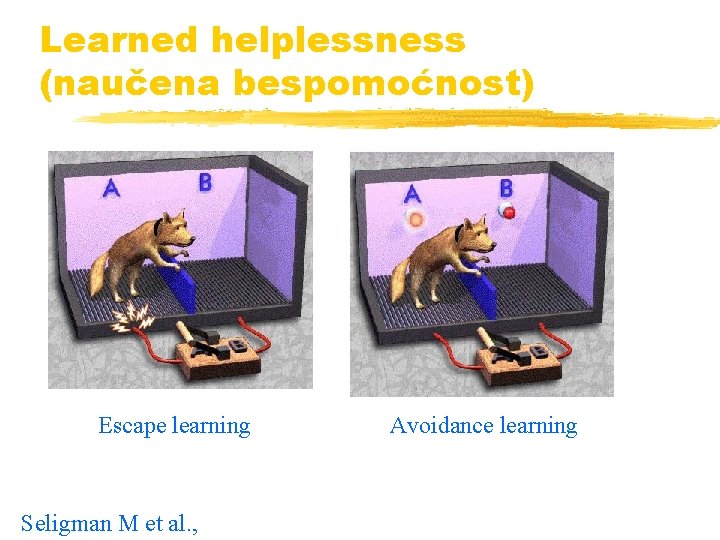
Learned helplessness (naučena bespomoćnost) Escape learning Seligman M et al. , Avoidance learning
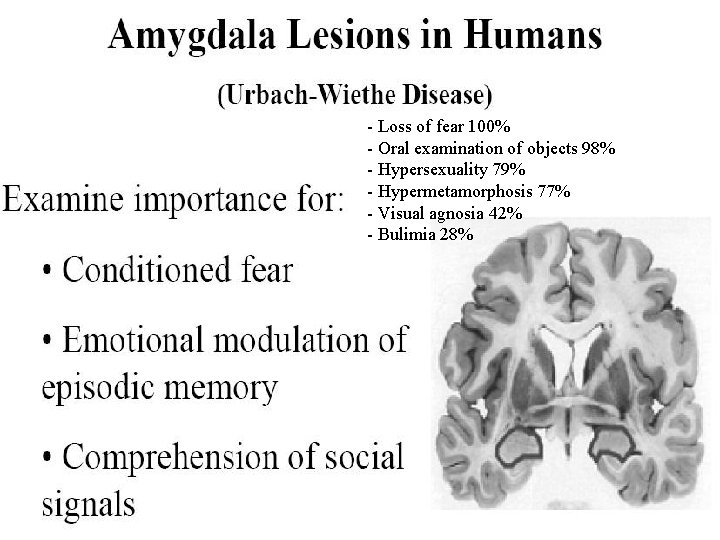
- Loss of fear 100% - Oral examination of objects 98% - Hypersexuality 79% - Hypermetamorphosis 77% - Visual agnosia 42% - Bulimia 28%
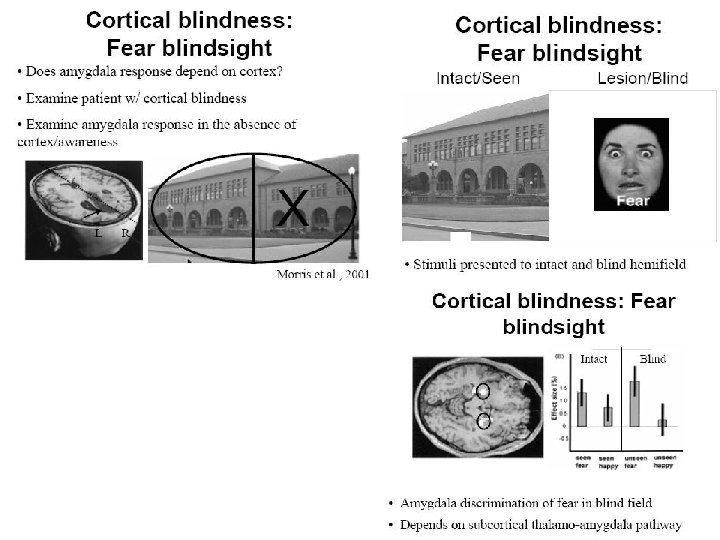
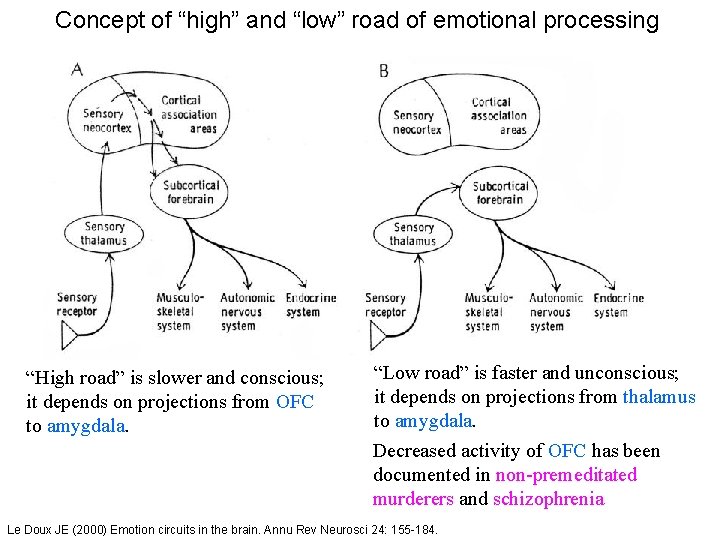
Concept of “high” and “low” road of emotional processing “High road” is slower and conscious; it depends on projections from OFC to amygdala. “Low road” is faster and unconscious; it depends on projections from thalamus to amygdala. Decreased activity of OFC has been documented in non-premeditated murderers and schizophrenia Le Doux JE (2000) Emotion circuits in the brain. Annu Rev Neurosci 24: 155 -184.
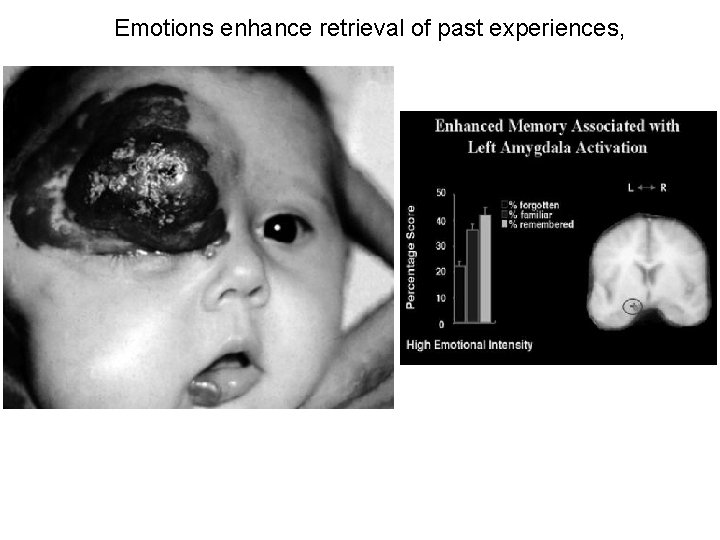
Emotions enhance retrieval of past experiences,
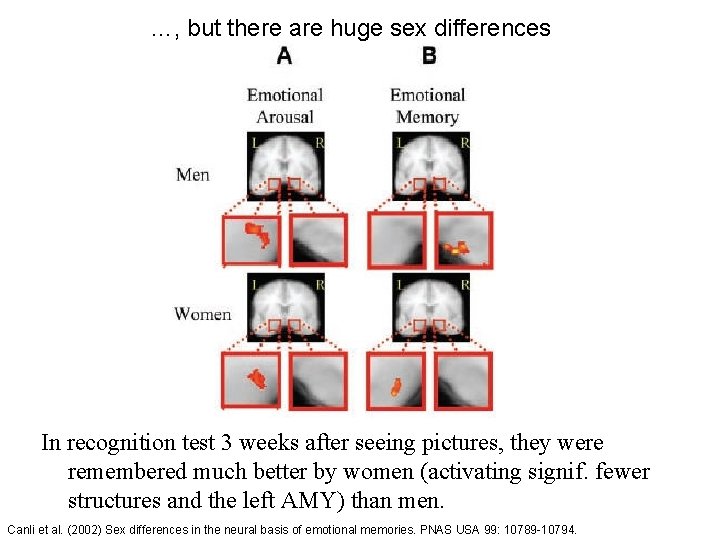
…, but there are huge sex differences In recognition test 3 weeks after seeing pictures, they were remembered much better by women (activating signif. fewer structures and the left AMY) than men. Canli et al. (2002) Sex differences in the neural basis of emotional memories. PNAS USA 99: 10789 -10794.
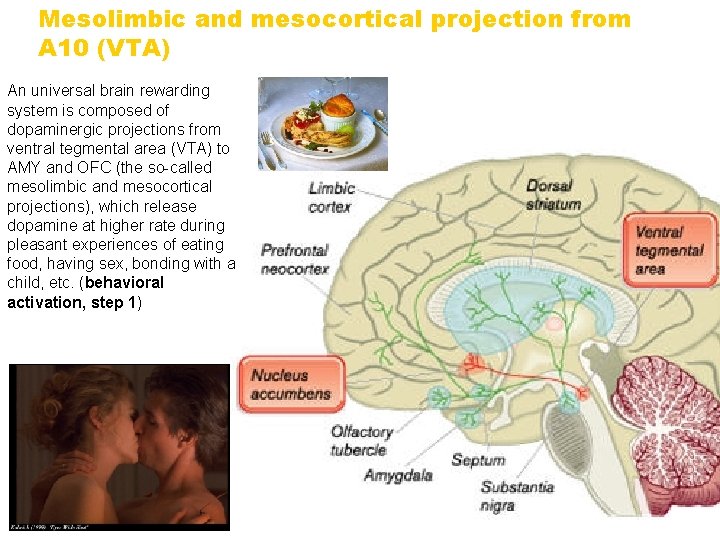
Mesolimbic and mesocortical projection from A 10 (VTA) An universal brain rewarding system is composed of dopaminergic projections from ventral tegmental area (VTA) to AMY and OFC (the so-called mesolimbic and mesocortical projections), which release dopamine at higher rate during pleasant experiences of eating food, having sex, bonding with a child, etc. (behavioral activation, step 1)
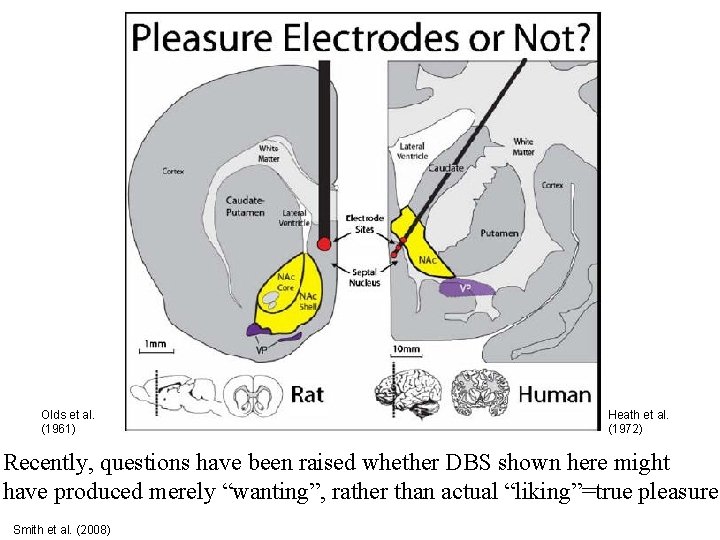
Olds et al. (1961) Heath et al. (1972) Recently, questions have been raised whether DBS shown here might have produced merely “wanting”, rather than actual “liking”=true pleasure Smith et al. (2008)
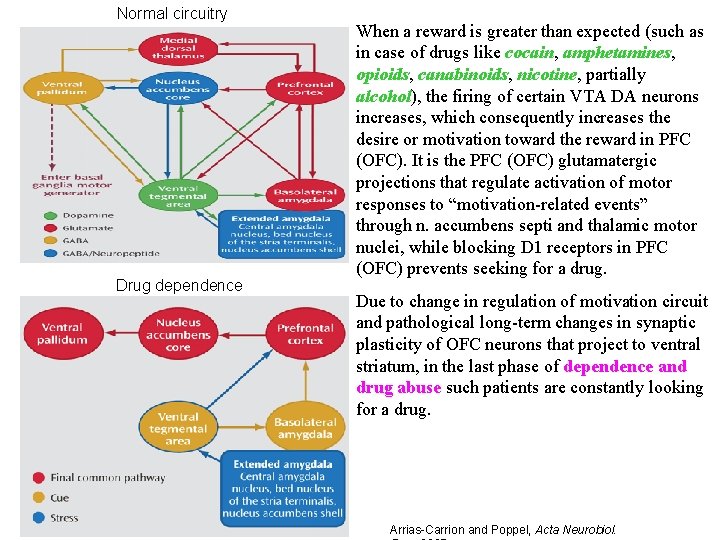
Normal circuitry Drug dependence When a reward is greater than expected (such as in case of drugs like cocain, amphetamines, opioids, canabinoids, nicotine, partially alcohol), the firing of certain VTA DA neurons increases, which consequently increases the desire or motivation toward the reward in PFC (OFC). It is the PFC (OFC) glutamatergic projections that regulate activation of motor responses to “motivation-related events” through n. accumbens septi and thalamic motor nuclei, while blocking D 1 receptors in PFC (OFC) prevents seeking for a drug. Due to change in regulation of motivation circuit and pathological long-term changes in synaptic plasticity of OFC neurons that project to ventral striatum, in the last phase of dependence and drug abuse such patients are constantly looking for a drug. Arrias-Carrion and Poppel, Acta Neurobiol.
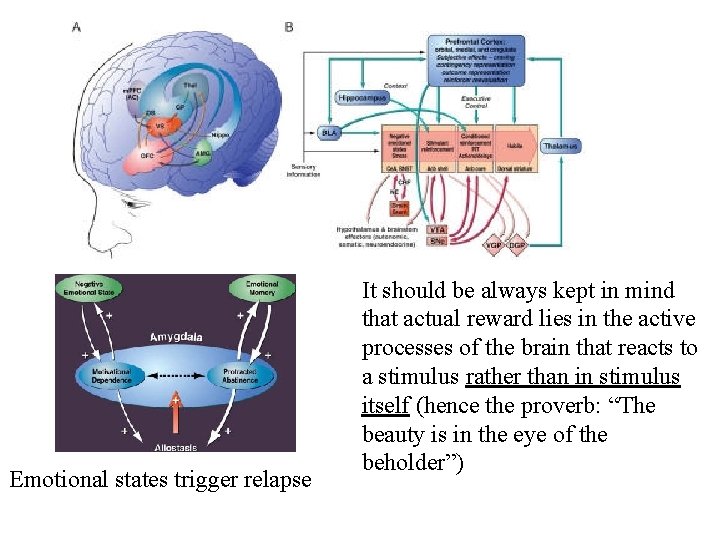
Emotional states trigger relapse It should be always kept in mind that actual reward lies in the active processes of the brain that reacts to a stimulus rather than in stimulus itself (hence the proverb: “The beauty is in the eye of the beholder”)
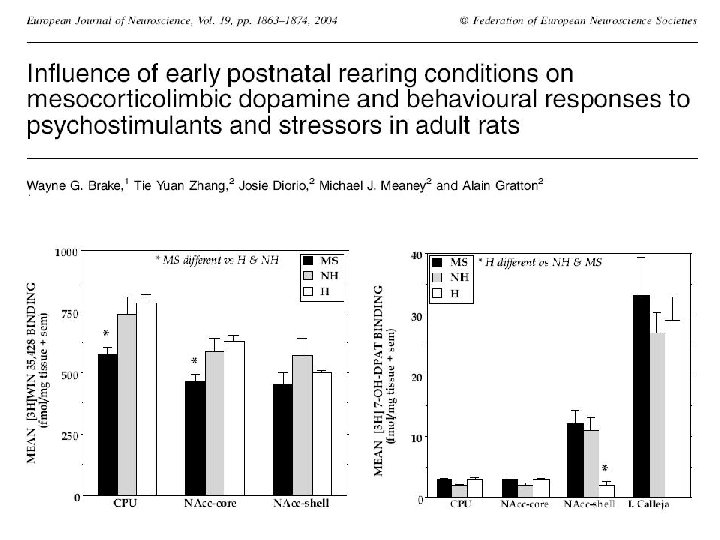
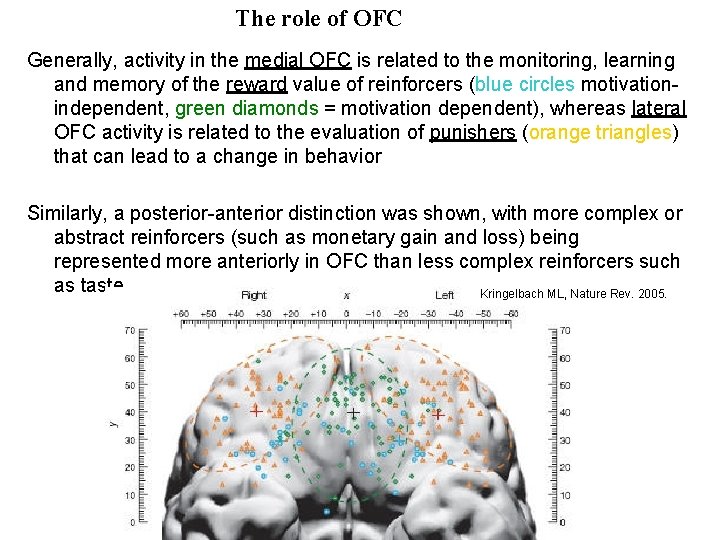
The role of OFC Generally, activity in the medial OFC is related to the monitoring, learning and memory of the reward value of reinforcers (blue circles motivationindependent, green diamonds = motivation dependent), whereas lateral OFC activity is related to the evaluation of punishers (orange triangles) that can lead to a change in behavior Similarly, a posterior-anterior distinction was shown, with more complex or abstract reinforcers (such as monetary gain and loss) being represented more anteriorly in OFC than less complex reinforcers such as taste Kringelbach ML, Nature Rev. 2005.
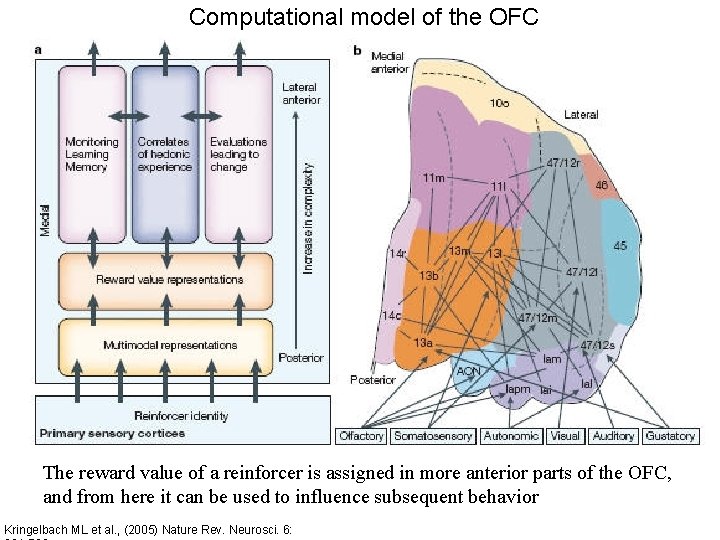
Computational model of the OFC The reward value of a reinforcer is assigned in more anterior parts of the OFC, and from here it can be used to influence subsequent behavior Kringelbach ML et al. , (2005) Nature Rev. Neurosci. 6:
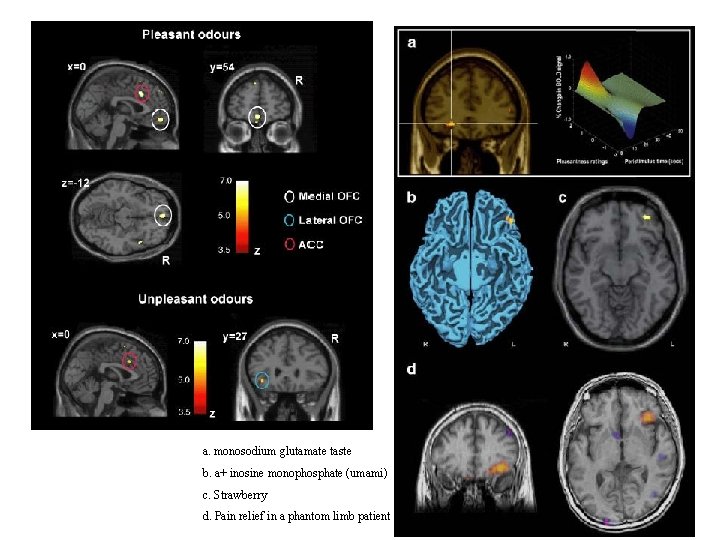
a. monosodium glutamate taste b. a+ inosine monophosphate (umami) c. Strawberry d. Pain relief in a phantom limb patient
Smell of fear z Dogs and horses can smell fear in humans. Work by Denise Chen (Chen & Haviland-Jones, Physiology and Behaviour 1999; 68: 241 -250) has demonstrated the ability of underarm odour to influence mood in others. Karl Grammer, in Vienna, has recently demonstrated that the smell of fear can be detected (by women) in the armpit secretions of people who watched a terrifying film (Ackerl, Atzmueller & Grammer, Neuroendocrinol Lett 2002; 23(2): 79 -84). The implication of this work is that a chemical signal is secreted in sweat which communicates the emotion.
Menstrual synchrony and smell z Armpit swabs taken from donor women at a certain phase in their menstrual cycle and wiped on the upper lip of recipient women can advance or retard menstruation in the recipients depending upon the phase of the donor (Stern & Mc. Clintock, Nature (1998) 392, 177 -179): They found that odourless compounds from the armpits of women in the late follicular phase of their menstrual cycles accelerated the preovulatory surge of luteinizing hormone of recipient women and shortened their menstrual cycles. Axillary (underarm) compounds from the same donors which were collected later in the menstrual cycle (at ovulation) had the opposite effect: they delayed the luteinizing-hormone surge of the recipients and lengthened their menstrual cycles. By showing in a fully controlled experiment that the timing of ovulation can be manipulated, this study provides definitive evidence of human pheromones.
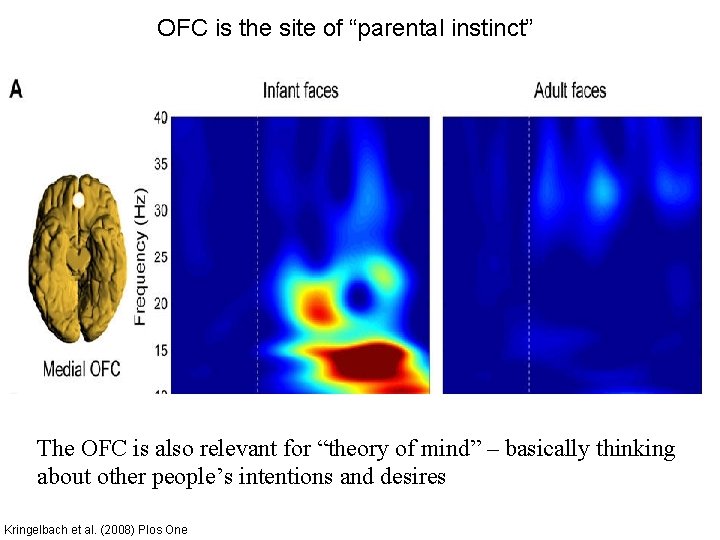
OFC is the site of “parental instinct” The OFC is also relevant for “theory of mind” – basically thinking about other people’s intentions and desires Kringelbach et al. (2008) Plos One
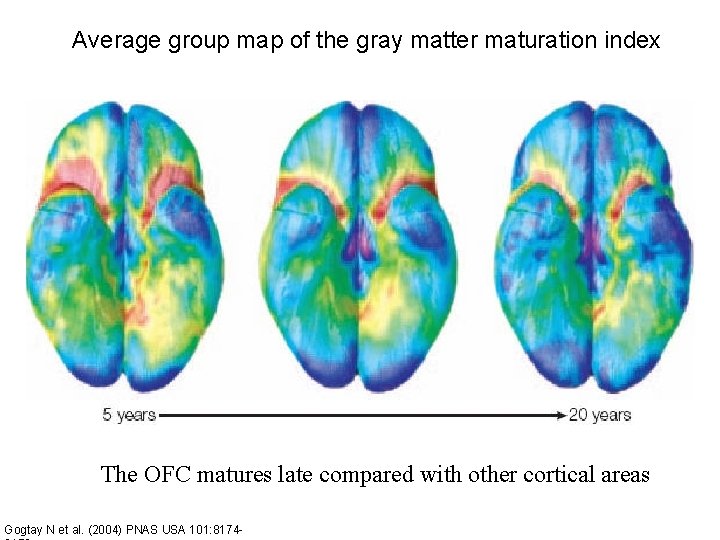
Average group map of the gray matter maturation index The OFC matures late compared with other cortical areas Gogtay N et al. (2004) PNAS USA 101: 8174 -
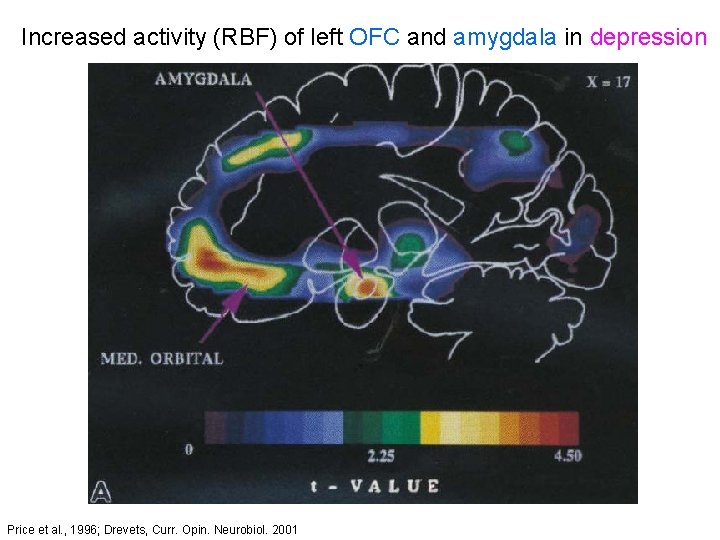
Increased activity (RBF) of left OFC and amygdala in depression Price et al. , 1996; Drevets, Curr. Opin. Neurobiol. 2001
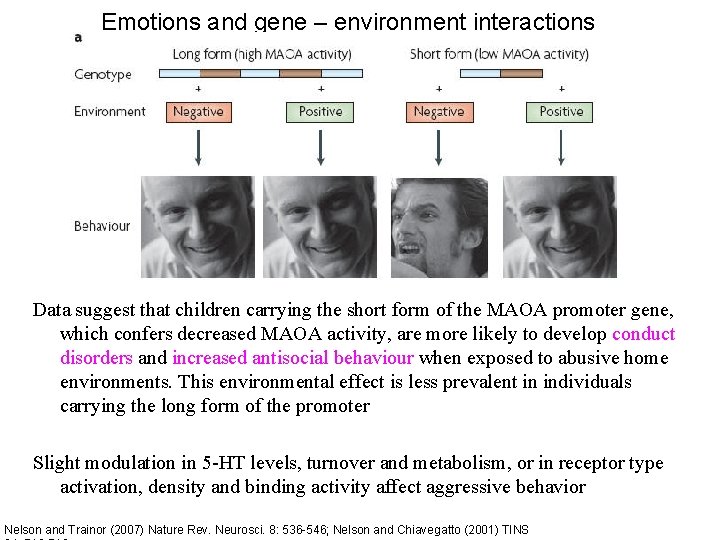
Emotions and gene – environment interactions Data suggest that children carrying the short form of the MAOA promoter gene, which confers decreased MAOA activity, are more likely to develop conduct disorders and increased antisocial behaviour when exposed to abusive home environments. This environmental effect is less prevalent in individuals carrying the long form of the promoter Slight modulation in 5 -HT levels, turnover and metabolism, or in receptor type activation, density and binding activity affect aggressive behavior Nelson and Trainor (2007) Nature Rev. Neurosci. 8: 536 -546; Nelson and Chiavegatto (2001) TINS
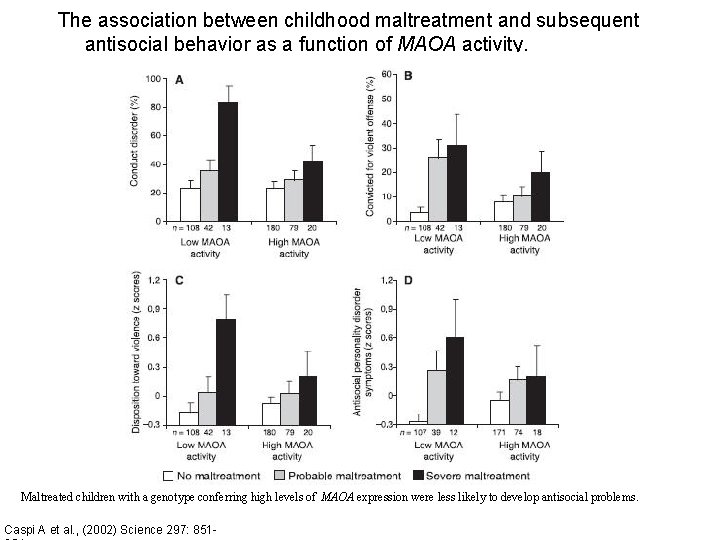
The association between childhood maltreatment and subsequent antisocial behavior as a function of MAOA activity. Maltreated children with a genotype conferring high levels of MAOA expression were less likely to develop antisocial problems. Caspi A et al. , (2002) Science 297: 851 -
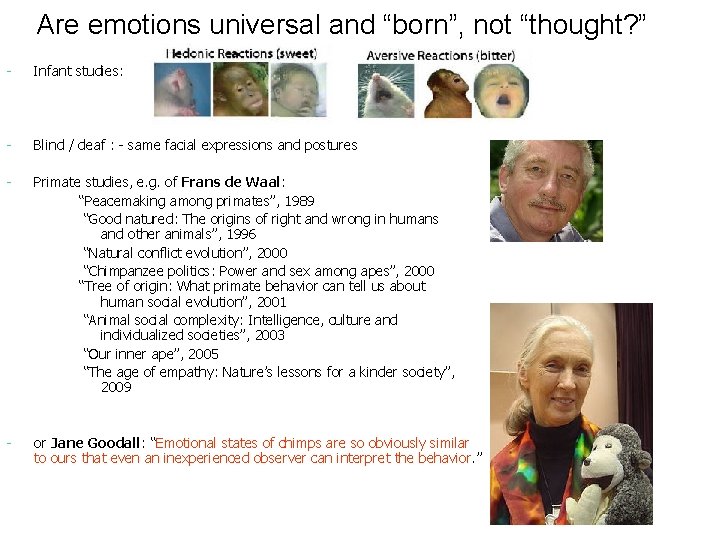
Are emotions universal and “born”, not “thought? ” - Infant studies: - Blind / deaf : - same facial expressions and postures - Primate studies, e. g. of Frans de Waal: “Peacemaking among primates”, 1989 “Good natured: The origins of right and wrong in humans and other animals”, 1996 “Natural conflict evolution”, 2000 “Chimpanzee politics: Power and sex among apes”, 2000 “Tree of origin: What primate behavior can tell us about human social evolution”, 2001 “Animal social complexity: Intelligence, culture and individualized societies”, 2003 “Our inner ape”, 2005 “The age of empathy: Nature’s lessons for a kinder society”, 2009 - or Jane Goodall: “Emotional states of chimps are so obviously similar to ours that even an inexperienced observer can interpret the behavior. ”
http: //www. bushorchimp. com
http: //www. bushorchimp. com
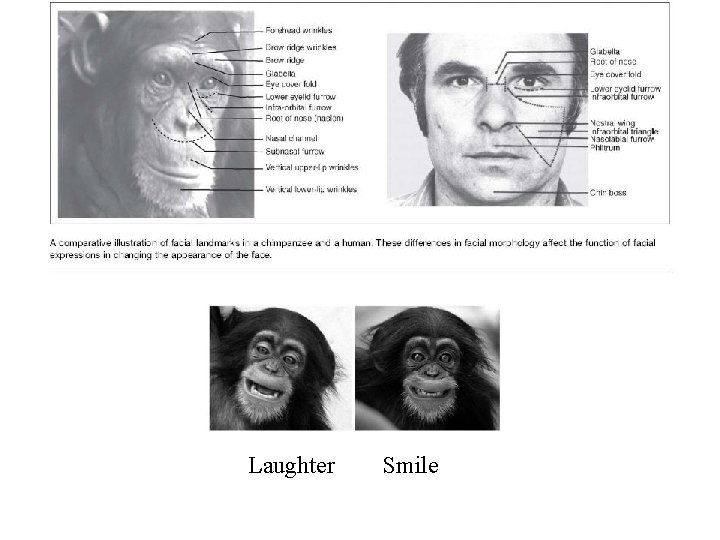
Laughter Smile
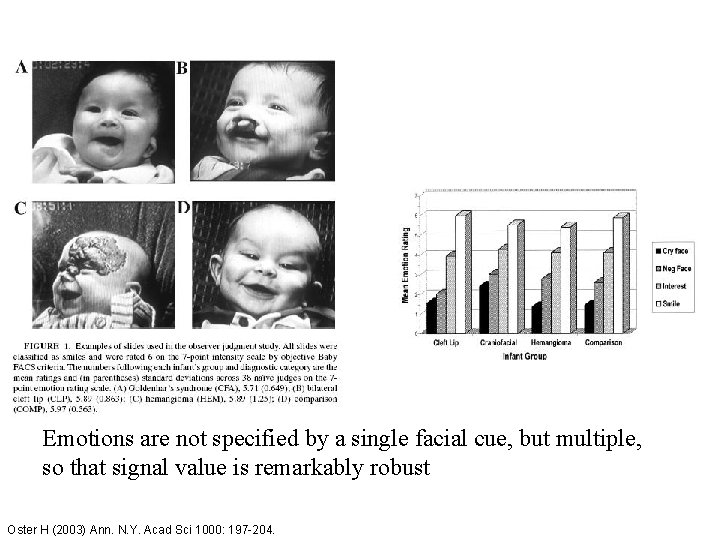
Emotions are not specified by a single facial cue, but multiple, so that signal value is remarkably robust Oster H (2003) Ann. N. Y. Acad Sci 1000: 197 -204.
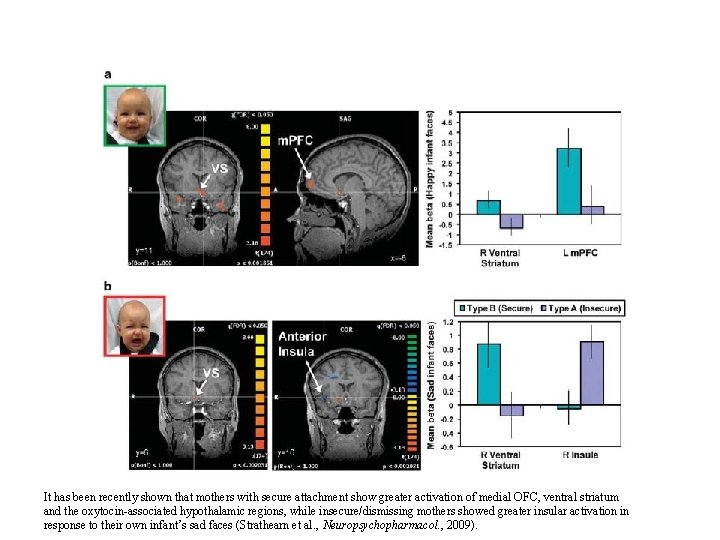
It has been recently shown that mothers with secure attachment show greater activation of medial OFC, ventral striatum and the oxytocin-associated hypothalamic regions, while insecure/dismissing mothers showed greater insular activation in response to their own infant’s sad faces (Strathearn et al. , Neuropsychopharmacol. , 2009).
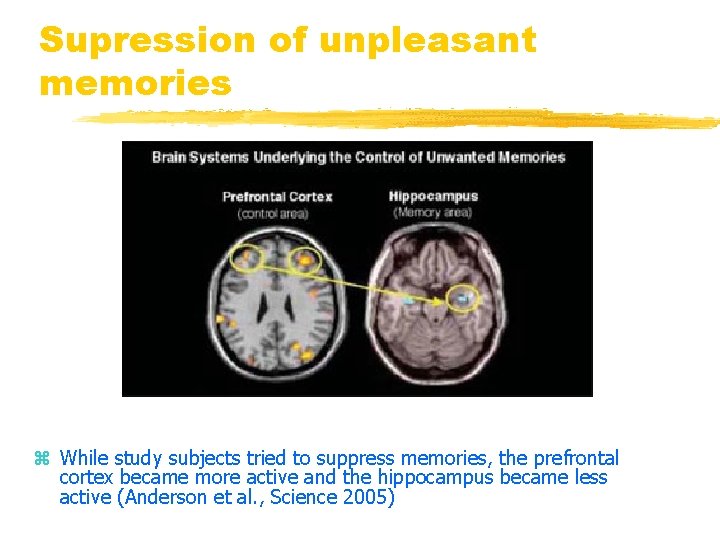
Supression of unpleasant memories z While study subjects tried to suppress memories, the prefrontal cortex became more active and the hippocampus became less active (Anderson et al. , Science 2005)
2006










































- Slides: 112