
Medicine Through Timeline 400 BC 500 AD 162
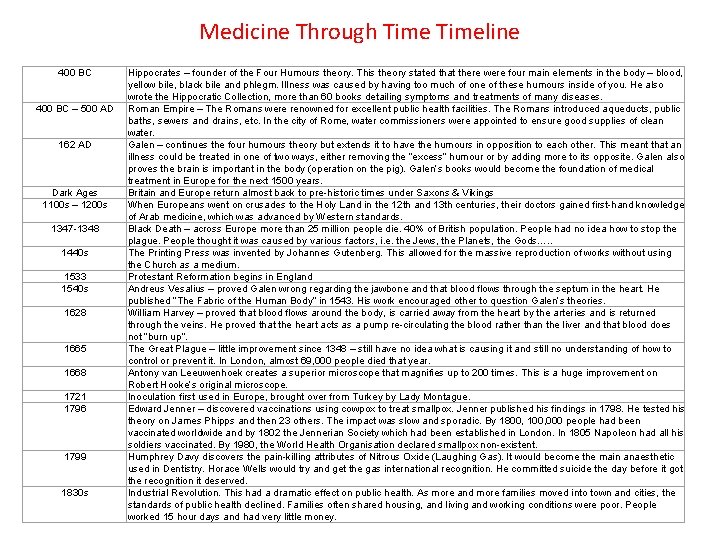
Medicine Through Timeline 400 BC – 500 AD 162 AD Dark Ages 1100 s – 1200 s 1347 -1348 1440 s 1533 1540 s 1628 1665 1668 1721 1796 1799 1830 s Hippocrates – founder of the Four Humours theory. This theory stated that there were four main elements in the body – blood, yellow bile, black bile and phlegm. Illness was caused by having too much of one of these humours inside of you. He also wrote the Hippocratic Collection, more than 60 books detailing symptoms and treatments of many diseases. Roman Empire – The Romans were renowned for excellent public health facilities. The Romans introduced aqueducts, public baths, sewers and drains, etc. In the city of Rome, water commissioners were appointed to ensure good supplies of clean water. Galen – continues the four humours theory but extends it to have the humours in opposition to each other. This meant that an illness could be treated in one of two ways, either removing the “excess” humour or by adding more to its opposite. Galen also proves the brain is important in the body (operation on the pig). Galen’s books would become the foundation of medical treatment in Europe for the next 1500 years. Britain and Europe return almost back to pre-historic times under Saxons & Vikings When Europeans went on crusades to the Holy Land in the 12 th and 13 th centuries, their doctors gained first-hand knowledge of Arab medicine, which was advanced by Western standards. Black Death – across Europe more than 25 million people die. 40% of British population. People had no idea how to stop the plague. People thought it was caused by various factors, i. e. the Jews, the Planets, the Gods…. . The Printing Press was invented by Johannes Gutenberg. This allowed for the massive reproduction of works without using the Church as a medium. Protestant Reformation begins in England Andreus Vesalius – proved Galen wrong regarding the jawbone and that blood flows through the septum in the heart. He published “The Fabric of the Human Body” in 1543. His work encouraged other to question Galen’s theories. William Harvey – proved that blood flows around the body, is carried away from the heart by the arteries and is returned through the veins. He proved that the heart acts as a pump re-circulating the blood rather than the liver and that blood does not “burn up”. The Great Plague – little improvement since 1348 – still have no idea what is causing it and still no understanding of how to control or prevent it. In London, almost 69, 000 people died that year. Antony van Leeuwenhoek creates a superior microscope that magnifies up to 200 times. This is a huge improvement on Robert Hooke’s original microscope. Inoculation first used in Europe, brought over from Turkey by Lady Montague. Edward Jenner – discovered vaccinations using cowpox to treat smallpox. Jenner published his findings in 1798. He tested his theory on James Phipps and then 23 others. The impact was slow and sporadic. By 1800, 100, 000 people had been vaccinated worldwide and by 1802 the Jennerian Society which had been established in London. In 1805 Napoleon had all his soldiers vaccinated. By 1980, the World Health Organisation declared smallpox non-existent. Humphrey Davy discovers the pain-killing attributes of Nitrous Oxide (Laughing Gas). It would become the main anaesthetic used in Dentistry. Horace Wells would try and get the gas international recognition. He committed suicide the day before it got the recognition it deserved. Industrial Revolution. This had a dramatic effect on public health. As more and more families moved into town and cities, the standards of public health declined. Families often shared housing, and living and working conditions were poor. People worked 15 hour days and had very little money.
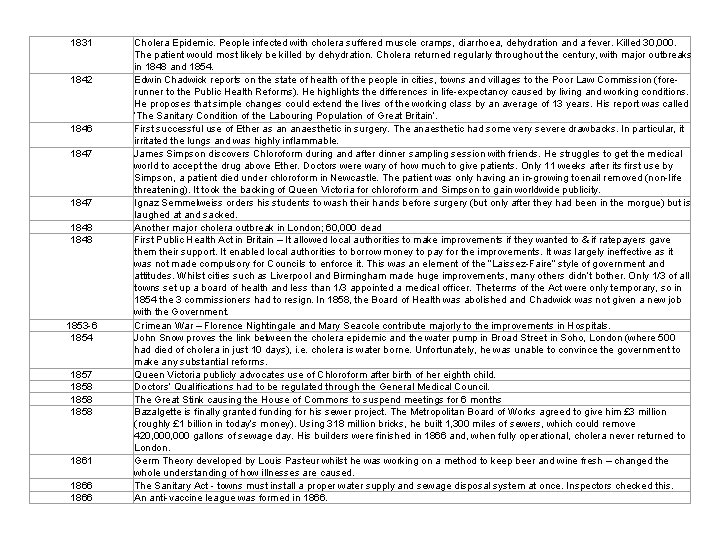
1831 1842 1846 1847 1848 1853 -6 1854 1857 1858 1861 1866 Cholera Epidemic. People infected with cholera suffered muscle cramps, diarrhoea, dehydration and a fever. Killed 30, 000. The patient would most likely be killed by dehydration. Cholera returned regularly throughout the century, with major outbreaks in 1848 and 1854. Edwin Chadwick reports on the state of health of the people in cities, towns and villages to the Poor Law Commission (forerunner to the Public Health Reforms). He highlights the differences in life-expectancy caused by living and working conditions. He proposes that simple changes could extend the lives of the working class by an average of 13 years. His report was called ‘The Sanitary Condition of the Labouring Population of Great Britain’. First successful use of Ether as an anaesthetic in surgery. The anaesthetic had some very severe drawbacks. In particular, it irritated the lungs and was highly inflammable. James Simpson discovers Chloroform during and after dinner sampling session with friends. He struggles to get the medical world to accept the drug above Ether. Doctors were wary of how much to give patients. Only 11 weeks after its first use by Simpson, a patient died under chloroform in Newcastle. The patient was only having an in-growing toenail removed (non-life threatening). It took the backing of Queen Victoria for chloroform and Simpson to gain worldwide publicity. Ignaz Semmelweiss orders his students to wash their hands before surgery (but only after they had been in the morgue) but is laughed at and sacked. Another major cholera outbreak in London; 60, 000 dead First Public Health Act in Britain – It allowed local authorities to make improvements if they wanted to & if ratepayers gave them their support. It enabled local authorities to borrow money to pay for the improvements. It was largely ineffective as it was not made compulsory for Councils to enforce it. This was an element of the “Laissez-Faire” style of government and attitudes. Whilst cities such as Liverpool and Birmingham made huge improvements, many others didn’t bother. Only 1/3 of all towns set up a board of health and less than 1/3 appointed a medical officer. Theterms of the Act were only temporary, so in 1854 the 3 commissioners had to resign. In 1858, the Board of Health was abolished and Chadwick was not given a new job with the Government. Crimean War – Florence Nightingale and Mary Seacole contribute majorly to the improvements in Hospitals. John Snow proves the link between the cholera epidemic and the water pump in Broad Street in Soho, London (where 500 had died of cholera in just 10 days), i. e. cholera is water borne. Unfortunately, he was unable to convince the government to make any substantial reforms. Queen Victoria publicly advocates use of Chloroform after birth of her eighth child. Doctors’ Qualifications had to be regulated through the General Medical Council. The Great Stink causing the House of Commons to suspend meetings for 6 months Bazalgette is finally granted funding for his sewer project. The Metropolitan Board of Works agreed to give him £ 3 million (roughly £ 1 billion in today’s money). Using 318 million bricks, he built 1, 300 miles of sewers, which could remove 420, 000 gallons of sewage day. His builders were finished in 1866 and, when fully operational, cholera never returned to London. Germ Theory developed by Louis Pasteur whilst he was working on a method to keep beer and wine fresh – changed the whole understanding of how illnesses are caused. The Sanitary Act - towns must install a proper water supply and sewage disposal system at once. Inspectors checked this. An anti-vaccine league was formed in 1866.
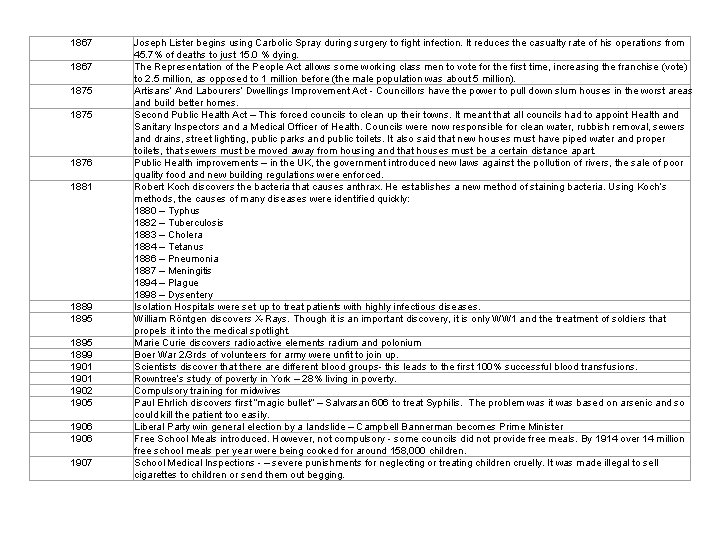
1867 1875 1876 1881 1889 1895 1899 1901 1902 1905 1906 1907 Joseph Lister begins using Carbolic Spray during surgery to fight infection. It reduces the casualty rate of his operations from 45. 7% of deaths to just 15. 0 % dying. The Representation of the People Act allows some working class men to vote for the first time, increasing the franchise (vote) to 2. 5 million, as opposed to 1 million before (the male population was about 5 million). Artisans’ And Labourers’ Dwellings Improvement Act - Councillors have the power to pull down slum houses in the worst areas and build better homes. Second Public Health Act – This forced councils to clean up their towns. It meant that all councils had to appoint Health and Sanitary Inspectors and a Medical Officer of Health. Councils were now responsible for clean water, rubbish removal, sewers and drains, street lighting, public parks and public toilets. It also said that new houses must have piped water and proper toilets, that sewers must be moved away from housing and that houses must be a certain distance apart. Public Health improvements – in the UK, the government introduced new laws against the pollution of rivers, the sale of poor quality food and new building regulations were enforced. Robert Koch discovers the bacteria that causes anthrax. He establishes a new method of staining bacteria. Using Koch’s methods, the causes of many diseases were identified quickly: 1880 – Typhus 1882 – Tuberculosis 1883 – Cholera 1884 – Tetanus 1886 – Pneumonia 1887 – Meningitis 1894 – Plague 1898 – Dysentery Isolation Hospitals were set up to treat patients with highly infectious diseases. William Röntgen discovers X-Rays. Though it is an important discovery, it is only WW 1 and the treatment of soldiers that propels it into the medical spotlight. Marie Curie discovers radioactive elements radium and polonium Boer War 2/3 rds of volunteers for army were unfit to join up. Scientists discover that there are different blood groups- this leads to the first 100% successful blood transfusions. Rowntree’s study of poverty in York – 28% living in poverty. Compulsory training for midwives Paul Ehrlich discovers first “magic bullet” – Salvarsan 606 to treat Syphilis. The problem was it was based on arsenic and so could kill the patient too easily. Liberal Party win general election by a landslide – Campbell Bannerman becomes Prime Minister Free School Meals introduced. However, not compulsory - some councils did not provide free meals. By 1914 over 14 million free school meals per year were being cooked for around 158, 000 children. School Medical Inspections - – severe punishments for neglecting or treating children cruelly. It was made illegal to sell cigarettes to children or send them out begging.
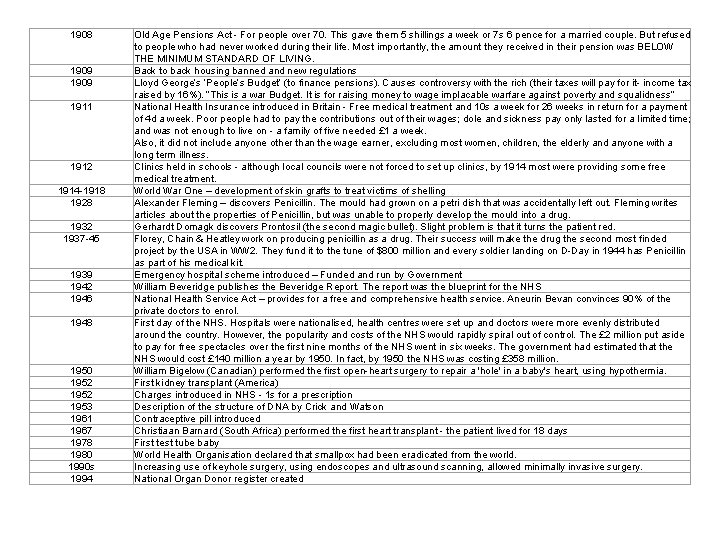
1908 1909 1911 1912 1914 -1918 1928 1932 1937 -45 1939 1942 1946 1948 1950 1952 1953 1961 1967 1978 1980 1990 s 1994 Old Age Pensions Act - For people over 70. This gave them 5 shillings a week or 7 s 6 pence for a married couple. But refused to people who had never worked during their life. Most importantly, the amount they received in their pension was BELOW THE MINIMUM STANDARD OF LIVING. Back to back housing banned and new regulations Lloyd George’s ‘People’s Budget’ (to finance pensions). Causes controversy with the rich (their taxes will pay for it- income tax raised by 16%). “This is a war Budget. It is for raising money to wage implacable warfare against poverty and squalidness” National Health Insurance introduced in Britain - Free medical treatment and 10 s a week for 26 weeks in return for a payment of 4 d a week. Poor people had to pay the contributions out of their wages; dole and sickness pay only lasted for a limited time; and was not enough to live on - a family of five needed £ 1 a week. Also, it did not include anyone other than the wage earner, excluding most women, children, the elderly and anyone with a long term illness. Clinics held in schools - although local councils were not forced to set up clinics, by 1914 most were providing some free medical treatment. World War One – development of skin grafts to treat victims of shelling Alexander Fleming – discovers Penicillin. The mould had grown on a petri dish that was accidentally left out. Fleming writes articles about the properties of Penicillin, but was unable to properly develop the mould into a drug. Gerhardt Domagk discovers Prontosil (the second magic bullet). Slight problem is that it turns the patient red. Florey, Chain & Heatley work on producing penicillin as a drug. Their success will make the drug the second most finded project by the USA in WW 2. They fund it to the tune of $800 million and every soldier landing on D-Day in 1944 has Penicillin as part of his medical kit. Emergency hospital scheme introduced – Funded and run by Government William Beveridge publishes the Beveridge Report. The report was the blueprint for the NHS National Health Service Act – provides for a free and comprehensive health service. Aneurin Bevan convinces 90% of the private doctors to enrol. First day of the NHS. Hospitals were nationalised, health centres were set up and doctors were more evenly distributed around the country. However, the popularity and costs of the NHS would rapidly spiral out of control. The £ 2 million put aside to pay for free spectacles over the first nine months of the NHS went in six weeks. The government had estimated that the NHS would cost £ 140 million a year by 1950. In fact, by 1950 the NHS was costing £ 358 million. William Bigelow (Canadian) performed the first open-heart surgery to repair a 'hole' in a baby's heart, using hypothermia. First kidney transplant (America) Charges introduced in NHS - 1 s for a prescription Description of the structure of DNA by Crick and Watson Contraceptive pill introduced Christiaan Barnard (South Africa) performed the first heart transplant - the patient lived for 18 days First test tube baby World Health Organisation declared that smallpox had been eradicated from the world. Increasing use of keyhole surgery, using endoscopes and ultrasound scanning, allowed minimally invasive surgery. National Organ Donor register created
- Slides: 4