
Medicine Through Time Medieval and Renaissance Key Terminology
- Slides: 1
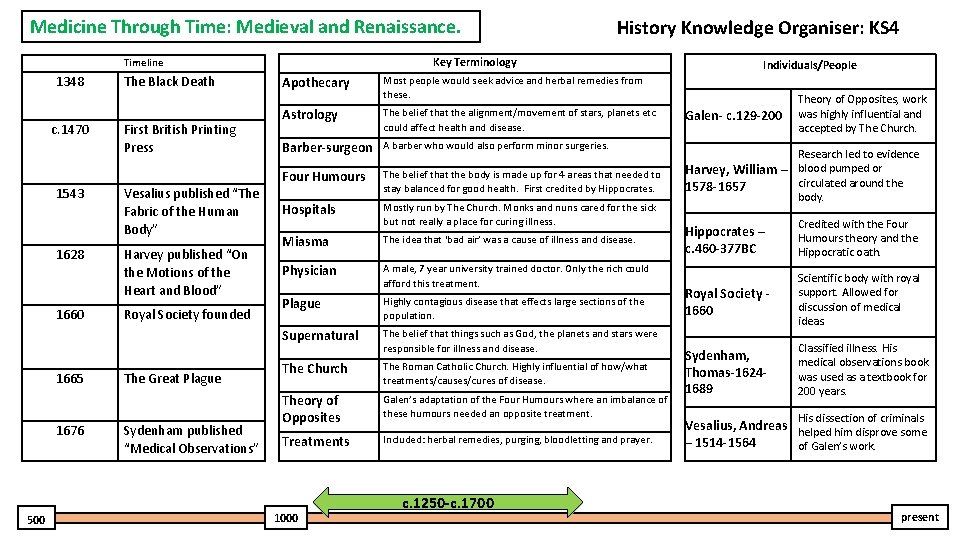
Medicine Through Time: Medieval and Renaissance. Key Terminology Timeline 1348 c. 1470 1543 1628 1660 1665 1676 500 The Black Death History Knowledge Organiser: KS 4 Apothecary Astrology The belief that the alignment/movement of stars, planets etc could affect health and disease. Barber-surgeon A barber who would also perform minor surgeries. Four Humours Vesalius published “The Fabric of the Human Body” The belief that the body is made up for 4 areas that needed to stay balanced for good health. First credited by Hippocrates. Hospitals Mostly run by The Church. Monks and nuns cared for the sick but not really a place for curing illness. Harvey published “On the Motions of the Heart and Blood” Miasma The idea that ‘bad air’ was a cause of illness and disease. Physician A male, 7 year university trained doctor. Only the rich could afford this treatment. Plague Highly contagious disease that effects large sections of the population. Supernatural The belief that things such as God, the planets and stars were responsible for illness and disease. First British Printing Press Royal Society founded The Great Plague Sydenham published “Medical Observations” The Church The Roman Catholic Church. Highly influential of how/what treatments/causes/cures of disease. Theory of Opposites Galen’s adaptation of the Four Humours where an imbalance of these humours needed an opposite treatment. Treatments Included: herbal remedies, purging, bloodletting and prayer. 1000 Individuals/People Most people would seek advice and herbal remedies from these. c. 1250 -c. 1700 Galen- c. 129 -200 Theory of Opposites, work was highly influential and accepted by The Church. Research led to evidence Harvey, William – blood pumped or circulated around the 1578 -1657 body. Hippocrates – c. 460 -377 BC Credited with the Four Humours theory and the Hippocratic oath. Royal Society 1660 Scientific body with royal support. Allowed for discussion of medical ideas. Sydenham, Thomas-16241689 Classified illness. His medical observations book was used as a textbook for 200 years. His dissection of criminals Vesalius, Andreas helped him disprove some – 1514 -1564 of Galen’s work. present