
Medicine Nursing and Health Sciences Australians awareness of
- Slides: 22
Medicine, Nursing and Health Sciences Australian’s awareness of cardiac arrest and rates of CPR training: results from the Heart Foundation’s Heart Watch Survey. A/Prof Janet Bray Catuscia Biuso, Susie Cartledge, Judith Finn Monash University, Curtin University, Heart Foundation, Deakin University, Australian Resuscitation Outcomes Consortium (Aus-ROC)
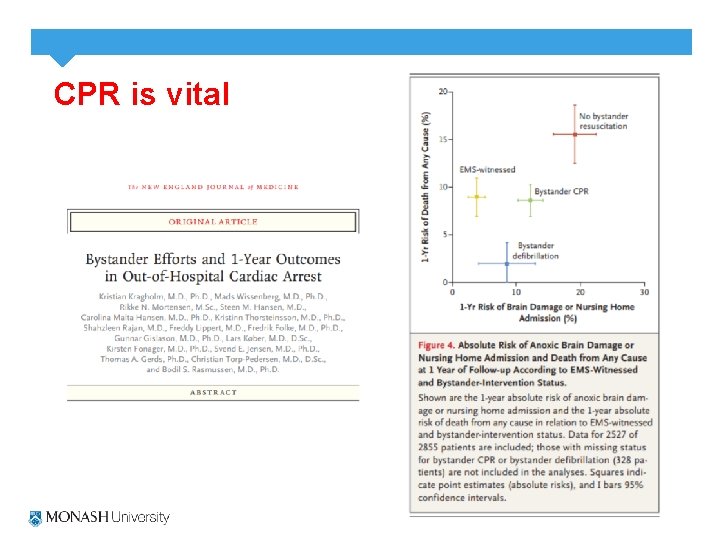
CPR is vital
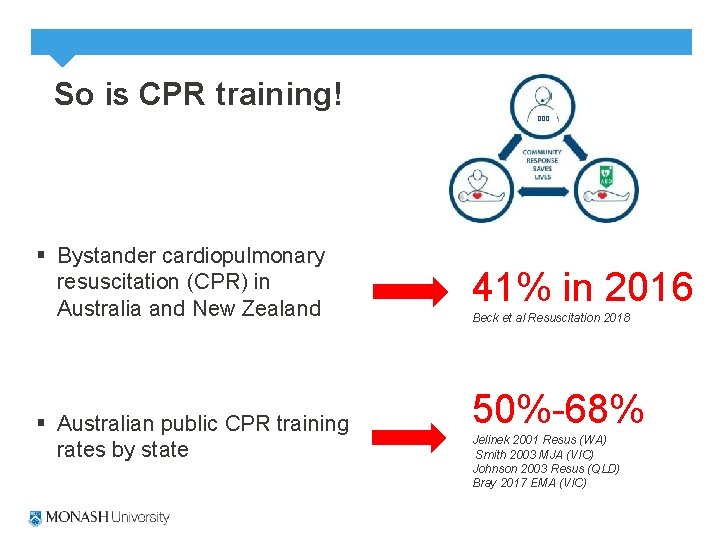
So is CPR training! 000 § Bystander cardiopulmonary resuscitation (CPR) in Australia and New Zealand § Australian public CPR training rates by state 41% in 2016 Beck et al Resuscitation 2018 50%-68% Jelinek 2001 Resus (WA) Smith 2003 MJA (VIC) Johnson 2003 Resus (QLD) Bray 2017 EMA (VIC)
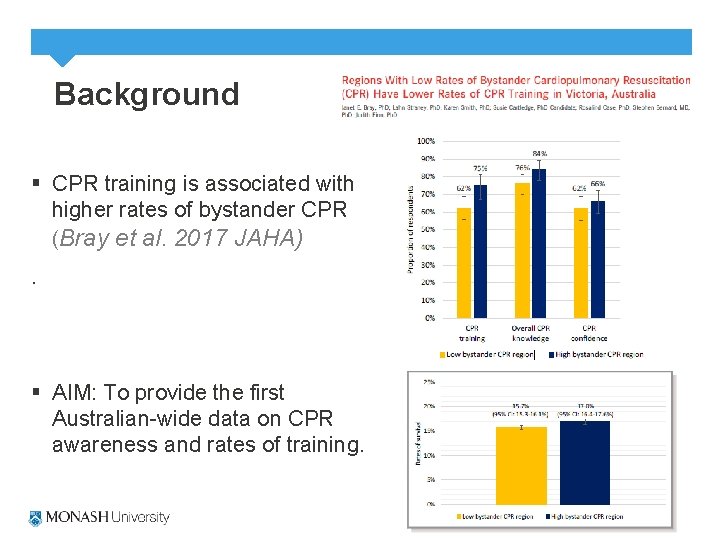
Background § CPR training is associated with higher rates of bystander CPR (Bray et al. 2017 JAHA). § AIM: To provide the first Australian-wide data on CPR awareness and rates of training.
Methods § The online survey was conducted on adults in July 2017 (Heart Watch survey conducted by Heart Foundation of Australia). § A purposive, non-probability sampling method - quotas for age, gender and area of residence to reflect the wider Australian population. § Respondents to the Heart. Watch survey belong to an online survey panel. § Approximately 12, 000 Australians per annum. § CPR questions added to July survey. § Descriptive analysis
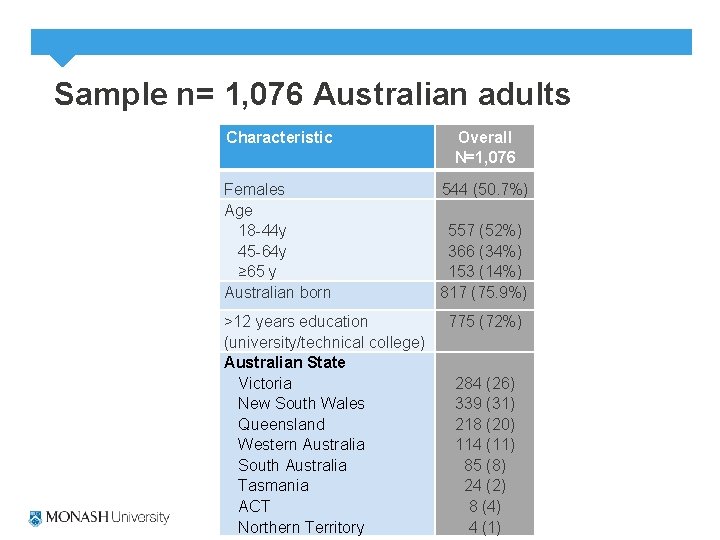
Sample n= 1, 076 Australian adults Characteristic Overall N=1, 076 Females Age 18 -44 y 45 -64 y ≥ 65 y Australian born 544 (50. 7%) >12 years education (university/technical college) Australian State Victoria New South Wales Queensland Western Australia South Australia Tasmania ACT Northern Territory 557 (52%) 366 (34%) 153 (14%) 817 (75. 9%) 775 (72%) 284 (26) 339 (31) 218 (20) 114 (11) 85 (8) 24 (2) 8 (4) 4 (1)
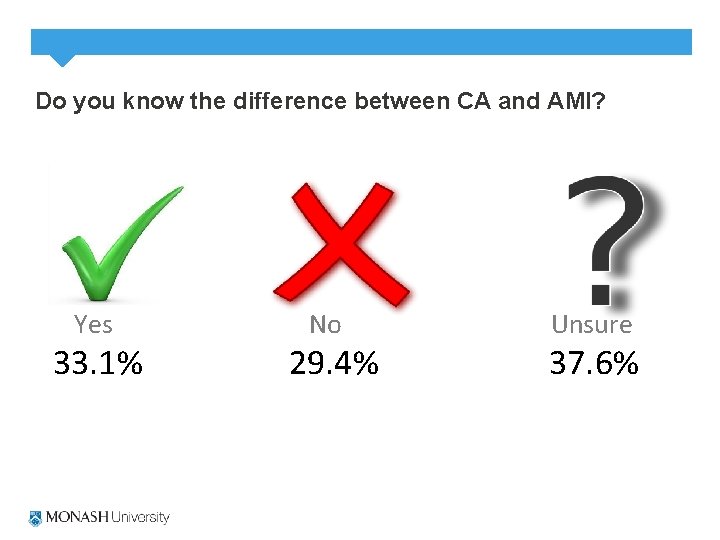
Do you know the difference between CA and AMI? Yes 33. 1% No 29. 4% Unsure 37. 6%
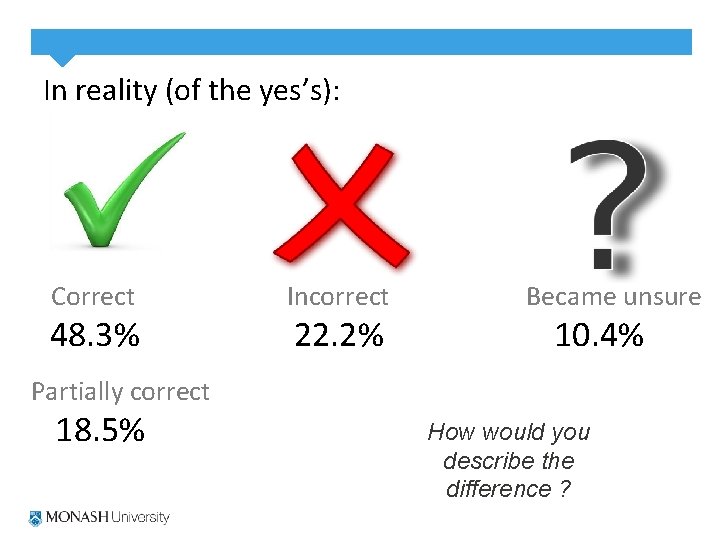
In reality (of the yes’s): Correct 48. 3% Incorrect 22. 2% Became unsure 10. 4% Partially correct 18. 5% How would you describe the difference ?
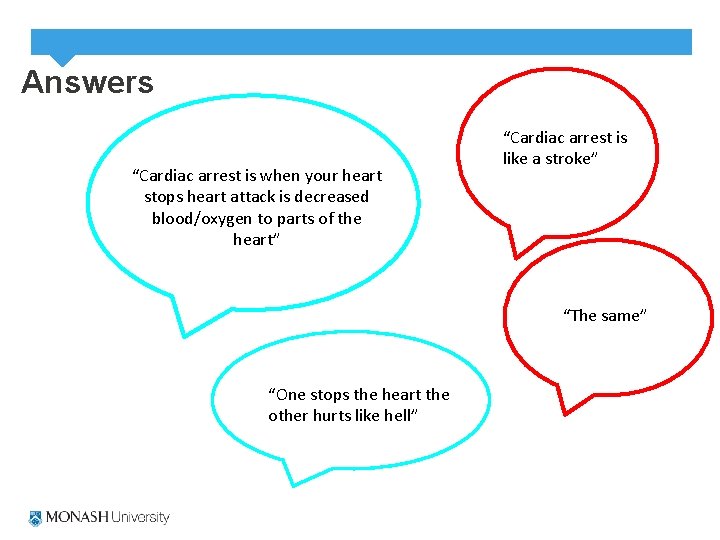
Answers “With a cardiac arrest the heart stops pumping and the individual “Cardiac arrest is when your heart is dead unless revived. stops heartwhen attack is decreased A heart attack occurs the to parts of the heart pumpsblood/oxygen inefficiently mainly heart” It because arteries are blocked. can lead to cardiac arrest” “Cardiac arrest is like a stroke” “The same” “One stops the heart the other hurts like hell”
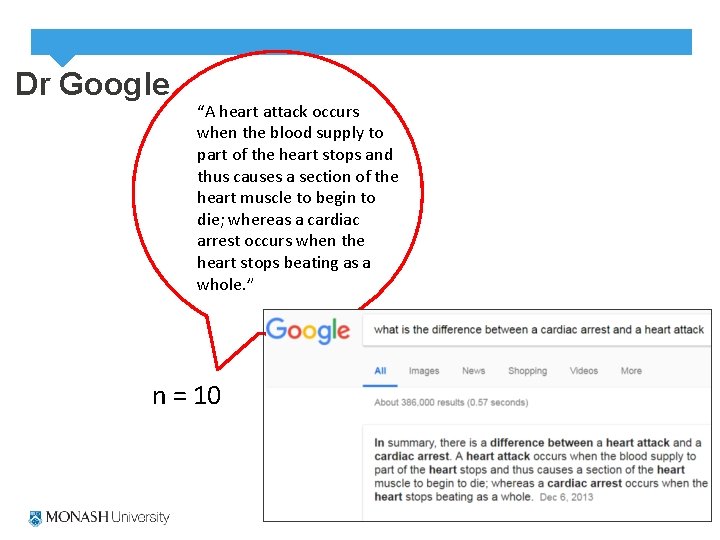
Dr Google “A heart attack occurs when the blood supply to part of the heart stops and thus causes a section of the heart muscle to begin to die; whereas a cardiac arrest occurs when the heart stops beating as a whole. ” n = 10
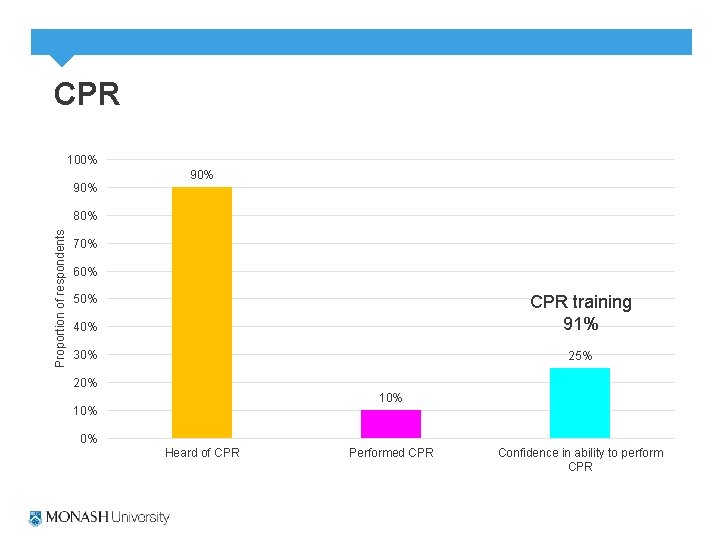
CPR 100% 90% Proportion of respondents 80% 70% 60% 40% CPR training 91% 30% 25% 50% 20% 10% 0% Heard of CPR Performed CPR Confidence in ability to perform CPR
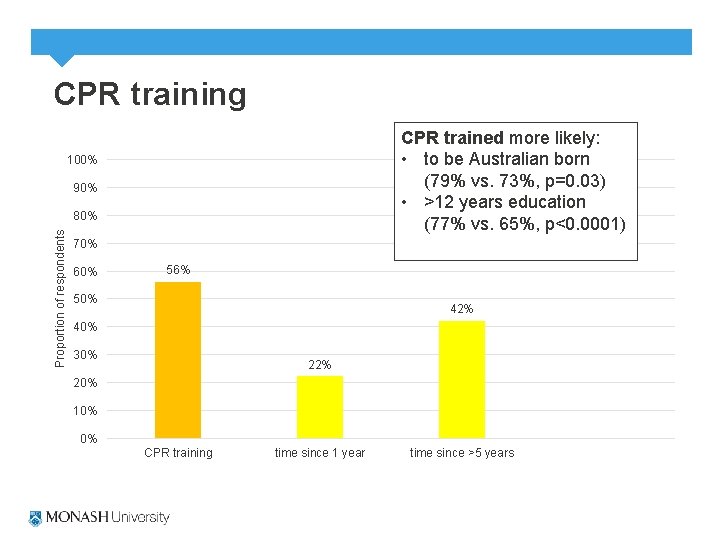
CPR training CPR trained more likely: • to be Australian born (79% vs. 73%, p=0. 03) • >12 years education (77% vs. 65%, p<0. 0001) 100% 90% Proportion of respondents 80% 70% 60% 56% 50% 42% 40% 30% 22% 20% 10% 0% CPR training time since 1 year time since >5 years
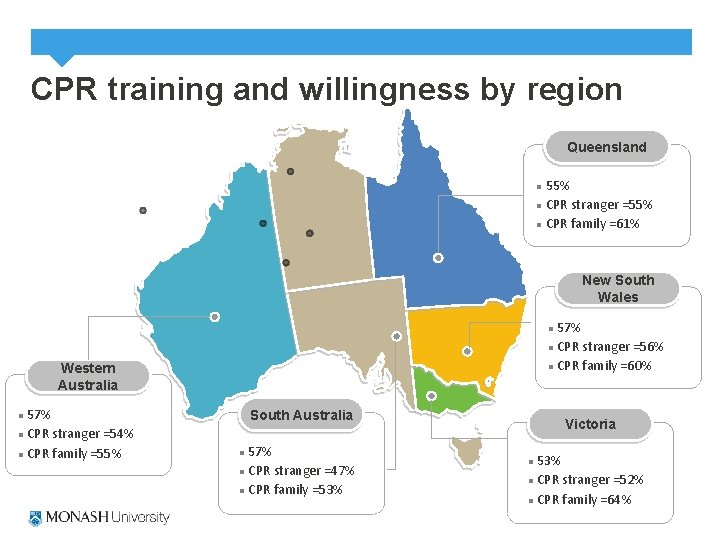
CPR training and willingness by region Queensland 55% l CPR stranger =55% l CPR family =61% l New South Wales 57% l CPR stranger =56% l CPR family =60% l Western Australia 57% l CPR stranger =54% l CPR family =55% South Australia l 57% l CPR stranger =47% l CPR family =53% l Victoria 53% l CPR stranger =52% l CPR family =64% l
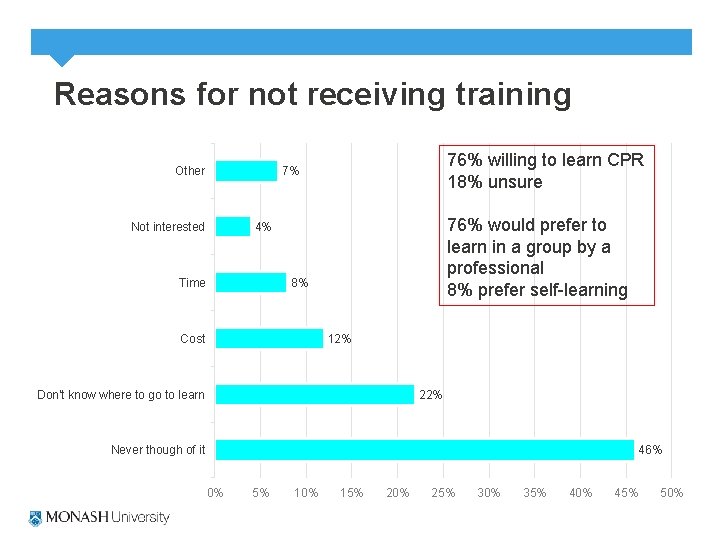
Reasons for not receiving training Other 76% willing to learn CPR 18% unsure 7% Not interested 76% would prefer to learn in a group by a professional 8% prefer self-learning 4% Time 8% Cost 12% Don't know where to go to learn 22% Never though of it 46% 0% 5% 10% 15% 20% 25% 30% 35% 40% 45% 50%
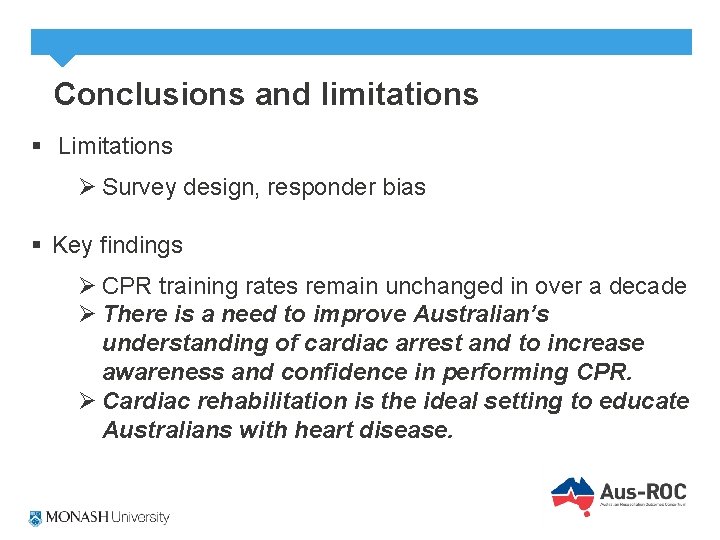
Conclusions and limitations § Limitations Ø Survey design, responder bias § Key findings Ø CPR training rates remain unchanged in over a decade Ø There is a need to improve Australian’s understanding of cardiac arrest and to increase awareness and confidence in performing CPR. Ø Cardiac rehabilitation is the ideal setting to educate Australians with heart disease.
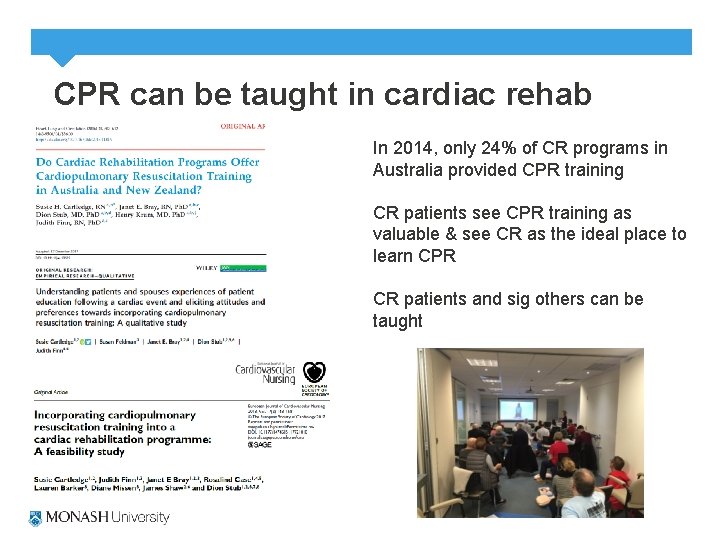
CPR can be taught in cardiac rehab In 2014, only 24% of CR programs in Australia provided CPR training CR patients see CPR training as valuable & see CR as the ideal place to learn CPR CR patients and sig others can be taught
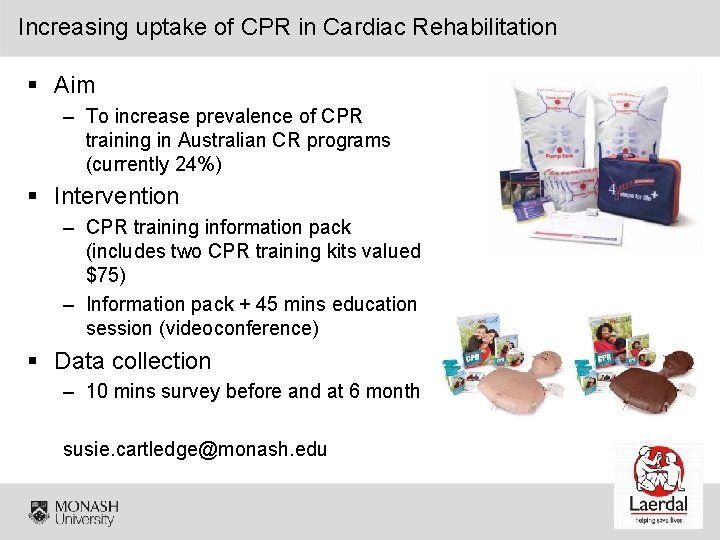
Increasing uptake of CPR in Cardiac Rehabilitation § Aim – To increase prevalence of CPR training in Australian CR programs (currently 24%) § Intervention – CPR training information pack (includes two CPR training kits valued $75) – Information pack + 45 mins education session (videoconference) § Data collection – 10 mins survey before and at 6 month susie. cartledge@monash. edu
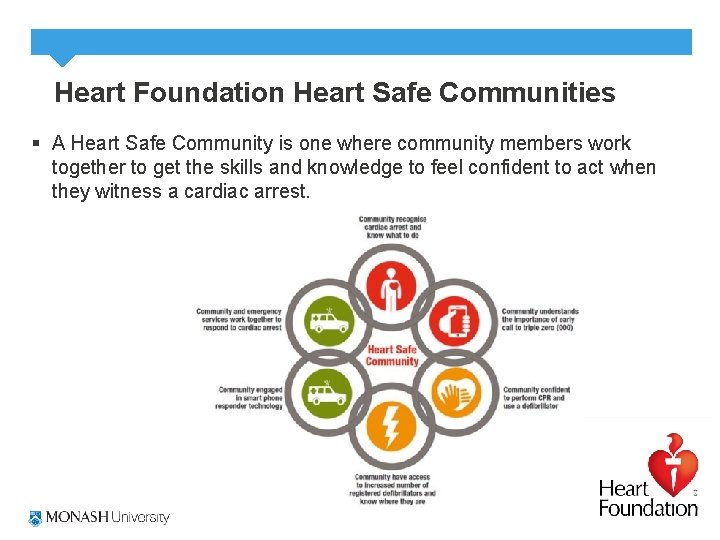
Heart Foundation Heart Safe Communities § A Heart Safe Community is one where community members work together to get the skills and knowledge to feel confident to act when they witness a cardiac arrest.
Presentation title 28 th 1
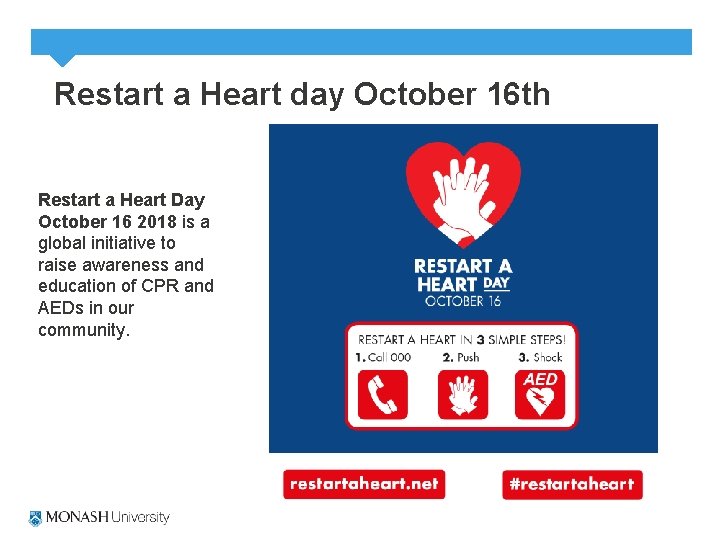
Restart a Heart day October 16 th Restart a Heart Day October 16 2018 is a global initiative to raise awareness and education of CPR and AEDs in our community.
Questions? ? Funding Heart Foundation Fellowship Janet. bray@monash. edu janet. bray@monash. edu www. ausroc. org. au
2 2