
Medicinal Chemistry Drug Receptor Interaction 2 Drug Receptor


- Slides: 22
Medicinal Chemistry Drug Receptor Interaction
2 • Drug? • Receptor? • How they acts? • Drug-receptor interaction • Proteins, enzymes, ion channels. .
3 Forces Involved with Drug–Receptor Interactions • a biological response is produced by the interaction of a drug with a functional or organized group of molecules. • This interaction would be expected to take place by using the same bonding forces as are involved when simple molecules interact.
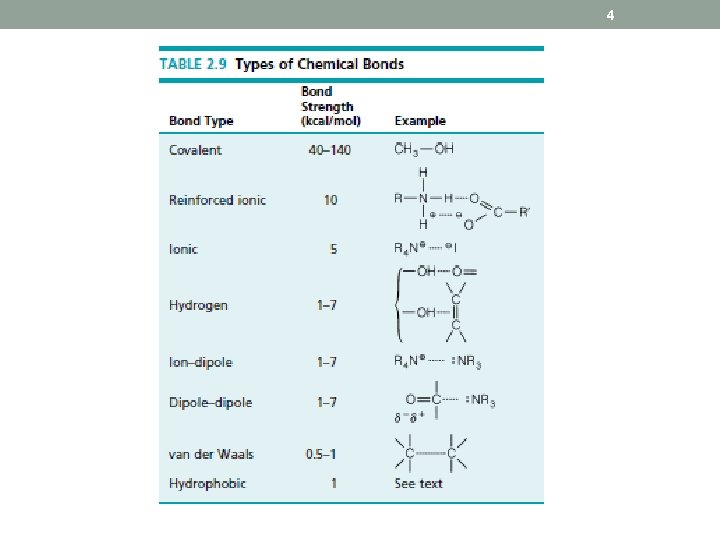
4
5 • Most drugs do not possess functional groups of a type that would lead to ready formation of strong and essentially irreversible covalent bonds between drug and biological receptors. • In most cases, it is desirable to have the drug leave the receptor site when the concentration decreases in the extracellular fluids. Therefore, most useful drugs are held to their receptors by ionic or weaker bonds. • When relatively long-lasting or irreversible effects are desired (e. g. , antibacterial, anticancer), drugs that form covalent bonds with the receptor are effective and useful. • The alkylating agents, such as the nitrogen mustards used in cancer chemotherapy, furnish an example of drugs that act by formation of covalent bonds
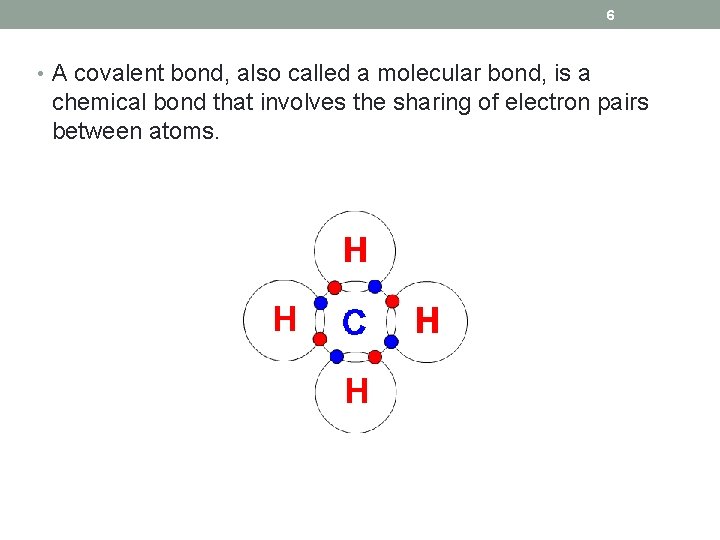
6 • A covalent bond, also called a molecular bond, is a chemical bond that involves the sharing of electron pairs between atoms.
7 • Note: it is desirable to have most drug effects reversible. • For this to occur, relatively weak forces must be involved in the drug–receptor complex • most drugs will bind to the receptor site by hydrogen bonds, ionic bonds, ion–dipole and dipole–dipole interactions, and van der Waals and hydrophobic forces. • Considering the wide variety of functional groups found on a drug molecule and receptor, there will be a variety of secondary bonding forces. • Ionization at physiological p. H would normally occur with the carboxyl, sulfonamido, and aliphatic amino groups, as well as the quaternary ammonium group at any p. H.
8 • Van der Waals forces are attractive forces created by the polarizability of molecules and are exerted when any two uncharged atoms approach each other very closely. • The hydrophobic bond is a concept used to explain attractive interactions between nonpolar regions of the receptor and the drug.
9 Steric features of drugs • Regardless of the ultimate mechanism by which the drug and the receptor interact, the drug must approach the receptor and fit closely to its surface. • Steric factors determined by the stereochemistry of the receptor site surface and that of the drug molecules are, therefore, of primary importance in determining the nature and the efficiency of the drug–receptor interaction. • With the possible exception of the general anesthetics, such drugs must possess a high structural specificity to initiate a response at a particular receptor.
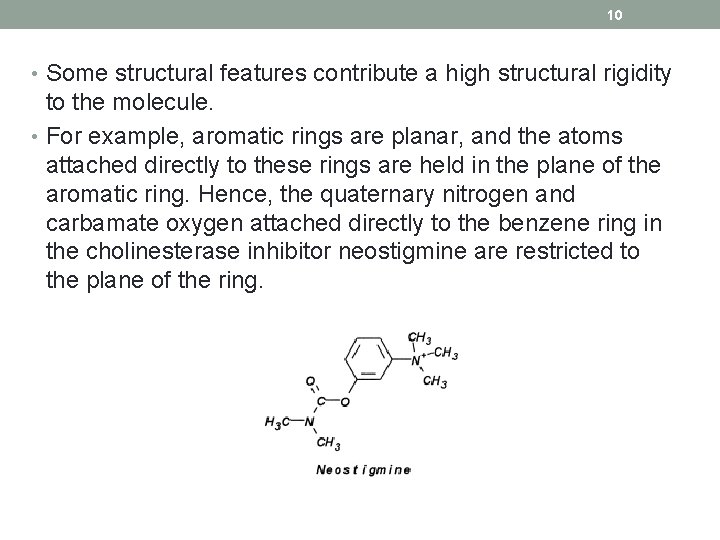
10 • Some structural features contribute a high structural rigidity to the molecule. • For example, aromatic rings are planar, and the atoms attached directly to these rings are held in the plane of the aromatic ring. Hence, the quaternary nitrogen and carbamate oxygen attached directly to the benzene ring in the cholinesterase inhibitor neostigmine are restricted to the plane of the ring.
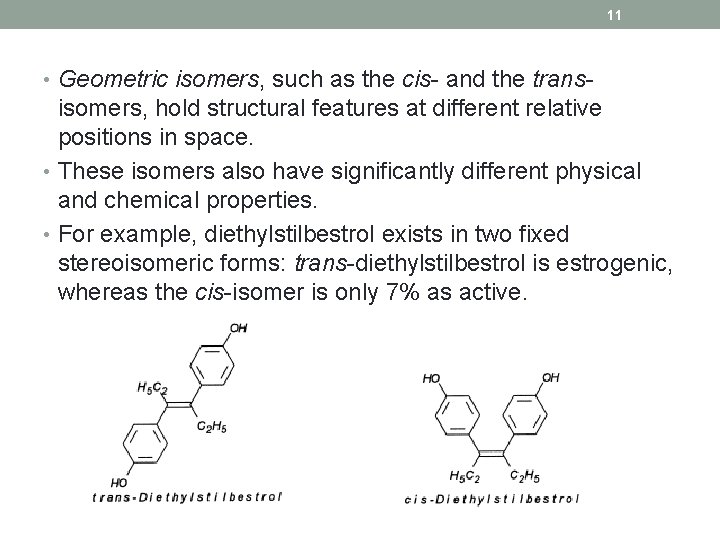
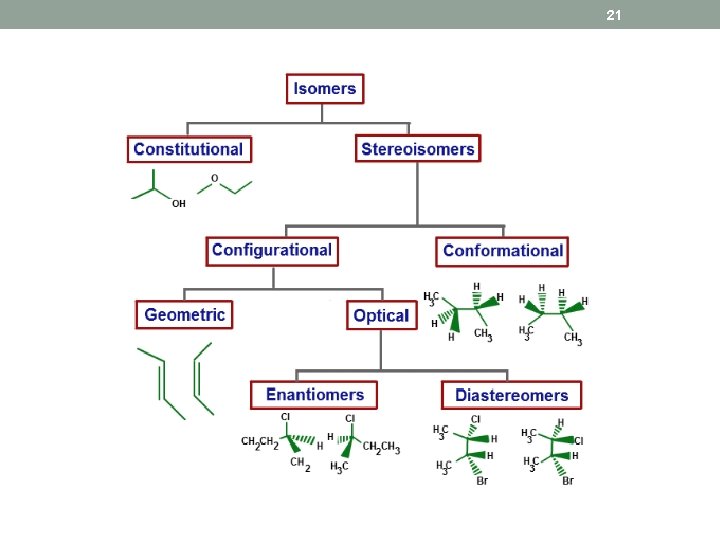
11 • Geometric isomers, such as the cis- and the trans- isomers, hold structural features at different relative positions in space. • These isomers also have significantly different physical and chemical properties. • For example, diethylstilbestrol exists in two fixed stereoisomeric forms: trans-diethylstilbestrol is estrogenic, whereas the cis-isomer is only 7% as active.
12 Conformational Flexibility and Multiple Modes of Action • the conformational flexibility of most open-chain neurohormones, such as acetylcholine, epinephrine, serotonin, histamine, and related physiologically active biomolecules, permits multiple biological effects to be produced by each molecule, by virtue of their ability to interact in a different and unique conformation with different biological receptors.
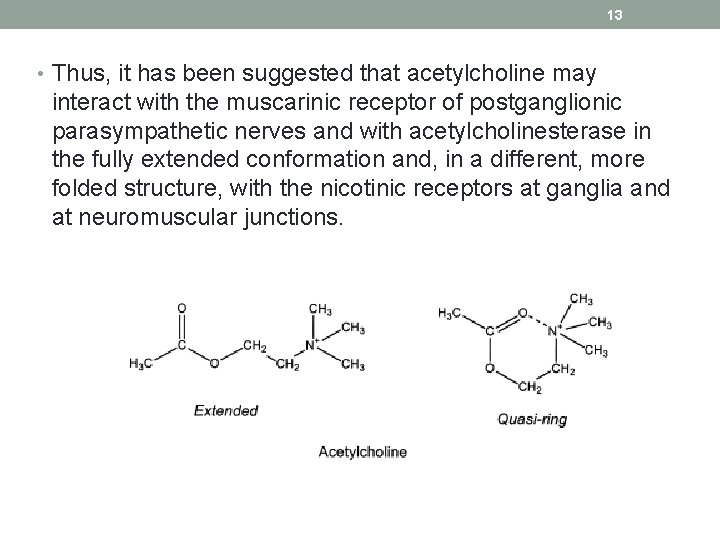
13 • Thus, it has been suggested that acetylcholine may interact with the muscarinic receptor of postganglionic parasympathetic nerves and with acetylcholinesterase in the fully extended conformation and, in a different, more folded structure, with the nicotinic receptors at ganglia and at neuromuscular junctions.
14 Optical isomerism and biological activity • The widespread occurrence of differences in biological activities for optical activities has been of particular importance in the development of theories on the nature of drug–receptor interactions. • Most commercial drugs are asymmetric, meaning that they cannot be divided into symmetrical halves, a large number of drugs are diastereomeric, meaning that they have two or more asymmetric centers.
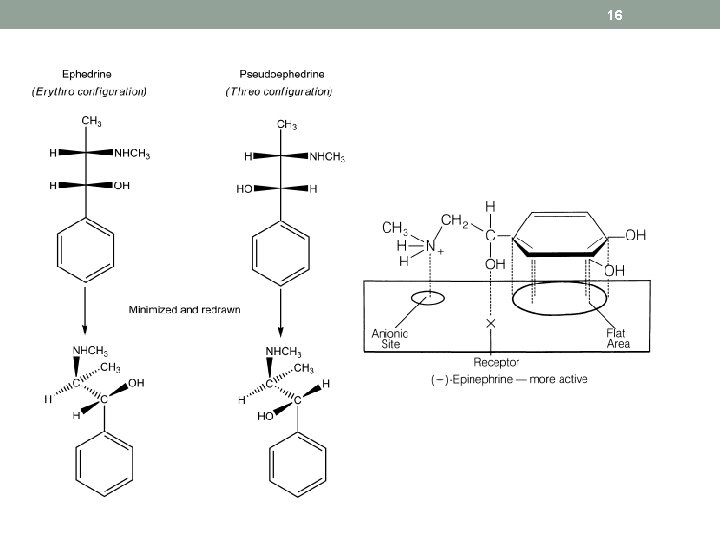
15 • Diastereomers have different physical properties. • Examples are the diastereomers ephedrine and pseudoephedrine. • The former has a melting point of 79° and is soluble in water, whereas pseudoephedrine’s melting point is 118°, and it is only sparingly soluble in water.
16
17 • receptors are asymmetric because they are mostly protein, meaning that they are constructed from L-amino acids. • Frequently, the generic name indicates a specific stereoisomer. • Examples include levodopa, dextroamphetamine, dextromethorphan, dexlansoprazole, and levothyroxine. • Sometimes, the difference in pharmacological activity between stereoisomers is dramatic. • The dextrorotatory isomers in the morphine series are cough suppressants with less risk of substance abuse, whereas the levorotatory isomers contain the analgesic activity and significant risk of substance abuse.
18 • More recently drugs originally marketed as racemic mixtures are reintroduced using the active isomer. • Examples include racemic citalopram and its S-enantiomer escitalopram; racemic omeprazole and its S-enantiomer esomeprazole. • Sometimes it may not be cost-effective to resolvethe drug into its stereoisomers. • An example is the calcium channel antagonist verapamil, which illustrates why it is difficult to conclude that one isomer is superior to the other. • S-Verapamil is a more active pharmacological stereoisomer than R-verapamil, but the former is more rapidly metabolized by the first-pass effect. • First-pass refers to orally administered drugs that are extensively metabolized as they pass through the liver.
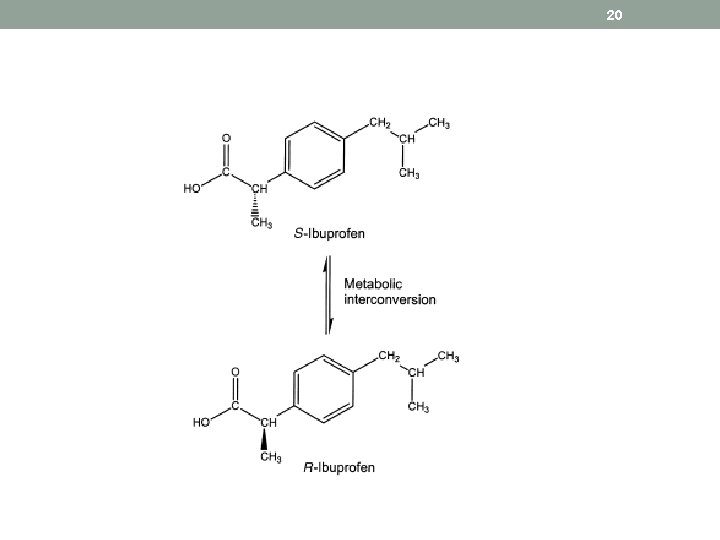
19 • Because of biotransformations after the drug is administered, it sometimes makes little difference whether a racemic mixture or one isomer is administered. • The popular nonsteroidal anti-inflammatory drug (NSAID) ibuprofen is sold as the racemic mixture. • The S-enantiomer contains the anti-inflammatory activity by inhibiting cyclooxygenase. • The R-isomer does have centrally acting analgesic activity, but it is converted to the S form in vivo.
20
21
22 END