
Medications related osteonecrosis of jaw Department of Oral

- Slides: 23
Medications related osteonecrosis of jaw Department of Oral and Maxillofacial Surgery Dentistry Explorer
contents • • MRONJ case definition Misdiagnosed conditions Medications Pathophysiology Clinical presentation Staging Management strategies Dentistry Explorer
Dentistry Explorer
MRONJ case definition • Patient may be considered to have MRONJ if all the following characterstics are present– Current or previous treatment with antiresorptive or antiangiogenic agents – Exposed bone or bone that can be probed through an intraoral or extraoral fistula in the maxillofacial region that has persisted for longer than 8 weeks – No history of radiation therapy to the jaws or no obvious metastatic disease to the jaws. Dentistry Explorer
Misdiagnosed conditions • • • Alveolar osteitis Sinusitis Gingivitis & periodontitis Caries Periapical pathology Odontalgia Atypical neuralgias Fibro-osseous lesions Sarcoma Chronic sclerosing OM TMD Dentistry Explorer
Medications • Antiresorptive medications 1. Bisphonates(IV) • to manage cancer related conditions including hypercalcemia of malignancy • SRE related events associated with bone metastasis in the context of solid tumours s/a breast, prostate & lung cancers, and mgmt of lytic lesions in the setting of MM Dentistry Explorer
Antiresorptive medications (contd. ) • Bisphonates(IO) – to manage osteoporosis & osteopenia, less commonly for paget’s disease of bone and osteogenesis imperfecta • 2. RANKL inhibitor – Used for TT of osteoporosis, SRE related to metastatic bone disease from solid tumours Dentistry Explorer
Antiangiogenic medications • To treat GI tumours, renal cell carcinomas, neuroendocrine tumours & other malignancies Dentistry Explorer
Pathophysiology • 1 st case- reported decade ago • PP not fully elucidated • Proposed hypothesis: – Altered bone remodeling or oversuppression of bone resorption – Angiogenesis inhibition – Constant microtrauma – Suppression of innate or acquired immunity Dentistry Explorer
Proposed hypothesis (contd. ) • Vitamin D deficiency • Soft tissue BP toxicity • Inflammation or infection Dentistry Explorer
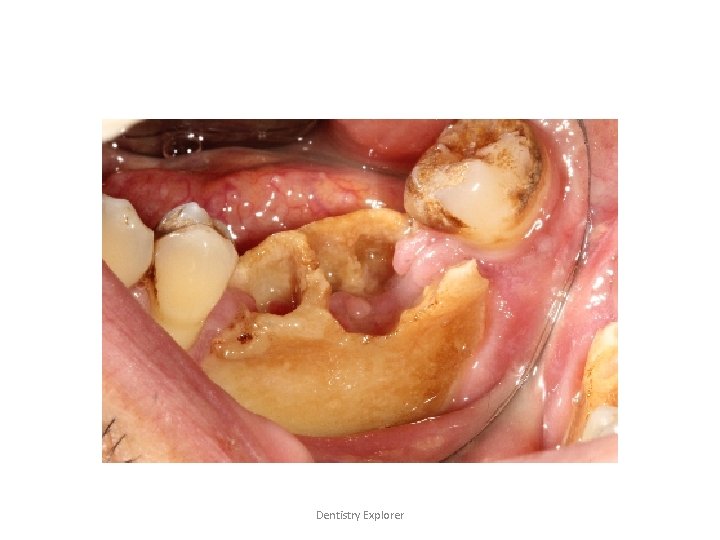
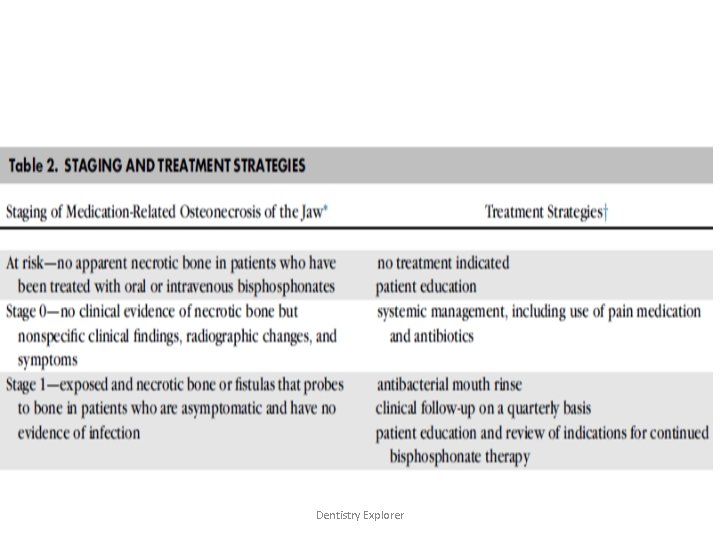
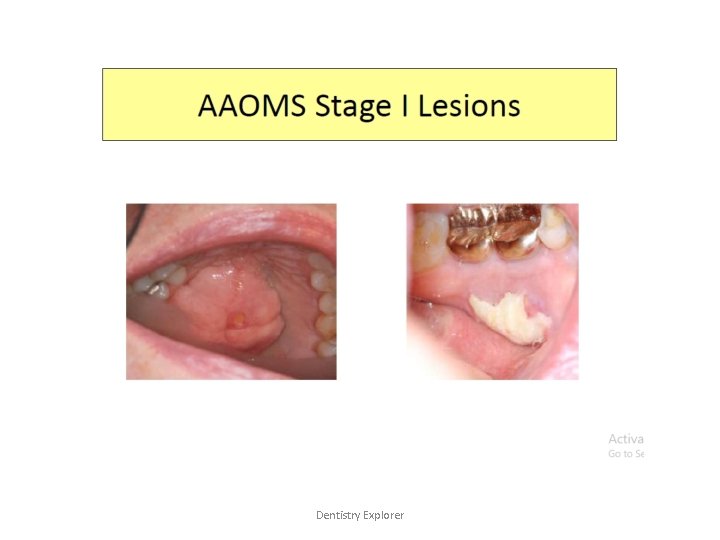
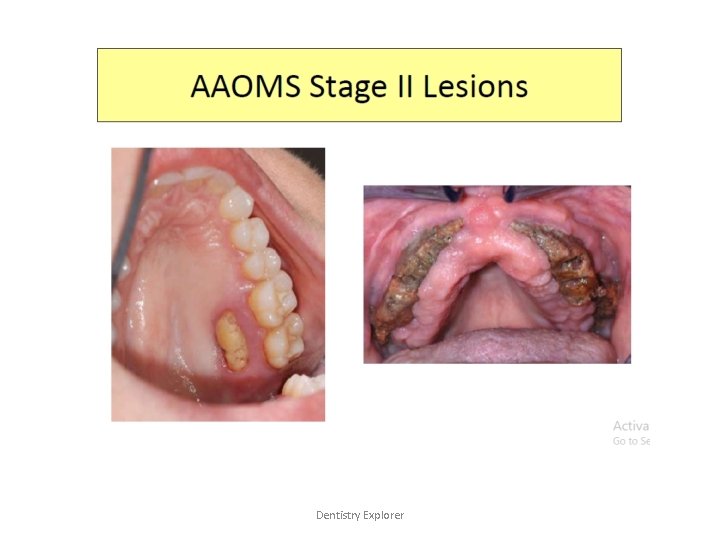
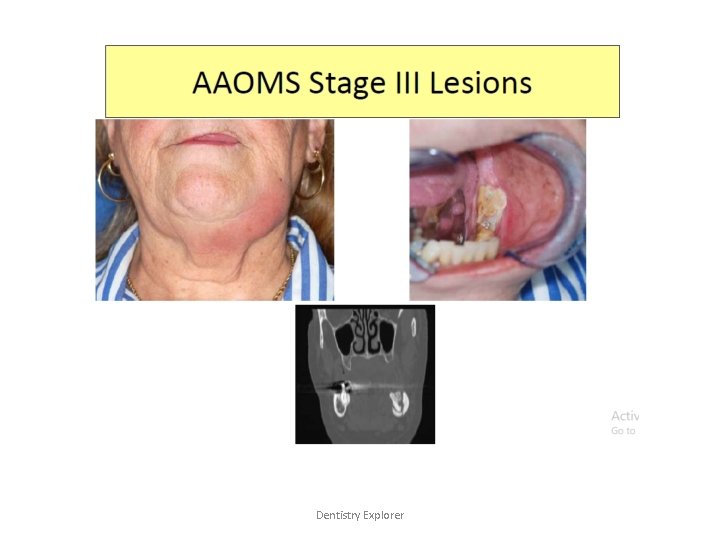
Clinical presentation • Ulcer with the exposed bone-most common • Initial complaints – Sudden presence of intraoral discomfort – presence of roughness of exposed bone that may progress to traumatize oral soft tissue surrounding areas of necrotic bone – Purulent discharge and local swelling in soft tissue, trismus and lymphadenopathy Dentistry Explorer
Management strategies • Patients about to initiate medication – TT obj-minimize the risk – Although small percentage develop ONJ spontaneously, most – dentoalveolar surgery – Therapy delayed if systemic condition permits (14 -21 days) – Nonrestorable/poor prognosis-Extracted – OP, caries control, restorative dentistry-regularly. – Full/partial dentures-examined Dentistry Explorer
Management strategies • Patient receiving IV BP or antiangiogenic drugs for cancer – Good oral hygiene & dental care – Procedures involving direct osseous surgeryavoided – Nonrestorable tooth-removal of crown and endodontic tt of root – Dental implant placement-avoided Dentistry Explorer
Management strategies • Asymptomatic patients receiving antiresorptive therapy for osteoporosis – Risk increases- 4 years – Elective dentoalveolar surgery-can be done – Drug holiday • <4 years with no clinical risk factors-no alteration • < 4 years with corticosteroids or antiangiogenic medication 2 months before if systemic condition permit • >4 years-2 months before if sys condition permit Dentistry Explorer
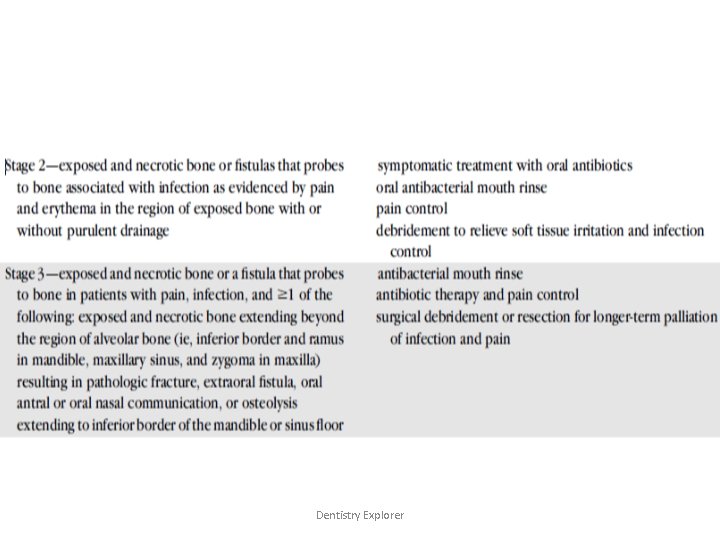
Management strategies • Patients with established MRONJ – TT obj- • Eliminate pain, control infection & minimize the progression or occurrence of bone necrosis – Avoid elective dentoalveolar surgery – When non operative therapies have failed-operative therapy would be prudent approach – Areas of necrotic bone that are constant source of irritation or loose bony sequestra-removed/recontoured regardless of the disease stage – Extraction of symptomatic tooth within exposed necrotic bone considered Dentistry Explorer
Dental care for patients with MRONJ (contd. ) • Treatment modalities(literature) • • • Minor debridement under LA Major surgical sequestrectomies Marginal and segmental mandibular resection Partial & complete maxillectomies HBO therapy – None of these have proved routinely successful – PRP, low-level laser irradiation, PTH, BMP-efficacy not established Dentistry Explorer
Dental care for patients with MRONJ (contd. ) • Patient closely monitored. To reevaluate affected areas & ensure these areas havenot become suppurative • If areas exhibits– Painful erythema, suppuration, sinus tracts or allantibiotics until areas heal • CHX mouthrinse 3 or 4 times a day-reduce bacterial load and colonization Dentistry Explorer
Dentistry Explorer
Dentistry Explorer
Dentistry Explorer
Dentistry Explorer
Dentistry Explorer
references • AAOMS position paper on Medication-Related Osteonecrosis of the jaw 2014 update • Contemporary oral and maxillofacial surgery, 6 th edition Dentistry Explorer