
MEDICATION THERAPY MANAGEMENT MTM OVERVIEW FOR PHARMACY TECHNICIANS
- Slides: 25
MEDICATION THERAPY MANAGEMENT (MTM) OVERVIEW FOR PHARMACY TECHNICIANS WILLIAM HAVINS, CPHT
OBJECTIVES • Explain MTM services • Identify the pharmacy technician’s role in MTM services • Support pharmacist clinician documentation of MTM services • Outline billing process for MTM services
MTM SERVICES MTM is a patient-centric and comprehensive approach employed by pharmacists (or other qualified health professionals) to improve medication use, reduce the risk of adverse events, improve medication adherence, improve patient outcomes, and reduce overall health care costs.
MTM SERVICES HISTORY • Medicare Prescription Drug, Improvement, and Modernization Act of 2003 (MMA) • MTM included in Medicare Part D benefit • Defined MTM as a drug therapy management program • That may be furnished by a pharmacist • Is designed to ensure that covered Part D drugs under prescription drug plan are appropriately used • Is designed to optimize therapeutic outcomes through improved medication use & to reduce the risk of adverse events 1
MTM SERVICES HISTORY, CONT. • Affordable Care Act (Section 10328), effective 1/1/13 • Required targeted beneficiaries be offed a comprehensive medication review (CMR) • The Part D quality improvement requirement of 42 CFR 423. 153(d) states a Part D sponsor must establish a MTM program that: • Ensures covered Part D drugs are used to optimize therapeutic outcomes through improved medication use, • Reduces the risk of adverse events, • Is developed in cooperation with licensed and practicing pharmacists and physicians, • May be furnished by pharmacists or other qualified providers.
MEDICARE PART D ENROLLEE ELIGIBILITY • Multiple Chronic Disease • At least 2 • 3 is the maximum minimum requirement Part D sponsor may require for targeted enrollment • Taking multiple Part D drugs • 2 is the minimum number of drugs • Sponsor cannot require a minimum above 8 covered drugs • Likely to incur annual costs for covered drugs exceeding a predetermined level • The 2017 MTM program annual cost threshold is $3, 9192
MEDICARE PART D ELIGIBILITY • Sponsors offer minimum level of MTM services to all targeted beneficiaries • Interventions • Annual comprehensive medication review (CMR) with individualized written summary in the CMS standardized format • Quarterly targeted medication reviews • Follow-up interventions may be necessary 2
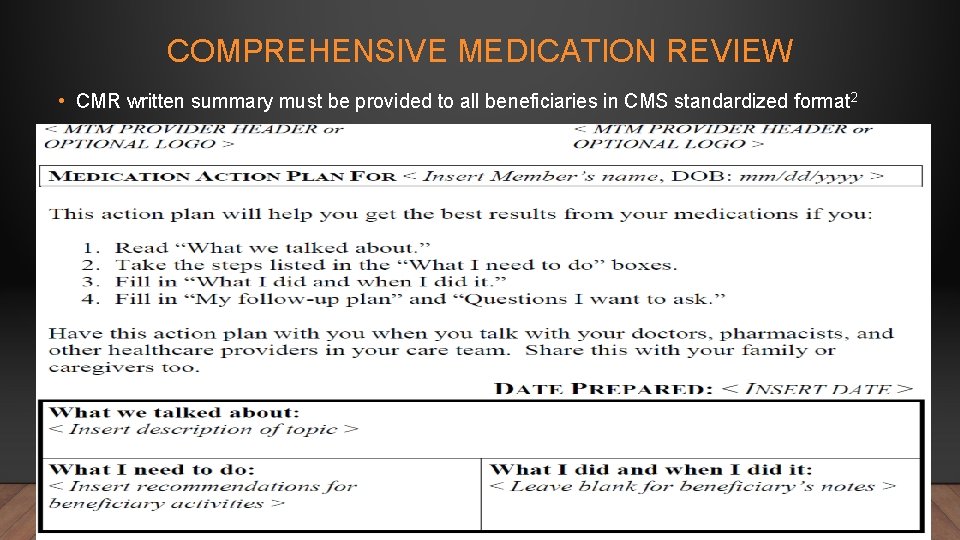
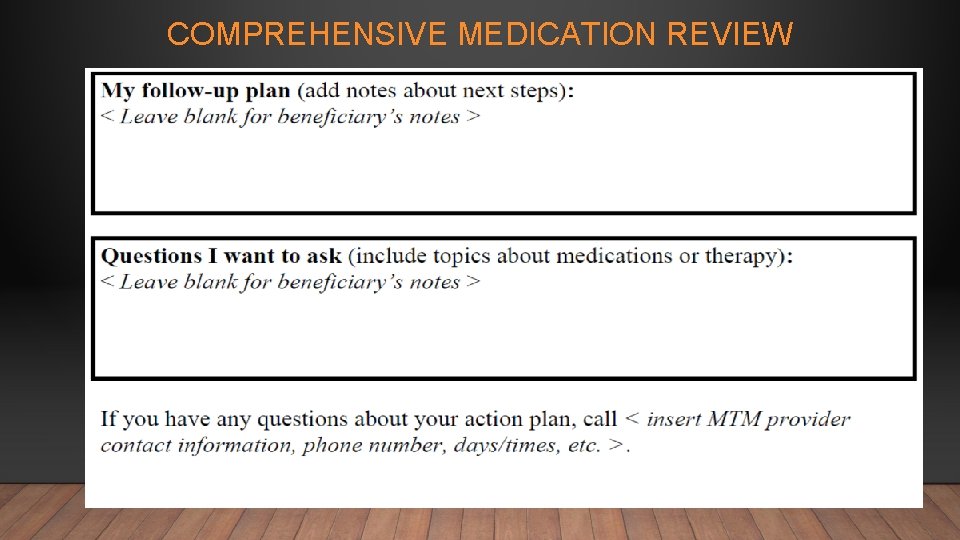
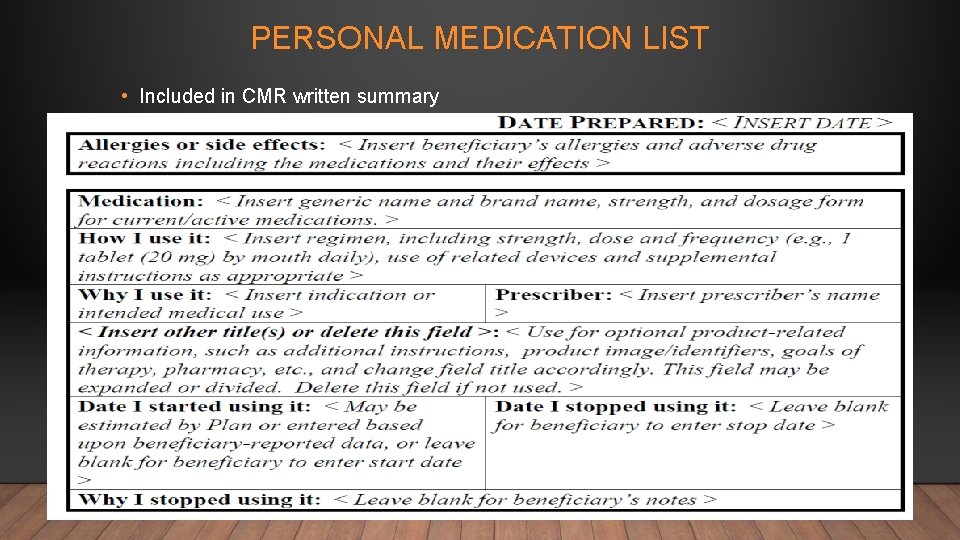
MTM PROCESS • Comprehensive medication review (CMR) • Personal medication list (PML) • Medication-related action plan (MAP) • Intervention • Follow-up • Documentation happens throughout process • Distributed to patient and prescribers (and payer)
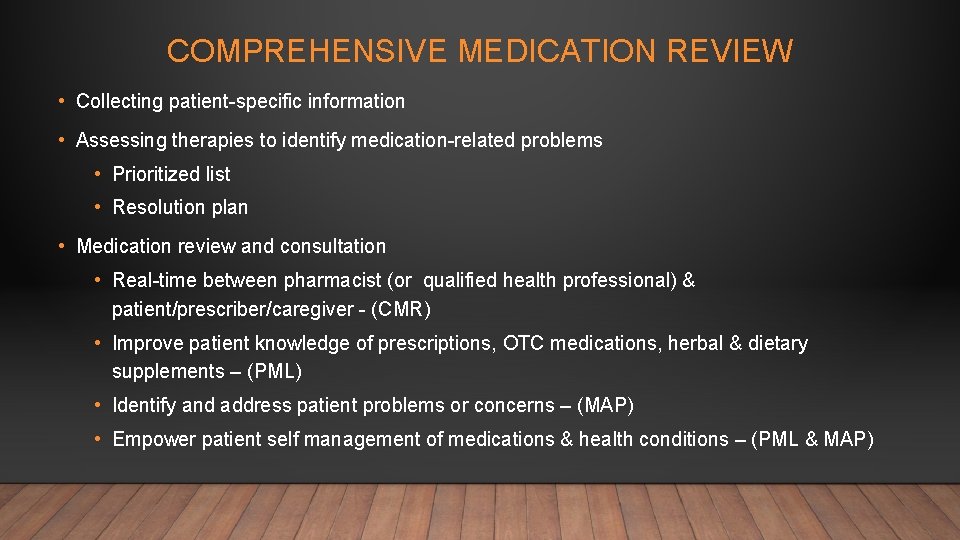
COMPREHENSIVE MEDICATION REVIEW • Collecting patient-specific information • Assessing therapies to identify medication-related problems • Prioritized list • Resolution plan • Medication review and consultation • Real-time between pharmacist (or qualified health professional) & patient/prescriber/caregiver - (CMR) • Improve patient knowledge of prescriptions, OTC medications, herbal & dietary supplements – (PML) • Identify and address patient problems or concerns – (MAP) • Empower patient self management of medications & health conditions – (PML & MAP)
COMPREHENSIVE MEDICATION REVIEW • CMR written summary must be provided to all beneficiaries in CMS standardized format 2
COMPREHENSIVE MEDICATION REVIEW
PERSONAL MEDICATION LIST • Included in CMR written summary
PHARMACIST INTERVENTION • Medication-related problems identified during CMR are • Resolved • Minimized • Avoided • Intervention may include • Consultation with prescriber • Referral to another healthcare professional
FOLLOW-UP • Determine if MAP goals were met • Targeted MTM visit • Phone call
THE PHARMACY TECHNICIAN’S ROLE IN MTM SERVICES • Help identify patients • Explain and promote available MTM services • Administrative support • Maintain filing system • Schedule appointments • Documentation • Billing
THE PHARMACY TECHNICIAN’S ROLE IN MTM SERVICES • Patient visit preparation • Print current medication list with disease states and refill history • Obtain documentation from patient, such as lab values • Measure vital signs and point of care testing • Prepare consultation area • Assist patients in form completion • Complete and accurate • Input gathered patient data into software
THE PHARMACY TECHNICIAN’S ROLE IN MTM SERVICES • Input pharmacist’s notes into software • Provide patient’s providers completed MTM documentation • Quality assurance reviews • Conduct satisfaction surveys
BILLING FOR MTM SERVICES • Payment sources for pharmacists • Medicare Part D sponsors • Third-party MTM vendors (Mirixa, Outcomes. MTM, etc. ) • Hospital-based programs • Employer-based health plans • Others
BILLING FOR MTM SERVICES • Medicare Part D • Pharmacist National Provider Identifier (NPI) number • Application link: https: //nppes. cms. hhs. gov/NPPES/ • Contracted Medicare Part D sponsors & pharmacy arrangement • Fee amounts determined in advance • May use Current Procedural Technology (CPT) codes: • CPT 99605: 1 st 15 minutes (Face-to-face pharmacist assessment & intervention) • CPT 99606: Follow-up visit or established patient, 15 minutes • CPT 99607: Additional 15 minute increments (use with one of the above)
BILLING FOR MTM SERVICES • Third-party MTM vendor • Subcontracted by health insurance and managed care companies • May not use CPT codes • Specific fees to pay pharmacists • May have online billing systems • Require pharmacist and technician training to use • Hospital-based programs • Readmission reduction programs – MTM services after discharge • May increase CMS STAR rating • Employer-based Health Plans • Billing system set up with employer
REFERENCES 1. Medicare Prescription Drug, Improvement, and Modernization Act of 2003 (MMA). Cost and Utilization Management; Quality Assurance; Medication Therapy Management Program. Pub L No. 108 -173, 117 Stat 2086. 2. Centers for Medicare & Medicaid Services (CMS). CY 2017 Medication Therapy Management Program Guidance and Submission Instructions. April 8, 2016. 3. Centers for Medicare & Medicaid Services (CMS). Medication Therapy Management Program Standardized Format Revisions. July 15, 2014.
Which of the following statements accurately describes how MTM services and patient counseling differ? A. MTM focuses on an individual medication while patient counseling focuses on individual patient disease state. B. MTM focuses on the individual patient’s disease state and healthcare while patient counseling focuses on an individual medication. C. There is no difference between MTM and patient counseling. D. None of the choices are accurate
A pharmacy technician may perform which of the following MTM activities? A. Determine the Medication-related action plan (MAP) with the patient. B. Conduct an intervention with the prescriber. C. Interpret meaning of vital signs and other point of care tests. D. Transcribe pharmacist notes into computer software.
Medicare Part D sponsor’s maximum minimum eligibility requirements for MTM services may include incurring annual costs for covered drugs exceeding a predetermined level and which of the following? A. At least one chronic disease and one covered drug B. At least two chronic diseases and one covered drugs C. At least four chronic diseases and eight covered drugs. D. At least three chronic diseases and eight covered drugs.
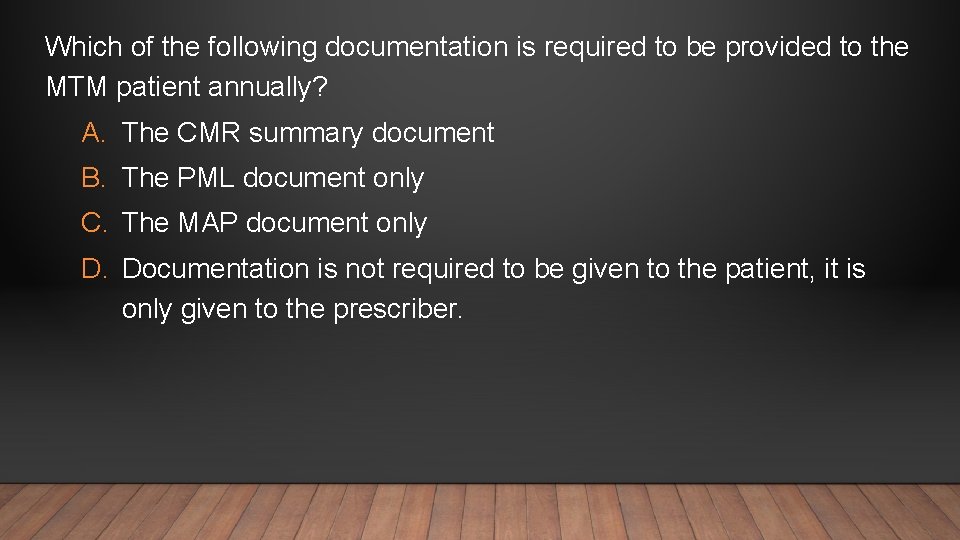
Which of the following documentation is required to be provided to the MTM patient annually? A. The CMR summary document B. The PML document only C. The MAP document only D. Documentation is not required to be given to the patient, it is only given to the prescriber.