
Medication Management Competency CNA Staff Training Objectives Upon
Medication Management Competency CNA Staff Training
Objectives Upon completion of the program, attendees should be able to: • Verbalize that residents who require medication management receive such services, consistent with professional standards of practice • Demonstrates the use of the comprehensive person-centered care plan reflecting the residents’ goals and preferences (resident/resident representative preferences This document is for general informational purposes only. It does not represent legal advice nor relied upon as supporting documentation or advice with CMS or other regulatory entities. © Pathway Health Services, Inc. – All Rights Reserved – Copy with Permission Only
Medication Administration A safe and competent medication management system that is based on best practice and the care process of the residents that includes: • Recognition of the problem/need, • Assessment, diagnoses • Medication administration, • Management, monitoring and revising the individualized, person-centered approach to care • Documentation consistent with standards of medication management and administration standards. This document is for general informational purposes only. It does not represent legal advice nor relied upon as supporting documentation or advice with CMS or other regulatory entities. © Pathway Health Services, Inc. – All Rights Reserved – Copy with Permission Only
Regulations Associated with Medication Management • F 726: Nursing Services – Competency in skills and techniques necessary to care for residents’ needs – Medication Management https: //www. cms. gov/Regulations-and. Guidance/Manuals/downloads/som 107 ap_pp_guidelines_ltcf. pdf This document is for general informational purposes only. It does not represent legal advice nor relied upon as supporting documentation or advice with CMS or other regulatory entities. © Pathway Health Services, Inc. – All Rights Reserved – Copy with Permission Only
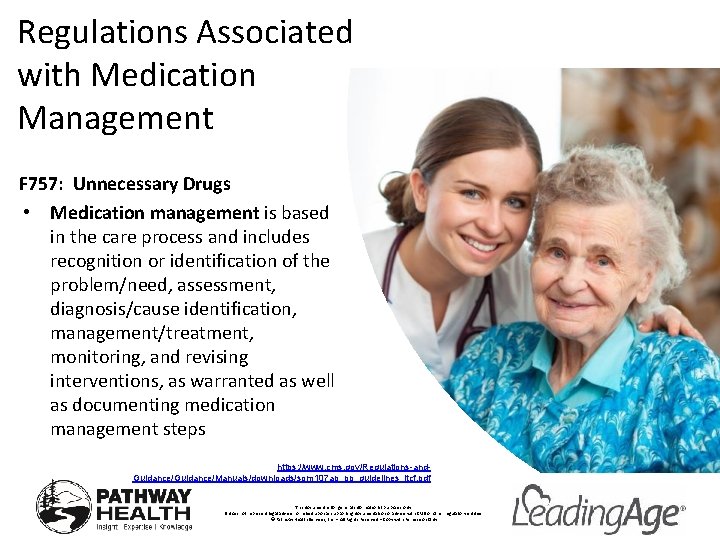
Regulations Associated with Medication Management F 757: Unnecessary Drugs • Medication management is based in the care process and includes recognition or identification of the problem/need, assessment, diagnosis/cause identification, management/treatment, monitoring, and revising interventions, as warranted as well as documenting medication management steps https: //www. cms. gov/Regulations-and. Guidance/Manuals/downloads/som 107 ap_pp_guidelines_ltcf. pdf This document is for general informational purposes only. It does not represent legal advice nor relied upon as supporting documentation or advice with CMS or other regulatory entities. © Pathway Health Services, Inc. – All Rights Reserved – Copy with Permission Only
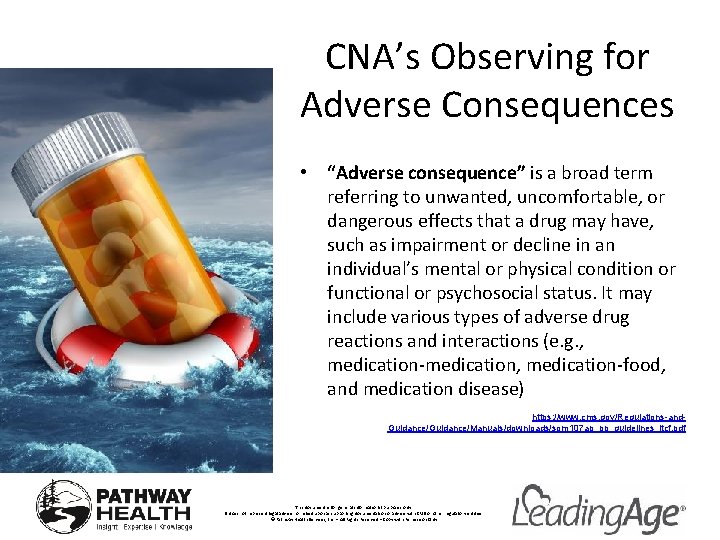
CNA’s Observing for Adverse Consequences • “Adverse consequence” is a broad term referring to unwanted, uncomfortable, or dangerous effects that a drug may have, such as impairment or decline in an individual’s mental or physical condition or functional or psychosocial status. It may include various types of adverse drug reactions and interactions (e. g. , medication-medication, medication-food, and medication disease) https: //www. cms. gov/Regulations-and. Guidance/Manuals/downloads/som 107 ap_pp_guidelines_ltcf. pdf This document is for general informational purposes only. It does not represent legal advice nor relied upon as supporting documentation or advice with CMS or other regulatory entities. © Pathway Health Services, Inc. – All Rights Reserved – Copy with Permission Only
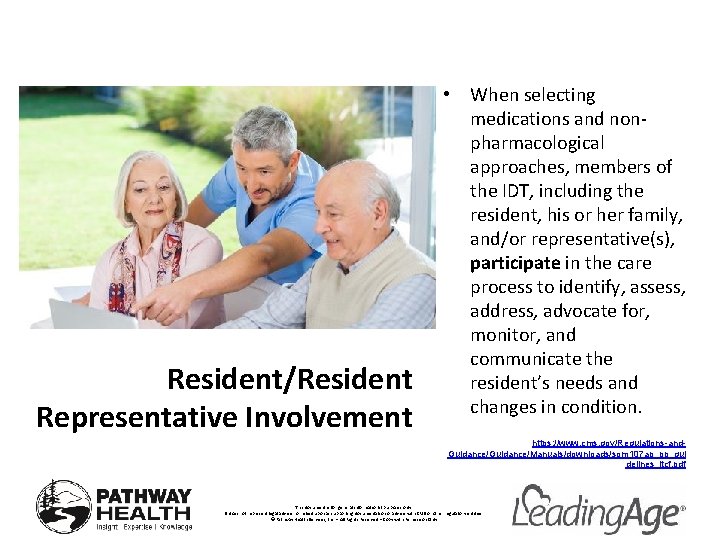
Resident/Resident Representative Involvement • When selecting medications and nonpharmacological approaches, members of the IDT, including the resident, his or her family, and/or representative(s), participate in the care process to identify, assess, address, advocate for, monitor, and communicate the resident’s needs and changes in condition. https: //www. cms. gov/Regulations-and. Guidance/Manuals/downloads/som 107 ap_pp_gui delines_ltcf. pdf This document is for general informational purposes only. It does not represent legal advice nor relied upon as supporting documentation or advice with CMS or other regulatory entities. © Pathway Health Services, Inc. – All Rights Reserved – Copy with Permission Only
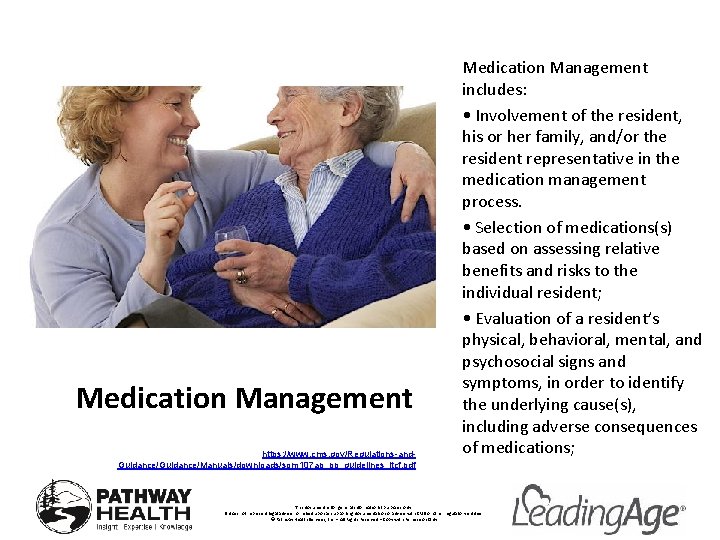
Medication Management https: //www. cms. gov/Regulations-and. Guidance/Manuals/downloads/som 107 ap_pp_guidelines_ltcf. pdf Medication Management includes: • Involvement of the resident, his or her family, and/or the resident representative in the medication management process. • Selection of medications(s) based on assessing relative benefits and risks to the individual resident; • Evaluation of a resident’s physical, behavioral, mental, and psychosocial signs and symptoms, in order to identify the underlying cause(s), including adverse consequences of medications; This document is for general informational purposes only. It does not represent legal advice nor relied upon as supporting documentation or advice with CMS or other regulatory entities. © Pathway Health Services, Inc. – All Rights Reserved – Copy with Permission Only
Medication Management includes: (continued) • Selection and use of medications in doses and for the duration appropriate to each resident’s clinical conditions, age, and underlying causes of symptoms and based on assessing relative benefit and risks to, and preferences and goals of, the individual resident; • The use of non-pharmacological approaches, unless contraindicated, to minimize the need for medications, permit use of the lowest possible dose, or allow medications to be discontinued; https: //www. cms. gov/Regulations-and. Guidance/Manuals/downloads/som 107 ap_pp_guidelines_ltcf. pdf This document is for general informational purposes only. It does not represent legal advice nor relied upon as supporting documentation or advice with CMS or other regulatory entities. © Pathway Health Services, Inc. – All Rights Reserved – Copy with Permission Only
Medication Management includes: (continued) • The monitoring of medications for efficacy and adverse consequences. • Resident Choice –If a resident declines treatment, the facility staff and physician should inform the resident about the risks related to the lack of the medication, and discuss appropriate alternatives such as offering the medication at another time or in another dosage form, or offer an alternative medication or non-pharmacological approach. https: //www. cms. gov/Regulations-and. Guidance/Manuals/downloads/som 107 ap_pp_guidelines_ltcf. pdf This document is for general informational purposes only. It does not represent legal advice nor relied upon as supporting documentation or advice with CMS or other regulatory entities. © Pathway Health Services, Inc. – All Rights Reserved – Copy with Permission Only
Resident Monitoring • All caregivers will need to monitor resident for: – Change in conditions – Adverse Consequences – Effectiveness of Medications – Documentation of notification of the change in condition to and resident representative as well as actions taken This document is for general informational purposes only. It does not represent legal advice nor relied upon as supporting documentation or advice with CMS or other regulatory entities. © Pathway Health Services, Inc. – All Rights Reserved – Copy with Permission Only
Non-Medication Interventions • On the resident care plan, there may be approaches for resident conditions that interventions other than medications should be implemented for the resident care: – Repositioning – Heat or Ice – Massage – Music – Redirect – Exercise – Etc. This document is for general informational purposes only. It does not represent legal advice nor relied upon as supporting documentation or advice with CMS or other regulatory entities. © Pathway Health Services, Inc. – All Rights Reserved – Copy with Permission Only
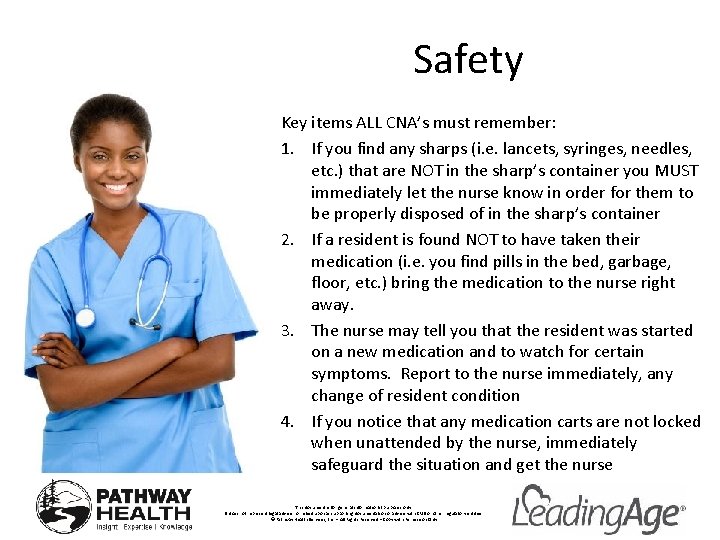
Safety Key items ALL CNA’s must remember: 1. If you find any sharps (i. e. lancets, syringes, needles, etc. ) that are NOT in the sharp’s container you MUST immediately let the nurse know in order for them to be properly disposed of in the sharp’s container 2. If a resident is found NOT to have taken their medication (i. e. you find pills in the bed, garbage, floor, etc. ) bring the medication to the nurse right away. 3. The nurse may tell you that the resident was started on a new medication and to watch for certain symptoms. Report to the nurse immediately, any change of resident condition 4. If you notice that any medication carts are not locked when unattended by the nurse, immediately safeguard the situation and get the nurse This document is for general informational purposes only. It does not represent legal advice nor relied upon as supporting documentation or advice with CMS or other regulatory entities. © Pathway Health Services, Inc. – All Rights Reserved – Copy with Permission Only
Demonstration This is where you will have each CNA perform demonstration of: – BP – Pulse – Respirations – Temperature This document is for general informational purposes only. It does not represent legal advice nor relied upon as supporting documentation or advice with CMS or other regulatory entities. © Pathway Health Services, Inc. – All Rights Reserved – Copy with Permission Only

In Summary This document is for general informational purposes only. It does not represent legal advice nor relied upon as supporting documentation or advice with CMS or other regulatory entities. © Pathway Health Services, Inc. – All Rights Reserved – Copy with Permission Only
This document is for general informational purposes only. It does not represent legal advice nor relied upon as supporting documentation or advice with CMS or other regulatory entities. © Pathway Health Services, Inc. – All Rights Reserved – Copy with Permission Only
References and Resources • Centers for Medicare & Medicaid Services State Operations Manual, Appendix PP – Guidance to Surveyors for Long Term Care Facilities (Rev. 173, 11 -2217): https: //www. cms. gov/Regulations-and. Guidance/Manuals/downloads/som 107 ap_pp _guidelines_ltcf. pdf • LTC Survey Pathways (Download) https: //www. cms. gov/medicare/provider-enrollmentand-certification/guidanceforlawsandregulations/nursing -homes. html This document is for general informational purposes only. It does not represent legal advice nor relied upon as supporting documentation or advice with CMS or other regulatory entities. © Pathway Health Services, Inc. – All Rights Reserved – Copy with Permission Only
Disclaimer “This presentation provided is copyrighted information of Pathway Health. Please note the presentation date on the title page in relation to the need to verify any new updates and resources that were listed in this presentation. This presentation is intended to be informational. The information does not constitute either legal or professional consultation. This presentation is not to be sold or reused without written authorization. ” This document is for general informational purposes only. It does not represent legal advice nor relied upon as supporting documentation or advice with CMS or other regulatory entities. © Pathway Health Services, Inc. – All Rights Reserved – Copy with Permission Only
- Slides: 18