
MEDICATION ERRORS UNDERSTANDING THE CAUSES AND DESIGNING EFFECTIVE





- Slides: 75
MEDICATION ERRORS: UNDERSTANDING THE CAUSES AND DESIGNING EFFECTIVE RISK MANAGEMENT STRATEGIES
DR. SHAUNA WHITE EXECUTIVE DIRECTOR, BOARD OF PHARMACY, DEPARTMENT OF HEALTH DISTRICT OF COLUMBIA 2
COLLABORATORS 3
More resources available at: https: //dchealth. dc. gov/dcrx 4
ADVISORS Donna Horn, MS, RPh, DPh, CHC • Ethics and Compliance Officer at Fresenius Medical Care, North America (FMCNA) supporting Fresenius Rx and Spectra Laboratories Seth Krevat, MD • Assistant Vice President for Safety at Med. Star Health’s National Center for Human Factors in Healthcare • Attending physician, Palliative Medicine, Med. Star Georgetown University Hospital. Misty Carney, B. S. , Pharm. D. , AAHIVP • Chief, Maryland AIDS Drug Assistance Program Fadia Shaya, Ph. D. , M. P. H. • Professor and Director of Informatics - University of Maryland School of Pharmacy 5
MODERATOR Fadia Shaya, Ph. D. , M. P. H. • Professor and Director of Informatics - University of Maryland School of Pharmacy 6
SPEAKERS Allen J. Vaida Pharm. D, FASHP • Executive Vice President, Institute for Safe Medication Practices Raj M. Ratwani, PHD • Vice President of Scientific Affairs, Med. Star Health Research Institute • Associate Professor, Department of Emergency Medicine, Georgetown University School of Medicine • Center Director, National Center for Human Factors in Healthcare, Med. Star Health 7
DISCUSSION PANEL Eileen R. Langstraat, Pharm. D. , BCPS, CPPS • Medication and Patient Safety Coordinator - Kaiser Permanente Georgia Z. Lewis, MSN, RN, CPNP-PC • Pediatric Nurse Practitioner - Signature Health Marybeth Kazanas, Pharm. D, BCPS, LSSGB • System Director, Clinical Pharmacy Services - Med. Star Health 8
OVERVIEW • The purpose of this module is to engage health care providers (prescribers), pharmacists, and other health care professionals in evidence based practices to avoid medication errors and enhance patient safety. Successful attainment of knowledge by the learner will enable improved awareness and lead to changes in clinical practice measures to overcome common causes of medication errors. 9
LEARNING OBJECTIVES Upon completing the module the learner should be able to : • Establish an understanding of contributing factors and epidemiology of medicationrelated patient safety events • A discussion on current research on causality (root cause analysis) and human factors design features to mitigate them • A review of best practice approaches in reducing errors in the inpatient and ambulatory setting (clinic and pharmacy) • Identify systems level innovations in risk management strategies that can be used to minimize or prevent medication errors and equip professionals to manage the consequences when they occur 10
Current Safety Challenges with Medications in the Inpatient and Ambulatory Settings Allen J Vaida, BSc, Pharm. D Executive Vice President, Institute for Safe Medication Practices ISMP Confidential © 2020 ISMP | www. ismp. org | 11 11
DISCLOSURE Allen Vaida declares no conflicts of interest, real or apparent, and no financial interests in any company, product, or service mentioned in this program, including grants, employment, gifts, stock holdings, and honoraria. ISMP Confidential © 2020 ISMP | www. ismp. org | 12 12
INSTITUTE FOR SAFE MEDICATION PRACTICES • Not-for-profit medication safety organization affiliated with ECRI • Operates a National Medication Errors Reporting Program for practitioners and consumers www. ismp. org • Follows up with reporters, manufacturers, FDA, and network of practitioners • Analyzes errors and reports on recommendations for prevention • Publishes recommendations ISMP Confidential © 2020 ISMP | www. ismp. org | 13 13
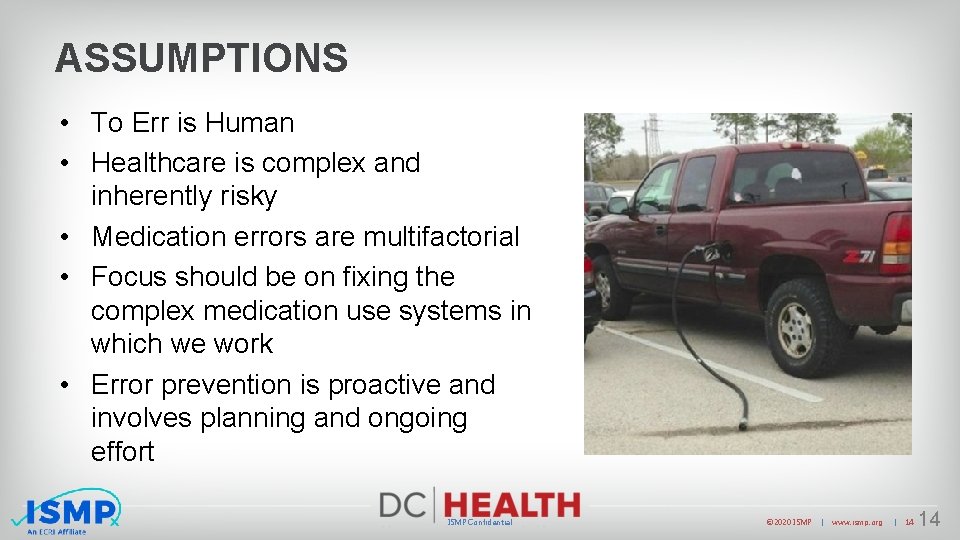
ASSUMPTIONS • To Err is Human • Healthcare is complex and inherently risky • Medication errors are multifactorial • Focus should be on fixing the complex medication use systems in which we work • Error prevention is proactive and involves planning and ongoing effort ISMP Confidential © 2020 ISMP | www. ismp. org | 14 14
CAPTURING ERRORS AND ANALYZING THEM • Voluntary reporting programs • Information from technology (infusion pumps, bar coding, EHR, electronic prescribing and pharmacy systems) • Focused reporting (triggers, specific medications) • Surveillance systems (AI) • Most important is using internal and external information ISMP Confidential © 2020 ISMP | www. ismp. org | 15 15
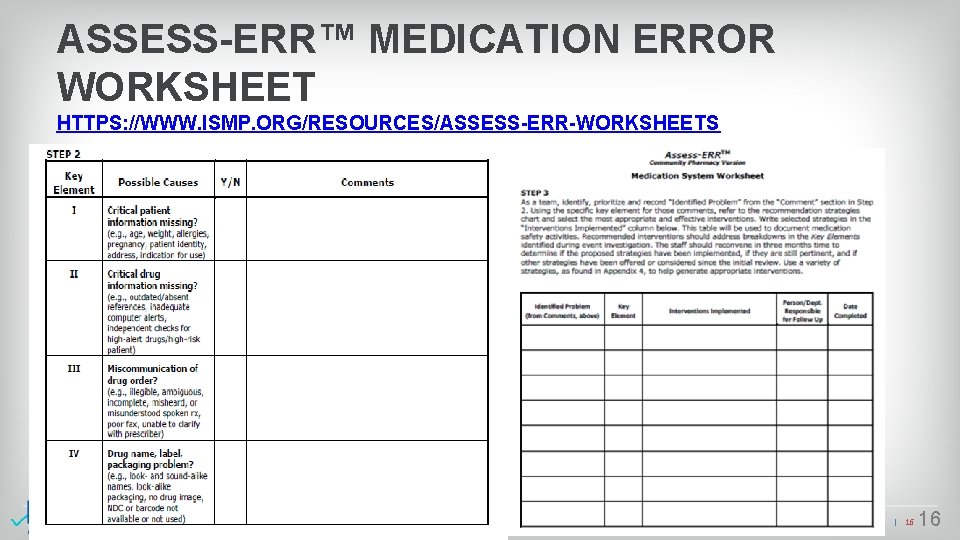
ASSESS-ERR™ MEDICATION ERROR WORKSHEET HTTPS: //WWW. ISMP. ORG/RESOURCES/ASSESS-ERR-WORKSHEETS ISMP Confidential © 2020 ISMP | www. ismp. org | 16 16
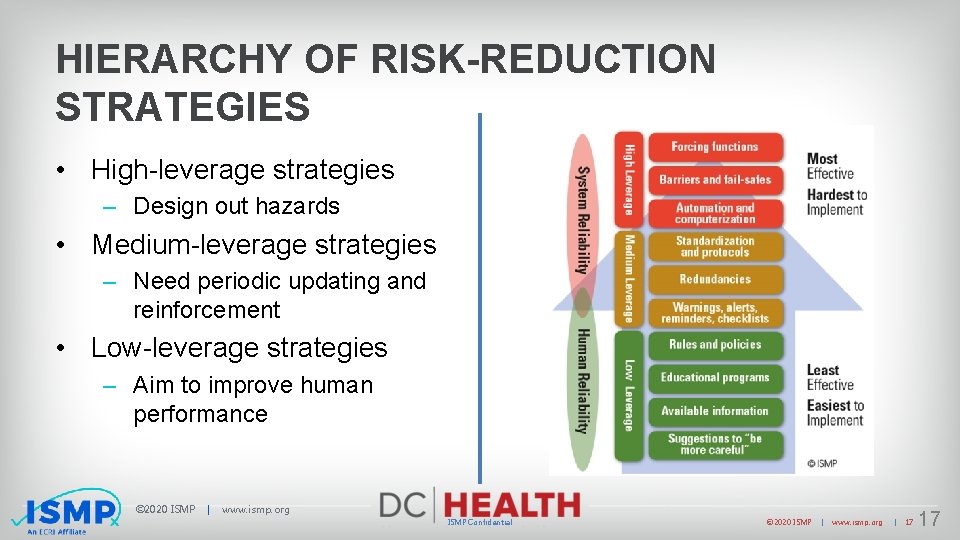
HIERARCHY OF RISK-REDUCTION STRATEGIES • High-leverage strategies – Design out hazards • Medium-leverage strategies – Need periodic updating and reinforcement • Low-leverage strategies – Aim to improve human performance © 2020 ISMP | www. ismp. org ISMP Confidential © 2020 ISMP | www. ismp. org | 17 17
CURRENT TRENDS ON ERRORS REPORTED TO ISMP • • • Electronic prescribing systems without adequate safeguards Similar named medication mix-ups - labeling of medication Methotrexate for non-oncologic use given more than once a week Wrong patient Vaccine related errors ISMP Confidential © 2020 ISMP | www. ismp. org | 18 18
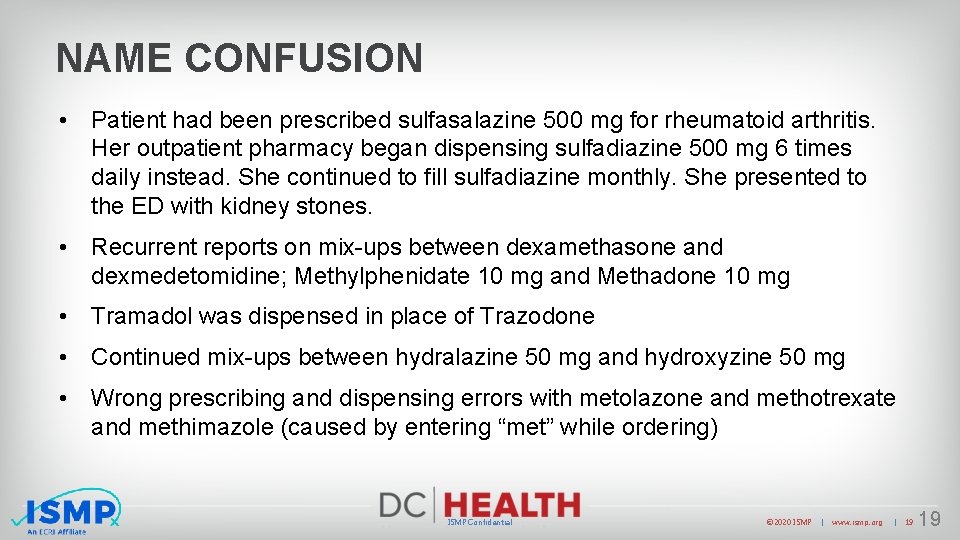
NAME CONFUSION • Patient had been prescribed sulfasalazine 500 mg for rheumatoid arthritis. Her outpatient pharmacy began dispensing sulfadiazine 500 mg 6 times daily instead. She continued to fill sulfadiazine monthly. She presented to the ED with kidney stones. • Recurrent reports on mix-ups between dexamethasone and dexmedetomidine; Methylphenidate 10 mg and Methadone 10 mg • Tramadol was dispensed in place of Trazodone • Continued mix-ups between hydralazine 50 mg and hydroxyzine 50 mg • Wrong prescribing and dispensing errors with metolazone and methotrexate and methimazole (caused by entering “met” while ordering) ISMP Confidential © 2020 ISMP | www. ismp. org | 19 19
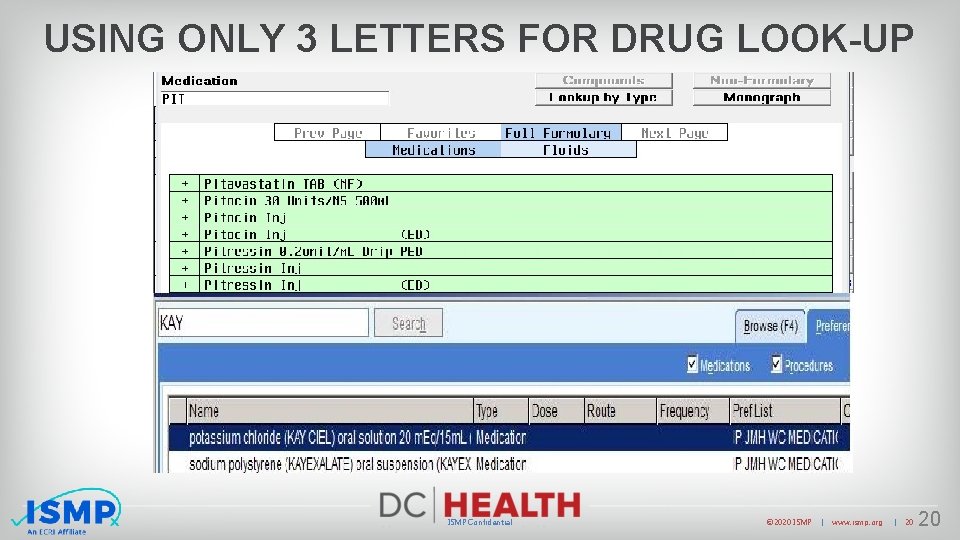
USING ONLY 3 LETTERS FOR DRUG LOOK-UP ISMP Confidential © 2020 ISMP | www. ismp. org | 20 20
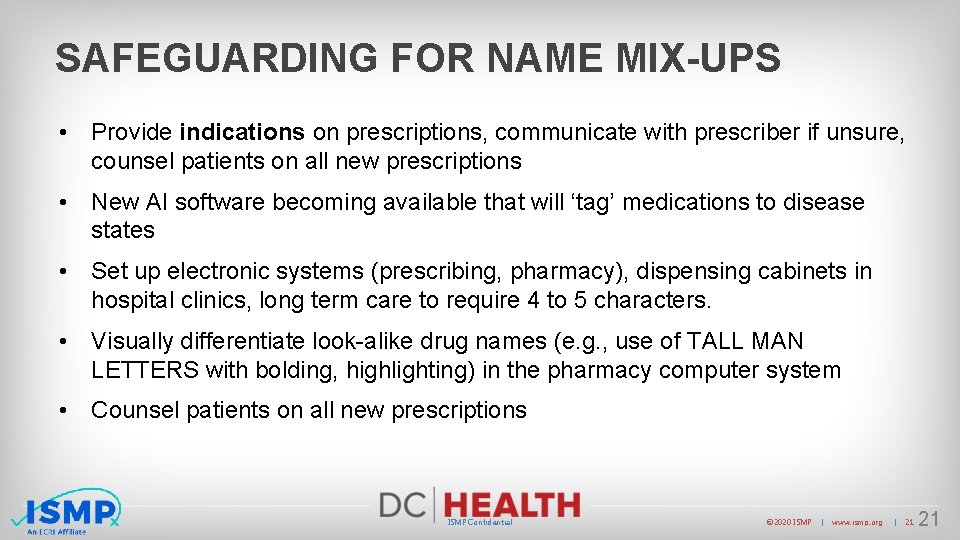
SAFEGUARDING FOR NAME MIX-UPS • Provide indications on prescriptions, communicate with prescriber if unsure, counsel patients on all new prescriptions • New AI software becoming available that will ‘tag’ medications to disease states • Set up electronic systems (prescribing, pharmacy), dispensing cabinets in hospital clinics, long term care to require 4 to 5 characters. • Visually differentiate look-alike drug names (e. g. , use of TALL MAN LETTERS with bolding, highlighting) in the pharmacy computer system • Counsel patients on all new prescriptions ISMP Confidential © 2020 ISMP | www. ismp. org | 21 21
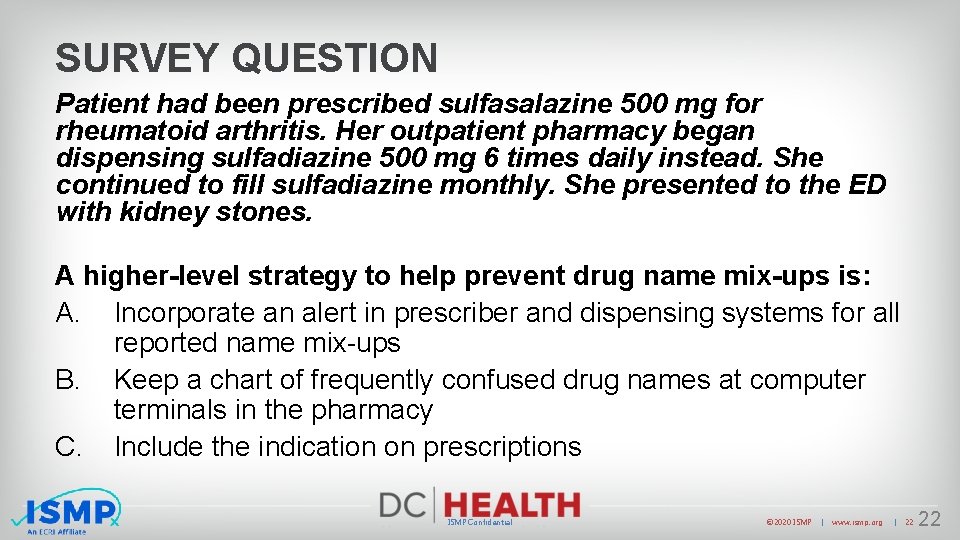
SURVEY QUESTION Patient had been prescribed sulfasalazine 500 mg for rheumatoid arthritis. Her outpatient pharmacy began dispensing sulfadiazine 500 mg 6 times daily instead. She continued to fill sulfadiazine monthly. She presented to the ED with kidney stones. A higher-level strategy to help prevent drug name mix-ups is: A. Incorporate an alert in prescriber and dispensing systems for all reported name mix-ups B. Keep a chart of frequently confused drug names at computer terminals in the pharmacy C. Include the indication on prescriptions ISMP Confidential © 2020 ISMP | www. ismp. org | 22 22
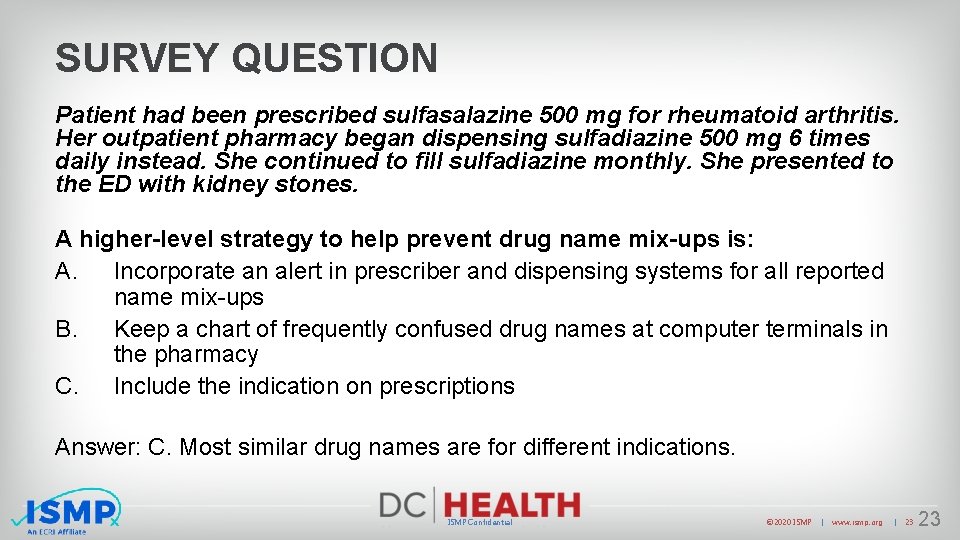
SURVEY QUESTION Patient had been prescribed sulfasalazine 500 mg for rheumatoid arthritis. Her outpatient pharmacy began dispensing sulfadiazine 500 mg 6 times daily instead. She continued to fill sulfadiazine monthly. She presented to the ED with kidney stones. A higher-level strategy to help prevent drug name mix-ups is: A. Incorporate an alert in prescriber and dispensing systems for all reported name mix-ups B. Keep a chart of frequently confused drug names at computer terminals in the pharmacy C. Include the indication on prescriptions Answer: C. Most similar drug names are for different indications. ISMP Confidential © 2020 ISMP | www. ismp. org | 23 23
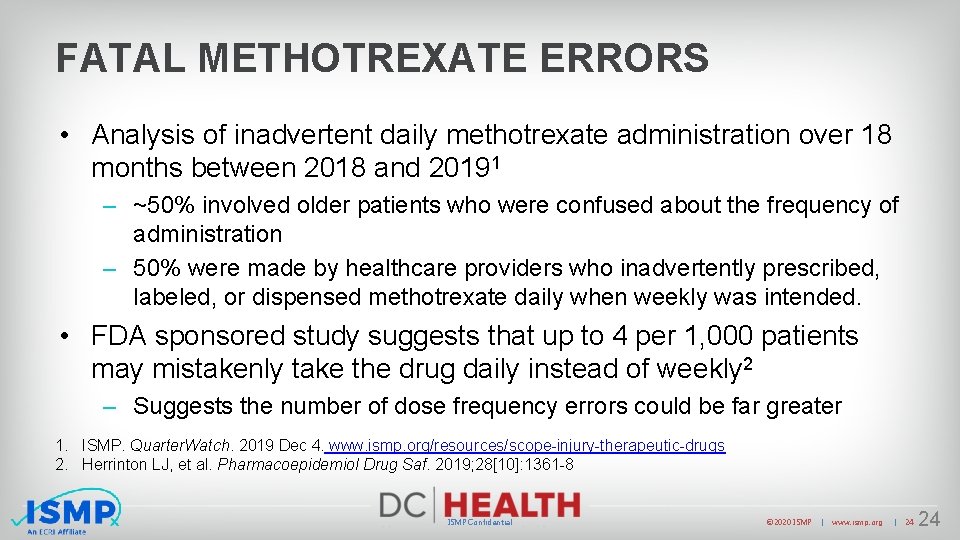
FATAL METHOTREXATE ERRORS • Analysis of inadvertent daily methotrexate administration over 18 months between 2018 and 20191 – ~50% involved older patients who were confused about the frequency of administration – 50% were made by healthcare providers who inadvertently prescribed, labeled, or dispensed methotrexate daily when weekly was intended. • FDA sponsored study suggests that up to 4 per 1, 000 patients may mistakenly take the drug daily instead of weekly 2 – Suggests the number of dose frequency errors could be far greater 1. ISMP. Quarter. Watch. 2019 Dec 4. www. ismp. org/resources/scope-injury-therapeutic-drugs 2. Herrinton LJ, et al. Pharmacoepidemiol Drug Saf. 2019; 28[10]: 1361 -8 ISMP Confidential © 2020 ISMP | www. ismp. org | 24 24
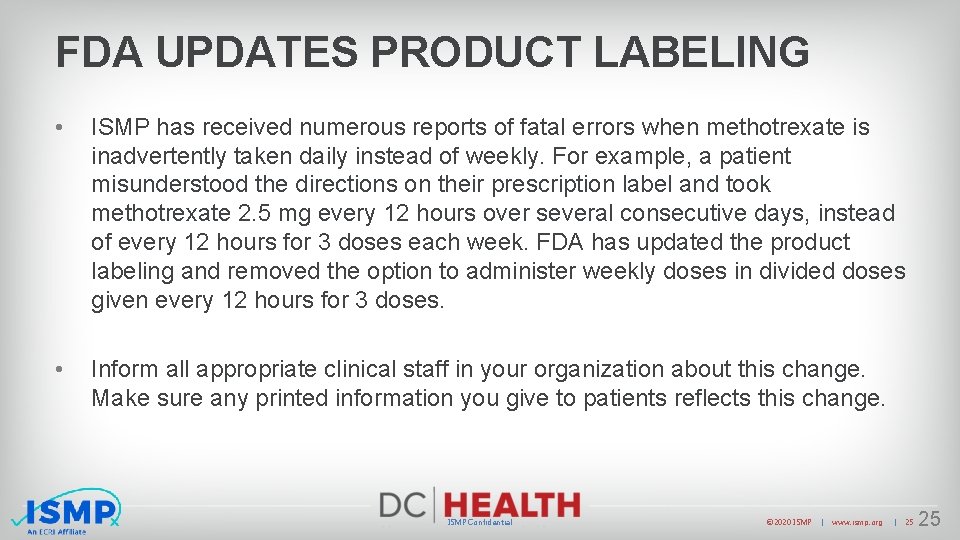
FDA UPDATES PRODUCT LABELING • ISMP has received numerous reports of fatal errors when methotrexate is inadvertently taken daily instead of weekly. For example, a patient misunderstood the directions on their prescription label and took methotrexate 2. 5 mg every 12 hours over several consecutive days, instead of every 12 hours for 3 doses each week. FDA has updated the product labeling and removed the option to administer weekly doses in divided doses given every 12 hours for 3 doses. • Inform all appropriate clinical staff in your organization about this change. Make sure any printed information you give to patients reflects this change. ISMP Confidential © 2020 ISMP | www. ismp. org | 25 25
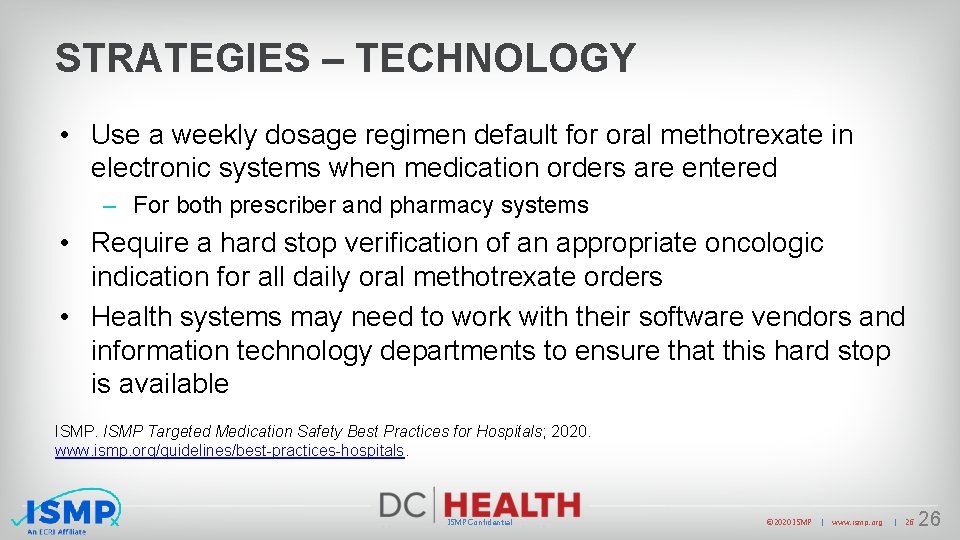
STRATEGIES – TECHNOLOGY • Use a weekly dosage regimen default for oral methotrexate in electronic systems when medication orders are entered – For both prescriber and pharmacy systems • Require a hard stop verification of an appropriate oncologic indication for all daily oral methotrexate orders • Health systems may need to work with their software vendors and information technology departments to ensure that this hard stop is available ISMP Targeted Medication Safety Best Practices for Hospitals; 2020. www. ismp. org/guidelines/best-practices-hospitals. ISMP Confidential © 2020 ISMP | www. ismp. org | 26 26
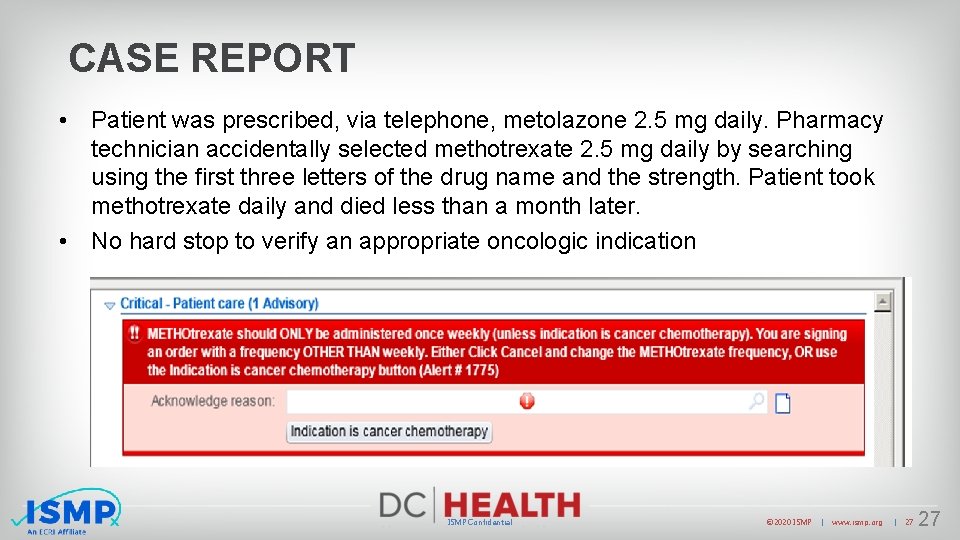
CASE REPORT • Patient was prescribed, via telephone, metolazone 2. 5 mg daily. Pharmacy technician accidentally selected methotrexate 2. 5 mg daily by searching using the first three letters of the drug name and the strength. Patient took methotrexate daily and died less than a month later. • No hard stop to verify an appropriate oncologic indication ISMP Confidential © 2020 ISMP | www. ismp. org | 27 27
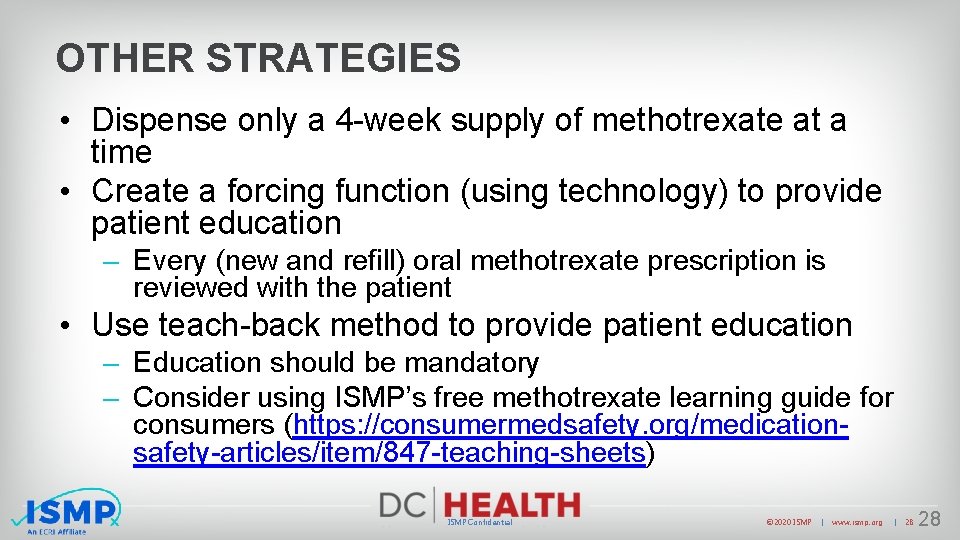
OTHER STRATEGIES • Dispense only a 4 -week supply of methotrexate at a time • Create a forcing function (using technology) to provide patient education – Every (new and refill) oral methotrexate prescription is reviewed with the patient • Use teach-back method to provide patient education – Education should be mandatory – Consider using ISMP’s free methotrexate learning guide for consumers (https: //consumermedsafety. org/medicationsafety-articles/item/847 -teaching-sheets) ISMP Confidential © 2020 ISMP | www. ismp. org | 28 28
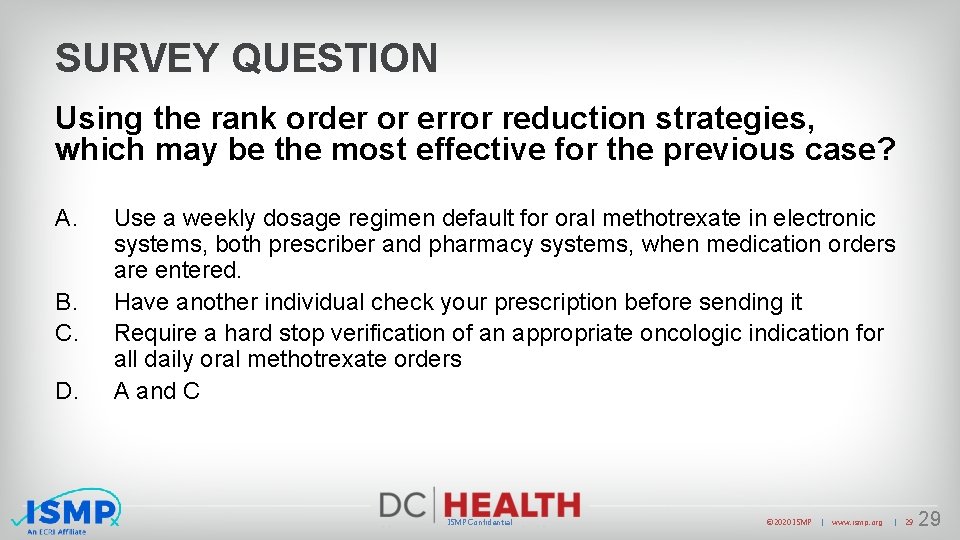
SURVEY QUESTION Using the rank order or error reduction strategies, which may be the most effective for the previous case? A. B. C. D. Use a weekly dosage regimen default for oral methotrexate in electronic systems, both prescriber and pharmacy systems, when medication orders are entered. Have another individual check your prescription before sending it Require a hard stop verification of an appropriate oncologic indication for all daily oral methotrexate orders A and C ISMP Confidential © 2020 ISMP | www. ismp. org | 29 29
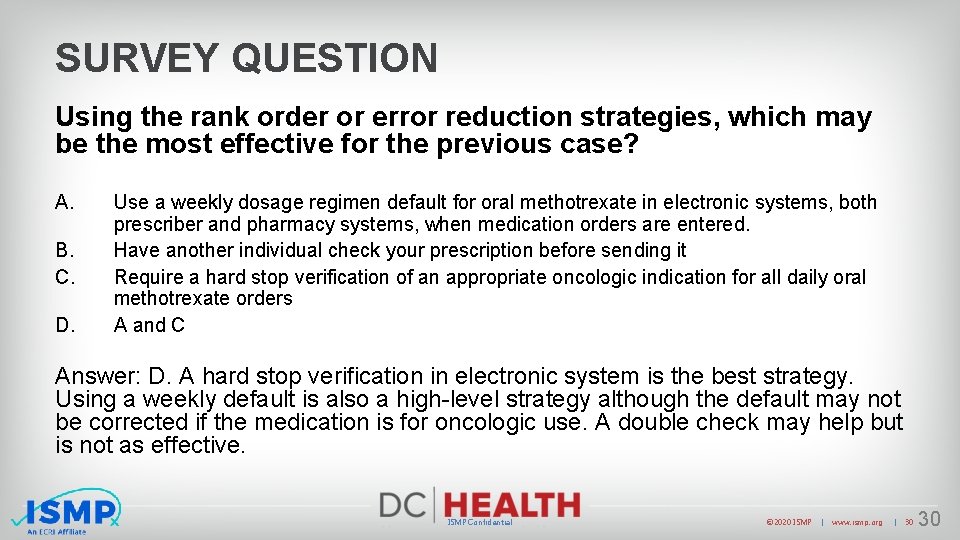
SURVEY QUESTION Using the rank order or error reduction strategies, which may be the most effective for the previous case? A. B. C. D. Use a weekly dosage regimen default for oral methotrexate in electronic systems, both prescriber and pharmacy systems, when medication orders are entered. Have another individual check your prescription before sending it Require a hard stop verification of an appropriate oncologic indication for all daily oral methotrexate orders A and C Answer: D. A hard stop verification in electronic system is the best strategy. Using a weekly default is also a high-level strategy although the default may not be corrected if the medication is for oncologic use. A double check may help but is not as effective. ISMP Confidential © 2020 ISMP | www. ismp. org | 30 30
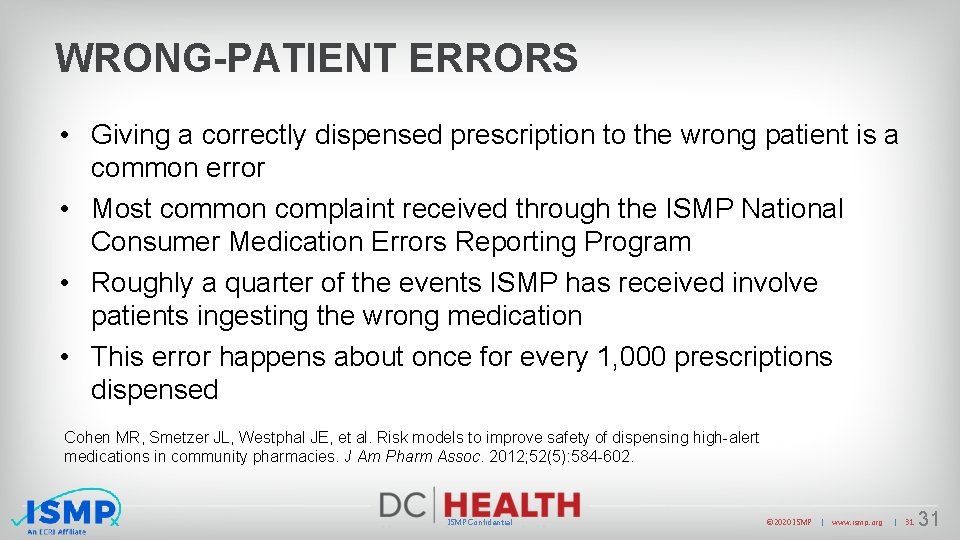
WRONG-PATIENT ERRORS • Giving a correctly dispensed prescription to the wrong patient is a common error • Most common complaint received through the ISMP National Consumer Medication Errors Reporting Program • Roughly a quarter of the events ISMP has received involve patients ingesting the wrong medication • This error happens about once for every 1, 000 prescriptions dispensed Cohen MR, Smetzer JL, Westphal JE, et al. Risk models to improve safety of dispensing high-alert medications in community pharmacies. J Am Pharm Assoc. 2012; 52(5): 584 -602. ISMP Confidential © 2020 ISMP | www. ismp. org | 31 31
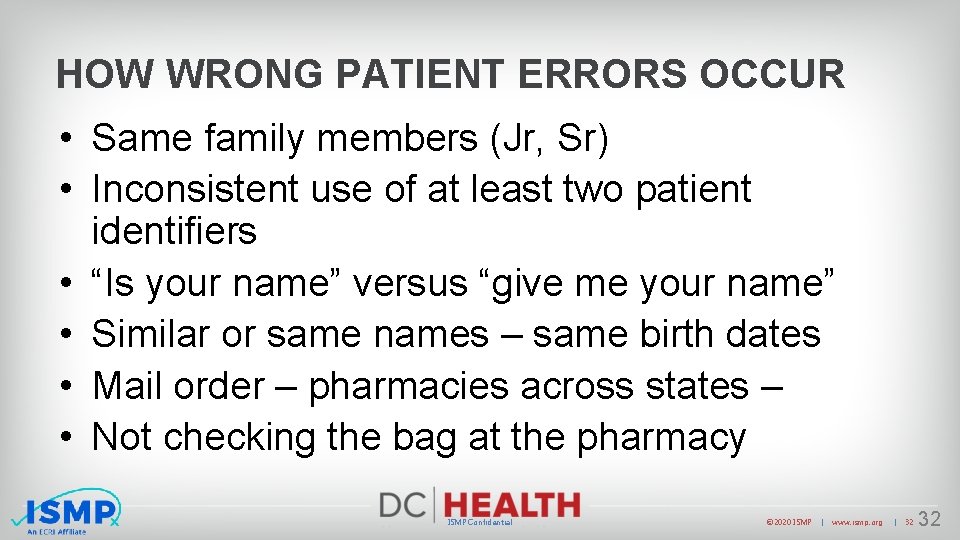
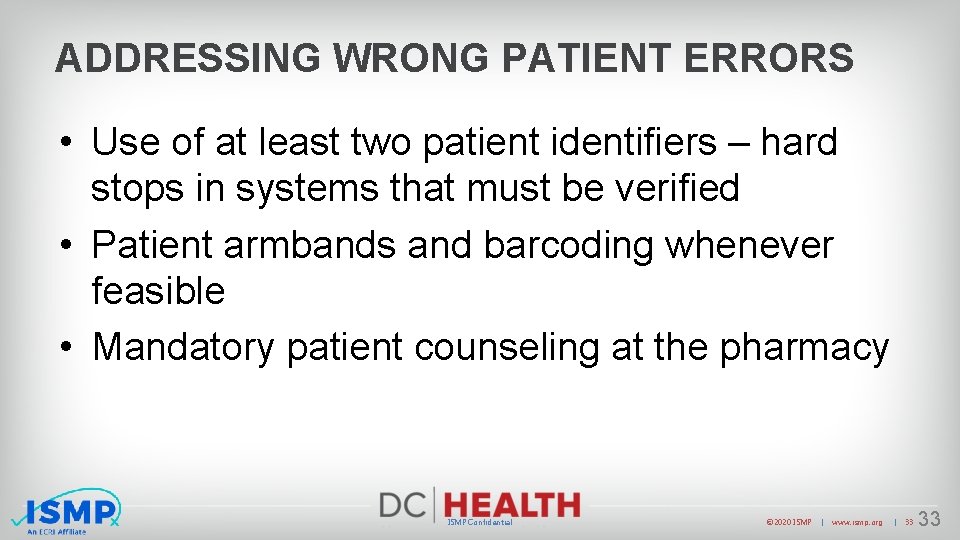
HOW WRONG PATIENT ERRORS OCCUR • Same family members (Jr, Sr) • Inconsistent use of at least two patient identifiers • “Is your name” versus “give me your name” • Similar or same names – same birth dates • Mail order – pharmacies across states – • Not checking the bag at the pharmacy ISMP Confidential © 2020 ISMP | www. ismp. org | 32 32
ADDRESSING WRONG PATIENT ERRORS • Use of at least two patient identifiers – hard stops in systems that must be verified • Patient armbands and barcoding whenever feasible • Mandatory patient counseling at the pharmacy ISMP Confidential © 2020 ISMP | www. ismp. org | 33 33
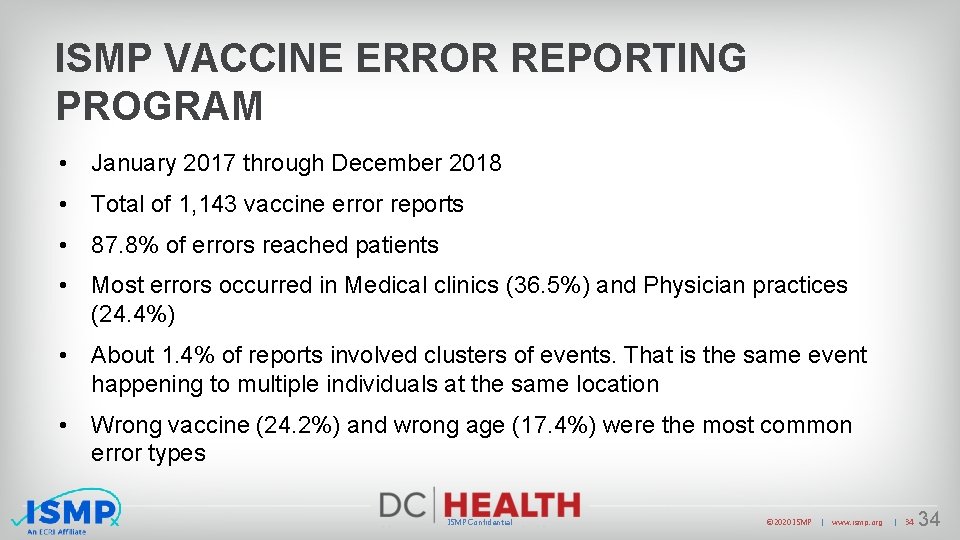
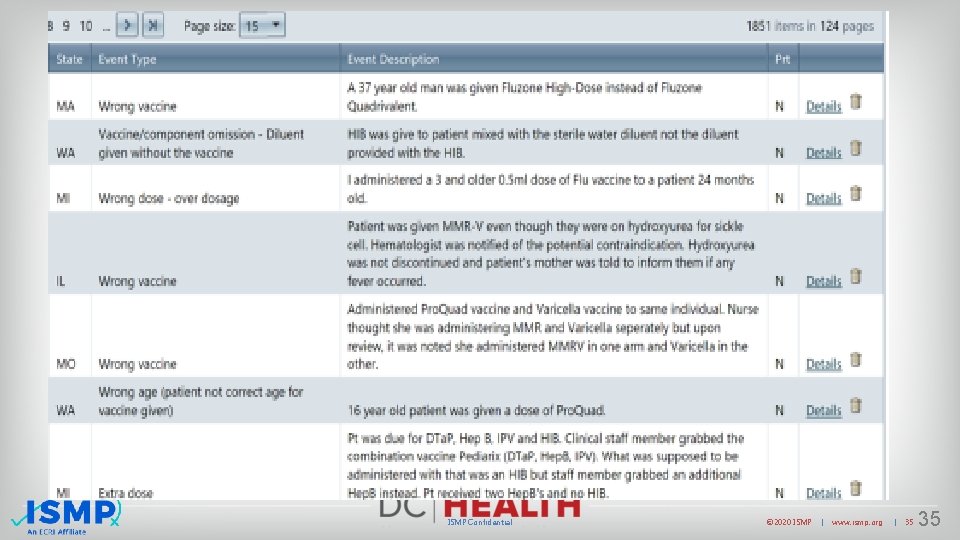
ISMP VACCINE ERROR REPORTING PROGRAM • January 2017 through December 2018 • Total of 1, 143 vaccine error reports • 87. 8% of errors reached patients • Most errors occurred in Medical clinics (36. 5%) and Physician practices (24. 4%) • About 1. 4% of reports involved clusters of events. That is the same event happening to multiple individuals at the same location • Wrong vaccine (24. 2%) and wrong age (17. 4%) were the most common error types ISMP Confidential © 2020 ISMP | www. ismp. org | 34 34
ISMP Confidential © 2020 ISMP | www. ismp. org | 35 35
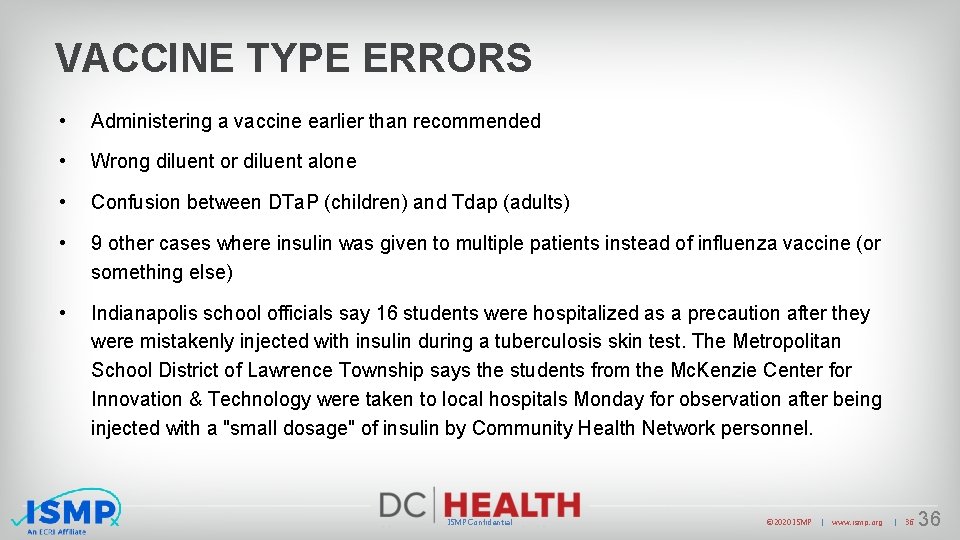
VACCINE TYPE ERRORS • Administering a vaccine earlier than recommended • Wrong diluent or diluent alone • Confusion between DTa. P (children) and Tdap (adults) • 9 other cases where insulin was given to multiple patients instead of influenza vaccine (or something else) • Indianapolis school officials say 16 students were hospitalized as a precaution after they were mistakenly injected with insulin during a tuberculosis skin test. The Metropolitan School District of Lawrence Township says the students from the Mc. Kenzie Center for Innovation & Technology were taken to local hospitals Monday for observation after being injected with a "small dosage" of insulin by Community Health Network personnel. ISMP Confidential © 2020 ISMP | www. ismp. org | 36 36
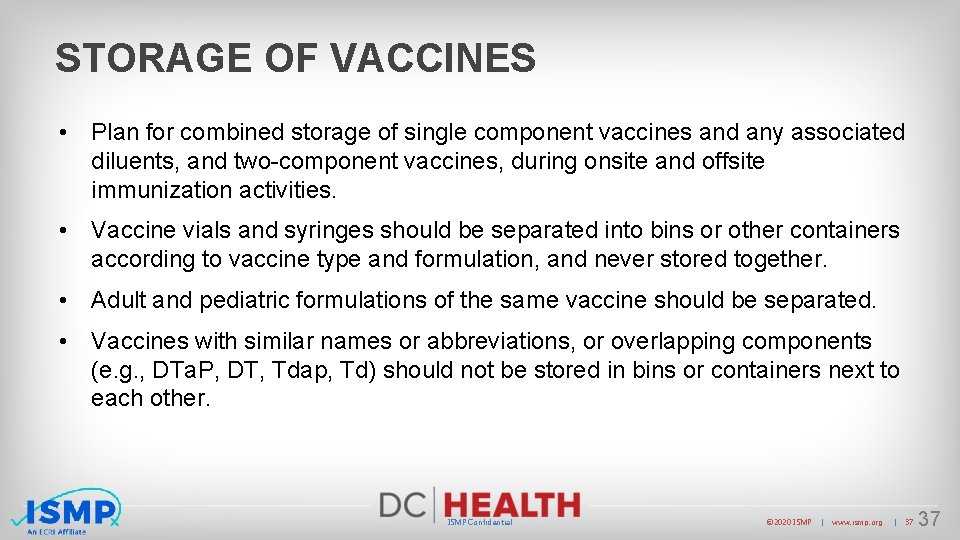
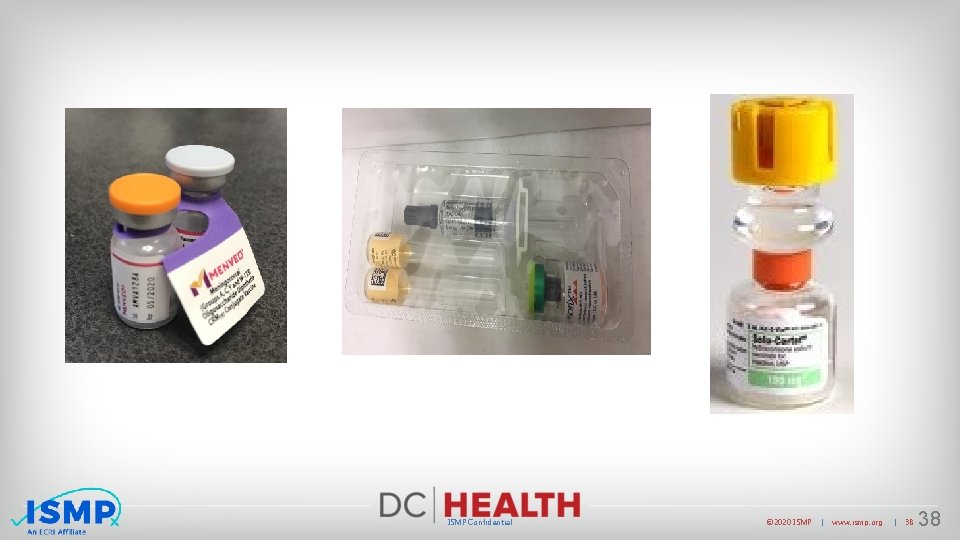
STORAGE OF VACCINES • Plan for combined storage of single component vaccines and any associated diluents, and two-component vaccines, during onsite and offsite immunization activities. • Vaccine vials and syringes should be separated into bins or other containers according to vaccine type and formulation, and never stored together. • Adult and pediatric formulations of the same vaccine should be separated. • Vaccines with similar names or abbreviations, or overlapping components (e. g. , DTa. P, DT, Tdap, Td) should not be stored in bins or containers next to each other. ISMP Confidential © 2020 ISMP | www. ismp. org | 37 37
ISMP Confidential © 2020 ISMP | www. ismp. org | 38 38
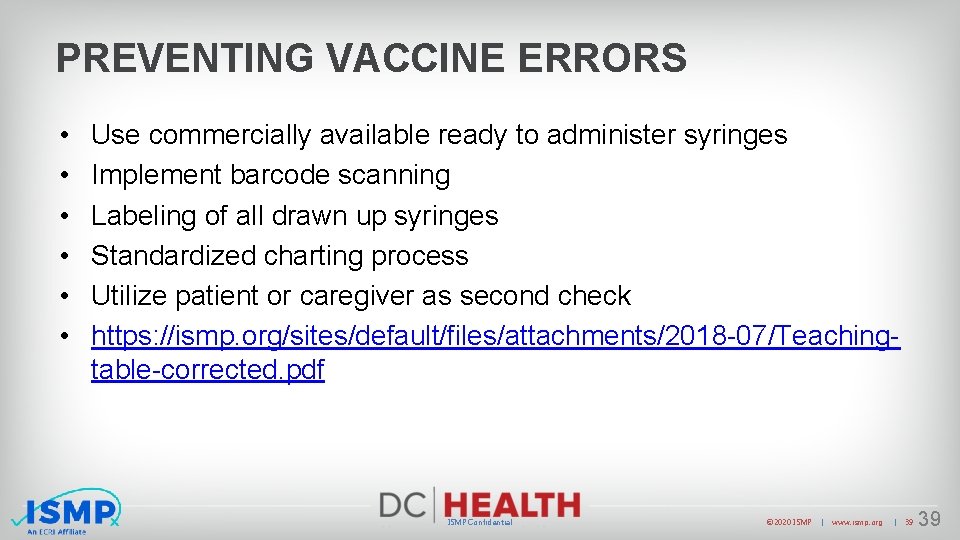
PREVENTING VACCINE ERRORS • • • Use commercially available ready to administer syringes Implement barcode scanning Labeling of all drawn up syringes Standardized charting process Utilize patient or caregiver as second check https: //ismp. org/sites/default/files/attachments/2018 -07/Teachingtable-corrected. pdf ISMP Confidential © 2020 ISMP | www. ismp. org | 39 39
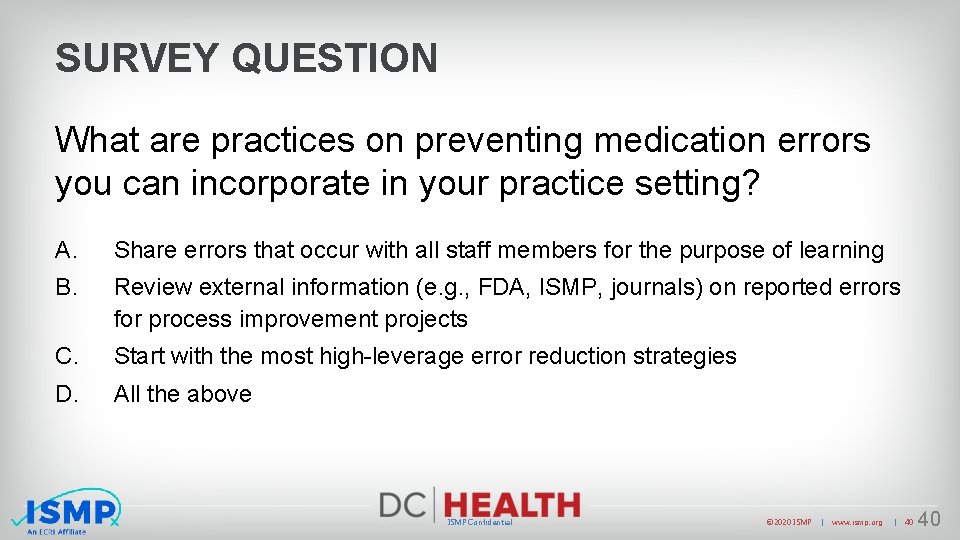
SURVEY QUESTION What are practices on preventing medication errors you can incorporate in your practice setting? A. Share errors that occur with all staff members for the purpose of learning B. Review external information (e. g. , FDA, ISMP, journals) on reported errors for process improvement projects C. Start with the most high-leverage error reduction strategies D. All the above ISMP Confidential © 2020 ISMP | www. ismp. org | 40 40
SURVEY QUESTION What are practices on preventing medication errors you can incorporate in your practice setting? A. Share errors that occur with all staff members for the purpose of learning B. Review external information (e. g. , FDA, ISMP, journals) on reported errors for process improvement projects C. Start with the most high-leverage error reduction strategies D. All the above Answer: D. Error prevention is a multifactorial process. Utilize information from externally reported errors in the literature to implement safeguards in your practice. Use the Hierarchy of Risk-Reduction Strategies chart and remember that more than one strategy is most often layered to achieve success. ISMP Confidential © 2020 ISMP | www. ismp. org | 41 41
REFERENCES • • • E. A. Flynn, K. N. Barker, B A. Berger, et al. Dispensing errors and counseling quality in 100 pharmacies. J Am Pharm Assoc. 2009; 49: 171– 180. C Cheung K-C, van, der Veen W, Bouvy ML, et al. Classification of medication incidents associated with information technology. J Am Med Inform Assoc 2014; 21: e 63–e 70. A Salazar, SJ Karmiy, KJ Forsythe, et al. How often do prescribers include indications in drug orders? Analysis of 4 million outpatient prescriptions. Am J Health-Syst Pharm. 2019; 76: 970 -979 K Aldhwaihi, F Schifano, C Pezzolesi, etal. A systematic review of the nature of dispensing errors in hospital pharmacies. Integrated Pharmacy Research and Practice 2016: 5 1– 10 Hickman T-TT, Quist AJL, Salazar A, et al. Outpatient CPOE orders discontinued due to ‘erroneous entry’: prospective survey of prescribers’ explanations for errors. BMJ Qual Saf 2018; 27: 293– 298. Abraham J, Kannampallil TG, Jarman A, et al. Reasons for computerized provider order entry (CPOE)-based inpatient medication ordering errors: an observational study of voided orders. BMJ Qual Saf 2018; 27: 299– 307. ISMP Confidential © 2020 ISMP | www. ismp. org | 42 42
A HUMAN FACTORS APPROACH TO MEDICATION SAFETY Raj Ratwani, Ph. D Center Director, Med. Star Health National Center for Human Factors in Healthcare Associate Professor of Emergency of Medicine, Georgetown University School Medicine @Raj. Ratwani @Medical. HFE 43
DISCLOSURES • Research is supported by the Agency for Healthcare Research and Quality (AHRQ), National Library of Medicine (NLM), and the Office of National Coordinator for Health Information Technology (ONC) 44
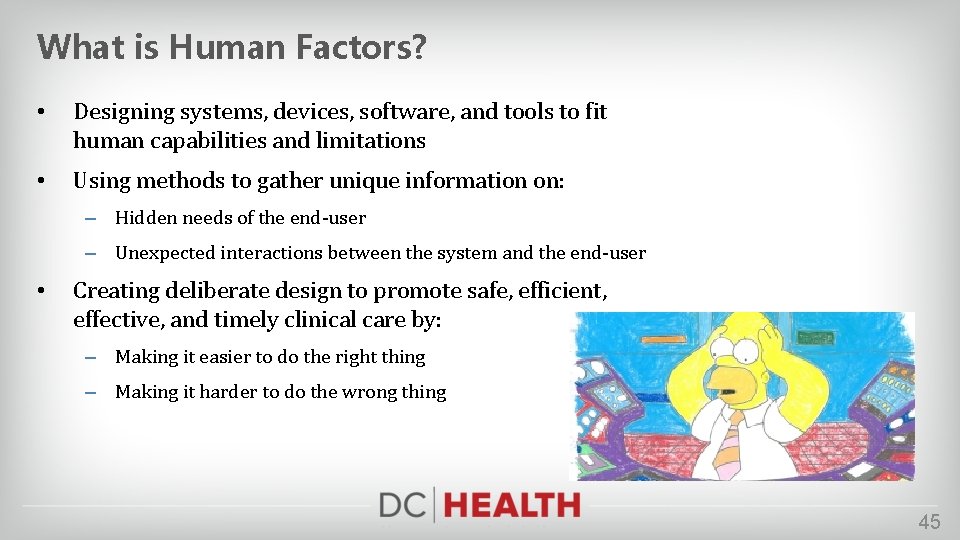
What is Human Factors? • Designing systems, devices, software, and tools to fit human capabilities and limitations • Using methods to gather unique information on: – Hidden needs of the end-user – Unexpected interactions between the system and the end-user • Creating deliberate design to promote safe, efficient, effective, and timely clinical care by: – Making it easier to do the right thing – Making it harder to do the wrong thing 45
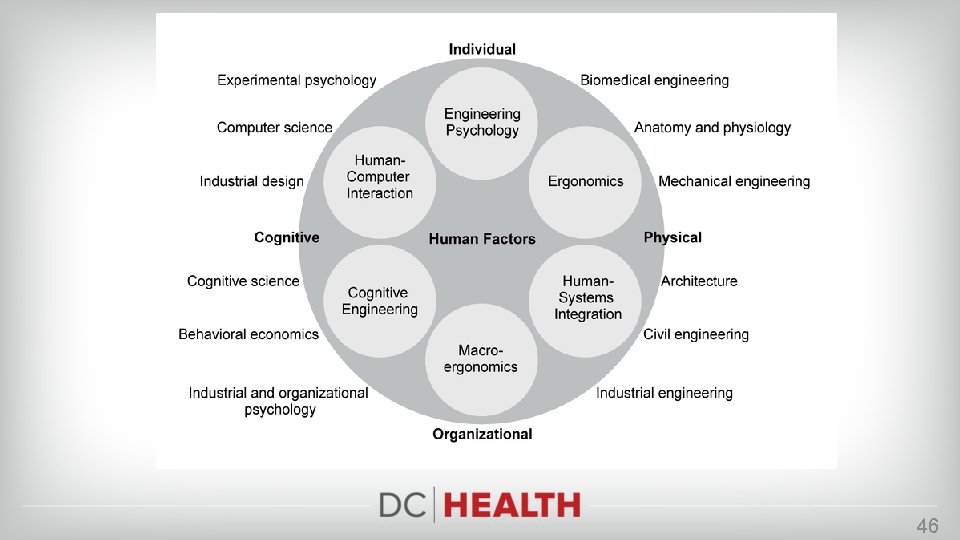
46
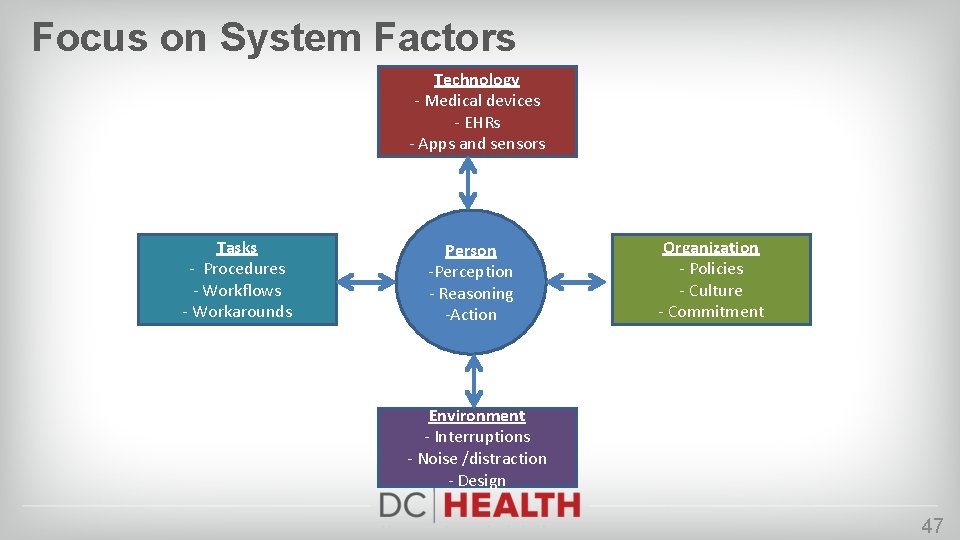
Focus on System Factors Technology - Medical devices - EHRs - Apps and sensors Tasks - Procedures - Workflows - Workarounds Person -Perception - Reasoning -Action Organization - Policies - Culture - Commitment Environment - Interruptions - Noise /distraction - Design 47
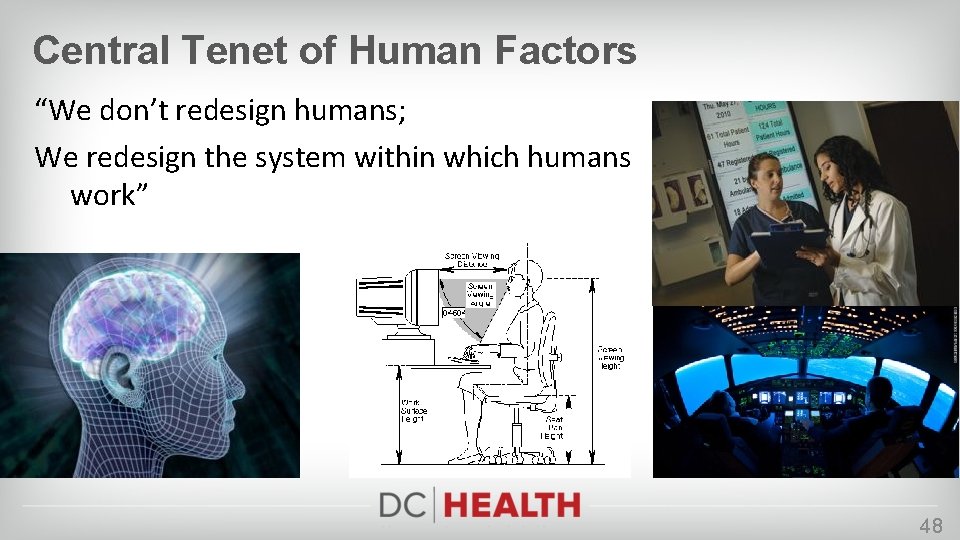
Central Tenet of Human Factors “We don’t redesign humans; We redesign the system within which humans work” 48
SURVEY QUESTION A human factors approach focuses on: A. Blaming individuals for the mistakes they make. B. Ignoring work system factors and hoping for the best. C. Identifying system factors that contribute to errors. D. Blaming leadership for a poor work culture. 49
SURVEY QUESTION A human factors approach focuses on: A. Blaming individuals for the mistakes they make. B. Ignoring work system factors and hoping for the best. C. Identifying system factors that contribute to errors. D. Blaming leadership for a poor work culture. Answer: C 50
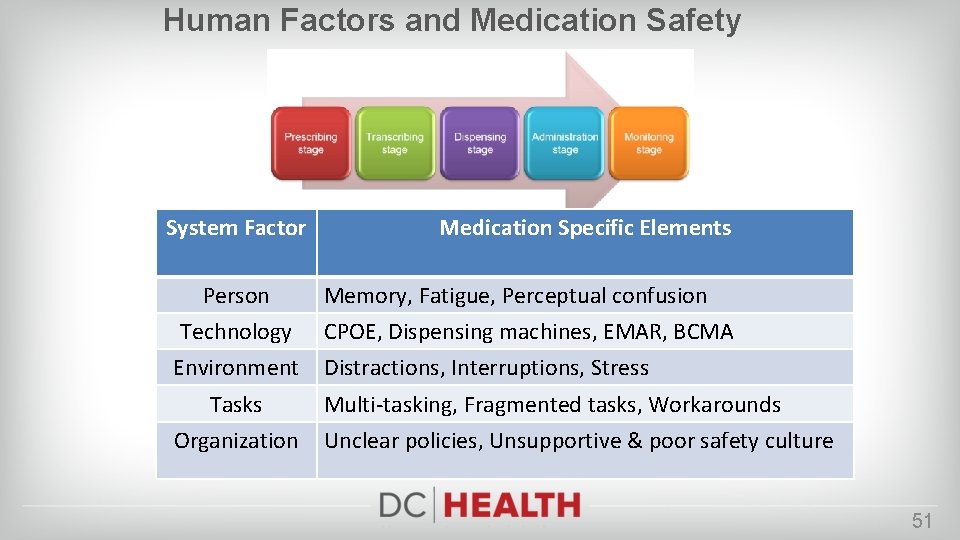
Human Factors and Medication Safety System Factor Medication Specific Elements Person Technology Environment Memory, Fatigue, Perceptual confusion CPOE, Dispensing machines, EMAR, BCMA Distractions, Interruptions, Stress Tasks Organization Multi-tasking, Fragmented tasks, Workarounds Unclear policies, Unsupportive & poor safety culture 51
Examples 52
Palese be as cerfaul as pisobsle as you raed tihs! 53
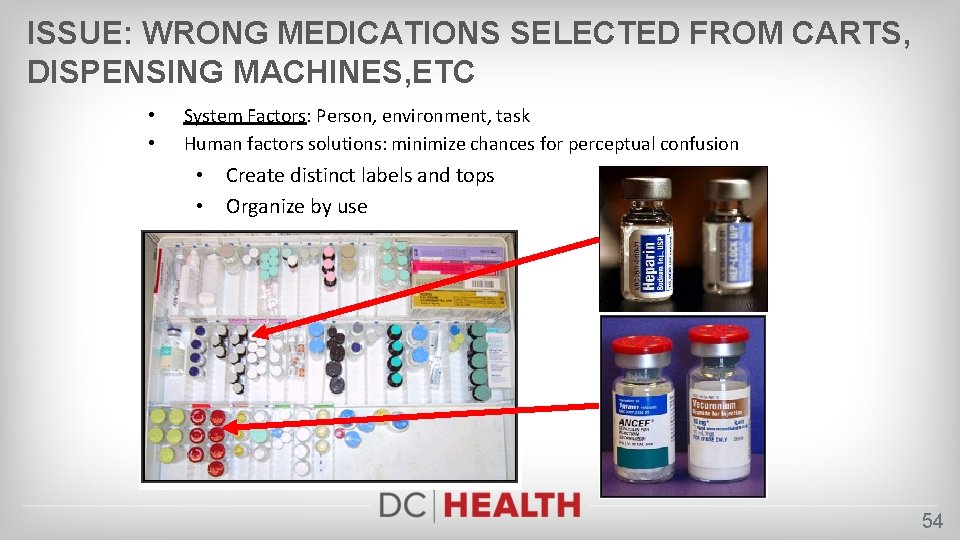
ISSUE: WRONG MEDICATIONS SELECTED FROM CARTS, DISPENSING MACHINES, ETC • • System Factors: Person, environment, task Human factors solutions: minimize chances for perceptual confusion • Create distinct labels and tops • Organize by use 54
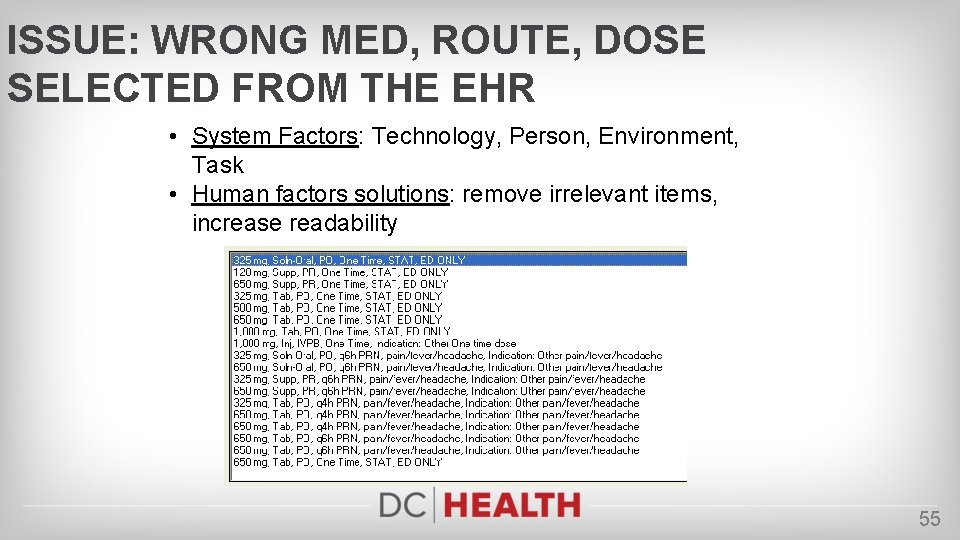
ISSUE: WRONG MED, ROUTE, DOSE SELECTED FROM THE EHR • System Factors: Technology, Person, Environment, Task • Human factors solutions: remove irrelevant items, increase readability 55
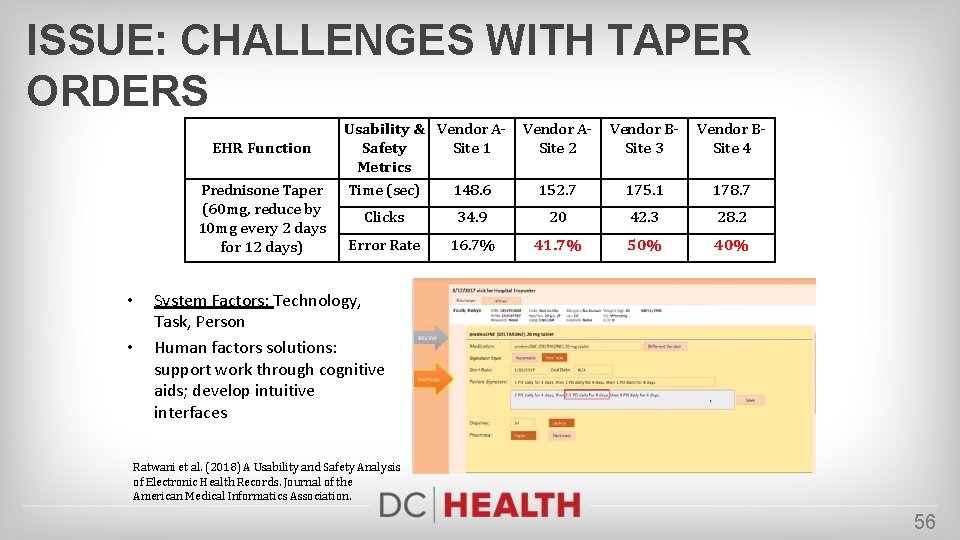
ISSUE: CHALLENGES WITH TAPER ORDERS EHR Function Prednisone Taper (60 mg, reduce by 10 mg every 2 days for 12 days) • • Usability & Vendor ASafety Site 1 Metrics Time (sec) 148. 6 Vendor ASite 2 Vendor BSite 3 Vendor BSite 4 152. 7 175. 1 178. 7 Clicks 34. 9 20 42. 3 28. 2 Error Rate 16. 7% 41. 7% 50% 40% System Factors: Technology, Task, Person Human factors solutions: support work through cognitive aids; develop intuitive interfaces Ratwani et al. (2018) A Usability and Safety Analysis of Electronic Health Records. Journal of the American Medical Informatics Association. 56
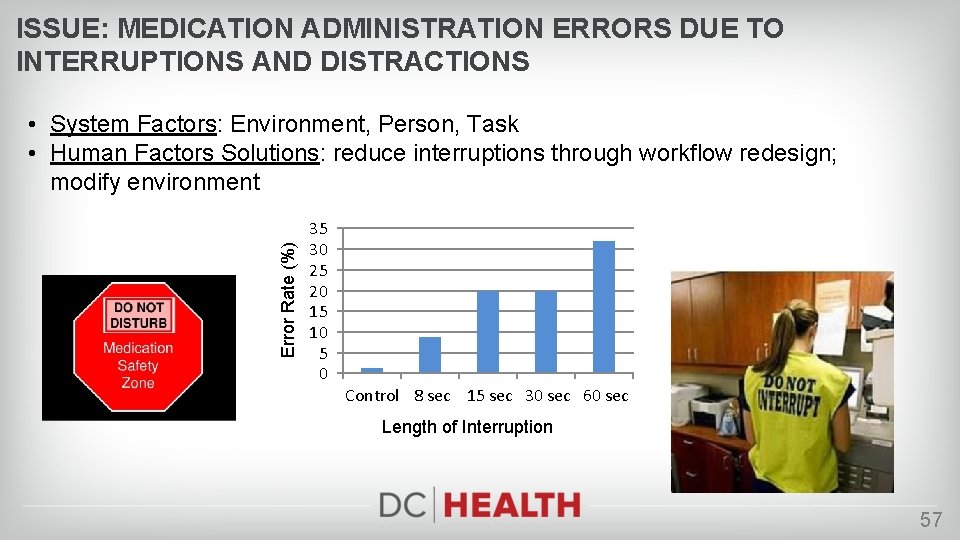
ISSUE: MEDICATION ADMINISTRATION ERRORS DUE TO INTERRUPTIONS AND DISTRACTIONS Error Rate (%) • System Factors: Environment, Person, Task • Human Factors Solutions: reduce interruptions through workflow redesign; modify environment 35 30 25 20 15 10 5 0 Control 8 sec 15 sec 30 sec 60 sec Length of Interruption 57
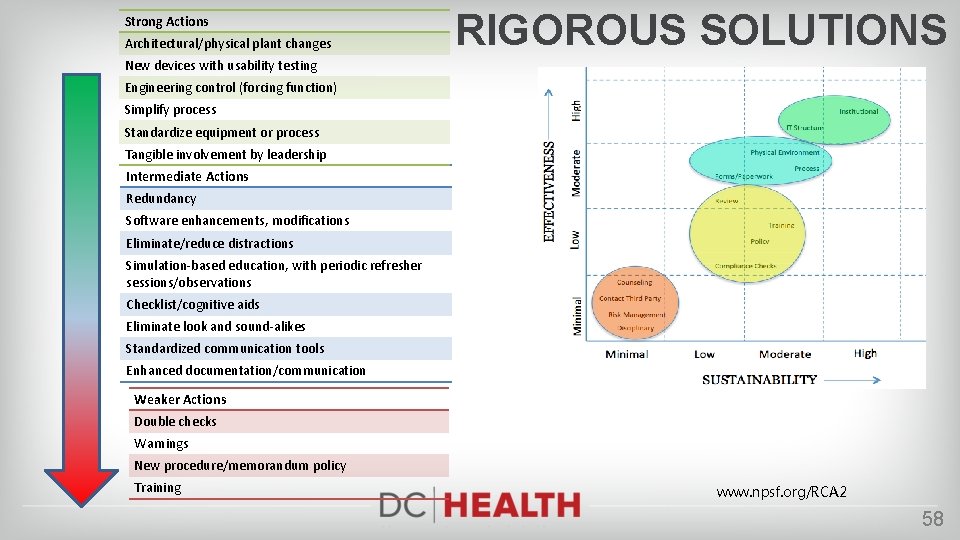
Strong Actions Architectural/physical plant changes RIGOROUS SOLUTIONS New devices with usability testing Engineering control (forcing function) Simplify process Standardize equipment or process Tangible involvement by leadership Intermediate Actions Redundancy Software enhancements, modifications Eliminate/reduce distractions Simulation-based education, with periodic refresher sessions/observations Checklist/cognitive aids Eliminate look and sound-alikes Standardized communication tools Enhanced documentation/communication Weaker Actions Double checks Warnings New procedure/memorandum policy Training www. npsf. org/RCA 2 58
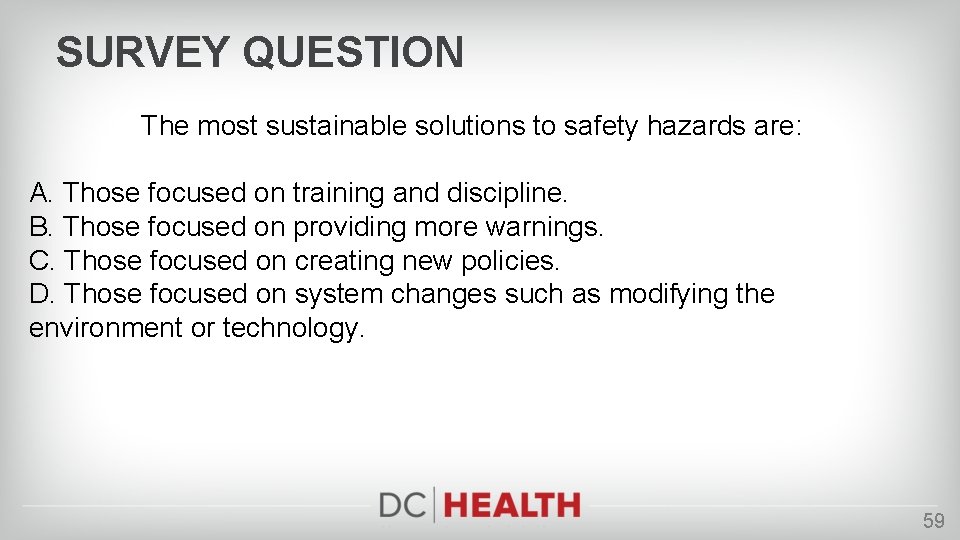
SURVEY QUESTION The most sustainable solutions to safety hazards are: A. Those focused on training and discipline. B. Those focused on providing more warnings. C. Those focused on creating new policies. D. Those focused on system changes such as modifying the environment or technology. 59
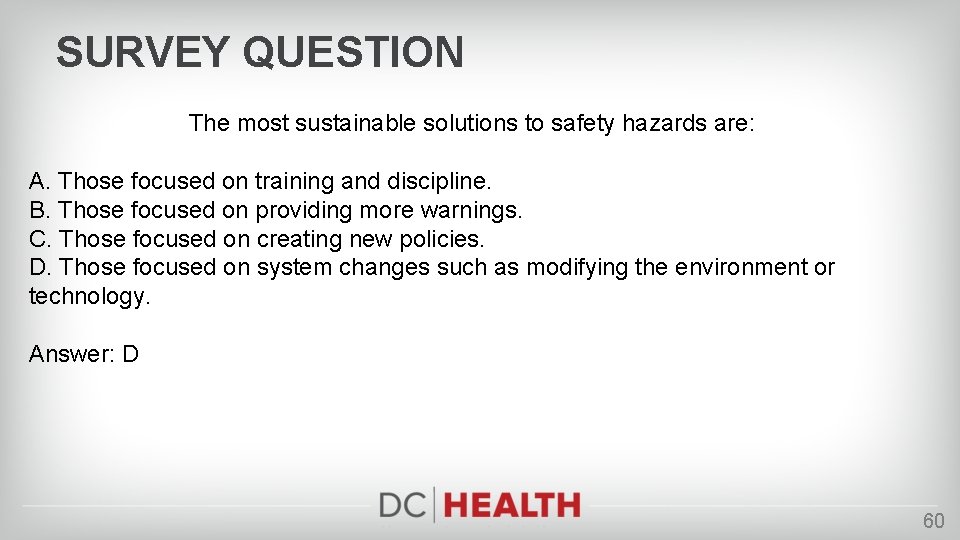
SURVEY QUESTION The most sustainable solutions to safety hazards are: A. Those focused on training and discipline. B. Those focused on providing more warnings. C. Those focused on creating new policies. D. Those focused on system changes such as modifying the environment or technology. Answer: D 60
APPLICATION 61
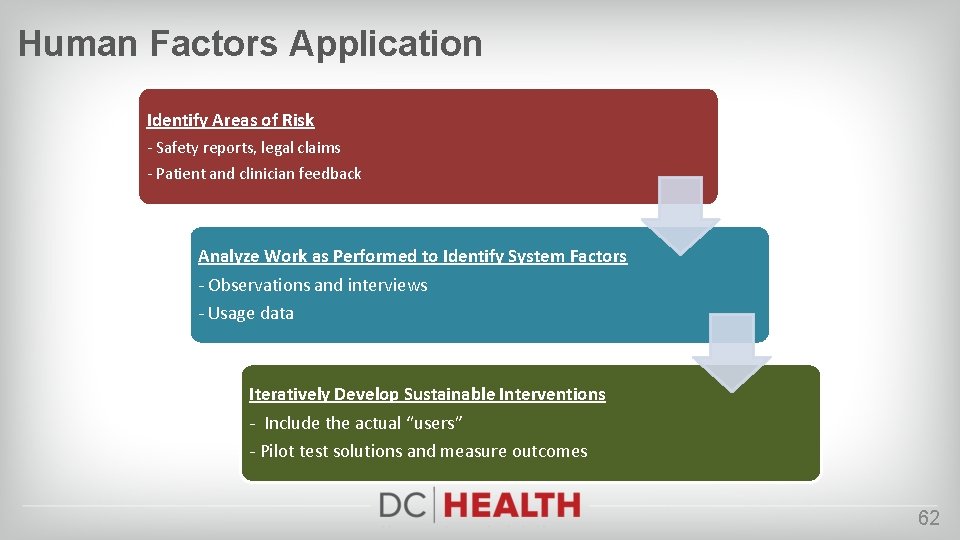
Human Factors Application Identify Areas of Risk - Safety reports, legal claims - Patient and clinician feedback Analyze Work as Performed to Identify System Factors - Observations and interviews - Usage data Iteratively Develop Sustainable Interventions - Include the actual “users” - Pilot test solutions and measure outcomes 62
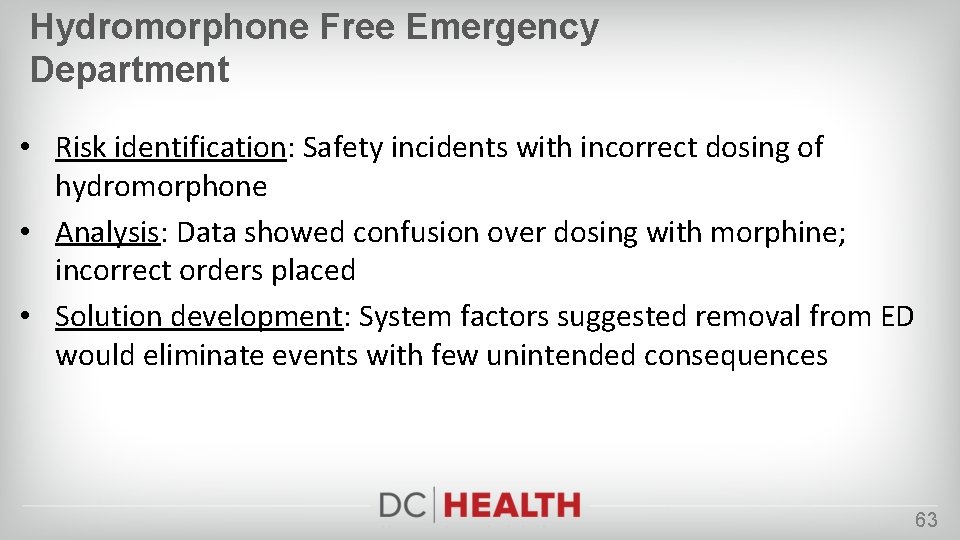
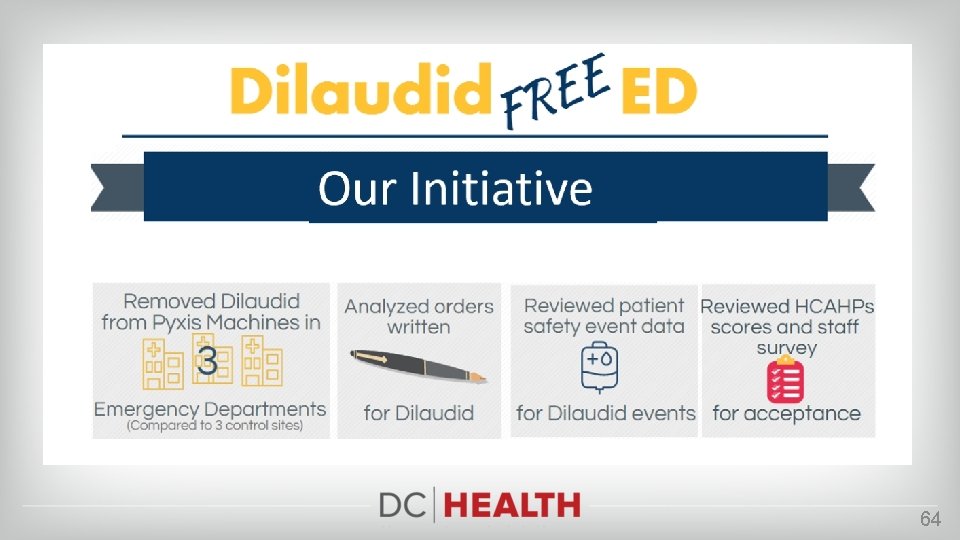
Hydromorphone Free Emergency Department • Risk identification: Safety incidents with incorrect dosing of hydromorphone • Analysis: Data showed confusion over dosing with morphine; incorrect orders placed • Solution development: System factors suggested removal from ED would eliminate events with few unintended consequences 63
64
SUMMARY • Human factors focuses on understanding human capabilities and ensuring the work system meets these capabilities. • Systems based solutions are more sustainable and effective • Identify risks -> Analyze the situation-> Iteratively develop solutions 65
THANK YOU Raj Ratwani, Ph. D Raj. M. Ratwani@medstar. net @Raj. Ratwani Medical. Human. Factors. Org 66
DISCUSSION PANEL Marybeth Kazanas, Pharm. D, BCPS, LSSGB • System Director, Clinical Pharmacy Services - Med. Star Health Georgia Z. Lewis, MSN, RN, CPNP-PC • Pediatric Nurse Practitioner - Signature Health Eileen R. Langstraat, Pharm. D. , BCPS, CPPS • Medication and Patient Safety Coordinator - Kaiser Permanente 67
MARYBETH KAZANAS, PHARMD, BCPS, LSSGB SYSTEM DIRECTOR, CLINICAL PHARMACY SERVICES - MEDSTAR HEALTH 68
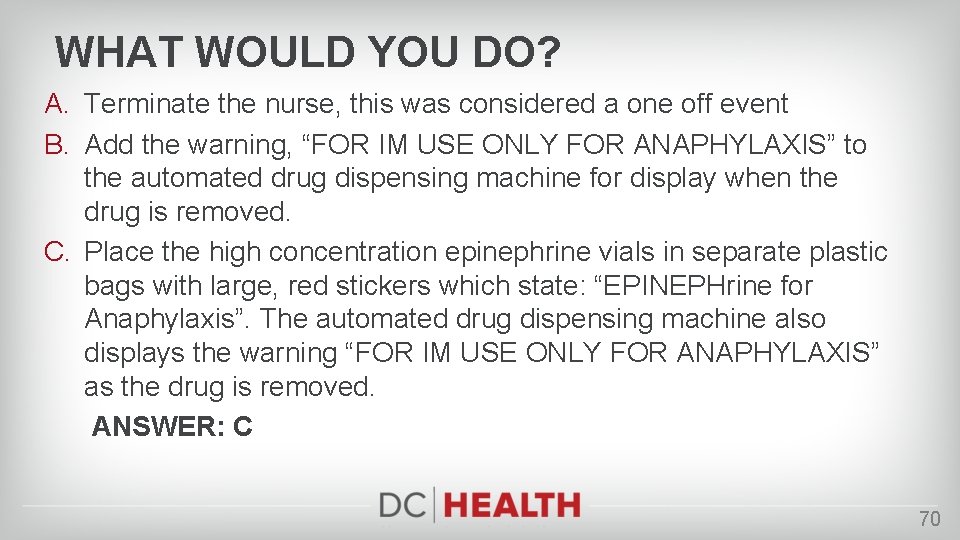
WHAT WOULD YOU DO? A. Terminate the nurse, this was considered a one off event B. Add the warning, “FOR IM USE ONLY FOR ANAPHYLAXIS” to the automated drug dispensing machine for display when the drug is removed. C. Place the high concentration epinephrine vials in separate plastic bags with large, red stickers which state: “EPINEPHrine for Anaphylaxis”. The automated drug dispensing machine also displays the warning “FOR IM USE ONLY FOR ANAPHYLAXIS” as the drug is removed. 69
WHAT WOULD YOU DO? A. Terminate the nurse, this was considered a one off event B. Add the warning, “FOR IM USE ONLY FOR ANAPHYLAXIS” to the automated drug dispensing machine for display when the drug is removed. C. Place the high concentration epinephrine vials in separate plastic bags with large, red stickers which state: “EPINEPHrine for Anaphylaxis”. The automated drug dispensing machine also displays the warning “FOR IM USE ONLY FOR ANAPHYLAXIS” as the drug is removed. ANSWER: C 70
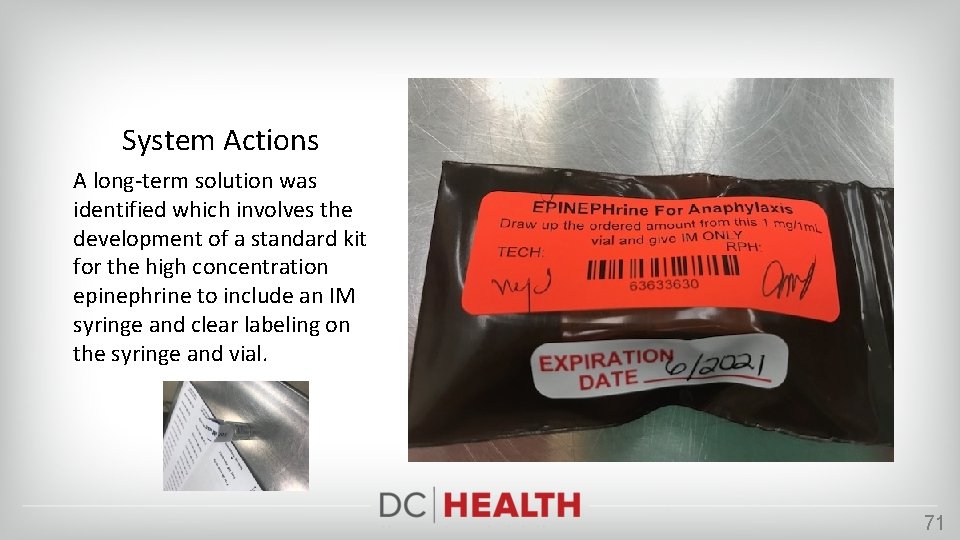
System Actions A long-term solution was identified which involves the development of a standard kit for the high concentration epinephrine to include an IM syringe and clear labeling on the syringe and vial. 71
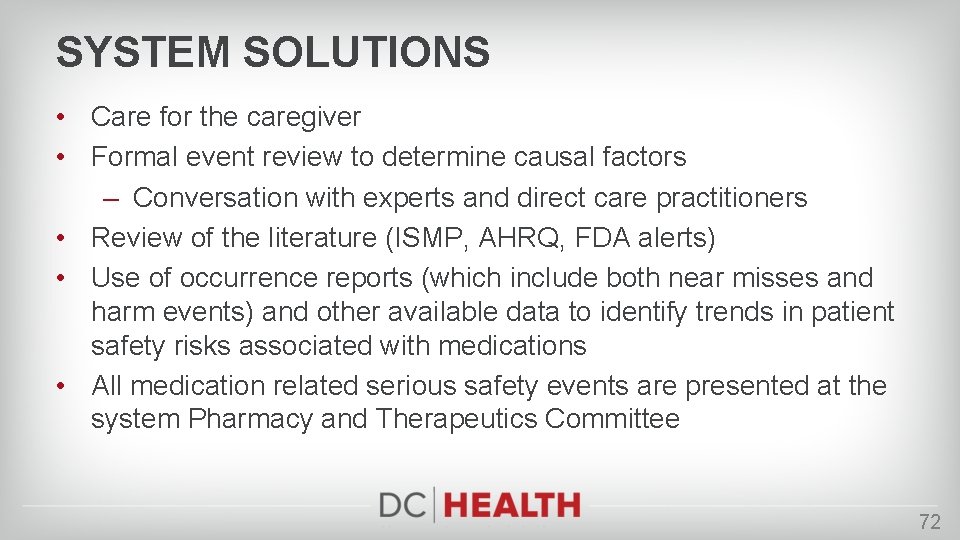
SYSTEM SOLUTIONS • Care for the caregiver • Formal event review to determine causal factors – Conversation with experts and direct care practitioners • Review of the literature (ISMP, AHRQ, FDA alerts) • Use of occurrence reports (which include both near misses and harm events) and other available data to identify trends in patient safety risks associated with medications • All medication related serious safety events are presented at the system Pharmacy and Therapeutics Committee 72
GEORGIA Z. LEWIS, MSN, RN, CPNP-PC PEDIATRIC NURSE PRACTITIONER SIGNATURE HEALTH 73
EILEEN R. LANG, Pharm. D. , BCPS, CPPS MEDICATION AND PATIENT SAFETY COORDINATOR – KAISER PERMANENTE 74
THANK YOU Visit us online at: https: //cme. smhs. gwu. edu/dcrx/group/dcrx-dc-center-rational-prescribing Follow us on social media: @DCHealth. DCRx DC Health 75