
Medication Administration Part II Stephanie Stevens MSN RN
- Slides: 42
Medication Administration Part II Stephanie Stevens MSN, RN, CNE
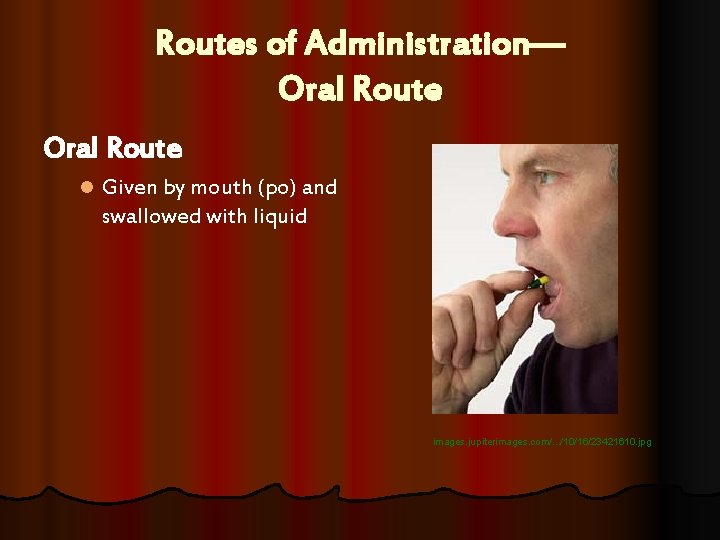
Routes of Administration— Oral Route l Given by mouth (po) and swallowed with liquid images. jupiterimages. com/. . . /10/16/23421610. jpg
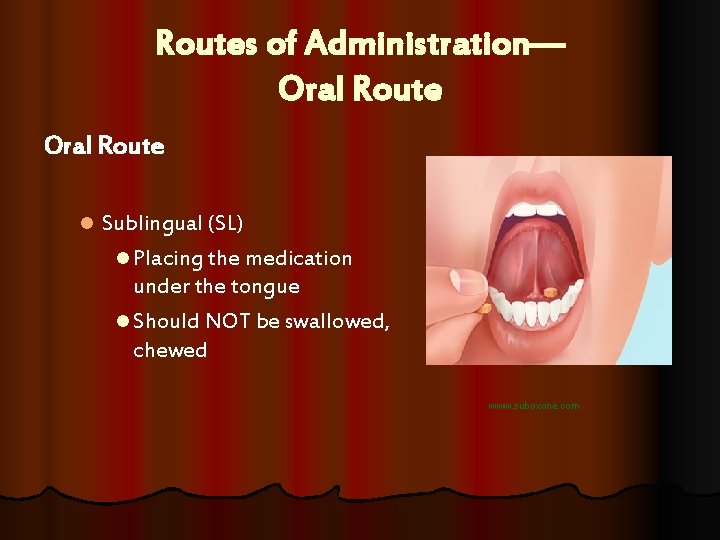
Routes of Administration— Oral Route l Sublingual (SL) l Placing the medication under the tongue l Should NOT be swallowed, chewed www. suboxone. com
Routes of Administration— Oral Route l Buccal l Placing solid medication against the mucous membranes against the cheek or under lip until dissolved Patient Education l Alternate cheeks with each dose to avoid irritation l Do not chew, swallow the medication l No intake of liquids l
Oral Medications l Aspiration Occurs when food, fluid, or medication intended for the GI route enters the respiratory tract. l Always evaluate your patient’s ability to swallow l Proper positioning will assist in preventing aspiration l Fowler’s position or seated position l Lateral position (when swallow, gag, and cough reflexes are intact) l l Trouble swallowing? May need consult (Speech therapy) l Use other routes, (IV, SC) if possible l May administer through NG or feeding tube l
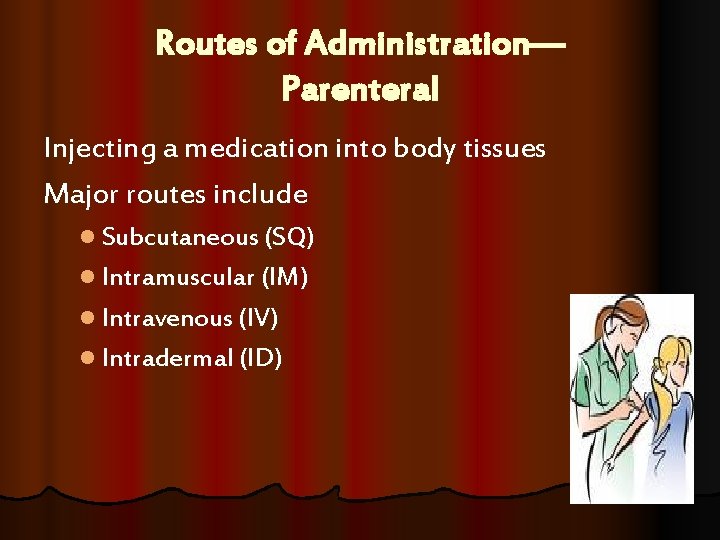
Routes of Administration— Parenteral Injecting a medication into body tissues Major routes include l Subcutaneous (SQ) l Intramuscular (IM) l Intravenous (IV) l Intradermal (ID)
Topical Medication Application Skin Protect hands by wearing gloves Apply to clean, dry, hairless, intact skin. l Lotions, Creams, Ointments l Transdermal Medications
Topical Medication Application Eye Instillation l Types of Ophthalmic Meds l Eye drops l Ointments l Problems for Older Adults l Hand tremors l Poor vision l Poor grasping l Improving Compliance l Demonstrating each step and return demonstration
Topical Medication Application Eye Instillation l Principles of Eye Instillation l Avoid instilling any form of eye medication directly onto the cornea. l Avoid touching the eyelids or other eye structures with eye droppers or ointment tubes l Use eye medication only for the patient’s affected eye l NEVER allow a patient to use another patient’s eye medication
Topical Medication Application Nasal Instillation l Nasal instillations come in: l. Sprays l. Drops l. Tampons
Topical Medication Application Ear Instillation l Internal ear structures are very sensitive to temperature extremes l Use sterile ear drops l Do not occlude the ear with the dropper or irrigating syringe l Straighten ear canal according to age of patient.
Topical Medication Application Vaginal Instillation l Foams, Jellies, Creams, Suppositories l Administer with applicator l Usually patients prefer to self- administer, but if required by nurse, use gloves. l With any vaginal medication… l Perineal pad may be desired l May have a foul odor l Allow perineal hygiene often
Topical Medication Application Rectal Instillation l l l “Bullet shaped”, thinner than vaginal suppositories Rounded end and lubrication- prevents anal trauma during insertion Do not force into a mass of fecal material Local or systemic effect Stored in refrigerator until given
Inhaled Medications l Respiratory tract- large surface area for absorption l Readily absorbed and work fast—vascularity l Can have local or systemic effect l Essential for patient to learn proper use of inhaler.
Medication Administration—Parenteral Administration of meds by injection -Considered an invasive procedure— use aseptic technique -Risk of infection -Injections requires certain skills to ensure safe administration -Effects of this route are rapid— depending on the rate of absorption. l Close observation is imperative l
Medication Administration—Parenteral Syringes l Syringe Parts l Only touch the outside of the syringe barrel and the handle of the plunger!!! DO NOT touch the shaft of the plunger and the needle—risk of infection.
Medication Administration—Parenteral Types of Syringes Standard l Can be 3 -, 5 -, 0 r 10 -m. L l May be supplied with or without needles l Usu. calibrated in increments of 0. 2 m. L l Insulin l Calibrated in units of insulin l Can be 0. 5 – or 1 m. L syringe l Used only to administer insulin l Tuberculin l 1 m. L syringes calibrated with 0. 01 markings l Used for skin testing l May also be used for SQ, e. g. heparin l
Medication Administration—Parenteral Needles l Attached or unattached to syringes l Has 3 parts, which fits onto the hub of the syringe l -Hub (fits on tip of syringe) l -Shaft (connects to the hub) l -Bevel (slanted tip) has narrow slit that quickly closes after removing the needle to prevent leakage of med.
Medication Administration—Parenteral Needle Length l Vary in length— 0. 4 in. to 3 in. l Length is determined by: l Size of patient l Weight l Route of administration
Medication Administration—Parenteral Needle Gauge l Gauge – inside diameter of needle lumen l Gauges are numbered 14 to 30. l Needles with the smallest gauges are labeled with the largest number. l Selection of gauge dependent upon: l Patient comfort l Viscosity of fluid l Speed of administration
Medication Administration—Parenteral Preparing Injections from Ampules l Contains single doses of medication l Use filter needle when aspirating (drawing up) medication into a syringe.
Medication Administration—Parenteral Preparing Injections from a Vial l l l Vials –single or multi-dose container that has a rubber seal at the top Air needs to be injected because it is a closed system. Can be liquid or powder Medications that are unstable in solution are packaged dry. The vial label specifies the solvent or diluent needed to prepare or reconstitute a desired medication concentration Common diluents-normal saline, sterile distilled water
Medication Administration—Parenteral Mixing Medications l Medications can be mixed—if they are compatible l Most nursing units have charts that list meds that are compatible l May need to consult a pharmacist
Medication Administration—Parenteral Mixing Medications l What if… Mixing one med from vial and other from ampule? Mixing meds from two vials?
Medication Administration—Parenteral Preparing Insulin Therapy l When preparing U-100 insulin, use a U-100 unit-scaled syringe. l Always have a second nurse double-check insulin for right drug, dose, etc. l Gently roll (not shake) all cloudy insulin for resuspension of insulin.
Medication Administration—Parenteral Preparing Insulin Therapy l Mixing two types of insulin in a syringe l Prepare the short-acting insulin first, then the intermediate acting Other principles to consider when mixing insulins l Do not mix insulin with other medications or diluents unless approved by prescriber
Administering Injections— Ways to Minimize Discomfort l Change needle after drawing up medication l Position the patient so that muscle tension is decreased. l Use Z-track method when administering irritating meds
Administering Injections— Ways to Minimize Discomfort l Divert patient’s attention—talk to the patient l Insert the needle QUICKLY and SMOOTHLY to minimize tissue pulling l Hold the syringe barrel steady while the needle remains in tissues l Inject the medication SLOWLY and STEADY.
Administering Medication— Subcutaneous Injections Subcutaneous or SC/SQ l. Injection of medication into the loose connective tissue under the dermis l Has slower absorption rate than IM
Administering Medication— Subcutaneous Injections l Subcutaneous Sites (preferred or best sites) l Outer posterior aspect of the upper arms l Abdomen below the costal margins to the iliac crest and 2” in. away from the umbilicus l Anterior aspects of the thighs l -Recommended site for heparin injections is the abdomen. l Low molecular weight heparin - right or left side of the abdomen. Give 2” from the umbilicus
Administering Medication— Subcutaneous Injections Other SC sites for other medications l Scapular areas of the upper back l Upper buttocks l Using the right equipment l U-100 insulin syringe for insulin l Tuberculin syringe for heparin l Injection sites l Rotating injections within the same body part for a sequence provides more consistency in the absorption of insulin. l Fastest to slowest absorption sites= abdomen→ arms→ thighs→buttocks l
Administering Medication— Subcutaneous Injections Give only small doses -Amount of dose 0. 5 -1. 0 ml Patient’s body weight indicates the depth of the SC layer -Amount of SQ tissue determines angle of administration
Administering Medication— Intramuscular Injections l Provides faster absorption than SC l Uses a longer and larger gauge needle than SC l Administer IM injections so that the needle is perpendicular to the patient’s body—as close as 90 degree angle as possible
Administering Medication— Intramuscular Injections l Sites l Consider the following l Area free from infection or necrosis? l Any localized bruising or abrasions? l Location of the underlying nerves, bones, major blood vessels? l Volume to be administered? l Each site has certain advantages and disadvantages
Administering Medication— Intramuscular Injections l Ventrogluteal l-Bony Landmarks l. Greater trochanter l. Anterior superior iliac spine l. Iliac crest
Administering Medication— Intramuscular Injections l Vastus lateralis l. Bony Landmarks l. Greater trochanter l. Patella of knee
Administering Medications. Intramuscular Injections l Rectus femoris l Bony Landmarks l. Anterior superior iliac spine l. Patella of knee
Administering Medication— Intramuscular Injections l Dorsogluteal l Bony Landmarks l Greater trochanter l Posterior superior iliac spine l Iliac crest
Administering Medication— Intramuscular Injections l Deltoid l Bony Landmark l. Acromium process
Administering Medication— Intramuscular Injections Z-Track Method l Recommended to use when giving IM medications that are irritating l Select site. Pull the overlying skin and SC tissue at least 1 inch laterally to the side with the non-dominant hand. l Hold the skin in this position until you administer the injection. l After preparing the site with alcohol pad, inject the needle deep into the muscle and slowly inject the medication if no blood return on aspiration l Hold 10 seconds, then withdraw the needle and release the skin
Administering Medication— Intradermal Injections Usually used for skin testing (diagnostic ) l Medication is usually potent—inject into the dermis, where there is reduced blood supply l Assess: l Site for changes in color and tissue integrity. l Best to choose a site lightly pigmented, free of lesions and relatively hair free l l Best sites - upper back , upper arms, and inner forearms
Administering Medication— Safety Devices l Most frequent route of exposure to blood-borne diseases is from needle-stick injuries l However, over 80% are preventable with implementing safe needle devices l Syringes l Special design—has sheath or guard that immediately covers the needle after it is withdrawn from the skin, reducing the risk of injury l Disposal of both in a receptacle—red sharps container; DO NOT RECAP! l Use these whenever possible to reduce injury