
Medication Administration Errors PRESENTED BY AIREEN PABLO JIN
Medication Administration Errors PRESENTED BY: AIREEN PABLO JIN YANG SHIOBEE ANN PANINGBATAN SKYE VAZQUEZ
Patient safety What do you think one of the most common types of errors affecting patient safety?
Medication Errors According to Getnet and Bifftu (2017), “medication errors identified as one of the most common types of errors affecting patient safety ranging from 42 to 59% of all medical errors” (p. 1).
What do we consider as an medication error?
Medication Errors According to National Coordinating Council for Medication Error Reporting and Prevention (NCCMERP, 2018), “a medication error is any preventable event that may cause or lead to inappropriate medication use or patient harm while the medication is in the control of the healthcare professional, patient, or consumer. Such events may be related to professional practice, healthcare products, procedures, and systems” (para. 1).
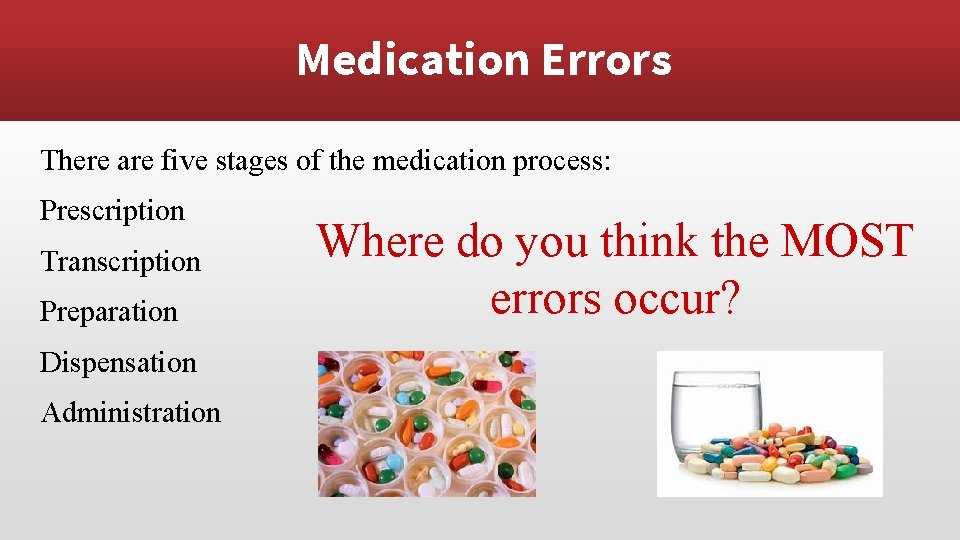
Medication Errors There are five stages of the medication process: Prescription Transcription Preparation Dispensation Administration Where do you think the MOST errors occur?
ADMINISTRATION ❏Median of 54% of errors occur at the administration phase ❏Hospitalized patients suffer up to 400, 000 medication errors each year ❏one medication error per patient per day ❏ 1. 5 billion annually ❏$3. 5 billion in hospital cost
Medication Administration Errors
Medication Errors Have you ever? ? ? Have you given a medication late / early? Have you given a medication through an NGT when the order said P. O. ? Have you ever overdosed or underdosed? Have you ever read the order wrong? - after the fact?
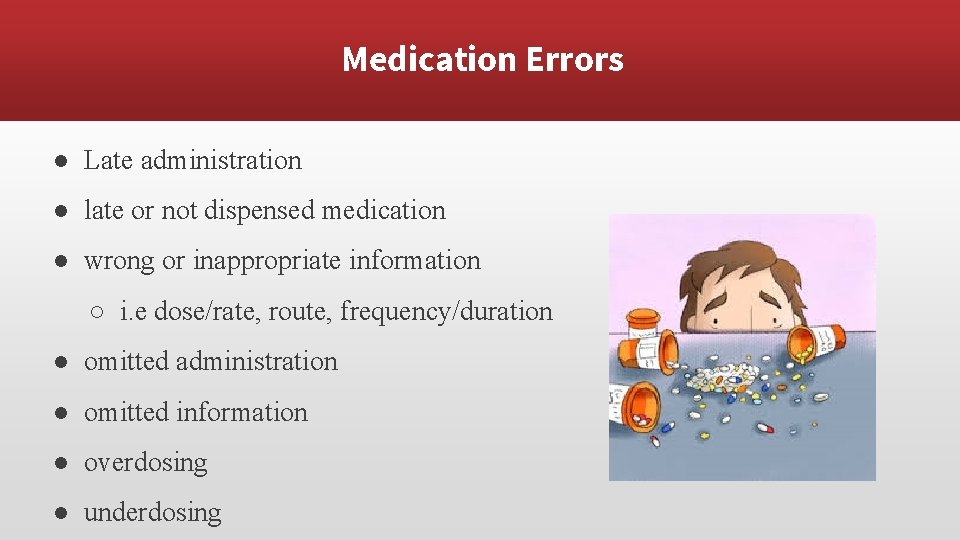
Medication Errors ● Late administration ● late or not dispensed medication ● wrong or inappropriate information ○ i. e dose/rate, route, frequency/duration ● omitted administration ● omitted information ● overdosing ● underdosing
WHY THE ADMINISTRATION PHASE ? What happen during the time a patient is getting his or her medication?
Medication Errors In a transitional care unit Interruptions during medication administration ▪ Phone calls ▪ Other patients’ needs ▪ Equipment malfunction ▪ Morning rounding
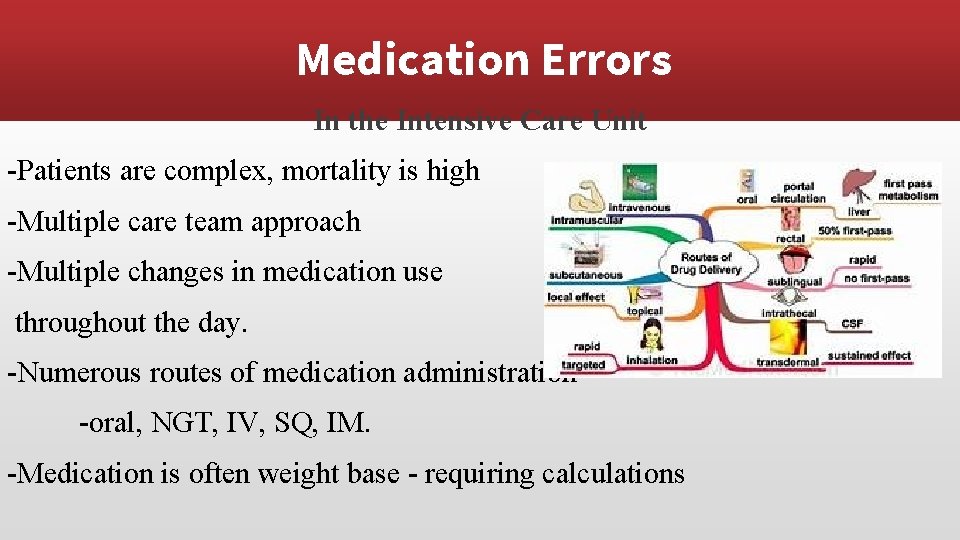
Medication Errors In the Intensive Care Unit -Patients are complex, mortality is high -Multiple care team approach -Multiple changes in medication use throughout the day. -Numerous routes of medication administration -oral, NGT, IV, SQ, IM. -Medication is often weight base - requiring calculations
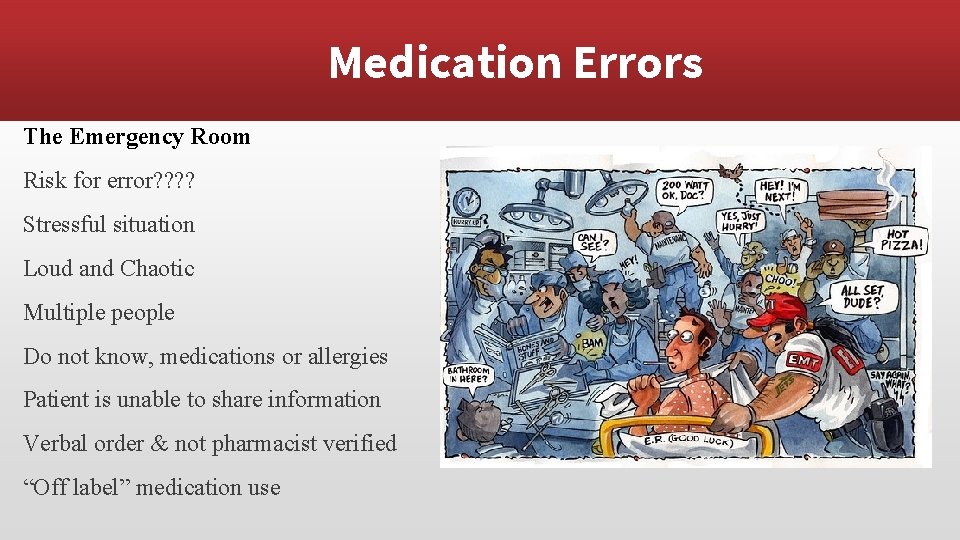
Medication Errors The Emergency Room Risk for error? ? Stressful situation Loud and Chaotic Multiple people Do not know, medications or allergies Patient is unable to share information Verbal order & not pharmacist verified “Off label” medication use
Medication Errors Perfect Storm Example ▪ Perfect storm= high frequency of medication use, high acuity, and complex use of medication (Weant, Bailey, & Baker, 2014). ▪ “The only real mistake is the one from which we learn nothing. ” Henry Ford ▪ Personal Experience - Patient is approximately 100 kg- Doctor orders 5 mg of Etomidate and 150 mg of Succinylcholine ? ? ? ▪ Rapid Sequential Intubation dosage- The Science ▪ Etomidate- 0. 3 mg/kg, anesthetic, anesthesia in 1 minute ▪ Succinylcholine- 1. 5 mg/kg, neuromuscular blocking agent
What nursing knowledge did I need to know? 1. 2. 3. 4. What does Etomidate and Succinylcholine do? How much is a normal dose for intubation? Which one should be administered first? Is this appropriate for this patient at this time? (Situation can change in seconds) Reevaluate 5. Now that medications are given, what do I look for? “The greatest mistake you can make in life is to be continually fearing you will make one. ” Elbert Hubbard We work as a team and incorporate knowledge sharing to prevent medication error.
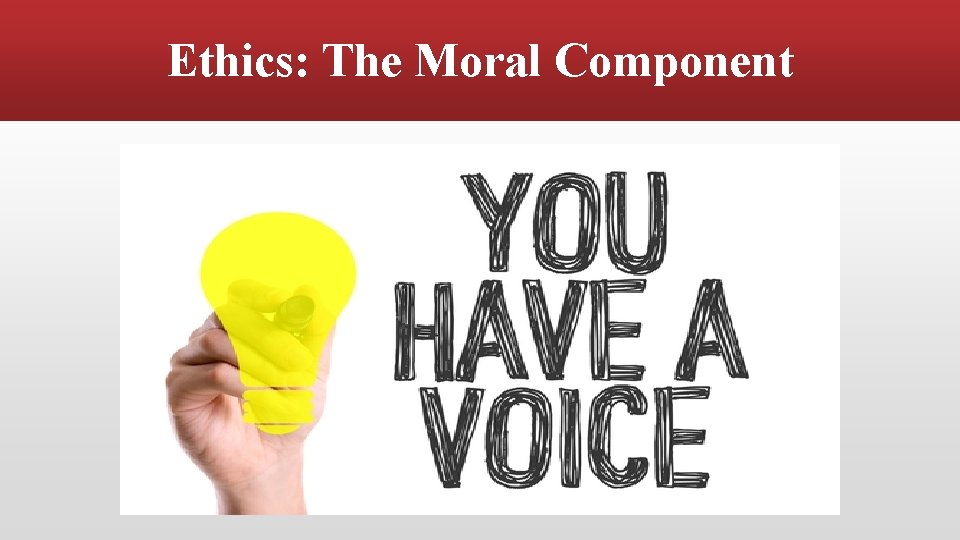
Nurse Medication Knowledge ***Nurse medication knowledge is key to reducing medication errors in the emergency department*** ▪ Needs to come second nature, no time to look up medications in a book or online. ▪ When doctor is ready, we have to be ready. ▪ Moral component to speak up. This example is not deadly but an error. ▪ “punishing honest mistakes stifles creativity. I want people moving and shaking the earth and they’re going to make mistakes. ” Ross Perot

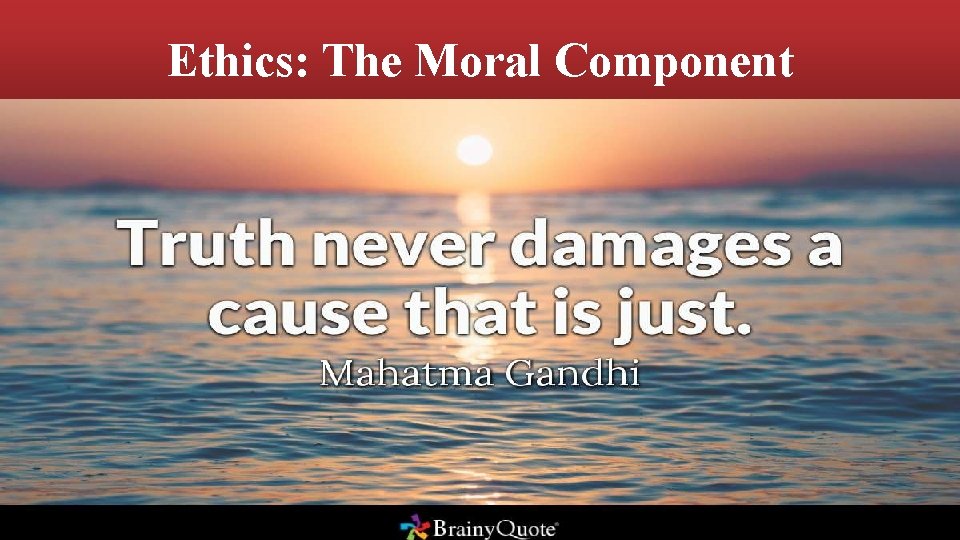
Ethics: The Moral Component
Ethics: The Moral Component
Ethics: The Moral Component
Ethics: The Moral Component

Caring Science What made you enter the nursing profession?
Caring Science Caring is regarded as the core concept in nursing (Brilowski & Wendler, 2005)
Ethics: The Moral Component Jean Watson’s Theory of Human Caring Caritas Process Five - "Being present to, and supportive of positive and negative feelings"(Watson, 2010, p. 2)
Ethics: The Moral Component Caritas Process #7: “Engaging in genuine teaching-learning experience that attends to wholeness and meaning, attempting to stay within other’s frame of reference” (Watson, 2010, p. 2).
References Brilowski, G. A. , & Wendler, M. C. (2005). An evolutionary concept analysis of caring. Journal of Advanced Nursing, 50(6), 641 -650. doi: 10. 1111/j. 1365 -2648. 2005. 03449. x Carayon, P. , Wetterneck, T. , Cartmill, R. , Blosky, M. , Brown, R. , Kim, R. , . . . Walker, J. (2014). Characterizing the Complexity of Medication safety using a human factors approach: An observational study in two intensive care units. BMJ Quality & Safety, 23(1), 56 -65. http: //dx. doi. org/10. 1136/bmjqs-2013 -001828 Foster, M. , Gary, J. , & Moodahanglur, S. (2018). Direct observation of medication errors in critical care setting. Critical Care Nursing Quarterly, 41(1), 76 -92. http: //dx. doi. org/10. 1097/CNQ. 0000000188 Getnet, M. A. , & Bifftu, B. B. (2017). Work Interruption Experienced by Nurses during Medication Administration Process and Associated Factors, Northwest Ethiopia. Nursing Research and Practice, 2017, 8937490. Retrieved from http: //doi. org/10. 1155/2017/8937490 Miller, L. (2017, May 8). Josh Barron's sad story [Video file]. Retrieved from https: //www. youtube. com/watch? v=j 0 DWGgwa 4 sk National Coordinating Council for Medication Error Reporting and Prevention (NCCMERP, 2018). About medication errors. Retrieved from http: //www. nccmerp. org/about-medication-errors
References Watson, J. (2010). Core concepts of Jean Watson’s theory of human caring/caring science. Retrieved from https: //www. watsoncaringscience. org/files/Cohort%206/watsons-theory-of-human-caring-core-concepts-and-evolution-to-caritas-processes-handout. pdf Weant, K. A. , Bailey, A. M. , & Baker, S. N. (2014). Strategies for reducing medication errors in the emergency department. Open Access Emergency Medicine, 45 -55.
Questions?
- Slides: 28