
Medicare Modernization Act of 2003 Product Development Strategies

- Slides: 36
Medicare Modernization Act of 2003: Product Development Strategies for Medicare Advantage John Gorman Tom Anderson Gorman Health Group, LLC February 27, 2004
Today’s Agenda • The Argument for Adverse Selection in Part D • Survival Tactics: – Product Design and Portfolio – Disease Management • Product Options in Medicare Advantage • Opportunity Segment Focus: – Retiree Groups – Dual Eligibles – Disease Management • Product Strategy and Positioning • Conclusions
Cut to the Chase! • Medicare Advantage will expand in 2004. • MMA will prompt increases in benefits from MA plans in 2004 -2005. • Broad participation in drug discount card program. • Emergence of stand-alone drug benefits. • Don’t expect significant strategic moves from PBMs. • Basis for concern about adverse selection in Part D. Survival long-term contingent on product design, disease management.
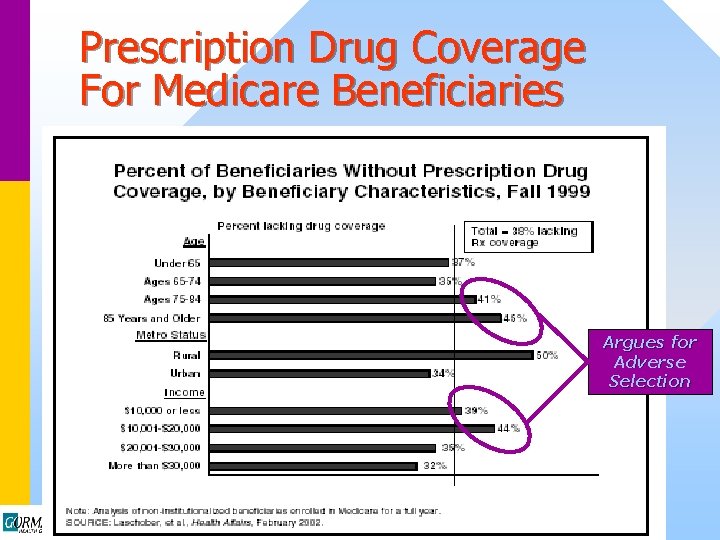
The Argument for Adverse Selection in Part D • Discount Rx cards and Part D are voluntary. – Older, lower-income beneficiaries disproportionately uninsured for drugs. • Rx cards and Part D both provide better benefits to lowincome beneficiaries. • Direct relationship between income and health status in Medicare. • Unfamiliarity with drug risk likely to result in high bids and high premiums in initial years of Part D. – High premiums result in adverse selection • Disproportionate number of chronically ill, high drug utilizers will join first.
Prescription Drug Coverage For Medicare Beneficiaries Argues for Adverse Selection
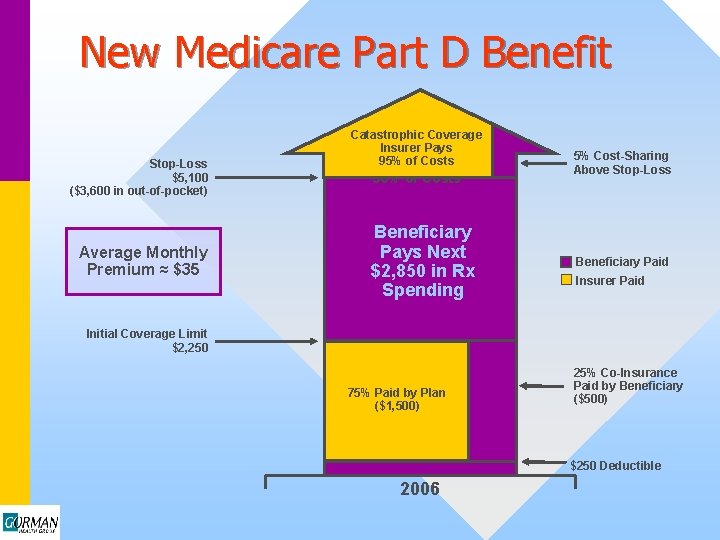
New Medicare Part D Benefit Stop-Loss $5, 100 ($3, 600 in out-of-pocket) Average Monthly Premium ≈ $35 Catastrophic Coverage Insurer Pays Coverage 95% of Costs Insurer Pays 90% of Costs Beneficiary Pays Next $2, 850 in Rx Spending 5% Cost-Sharing Above Stop-Loss Beneficiary Paid Insurer Paid Initial Coverage Limit $2, 250 50% of Costs 75% Paid by Plan Paid ($1, 500) by Insurer ($2, 113) 25% Co-Insurance Paid by Beneficiary ($500) $250 Deductible 2006
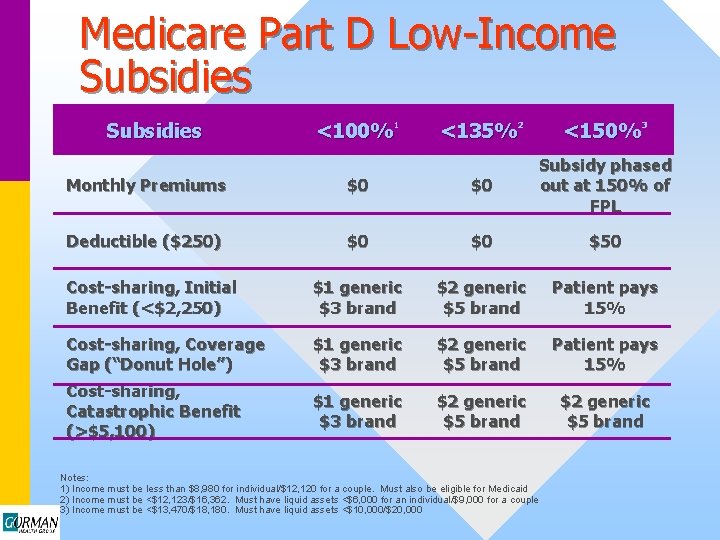
Medicare Part D Low-Income Subsidies <100%1 <135%2 <150%3 Monthly Premiums $0 $0 Subsidy phased out at 150% of FPL Deductible ($250) $0 $0 $50 Cost-sharing, Initial Benefit (<$2, 250) $1 generic $3 brand $2 generic $5 brand Patient pays 15% Cost-sharing, Coverage Gap (“Donut Hole”) Cost-sharing, Catastrophic Benefit (>$5, 100) $1 generic $3 brand $2 generic $5 brand Patient pays 15% $1 generic $3 brand $2 generic $5 brand Notes: 1) Income must be less than $8, 980 for individual/$12, 120 for a couple. Must also be eligible for Medicaid 2) Income must be <$12, 123/$16, 362. Must have liquid assets <$6, 000 for an individual/$9, 000 for a couple 3) Income must be <$13, 470/$18, 180. Must have liquid assets <$10, 000/$20, 000
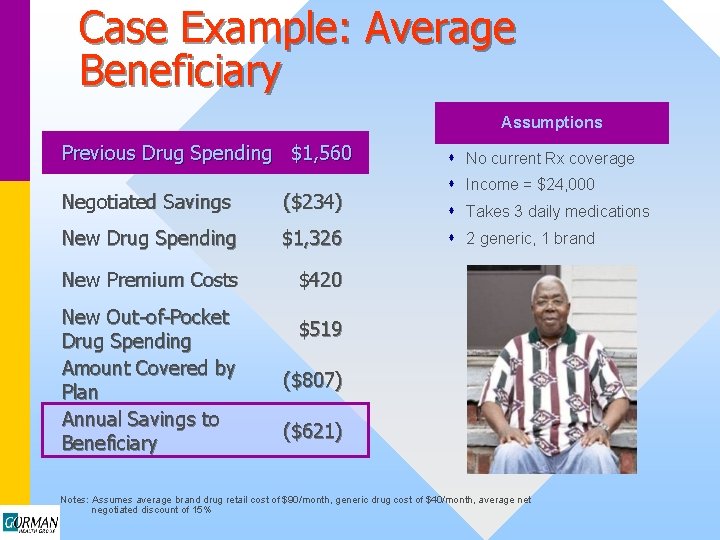
Case Example: Average Beneficiary Assumptions Previous Drug Spending $1, 560 Negotiated Savings ($234) New Drug Spending $1, 326 New Premium Costs $420 New Out-of-Pocket Drug Spending Amount Covered by Plan Annual Savings to Beneficiary s No current Rx coverage s Income = $24, 000 s Takes 3 daily medications s 2 generic, 1 brand $519 ($807) ($621) Notes: Assumes average brand drug retail cost of $90/month, generic drug cost of $40/month, average net negotiated discount of 15%
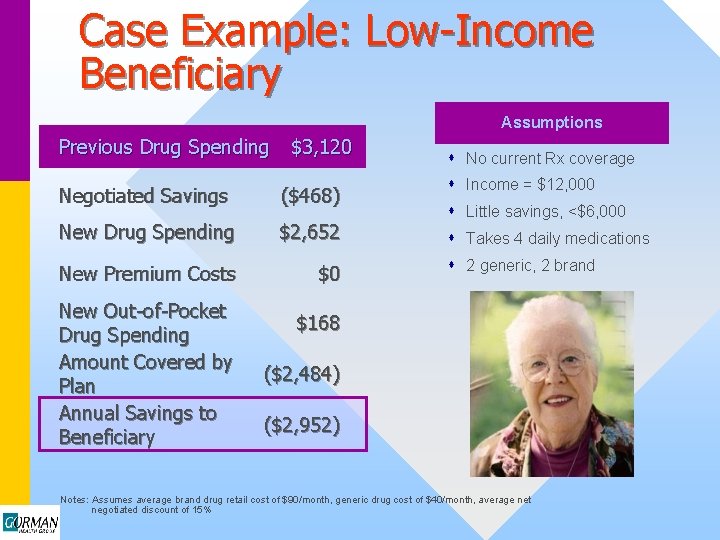
Case Example: Low-Income Beneficiary Assumptions Previous Drug Spending $3, 120 Negotiated Savings ($468) New Drug Spending $2, 652 New Premium Costs $0 New Out-of-Pocket Drug Spending Amount Covered by Plan Annual Savings to Beneficiary s No current Rx coverage s Income = $12, 000 s Little savings, <$6, 000 s Takes 4 daily medications s 2 generic, 2 brand $168 ($2, 484) ($2, 952) Notes: Assumes average brand drug retail cost of $90/month, generic drug cost of $40/month, average net negotiated discount of 15%
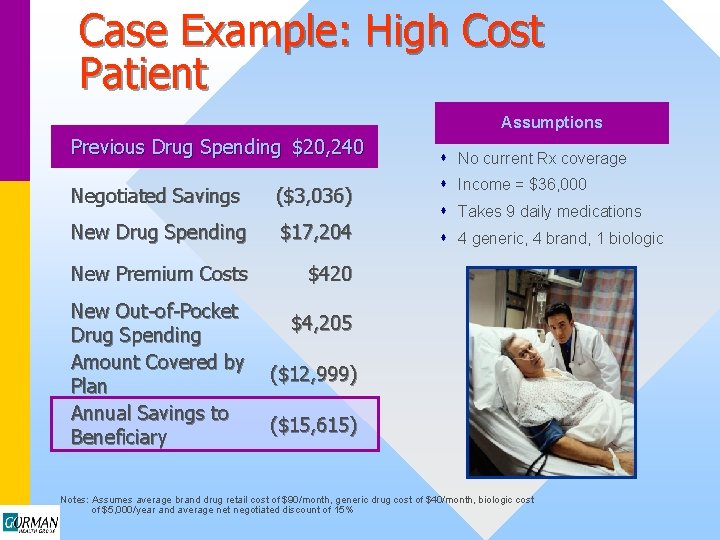
Case Example: High Cost Patient Assumptions Previous Drug Spending $20, 240 Negotiated Savings ($3, 036) New Drug Spending $17, 204 New Premium Costs $420 New Out-of-Pocket Drug Spending Amount Covered by Plan Annual Savings to Beneficiary s No current Rx coverage s Income = $36, 000 s Takes 9 daily medications s 4 generic, 4 brand, 1 biologic $4, 205 ($12, 999) ($15, 615) Notes: Assumes average brand drug retail cost of $90/month, generic drug cost of $40/month, biologic cost of $5, 000/year and average net negotiated discount of 15%
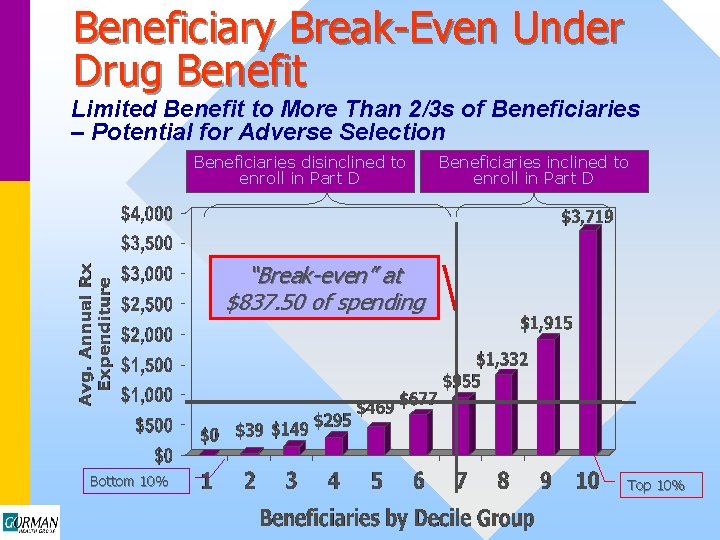
Beneficiary Break-Even Under Drug Benefit Limited Benefit to More Than 2/3 s of Beneficiaries – Potential for Adverse Selection Beneficiaries disinclined to enroll in Part D Beneficiaries inclined to enroll in Part D “Break-even” at $837. 50 of spending Bottom 10% Top 10%
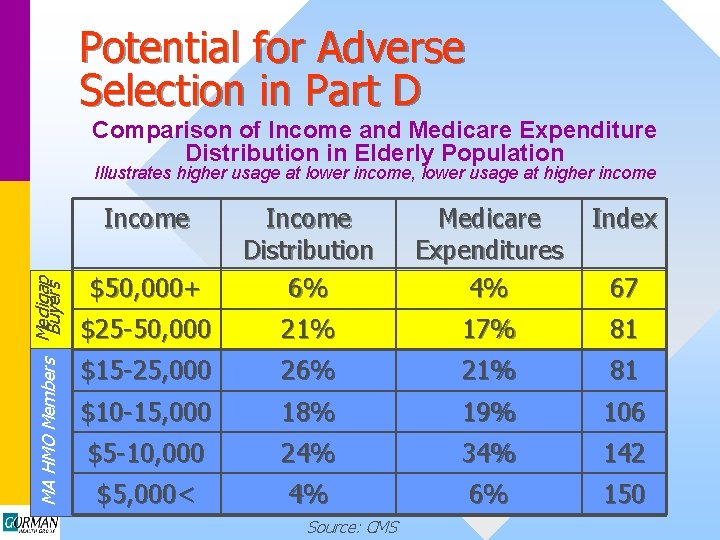
Potential for Adverse Selection in Part D Comparison of Income and Medicare Expenditure Distribution in Elderly Population Illustrates higher usage at lower income, lower usage at higher income MA HMO Members Medigap Buyers Income Medicare Expenditures 4% Index $50, 000+ Income Distribution 6% $25 -50, 000 21% 17% 81 $15 -25, 000 26% 21% 81 $10 -15, 000 18% 19% 106 $5 -10, 000 24% 34% 142 $5, 000< 4% 6% 150 Source: CMS 67
Reimbursement to MA Plans • In 2004, M+COs would be paid at the greater of: – 100% FFS – Blended rate of national and local (including VA/DOD) – Floor payment rate (2/3 of counties) – 2% or national per capita M+C growth percentage • Rates increase by national per capita MA growth rate thereafter (min. 2%, est. 3. 7%) – improves benchmark • In 2006, competitive bidding begins with “blended benchmark”
MMA: Interim Payment Increases to MA Plans • $500 M increase in 2004, $800 M increase in 2005 – Revised ratebook includes average increase 10. 6% • New funds to be used for 3 approved purposes: – Benefit enhancements (Rx, vision, dental, etc. ) – Reduction in beneficiary out of pocket costs – Increased reimbursements to providers to expand networks • Reluctance to significantly expand Rx benefits due to adverse selection concerns
Notable Provider Provisions • Significant expansions of cost-based reimbursement designations, especially rural. • Hospital update set at market basket for FY 04; -0. 4% in FY 05 -07 if hospital did not provide quality data to CMS. • Physicians receive 1. 5% increase in 2004 and 2005. • 7 -year freeze on lab payments. • DME frozen 2004 -2006. • AWP – 15% for most in 2004; ASP +6% in 2005; ASP + 6% or competitive bidding in 2006 • No copay for home health.
MMA: Impact of Interim Payment Increases to MA Plans – Some Examples
Long-Term Survival Tactics • Product Design – Increase likelihood of average selection into selected product • Product Portfolio – Expand market share, balance risk across products by appealing to multiple income segments. • Disease Management – More effectively manage costs of high-risk patients while reducing “hassle factors” for low-risk members
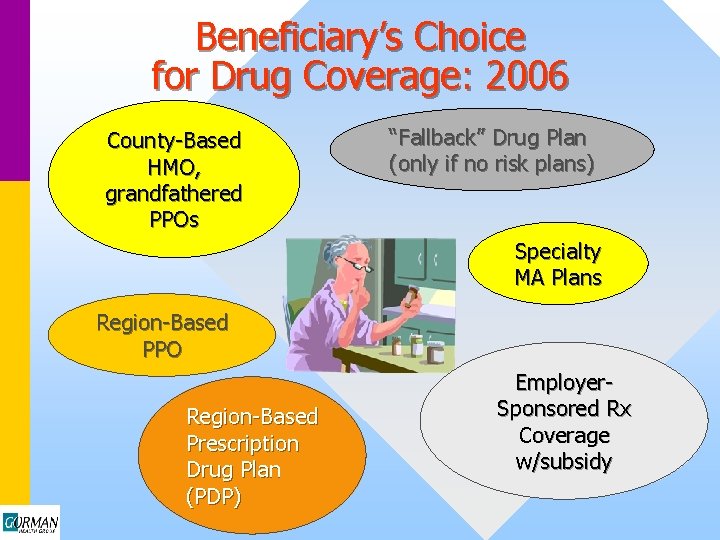
Beneficiary’s Choice for Drug Coverage: 2006 County-Based HMO, grandfathered PPOs “Fallback” Drug Plan (only if no risk plans) Specialty MA Plans Region-Based PPO Region-Based Prescription Drug Plan (PDP) Employer. Sponsored Rx Coverage w/subsidy
Regional Plans (PPOs/PDPs) • CMS will establish 10 -50 MA Regions. Minimum size likely: a whole state. • PPOs and Prescription Drug Plans (PDPs) can serve one or more regions. • Beneficiary lock-in applies in 2006 onward • Sweeteners to encourage plan participation: – Blended benchmark (allows bids to influence final payment rate) – Stabilization and network adequacy funds – Risk corridors for Parts A, B and D – PPOs licensed in one state in region waives out of other state licensure laws
Regional PPOs and Fallback Plans • Many PPOs will resort to consortia of leased or subcontracted networks. • PPOs may contract with CMS on local basis – Local MA PPOs not required to offer standard Part D benefit (all other local plans are) • CMS can contract for fallback plans if don’t achieve 2 plans per region – Fallback plan must offer benefit, paid actual costs of drugs and management fees. • 1 fallback/region, 3 years • like carrier/FI contract
Part D Subsidies • Will cover approximately 75% of cost of providing standard drug benefit • Direct subsidies and reinsurance: – Subsidies based on average expected cost of providing drug benefit (standardized bid amount minus premium) – Reinsurance for 80% of costs over catastrophic threshold (plan absorbs remaining 15%)
Drug Benefit: Notable Provisions • MA plans and PDPs must offer at least one package that provides standard Part D coverage or actuarial equivalent – May not offer less coverage or impose greater costsharing than under standard package • “Any willing pharmacist” – plan must reimburse any agreeing to reimbursement rate • Prohibition on exclusive mail order – Community pharmacists may dispense 90 -day supply
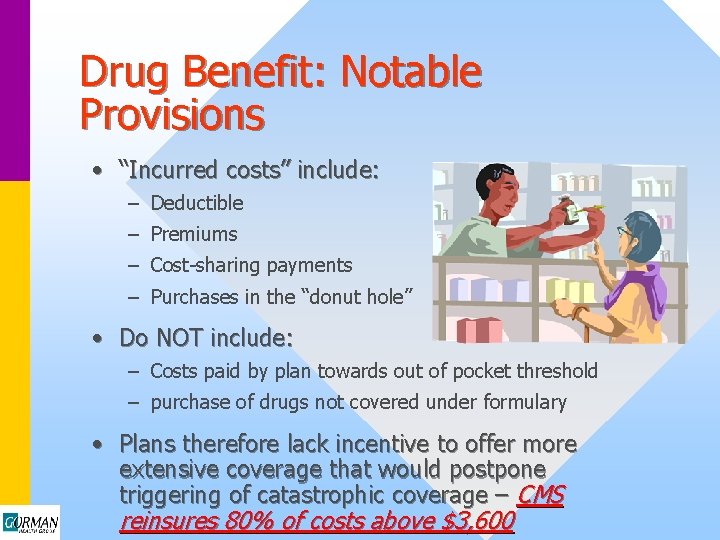
Drug Benefit: Notable Provisions • “Incurred costs” include: – Deductible – Premiums – Cost-sharing payments – Purchases in the “donut hole” • Do NOT include: – Costs paid by plan towards out of pocket threshold – purchase of drugs not covered under formulary • Plans therefore lack incentive to offer more extensive coverage that would postpone triggering of catastrophic coverage – CMS reinsures 80% of costs above $3, 600
Retiree Plans • Employers to receive subsidy worth 28% of drug costs $250 -5, 000, tax-exempt, IF match or exceed standard coverage. • Retiree Rx plans “must have maximum flexibility on plan design, formularies, and networks. ” • Employers can provide premium subsidies and cost-sharing assistance for retirees enrolling in PDPs or integrated MCOs. • Employers can negotiate preferential premiums from integrated plans.
Employer Options for Retiree Health Costs • Contract directly with CMS • Self-insure • Buy supplemental coverage • Contract with local Medicare Advantage plans/PDPs • Combination of above
Dual Eligibles • Federal government assumes duals’ Rx costs over 10 -year period; states maintain 75% LOE • Full dual-eligibles gain access to Medicare Part D in 2006 • State Medicaid programs can provide coverage for drugs not covered by Medicare and receive federal matching funds • QMBs, SLMBs & QI-1 s would be eligible for Part D and may be eligible for low income premium and cost sharing subsidies • QI-1 program extended through September 2004 • Cost-sharing and premium assistance to 150% FPL with no gap in coverage • Emphasis on LTC, home and community-based services
Upcoming Medicare Experiments • Disease Management Demos: – Population-Based: FFS, Chronic Care Improvement Demonstration • Q 1 2004 solicitation • $50 -150 PMPM fees for DM services – Portion of fees at-risk for poor performance • Minimum 10, 000 beneficiaries with targeted conditions in service area • Focus on CHF, diabetes, COPD (CMS may add others) • 90 -day turnaround to submit application • Will be implemented nationally if success in 3 years
Opportunities for Health Plans and Insurers • Medicare PPOs – Local before 12/05 – Regional: Leased networks via “consortia” – Regional: Subcontracting via “consortia” • County-based Medicare HMO • Private Fee-for-Service (beware “deemed” network) • PDP plan • K&L “gap” insurance • Health Savings Accounts (HSAs) • Fallback plan (if pursue no MA option)
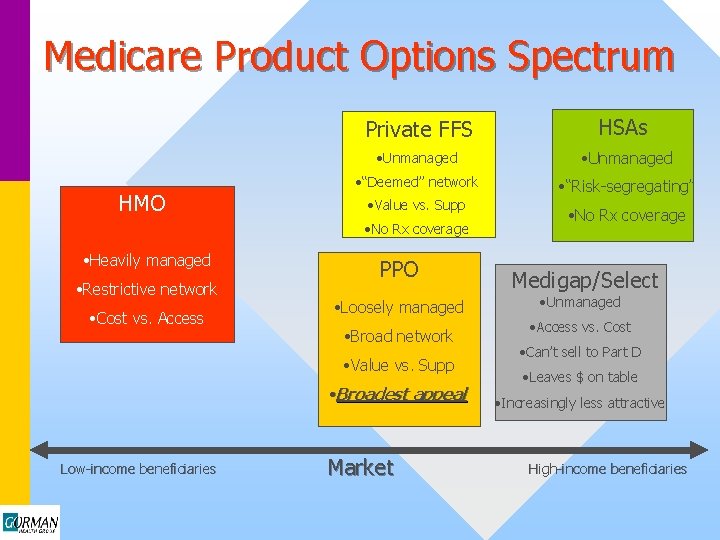
Medicare Product Options Spectrum HMO Private FFS HSAs • Unmanaged • “Deemed” network • “Risk-segregating” • Value vs. Supp • No Rx coverage • Heavily managed • Restrictive network • Cost vs. Access PPO • Loosely managed • Broad network • Value vs. Supp • Broadest appeal Low-income beneficiaries Market • No Rx coverage Medigap/Select • Unmanaged • Access vs. Cost • Can’t sell to Part D • Leaves $ on table • Increasingly less attractive High-income beneficiaries
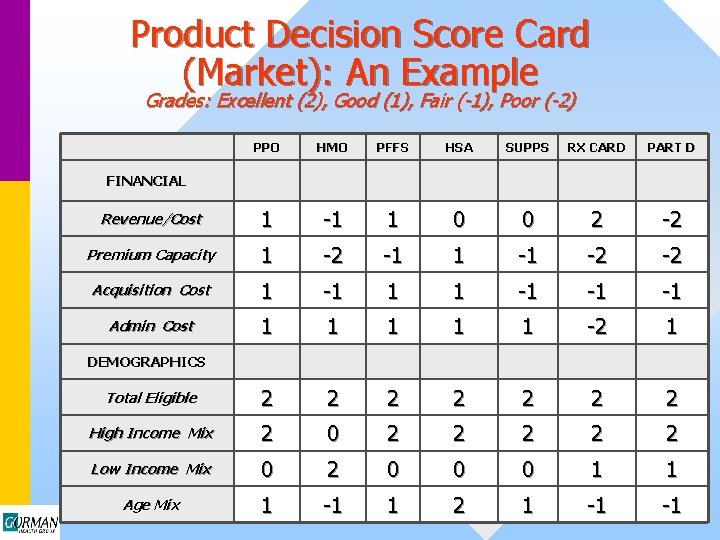
Product Decision Score Card (Market): An Example Grades: Excellent (2), Good (1), Fair (-1), Poor (-2) PPO HMO PFFS HSA SUPPS RX CARD PART D Revenue/Cost 1 -1 1 0 0 2 -2 Premium Capacity 1 -2 -1 1 -1 -2 -2 Acquisition Cost 1 -1 1 1 -1 -1 -1 Admin Cost 1 1 1 -2 1 Total Eligible 2 2 2 2 High Income Mix 2 0 2 2 2 Low Income Mix 0 2 0 0 0 1 1 Age Mix 1 -1 1 2 1 -1 -1 FINANCIAL DEMOGRAPHICS
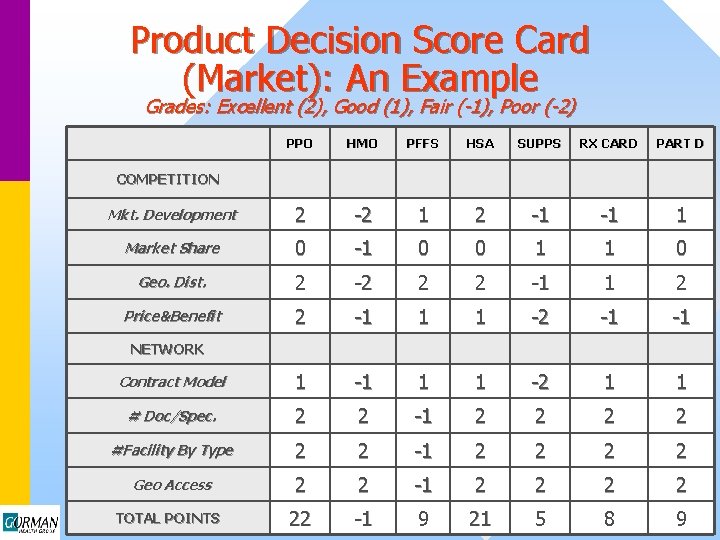
Product Decision Score Card (Market): An Example Grades: Excellent (2), Good (1), Fair (-1), Poor (-2) PPO HMO PFFS HSA SUPPS RX CARD PART D Mkt. Development 2 -2 1 2 -1 -1 1 Market Share 0 -1 0 0 1 1 0 Geo. Dist. 2 -2 2 2 -1 1 2 Price&Benefit 2 -1 1 1 -2 -1 -1 Contract Model 1 -1 1 1 -2 1 1 # Doc/Spec. 2 2 -1 2 2 #Facility By Type 2 2 -1 2 2 Geo Access 2 2 -1 2 2 TOTAL POINTS 22 -1 9 21 5 8 9 COMPETITION NETWORK
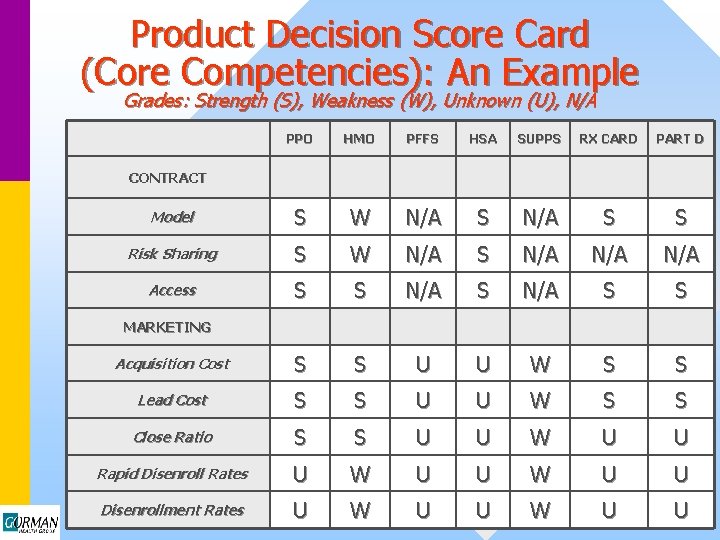
Product Decision Score Card (Core Competencies): An Example Grades: Strength (S), Weakness (W), Unknown (U), N/A PPO HMO PFFS HSA SUPPS RX CARD PART D Model S W N/A S S Risk Sharing S W N/A S N/A N/A Access S S N/A S S Acquisition Cost S S U U W S S Lead Cost S S U U W S S Close Ratio S S U U W U U Rapid Disenroll Rates U W U U Disenrollment Rates U W U U CONTRACT MARKETING
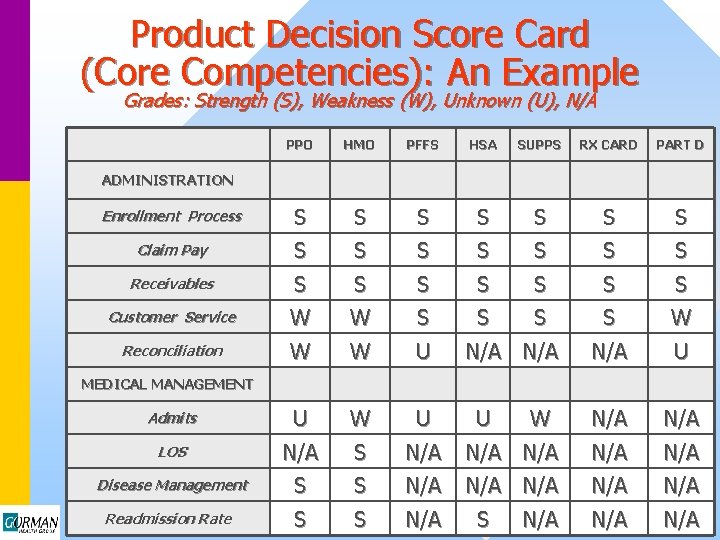
Product Decision Score Card (Core Competencies): An Example Grades: Strength (S), Weakness (W), Unknown (U), N/A PPO HMO PFFS HSA SUPPS RX CARD PART D S S S S Customer Service S W S S S S S W Reconciliation W W U N/A N/A U U N/A W S U N/A N/A N/A S S N/A U W N/A N/A ADMINISTRATION Enrollment Process Claim Pay Receivables MEDICAL MANAGEMENT Admits LOS Disease Management Readmission Rate S N/A
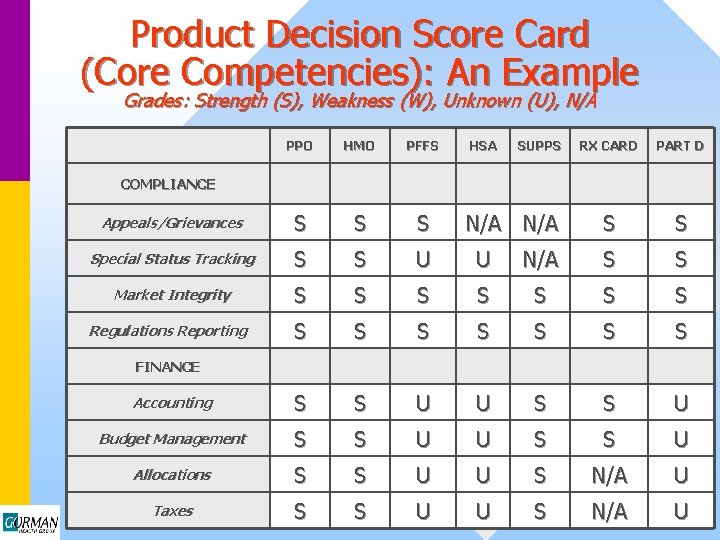
Product Decision Score Card (Core Competencies): An Example Grades: Strength (S), Weakness (W), Unknown (U), N/A PPO HMO PFFS HSA Appeals/Grievances S Special Status Tracking S S U U Market Integrity S S S Regulations Reporting S S Accounting S Budget Management SUPPS RX CARD PART D S S N/A S S S U U S S U Allocations S S U U S N/A U Taxes S S U U S N/A U COMPLIANCE N/A FINANCE
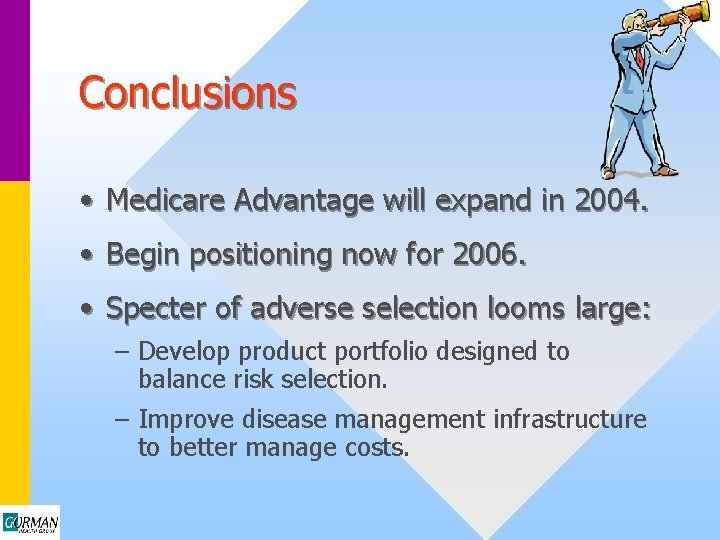
Conclusions • Medicare Advantage will expand in 2004. • Begin positioning now for 2006. • Specter of adverse selection looms large: – Develop product portfolio designed to balance risk selection. – Improve disease management infrastructure to better manage costs.
How to Reach Us Gorman Health Group, LLC (202) 364 -8283 jgorman@gormanhealthgroup. com