
Medicare IBT Intensive Behavior Therapy for Obesity and
Medicare IBT (Intensive Behavior Therapy) for Obesity and a Potential Clinical Trial Involving Nutrisystem Adam Gilden Tsai, MD, MSCE, FACP Assistant Professor of Medicine University of Colorado adam. tsai@ucdenver. edu 303 -724 -9053
LEARNING OBJECTIVES • Understand specifics of the new Medicare benefit for intensive behavior therapy (IBT) for obesity • Understand value of IBT weight loss counseling • Explore the intent to use IBT in practice • Explore the additional value of using portioncontrolled foods for weight loss and weight loss maintenance within an IBT program
CONFLICTS OF INTEREST • Nutrisystem is subsidizing part of the cost of their program for participants in my clinical trial (career development award supported by AHA) – I do not receive salary or consulting fees from Nutrisystem or any other food companies
BURDEN OF OBESITY: pre-diabetes • CDC estimates – 25. 8 million with diabetes (18 million diagnosed) – 79 million with pre-diabetes • Pre-diabetes diagnosis – Hb. A 1 c 5. 7 -6. 4% – Fasting glucose 100 -125 • Diabetes risk – 38% after 4 years (DPP control group) CDC Diabetes Fact Sheet, 2011 DPP Research Group, NEJM, 2002
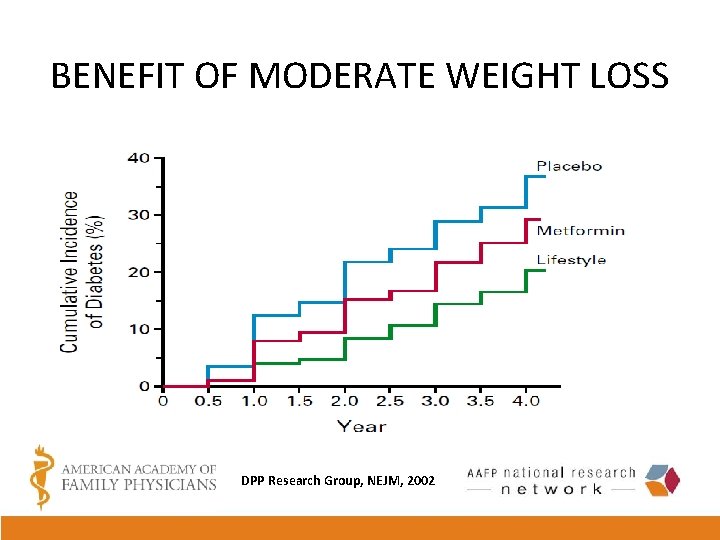
BENEFIT OF MODERATE WEIGHT LOSS DPP Research Group, NEJM, 2002
Background of IBT • Primary care providers do not consistently address obesity • Reimbursement has long been cited as a barrier to addressing obesity – Other barriers cited include time, perceived lack of patient motivation for behavior change, lack of provider comfort and training Kushner, 1995, Prev Med Post, 2011, Arch Int Med Leverence, 2007, Am J Prev Med Huang, 2004, Acad Med
Background of IBT • Dozens to hundred of studies including two large trials showing that intensive weight loss counseling is effective – DPP – Look AHEAD • Can this be done in a primary care setting? DPP Research Group, NEJM, 2002 Look AHEAD Research Group, Arch Intern Med, 2010
USPSTF recommendation (2003) • The U. S. Preventive Services Task Force (USPSTF) recommends that clinicians screen all adult patients for obesity and offer intensive counseling and behavioral interventions to promote sustained weight loss for obese adults. This is a grade B recommendation. – Intensive = at least twice monthly for the first 3 months
USPSTF update (2012) • Clinicians should offer or refer patients with a body mass index of 30 kg/m 2 or higher to intensive, multicomponent behavioral interventions. (Grade B recommendation). • Intensive, multicomponent behavioral interventions for obese adults include the following components: – Behavioral management activities, such as setting weight-loss goals – Improving diet or nutrition and increasing physical activity – Addressing barriers to change – Self-monitoring – Strategizing how to maintain lifestyle changes
What is the Medicare IBT • Every week during first month • Every other week during months 2 -6 • If the patient loses at least 3 kg monthly visits during months 7 -12 • Total = 20 visits total per year – Meets USPTF criteria for an intensive intervention • Schedule of visits can be repeated annually
WHO CAN BILL FOR DOING THE IBT • Primary care providers – MD, CRNP, PA • Other licensed health care professionals? – RD, psychologist, clinical nurse specialist – “Incident to” requirmements must be met • May depend on regional Medicare Administrative Contractor (MAC)
REIMBURSEMENT FOR THE IBT • CPT code G 0447, a 15 -minute face-to-face behavioral counseling for obesity • RVUs of 0. 74 – The 2011 conversion factor is $33. 9764. • (0. 74 x $34 x 20 visits) = $503 http: //www. modernmedicine. com/modernmedicine/Modern+Medicine+Now/Medicare-to-reimburse-forobesity-screening-and-co/Article. Standard/Article/detail/752457? context. Category. Id=40158&ref=25
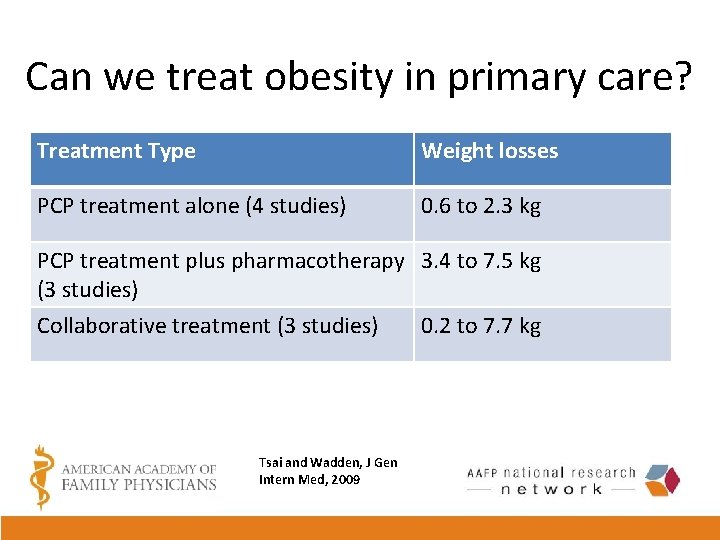
Can we treat obesity in primary care? Treatment Type Weight losses PCP treatment alone (4 studies) 0. 6 to 2. 3 kg PCP treatment plus pharmacotherapy 3. 4 to 7. 5 kg (3 studies) Collaborative treatment (3 studies) 0. 2 to 7. 7 kg Tsai and Wadden, J Gen Intern Med, 2009
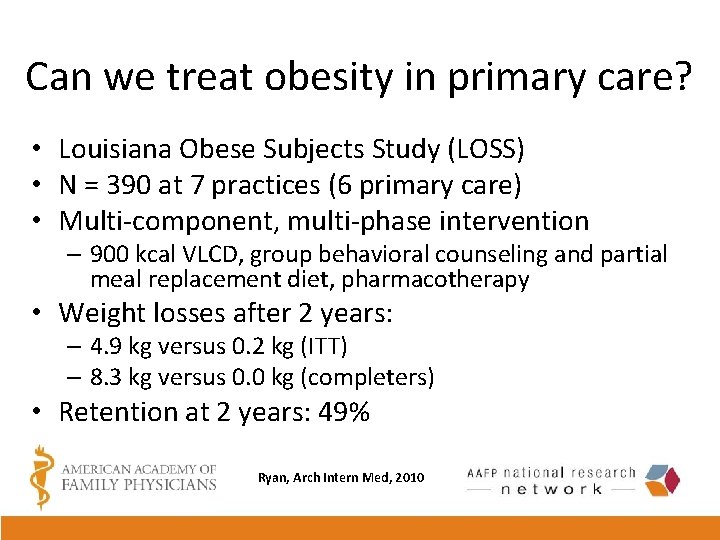
Can we treat obesity in primary care? • Louisiana Obese Subjects Study (LOSS) • N = 390 at 7 practices (6 primary care) • Multi-component, multi-phase intervention – 900 kcal VLCD, group behavioral counseling and partial meal replacement diet, pharmacotherapy • Weight losses after 2 years: – 4. 9 kg versus 0. 2 kg (ITT) – 8. 3 kg versus 0. 0 kg (completers) • Retention at 2 years: 49% Ryan, Arch Intern Med, 2010
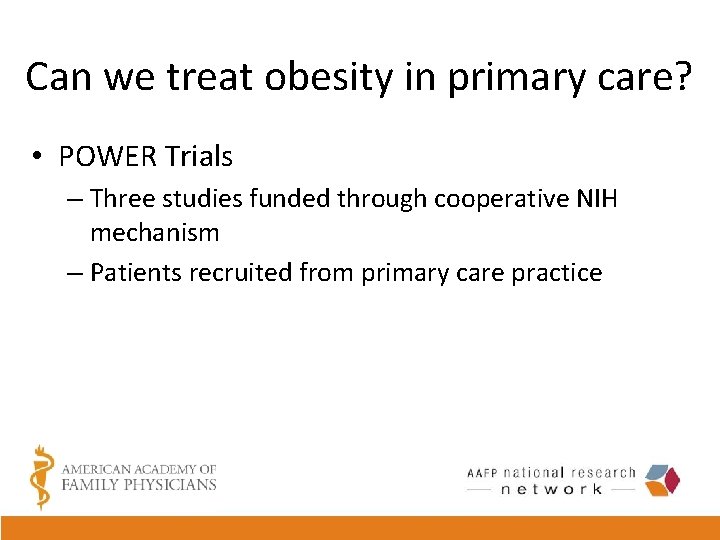
Can we treat obesity in primary care? • POWER Trials – Three studies funded through cooperative NIH mechanism – Patients recruited from primary care practice
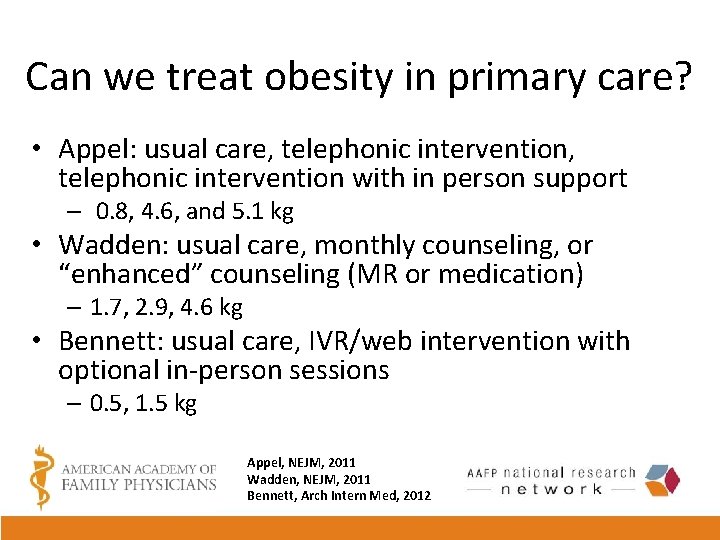
Can we treat obesity in primary care? • Appel: usual care, telephonic intervention with in person support – 0. 8, 4. 6, and 5. 1 kg • Wadden: usual care, monthly counseling, or “enhanced” counseling (MR or medication) – 1. 7, 2. 9, 4. 6 kg • Bennett: usual care, IVR/web intervention with optional in-person sessions – 0. 5, 1. 5 kg Appel, NEJM, 2011 Wadden, NEJM, 2011 Bennett, Arch Intern Med, 2012
So, can we treat obesity in primary care? • Yes, but … • Success rates in unselected patient populations will be moderate • We still don’t know how to assess readiness for change
A Possible Study Involving Nutrisystem • Nutrisystem (and other portion-controlled food [PCF] companies) are interested in getting primary care providers to recommend their program • Discussion between Nutrisystem and AAFP NRN
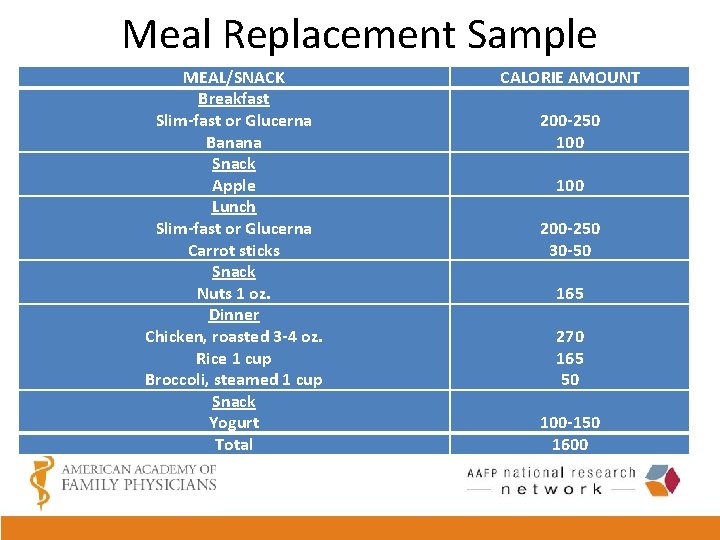
Meal Replacement Sample MEAL/SNACK Breakfast Slim-fast or Glucerna Banana Snack Apple Lunch Slim-fast or Glucerna Carrot sticks Snack Nuts 1 oz. Dinner Chicken, roasted 3 -4 oz. Rice 1 cup Broccoli, steamed 1 cup Snack Yogurt Total CALORIE AMOUNT 200 -250 100 200 -250 30 -50 165 270 165 50 100 -150 1600
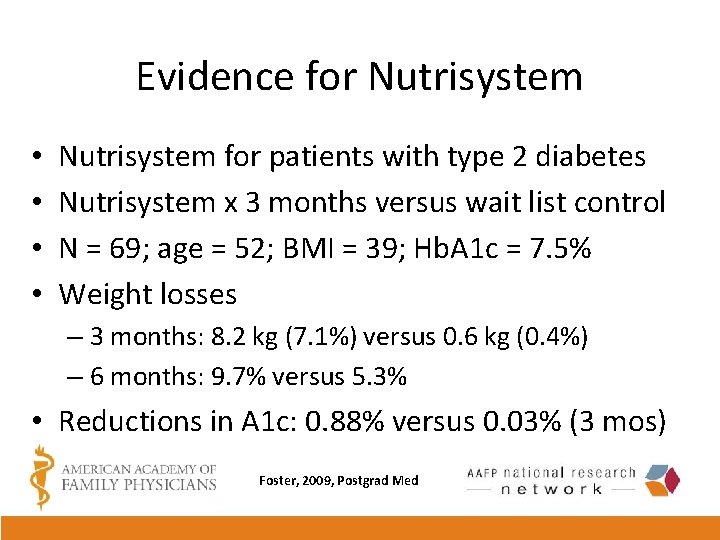
Evidence for Nutrisystem • • Nutrisystem for patients with type 2 diabetes Nutrisystem x 3 months versus wait list control N = 69; age = 52; BMI = 39; Hb. A 1 c = 7. 5% Weight losses – 3 months: 8. 2 kg (7. 1%) versus 0. 6 kg (0. 4%) – 6 months: 9. 7% versus 5. 3% • Reductions in A 1 c: 0. 88% versus 0. 03% (3 mos) Foster, 2009, Postgrad Med
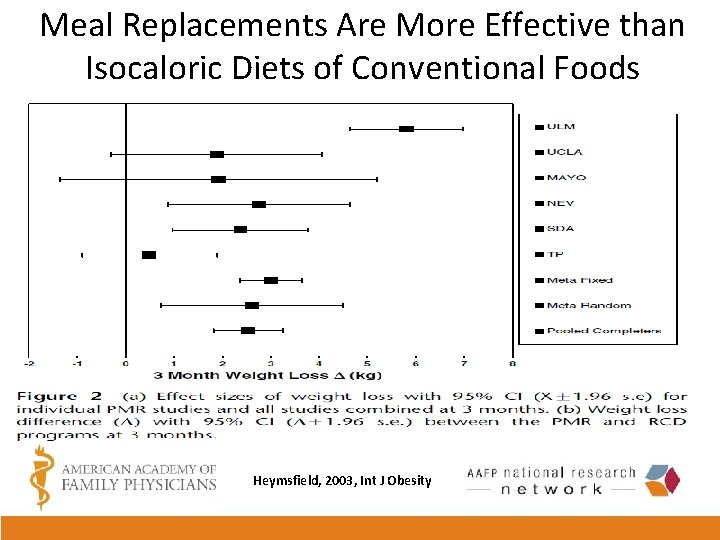
Meal Replacements Are More Effective than Isocaloric Diets of Conventional Foods Heymsfield, 2003, Int J Obesity
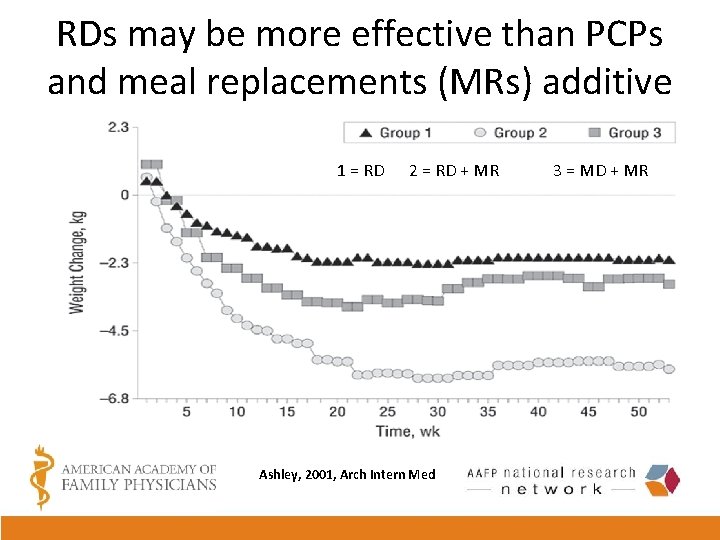
RDs may be more effective than PCPs and meal replacements (MRs) additive 1 = RD 2 = RD + MR Ashley, 2001, Arch Intern Med 3 = MD + MR
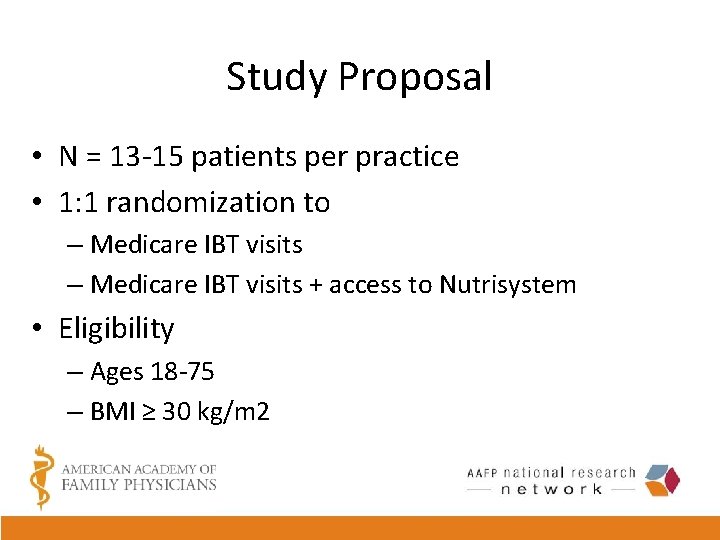
Study Proposal • N = 13 -15 patients per practice • 1: 1 randomization to – Medicare IBT visits + access to Nutrisystem • Eligibility – Ages 18 -75 – BMI ≥ 30 kg/m 2
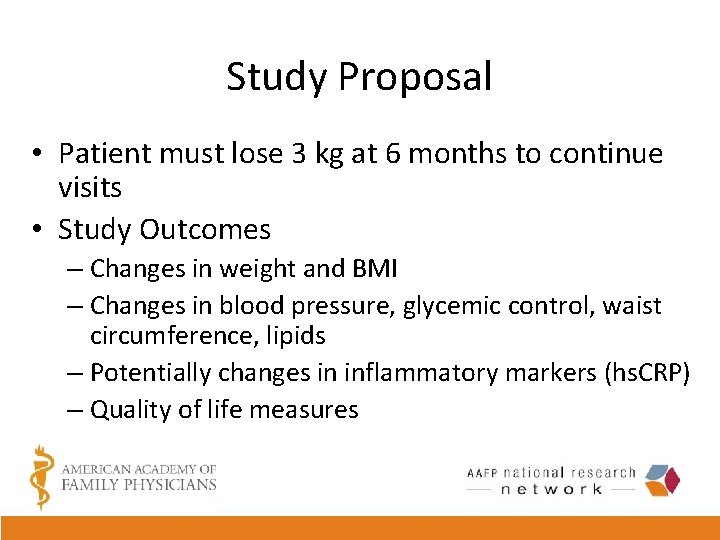
Study Proposal • Patient must lose 3 kg at 6 months to continue visits • Study Outcomes – Changes in weight and BMI – Changes in blood pressure, glycemic control, waist circumference, lipids – Potentially changes in inflammatory markers (hs. CRP) – Quality of life measures
Hypothesis • Medicare IBT + Nutrisystem significantly more weight loss • Medicare IBT + Nutrisystem clinically significant weight loss
Counseling Materials for Study Visits • Diabetes Prevention Program materials • LEARN Manual (Lifestyle, Exercise, Attitudes, Relationships, Nutrition) – Kelly Brownell, Ph. D • Other patient education materials – National Institutes of Health – USDA – Academy of Nutrition and Dietetics (formerly ADA)
Finances • Discussion with Nutrisystem about reimbursing something slightly more than the Medicare reimbursement ($50) • Reimbursement for training time with providers (2 -3 hours initially, 0. 5 -1 per year follow up) • Additional payments depending on extent of data collection needed (e. g. , lab draws)
Summary • Patients with obesity should be screened – Diabetes – Readiness to make behavior change • Intensive weight loss programs should be recommended • Pharmacotherapy and/or portion-controlled food regimens should be recommended
Questions for Discussion • Are any practices considering offering the Medicare IBT? – If so who will provide the counseling? – Is it worth the PCP’s time? – If no, is there another provider who you might work with to implement it? RD? Psychologist? Clinical nurse specialist?
Questions for Discussion • What are your thoughts about participating in this study with Nutrisystem? – Where do portion-controlled food (including MR) fit in the recommendation about intensive treatment of obesity? – Would it help you to become better at treating obesity? – Would it benefit your patients? – Is it worthwhile financially?
- Slides: 30